
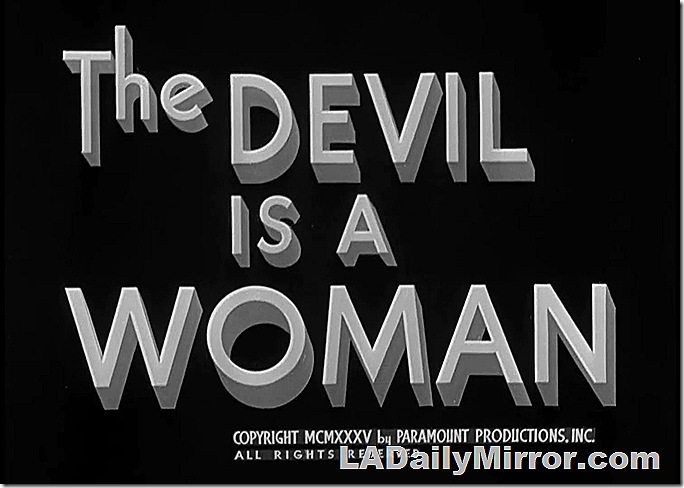
This week’s mystery movie was the 1935 Paramount film The Devil Is a Woman, with Marlene Dietrich, Lionel Atwill, Edward Everett Horton, Alison Skipworth, Cesar Romero, Don Alvarado, Tempe Piggott and Paco Moreno. Continue reading
This week’s mystery movie was the 1935 Paramount film The Devil Is a Woman, with Marlene Dietrich, Lionel Atwill, Edward Everett Horton, Alison Skipworth, Cesar Romero, Don Alvarado, Tempe Piggott and Paco Moreno. Continue reading

Above, Mayor Harper’s goals for his administration. Note especially item No. 11–more police officers–and item No. 17: new schools.
Note: This is an encore post from 2006.
July 27, 1907
Los Angeles
One of Mayor Harper’s promises in taking over City Hall, along with completing the Owens Valley aqueduct and building a library, is to purify the city’s billboards.
Although the City Council presented him with a new billboard law in March 1907, Harper vetoed the measure because it was too lax, despite lobbying by companies that said tighter laws would affect 300 sign painters and other workers.
Note: This is an encore post from 2005 and originally appeared on the 1947project.
One night in July, Bernard Robert Monday Jr. finally had enough.
The violence had been going on at least a decade, maybe longer. In 1937, when Bernard was 8, his father attacked one of two deputies serving a warrant and tried to grab the officer’s revolver out of its holster.
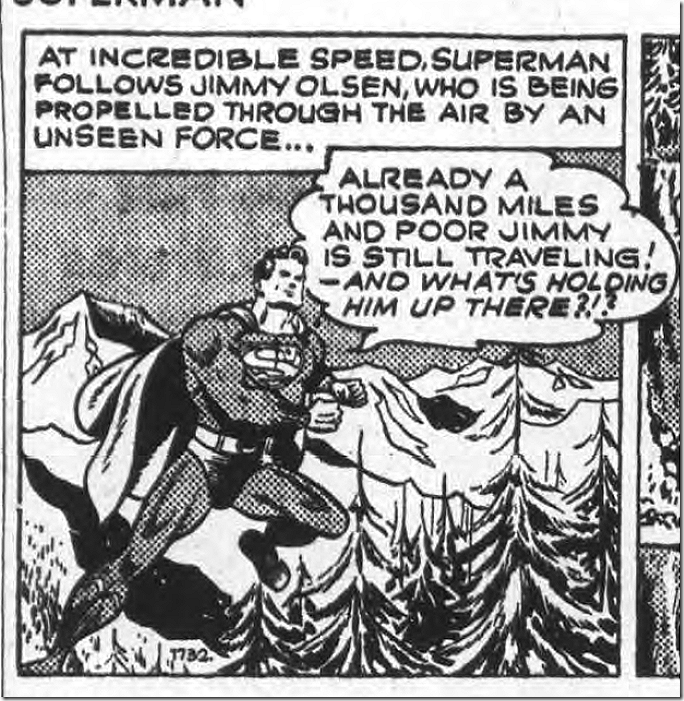
July 25, 1944
George Raft has always hankered after romantic parts. Time after time he has turned down “heavy” roles that have brought fame to other actors. But George has always argued that fans like romance and adventure, so it’s interesting that RKO has bought “Mr. Angel Comes Aboard,” the Charles Gordon Booth book. It gets the new title of “Johnny Angel” and George plays a modern swashbuckler and adventurer. He goes to RKO as soon as he finishes “Nob Hill” at 20th. Speaking of George – he’s about 20 pounds thinner and looks much better.
Loretta Young and Col. Tom Lewis have not bought “Bugsey” Siegel’s mansion. Too expensive, they decided, and the baby, due in a month, will have its first nursery in the house where they now live.
LEO: Power of thought, predicated with determined action, should render effectual assistance in solving tasks successfully. Don’t abuse or dissipate health.
Note: This is an encore post from 2014.
“Here’s a good spot to shoot, baby” are the probably the last words spoken by William B. Smith, 39, a dental technician (or a shipyard worker, depending on the story) who was confronted by his angry girlfriend, waitress Mildred Cook, 30, after he told her that he was reconciling with his wife, according to a Times story.
Note: This is an encore post from 2005 and originally appeared on the 1947project.
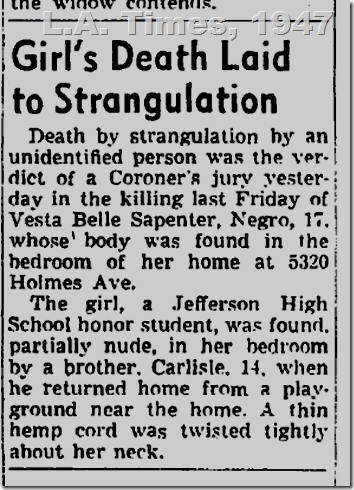
Her name was Vesta Belle and she was 17, an honor student at Jefferson High, a mile and a half from her home at 5320 Holmes Ave. You might think she got her name in the paper for earning a scholarship or receiving an academic award.
Instead, her 14-year-old brother, Carlisle, came home from a playground and found Vesta Belle Sapenter’s body in her bedroom. She was partially undressed and had been strangled with a thin hemp cord. With so many murders of women in Los Angeles, you might expect The Times to give it decent play, but Vesta Belle got two paragraphs on Page 8. Just enough to give a few details and that fact that she was black.

Note: This is an encore post from 2006.
July 24, 1907
Los Angeles
On a speaking tour of America, former Columbia professor James H. Hyslop is trying to raise interest in a scientific approach to psychic research while deflating the fabulous claims of mediums and other fakers.
“There is so much fraud in connection with the physical demonstrations, said Dr. Hyslop, that much time would be wasted in making the investigation,” The Times said. “To see a table get up and prance across the floor doesn’t prove anything in connection with a future life.”
Continue reading
 July 17, 1959: Darryl Thomas Kemp is linked to the killing of Marjorie Hipperson. He killed again a few months after being paroled in 1978.
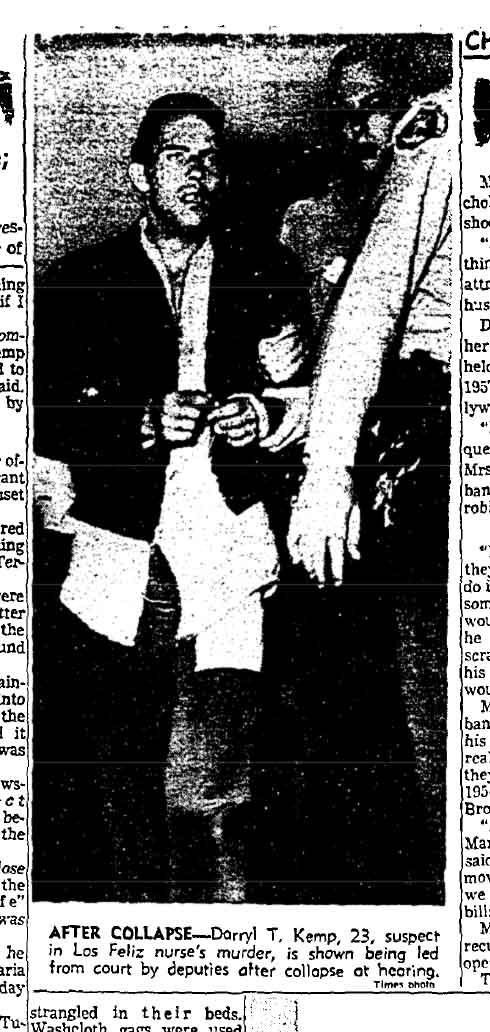
The nylon stocking murder of nurse Marjorie Hipperson, one of the most sensational Los Angeles crimes of the 1950s, was taken out of its musty files and brought back to life last year for the prosecution of her slayer, an odd little man named Darryl Thomas Kemp who was paroled by the state of California in 1978 only to rape and kill again.
The man sentenced to death last month in the 1978 killing of Armida Wiltsey bears little resemblance to the “pint-sized Canoga Park carpenter” of 23 who was arrested in 1959 on charges of kidnapping and raping a woman in Griffith Park while posing as a ranger. At 73, according to news reports, Kemp often dozes behind dark glasses and uses a wheelchair although some doctors say he is faking his mental and physical illnesses and is perfectly capable of walking.
Kemp’s story is a triumph of criminal forensics in which investigators working nearly 50 years apart used crime scene evidence to link him to two notorious unsolved killings. And for supporters of capital punishment, his life highlights the tragedy of failing to enforce the death penalty.
Continue reading
Note: This is an encore post from 2014.
July 23, 1944
The conversation I had with Bing Crosby several days ago was not about the world-famous crooner, the man who is already mentioned for this year’s Oscar because of his performance in “Going My Way.” It was with Bing Crosby, the star-maker – the man who was courageous enough to select Greg McClure, an unknown, to play John L. Sullivan in “The Great John L.”
CANCER: Aspects similar to Gemini today, heed same cautions. Especially protect family interests. Don’t worry about what is coming, prepare as well as can, then take things in stride.

Note: This is an encore post from 2006.
July 23, 1907
Los Angeles
John Conroy, a career criminal, planned his work carefully: He would wait until 10 p.m., pry open the skylight of J.C. Fleming’s jewelry store at 531 S. Broadway, climb down a rope and help himself to whatever he wanted.
But Conroy didn’t know that along with putting alarms on the front and back doors, A.D.T. security service, 118 W. 3rd St., had put a sensor on the skylight as well. As soon as the circuit was broken, supervisor J.P. Quinn called police while he sent Herbert Johnson to watch the store.
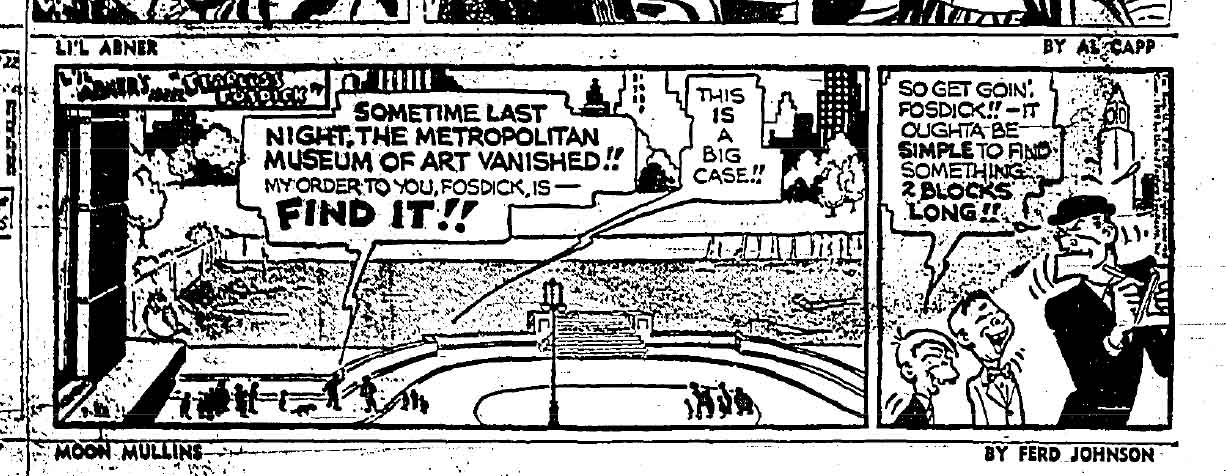
 Let us re-examine the premise, frequently developed here, that many mounted policemen seem to have been trained to the principle that the most important phase of traffic enforcement is writing the citation rather than guiding erring motorists in the path of righteousness.
A man was nudged to the side in the southwest section by an officer who said he’d gone through a red light. The driver said he was certain he’d made it on the yellow. Everyone knows who wins that one.
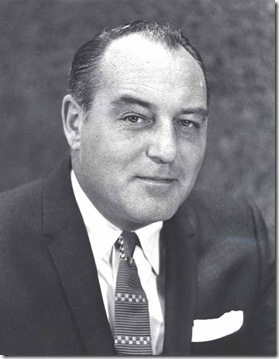 A policeman’s lot, I’ve heard it sung, is not a happy one.
And I’m inclined to agree.
He’s an underpaid, overinsulted public servant who even has to make good on the bullets he uses protecting the proverbial life and limb.
He’s the guy who finds himself pounding a lonely beat in Staten Island for giving a friend of a friend of the mayor a bad time about a traffic ticket.
While the top brass works in air-conditioned offices, he patrols the streets in 90-deg. weather wearing a heavy wool uniform shirt. And they tell him he is to conduct himself in “a manner becoming an officer” even under conditions when human nature makes it just about impossible. Continue reading
Note: This is an encore post from 2005 and originally appeared on the 1947project.
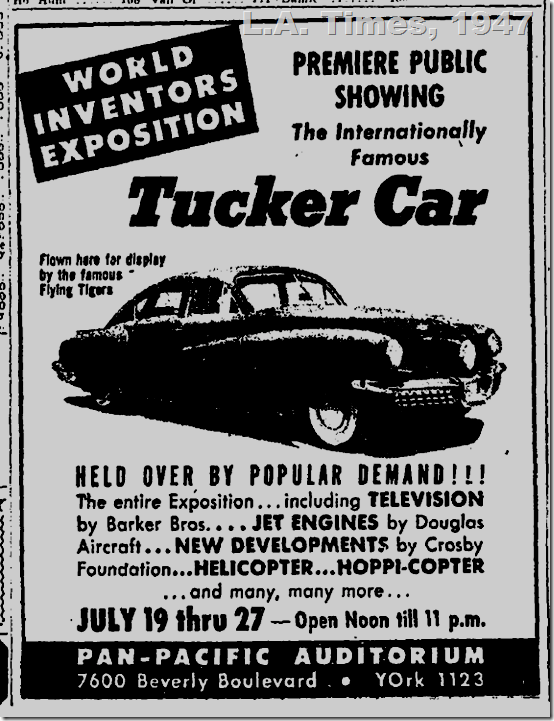
First-prize winner at the inventors exposition was Stanley Hiller Jr., who developed a helicopter in which two blades on a single shaft rotated in opposite directions, eliminating the need for a tail rotor.

This is an encore post from 2006.
Note: $90 a month is $1,847.12 USD 2005 and $3,197.41 in 2026 dollars.
Welcome to the seventh session of the Black Dahlia Book Club!
I finally got tired of talking about George Hodel and Steve Hodel (at this point, I know Steve’s monologues from memory) so I decided to spend some time looking at portrayals of the murder and the investigation. I consider myself first and foremost a historian of the Black Dahlia case, and think it’s important to examine the source material in detail to emphasize the challenges of researching the murder of Elizabeth Short.
Next month: Black Dahlia Ask Me Anything, August 4 on YouTube.
Black Dahlia Book Club: The Los Angeles city archives, August 18 on YouTube.
Reminder: July 29 is Elizabeth Short’s birthday. If you observe it, please be respectful, especially at her grave. She didn’t drink, so don’t leave liquor at her grave, and she didn’t smoke, so don’t leave cigarettes. Be Respectful. Above all, don’t be like paranormal “influencer” Dalen Spratt and try to communicate with Elizabeth Short using a ridiculous “spirit box.” Continue reading
Note: This is an encore post from 2005 and originally appeared on the 1947project.
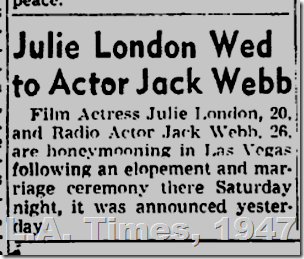
In the courthouse corridor, just after she received one of the biggest divorce settlements in Los Angeles history, someone asked her: “If you had your choice between half a million dollars and a happy home, which would you take?”
“A happy home.”
“With this husband?”
“I guess so.”
She walked to the elevator, looking unhappy.
Note: This is an encore post from 2006.
July 21, 1907
Los Angeles
President Theodore Roosevelt suggests “reading of certain books of pure fiction that have the prime quality of being interesting.”
Continue reading
Note: This is an encore post from 2005 and originally appeared on the 1947project. This was a follow-up to a post by Kim Cooper.
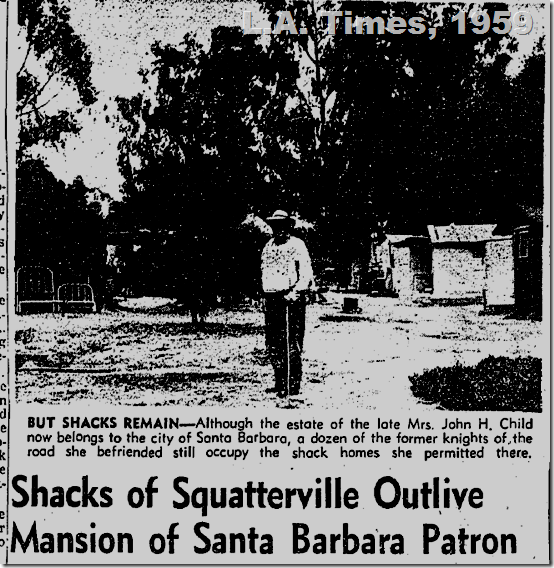
Lillian Child died in 1951 at the age of 75, four years after setting up provisions for a hobo jungle nicknamed Childville at her 17-acre estate on East Cabrillo Boulevard. Two years later, the property was deeded to the city of Santa Barbara by the Santa Barbara Foundation, the original recipient.
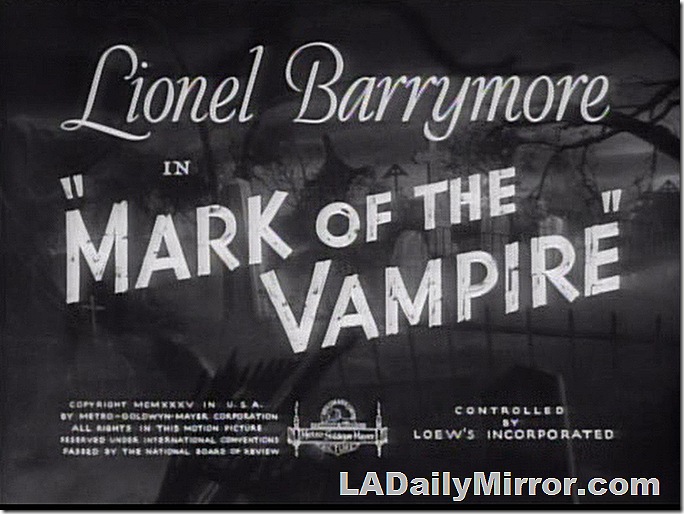
This week’s mystery movie was the 1935 MGM film Mark of the Vampire, with Lionel Barrymore, Elizabeth Allan, Bela Lugosi, Lionel Atwill, Jean Hersholt, Henry Wadsworth, Donald Meek, Jessie Ralph, Ivan Simpson, Franklyn Ardell, Leila Bennett, June Gittelson, Carol Borland, Holmes Herbert and Michael Visaroff. Continue reading
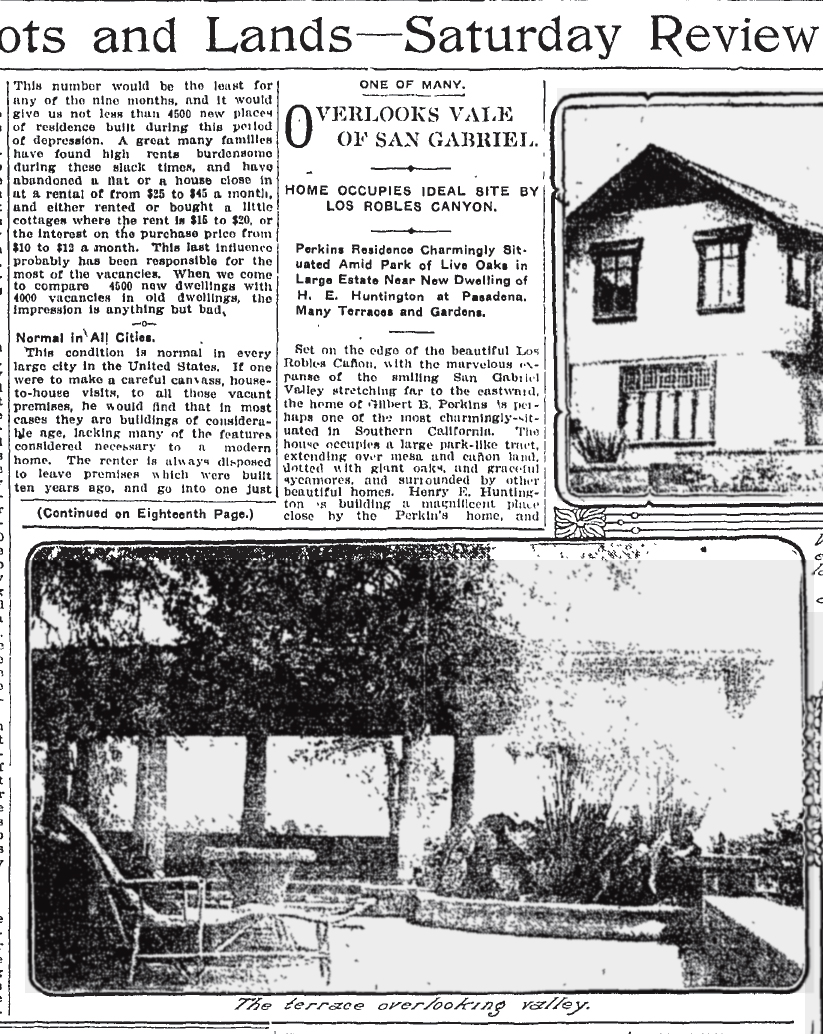 Above, details of the Gilbert B. Perkins home on Hillcrest in Pasadena.
 his was a fun little mystery, complicated by The Times using the wrong middle initial for Gilbert Perkins in the caption.
Perkins sold the home in 1914 to oil executive Frank W. Emery for a reported $125,000 ($2,591,561.05 USD 2007). After Emery died in 1920, the property at 1400 Hillcrest Ave. was sold to Mary Virginia McCormick, daughter of Cyrus H. McCormick, the head of International Harvester. (The Times originally identified her as his sister — ahem).
 ladailymirror.com