November 5, 1944: Arturo Toscanini conducts the NBC Symphony Orchestra in Beethoven’s Symphony No. 3, followed by Glinka’s “Caprice Brillant Jota Aragonesa.” Courtesy of otronmp3.com.

November 5, 1944: Arturo Toscanini conducts the NBC Symphony Orchestra in Beethoven’s Symphony No. 3, followed by Glinka’s “Caprice Brillant Jota Aragonesa.” Courtesy of otronmp3.com.

Note: This is an encore post from 2006.
November 5, 1907
Los Angeles
John Richie led the bass section of the choir at St. Machar’s Cathedral in Aberdeen, Scotland, while Testristina Adams was a contralto. They sang in the choir for about 10 years, and fell in love.
Two years ago, in hopes of more opportunity, John left Scotland and came to Los Angeles, but not before asking Testristina, a pretty brunette, according to The Times, to marry him. “If I had not said that I would follow him he would never have come,” she said.
In the November Ask Me Anything on the Black Dahlia case, I discussed my work in progress, Heaven Is Here!
I discussed The Consult podcast by former FBI profilers, Carl Balsiger and why the Black Dahlia case isn’t a game of “Clue.” Continue reading


Note: This is an encore post from 2005 and originally appeared on the 1947project.
November 4, 1947: Although it isn’t mentioned, this sounds like a riff on “Sadie Hawkins Day,” founded by “Li’l Abner” cartoonist Al Capp, who has been featuring the holiday for the last month.

Note: This is an encore post from 2006.
November 4, 1907
Los Angeles
About a year ago, Eugene Rowe’s little runabout was smashed by a trolley. After some repairs, it won a trophy, but a month later, it was wrecked in the Pasadena hill climb. And then it overturned in a ditch.
Undeterred, and practicing the route of a Thanksgiving run, Rowe and his friend Charles Fuller Gates set off for Box Springs in Riverside County, where the runabout overturned on a curve. Gates was pinned under the car, crushing his left leg. Rowe was thrown clear and although he was badly battered managed to free Gates from the wreck. Continue reading

Director Herbert Biberman set out to right wrongs when he directed “Salt of the Earth,” Michael Wilson’s moving script of poor Hispanic miners in New Mexico overcoming their goliath mining owners. As timely now as then, it’s a difficult story of ever making it to theatres through censorship, threats, and bullying by powerful business interests and the government reverberates today.
Biberman, active in liberal politics and supportive of human rights, freedom of speech, and democratic causes, refused to testify in front of the demagogic House Un-American Activities Committee whether he was a member of the Communist party, thus joining the group that came to be known as the Hollywood Ten. While most received one year prison terms on contempt charges for refusing to testify to Congress, the writer/director saw his reduced to a six month term along with director Edward Dmytryk. Continue reading

Honestly! The Christmas ads start earlier every year. I remember when they used to wait until after Thanksgiving! Continue reading
Look beyond the nostalgia factor in this film produced for Studebaker dealers. Listen to the comments. The Studebaker Lark was, according to this film, intended to give consumers what they wanted: a low-priced, fuel economy car. We know today, of course, that Studebaker failed for many reasons. But these executives were positive they had read the market correctly.
“Your product philosophy is right. This is exactly what our customers want.”

![]()
November 3, 1941: Tom Treanor goes to a dance at the Glendale Civic Auditorium for swing shift workers, about 5,000 of them, from 1 a.m. to 5 a.m. on a Saturday morning. Most of the couples are married, he says, and the wives are 18 or 19.
One of the trombonists wasn’t playing because his instrument was broken at a Halloween job. Why did he show up? Because he still got paid, even without his instrument. Trumpeter Wingy Manone [often spelled Wingie and Mannone] (d. 1982) played left-handed because his right arm was missing. Manone wrote an autobiography titled “Trumpet on the Wing.”
Videos of Wingy Manone: Jukebox Joe’s | Tailgate Ramble | Vine Street Blues |
The Times also publishes a story about a woman who was “criminally assaulted” – one of those quaint terms newspapers used to use — by four men. One of them was a friend of her brother and wanted to kill her because she recognized him, but the others prevented him. And, as was customary in those days, The Times published her name and address.
Jimmy Fidler says: REPUBLIC’S “RED RIVER” SET AT A GLANCE: Cowboy extras using between scene leisure to shine already gleaming boots … “Gabby” Hayes displaying femme star temperament when a prop barber’s chair refuses to work … Sally Payne (industriously knitting a washcloth): “Other girls can keep the soldiers warm; I’m concentrating on keeping the Army clean” … The Sons of the Pioneers and Roy Rogers (who used to be one of them) blending voices for a sentimental rendition of “Sweet Adeline” … Veteran Henry Morris, greatest bulldogger in rodeo history, standing in for “Gabby” Hayes … Set visitors examining a bench carved with the initials B.C. as Billy Gilbert explains that Bing Crosby got his screen start on this very sound stage in Sennett shorts … Gale Storm (watching Mexican extras in a knife-throwing contest): “What a useful accomplishment in Hollywood society!”
[And yes, this was released as “Red River Valley.”]

This week’s mystery movie was the 1930 Warner Bros. film Sinners’ Holiday, based on the play Penny Arcade by Marie Baumer, with Grant Withers, Lucille LaVerne, Warren Hymer, James Cagney, Joan Blondell, Noel Madison, Evalyn Knapp, Otto Hoffman, Hank Mann and Ray Gallagher. Continue reading

Note: This is an encore post from 2006.
November 3, 1907
Los Angeles
Mrs. E.N. Eskey is building this 10-room house in Pico Heights, on Van Ness just south of Pico.
According to The Times, the two-story house (with basement) has a first floor divided into a reception hall with an oak staircase leading upstairs. The living room features built-in bookcases and a massive brick mantel. The dining room has a built-in buffet and china closet, with a pantry and kitchen.
The floors are quarter-sawn oak on the first floor and maple flooring in the rest of the house. The Times says there are four chambers, presumably bedrooms, a sewing room and a bathroom upstairs, as well as an alcove.
In the basement, a coal bin and a Rudd heater.
The cost? $5,000 ($102,617.85 USD 2005) a bargain by today’s standards. Note that in March 2004, 1244 S. Van Ness sold for $1,037,500.
Update: This house is still standing and has been painted blue. I’ll post some photos once I get the film developed (yes, I’m old-school).

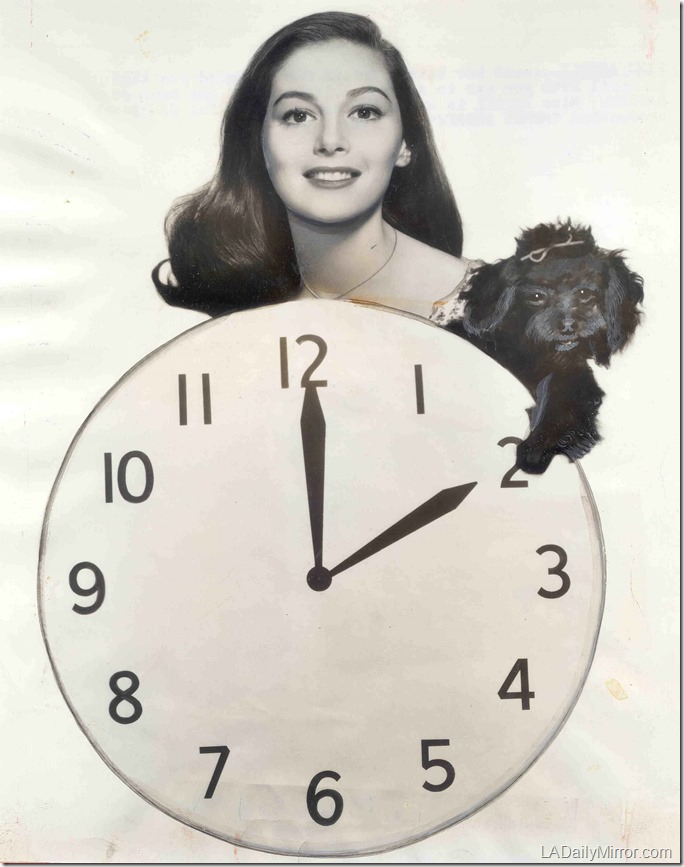
Pier Angeli and her adorable little friend remind Daily Mirror readers that Daylight Saving Time ends today and to turn your clocks back one hour. Hi Eve!!

Note: This is an encore post from 2005 and originally appeared on the 1947project.
The assault on USC’s campus canine prompted angry letters to The Times and a pointed barb on the sports pages. “Whoever did that had a warped mind,” columnist Braven Dyer said.
Of course, the Trojans were up to the challenge and shortly before the schools’ annual grudge match, painted the Westwood campus with slogans like “George Tirebiter’s Revenge.” The scoreboard was vandalized to read: “USC 1,000, UCLA 0.” The actual score was much closer. USC, which at that point was unbeaten, defeated UCLA 6-0 and went to the Rose Bowl, although it subsequently lost its homecoming game to Notre Dame 38-7.
Photograph by Larry Harnisch / Los Angeles Times
The “Trick-or-Treat Murder” house, 13236 Community St., October 27, 2007.

October 31, 1957
Los Angeles
They had planned the murder for months as the vague wish turned into a solid, horrible truth. They played out each variation in the script again and again until every detail was polished and perfect. They thought of everything. One was the brains behind the killing and the other was the willing, gullible stooge. Neither could have done it
alone, but the odd chemistry formed a murderous bond between the two women.
The first step took more than a month as Joan laid the groundwork for the killing, continually telling Goldyne that the victim deserved to die. “She painted him as a vile, evil man who wanted to destroy all people around him,” Goldyne said. “Although I had never seen him, I built up an intense hatred for him.”
Next, they had to choose a method. They decided they couldn’t use poison or a knife. They needed a gun.
With a male friend, Goldyne went to a Pasadena gun shop to select a .38 Smith & Wesson “for home protection.” Three days later, Joan took her to the store and gave her the money to buy the revolver and two bullets. Continue reading
In case you’re too young to understand Matt Weinstock’s reference, Crest toothpaste had a famous – and frequently satirized – ad campaign in the 1950s.
Last Saturday as Hildred M. Hodgson, a lively grandmother, was walking along N. Beverly Glen Blvd. near her home, a big yellow bus marked “Special” stopped and a friendly gentleman inquired, “Where are you going, my pretty madam?”
“I’m going to the village to shop, kind sir,” she said.
At first she wondered if anew bus service had been established in the Glen. Then, from the convivial singing, with banjo accompaniment, emanating from the bus, she realized she’d been captured by a band of Stanford Indians — alumni, that is, some of whom were neighbors. Continue reading
TOKYO — In today’s lesson, boys and girls, we will turn our rapt attention to the strange Japanese preoccupation with “saving face.”
All we’ve known about it in the past, of course, is what we’ve learned from the highly unreliable school of the American movie.
From the dim, distant days of the silent pictures up to the present era of the wide screen, we’ve watched countless Japanese bad guys (all of whom were Sessue Hayakawa) behave atrociously through every reel, but the last.
In the final scene, after being properly embarrassed by defeat at the hands of the hero, they would invariably take, what was for them, the easy way out by committing hara-kiri. Continue reading

Note: This is an encore post from 2006.
October 30, 1907
Los Angeles
The young men of Los Angeles High School have issued a direct challenge to the Board of Education, defying its authority by enlisting fraternity members despite a ban issued last year.
The chief offenders are the Pi Phis, who just added seven members, The Times says. “Another ‘brat frat,’ as they have been dubbed, recently held high jinks at Levy’s restaurant and made a burning declaration of independence in which the city superintendent of schools and all persons concerned in opposing them were relegated to a place where a fire company would not be a circumstance,” The Times said.

Photo: June 23, 1919, “Auction of Souls.” Credit: Los Angeles Times
Note: This is an encore post from 2011.
Los Angeles has long been a haven for refugees and artists, particularly those fleeing political and militaristic struggles. As early as 1915, Armenians began arriving in Southern California after fleeing from the massacres and pogroms inflicted on them by Kurds and Turks. By December of that year, 1,500 Armenians lived here without knowing the whereabouts of many members of their families back home.
Many continued to come, as the papers warned of massacres, imprisonment, torture, and murder of innocent men, women, and children. Genocide. An article’s headline in the September 27, 1915, Los Angeles Times read, “Massacre of Armenians at Height of Its Fury, … Report States that Five Hundred Thousand Men, Women, and Children Have Either Been Killed by the Turks or Driven to the Desert to Perish of Starvation – Extermination of Non-Moslems is Programme Decided Upon.” 850,000 were reported killed by late October, nearly three quarters of the population of the entire country.

The girls in classified are a little dewy-eyed today over a Public Announcement ad. It states simply, “Happy birthday, pretty Beverly.” But there’s more to it than that.
Beverly, whoever she is, frequently remarks that nothing exciting ever happens to her. An admirer, the man who phoned in the ad, confided to the classified ladies that he has arranged a day-long antidote for her boredom.
“When Beverly awakened this morning she was scheduled to be served a champagne breakfast with rosebud in vase. Her roommate, who arises at 6 a.m., was in on the plot with her admirer.
When Beverly arrived at work she was confronted, according to schedule, by a 15-foot birthday card and a dozen roses. Continue reading
LADIES DAY IN TOKYO (Part Two) — When General of the Army Douglas MacArthur returned, as he had somehow hurriedly promised to do, Japan got its first taste of democracy.
In the manner of a triumphant but just warrior, he used an iron hand to force the philosophy of freedom on them.
Say what you will about the pompous, rather regal ruler of our Pacific forces during and after our World War II, he was unquestionably the man who finally managed to introduce the West to the East.
And the main beneficiaries of that introduction were the women of Japan.