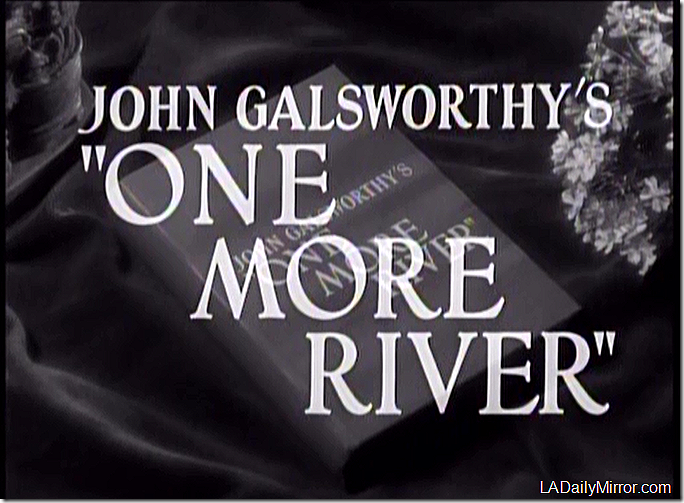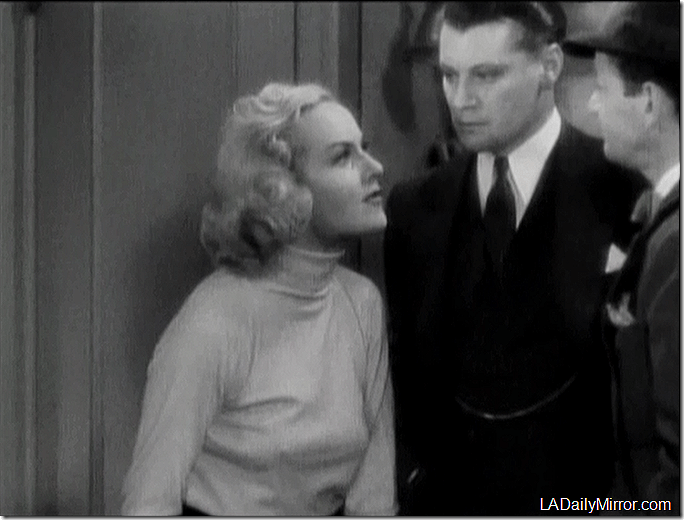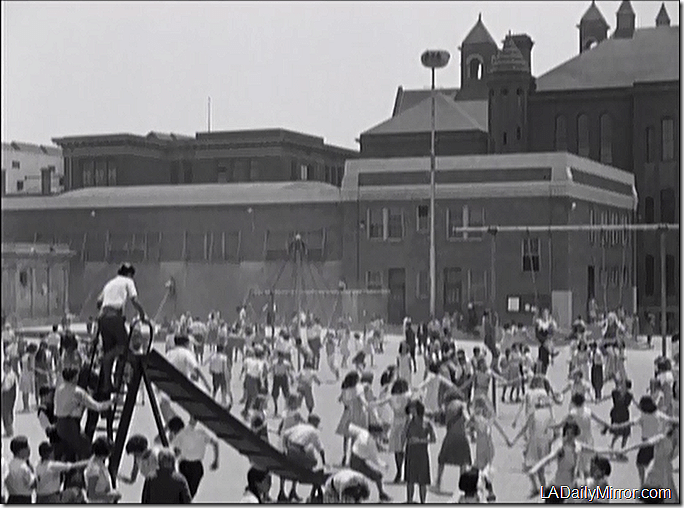
This is the 1939 film “Captain Fury,” which for some mysterious reason isn’t out on DVD or VHS and is only available on the gray market.

This is the 1939 film “Captain Fury,” which for some mysterious reason isn’t out on DVD or VHS and is only available on the gray market.

“Cross Word Puzzle Mama, You Puzzle Me,” courtesy of Mary Mallory.
Recording of “Cross Word Puzzle Mama.”
The 1920s were a decade of fads. Everything from mah jongg, radio, bridge, golf, solitaire and dance steps exploded into popularity before being replaced by the next big thing. Though around for about a decade, crossword puzzles shot to fame when Simon and Schuster introduced a crossword puzzle book in 1924.
Various forms of puzzles existed for centuries before the crossword puzzle. Frances Hansen writes in “The Crossword Obsession” that Greeks inscribed word squares into statues in 6th century B. C. Acrostics, anagrams and riddles puzzled people for decades as well, a form of study for learning vocabulary, word origins and the like. Will Shortz, crossword puzzle editor of the New York Times, notes that word square puzzles became popular in the 1870s, though existing since 1859. In 1896, the San Francisco Call ran a regular section called “cross-word puzzle,” similar to Mensa mind puzzles and quizzes today.
Mary Mallory’s “Hollywoodland: Tales Lost and Found” is available for the Kindle.
Here are some videos culled from YouTube of the late Lorin Maazel.
Maazel conducts his arrangement of Wagner’s music in “The ‘Ring’ Without Words” with the NHK Symphony Orchestra of Tokyo.

Jan. 6, 1924: The Times publishes a photo of an Oakland car that was driven up to the Hollywood sign.
Note: Here’s a post from November 2013 for those who wrongly assume that the Hollywood sign was unveiled on July 13, 1923. (Wikipedia, no surprise, has it wrong). Mary Mallory gives the real story
In the early 1920s, developers began opening virgin tracts of land for construction all around Los Angeles. To help sell these new developments, real estate agents coined fancy names like Bryn Mawr, Outpost Estates and Whitley Heights, while also constructing large signs spelling out their names with individual letters in white and red.
The Beachwood Canyon development named Hollywoodland opened March 31, 1923, under the auspices of real estate developers Tracy Shoults and S. H. Woodruff, on behalf of landowners E. H. Clark and Moses Sherman, and partner Harry Chandler. They considered the best way to advertise their new planned community, as well as outshine the myriad other developments around the city.
Mary Mallory’s “Hollywoodland: Tales Lost and Found” is available for the Kindle.

July 12, 1944
If and when Robert Cummings is free from his Universal troubles he will make a picture for Harold Lloyd. Harold, who is just back from a Shrine convention in the East, cannot discuss the Cummings deal because Judge Hollzer, to whom the Cummings vs. Universal case went, has not yet handed down his final decision.
“The Freshman,” which many people regard as Harold’s best, was run a few weeks ago for Preston Sturges, who is crazy about the story and the idea. The plan now is to bring it up to date, with Bob doing the Lloyd role. We could do with a few pictures on the order of “The Freshman,” “Grandma’s Boy” and others of this ilk.
From the Philadelphia Inquirer via Fultonhistory.com.

A copy of the October 1948 issue of True Detective with a cover story on “The Black Dahlia Murders” has been listed on EBay. This is the magazine that got poor old Leslie Dillon in trouble. The article by George Clark identifies Dr. Joseph Paul De River as “an eminent psychiatrist and head of the Sex Offence Bureau of the Los Angeles Police Department” and gives his views on the case.

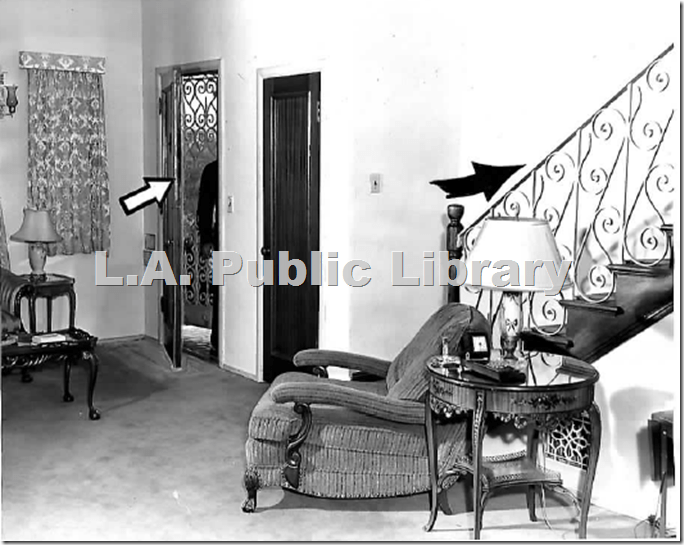
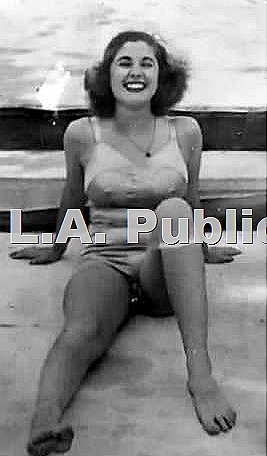
Leslie Dillon’s postcard, in an image from the Los Angeles Public Library.
After reading the article, Dillon wrote to De River about his theories on the Black Dahlia case and De River developed the notion that Dillon had a split personality and under an alternate identity named Jeff Connors killed Elizabeth Short.
Without telling homicide detectives, De River launched his own investigation, enticing Dillon to meet him in Las Vegas under the pretense of serving as his secretary. De River and the LAPD’s gangster squad picked up Dillon and on the drive to Los Angeles, stopped at Banning, where De River began interrogating Dillon, who eventually sailed a postcard out a window saying that he was being held captive and to please get him a lawyer.

July 11, 1944
The parents of Marine veteran J.P. Thomas Jr. sue Mayor Fletcher Bowron, Police Chief Clemence C.B. Horrall and other city officials, charging that their son died after being beaten in jail by police.
The Times reported that Thomas, who was medically discharged after 3 1/2 years in the Marines, was hit by a car in San Pedro. The parents charged that police assumed he was drunk and took him to a hospital, where he was treated for head injuries. Booked into jail as a draft evader for not having his draft papers, he was beaten, the lawsuit said. Thomas was finally released to his mother and taken home, where he died hours later.
Police are seeking Mrs. Eleanor Rostosky, who was charged with abandoning her three children at a Los Angeles movie theater. The Times said Rostosky arrived from Pennsylvania, registered at a Main Street hotel and left Andy, 10, Gilbert, 8, and Ginger, 6, at an all-night movie theater on Main.
“Once before in Pennsylvania she left us in a show and was gone a week,” one of the children said.
Edwin Schallert says to ignore the rumors about Cary Grant starring in “Lost Weekend.” The part is going to Ray Milland. Billy Wilder and Charles Brackett are discussing Katharine Hepburn as the female lead, Schallert says.
At the Hollywood Bowl: Dimitri Mitropoulos conducts the Los Angeles Philharmonic in concerts with violin soloist Yehudi Menuhin and baritone John Charles Thomas.


July 11, 1944
The highly successful Gertrude Niesen musical “Follow the Girls” will be filmed by Ben Bogeaus, head of General Service Studio. David Wolper, the producer, has been here talking price to Bogeaus and the money paid is said to be $300,000. Wolper will assist in the production of the picture, and that probably means a percentage deal as well as a flat sum.
An effort will be made to get Miss Niesen to play the role she created on the stage, but because the play is going such great guns on Broadway it will not be produced until next year. The deal is for the run of the play. P.S. Wonder if the censors will let Gertie get by with her sensational song, “I Want to Get Married”?
From the Philadelphia Inquirer via Fultonhistory.com.

For those who just tuned in, I’m using Louella Parsons’ May 15, 1944, item on Rouben Mamoulian being replaced as director of “Laura” to take a meandering look at the making of the film.
We have been focusing on a series of eight stories sold to the studios by “Laura” novelist Vera Caspary, starting with “Suburb,” which was made as “The Night of June 13” (1932), and ending with this film, “Scandal Street” (1938), that were variations on the same plot — “a murder story without a murder” in Caspary’s words, although that description isn’t entirely true, as we saw with “Private Scandal” (1934) and will see in “Scandal Street.”
Although “Laura” is not precisely “a murder story without a murder” it comes close. Instead of the wrong cause of death as in “Suburb,” “Laura” has the wrong victim. In “The Night of June 13” and “Such Women Are Dangerous” (1934), a suicide is mistaken as a murder. In “Private Scandal,” the murder of a character planning to commit suicide is mistaken for a suicide. (Got that?) And in all four movies, authorities have the wrong suspect, as one would expect in a murder mystery.
According to Caspary’s autobiography, her stories were so similar that Paramount told her to knock it off because it was worried about a plagiarism suit, which was a valid concern as she had sold one of the stories to Fox for “Such Women Are Dangerous” (1934).
The Making of “Laura” Part I | Part II | Part III | Part IV | Part V | Part VI | Part VII | Part VIII | Part IX
Spoilers ahead

July 10, 1944
Adm. Chester Nimitz is the cover story this week.
A photo feature shows the work of jigsaw puzzle makers John N. Henriques and Francis Q. Ware, who make fiendishly difficult puzzles under the name Par.
Life also goes to the Republican National Convention (I have an upcoming post about the convention, in which California Gov. Earl Warren turned down the vice presidential nomination).
The movie of the week is “Double Indemnity.”


July 10, 1944
I’LL ADMIT I am surprised that Humphrey Bogart’s suspension at Warners has gone on this long. Usually Bogey and the bosses kiss and make up by this time. But so far no armistice. In fact, John Garfield steps into Bogart’s role in “Nobody Lives Forever,” the racketeer opus.
Note: Bogart was under suspension at Warners from June 1944 to October, when he began work on “The Big Sleep.”

In case you just tuned in, I am using Louella Parson’s May 15, 1944, item on Rouben Mamoulian being replaced as the director of “Laura” to take a meandering detour into the making of the film.
Most recently, we have been focusing on a series of eight stories sold to the studios by “Laura” novelist Vera Caspary, starting with “Suburb,” made as “The Night of June 13” (1932) and ending with “Scandal Street” (1938) that were variations on the same plot — “a murder story without a murder” in Caspary’s words, although that description isn’t entirely true, as we saw with “Private Scandal” (1934) and will see in “Scandal Street.”
Although “Laura” is not precisely “a murder story without a murder” it comes close. Instead of the wrong cause of death as in “Suburb” and it variations (a suicide mistaken for a murder or a murder mistaken as a suicide as in “Private Scandal”), “Laura” has the wrong victim.
Caspary’s stories were so similar that Paramount finally realized what she was doing and told her to stop because it was worried about a plagiarism suit, according to her autobiography. Paramount’s concerns seem justified; notice that she sold this version of the story to Fox.
The Making of “Laura” Part I | Part II | Part III | Part IV | Part V | Part VI | Part VII | Part VIII


July 9, 1944
HOLLYWOOD — Politics is not my dish of tea. I write about the movies and love them. But I was knee deep in governors, senators and their wives while attending the Republican National Convention in Chicago and I had a chance to talk with a few of these leading politicos. I found out just what they thought of our motion pictures.


July 9, 1944
Hey, look! It’s our old pal Jimmy (Jimmie) Fidler!
Hollywood, July 8 — Some months ago, a group of prominent stars, producers, directors and studio executives formed the Motion Picture Alliance. Their organization, officially designed to combat “un-American” propaganda films, immediately incurred the enmity of Hollywood’s labor unions and guilds, which charge that the alliance is, in fact, anti-labor and anti-Semitic in character.

In case you just tuned in, I’m using Louella Parsons’ May 15, 1944, item on Rouben Mamoulian being removed as the director of “Laura” to take a long and meandering look at the making of the film. In examining Caspary’s career prior to “Laura,” we have found that by the 1930s, she had been the ghostwriter of a correspondence course on writing films, and had done a couple of novels and several plays, one of which, “Blind Mice,” was made into the 1931 film “Working Girls”
In her autobiography, “The Secrets of Grown-Ups,” she brags that between 1932 and 1938 she sold eight versions of the same story (“Suburb”) to the studios before Paramount told her to knock it off, all of them involving some permutation of what she called “a murder story without a murder.” As we will see in this post — and with the last of the films, “Scandal Street,” (1938) — this isn’t always true, but that’s how she described them.
We previously looked at the 1932 film “The Night of June 13,” based on the root story “Suburb,” and in the next post, we will next look at “Such Women Are Dangerous,” (released in June 1934).
The Making of “Laura” Part I | Part II | Part III | Part IV | Part V | Part VI | Part VII


July 8, 1944
HOLLYWOOD — Mary Pickford tells me the new musical version of “Rain” is not the first Broadway show in which she has been financially interested. “I angeled ‘New Faces,’ ” she said, “out of which came Henry Fonda, Tyrone Power and Gypsy Rose Lee — none of whom did badly, you’ll admit.”
Mary hopes to go to New York for the opening of “Rain,” which will star Ethel Merman, when it makes its appearance under the name “Sadie Thompson.”

The world turns while the RKO Pathe rooster stands still. Go figure.

This is “Panama Flo,” with Helen Twelvetrees, Robert Armstrong and Charles Bickford.
The movie opened Jan. 19, 1932, in New York. The New York Times said: “The story offers all the coherence, credibility and realism of a hasheesh dream, and it managed to confound a startled audience last night right down to the fade-out.” The movie opened March 26, 1932, in Los Angeles at the Hillstreet Theater. In an unsigned review, The Times generally praised the movie but considered Twelvetrees miscast.
Apparently this film has never been commercially released on DVD or even on VHS. It aired on TCM last year.

A still from “The Hope Chest,” courtesy of Mary Mallory.
Serving both sweet and medicinal purposes, chocolate has been served up as a special treat since at least 1900 BC and continues as a favored gift and treat today. As it became more mass produced, it gained a wide following in Europe and America. By the early 1910s, the chocolate craze overtook Los Angeles. A gorgeous chocolate shop would be designed and constructed at 217 W. Sixth Street in 1914 to feed this mania. In business for less than a decade, the striking artwork still survives, though somewhat hidden away in downtown Los Angeles.
Los Angeles businessman Gerhard Eshman bought and sold property in the downtown area from the late 1890s into the 1900s, “a firm believer in the future greatness of this city…,” per his 1915 obituary in the Los Angeles Times. He purchased land on West Sixth Street in 1903 and hired the architectural firm of Morgan and Walls to design a building at 217-219 W. Sixth St. A Sept. 6, 1903, Times article stated he would spend $25,000 to construct a four-story building on the site. Little is known of its earliest tenants, save for ads for the high-class Davis Massage Parlor listed in the Los Angeles Herald from 1906-1909. The Meyberg Co., designers and manufacturers of fixtures, occupied the building from 1910-1913.
Mary Mallory’s “Hollywoodland: Tales Lost and Found” is available for the Kindle.

July 6, 1944
Hartford, Conn. – The Ringling Bros. circus tent catches fire during a performance, sending an audience estimated at 6,000 scrambling to escape. It was the worst circus fire in U.S. history, with a final death toll of 168 people.
Charles Nelson Reilly recalls the Hartford circus fire.
Here is a 1991 story by Nita Lelyveld (then with the Associated Press, now with The Times) about the identification of “Little Miss 1565.”
Here is the Hartford Courant’s 2014 retrospective.
There is a discussion of the fire today at the Mark Twain House in Hartford, featuring authors Stewart O’Nan and Mike Skidgell, who have written about the tragedy, but it is sold out.