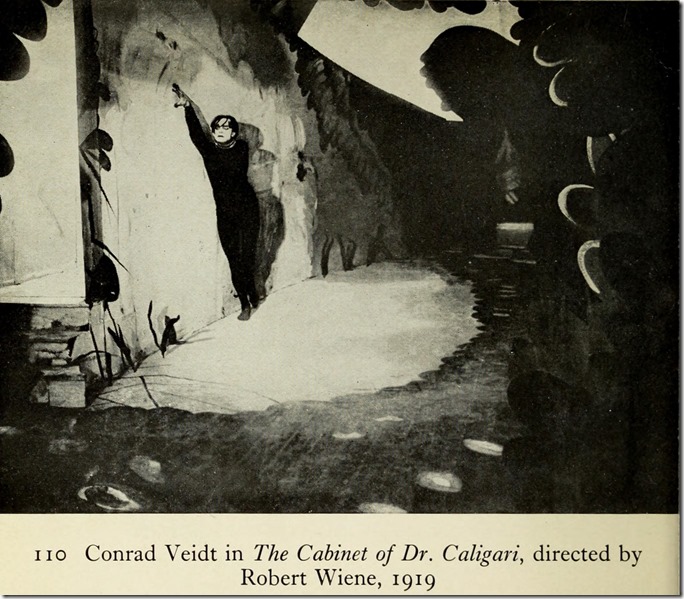
A still from “The Cabinet of Dr. Caligari from “The Movies Come From America.”
Update: A reader on the film site, Nitrateville, pointed out that novelist Upton Sinclair wrote about the protest at “The Cabinet of Dr. Caligari” in his short story/novel, “They Call Me Carpenter: Tale of the Second Coming,” for Hearst International in 1922.
As with most of his writing, he points out the political and social aspects of the protest, that it was not so much about German propaganda, as it was protesting imports that might hurt American business if they were better products. An early dig at the film industry working to try and stop foreign competition might have come back to hurt him when he ran for Governor of California in the 1930s, and the industry worked to smear him and his reputation.
Sinclair describes the scene as his character decides to go to Western City’s Excelsior Theatre on Broadway with his friend, German professor, Dr. Henner, to see a German film that Henner recommended.
They see a large crowd out front, and realize they’re dressed in military uniforms, pushing and yelling at patrons attempting to enter the theatre. Dr. Henner decides to hang back, but the protagonist asks a bystander why the crowd is doing this, and he replies, “Because it’s Hun propaganda.” He breaks through the crowd to get in and asks the man at the door of the theatre if the film is propaganda. The theatre worker replies, “They say they won’t let us show German pictures, because they’re so much cheaper; they’ll put American-made pictures out of business, and it’s unfair competition.”
After watching the film, he realizes how different it is from American films, with the futuristic sets taking him into the dreams and mind of a mad man. He thought it was very interesting and contained fine acting.
Exiting the theatre, he hears the protesters shouting that watchers are sending money to the Germans watching the film, sending their cash to the enemy rather than helping starving Americans. He describes the scene as a mad scene, almost like something out of the movie. He tries to get away, but they start beating and kicking at him, calling him a traitor as he runs for cover.
In effect, he describes how the film industry helped manipulate Anti-German opinion to their own benefit in banning “The Cabinet of Dr. Caligari” from playing in Los Angeles’ Miller’s Theatre in his fictional account.
Over the last few weeks, news of Sony Studios pulling “The Interview” from film theaters after threats by the Guardians of Peace (GOP), who may or may not be North Korea, flooded the internet. After suggestions of possible 9-11 style attacks on cinemas that might show the film, exhibitors quickly cancelled tit, and it appeared “The Interview” might possibly never be seen. The artistic community scoffed at Sony’s abandoning freedom of speech. It appears as of Tuesday, December 23, 2014, that independent exhibitors approached Sony (or vice versa) and now the film will open in perhaps 200 theaters on Christmas Day.
In May 1921, however, Los Angeles residents caused such a ruckus that the German Expressionist film, “The Cabinet of Dr. Caligari,” was pulled from Miller’s Theatre, never seen in the city until six years later. This time, creative organizations worked to try and ban all German films from the United States, which would have been a terrible blow to freedom of speech and expression.
Mary Mallory’s “Hollywoodland: Tales Lost and Found” is available for the Kindle.
Continue reading →