
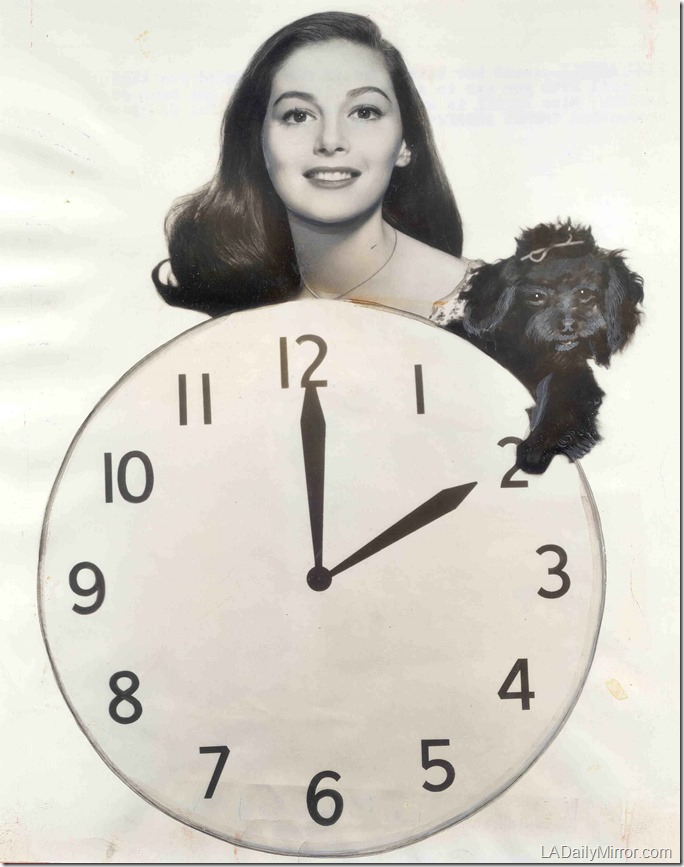
Pier Angeli and her little friend remind Daily Mirror readers that Daylight Saving Time begins today and to set your clocks forward one hour.
Pier Angeli and her little friend remind Daily Mirror readers that Daylight Saving Time begins today and to set your clocks forward one hour.

I like mine fried upside down.
Ham ‘n’ eggs.
Flip ’em, flop ’em, flap ’em.
Ham ‘n’ eggs.
–Los Angeles Breakfast Club’s anthem
Noted film historian and photo collector Marc Wanamaker will be speaking about the history of the Los Angeles Breakfast Club (established in 1925) during a meeting of the club beginning at 7 a.m. on Wednesday March 4 at Friendship Auditorium, 3201 Riverside Drive.
The buffet breakfast (free to first-time guests) is served at 7, followed by a meeting and the guest speaker, concluding by 9 a.m. The dress code is business casual and parking is free.

This week’s mystery movie has been the 1966 camp fest known as “Billy the Kid versus Dracula,” starring John Carradine (Friday’s mystery gent), Chuck Courtney (Thursday’s mystery gent), Melinda Plowman (Wednesday’s mystery woman), Virginia Christine and Walter Janowitz (Thursday’s mystery guests), Olive Carey (Tuesday’s mystery guest) and Hannie Landman (Monday’s mystery guest). It was written by Carl Hittleman and directed by William Beaudine.

George E. Stone in a photo courtesy of Mary Mallory.
Velvet Smith, Sparrow, Slinky, Dippy, Johnnie the Shark, Spats, Tough Tony, Ropes, McGonigle, Toothpick Charlie: just a few of the wise guy characters that made diminutive character actor George E. Stone famous. Though actually Jewish, the sharp-dressed Stone is more remembered for playing flashy Italian street toughs than the many ethnic characters he portrayed in films. While similar in many ways to most of the characters he played on screen, the likable actor suffered more emotional hardship than many film characters.
Born Gerschon Lichtenstein May 18, 1900 (or possibly 1902 or 1903), in Lodz, Poland, young Georgie Stone and his family struggled, so much so that the young lad began working in a silk factory at the age of six, at least per New Movie Magazine in 1935. On his way home one day, he saw fellow Jews slaughtered in a front of his eyes, and played dead to escape the pogrom. The family was smuggled into Germany on a hay wagon, with his father coming to America to make a living and support the family. Mother and children were supposedly turned away twice at Ellis Island because of one of the girl’s eye infection, before entering the country in 1912. The children’s mother had died before they arrived, and their new stepmother detested them, so Stone ran away from home. Stone became a naturalized citizen August 17, 1915, in New York City, living at 231 W. 96th St.
Mary Mallory’s “Hollywood land: Tales Lost and Found” is available for the Kindle.

Marion Eisenmann, who contributed such wonderful artwork to the Daily Mirror, has opened an Etsy shop. She’s offering a selection of mugs and cups with her artwork (we own two, and the morning grouch has become one of our favorites). These are high-quality porcelain rather than the more cheaply made coffee mugs one frequently finds for sale online. She says that she also has some selected prints of her artwork available. Here’s the link. You can also contact her here.

This week’s mystery movie has been the 1942 Columbia picture “You Were Never Lovlier,” the second of two movies to feature Fred Astaire and Rita Hayworth. It stars Adolphe Menjou (not shown), Isobel Elsom (Wednesday’s mystery woman), Leslie Brooks (Tuesday’s mystery woman), Adele Mara (Tuesday’s mystery woman), Gus Schilling (Wednesday’s mystery gent) and Xavier Cugat (Thursday’s mystery gent). It was written by Michael Fessier, Ernest Pagano and Delmer Daves, from a story by Carlos Olivari and Sixto Pondal Rios, with music by Jerome Kern, lyrics by Johnny Mercer, photographed by Ted Tetzlaff and directed by William A. Seiter.
I rarely do musicals as mystery movies, so I decided to pull this one out of the archives for variety.
I have given up trying to correct mistakes on imdb, but neither Kern nor Mercer are credited, oddly enough.

“The Road Is Open Again,” via YouTube.
In times of adversity and challenge, catchy songs or phrases have captured Americans’ imaginations, rallying spirits and action. Though written in 1929, the tune, “Happy Days Are Here Again,” was first employed by Franklin Delano Roosevelt at the 1932 Democratic National Convention, becoming his campaign theme song and celebratory salute after the end of Prohibition, suggesting better days ahead. Harold Arlen and Ted Koehler’s song, “Get Happy,” composed in 1930, revived spirits with ecstatic gospel lyrics. The unofficial National Recovery Act theme song, “The Road Is Open Again,” written in 1933, promises golden times, more employment, and better financial conditions thanks to Roosevelt’s New Deal policies. Its spirited, can-do lyrics cheered the NRA, appealing to movie fans and uptempo swingers alike.
The Black Tuesday Stock Market Crash of October 29, 1929 wiped out fortunes, destroyed lives, and decimated the American economy. Businesses failed, jobs disappeared, and families struggled over the next several years, with unemployment as high as 25%. Each round of industry or factory shutdowns caused more financial calamities. President Herbert Hoover took a laissez-faire approach to the situation, assuming business policies would eventually turn the situation around.
Mary Mallory’s “Hollywood land: Tales Lost and Found” is available for the Kindle.

Eve Golden recently shared this photo of Leatrice Gilbert, the daughter of John Gilbert and Leatrice Joy. The question was the identity of the gentleman with the monkey.
Thanks to Mary Mallory, we have a partial answer. The monkey was named Jocko and he was apparently popular entertainment for children in the movie colony in the 1920s. A monkey named Jocko even has an entry on imdb about the same time. The trainer, however, has yet to be identified.

This week’s mystery movie was “The Big Combo,” a 1955 movie released by Allied Artists, starring Cornel Wilde, Richard Conte (Friday’s mystery gent), Brian Donlevy (Thursday’s mystery fellow), Jean Wallace (Friday’s mystery woman), with a young Lee Van Cleef (Thursday’s mystery gent), Earl Holliman (Thursday’s mystery gent), Helen Walker (Wednesday’s mystery woman), Jay Adler (Monday’s mystery chap) and Helene Stanton (Tuesday’s mystery woman). It was written by Philip Yordan, photographed by John Alton, with a great score by David Raksin and directed by Joseph Lewis,
“The Big Combo” is in public domain and is available at Archive.org.

Virginia Bruce, courtesy of Mary Mallory.
When most people think of motion picture stills photographers, they think of such renowned portraitists as George Hurrell, Ruth Harriet Louise, Clarence Sinclair Bull, and Eugene Richee, who created the glamour and iconography of the classic film stars of the 1930s and 1940s. Often forgotten are the lensers who concentrated on scene stills, establishing a film’s mood or theme as they also developed character. German Alex Kahle brought dynamism and verve to his work as a scenes and off-camera stills photographer by shooting for the angles, making his images often “pop” off the page.
Born October 11, 1886 in Berlin Germany, Alexander Paul Kahle achieved a modest education, attending school through the eighth grade before going to work. International Photographer reported in its April 1934 issue that he found his first film industry job in 1902, going on to work for Nestor, Decla, Maxine, and UFA as a stills photographer over the years.
Mary Mallory’s “Hollywood land: Tales Lost and Found” is available for the Kindle.

A scan of one of the transparencies being offered on EBay. This is from an unidentified Western.
A vendor has listed a lot of about 500 transparencies that were owned by a “Hollywood filmmaker.” A bit of research indicates that these probably belonged to Jack Greenhalgh, a prolific cinematographer who worked on such low-budget pictures as “Hollywood Barndance” and the immortal “Robot Monster.”
Of particular interest is two images — not shown in the EBay listing — that the vendor says show Elizabeth Short as an extra in a film that is in all probability “Adventure Island” with Rory Calhoun and Rhonda Fleming, which was filmed on Santa Catalina Island in September 1946 and released in 1947. In all my years of research, I have never heard anything about Elizabeth Short ever setting foot in front of a movie camera, although she was in Los Angeles at the time.
Bidding starts at $9,999.99. As with anything on EBay, an item and vendor should be evaluated thoroughly before submitting a bid.

Last week’s mail brought us an advance copy of “Dead to Me” by our longtime friend Mary McCoy of the Los Angeles Public Library, one of the leading lights among those of us who research L.A. history and a past contributor to the 1947project and On Bunker Hill.
Set in Los Angeles in 1948, “Dead” is narrated by 16-year-old Alice Gates and the book is intended for young adults, meaning that – as far as Amazon is concerned, anyway – “Dead” is for ages 12 through 18. But that’s somewhat misleading. Despite Alice’s age, “Dead” is in many ways an adult story. Alice certainly faces adult problems and she shows a surprising precocity in reasoning far beyond her years – except for her knack of getting into trouble with various unsavory Hollywood types, of which there are many.
Spoilers ahead.

The Washington Post has published an interesting review by Philip Kennicott of an exhibit at the Phillips Collection of Man Ray’s works. And yes, there isn’t a single mention of the ridiculous allegations about Ray, Dr. George Hodel and the Black Dahlia.
All of this was happening in Hollywood, at a time when many of the greatest artists and intellectuals of Europe were languishing there in spectacularly productive pools of ennui. The opening party for Man Ray’s first Shakespearean Equations exhibition included among its guests Igor Stravinsky, Aldous Huxley, Luis Bunuel and Jean Renoir, plus assorted Americans of significant stature.

This week’s mystery replacement movie was the 1951 Twentieth Century-Fox picture “Elopement,” starring Clifton Webb (Friday’s mystery feet), Anne Francis (not shown) Charles Bickford, William Lundigan (Wednesday’s mystery chaps), Reginald Gardiner (Thursday’s mystery gent), Evelyn Varden (Tuesday’s mystery woman) and Margalo Gillmore (Monday’s mystery woman). It was written by Bess Taffel (whom imdb identifies as Bess Boyle), with music by Cyril Mockridge, conducted by Lionel Newman, photographed by Joseph La Shelle and directed by Henry Koster.

On Sept. 18, 1951, Taffel, above, appeared before a House Un-American Activities Committee in the Federal Building in downtown Los Angeles during hearings on Communists in Hollywood. She refused to state whether she was a member of the Communist Party and she was subsequently blacklisted.

The Zomba Cafe in “The Loved One,” about the 1:38 mark.
Thanks to its geographic location and its proximity to entertainment industry businesses, Studio City has served as the home for eclectic restaurants and nightclubs providing a variety of amusement and atmosphere. Several film industry professionals operated their own niteries, such as screen villain Jack La Rue and Academy Award winning cinematographer James Wong Howe. Others featured eclectic decoration or strong celebrity clientele. Some venues hosted variety performers entertaining guests, such as clubs at 11502 Ventura Blvd. and 12449 Ventura Blvd.
11502 Ventura Blvd. has hosted a revolving clientele of clubs since at least 1936, when Rex’s White Cabin operated at the location. The Everglades premiered at the location in December 1939, featuring singing star Beth Williams, accompanied by Harry Powell and his Gladesmen, per the December 7, 1939 Van Nuys Valley News. The club offered dinner and dancing, and such special cuisine as Chicken a la Maryland.
Mary Mallory’s “Hollywood land: Tales Lost and Found” is available for the Kindle.

Eve Golden forwards this interview conducted with the late Stewart Stern, in which he commented on his screenplay for “Rebel Without a Cause”:
As he has noted elsewhere, “Rebel Without a Cause” is inspired by [the play “Peter Pan”] — “my whole life has revolved around that play, which I felt was the story of my own life — I never stopped wanting to be Peter Pan. The character played by James Dean is Peter, Sal Mineo is all of the Lost Boys, and Natalie Wood is Wendy.”
Thanks, Eve!

Yesterday’s mail brought two long-anticipated books. The recently published “Missing Reels” by Farran Smith Nehme and an advance copy of Mary McCoy’s “Dead to Me.” I may do nothing but read this weekend.

One of my projects while on sabbatical is digitizing my old videotapes. And look what I found!

The Los Angeles Conservancy has announced the films for its 2015 Last Remaining Seats series. I wish I could be more enthusiastic about this year’s LSR, because the conservancy does terrific work, but the programming is about as adventuresome as TCM’s 31 Days of Oscar or the old Classic Film section at Blockbuster:
“Psycho.”
“City Lights.”
“How to Marry a Millionaire.”
“Willy Wonka and the Chocolate Factory.”
“Raiders of the Lost Ark.”
Meh. I used to be a big fan of Last Remaining Seats, but the selections haven’t been that interesting in recent years.
One film does sound worthwhile and that’s the Argentine picture “Dios se lo pague” (“God Bless You”), the traditional Spanish-language feature of the series. There’s a funky copy on YouTube in case you are curious about it.

Here’s a true mystery photo, sent along by a member of the Brain Trust. The young girl in this photo is Leatrice Gilbert, the daughter of Leatrice Joy and John Gilbert. The question is whether anyone can identify the man in the photo.
Note: Leatrice Gilbert was born in 1924 and I would guess she is no more than 4 years old in this picture, which would make it about 1928.

