Black Dahlia: Blogging ‘Black Dahlia Files’ Part 30 — Tick, Tick, Tick

Note: This is an encore post from 2006.
Page 39

We’re blogging Donald H. Wolfe’s “The Black Dahlia Files: The Mob, the Mogul and the Murder That Transfixed Los Angeles.” Yesterday, one sentence. Today, let’s try to double that, eh?

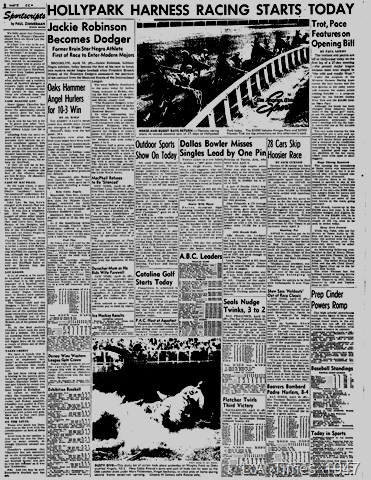
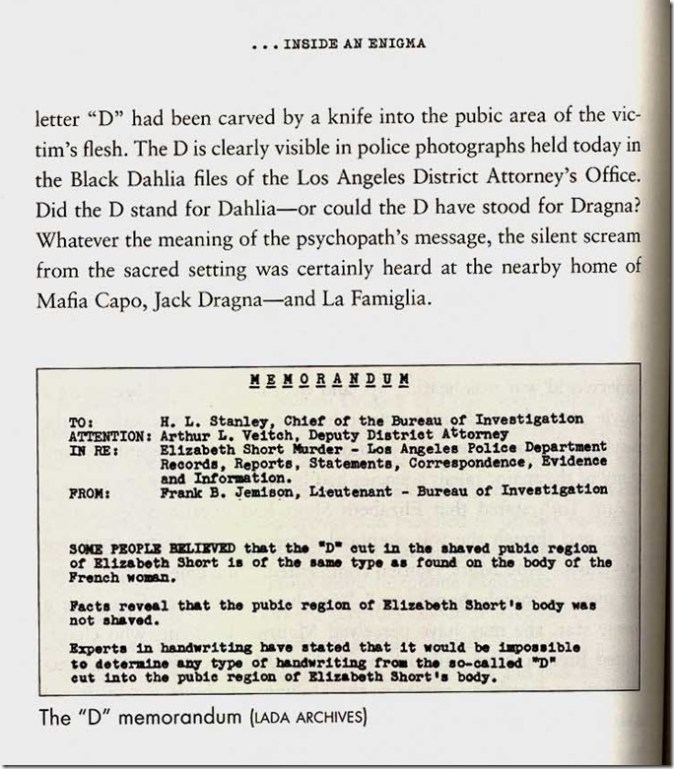
“The Examiner headline story of Friday, January 17, included the Santa Barbara police photos and an interview with Santa Barbara policewoman, Mary H. Unkefer. Juvenile Officer Unkefer had been called into the 1943 case when Elizabeth Short was arrested for drunk and disorderly and was identified as a minor.”

Continue reading

Posted in 1947, Black Dahlia, Books and Authors, Cold Cases, Donald Wolfe, LAPD, Uncategorized | Comments Off on Black Dahlia: Blogging ‘Black Dahlia Files’ Part 30 — Tick, Tick, Tick

Page 1 News

Note: This is an encore post from 2007.
March 2, 1907
Los Angeles

Posted in 1907, Black Dahlia, Books and Authors, LAPD, Streetcars | Tagged , | Comments Off on Page 1 News

Black Dahlia: Blogging ‘Black Dahlia Files’ Part 29 — Wreck of the Old 97


Note: This is an encore post from 2006.
Uh-Oh. All I had to do was read the opening line in this section of Donald H. Wolfe’s “The Black Dahlia Files: The Mob, the Mogul and the Murder That Transfixed Los Angeles” to know…

This is not going to be pretty.

Continue reading

Posted in 1947, Black Dahlia, Books and Authors, Donald Wolfe, LAPD | Comments Off on Black Dahlia: Blogging ‘Black Dahlia Files’ Part 29 — Wreck of the Old 97

March 1, 1907: L.A. Businesses Running Out of Space to Dump Garbage


Note: This is an encore post from 2007.
March 1, 1907
Los Angeles

Downtown businessmen are at a complete loss over what to do with the garbage from their operations and want the city to either take it or designate a dump they can use.

“They declare that the Board of Health has refused to let further deposits of garbage or refuse be made at the old dumping ground to the southeast of the city and state that if the city does not come forward with a proposition to locate a new dump, or to cremate the stuff, they will be helpless to get rid of the accumulations of each day’s business,” The Times says.

Continue reading

Posted in 1907, Black Dahlia, Books and Authors, Downtown, LAPD, Streetcars | Tagged | Comments Off on March 1, 1907: L.A. Businesses Running Out of Space to Dump Garbage

Black L.A., 1947: Animator George Pal Sponsors Youth Basketball Team

Feb. 27, 1947

Feb. 27, 1947: The Sentinel never wrote anything further about the Newton Pals basketball team. The team members were listed as Charles Ward, Louis Augistine, Marion Person, Charles Davis, Henry Morrison, Aroyce Robinson, Ralph Swere, Roland Bundice and James Howard.


Posted in 1947, African Americans, Film, Hollywood, Sports | Tagged , , , , , | Comments Off on Black L.A., 1947: Animator George Pal Sponsors Youth Basketball Team

Black Dahlia: Blogging ‘Black Dahlia Files’ Part 28 — A Rain Check


Note: This is an encore post from 2006.
After spending so much time on Elizabeth Short’s autopsy, Wolfe is heading into autobiographical material. Given all the nonsense surrounding our last foray into the Wolfe household (remember “Uncle Vern
” who used to house-sit for neighbor Bugsy Siegel, except Siegel moved in three years after the Wolfes moved out?) I may take a rain check and come back if this proves to be significant regarding the Black Dahlia case.

Page 36

Wolfe is going to talk about his stepfather, studio executive Jeffrey Bernerd, who died in 1950, although we don’t seem to get that little factual bonbon.
Continue reading

Posted in Uncategorized | Comments Off on Black Dahlia: Blogging ‘Black Dahlia Files’ Part 28 — A Rain Check

Feb. 28, 1907: Edison Crew Cuts Down 300-Year-Old Oak to Keep Power Line Straight

Note: This is an encore post from 2007.
Feb. 28, 1907
Los Angeles

An old and massive California live oak used to mark the division between three Spanish land grants lies in pieces on the ground because an Edison foreman refused to run a transmission line around it.

“The tree was a full hundred feet in its spread,” The Times says,” and stood on the end of a little plateau, all alone in its greatness. The massive trunk could not be circled by three men stretching their arms and touching their fingertips—hardly by four men. Above, it split into four great branches that spread out and out and then again downward, containing with an evergreen shield a refuge where two full companies of soldiers might have bivouacked in comfort.”

Continue reading

Posted in 1907, Black Dahlia, Books and Authors, Freeways, LAPD, San Fernando Valley, Streetcars | Tagged , , , | Comments Off on Feb. 28, 1907: Edison Crew Cuts Down 300-Year-Old Oak to Keep Power Line Straight

Black L.A. 1947: Huge Blast Kills 17, Show Dangers of Industry Moving Into Black Neighborhoods

O'Connor Electroplating
Feb. 20, 1947: An aerial view of the devastation from the explosion at the O’Connor Electroplating Corp.,  926 E. Pico Blvd.  Los Angeles Public Library Herald Examiner collection.

oconnor_electroplating_site_2018
The site of the O’Connor Electroplating explosion via Google Satellite View.

Feb. 27, 1947, O'Connor Electroplating Blast

The Sentinel reports that five African Americans were among the 17 people killed by the Feb. 20, 1947, explosion at the O’Connor Electroplating Corp., 926 E. Pico Blvd. The explosion injured 128 people and wiped out most of the block.

The blast, the Sentinel said, reflected the hazards of industry encroaching into a residential neighborhood, especially when the city of Los Angeles was segregated by deed covenants.

Blacks “are hemmed in by these ghetto agreements and the city fathers, busy protecting lily-white suburban communities, tend to shoo all business establishments off to Negro residential areas,” the paper said.

The Sentinel criticized the district’s councilman, the Rev. Carl C. Rasmussen, for failing to protect his constituents.

According to the Sentinel, Rasmussen dismissed an effort to prevent rezoning of an area on East 28th Street near the YMCA and St. Phillips Church. “After all, this is a business community. Why don’t you people buy a church somewhere else? You can get a big price for your property now,” Rasmussen said.

Continue reading

Posted in 1947, African Americans, Fires | Tagged , , , , , , , | Comments Off on Black L.A. 1947: Huge Blast Kills 17, Show Dangers of Industry Moving Into Black Neighborhoods

Black Dahlia: Blogging ‘Black Dahlia Files’ Part 27 — The Pinata Collecting Our Thoughts


Note: This is an encore post from 2006.
The two-minute executive summary:

In analyzing Donald H. Wolfe’s “The Black Dahlia Files: The Mob, the Mogul and the Murder That Transfixed Los Angeles,” we have spent the last week on the identification of Elizabeth Short and her autopsy, finding fiction, literary fraud, a studious disinterest in the facts and an annoying inability to distinguish between city and county agencies.

In addition, research in original newspapers has revealed that despite the claims of living near Bugsy Siegel when he was killed in 1947, Wolfe apparently lived elsewhere as his mother sold the house in question in 1944.

Continue reading

Posted in 1947, Black Dahlia, Books and Authors, Cold Cases, LAPD, Uncategorized | Tagged , , , , | Comments Off on Black Dahlia: Blogging ‘Black Dahlia Files’ Part 27 — The Pinata Collecting Our Thoughts

Feb. 27, 1907: Downtown Fire Kills Secretary Who Stopped to Call Boss


Note: This is an encore post from 2007.
Feb. 27, 1907
Los Angeles

A thick cloud of smoke from a raging fire in the basement swept through the Germain building on South Spring Street at lunch hour, engulfing businessmen and office workers. In a fraction of a second, the building’s occupants were transformed from powerful executives conducting elaborate stock deals into blind and struggling humans groping on their knees through the hallways to save their lives.

There were many daring rescues and examples of selfless sacrifice. One man was saved as he was about to commit suicide rather than die in the fire. Firefighters battled the blaze until they were at the point of collapse, left to revive themselves and then returned. The only fatality was Emma Stewart, a secretary who died because she turned back from her flight to telephone her employer about the fire.

Continue reading

Posted in 1907, Black Dahlia, Books and Authors, LAPD, Streetcars | Tagged | Comments Off on Feb. 27, 1907: Downtown Fire Kills Secretary Who Stopped to Call Boss

Black L.A., 1947: Husband Suspected of Killing Mary Tate


Feb. 27, 1947, Edgar Hayes and His Star Dusters

Feb. 27, 1947: Terry Tate, of 123 N. San Pedro Street, is arrested in the death of his wife, Mary, at 107 Weller Street, described by the Sentinel as a rooming house or hotel. Tate was strangled and beaten Jan. 18, 1947. In July, Ocar J. Hallgren was arrested in the killing, which was never solved.

Continue reading

Posted in 1947, African Americans, Black Dahlia, Cold Cases, Crime and Courts, LAPD | Tagged , , , , , , , | 2 Comments

Movieland Mystery Photo (Updated + + + +)

March 3, 2018, Mystery Photo
This week’s mystery movie has been the 1955 Warner Bros. film “Tall Man Riding,” with Randolph Scott, Dorothy Malone, Peggie Castle, Bill Ching, John Baragrey, Robert Barrat, John Dehner, Paul Richards and Lane Chandler. The screenplay was by Joseph Hoffman, from the novel by Norman A. Fox, photography was by Wilfrid M. Cline, art direction by Stanley Fleischer, set decoration by G.W. Berntsen, wardrobe by Moss Mabry, orchestrations by Max Reese and music by Paul Sawtell. The producer was David Weisbart and the director was Lesley Selander.

“Tall Man Riding,” with “Colt .45” and “Fort Worth,” is available on DVD from Amazon.

Continue reading

Posted in Film, Hollywood, Mystery Photo | Tagged , , | 37 Comments

Mary Mallory / Hollywood Heights: ‘Moving Picture Hero of My Heart’ Promotes Movies


moving_picture_hero_cover

From its beginnings, the motion picture industry developed adept advertising and promotional concepts to spread the word of its film products and stars. Quick to develop cross-promotions and partnerships with magazines and newspapers, the film industry grew new fans and box office receipts with practical but novel concepts like employing sheet music to sell its films. The Essanay Film Company followed the same playbook with sheet music titled “The Moving Picture Hero of My Heart” as a special giveaway at the 1916 Motion Picture Exhibitors League of America’s national convention, which later became popular across the country.

The Selig Film Company perhaps pioneered the practice of cross-promotion when they developed a partnership with the Chicago Tribune in 1913 to collaterally sell the serial “The Adventures of Kathlyn,” with the newspaper running serialized installments of each episode after it played in theatres, thus whetting the appetites of readers to see how the next episodes would play out. The serial set attendance records for those coming to see it, and the Tribune saw subscriptions and sales increase. As their book, “The WGN” stated in 1922, “The first step was to capitalize the soaring motion picture craze for Tribune benefit.”

Mary Mallory’s latest book, “Living With Grace: Life Lessons from America’s Princess,” will be released June 1.


Continue reading

Posted in Film, Hollywood, Hollywood Heights, Mary Mallory, Music | Tagged , , , , , | Comments Off on Mary Mallory / Hollywood Heights: ‘Moving Picture Hero of My Heart’ Promotes Movies

Black Dahlia: Blogging “Black Dahlia Files” Part 26 — Missing Man Formation


Note: This is an encore post from 2006.
Our story so far: I am blogging—in real time—as I read Donald H. Wolfe’s “The Black Dahlia Files.” It’s been slow going and this is an especially tedious part because I’m examining Wolfe’s treatment of Elizabeth Short’s autopsy. I’m not through and I’ve turned up some outright literary fraud, so it’s prudent to be particularly careful.

Page 33

Let’s pick up where we left off yesterday:

“Yet there is not another cold-case homicide on record in Los Angeles in which the autopsy report has not been made available to the public.”

Continue reading

Posted in 1947, Black Dahlia, Cold Cases, Donald Wolfe, LAPD, Uncategorized | Tagged , , , , , | Comments Off on Black Dahlia: Blogging “Black Dahlia Files” Part 26 — Missing Man Formation

In Indiana, There Is No Beer

Note: This is an encore post from 2007.
Feb. 14-26, 1907
Los Angeles

The Rev. Ervin S. Chapman, a Presbyterian minister who heads the Anti-Saloon League of California, has won a victory through an address that persuaded an Indiana judge to rule that saloons are unconstitutional.

Chapman concluded his series of points by saying:

Continue reading

Posted in 1907, Black Dahlia, Books and Authors, Crime and Courts, LAPD, Streetcars | Tagged | 1 Comment

Black Dahlia: Blogging “Black Dahlia Files” Part 25 — Loyalty

Note: This is an encore post from 2006.
Just out of curiosity, I did a Google image search for “loyalty
.” I got Johnny Cash flipping the bird (turned into a mock motivational poster); another poster for the Army on its values; a picture of a dog, a huge tattoo reading “Love” and “Loyalty” featuring rosary beads, a cross and other Christian symbols; James Montgomery Flagg’s famous World War I recruiting poster of Uncle Sam; a boomerang; and a couple of ships.

A search for “loyal” brought up a company’s logo; an image of the Boy Scouts; and the cover to Tupac Shakur’s “Loyal to the Game.”

Continue reading

Posted in Uncategorized | Comments Off on Black Dahlia: Blogging “Black Dahlia Files” Part 25 — Loyalty

Black Dahlia: Blogging “Black Dahlia Files” Part 24 — He Walked by Night


Note: This is an encore post from 2006.
Much has been written about poor crowd control at the Black Dahlia crime scene. Here’s an example of LAPD crowd control from the 1948 film “He Walked by Night,” which was the genesis of “Dragnet,” first as a radio show and then as a TV program. The idea of “Dragnet” arose during filming of “He Walked by Night” as Homicide Sgt. Marty Wynn, the technical advisor on the film, talked with actor Jack Webb about all the mistakes Hollywood made in portraying police work.

A frame grab from the movie shows the ropes used to keep people away from the car where a police officer has been killed. Retired Capt. Ed Jokisch has told me many times that in the 1940s, when he worked homicide, the call car had ropes used for crowd control.

Posted in Uncategorized | Tagged , , , , | Comments Off on Black Dahlia: Blogging “Black Dahlia Files” Part 24 — He Walked by Night

Black Dahlia: Blogging “Black Dahlia Files” Part 23 — The Pinata


Note: This is an encore post from 2006.

So what’s your point, Harnisch? Isn’t there a little schadenfreude here in dismantling Donald H. Wolfe’s “The Black Dahlia Files: The Mob, the Mogul and the Murder That Transfixed Los Angeles”? Didn’t you make your point at the preface?

Absolutely. So, as Sandy Koufax said: “The question is why.”

Continue reading

Posted in Uncategorized | Comments Off on Black Dahlia: Blogging “Black Dahlia Files” Part 23 — The Pinata

Feb. 24, 1907: Samuel Tilden Norton Designs Eagle Rock Bank Building

Eagle Rock Bank Building
Eagle Rock bank building designed by Samuel Tilden Norton, via Google Street View.

Note: This is an encore post from 2007.
Feb. 24, 1907
Eagle Rock

Architect Samuel Tilden Norton has designed a bank building for Townsend Avenue and Colorado Boulevard in Eagle Rock, The Times says.

Just to make research interesting, The Times misspelled his name as S. Tilton Norton. According to his 1959 obituary, his mother was the first Jewish child born in Los Angeles. After studying architecture in Los Angeles and New York, he designed the Wilshire Fox Building and Sinai Temple.

Continue reading

Posted in 1907, Architecture, Black Dahlia, Books and Authors, LAPD, Obituaries, Streetcars | Tagged | Comments Off on Feb. 24, 1907: Samuel Tilden Norton Designs Eagle Rock Bank Building

Black Dahlia: Blogging “Black Dahlia Files” Part 22 — The Funny Papers


Note: This is an encore post from 2006.
Oh dear…. oh dearie, dearie, dear. Just out of curiosity, I decided to check the address Wolfe gave as his home
when Bugsy Siegel was killed. This was 803 N. Roxbury Drive (“Mogul,” Page 26).

First the good news. Wolfe actually lived there. Now for the bad news: It turns out that Wolfe’s mother sold the house to Sol Hurok in—what’s this—1944? That’s three (count them 1… 2… 3…) years before Siegel was killed.

Continue reading

Posted in Uncategorized | 1 Comment