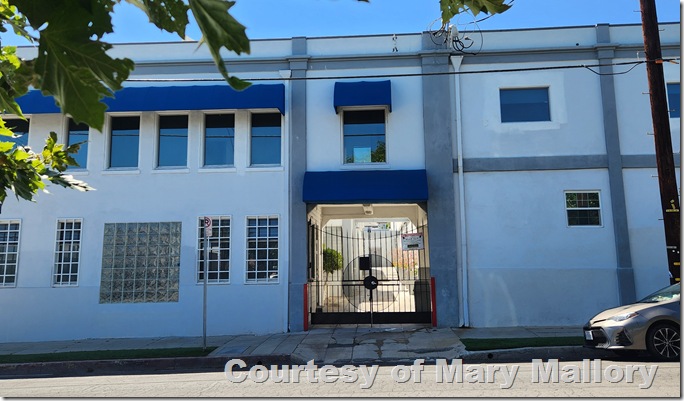
Occidental Studios, photograph by Mary Mallory.
Film production in the mid-1910s quickly transformed Hollywood the farming community into the world’s film manufacturing hub. Originally employing simple buildings like barns, ex-saloons, and laundry yards as studio headquarters and stages, the industry quickly began constructing actual production facilities as they turned increasingly professional. Most were located adjacent or within blocks of others in such areas as central Hollywood and Edendale.
Los Angeles sportsman turned ferry owner Frank Garbutt and Selig Studio star Hobart Bosworth decided to construct their own state-of-the-art facility more than a mile from any other movie studio, isolating themselves from distractions or interruptions. Located at 201 N. Occidental Blvd. a block off Temple Street and distant from downtown Los Angeles, the new intimate film studio focused on quality, not quantity. Significant visionaries as diverse as Lois Weber, Mary Pickford, and Howard Hughes advanced the industry from this location.
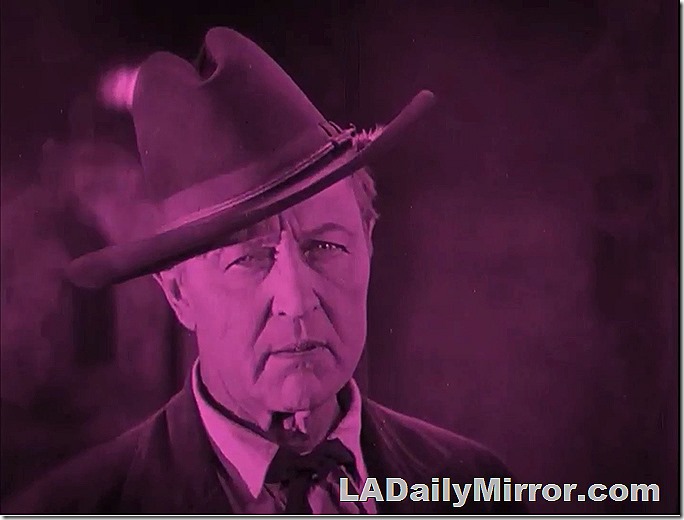 Hobart Bosworth in Zander the Great, 1925.
Total opposites Bosworth and Garbutt shared a vision: to produce Jack London’s stirring adventure stories for the screen, after acquiring rights from the famous novelist. Garbutt invented and patented a few oil drilling tools in the late 1880s, parlaying his growing wealth into oil wells, Glenn Martin’s growing aviation business, and a ferry connecting San Pedro and Terminal Island. His wealth allowed him to compete as one of Los Angeles’ premiere athletes: successful auto racer, speedboat/yacht expert, and dominant handball player, before serving a term as President of the Los Angeles Athletic Club. Recognizing the opportunity to rapidly expand his wealth in the fledgling film business, he joined with Bosworth to construct a new studio. Impressed with movies, he would help found Paramount Pictures Corporation and the Oliver Morosco Photoplay Company, both in 1914.
Bosworth, on the other hand, focused his attentions on theatre before turning to the exciting new medium of film. The son of a sea captain during the Civil War, Bosworth ran away to sail the seas at the age of 12. During shore leave in San Francisco in 1885, he joined McKee Rankin’s stage company, looking for new challenges and an opportunity to earn money to turn landscaper. Starting as a stage manager before moving into performing, the respected actor climbed the ranks and began earning leading roles in New York before stricken with tuberculosis. Bosworth moved west, and after a few years of recuperation, joined the Selig Polyscope Company in 1908, happy to return to his love of acting by filming movies on outdoor stages. Looking for independence in 1913, he joined forces with Garbutt to combine his love of acting with his love of the sea.
The two joined forces on July 29, 1913, forming Bosworth Incorporated. Bosworth provided the artistic direction, Garbutt the financial backing for filming at the Occidental Blvd. lot. The Los Angeles Times stated, ”The greatest asset of the new company is its contract with Jack London, whereby it has exclusive control, as far as the screen is concerned… .” Garbutt invested with W. W. Hodkinson in a film distribution company known as Paramount Picture Corporation not long after, which was soon purchased by Famous Players-Lasky as their own distribution arm. With the merger, Garbutt became a major player with the growing company, which later changed their name to Paramount as well.
Not until November 1914 did Garbutt pull permits to construct an elaborate studio at 201 N. Occidental Blvd., a Class A building composed of steel and concrete construction, rendered as fireproof as could be at the time. Understanding the hazards of nitrate film, “Particular attention has been paid to the laboratory and interior and exterior film vaults. These are of solid concrete reinforced with steel and lined with hollow tile,” as reported by Motion Picture News.
At virtually the same time, industrialist Garbutt and his sister provided money for stage producer Oliver Morosco to enter film production under the name Oliver Morosco Photoplay Company. Morosco would produce their films in conjunction with Pallas Pictures at the Garbutt Bosworth Studio as well. One of the developers of synergy, the company incestuously created film versions of stage plays produced by the company, filming at the Garbutt owned stage, and releasing through Paramount Pictures. Always in search of prestige, the company lured renowned writer/actor/director Lois Weber and her husband Phillips Smalley from Universal’s Rex Company, to produce and distribute films under their banner at this time too.
Weber’s film “Hypocrites,” filmed at the Bosworth studio, received ample praise in the press upon its 1915 release, as did the leading director. The Los Angeles Evening Post-Record called her “a talented and an able woman. it is from the Bosworth studio, and in many respects it is the most remarkable work that concern has turned out.” Weber aimed to stretch the medium, to turn it mainly from a form of entertainment into one providing education and leading to social change. Her acclaimed work demonstrated that art and commerce could unite, and that women could do it all in film.
Looking for more voice, control, and independence, Bosworth sold out his part of the company to Garbutt in 1915, and joined Universal to work as actor and director. Tired of sharing the small stage and studio with others, Bosworth hoped for his own independent space at the new company, where he could more leisurely turn out product. Not long after moving to Universal, Bosworth focused his efforts on acting, perhaps as he separated from his wife.
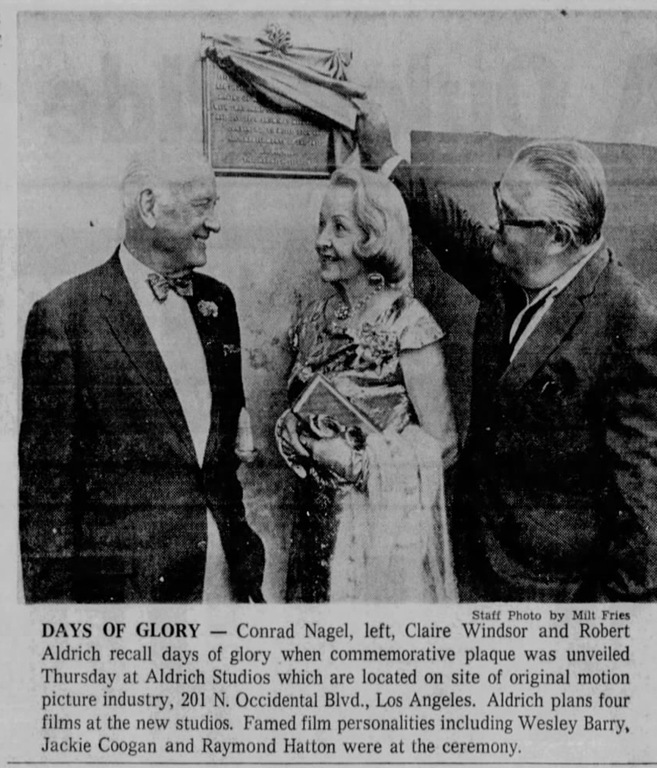
Conrad Nagel, left, Claire Windsor and Robert Aldrich at the unveiling of a commemorative plaque at the Aldrich Studios, 201 N. Occidental Blvd. Valley Times, August 9, 1968.
Garbutt successfully organized and coordinated filming by the various production entities without one disturbing the other during this time, perfectly balancing all his assets. The astute industrialist understood how to keep everyone happy and blend his forces harmoniously, particularly in the crowded space. By this time, such famous actors and directors as William Desmond Taylor, Frank Lloyd, Anna Held, Dustin Farnum, Wallace Reid, Jack Pickford and Elsie Janis worked on the lot.
Always looking to improve his property, Garbutt upgraded in 1916. It’s possible renowned architect Frank Lloyd Wright Jr. designed new buildings for the property: a stage/prop shop to construct sets and props for the productions, and a greenhouse to grow potted plants, flowers, greenery, and palm trees employed for their productions, as the name “Frank Lloyd Wright” is listed as the architect for new additions in 1916. These improvements led Famous Players-Lasky to purchase the lot for production in 1917. Lasky stars like Mary Pickford as well as performers like Constance Talmadge filmed on the lot as well.
Deciding to focus on updating their own property, Lasky sold the property in 1919, with the respected Realart Pictures taking over in 1920. Mary Miles Minter would star in films directed by William Desmond Taylor here, along with stars like Francis X. Bushman and Bebe Daniels. Looking to grow, the company purchased eight additional lots to construct more studio space and production facilities.
Looking to retrench, Lasky reduced out of state properties in 1921 to once again take control of the former Garbutt stage. Top talent such as Cecil B. DeMille, Edith Clayton, Thomas Meighan, Bebe Daniels, Roscoe “Fatty” Arbuckle, and Gloria Swanson would film at the location, and a young Dorothy Arzner would work as an editor here. By 1922, the studio renamed it Wilshire-Paramount Studio of the Famous Players Lasky Corporation. They would remain here only a couple of years before divesting themselves of the property as they purchased land off Melrose and Marathon Avenues south of the Hollywood Cemetery in which to construct a massive up-to-date studio.
At this point, the classy lot would begin changing owners every five to ten years, swaying back and forth from middle of the road companies like the Roy Davidge Laboratories in the mid-1920s to MultiColor Films, which produced advertising pieces as well as colorized and treated films. Purchased by a 25-year-old Howard Hughes in 1930 in hopes of advancing color film , the company lasted a short time at the location before he constructed a new facility off Romaine Street in Hollywood. Color companies such as Cine Color and Prizmatic Studios followed. John Sutherland Productions took over in the mid-1940s to produce popular educational films for the government and schools, remaining until the late 1960s, when director Robert Aldrich employed it as his base of operations for the Aldrich Studios.
Since 1972, the lot has mostly been employed for TV and music video production, such TV and music productions as “Tales of the City,” “New Girl,” “Sharp Objects,” Phil of the Future,” “The United States of Tara,” and video shoots for groups like the Los Angeles Philharmonic. Known as the Occidental Studios since the 1980s, it is the longest running motion picture studio in all of Los Angeles.
Historic but long forgotten, Occidental Studios hearkens back to a day of independence, inspiration, opportunity, when young filmmakers gambled with their life savings on motion picture production, helping turn Hollywood and Los Angeles into the filmmaking capital of the world.


Thanks Mary. An interesting read.
LikeLike