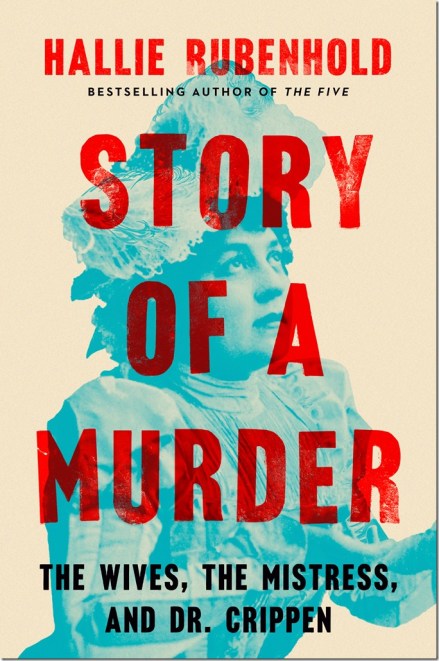
Story of a Murder: The Wives, the Mistress, and Dr. Crippen, by Hallie Rubenhold, Dutton, 512 pages, March 25, 2025. $32.
In Story of a Murder, her latest book on sensational British crimes, Hallie Rubenhold explores the 1910 case of the murderous Dr. Hawley Crippen, who absconded with his “lady typist” after burying the remains of his inconvenient wife in the cellar. As with Rubenhold’s earlier work, The Five, a ground-breaking exploration of the lives of Jack the Ripper’s victims, Story of a Murder focuses on the women in Crippen’s life, telling their stories with depth, insight and empathy. A welcome departure from the run-of-the-mill “true” crime books and a breath of fresh air for a stale, tawdry genre. Well-written and suspenseful. An excellent prospect for film or TV.
::
There is something in the British national character that loves a good murder story told and retold with increasing dollops of fiction, stated with unwavering confidence until the killing becomes an epic tragedy carved ever deeper into the cultural consciousness.
But as Rubenhold says: “The process of rarefying a crime into a legend removes all nuance” and it is her gift to upend such stories that everyone thinks they know by telling them in a way that is utterly new. The Five (2020) tosses the customary narrative about the Whitechapel murders into the bin, using the victims to explore the social history of the era. The biographies take the women up to almost the moment when they have their encounter with the killer and no further. There is no blood, no gore and no speculation as to who the Ripper might be.
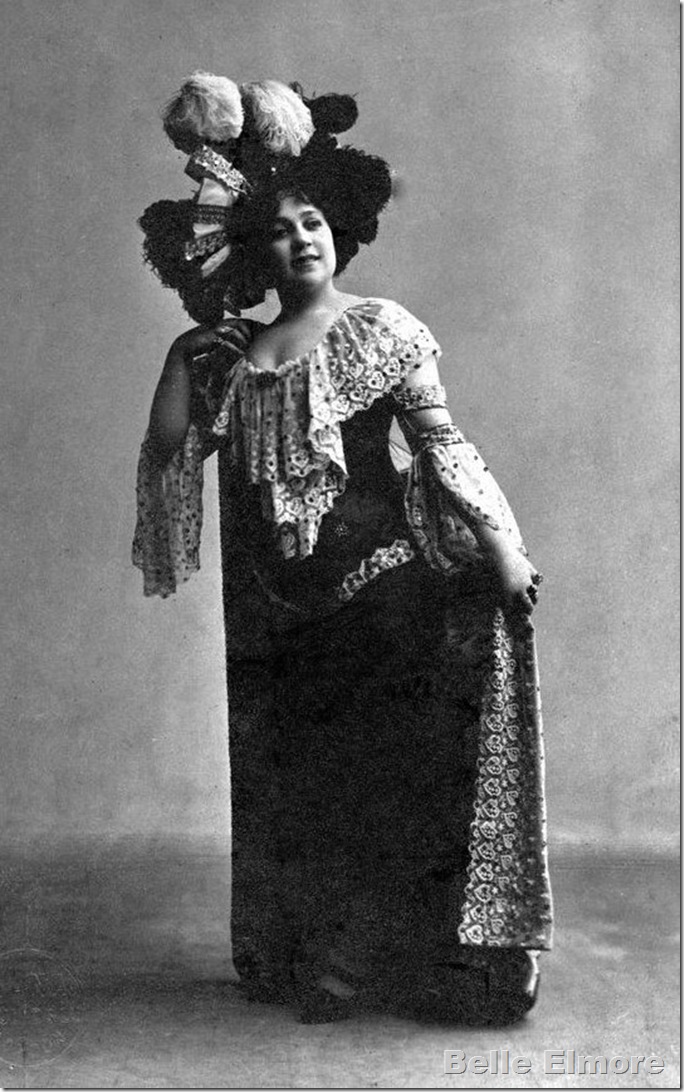
Belle Elmore in an undated photo.
This deliberate omission of the killer has provoked walrus-like bellowing from certain male quarters of “Ripperology” and whenever I recommend The Five as a model of what a literary “true” crime book ought to be (which is often), I receive rebukes and huffy tut-tuts from some Ripperologists over the affront that a woman author should dare to write about their murders and even worse, leave Jack out of the story entirely.
The Five is such a truly remarkable book that I could not imagine what Rubenhold would do for an encore. But she has done it with Story of a Murder.
Unlike Jack the Ripper, who remains unseen in The Five, Crippen plays a role in Story of a Murder, but it is a secondary one. Rubenhold delves into his American roots (Crippen was born in Michigan; his father and son lived in Los Angeles), his abandonment of a somewhat respectable medical career and descent into a patent medicine huckster and all-around fraud in London. And yet Crippen is a pale, bland, dull little man with spectacles, a droopy mustache and a bowler hat. He embodies the utter banality of total evil, as a professor friend who teaches courses on evil might say.
In contrast, Rubenhold paints vivid and carefully delineated portraits of the two female leads: The victim and Crippen’s culpable co-conspirator. There is the inconvenient spouse, the flamboyant Belle Elmore, a frustrated opera singer turned vaudevillian and music hall entertainer with a penchant for expensive costumes and jewelry, and a generous heart for benevolence. And the young “lady typist,” Ethel Le Neve, increasingly frustrated at her neglected corner of the love triangle, who is exonerated while her lover goes to the gallows, but bears the mental scars of their murderous affair for the rest of her life.
Rubenhold also proves herself capable of writing a suspenseful page-turner. Will the fugitive lovers make their escape or will ever-diligent Scotland Yard capture them as they flee the country? And yes, reporters were obnoxious sensationalists even then.
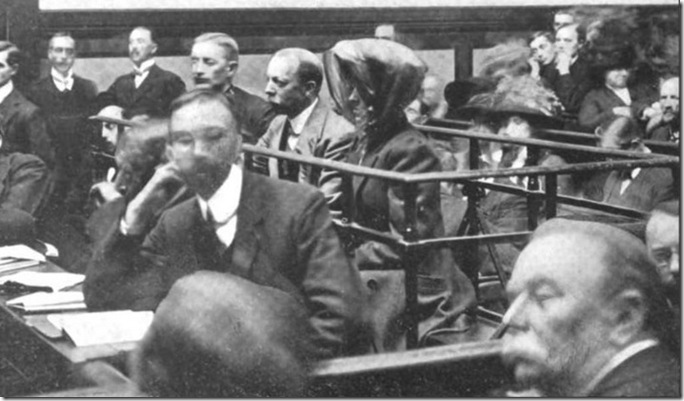
Dr. Hawley Crippen and Ethel Le Neve in the dock, The Trial of Hawley Harvey Crippen, 1920
There is, of course, also an element of the British national character that takes a staunch, contrarian attitude toward their favorite murders. Was Jack the Ripper a member of the royal family? Do recent DNA tests point to a real killer? This has become part of the Crippen epic as well: Were the remains found in the cellar that of his wife or someone else? Did Belle Elmore simply walk out of the house with nothing but what she was wearing and a small valise, dying of pneumonia on a ship to America? Or was it in Los Angeles? Or San Francisco? Was an innocent man hanged?
Rubenhold addresses these issues with an appendix to the book in which an expert critiques a DNA test that might indicate the scant remains in the cellar were not those of Belle Elmore. More important, Rubenhold examines how the story of Crippen has been told over the years: The transformation of his wife, Belle Elmore, into an insufferable harpy and adulterous spendthrift who brought her murder upon herself; the portrayal of Crippen as a horribly wronged man, a gentle, romantic soul who only ached to be with the woman he loved, Ethel Le Neve, the long-suffering “lady typewriter.”
My personal curiosity, as a writer with some experience at the crossroads of history and legendary crime, was to see how Rubenhold handled the huge cast of characters, how she treated the context of the case by portraying the era without being overwhelmed with intriguing but irrelevant details, and how she sampled trial testimony rather than using extended quotes that veer quickly toward tedium. And most of all how she portrayed Belle Elmore and Ethel Le Neve so thoughtfully and with such depth. Rubenhold’s postscript (“The Last Word”) is by itself worth reading as an examination of how repeated retellings by unscrupulous authors transform a complex crime with three-dimensional individuals into flat, palatable folklore where “good” and “bad” are sharply demarcated.
Thoroughly footnoted with a robust bibliography, Story of a Murder is another model of what literary “true” crime ought to be: a refreshing read appealing even to those who don’t care for “true” crime and a guide for any writer contemplating a project in vintage murder.


This sounds like such an excellent, insightful story. I can’t wait to read it!
LikeLike