
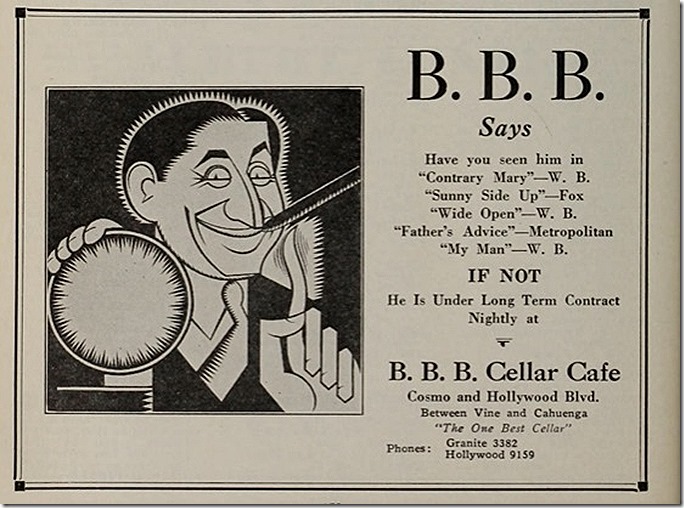
Long before Silver Lake’s Black Cat Cafe or the first LBGT parade down Hollywood Boulevard in the 1960s, Hollywood highlighted female impersonators and the gay community in a popular, energetic nightclub called B. B. B.’s Cellar and led by host Bobby Burns Berman. Introducing tasteful female impersonators elegantly attired, many more conservative audiences found the drag and atmosphere a little too much. Lasting three years, the nightclub could be the beginnings of gay life in Los Angeles.
Bobby Burns Berman grew up ready with a song and a laugh, as he and his brother Harry joked around in New York, singing and performing in clubs. While Harry would go the Ziegfeld Follies route, Bobby first served as master of ceremonies in Atlantic City and wrote cabaret reviews for Variety under the pseudonym “B. B. B.,” employing it as his stage name.. He drew up his own nightclub act, devising humorous songs, making wisecracks, caricaturing celebrities and engaging in witty repartee with club audiences, starting in Greenwich Village and moving on to Chicago.
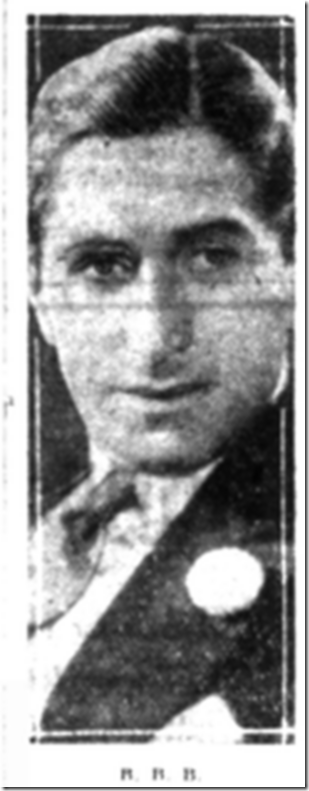 Mike Lyman brought him to Los Angeles in 1927 to serve as master for ceremonies for his new revue patterned after Club Alabam. Sometimes known as “the male Texas Guinan,” Berman was also renowned as a “Human radio station,” the station of F.U.N.” An early Los Angeles entertainment influencer, wisecracker B. B. B. grew popular as emcee at Coffee Dan’s downtown thanks to his sarcastic retorts and humorous songs for two years in the late 1920s.
In 1929, Berman decided to employ his skills operating his own nightclub, devising an uptown cabaret in a Hollywood basement. While many Hollywood clubs and cafes closed due to flagging sales in summer and fall 1929 before the stock market crash, B. B. B.’s Cellar opened to smashing business in late August. A full house of 500 people paid a $2.50 cover charge to enjoy the fun and fancy free entertainment at the speakeasy located in the basement of the Markham Club at 1651 Cosmo Street. Clubhoppers waited in line at 1 am still attempting to gain admittance.
B. B. B.’s offered popular, slightly risque entertainment accompanied by two pianists playing popular music.In a news story, Variety stated that his club was “destined….to become Hollywood’s future casting and tryout shop where guest talent is prevailed upon by B. B. B. Again it may develop into a song plugger’s paradise.” Wiseguys, Broadway song tunesters, and entertainers flocked to the club, as did locals and tourists looking for celebrities and a taste of a wild nightlife. Many learned about Berman himself from his appearance in the Fox film “Sunny Side Up” besides winks in newspaper gossip columns. For a short time in 1931, he starred in George Gershwin’s “Girl Crazy” on the West Coast when forced to close for back rent.
An entrepreneur ingratiating himself with clubgoers and entertainers through charm and wit, Berman also possessed a generous side, entertaining for charity and giving a handout to those finding their careers in a tailspin. His singing and hamming drew huge crowds to the club, including those who walked on the dark side, sometimes conducting a little shady business on the side. Berman struggled with financial problems in 1931 due to some believing he was selling booze illegally or allowing others to set up deals for it, leading to raids. In April 1932, financial assistance from agent Al Rosen got him up to speed, reopening as what The New Movie Magazine called “the imitation of the El Dorado Club in Berlin…Both are new and attract the jaded.”
After reopening, Berman turned the club even more into a toned down version of Berlin and its wild cabarets. He employed seven female impersonators in a take off on Hollywood stars and glamour in an upscale floor show Some of the performers closely resembled female superstars like Marlene Dietrich and Greta Garbo and performed cabaret numbers like “Boys Will Be Girls.” While more sophisticated audiences enjoyed the risque humor, it was too much for more conventional audiences, with some reviews employing derogatory terms for the men. Variety’s cutting review says it all: “This is the film colony’s first sign of pro pansies and in consequence the rake-in is greater than ever before experienced by this side street dropdown,” describing prancing and and wisecracks but a cleaner show than most nightclubs.
By April 1933, Berman chafed under Rosen’s management, selling out his share and returning to entertainment. He sold J. Walter Thompson agency the idea of a barbershop set and act for Williams Shaving Soap. He then returned to New York and cabareting as the emcee/host for the Monte Carlo floor show before moving on to the El Garron and then coming back to Hollywood’s Sardi’s in 1937 and marrying. He and his wife settled down, raising schnauzers and appearing at dog shows. Berman turned his love of entertainment intro one of carrying for animals.
Virtually forgotten today, Bobby Burns Berman introduced Hollywood to drag performances in 1929, inching the door forward for gay and lesbian performers in Los Angeles.

 ladailymirror.com
I thoroughly enjoyed this excellent article and read it with great interest as my great uncle was Bobby Burns Berman. I never met him but grew up hearing about his career in clubs and movies.
The article brought out many facts I didn’t know. However one I suspected was that B.B.B’s Cellar Cafe was the first to feature cross dressing entertainment. Other articles refer to Jimmy’s Back Door as the first LA club offering female impersonators. I knew B.B.B.’s Cellar Cafe opened several months before Jimmy’s and this article confirmed my suspicion.
LikeLike