
Little known beyond animation circles, Margaret J. Winkler was one of the earliest distributors and producers of animated cartoons, the first woman in her field. Possessing savvy and a sharp eye, she signed two animators early in their career who would become superstars, Max Fleischer and Walt Disney. One hundred years ago, October 16, 1923, Winkler agreed to distribute Disney’s first animation series, the Alice comedies, launching his iconic career.
Born April 22, 1895 in Hungary, Winkler moved to America with her family as a chlld. She first found a position in the moving picture field as Harry Warner’s secretary in 1918. Observant and a quick study, she watched executive Warner at work purchasing film properities, coming to understand the complex, commercial nature of the artistic business.
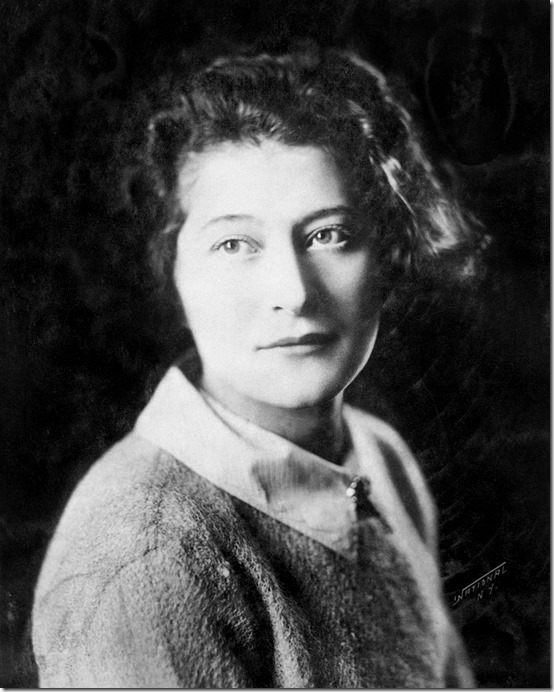
Margaret Winkler in an undated photo.
The assertive young woman stepped out on her own in 1921, and found success almost immediately. Determined to prosper in a difficult field, she changed her name to M. J. Winkler, a non-gendered name to make her palatable to those perhaps challenged by women. Establishing M. J. Winkler Productions, the ambitious Winkler thus became the first female producer and distribution in animation, and one of the most successful in the field. As she told a 1922 trade magazine in a story entitled “Distributor As a Woman Proves Surprise,” “I think the industry is full of wonderful possibiities for an ambitious woman, and there is no reason why she shouldn’t be able to conduct business as well as the men.”
Winkler acknowledged superior talent and works from the beginning. Recognizing that Paramount Studios had not been doing enough for three years to promote the frisky and popular “Felix the Cat” on a steady release schedule, she arranged to distribute Otto Messmer and Pat Sullivan’s humorous shorts starring the ultimate cat with moxie. A whiz at promotion and advertising, the canny Winkler pushed Felix into the stratosphere, employing flashy one-sheet posters that popped, large ads in trade magazines to impress exhibitors, tie-ins and mass merchandising, bookings in first run, high end theatres, and stories promoting her acumen, helping build a brand.
She also forced the men to produce a steady and reliable release of films, always keeping something in the pipeline, thus keeping exhibitors happy and building a market for the Fleischer product. The Hollywood Citizen News in April 1924 declared that “the cartoon cat was a nobody until Miss Winkler got hold of him and put him over.”
Recognizing the comic potential of Fleischer’s KoKo the Clown in his “Out of the Inkwell” series, Winkler signed to distribute the brothers’ work which closely patterned that of early J. Stuart Blackton stop motion animation. In both, the artist himself appears on screen creating and interacting with his invention.
A year later, a brash but virtual neophyte young artist slowly going bankrupt in Kansas City with his Laugh-O-Grams arrived in Los Angeles looking to establish himself as an animation producer. Setting up shop with his brother Roy in their uncle’s garage off of Kingswell, and later at a real estate office a few bocks away, Walt Disney approached Winkler for representation. Sensing a kindred spirit of risktaking and determination, she signed the energetic Disney to a contract for his “Alice Comedies” on October 16, 1923, the start of his full fledged animated career. Winkler thus established herself as the first female producer and the most successful distributor of animated films.
Disney’s series copied some of the same elements as Fleischer’s “Out of the Inkwell” series, combining live action and stop motion animation. Instead of displaying the artist at work, the shorts featured a spunky, energetic five-year-old by the name of Alice Davis, another Midwest transplant like himself, engaged in rambunctious activities with animated characters. Winkler’s ads in the trades described the series as “kid comedies with Cartoons Co-ordinated into the Action, a Distinct Novelty.” Winkler played up the distinct aspect of the work in her contract with Disney, emphasizing they must be produced in a “high-class manner…and satisfactory to the Distributor.” Trades uniformly praised the Alice series, recognizing the films’ artistic elements as well as comic touches
Not long after agreeing to distribute Disney’s works, Winkler officially incorporated her business under the name M. J. Winkler Productions, Inc. Ponying up $20,000 on October 27 to the State of New York, the company featured Winkler, her brother George, and her soon to be husband Charles Mintz as directors. Near the end of the year Winkler married Mintz, the beginning of the end for her career. A traditional values man, Mintz desired a wife and mother, not a businesswoman. Winkler began turning her business over to her husband, and just three years later, would totally retire from motion pictures.
Winkler entered a silent film industry that had welcomed the work of women in its first decades, eager to obtain their creativity to produce enough film output to keep up with demand. As Wall Street money began entering the moving picture field, turning a few production companies into movie factories, women were gradually forced out. Just as Winkler and others demonstrated technical and creative success while establishing practices of the booming film industry, they found their talents and smarts pushed aside. Visionary M. J. Winkler turned animation into a profitable business through smarts and acumen, making it an essential part of movie exhibition for decades, just as she successfully kickstarted the career of the legendary Walt Disney a century ago.

 ladailymirror.com