
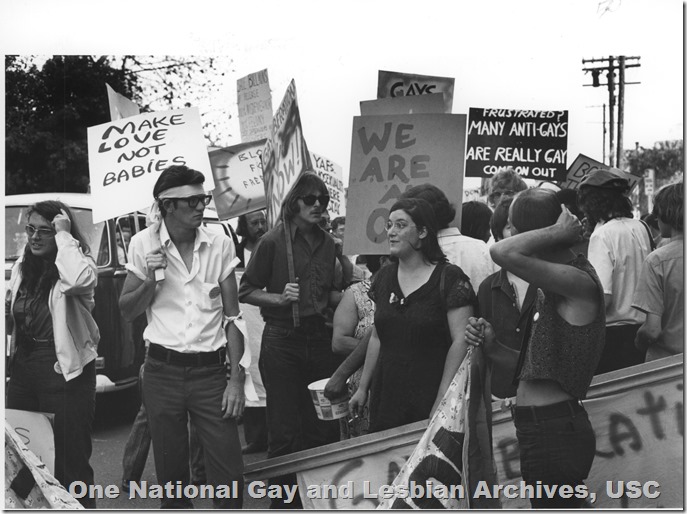
Crowd gathering to march in the Los Angeles Christopher Street West pride parade. June 28, 1970.
On June 28, 1970, Hollywood hosted the nation’s first legally permitted LGBT Parade, helping spark gay pride and the right for equality in California. Tired of prejudice and bigotry, homosexuals fought back against illegal violence by police in East Hollywood’s Black Cat Cafe in 1967 and the more well known Stonewall Riots in New York City’s Stonewall Inn on June 28, 1969. A movement was born, demanding equality, rights, and to live proudly as themselves.
Morris Kight, leader of the Gay Liberation Front, Rev. Bob Humphries, founder of the United States Mission, and Rev. Troy Perry, founder of Metropolitan Community Church, developed the idea for a legitimate parade to celebrate the one year anniversary of gays standing up for their rights rather than marching or holding a rally. Perry himself on behalf of the Metropolitan Community Church filed for a parade permit on Hollywood Blvd., long the site of famed Christmas parades for decades. 34 groups from across the state, both straight and gay, banded together under the name Christopher Street West to sponsor the parade.
None expected it to be easy, since homosexuality was illegal in California, and no one had ever experienced large groups of LGBT people openly marching and proclaiming their identity. Kight told Paul Houston of the Los Angeles Times that the parade “would be a joyous affirmation of self-respect.”
Los Angeles Police Chief Edward M. Davis and the Los Angeles Police Commission protested the application. Davis railed to Perry that “…giving a permit to a group of homosexuals to march down Hollywood Boulevard would be the same as giving a permit to a group of thieves and robbers.” The Commission grudgingly approved the permit on a vote of 4-1 June 10 with onerous conditions, after Commissioner Michael Kohn claimed that bystanders could potentially riot, demanding the group purchase a $1.5 million liability insurance policy in case of violence and pay a $1,500 fee for police services as protection. An insurance agent told the Times, “The price is jacked up by the group’s notoriety and by the unknown reaction from Hollywood’s version of the hard hats.” The Commission had only recently gained the power to require applicants to purchase insurance policies from the City Council as a result of violence at a rock music festival at Devonshire Downs in Northridge in June 1969.
The American Civil Liberties Union joined Metropolitan Community Church’s fight for the parade permit, with the ACLU’s attorney Herbert Selwyn calling the conditions ridiculous and an attempt to kill the parade outright while denying the group the legitimate right to assemble. The Group requested reconsideration by the Commission and appealed to the Los Angeles Superior Court, since no conditions were placed on women’s or conservative groups applying for parade permits that same day.
On June 19, Superior Court Judge Richard Schauer ordered the Commission to issue a permit or show cause of why not by June 26. The Commission rescinded the liability insurance policy but still demanded a $1,500 bond as a deposit to cover extra police for security that day. Perry commented that the parade was a “peaceful demonstration calling for a change in certain laws.” He filed a petition to overturn the decision with the help of the ACLU, and on June 26, Judge Schauer ruled “that the committee’s bond request was an unreasonable interference with freedom of expression,” waiving that cost as well. The group issued a statement that holding the parade would “show people that homosexuals are human beings with the same civil rights and civil liberties as other residents,”
The morning of the parade, Kight received eight different death threats, but soldiered on in the fight for equal rights. As the June 29 Times reported, Kight stated, “We want to establish our presence. We want to show that we live in the community too.” The “gay power” parade began at 7 pm at the corner of Hollywood Boulevard and McCadden Place heading the half mile east to Ivar Avenue. Anywhere from 500 to 1,500 participated in the hour-long parade, which included floats, cars, and a wide variety of marchers from leather-clad motorcycle riders to cowboys to drag queens to “fairies” with paper wings to clowns, carrying such things as American flags, a python, and signs of all types. Some marchers chanted, “Two, Four, Six, Eight – gay is just as good as straight.” While the city estimated that 500 demonstrators booing and catcalling attendees and 4,000 bystanders joyously watched the parade, sponsors claimed that crowds numbered as high as 25,000.
Thus began the tradition of parades and celebrations in June highlighting Pride month, which continue until this day. This year they appear more needed than usual, as bigotry and prejudice influenced by scurrilous misinformation raise their ugly heads.

 ladailymirror.com
Thank you for this compelling and timely story. It is a testament to persistence in the face of injustice and a reminder that changing hearts and minds is a slow and often painstaking process.
LikeLike