
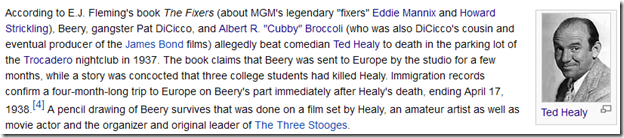
In case you just tuned in, I am using the Wikipedia entry on Wallace Beery – alleging that he was involved in the death of Ted Healy – as a way to explore Wikipedia’s fundamental problems with accuracy and delve into Hollywood myths.
In Part 1, we found that Wikipedia had eight entries linking Beery to Healy’s death. Two of them were nearly identical and the rest contradicted one another. So much for Wikipedia being as accurate and reliable as an encyclopedia.
In Part 2, we began looking at the book that was cited in all the entries that listed a source: E.J. Fleming’s “The Fixers,” a book that failed to get a review from a single reputable news outlet. We also found that a main informant, Col. Barney Oldfield, most likely had no firsthand knowledge of the incident.
Now let’s look at the account of the alleged incident in “The Fixers,” Page 176
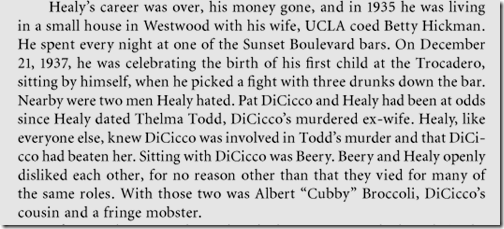
Now where do you start with something like this?
Out of all these claims, the one that is most amusing is:
Beery and Healy openly disliked each other for no reason other than that they vied for many of the same roles.
Let’s get this straight: Wallace Beery and Ted Healy competed for “many of the same roles?”
OK. Try to imagine Ted Healy in “Grand Hotel” In “Tugboat Annie.” In “Viva Villa!” In “Treasure Island.” In “China Seas.” In “Ah, Wilderness!”
For that matter, do you really think Wallace Beery went after the role of Police Sgt. Magee in “The Longest Night?” And was hoping to get fourth billing in “Sing, Baby, Sing?”
Not on your life.
I hesitate to get into anything involving Thelma Todd (d. 1935) because so much has been written her death. However, The Times published many social items in the 1930s involving the stars and there’s nothing linking Todd and Healy. A search of various archival newspapers from the 1930s via Google also returns nothing to indicate a relationship. Furthermore, there is nothing about Ted Healy in “The Life and Death of Thelma Todd (William Donati), or in “Hot Toddy (Andy Edmonds).
So much for that.
As for the assertion that “Healy’s career was over,” this is utterly false. Here’s proof:
According to a Dec. 22, 1937, story in The Times, “On account of his work in his last picture, Warner executives already had a deal on to borrow him again from Metro-Goldwyn-Mayer for a big part in the forthcoming “Golddiggers in Paris.”
Had enough? I’m not done yet.

Remember, way back on Page 175, we have Wallace Beery calling Eddie Mannix “on the morning of Dec. 21, 1937.”

Now on Page 176 we have “On Dec. 21, 1937, he was celebrating the birth of his first child at the Trocadero….”
Do we mean early on the morning of Dec. 21, 1937? Or that night? Was Wallace Beery a clairvoyant? Did he call Mannix about the purported incident before it occurred? Have we fallen into a time warp?
My head hurts.
To be continued.


Surprised that Beery didn’t make Judge Crater disappear in a dreadful, magic act mishap…
LikeLike