
 Albert and Alfred… Before and after… Lost and found… Found but still missing … still haunted by something and still walking in a dream.
I pulled the photos of Albert and Alfred from their old-fashioned paper envelope, slightly tattered and crumbling–the kind The Times used before the library switched to manila folders.
Albert is just another middle-aged man in a coat and tie. He’s losing his hair and has a thin mustache, with a pleasant half-smile that looks like he was being coached by some portrait photographer. Albert Clark Reed, 45, looks like any other husband and father from the 1950s. His wife called him a “cool, levelheaded scientist and test pilot.”
He graduated from Caltech in 1929 and returned for more studies in 1932. During World War II, he was a flier and worked on classified military projects, The Times says.
After the war, he and his wife, Florence, lived in Seattle, where he tested and designed aircraft for Boeing. The Times says he was a consultant and test pilot on the Stratocruiser, a problematic aircraft with a troubling record, like the Romance of the Skies, which crashed at sea in November 1957.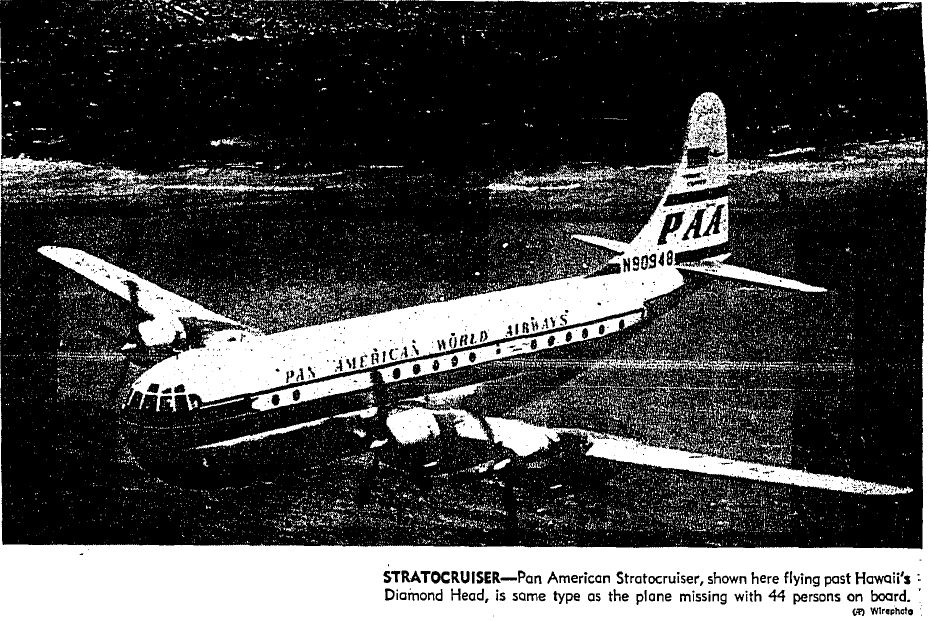 Albert and Florence moved from Seattle to Pasadena in 1944 and bought a home near the Rose Bowl at 475 Bellmore Way. A few years later, they had a son, Timothy James. There were some arguments, but apparently nothing serious. And maybe some money problems. Albert and Florence moved from Seattle to Pasadena in 1944 and bought a home near the Rose Bowl at 475 Bellmore Way. A few years later, they had a son, Timothy James. There were some arguments, but apparently nothing serious. And maybe some money problems.“He loved to bet the horses,” Florence said after he disappeared. “Bet them heavily. Even owned two horses once. I don’t know. He may have been having financial troubles. He never mentioned finances to me. I know he made a good deal of money. As much as $3,000 ($23,706.89 USD 2007) or more a month. But he never discussed such things with me.” On Monday, July 7, 1952, Albert got in his 1941 sedan with his briefcase and bag of clothing and headed for Caltech. He was preparing to meet with military officials in Washington about some classified matter; it’s not clear what it was. He had recently finished work on Project Vista, a controversial program stemming from the Korean War that also evaluated how existing technology–including nuclear weapons on the battlefield–could be used by NATO countries to repel an attack by superior forces of the Soviet Union. (More about Project Vista here). But he never arrived on campus. The years passed. Years of waiting and wondering and investigation by police and the FBI. Years of crackpot calls and false hopes. Until the day she died in 1955, Florence never gave up hope that Albert would return. “I want Al to know that if it’s a matter of pride, if he’s ashamed to come back, if … well, no matter what he’s done, I want him to know we want him back. No matter what he’s done.” Florence couldn’t keep up the house payments and without proof that Albert was dead, she couldn’t claim any money on his large insurance policies, so she let them lapse. She and Timmy moved to South Pasadena and she got a job selling welding rods and did public relations for a manufacturer until she had a nervous breakdown. The disappearance was especially hard on their son, who had a heart ailment, The Times said. When his mother died, Timmy went to live with relatives back East and took their family name. Police turned up a few leads: Albert sold his 1941 sedan to a Pasadena car dealer for $100. He sent Florence his driver’s license and a handwritten will in an envelope postmarked San Bernardino leaving all his possessions to her with instructions that Timmy was to get everything in the event of her death. The day after he vanished, a woman called Florence and said, “Your husband is being held for information” and added “the plans are in the den.” In 1955, an acquaintance ran into Albert in San Gabriel and they had a few drinks. Albert said he was going to go home and clear up his family affairs. But he never did.
|
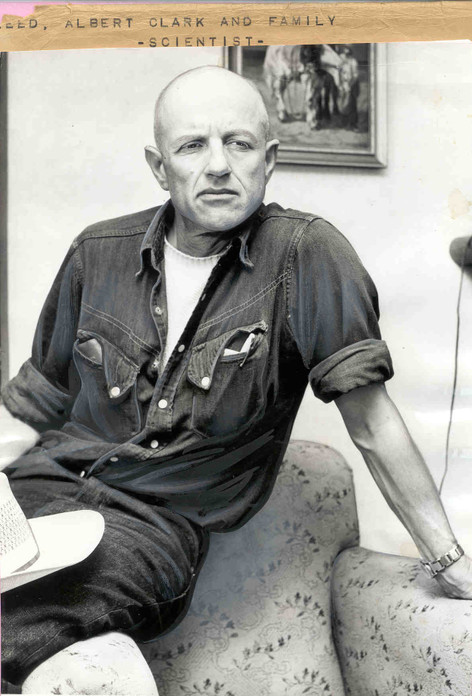
 “Time and time again, he closed his eyes for long seconds after a question, his facial muscles working, his tired mind focusing futilely on blurred pictures,” The Times said.
 ladailymirror.com
Holy hoofpick! Albert Clark Reed! Alfred Cole Reese! Back when I cohosted the Pasadena Confidential crime bus tour for Esotouric, it fell to me to explicate the strange story of ACR as we drove slowly past the home on Bellmore. Reed reminded me somewhat of Repo Man’s J. Frank Parnell, who in the picture went on about the neutron bomb as so immoral that it drove its inventor mad. Parnell escaped Los Alamos to cruise around Los Angeles in his ‘64 Malibu; Reed escaped Project Vista to wield dandy brushes and mane combs. But like trying to get out of the mob…they pull ya back in…
…and these photos. As a long-time Albert Clark Reed fan (and how many of those can there be?) to see these is really something. Who’s going to play him in the movie (there’s so much more to this story, there just has to be)—one look at that ’58 photo and you might say, I dunno, Ed Harris, but I think renegade author Jim Goad would hit the tactical battlefield nuke right on the head!
LikeLike
Terry O’Quinn would be my choice to play the part on screen.
LikeLike
“If it hadn’t been for a new law that racetrack employees had to be fingerprinted, Alfred’s earlier life might have remained a secret forever. ”
Here is a naive question for you — In an era long before the personal computer, how did the authorities identify his fingerprints? Was there really a team if diligent people carefully examining all the fingerprints in the city? I have this image in my mind of Old School nerds bending over a table holding gargantuan magnifying glasses.
LikeLike
Does anyone know what happened to him? When he died, where he was buried, etc?
LikeLike
This is such a fascinating story… I’m really disappointed that it ends when he “disappeared from the pages of The Times”. That may be the end of your story… but it is obviously not the end of THE story.
And it’s hard to imagine ANYONE reading this story without wanting to know what happened post 1959. So I can only guess that cutbacks really have been brutal.
LikeLike
Here’s a small scrap of additional information that might offer some insight:
Today, government agencies that grant security clearances are keenly interested in the financial stability of anyone who holds such a clearance; the concern is that people with money problems might be tempted to resolve them by selling secrets to our country’s enemies. Consequently, habitual gambling is a big red flag.
I don’t know what the security policies were in the ’50s, but it’s easy for me to imagine government officials getting wind of Reed’s heavy betting, launching an investigation, and revoking his clearance, possibly triggering some sort of mental breakdown.
LikeLike
What is the point of this article? He disappeared from the pages of the Times. Does that mean he disappeared from all pages (metaphorically speaking). Why doesn’t the Times track him down? There’s really no story otherwise. Journalism… not what it used to be.
LikeLike