Blogging the Wolfe Book, Extra! Extra!

P. 5

Extra! Extra!

I was raised on the wrong side of the tracks in Beverly Hills.

This is the most marvelously amusing statement. I suppose there are people—somewhere—who might find this believable. But for anybody local, especially a homebuyer, a comment like this is almost indescribably hilarious and I’m starting to wonder if Wolfe was a comedy writer at some point in his career.

In the 1940s, Beverly Hills was a ritzy, exclusive, lily white enclave separate from the city of Los Angeles, with rigidly enforced deed restrictions to keep out non-whites. The only people of color ever seen in Beverly Hills in this era were the maids and chauffeurs. The deed restrictions were so vital to the people of Beverly Hills that several of them filed lawsuits that forced non-whites out of their homes; a very ugly period in Los Angeles history.

The average reader would probably skip by this comment en route to more important things, but then I’m not the average reader and I have a few extra tools at my disposal. So let’s pull the comps on all of Wolfe’s riff-raff neighbors on South Camden Drive. (Note to out-of-towners, Camden is one block west of Rodeo Drive).
On Feb. 18, 1940, the house at 473 S. Camden Drive sold for $13,000 or $172,992.24 USD 2005.

May 25, 1941, a real estate sales report describes a nine-room Spanish home being sold at 309 S. Camden Drive.

June 10, 1941, a report described the sale of a two-story Colonial at 474 S. Camden Drive.

Jan. 31, 1943, the two-story Monterey home at 426 S. Camden sold for $11,500 ($130,353.54 USD 2005).

July 25, 1943, two-story Spanish home at 416 S. Camden sold for $15,000 ($170,026.35 USD 2005)

Aug. 21, 1949, two-story Colonial home, four bedrooms, two baths, den with a half-bath, breakfast room and servants quarters (ahem) at 446 S. Camden Drive. No price listed.

Mind you, even the inflation-adjusted prices are misleading. Anything with four walls and a roof in Beverly Hills goes for megabucks today. For example, the starter house at 344 S. Camden Drive is currently on the market for a little over $2 million.

What’s especially interesting in “Mogul” is that Wolfe’s neighbors included “strictly name below the title folks” like Joe E. Brown. In 1940, Brown sold his house at 707 N. Walden for $35,000 ($465,748.34 USD 2005), a considerable sum for the era.
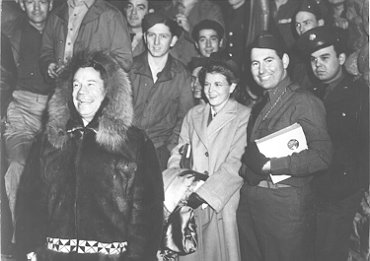
And if I were writing this story, I wouldn’t be so hard on Brown. A little research shows that he pretty much abandoned his movie and stage career after his son Don was killed on a training flight in 1942 and Brown, shown with servicemen in Alaska, devoted the following years to entertaining the troops in his son’s memory.

Now granted, I don’t read most books at the molecular level as I’m doing here. But most books don’t need to be read at the molecular level either. I warned you this would be tedious. But when Wolfe complains about his pitiful youth on “the lower depths of the south side” it’s a bit much. Of all the Dahlia authors, I’d say Steve Hodel, whose mother went to jail for child neglect, has a genuine right to talk about a harsh childhood. But the wrong side of Beverly Hills? Oh really. It is difficult to generate much sympathy for someone who first saw “Gone With the Wind” in the living room of the producer’s home.

But wait…. there’s more

Page 6

After my parents divorced in 1943, my mother married Jeffrey Bernerd, a movie producer, and we moved north, across the tracks to the land of the majors, where we lived behind one of those mansion doors where “there’s often a great deal of unhappiness.”

The name Jeffrey Bernerd means nothing today, but imdb.com lists him as working on such cinematic triumphs as “Women in Bondage” (1943) and “Black Market Babies” (1945). Bernerd’s Aug. 11, 1950, obituary says that he lived—what’s this?—at 226 S. Camden Drive.

Time to go to the files and dig out the 1946 map of streetcar routes and see exactly where these horrid tracks were (again, not everybody has a 60-year-old streetcar map just sitting around waiting to be consulted, but as I think we’ve conclusively established, not everybody is me and certainly most people don’t read a book this way).

Ah! The map shows a Red Car headed west along Santa Monica Boulevard. Those poor people living in the ghetto south of Wilshire Boulevard—how did they ever make ends meet?

But let’s have a little more fun. We find with a little digging that Wolfe’s mother, Elizabeth, married Bernerd on April 2, 1945, at Bernerd’s home. We also learn that Wolfe’s father was Sailing Wolfe, a real estate salesman who was a nephew of Bernard Baruch. (Sailing Wolfe was apparently named for Baruch’s grandfather).
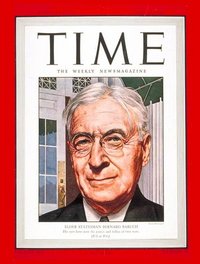
I’m blogging this as I read, so I have no idea what’s coming up. But I just flipped to the index to see if maybe we’re going to learn something about Sailing Wolfe or Bernard Baruch, left, in one of his three appearnces on the cover of Time magazine.

Not a word.

Hm. This is starting to look bad. I think if I were the grand-nephew of one of the world’s leading financiers I might just drop it in somewhere. Not make a big deal out of it but maybe I’d allude to it.

And about that impoverished childhood? We find that in 1941, Mrs. Sailing Wolfe was a member of Beverly Hills Assistance League (helping the less fortunate, presumably) and seemed to have had enough disposable income to collect Currier and Ives prints.

I have to go for a walk.

Posted in Uncategorized | Comments Off on Blogging the Wolfe Book, Extra! Extra!

Blogging the Wolfe Book, "The Monster"


Page 3

There wasn’t much nightlife in Los Angeles back in the 1940s.


Most people went to bed early.

Even in Hollywood the streets were empty and the town was pretty dead by 10 p.m.

My goodness, I had to go for a walk around the block and clear my head after that.

Entire books could be written on the subject of Los Angeles nightlife in the 1940s—fairly entertaining ones, at that; but they would be more than a little off the subject. It’s difficult to imagine a simple declarative sentence that presents such sweeping absurdity with such bold confidence and authority, except to say: “There wasn’t much water in the ocean in the 1940s” or something similarly ludicrous. As any competent historian—or fan of the 1947 Project—knows, Los Angeles had a thriving entertainment industry during World War II and the postwar period and the liquor flowed freely.

P. 4.

Wolfe paints a vivid portrait of “the Monster,” the presses at the Examiner coming to life—with one problem. He describes the paper putting out one edition, when it published something like seven throughout the day.

When the Black Dahlia murder hit the headlines on January 15, 1947, it led to one of the biggest press runs in the history of the newspaper. More copies of the Los Angeles Examiner were printed and sold on that day than any edition during World War II.

This is more or less Will Fowler’s contention, amended slightly. Will always maintained that the Examiner’s extra on the Dahlia killing was the biggest edition since V-J Day. In “Reporters,” P. 76, Will says “It ended up being the second-largest run in the Examiner’s history, bettered only by the VJ Day extra in 1945.”

But in reality, no copy of this mythical extra has ever been found. It doesn’t exist on the microfilm nor among the original newspapers, according to people who have seen them. I can only conclude that the fabulous extra edition was only to be found in the tales of William Randolph Fowler. The Examiner and The Times printed nothing about the Elizabeth Short murder on Jan. 15, 1947, and the Herald-Express ran a brief story on Page 1. Only the Daily News put a picture on the cover with a story. The headlines didn’t really hit until the next day, Jan. 16, 1947.

…there were those in the City of Angels who knew what was printed in the L.A. newspapers about the Black Dahlia case wasn’t worth two cents.

This is another sweeping absurdity made with simple, brazen confidence. As police officers at the time bitterly complained, reporters were so aggressive in gathering and reporting the story—accurately—that detectives were afraid the papers would jeopardize the investigation.

Gosh… I think I need to go for another walk.

Posted in Uncategorized | Comments Off on Blogging the Wolfe Book, "The Monster"

Blogging the Wolfe Book

People keep asking me: “Have you read the Wolfe book?” meaning Donald H. Wolfe’s “The Black Dahlia Files: The Mob, the Mogul and the Murder That Transfixed Los Angeles.” My answer is always the same: I bought a copy but I haven’t read it yet.

Still, people keep telling me it’s a wonderful job and solves the murder, usually prefaced by the statement that “I don’t know anything about the case, but…”

So here we go, in excruciating detail, with frequent detours, asides and references to the five-foot shelf of Black Dahlia books. Since I have to read this turkey, you might as well suffer right along with me. If you’re not interested in Black Dahlia minutiae you will find this a painfully tedious process, which is why I don’t read other Black Dahlia books—they’re junk.

The dedication: “To Vince Carter… and all the honest cops who took the oath and kept it.”

Vincent Carter is, in fact, the author of a 1993 crackpot, self-published book titled “LAPD’s Rogue Cops, Cover Ups and the Cookie Jar.” At right, the cover (not that one can always judge the quality of a book this way, but the outsider artwork doesn’t exactly say: “I’m a definitive source, trust me.”). More—much, much more—about “Cookie Jar” later. At least Vincent Carter actually exists, however, unlike the nonexistent Detective Herman Willis who is one of the purported sources in John Gilmore’s “Severed.”

Next page: “It was that name, Black Dahlia, that set this one off…” quoting Detective Harry Hansen.

This is from The Times’ often-cited March 28, 1971, article titled “Farewell, My Black Dahlia,” by Todd Faulkner. One of the more interesting aspects of this article is that Faulkner mysteriously christened Elizabeth Short with a fictitious middle name, Ann, that is now taken as gospel—even infecting her FBI file, and used rather amusingly as a smoking gun in Steve Hodel’s “Black Dahlia Avenger” to prove his father’s guilt, an “exacta” that shows 1) “Dahlia Avenger” is poorly researched and 2) mercilessly distorted to support its reverse-engineered assumption that Dr. George Hodel committed every unsolved murder in L.A. for several decades.

The Faulkner article isn’t listed in the book’s bibliography, so apparently we’re to assume it’s from an interview (a neat trick since Hansen died in 1983). But any thorough researcher would recognize the source immediately.

More to the point in the 1971 piece, however, is Hansen’s emphasis that Elizabeth Short “was a man-crazy tramp but she wasn’t a prostitute.” This is the sort of thing that a conscientious and dedicated researcher is going to take to heart—and a quick-buck artist is going to sweep under the rug in favor of a shadowy conspiracy involving circles within circles of purported corruption, call girls and mobsters.

Preface Page XI

“Often referred to as ‘a riddle wrapped in a mystery inside an enigma….’ ”

The Black Dahlia case was often described that way by the late Examiner reporter and foxy grandpa Will Fowler (see the readable but heavily fictionalized “Reporters: Memoirs of a Young Newspaperman,” P. 92). I’ve never heard anybody else ever call it that. “Mogul” certainly doesn’t credit Will for this statement.

…The Black Dahlia case remains stamped “Open and Unsolved.”

It’s unsolved all right, but nobody went through the pages pounding them with a rubber stamp. That’s a little ridiculous.

Page XII

In 2002, Los Angeles District Attorney Steve Cooley began establishing an archive of historic twentieth century crime investigations culled from the immense LAPD warehouse and files of the district attorney’s office.

Now wait…. This is not just wrong; it’s a serious error. The district attorney is a Los Angeles County jurisdiction while the Los Angeles Police Department is a city agency. It’s amusing to think of Cooley traipsing into the city archives at the C. Erwin Piper Technical Center on Ramirez and making the staff hand over their material from the LAPD.

What actually happened is that the district attorney’s office was cleaning house and shoveled papers that looked important into boxes. The papers aren’t the least bit organized and material from one investigation is mixed up in another. I should know—every Wednesday for a year, I visited the district attorney’s office and read old murder cases, thanks to the very generous people there.

In the case of the Black Dahlia material (which I thoroughly inventoried and indexed, and yes, I have a copy of every bit of it except for the body shots—which nobody is allowed to copy) items from several other murder investigations have been erroneously included to rather awkward results. An unlabeled photograph in the Dahlia files is identified in “Mogul” as poor old Maurice Clement—when in fact it’s Salvadore Torres Vara, a suspect in another murder. The only people who would know better are those of us who have seen not only the Dahlia files but other cases.

I’m getting way ahead of myself. But it’s disturbing when a purportedly well-researched and well-documented book about a crime tries to sound authoritative while making a gross factual blunder on such an elementary issue.

For the first time, the district attorney’s files reveal the bizarre modus operandi of the crime, establish a time line of where the victim lived in the last years of her life, identify the people she knew, and provide a list of all the suspects….

Well, not for the first time. The transcript of the inquest appears in one form or another in several books. But the time line in the district attorney’s files is quite pertinent to “Mogul,” for it shows conclusively that Elizabeth Short wasn’t anywhere near Los Angeles in 1944 or 1945 (despite the lengthy treatment in “Severed” or “Dahlia Avenger.” There goes the Georgette Bauerdorf/Hollywood Canteen connection) . Another inconvenient little detail swept under the rug because only the people who have seen the files know better.

The files also reveal the Herculean effort by the upper echelons of the Los Angeles Police Department to cover up the nature of the crime.

In a word: No. There’s nothing about any sort of cover-up in the district attorney’s files. In fact, the files reveal just the opposite–no sign of anything other than a harried and harassed Police Department victimized by the overzealous police psychiatrist, Dr. Joseph Paul DeRiver, who sincerely but erroneously believed he had solved the case by accusing Leslie Dillon. DeRiver’s actions prompted the 1949 Los Angeles County Grand Jury to investigate the case, the reason for the district attorney’s files on Elizabeth Short. The Dillon matter constitutes the vast majority of the district attorney’s files.

The next paragraph is quite handily done. Wolfe quickly dispenses with “Dahlia Avenger,” Mary Pacios’ “Childhood Shadows,” Janice Knowlton’s “Daddy Was the Black Dahlia Killer” and makes peace with “Severed,” paving the way for inclusion of John Gilmore’s book, which is 25% mistakes and 50% fiction, as we’ll see later.

Will Fowler, first reporter on the scene….

Ah, no. Even I fell for that one. Will was one of the last ones there. His story about arriving at the crime scene with Felix Paegel, getting his picture taken with the body (he always claimed the photo had “vanished”), rushing to the Examiner to put out an extra, and returning to the crime scene to “fool the competition” is utterly false. No copy of the supposed extra has ever surfaced and photos of the crime scene completely disprove his claims of being the first reporter at the crime scene.

Gosh, we’re not even through the preface and we’re out of time for the day. This is not a project for anybody in a hurry. Stay tuned….


free page hit counter

Posted in Uncategorized | 1 Comment

Product Placement

New York Times, June 15, 2005
William Hamilton:

“I‘ve never before felt like losing was winning,” said Lee Mindel of Shelton, Mindel & Associates, a New York architecture firm, who was the underbidder. Cristina Grajales, the New York dealer who won the table, looked alternately shocked and pleased as she swigged hard on a bottle of Poland Spring water and accepted incredulous congratulations from colleagues.

Posted in Uncategorized | Comments Off on Product Placement

That Little Old Thing Called Attribution

From the New York Times, June, 1, 2005
David M. Halbfinger

The diminutive Mr. Greenwald, 61, is leading this assault on the retailing behemoth of Bentonville, Ark., from a converted hot-sheets motel in Culver City, Calif. There, where MGM executives once conducted their trysts, he and a dozen or so young producers and editors are compiling digital video from interviewing teams across the country, while spreading the word through advocacy groups and labor unions to invite whistleblowers to come forward.

I would really enjoy knowing the source of the background on this hotel. The name, for example, or who exactly provided the information on its tawdry past.

Posted in Uncategorized | 1 Comment

That Little Old Thing Called Attribution

From the New York Times, June, 1, 2005
David M. Halbfinger

The diminutive Mr. Greenwald, 61, is leading this assault on the retailing behemoth of Bentonville, Ark., from a converted hot-sheets motel in Culver City, Calif. There, where MGM executives once conducted their trysts, he and a dozen or so young producers and editors are compiling digital video from interviewing teams across the country, while spreading the word through advocacy groups and labor unions to invite whistleblowers to come forward.

I would really enjoy knowing the source of the background on this hotel. The name, for example, or who exactly provided the information on its tawdry past.

Posted in Uncategorized | Comments Off on That Little Old Thing Called Attribution

Squinting at the Distant Paradise, Take II

L.A. Existential

By BRUCE WAGNER
New York Times,
May 23, 2005

Los Angeles
NO one here even knew there was an election last week.

I couldn’t have said it better than the San Francisco Chronicle (as quoted in L.A. Weekly):

Wagner’’s fiction reads like pornography for California-haters,” noted the book critic for the San Francisco Chronicle, David Kipen, who is an admirer, nonetheless. “All their cozy East Coast prejudices, all their suspicions about ‘Lotusland’ come echoing back to them in Wagner’’s fiction, confirmed and exaggerated.”

Posted in Uncategorized | Comments Off on Squinting at the Distant Paradise, Take II

Squinting at the Distant Paradise

Manohla Dargis writes in the May 10, 2005, New York Times:

LOS ANGELES – Los Angeles is in love with the idea of its own self-destruction; it’s hard to think of another American city so similarly possessed.

Actually, no. New York publishers are in love with the idea of destroying Los Angeles.

This view of Los Angeles is really quite simple: A landscape of car-obsessed kooks and cult members who live in Malibu and only venture beyond the San Diego Freeway for breakfast at Farmers Market or lunch at Du-Par’s (ever eaten at Du-Par’s? The food is lousy and the service is terrible). They earn pallets of money producing crappy movies or crappy albums (or starring in crappy movies and making crappy albums). Or the South L.A. version: bling-swaddled gang members who only venture north of the Santa Monica Freeway for Lakers games and produce crappy movies or crappy albums (or star in crappy movies and make crappy albums).

Posted in Uncategorized | Comments Off on Squinting at the Distant Paradise

Writing Cliche No. 1

New York Times, April 26, 2005
BOCAS DEL TORO, Panama – Dr. Jeremy Jackson is in an open boat, speeding across the waters of Laguna de Chiriquí, on the Caribbean coast of Panama. His graying red pony tail is frizzing and flapping in the wind, and he is gesticulating wildly, waving his long arms, his lanky frame twisted toward his fellow passengers.

Nothing–and everything–is wrong with this lede. If it had never been done before, it would be fine. The problem is that the anecdotal lede in present tense is a formula that has been done to death. In some newspapers, half the Page 1 stories start in exactly this way. I wish line editors would ban this old chestnut for about 10 years, just to give it a well-earned rest.

Posted in Uncategorized | Comments Off on Writing Cliche No. 1

Don’t Stop Me if You’ve Heard This One

Hollywood writers, and those who aspire to be Hollywood writers, are fond of saying there are only so many plots in the world. The number varies depending on when the speaker went to film school, but it’s usually low and the message is always the same: cannibalizing old plots is perfectly fine and “recycling” is inevitable. Usually followed by the line: “Shakespeare did it!”

The latest installment in this game (sure to be on film school reading lists this fall) is Christopher Booker’s “The Seven Basic Plots,” a rather generous number compared to what I was once told by a screenwriter: There are only two. Plot A) Someone leaves home (“Star Wars,” “The Odyssey”). Plot B) A stranger comes to town. (“Beverly Hills Cop,” “Sir Gawain and the Green Knight”)

I‘m just waiting for the 30-second pitch: “My Mother the Car” meets “Pimp My Ride” as the ultimate in recycling.

Hey, it’s Hollywood. Anything could happen. (Is Cedric the Entertainer available? And how about Tina Turner as “Mom”?). Special note to development: Lots of opportunities for product placement, like when Mom shows up on the extra-large plasma screen TV in the back of the Escalade.

Posted in Uncategorized | Comments Off on Don’t Stop Me if You’ve Heard This One

The Well-Fed Interview (Add 1)

New York Times, April 30, 2005
“I always wanted to drive a bus because it’s big, it’s huge,” Ms. Small, 36, said as she picked through a fried shrimp sandwich on a recent lunch break. “My own personal conquest, I guess.”

Posted in Uncategorized | Comments Off on The Well-Fed Interview (Add 1)

Oh, Those New Yorkers

Verlyn Klinkenborg writes (Saturday, April 16, 2005) in the New York Times about the rites of the Los Angeles carwash, explaining them to car-bereft New Yorkers as if we were Trobriand Islanders:

For weeks, I drove past our local carwash without turning in, certain, as only a New Yorker can be, that I would be ignorant of some secret protocol and make a fool of myself. But the secret of Southern California is that, except in a few circles, there are no secret protocols.

Of course there are secret protocols. Real Angelenos always get a hand wash. Those brushes wreck your paint job. And the answer to “Armor All on the tires?” is “no.”

Posted in Uncategorized | Comments Off on Oh, Those New Yorkers

Not What It Seems

I came across Thomas Lynch’s op/ed piece in Saturday’s (April 9, 2005) New York Times quite by accident.While it appears to be about death (Lynch is a funeral director–and I have promised to keep the noir off this blog), his essay is a nice bit of work on faith and our current mode of mourning the deceased:

Instead of dead Methodists or Muslims, we are now dead golfers or gardeners, bikers or bowlers. The bereaved are not so much family and friends or fellow believers as like-minded hobbyists or enthusiasts. And I have become less the funeral director and more the memorial caddy of sorts, getting the dead out of the way and the living assembled for a memorial “event” that is neither sacred nor secular but increasingly absurd – a triumph of accessories over essentials, stuff over substance, theme over theology. The genuine dead are downsized or disappeared or turned into knickknacks in a kind of funereal karaoke – bodiless obsequies where the finger food is good, the music transcendent, the talk determinedly “life affirming,” the accouterments all purposefully cheering and inclusive and where someone can be counted on to declare “closure” just before the merlot runs out. We leave these events with the increasing sense that something is missing.

The piece will eventually vanish from the New York Times’ free archives, but it’s worth a look while it is still available.

Posted in Uncategorized | Comments Off on Not What It Seems

A Rediscovered Gem

I spent the evening listening to a concert version of Act III of “Siegfried” performed by the Chicago Symphony Orchestra under Sir Georg Solti on April 16, 1980, which I haven’t heard since I recorded it off the air 25 years ago. It’s a pity the CSO doesn’t release something like this on CD because it’s a fabulous performance. Dennis Bailey as Siegfried; Berit Lindholm as Brunhilde; Franz Mazura as Wotan/the Wanderer; and Birgit Finnila as Erda. I don’t believe any of them made commercial recordings in those roles, although I could certainly be wrong.

For those who are interested, the recording is in the Rosenthal Archives of the Chicago Symphony Orchestra, AV-CSO-360. Tell them I sent you.

Posted in Uncategorized | 1 Comment

A New Toy

Amazon recentlly made a curious addition to its “Search Inside” feature: Statistically Improbable Phrases. Amazon explains:

Statistically Improbable Phrases, or “SIPs”, show you the interesting, distinctive, or unlikely phrases that occur in the text of books in Search Inside the Book. Our computers scan the text of all books in the Search Inside program. If they find a phrase that occurs a large number of times in a particular book relative to how many times it occurs across all Search Inside books, that phrase is a SIP in that book.

The phrases for James Joyce’s “Ulysses” include tooraloom tooraloom tooraloom, quaker librarian, absentminded beggar, matrimonial gift, base barreltone

For “Ivanhoe”: eighty zecchins, hundred zecchins, green cassock, our holy order, thy ransom, good yeoman, thy tribe, sayst thou, good youth, wounded knight, most reverend father, hundred crowns, good knight, thy choice, your valour

Alas, there is no way to search “Tristam Shandy” or “The C Programming Language.”

Posted in Uncategorized | Comments Off on A New Toy

Ledes I Never Finished

THE second “Greater New York,” the youth-besotted, cheerful, immodestly ingratiating jumbo survey of contemporary art….
Michael Kimmelman, New York Times, March 18, 2005

Posted in Uncategorized | Comments Off on Ledes I Never Finished

The Well-Fed Interview

I‘ve always wondered why writers devote space to what the subjects of their profiles eat during an interview. Maybe they’re justifying the restaurant charges on their expense accounts. Here are a few gustatory delights:

Ned Martel, New York Times, March 14, 2005:
A few weeks ago, over eggs and turkey sausage on Sunset Boulevard… (this was the lede, no less).

Ned Martel, New York Times, March 28, 2005
Seated in the choicest nook in the lobby of the Chateau Marmont hotel in Los Angeles recently, the actress Cameron Diaz was attended to by chiseled waiters who apparently knew her dietary tastes and needs. In Hollywood’s hierarchical taxonomy, Ms. Diaz is at the top of the food chain. So why was she eating her arugula and proscuitto with her fingers?

(Obviously, this is the lede, with bonus points for one of New Yorkers’ cliches about Los Angeles: the Chateau Marmont).

Posted in Uncategorized | Comments Off on The Well-Fed Interview

A Nice Bit of Work

Someone at the Washington Post turned in a great headline on a recent Tom Shales review:

‘Fat Actress’: Jolly-Unsaturated

It’s quite a trick to summarize an entire review in two words, but the headline writer did it cleverly and with finesse.

Posted in Uncategorized | Comments Off on A Nice Bit of Work

My Best Laugh of the Week

In an oped piece for the New York Times, (March 5, 2005) Jessica Queller, a writer for “The Gilmore Girls,” describes her mother growing up “in a small house on the outskirts of Beverly Hills.” I can just see the dust rising from the rutted gravel road as the family’s battered Chevy pickup coughs its way back from the general store with a slab of bacon, a sack of flour and baby sister’s first pair of store-bought shoes.

Posted in Uncategorized | Comments Off on My Best Laugh of the Week

Hunter S. Thompson, Gunzo Journalist

The tributes have poured in and some of his works have been reprinted since Hunter S. Thompson committed suicide Sunday, although one could easily say he killed himself in bits and pieces years ago.

It seems few writers at the moment are willing to voice anything but adulation for Thompson. Paul Krassner says: “It was hard to say sometimes whether he was being provocative for its own sake or if he was just being drunk and stoned and irresponsible.

“But every editor that I know, myself included, was willing to accept a certain prima donna journalism in the demands he would make to cover a particular story — demanding that we send him to Hawaii with three beautiful maidens he could dictate his stories to, for example. They were willing to risk all of his irresponsible behavior in order to share his talent with their readers.”

I prefer the comments of Larry B. Thoreson, the sales tax administrator for the city government of Aspen, who told the New York Times: “I heard him speak once, and he was totally incomprehensible, to be honest.”

If it weren’t for the notorious byline, how far would any reader get in something like this, published in 1997 by Time:

I have always hated astrologers, and I like to have sport with them. They are harmless quacks in the main, but some of them get ambitious and turn predatory, especially in Hollywood. In Venice Beach I ran into a man who claimed to be Johnny Depp’s astrologer. “I consult with him constantly,” he told me. “We are never far away. I have many famous clients.” He produced a yellow business card and gave it to me. “I can do things for you,” he said. “I am a player.”

I took his card and examined it carefully for a moment, as if I couldn’t quite read the small print. But I knew he was lying, so I leaned toward him and slapped him sharply in the nuts. Not hard, but very quickly, using the back of my hand and my fingers like a bullwhip, yet very discreetly.

He let out a hiss and went limp, unable to speak or breathe. I smiled casually and kept on talking to him as if nothing had happened. “You filthy little creep,” I said to him. “I am Johnny Depp!”

Outside on the boulevard I saw a half-naked young girl on roller skates being mauled by two huge dogs. They were Great Danes, apparently running loose. Both had their paws on her shoulder, and the gray one had her head in its mouth. But there was no noise, and nobody seemed to notice.

I grabbed a fork off the bar and rushed outside to help her, giving the bogus astrologer another slap in the nuts on my way out. When I got to the street, the dogs were still mauling the girl. I stabbed the big one in the ribs with my fork, which sank deep into the tissue. The beast yelped crazily and ran off with its tail between its legs. The other one quickly released its grip on the girl’s head and snarled at me. I slashed at it with the fork, and that was enough for the brute. It backed off and slunk away toward Muscle Beach.

For that matter, go to Amazon and read the opening of “Fear and Loathing: On the Campaign Trail”

The truth is that Thompson had gone from self-indulgence and self-destruction to self-parody. He wanted to be cremated and have his ashes shot from a cannon? I suppose it figures.

To give the devil his due (and I believe in that) I looked over his 1966 book “Hell’s Angels.” Parts of it seem almost readable:

The Labor Day run is the outlaws’ answer to New Year’s Eve; it is a time for sharing the wine jug, pummeling old friends, random fornication and general full-dress madness. Depending on the weather and how many long-distance calls are made the week before, anywhere from two hundred to a thousand outlaws will show up, half of them already drunk by the time they get there.
By nine o’clock that morning both Terry and Scraggs were on their feet. Vengeance on the Diablos could wait. Today, the run. Terry lit a cigarette, examined the bumps and welts on his body, then pulled on a pair of crusty Levi’s, heavy black boots, no underwear and a red sweatshirt smelling of old wine and human grease. Scraggs drank a beer while his wife heated water for instant coffee. The children had been put with relatives the night before. The sun was hot outside. Across the Bay, San Francisco was still covered in a late-lifting fog. The bikes were gassed and polished. All that remained was the gathering of any loose money or marijuana that might be lying around, lashing the sleeping bags to the bikes and donning the infamous “colors.”

Compare that writing to what he was doing 30 years later in the Time excerpt and you’ll see what I mean. Writing is difficult and it’s a shame to see someone squander his obvious gifts.

Posted in Uncategorized | Comments Off on Hunter S. Thompson, Gunzo Journalist