
PaineWebber (162.66.50.2)
IBM (129.33.1.37)
Egypt (217.54.254.97)
Williams College (137.165.29.173)
Peru (201.240.209.140)
Galbraiths Ltd. (217.169.34.76)
Hurry back!
PaineWebber (162.66.50.2)
IBM (129.33.1.37)
Egypt (217.54.254.97)
Williams College (137.165.29.173)
Peru (201.240.209.140)
Galbraiths Ltd. (217.169.34.76)
Hurry back!

June 28, 1907
Los Angeles
Give cars to a bunch of wealthy Los Angeles residents and what do they do? Race them, of course. Not on a track this time, but in an endurance test from Los Angeles to Lakeside. And yes, it’s a bit warmish for an endurance race, especially once the drivers get further inland—100 degrees.

So far, all 62 cars that began the race arrived intact at Lake Elsinore. Note that the drivers didn’t have the advantage of maps.google.com and went via Upland and Riverside.
For a while, it looked as if the machines were going to be stranded in Lake Elsinore because there was no gasoline, but a freight train arrived in time with two carloads of gas. One driver, George Kowonto, suffered heat prostration, The Times noted.
So far, most of the cars have fared well. Forty received perfect scores, while several had points deducted for problems with the coil or the carburetor. “There were a few complaints of road hogging, but not many,” The Times said.
Lmharnisch.com
Lmharnisch.blogspot.com

A Kinder, Simpler Time
June 27, 1907
Los Angeles
Louise arrived in Los Angeles three months ago from Norway with her four young children. She met a man who worked in San Pedro (we only know his initials, F.G.) and before long, they were married and living in his small home at 825 Tennessee St.
One morning, she got up to make coffee, turned on the stove, took a glass of dark liquid from a shelf and poured it into the coffee pot.
But the liquid was gasoline.
“In a flash, the woman was on fire,” The Times said. “Shrieking with pain, Mrs. Rohan dashed into the bedroom, where her husband was just arising. He seized her and rolled her in blankets until the flames had been extinguished, but too late.”
Doctors said there was nothing they could do for her. She had been burned over 50% of her body and also inhaled the flames, apparently scorching her lungs.
“I do not fear to die,” she whispered to her husband, “but take care of the children and furnish them a good home.”
The Times explained that before installing a gas stove, Mr. Rohan had used a gasoline burner and kept fuel on a shelf in the kitchen.
This is one of the frustrating moments in historical research. There’s no further record of F.G. Rohan or the children. In fact, the California death records don’t even report Louise Rohan’s death, raising the question of whether The Times misspelled her name. It’s also impossible to locate 825 Tennessee St. in the maps at 1907 HQ. There is a Tennessee just north of Pico on the Westside, but much too far to the west. We can only wonder what became of her four children.
Lmharnisch.com
Lmharnisch.blogspot.com

City of Whittier (4.38.41.75)
City of New York (167.153.5.196)
Hewlett-Packard (161.114.64.72)
A very avid reader in Stuttgart (84.161.22.102)
Hurry Back!

June 26, 1907
Los Angeles
Fred D. Samuels is a monster and nothing less, according to his aunt, Sister Kostka, assistant mother superior of the Ursuline Convent in Frontenac, Wis. As her mother, Maria S. Bowman, lay dying at her home, 1266 E. Adams, Samuels refused to let Sister Kostka (nee Minnie Bowman) see her.
In fact, Kostka charged, Samuels refused to let a Catholic priest visit Mrs. Bowman and refused to grant her a Catholic funeral. Instead, Bowman received two services, one at St. Patrick’s on Central Avenue and another at the Lutheran church on East 46th St.
Kostka complained to the district attorney’s office that Samuels starved Bowman and abused her, leaving bruises on Bowman’s arms from where she was restrained. He did all of this, Kostka said, because he wanted the inheritance, which included $12,000 ($246,282.84 USD 2005) and some property.
“My mother died of starvation,” Kostka said. “She would be alive today but for my nephew. He has a horrible temper and he abused my mother shamefully. He repeatedly held her hands behind her back and forced her into a chair by taking hold of her wrists. I saw the marks of his fingers on my mother’s dead body.”
In an account supported by Mrs. Bowman’s nurse and doctor, Samuels said that Bowman was senile and that the marks on her wrists were from holding her hands so she could receive an injection. She had been unable to eat for the last week of her life, he said.
And he added: “I would not allow the Catholics to bury her because was not a Catholic.” As for not allowing Kostka to see Bowman, Samuels said: “My grandmother hated her and did not want her near her.”
The Times noted that Bowman was the widow of former East St. Louis Mayor John B. Bowman, who was assassinated in 1885.
Lmharnisch.com
Lmharnisch.blogspot.com


June 23, 1907
Los Angeles
The Auto Club of Southern California has begun posting white enamel signs with blue lettering along Foothill Boulevard between Los Angeles and Riverside.
Spending about half a day, auto club President George Allen Hancock and Charles Fuller Gates, who is in charge of the county’s signage, staked the route through Highland Park, South Pasadena and Pasadena, Lamanda Park, Baldwin’s ranch, Monrovia, Azusa, Glendora, Claremont, Uplands, Cucamonga, Etiwanda, Stalder (34.0119/117.3125 to folks with GPS) to West Riverside.
To protect the signs, a $200 reward ($4,104.71 USD 2005) was offered for anyone caught vandalizing them. “For a while the motoring public did not understand these signs,” The Times said, “but gradually their value dawned upon them and then the rest of the highway traveling public understood them too. After that, very few were destroyed. Now it is seldom that any are molested.”
Lmharnisch.com
Lmharnisch.blogspot.com


June 22, 1907
Los Angeles
Let’s suppose for a moment that you are a handsome former Army sergeant who has served in the Philippines. Let’s further suppose that you get into a fight in a bar on South Main Street and hit another patron in the face with a heavy beer glass. Then let’s suppose you escape to St. Louis, change your name and start life over.
Which is exactly what Edward H. Freund did. And then he was undone by a woman, or rather two women, since he was courting two at the same time. It seems that one of them wanted a picture of dear Edward and the only photo he had of himself was the wanted posted issued by the Los Angeles Police Department.
So he gave her a copy of the wanted poster.
We know where this is going, don’t we? Edward was held in the local jail on $1,500 bail.
Lmharnisch.com
Lmharnisch.blogspot.com

acog.org, Kabul, Afghanistan (209.116.152.253)
Sony Pictures (71.134.16.161)
Comcast subscriber in Reading, Pa. (68.82.102.176) Windows 98? Upgrade that antique operating system!
Hurry back!
Dow Jones (205.203.128.142)
Twentieth Century Fox (216.205.224.52)
E! Entertainment (12.46.6.69)
Jeff Poulin (63.227.219.81)
County-USC Medical Center (163.40.12.37)
San Francisco Public Library (67.115.155.138)
Verizon User, District of Columbia (70.108.61.155)
Hurry back!
June 20, 1907
Los Angeles
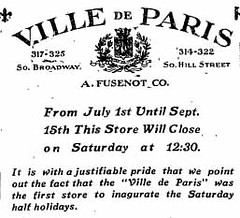
The salesclerks of Los Angeles are steaming—and not over the warming temperatures. Beginning last summer, all the department stores agreed that instead of closing at 10 p.m. on Saturdays, they would close at 12:30 p.m., giving the staff a half-day off with pay.
But the new manager of the Bon Marche, J.W. Eccleston, decided he could increase business by remaining open, incurring the anger of every other merchant—and clerk—in town. Eccleston said: “We have the matter under advisement. We have not determined that we will not close, but we will probably not do so on next Saturday night. We have our side of the story; our employees are unanimously with us and I don’t see that we need any outside sympathy.”
Thousands of store workers crowded into Simpson Auditorium for a meeting on preserving the half-holiday in the summer and closing at 6 p.m. instead of 10 p.m. on Saturdays for the rest of the year. Speeches were made and boycotts were threatened.
In the end, the half-holiday prevailed.
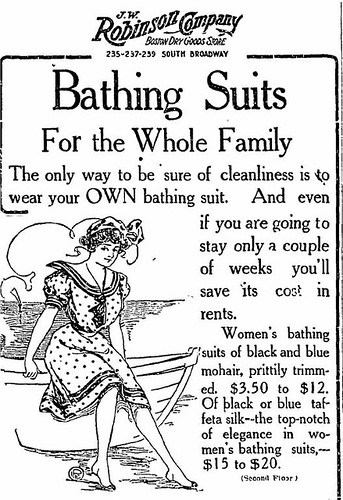
Here’s an inflation reality check:
Women’s mohair swimsuits $3.50-$12 ($71.83-$246.28 USD 2005). Taffeta silk $15-$20 ($307.85-$410.47 USD 2005).
Weather in Los Angeles for June 20, 1907: A low of 55 and a high of 72; at midnight, it was 61 and cloudy.
Lmharnisch.com
Lmharnisch.blogspot.com


June 19, 1907
Los Angeles
What shall we do with the insane? Don’t give them drugs… give them music! (Well, some music).
Dr. E.C. Dent of the hospital for women on Ward’s Island in New York says: “I firmly believe in the curative power of music for insane patients and those who suffer from nervous diseases, but I do not say that music in itself is a cure. It is true that music is now a regular part of the treatment in this hospital systematically employed in reaching and stimulating the brain.”
The musical selections are important, Dent says, because “popular airs … were useless or injurious in the case of a patient accustomed to the classics while the classics would be entirely without effect on the brain of an uneducated person.”
For simple mania, Dent says, slow, dreamy music is best while someone with melancholia is best treated with a stirring air. Dent’s assistant Miss Vescelius has classified music much like drugs: stimulants, sedatives, bromides, narcotics and tonics.
Dent uses Franz’s Liszt’s Hungarian Rhapsody No. 2 as a stimulant (predating Warner Bros.’ cartoons by several decades), and Felix Mendelssohn’s “On Wings of Song” as a sedative. Franz Schubert’s “Ave Maria” is a narcotic and marches and bright waltzes are considered as tonics.
“One day a dear friend mentally and physically at the lowest ebb lay in a half-fainting condition on a lounge as I sat at the piano, singing. Through a sudden impulse, I broke into the old gem ‘She Touched the Hem of His Garment,’ knowing it to be a favorite of the invalid. When I had finished she was standing by my side, with bright eyes and cheeks flushed. ‘I am revived; I am well,’ she said as she grasped me. And it was true that from that hour she improved and rapidly recovered.”
“The time will come when discordant tones in the sick room will be recognized as a crime, just as heinous as giving the sick adulterated drugs or impure food,” Vescelius said.
Although Dent doesn’t give an example of bromides, one might easily suggest, for starters, Tchaikovsky’s “1812 Overture” and Vivaldi’s “The Four Seasons.” I wonder what they would have thought of Steve Reich’s “Come Out.”
Lmharnisch.com
Lmharnisch.blogspot.com


June 18, 1907
Los Angeles
The victim: A collie named Baby
The plaintiff: Hazel G. (or Ella M.) Schurger, 1156 S. Flower.
The suspect: J.J. Brady of the Immigration Bureau, a next-door neighbor.
Baby’s agonizing death scandalized residents of the fashionable homes around 12th Street and South Flower, because everyone—except for J.J. Brady—loved the dog.
In May, Schurger found Baby in convulsions on the front lawn. Analysis determined that it was given strychnine. She suspected Brady because he had threatened the dog and thrown rocks at it. Schurger said that shortly before the death, she saw Brady throw some meat to Baby over the back fence. Schurger said: “I will not let the man who killed my pet go free if I can help it.”
Brady said: “I had a grudge against the dog because she barked at me, but I didn’t poison her.”
Brady was freed after a chemist testified that Baby had been given strychnine, but in such a small dose that it would have taken hours for the dog to die, not immediately, as Schurger said.
Lmharnisch.com
Lmharnisch.blogspot.com

 June 16, 1907
Los Angeles
Despite the old saying—a lawyer who represents himself has a fool for a client—Edith Foulkes is a smart woman, at least in the courtroom. She can’t make the same claim about her trip to the altar, however, which is what brings before Judge Bordwell.
Although she had known her husband, Ralph, for eight years, they were only engaged for a week before they got married in 1905. His family was coming to visit and he wanted to be married when they arrived, he said.
A member of the California bar who had practiced law in San Francisco and Tulare County, Edith had previously worked as a proofreader in Los Angeles and presumably that’s how she met Ralph, who had been the foreman of a printing shop on Los Angeles Street.
Edith had spent a fair amount of time in Mexico and Porterville, Calif., so most of what she knew about Ralph was by correspondence. If she had spent more time with him, she might have known that he had a tendency to steal and pawn whatever he got his hands on. And he drank all the time.
In fact, once he lost his job, Ralph drank constantly, Edith and a pressman from the print shop told the judge. The rest of the time, he was in a bad mood, they said.
“Suspecting that his wife was beginning to consider her marriage a failure, he had talked in melancholy fashion of murder and suicide, somewhat to the martial discomfort of Mrs. Foulkes,” The Times said.
The judge ruled in her favor.
Lmharnisch.com
Lmharnisch.blogspot.com

 June 15, 1907
Los Angeles
Helen Hurley paused at the doors of St. Vibiana’s Cathedral. In pain, she shoved her left wrist inside her dress so that it wouldn’t show as she went in to pray during Mass.
But the pain was too great and she fled the cathedral for her room at the Ramona lodging house on South Spring Street.
While struggling with her at the rooming house, police officers discovered that she had cut off her left hand with a butcher knife. They took her to the Receiving Hospital and after treatment she was taken to County Hospital.
For the last year, Hurley had worked as a cook at several Los Angeles restaurants. Her husband died, leaving her broke and grieving. “It is said that for days at a time she would lie in her room, under the influence of liquor, and brood,” The Times said.
The night before she was taken into custody, lodgers heard her walking around her room, moaning.
The Times said: “In her frenzied condition, the woman became possessed of the idea that her husband’s soul was held in the chains of purgatory and demanded a sacrifice. She was willing to give that sacrifice. The gleam of her wedding ring on one of the fingers of her left hand attracted her attention. She seized a butcher knife and sharpened it. Then she hacked away at the soft flesh. The knife caught in the heavy tissue and she used it in the manner of an ax and beat against the flesh with it until the hand fell from her wrist. Then she tossed it behind a trunk in her room and hurried to church for morning Mass.”
Hospital officials were keeping close watch on Hurley and said that if she didn’t improve she would be sent to an insane asylum.
Lmharnisch.com
Lmharnisch.blogspot.com


 June 14, 1907
Los Angeles
Like many young men, Stuart, Sayre and Maynard decided to walk home from school—but it was a bit farther for these college friends because they were going to Berkeley.
It was apparently an uneventful trip aside from the distance—the three friends covered more than 500 miles in 27 days, leaving the morning after commencement. The traveled lightly, wearing sombreros, khaki and hobnailed boots, carrying water and packs weighing about 8 pounds, while shipping a heavier trunk ahead of them.
The began in San Francisco to San Mateo, Half Moon Bay, then a detour to Santa Cruz, then Watsonville. They followed the Southern Pacific tracks from Salinas to King City. The next stop was Jolon, then Paso Robles, San Luis Obispo, Pismo Beach (then known as El Pizmo), Santa Maria, Santa Ynez, San Marcos Pass, Santa Barbara, Ventura, Calabasas, through the Cahuenga Pass to Hollywood and then Los Angeles, where they walked to their homes.
“We did not attempt to rough it by camping along the way,” Stuart told The Times. “The tramp itself was rough enough, although extremely pleasant after the stiffness of the first few days had worn off. We stayed overnight at hotels and farm houses, had good beds and excellent fare. The water at some points was poor, but bottled water helped us over this difficulty.
“We made no attempt to make a record. Our only idea was recreation and we had that a-plenty.”
Along the way, the friends were frequently offered rides, which they always declined, and were mistaken for forest rangers, railroad inspectors and soldiers on leave. Many they met “could not understand why young men apparently well able to pay their fare should chose to walk so far for the fun of the thing,” The Times said.
You might wonder what became of these three young friends.
Maynard McFie died in 1958 at the age of 72, having been the director of Security-First National Bank and president of the Chamber of Commerce. Sayre Macneil died in 1961, having been a law professor at Harvard and dean of Loyola Law School.
Stuart O’Melveny, who said, “We wanted a change into the open air and we thought this would be the best way to get it,” died in 1974 at the age of 85. He was president of Title Insurance and Trust Co., which was begun by his father, Henry, who founded a little law firm now known as O’Melveny and Myers.
Lmharnisch.com
Lmharnisch.blogspot.com


June 13, 1907
Los Angeles
Voters approved a $23-million bond issue ($472,042,116.32 USD 2005) for the Owens River Aqueduct, 21,923-2,128. The Times helped mount a turnout campaign in which automobile owners volunteered to ferry voters to the polls.
Interestingly enough, The Times put the story on the first page of the second section rather than the front page.
Lmharnisch.com
Lmharnisch.blogspot.com

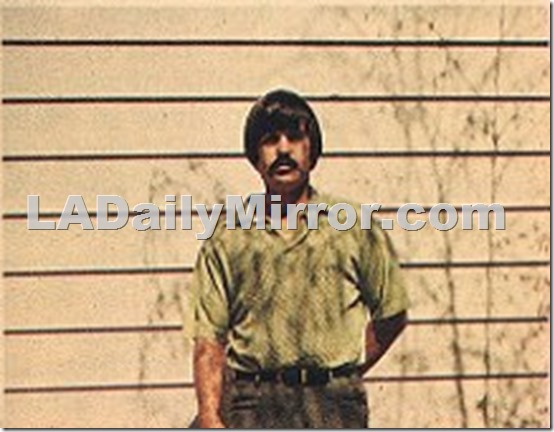 I recently obtained an original copy of The Times’ March 28, 1971, story “Farewell, My Black Dahlia,” which includes the account of the “Boy on the Bicycle.” Here’s a color picture of the purported “Bobby Jones.”
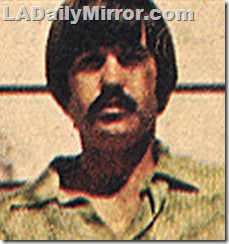
Here’s a better look:
Continue reading

June 12, 1907
Los Angeles
At 19, Florence Grover was old enough to be in love and living with a man, and at 19, she was old enough to become a mother. Her boyfriend, L.C. Lutzen of the National Messenger Service, with whom she lived at 120 N. Broadway, testified that he had made preparations to raise their child as his own.
Instead Florence sought out Dr. C. Van Peter Watson. On May 28, she took a streetcar to his home at 2652 W. Pico. When she left 30 minutes or an hour later, she was so weak that she couldn’t walk and someone sent for a carriage.
“Before her death, she tried to sign a statement, prepared by the physicians attending her, after it had been read to her: ‘Realizing that I am about to die, I certify that an abortion was to be performed and was performed on me by Dr. C.V.P. Watson,’ ” The Times said. “She became too weak to finish her signature.”
Watson was brought to trial—in fact he was also charged with a variety of offenses regarding land swindles involving Ollie J. Watkins. The Times described him as walking with a cane because he was handicapped and said he wore a Masonic pin and another badge showing that he was a Civil War veteran.
But the judge regretfully ruled that Florence’s statement was inadmissible.
“There is nothing in the statement partly signed by that poor, dying girl to show just what this defendant did. For some incomprehensible reason the statement was not even prepared in the presence of the girl. The physicians, not realizing what constitutes legal evidence, or swayed by professional ethics, failed to comply with the requirements of the law,” the judge said.
“The court regrets very much that the evidence is not conclusive, as to who was the perpetrator of that crime, that it might be legally fastened upon him and justice be done.
“With the infirmities of the testimony and in view of all the painful and abhorrent features of the case, I do not believe there is a court in the state that would permit the question to go to a jury.
“The defendant is discharged and the bail will be released.”
Lmharnisch.com
Lmharnisch.blogspot.com


June 9, 1907
Los Angeles
Olga Miller was a comely young thing who worked at the Hotel Rosslyn and was considered quite attractive despite the scar on her temple from shooting herself in the head.
One day she fell ill and was taken to County Hospital, where she went into convulsions and died after a visit from Richard Hardy, who forced his way into her room and made her drink a glass of milk that police suspected was poisoned.
But her death was only the beginning of the complicated story, a morbidly Victorian tale that includes murder, insanity, false identities, suicides and fears of body snatching.
Shortly after Miller died, officials learned that she was actually Bertha Beilstein, the daughter of John Frederick Beilstein, a wealthy Allegheny, Pa., businessman and politician. Before his mysterious death in 1897 (some people suspected Bertha of poisoning him in a fit of insanity), he wrote a will putting all his money in a trust for his heirs as long as she was alive.

Then “on the night of Oct. 2, 1898, she shot her mother three times and took a hatchet and hacked the body almost to pieces,” The Times said.
“Afterward she walked the floor for hours, when a cloud seemed to leave her mind and she saw what she had wrought. She seized the same revolver and sent a bullet crashing into her skull just to the left of the temple. She fell to the floor and struck her head on the point of a piece of furniture.
“She lay there for hours—her murdered mother on the bed and the daughter unconscious on the floor. Then she regained consciousness and, raising herself, saw the bloody body of her parent on the bed. She seized the revolver again and sent a bullet into her breast over her heart.”
But still, she did not die and the neighbors found her the next day. She said: “I was tired of life. It had no pleasure for me. I wanted to die and did not want my mother to live and fret over my death. For that reason I killed her.”
At the trial for her mother’s murder, Bertha was declared utterly mad and imprisoned at the Dixon Asylum for the Criminally Insane outside Pittsburgh, where she became a model prisoner and was given free reign.
In the meantime, her brother Edward, apparently unable to live with the family scandal, killed himself by drinking prussic acid at the Voegtly Cemetery, where his body laid undiscovered for days. Shamed by the scandal, her uncle David Reich “threw himself in front of an express train and was ground to death,” The Times said.
Then in 1906, Bertha escaped from Dixon, and here is where the story becomes almost impenetrably complex. It may have been that her lover in Los Angeles, Richard L. Hardin (or Hardy or Harding), was also an attendant at Dixon and disappeared when Bertha escaped from the asylum. Or it may have been, as he said, that he only met her in California. Or maybe her brother Frederick Beilstein of Chicago sent her to Los Angeles under the name Olga Miller.
Whatever the cause, Bertha arrived in Los Angeles and moved into the Royal Hotel on South Main Street. Hardin said he met her at the hotel three weeks before her death. He said that they quickly became friends because they were both Easterners and when she got sick, he brought meals up to her room and had a doctor prescribe medicine for her.
Hardin said that although he helped get her admitted to County Hospital, he was distressed by her treatment there. “It wrung my nerves to see her tied down and her hands tied, so that is why I asked the doctor to unloosen her hands and the waist bandages,” said Hardin, who was freed when it was determined that Bertha died of brain tumors rather than poisoning.
Then the various factions of her family began fighting over the body. Some, to preserve the trust set up by her father, claimed that Bertha had gone to England and that the deceased was merely some unfortunate woman.

Her brother Frederick, however, insisted that the body was hers and warned officials of Evergreen Cemetery to protect her remains as some members of the family might try to steal it. As a result, police officers were stationed outside her crypt, allowing access only to the series of people sent to identify the body.
Trying to view Bertha’s remains became a popular pastime in Los Angeles as cemetery officials noted that more than 40 women had attempted to get a look by claiming to be a friend or relative. Cemetery superintendent Olneyman told The Times “that all are simply morbidly curious and always depart when their names and addresses are asked.”
After six weeks, Bertha’s body was conclusively identified and sent to Pittsburgh. Later that year, her brother Charles died when he fell from a ladder at his hotel in Vandergrift, Pa.
The Times said: “Charles was a firm believer in Bertha Beilstein’s declaration years ago that an avenging hand followed every member of the family. Less than a month ago the hotel keeper declared to a friend that he fully expected to die a violent death.”
Lmharnisch.com
Lmharnisch.blogspot.com


