The Little Devil


Sept. 5, 1907
Los Angeles

Poor old Mrs. Moore was ill, so instead of paying the grocer his monthly bill, she put a $10 gold piece in an envelope and told her 9-year-old son, Cecil, to take it to him. But Cecil, of 155 W. 51st St., tore open the envelope, found the $10 ($205.24 USD 2005) and got other ideas, none of them good.

First, Cecil treated his chums to sodas at a delicatessen, then he was off for trolley rides to see the city. For the last two days, he has kept one step ahead of police officers, telling his pals that he plans to visit all the local beaches and “see what’s going on.”

“Cecil has been in the Juvenile Court and is on probation. An effort will be made to send him to the reformatory at Whittier—when he is caught,” The Times said.


What’s this? Google Earth shows that the Cecil Moore Incorrigible Child HQ is still standing.


Lmharnisch.com


Lmharnisch.blogspot.com


Posted in 1907, Black Dahlia, Books and Authors, Crime and Courts, LAPD, Streetcars | Comments Off on The Little Devil

Nooooo!!!

I couldn’t stand the thought of James Ellroy’s copies of “Black Dahlia Avenger” going for so little on EBay. After all, don’t people know the book has been optioned by New Line Cinema? Surely books that are inscribed to the Demon Dog of American Fiction are worth more than $20. So I bumped up my bids by 50 cents on the hardback and paperback.

Outbid!

As mentioned on L.A. Observed.

My prediction? Once people see the Brian De Palma movie, the Black Dahlia will be radioactive at the box office for years to come. Read a review from the Venice Film Festival.

During the first hour, the hope that the director has tapped into something really great mounts with each passing minute. Then, gradually, the feverish pulp imagination of James Ellroy, on whose novel Josh Friedman based his screenplay, feeds into De Palma’s dark side. The violence grows absurd, emotions get overplayed, and the film revels once too often in its gleeful depiction of corrupt, decadent old Los Angeles. Disappointingly, the film edges dangerously into camp.

Lmharnisch.com

Lmharnisch.blogspot.com

Posted in 1947, Black Dahlia, Books and Authors, Cold Cases, Crime and Courts, Homicide, LAPD, Uncategorized | Tagged , , , | Comments Off on Nooooo!!!

So Rude!


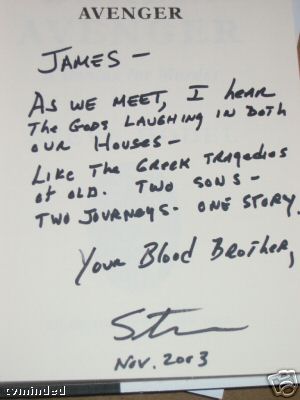
My goodness, one never knows what will turn up on Ebay. This morning I found a copy of “Black Dahlia Avenger” inscribed by Steve Hodel to James Ellroy, who wrote the introduction to the paperback, praising Hodel’s work and endorsing his solution.

And bidding started at $19.99.

Nice way to treat your “blood brother,” James. I don’t know whether the gods are laughing–but I am.

Lmharnisch.com

Lmharnisch.blogspot.com

But wait!

Can it be?

Here’s the paperback version of “Avenger” inscribed to Ellroy, which carries Ellroy’s forward to the case!

With bids starting at $19.99? That’s only $5.04 over the original price. I just have to put in a 50-cent bid on this puppy. The happy face alone is worth it.

Posted in 1947, Black Dahlia, Books and Authors, Cold Cases, Crime and Courts, Homicide, LAPD, Uncategorized | Tagged , , , | 1 Comment

A Labor Day Oration

Sept. 3, 1907
Editorial, Los Angeles Times

“I have no patience with the prejudices which exist between alleged classes when the classes themselves do not exist. There is no reason for hostility between employer and employee, between capitalist and wage earner. A condition of class hatred, such as has developed in Colorado, is a curse to this country.”

The utterer of these excellent sentiments was W.R. Hearst, orator of the day at the Jamestown Exposition yesterday—whose string of yellow socialistic newspapers and magazines has done more than any other agency existing to foment prejudice and class hatred and arouse reasonless hostility between capitalists and wage earners.

The first few hundred words of Hearst’s speech read like a prelude to a scathing arraignment of the New York Journal and American for their persistent efforts to teach the working people of America that they are the slaves of the “predatory rich”; that every corporation is a conspiracy to rob; that all capitalists are brainless brutes; that the government of the United States is a corrupt glutocracy; that the non-union laborer is a pest to be exterminated; that a “captain of industry’ is a pirate and that the only hope of salvation for downtrodden labor in this country lies in revolution and the “speeding to Washington of the bullet that killed Goebel.”

In a stern rebuke of his own editorial writers and cartoonists, Mr. Hearst said:

We have no aristocracy save that of intellect and industry, and the proudest title of our most successful millionaire is “captain of industry.”

The true captain of industry is the general of our industrial army. He cannot do without soldiers, and yet, no matter how well the soldiers fight, the victory depends very largely on the general’s skillful conduct of the campaign.

lmharnisch.com

lmharnisch.blogspot.com


Posted in 1907, Black Dahlia, Books and Authors, LAPD, Streetcars | Comments Off on A Labor Day Oration

A Nation of Vice

Aug. 31, 1907
Los Angeles

The ugly statistics should dishearten even the most ardent temperance worker. According to federal tax data for the last fiscal year, distillers produced 20 gallons of beer and 1.4 gallons of whiskey for every man, woman and child in America, a 5% increase and 8% increase respectively over 1906.

Cigar, cigarette and snuff production also showed similar increases. “The country being prosperous, cigar smoking grew at an amazing pace,” The Times said. Referring to cigars weighing more than 3 pounds per thousand, The Times said: “The public smoked about a billion and a third more of these cigars in the fiscal year just ended than it did the year before.”


Statistics for cigarettes are even worse: Americans smoked 5,151,862,120 in the last fiscal year. “It is small wonder that the tobacco trust has thrived,” The Times said.

And then there’s the apparently distressing use of oleomargarine instead of butter, 68,988,850 pounds.

Lmharnisch.com


Lmharnisch.blogspot.com

Posted in 1907, Black Dahlia, Books and Authors, LAPD, Streetcars | Comments Off on A Nation of Vice

Dreams of Higher Learning


Aug. 30, 1907
Los Angeles

Led by Rabbi Alfred Arndt of Congregation Beth Israel, the local Jewish community hopes to open what The Times describes as “the only Hebrew university within the entire United States.”

Noting the increased immigration to Southern California (the estimated number of Jews in the state went from 28,000 in 1905 to 42,000 in 1907), The Times said: “For a decade there has been a rapidly increasing Hebrew population in Los Angeles and other sections of Southern California. There is scarcely a place of any prominence within the seven southern counties which has not received a large quota of Hebraic citizens, especially within two or three years.”

Arndt told The Times that he hoped to open the new university soon after Rosh Hashanah, which began at sundown Sept. 8, 1907. The Times notes that Cantor J. Weinstock has been engaged for Rosh Hashanah services of the Independent Sons of Israel.

Unfortunately, there are no follow-up stories about the attempts to found a Hebrew university and very little information about Arndt, except for the footnote that in 1911 he performed a marriage between a Muslim bride (Fanny Alishabron) and a Jewish groom (Charles Levin).

We also know that Rosh Hashanah services were held at Temperance Temple, operated by the WCTU, at Broadway and Temple, a site now occupied by a generating station across from the Cathedral of Our Lady of the Angels.

Jewish Institutions in Los Angeles, 1908-1920

American Jewish Yearbook 5669 (1908-1909)

Lmharnisch.com

Lmharnisch.blogspot.com

Posted in 1907, 1908, 1909, 1911, Black Dahlia, Books and Authors, Immigration, LAPD, Religion, Streetcars | Comments Off on Dreams of Higher Learning

Firefighters’ Pranks


Aug. 29, 1907
Los Angeles

Around Engine Co. 20 at Sunset Boulevard and Mohawk Street, Lt. Samuel Dodd is something of a practical joker, so when he left on his honeymoon with his bride, Juanita, his fellow firefighters decided to get even.

They did such a good job plastering the house across the street at 2149 Sunset Blvd. with signs and old shoes that passing streetcars stopped so passengers could get a look.

The Times said: “The cottage is festooned with shoes—shoes of all sizes and kinds, men’s shoes, ladies’ shoes, babies’ shoes and boots. It’s a startling sight. But this is not all. It is also covered with signs—and such signs!

“Don’t Worry, Watch Our Family Grow.”

“Look in Papa’s Eyes and Say Goo-Goo.”

“Compliments of Engine Company No. 20.”

Were the newlyweds upset? After a trip to Coronado and Trabuco Canyon, not at all.

“The young couple stood for a moment and looked,” The Times said. “Then the bride laughed. It was catching. It won the hearts of Engine Company No. 20 on the spot.”

Samuel H. Dodd, retired assistant chief of the Los Angeles Fire Department, died in June 1953, survived by his wife Hazel; sons Samuel H. Dodd Jr. and Donald W. Dodd; and two grandchildren.

Today, 2144 W. Sunset Blvd. is home to Fire Station 20.

Lmharnisch.com

Lmharnisch.blogspot.com

Posted in 1907, Black Dahlia, Books and Authors, LAPD, Streetcars, Transportation | Comments Off on Firefighters’ Pranks

A Fun Question

Where do most Black Dahlia freaks live? According to Google’s trend search, Irvine, Calif., leads the world in searches about the Black Dahlia, followed by Los Angeles and San Diego. Who knew there was noir behind the Orange Curtain? Can “Fullerton Confidential” be very far away? Maybe it’s all those hits from UCI Medical Center. Hmmmm.

The top 10 Dahlia freak locations:

1. Irvine, Calif.

2. Los Angeles, Calif.

3. San Diego, Calif.

4. San Antonio, Texas

5. Tampa, Fla.

6. Phoenix, Ariz.

7. Salt Lake City, Utah

8. Chicago, Ill.

9. Philadelphia, Pa.

10. Orlando, Fla.

Top three cities in searches for Elizabeth Short:

1. Los Angeles, Calif.

2. New York, N.Y.

3. London, U.K.

Top 10 cities for James Ellroy freaks:

1. Los Angeles, Calif.

2. Paris, France

3. Montreal, Canada

4. Stockholm, Sweden

5. Helsinki, Finland

6. Melbourne, Australia

7. New York, N.Y.

8. Milan, Italy

9. Rome, Italy

10. San Francisco, Calif.

Lmharnisch.com

Lmharnisch.blogspot.com

Posted in Uncategorized | Comments Off on A Fun Question

He Lives


Manhattan Beach
Aug. 27, 2006

Retired Episcopal minister the Rev. John Jewett, 83, wanted to die, so while staying with his son-in-law, J.D. Porter, he slit his throat with a razor.

The undertaker was called, but when he arrived with his hearse, Jewett was still alive, although death was imminent. The undertaker went back to his funeral home to wait.

Later that day, the undertaker got a second call to go out to Manhattan Beach and get the body of a suicide victim. When he got there, Jewett was still alive.

“At 9:30 o’clock tonight Jewett was alive and able to talk,” The Times said. “Jewett made a bungling job in attempting to cut his throat. He is in great pain, but will survive, it is now thought.”

The Times said: “No reason is given for wanting to end his days. It is thought his mind has become temporarily impaired.”

California public records list the death of a John M. Jewett in June 1911 at the age of 87.

Lmharnisch.com


Lmharnisch.blogspot.com

Posted in 1908, 1911, Black Dahlia, Books and Authors, LAPD, Streetcars | Comments Off on He Lives

Black Dahlia Video

Click on the envelope to watch the Black Dahlia video.

Posted in Uncategorized | 5 Comments

Save Those Redwoods


Aug. 27, 1907
Santa Rosa, Calif.

Elected officials addressed a large rally devoted to saving the 800-acre Armstrong Grove, named after lumber baron J.B. Armstrong, who decided to save the stand of soaring redwoods rather than clearing it.

“Armstrong Grove contains the finest and largest redwood timber in California,” The Times said. “For years it has been a great attraction to tourists and is one of the features of the Russian River section.

“When the late Capt. Armstrong owned all the timber in that vicinity and was milling it and putting the lumber on the market, he was so impressed with the beauty of this tract that he refused to allow the woodman’s ax to despoil any portion of it and decided that it should go to the state.”

Although Armstrong’s will donated the land to the state of California, the Legislature rejected the bequest over some of the will’s stipulations. Sonoma County bought the land from Armstrong’s daughter in 1916, and it wasn’t until 1934 that the state of California took over the park. To further protect the redwoods, the area was designated as a reserve in 1964.

Lmharnisch.com


Lmharnisch.blogspot.com

Posted in 1907, Black Dahlia, Books and Authors, LAPD, Streetcars | Comments Off on Save Those Redwoods

Death at the Lummis House


Aug. 25, 1907
Los Angeles

A 20-year-old Pueblo Indian from New Mexico was shot to death at the home of City Librarian Charles F. Lummis in a fight with a houseguest that began over a garden hose.

The gunman, Francisco Amante, 51, described as a Spanish minstrel who has been Lummis’ houseguest for two years, surrendered to police, but no charges were filed.

Lummis told police that he had known Procopio Montoya since the victim was a 2-year-old growing up in Isleta, N.M., and that he brought Montoya to Los Angeles about a year ago to work as a gardener and servant. Although Montoya was extremely devoted to his employer, he refused to obey orders from anyone else, Lummis said.

According to Lummis, Amante had planted a garden and on the morning of the killing, went out to water it with a hose. Montoya, who had already done the day’s watering, yelled: “What are you doing with that hose?” and hit Amante with a large rock.

Amante ran to his room, chased by Montoya, who was carrying another large rock. Amante got a pistol and shot Montoya in the groin.

Lummis called a doctor after unloading Amante’s pistol, saying that Montoya did not appear to be badly wounded.

“Amante went to see him and the lad asked the Spaniard’s pardon for having struck him with the stone. Then he embraced the old man. Just about 6 o’clock, he died,” The Times said.

The coroner’s jury returned a verdict of self-defense.

Lmharnisch.com

Lmharnisch.blogspot.com

Posted in 1907, Black Dahlia, Books and Authors, LAPD, Streetcars | Comments Off on Death at the Lummis House

A Jaunt Across Country Goes Awry

A Jaunt Across Country Goes Awry

Aug. 23, 1907
Los Angeles

William Renwick, recent graduate of Pomona College, was to attend Yale in the fall, and rather than more mundane modes of travel decided to head East by auto in what he hoped would be the first transcontinental motor tour to begin in Los Angeles. To ensure that he arrived on time, he left in his Olds machine July 23, accompanied by professor E.E. Chandler.

“The couple were well-equipped for the long and tedious journey,” The Times said. “Renwick, as on one of his former appearances in public, looked like a walking arsenal, prepared for bears or Indians, but the only game encountered were jack rabbits.”

Unfortunately, the trip did not proceed well. On Aug.17, Renwick became ill and left the Olds in Ogden, Utah, for repairs while he visited friends in South Dakota to recuperate. Note: 727 miles in 25 days = 29 Miles Per Day or 1.211 MPH.

In the meantime, Chandler abandoned plans to accompany Renwick the rest of the way to Yale because his vacation was nearly over.

Chandler “reports that the trip was uneventful except for several hard-luck mishaps which befell them en route. Several breaks occurred, one when they were stuck in the sand and another when they struck a large rock and bent the axle. On another occasion they took the wrong road and went 50 miles out of their course before they saw anyone to direct them.”

Unfortunately, if Renwick and his Olds arrived at Yale, it was never recorded in The Times.

Lmharnisch.com

Lmharnisch.blogspot.com

Posted in 1907, Black Dahlia, Books and Authors, LAPD, Streetcars | Comments Off on A Jaunt Across Country Goes Awry

The Rich Owens Saga

Oklahoma City
Feb. 27, 1948


Ray Parr’s
story about Rich Owens, the longtime executioner at McAlester State Penitentiary, has been knocking around my home office for ages, passed along by a former co-worker many years ago. Writing for the Daily Oklahoman, Parr painted a long, vivid portrait of the man who killed 75 human beings: 65 by electrocution, one by the gallows, two with a knife, six with a gun and one with a shovel. And there could have been more: “I never count peckerwoods,” he said.

By 1948, Owens was bedridden and dying of cancer. Parr paid a final visit to the old executioner to see how he was facing his own death. The headline (incomplete in my copy) says:

“Afraid of Death?
Now Rich Owens
Has the Answer.”

Part II

Part III

lmharnisch.com

lmharnisch.blogspot.com

Posted in 1948, Crime and Courts | 3 Comments

Unrest in Morocco


Casa Blanca, Morocco
Aug. 20, 1907

The Times carries a vivid description of a battle between Moorish tribesmen, French sharpshooters and spahis (Arabs in the French service), and though the story is extremely detailed about the fighting, there isn’t a word of background as to the cause.

The unrest dates to March 1907, when a mob in Marrakesh killed Dr. Emile Mauchamp, a member of the geodetic survey. Further inquiry shows that there was a general attack on Europeans in which a British official killed two people.

The French officials and newspapers demanded reprisals for the killing of the scientist, and French troops crossed from Algeria into Morocco. The Moors, however, become “more and more insolent,” with the sultan refusing to respect French rights. The French eventually occupied Casablanca.

In August, there was further fighting between Moroccan troops and the French. Later that month, The Times editorialized: “The Moslems evidently do not intend to lie down until they are shot down. The discontent and resentment against foreigners in Morocco are becoming more and more intense.”


In September, The Times reports: “About 6,000 Moors participated in Monday’s fight. The Moors, who were repulsed on all sides, made a most impressive picture as, garbed fantastically mounted on wild horses and carrying their banners in the front line, they swept down from the hills in splendid formation and charged thunderously to within about 400 yards of the French, who, for a moment, seemed in danger of being overridden.

“As they advanced, the Moors chanted verses from the Koran.”

On Sept. 23, 1907, peace is declared in Morocco. For now, anyway.

Read more about the Mauchamp affair
.

The 1911 Encyclopedia Britannica article is here
.

Lmharnisch.com


Lmharnisch.blogspot.com

Posted in 1907, 1908, 1911, Black Dahlia, Books and Authors, LAPD, Streetcars | Comments Off on Unrest in Morocco

The Bucket of Blood


Aug. 12-13, 1907
Los Angeles

Despite the name Bismarck Cafe, police call the saloon at Main and Winston Streets the Bucket of Blood because it’s a continual source of crime and violence.

It is a place, The Times says, “of drunken debauchery among girls of tender ages, painted women and men. Into this immoral pesthole, young girls are enticed nightly to drink and listen to a band concert. Although the police make arrests in this dive every night, it is allowed to run unmolested.”


The Bismarck’s bill of fare is limited: beans, sandwiches and liquor. There is a women’s entrance in the alley off Winston that leads to one section of the cafe. Another section features the bar, along with some tables “where men lounge around to meet some young girl or woman,” The Times says, and between the two is the bandstand.

There’s sawdust on the floor, and “with an ordinary garden rake, the filth is cleaned out once a day,” The Times says.

Soon, a fight broke out between two men over who was going to buy a drink for a woman. Waiters pulled the men apart, but they moved to another part of the saloon and started fighting again. One of them, J.A. Salas, pulled a gun. Police discovered that Salas and his partner Edward Wilson, had stolen the pistol in a burglary at the Hotel Marlowe, 5th Street and Main, earlier that night.

Before police could take Salas away, another fight broke out in which a man threw a beer glass across the table and hit another man above the eye. The victim lunged at his assailant and overturned the table trying to get at him.

Still another fight broke out between two women, their cries muffled by the music from the bandstand.

The next night, it was the same. “A plate of beans was placed on the table in front of a customer and then any kind of drink could be purchased…. The cafe was filled during the early part of the evening. The usual number of fights took place and several girls were seen drinking at the tables.”

A woman who is down on her luck gets her meals and drinks from cafe owner John Edwards in return for procuring young women customers.

“Late Saturday night there were four girls, whose dresses were above their shoe tops, in the beer hall drinking,” The Times says of the female customers procured by the unidentified woman. “Two men eagerly sought their acquaintance. They were introduced. Soon all five were seated at a table. One of the young girls refused to drink, saying that she had never tasted beer. After coaxing, she sipped at the beer occasionally. For nearly an hour, the five were seated at the table. When they left, the young girls were unsteady on their feet. The two men accompanied them.”

In the last 10 days, three female customers under the age of 18 had been taken to the hospital for treatment. One claimed she had been drugged by a young man, the other two had passed out.

“I am getting tired of this life,” said the procuress. “For several weeks I have been out of work and have lived at the Bucket of Blood. If you stand in with the manager down here you can get all you want to eat and drink. They will feed you if you get a bunch coming down with you every night.”

The day after the Times story appeared, the cafe was a temple of propriety. “A man was stationed at the ‘ladies entrance’ and no person of questionable age was admitted. The waiters were instructed to keep customers as quiet as possible. In several selections rendered by the band there were strains of sacred music. The plain words of John Edwards were: ‘I am taking no chances.’ ”

The Times tells a compelling tale, but neglects to mention a key fact: The Bismarck is a stronghold of organized labor, while the paper is staunchly anti-union. It isn’t until the next year, when Edwards was put under a boycott for firing a union bartender, that The Times began portraying him as a fearless opponent of organized labor.

“For 20 years I was a member of the bricklayers union,” Edwards says. “But I will not stand for the manner in which they are trying to run things now. When I was a union man we tried to get good men into our ranks. My idea of the proper way to run a union is to make it attractive so that men will want to join. This idea that, because a man does not see fit to join a union, he cannot work, won’t go with me. It’s not square, and I, for one, don’t propose to stand for it.”

The Police Commission closed the Bismarck in June 1908. The address, 426 S. Main St., is currently occupied by the Blossom Restaurant.

Lmharnisch.com


Lmharnisch.blogspot.com

Posted in 1907, 1908, Black Dahlia, Books and Authors, Crime and Courts, LAPD, Music, Streetcars | Comments Off on The Bucket of Blood

A Major Commitment


I put a Satsuma mandarin orange tree in the backyard today, a nice healthy one, and was impressed with the realization of what a commitment it is.

Actually, the Satsuma is a replacement for a smaller one that flourished and bore fruit for a year but turned a nasty brown and died when I gave it too much chelated iron.

In the last month, I spent a fair amount of time preparing the soil after ripping up an old brick patio that was uneven and bulging from tree roots and extending my sprinkler system 45 feet to turn bare dirt into lawn—or something greener than bare dirt, anyway.

And then I planted the Satsuma, a serious investment because it was the biggest I could find. Of course, I could have put in another type of orange tree—something that’s cheaper and less of a challenge. In fact, I have a navel orange tree out front that grows like a weed and takes no care at all other than cutting off suckers. But the fruit doesn’t have much taste, while the Satsumas are deliciously tangy and tart. Only a Satsuma would do.

San Gabriel Nursery
assured me when I bought it that I could leave the Satsuma in the container and it would do fine. But I don’t do things casually, and I think trees—if you’re serious about them—belong in the ground. For keeps.

Since I was intent on planting it in the yard, I had to haul the heavy container around to decide where the tree would look best, which was a fair amount of work. I picked the spot, dug my hole and carefully unpotted the roots.

And in it went, circled by a ring of bricks from the old patio to help hold water.

Of course planting the tree is merely beginning. Now come the weeks and months of watchful care. Water but not too much water. Citrus food but not too many chemicals (remembering the sad effects of too much chelated iron). And then there’s my shade abatement program, which is causing a bit of anxiety in the neighboring trees.

There’s already fruit on the Satsuma, and if all goes well, it should be ripe around Thanksgiving or a few weeks before Christmas.

Wish me luck. I’m committed to this thing.

Posted in Uncategorized | Comments Off on A Major Commitment

Blind Justice


Aug. 7, 1907
Los Angeles


He swore at her and told her to go to hell. He rarely worked and only helped her run their boarding house when he felt like it. She hid all the butcher knives to keep him from killing her and their little girl. She hid his pistol in a bag of rags and sold it. She threw his razor down between two houses.

Finally, she sought a divorce after he came home drunk Feb. 22, 1907, and began hammering on the doors, threatening to break them down, and promising to kill her and their daughter, who had sought refuge with one of the lodgers in their boarding house.

Paul J. and Kate A. Conrad had known each other for 18 years, according to testimony, and although she detested being with him, she said: “I hated to have people think I had such a husband that I couldn’t live with.”

Nearly blind, Paul Conrad left his family and came West from Buffalo, N.Y., in hopes that his vision would improve in Los Angeles. He had sold her interest in a saloon—for too low a price, she said.

Once in California, he persuaded her to sell her candy store for $500 ($10,261.79 USD 2005) , give him half the money and bring their daughter, Irene, to Los Angeles, where they began a boarding house at 1145 Maple Ave.

At dinner, “Conrad had asked that some dish be passed to him and after waiting, reached for it gropingly, and finally plunged his hand into the syrup. He had burst forth in angry profanity at his wife, it was said, raging at her for not passing what he had wanted,” The Times said.

Conrad admitted that he had been drinking on the night in question and that he had made a disturbance, but said his anger was not directed at his wife but at one of the boarders. He said he had taken some of their furniture, although complaining that it had not been divided fairly, and started a smaller boarding house of his own.

Upon hearing the testimony, Judge Bordwell ruled against Kate Conrad’s plea for a divorce.

“He said that as Mrs. Conrad had known Paul Conrad since she was a girl of 13 and had been his wife for 18 years, it was rather late in the day for her to decide she did not want him any more,” The Times said.

Lmharnisch.com


Lmharnisch.blogspot.com

Posted in 1907, Black Dahlia, Books and Authors, LAPD, Streetcars | Comments Off on Blind Justice

From the Florentine Gardens

Posted in Uncategorized | Comments Off on From the Florentine Gardens

One Name in Many Accents: America


Aug. 4, 1907
Galveston, Texas

The Times reports on the Jewish Territorial Organization headed by author and playwright Israel Zangwill and banker Jacob Schiff to help Jews fleeing persecution in Russia.


In July, the first group of 50 immigrants arrived in Galveston to be hosted and then dispersed throughout the American Southwest. “Whenever an agent of the branch society heard of a Hebrew in stricken Russia who planned a journey to America, he called upon him,” The Times said. “Go to Galveston,” he advised. “Join us and find a home in the West.”

“The growing cities and towns of the West and Southwest sent news of their urgent needs and among these the newcomers were divided because the demand was far greater than the supply, for all through the West the cry is for more workers,” The Times said.

The newcomers spoke in Yiddish, German and Polish, but “America in a dozen different accents always sounds like ‘America,’ ” The Times said.

“The sound of splashing came from the bathrooms. It had been three weeks since any of the party had enjoyed a fresh-water event of the nature. It wrought a transformation. High Russian boots that had been worn outside went inside of wide Russian trousers. Blouses and shirts that had once waved full length in the breeze were stowed away in the manner of an American.”

The Galveston Plan
brought about 10,000 Jews to America between 1907 and 1914.

Lmharnisch.com


Lmharnisch.blogspot.com

Posted in 1907, 1914, Black Dahlia, Books and Authors, Immigration, LAPD, Religion, Streetcars | Comments Off on One Name in Many Accents: America