No Corduroys for the Frosh!


Sept. 16, 1907
Los Angeles

Occidental’s fall semester has gotten underway with a boisterous gathering in the Hall of Letters. The first order of business was to punish underclassmen who dared to wear corduroy trousers, a right restricted to the upper classes. “Offending students were unceremoniously shorn of the ‘extreme pegs,’ ” The Times said. “ In the roughhouse, Dean Ward was among those who went to the floor.”

Next, the students gathered under banners of their home states and competed to see which group could sing down the others, with the Californians winning easily.

The Oxy students concluded the evening with a bonfire on the athletic field, as faculty and students made impromptu speeches. The students took off their ties and shirt collars, and any who refused were stripped of them in what The Times called “lively scrimmages.” The young men’s education had indeed begun.

Lmharnisch.com

lmharnisch.blogspot.com

Posted in 1907, Black Dahlia, Books and Authors, Education, LAPD, Streetcars | Comments Off on No Corduroys for the Frosh!

Brian De Palma’s ‘The Black Dahlia’

“The Black Dahlia,” directed by Brian De Palma, screenplay by Josh Friedman based on the novel by James Ellroy. Starring Josh Hartnett (Dwight “Bucky” Bleichert), Aaron Eckhart (Leeland “Lee” Blanchard), Scarlett Johansson (Kay Lake), Hillary Swank (Madeleine Linscott) and Mia Kirshner (Elizabeth Short). Universal Pictures.

(Contains spoilers. You have been warned)

While not quite the “Heaven’s Gate” of film noir, “The Black Dahlia” is a long (121 minutes), bloated, confusing, self-important, self-consciously artsy movie undermined by miscasting, absurd plot turns, naive symbolism, an utter disdain for history and laughable overacting that make Robert Towne’s ponderous, plodding “Chinatown” sequel, “Two Jakes” (1990), look like a taut thriller. After what may be a strong opening weekend thanks to heavy marketing, interest should plummet except among the most ardent fans of De Palma, Ellroy and the Dahlia murder.

As regular blog readers will know, “The Black Dahlia” is based on Ellroy’s 1987 novel, which in turn is distantly related to the unsolved 1947 murder of Elizabeth Short, an unemployed 22-year-old cashier and waitress whose gruesomely mutilated body was posed in a vacant lot just off Crenshaw in the 3800 block of South Norton Avenue between Coliseum and 39th Street.

I last read Ellroy’s novel in 1996 and have no desire to renew my acquaintance with it, but if my recollections are correct, Friedman and De Palma have stayed fairly close to the plot, which is one of the movie’s worst flaws. Recall, for example, that director Curtis Hanson and screenwriter Brian Helgeland radically altered, restructured and streamlined “L.A. Confidential” in filming the movie. Granted, the story arc of “L.A. Confidential” wilts a bit more with each viewing, but it’s quite forceful the first time.

The most marked difference between “Dahlia” and other classics of the more recent genre is that although “L.A. Confidential” is firmly planted in the 1950s and “Chinatown” takes place in the 1930s, De Palma’s film has shallow roots “once upon a time in Los Angeles.”

Clearly, a movie nominally set in 1943-47 in which the lead characters attend a silent movie (above, “The Man Who Laughs, ” 1928–note that the characters are sitting in the balcony, which was reserved for blacks back in the ugly days of segregation. And look at the man right behind Harnett. He’s smoking. In a theater?? Oops!) has nothing but contempt for the past, which is reflected in a thousand ways, from male actors’ scruffy haircuts (see above) and inability to wear hats (at right) properly to a laughable lesbian nightclub scene (below) featuring K.D. Lang in top hat and tails singing “Love for Sale,” which rather than depicting the classic film noir era is most evocative of “Bugsy Malone,” a far more accurate film. Note to Elisabeth Fry, personal hairstylist for Eckhart: Men’s haircuts in the 1940s look like Red Manley’s, above. I mean really!

One can find fatal flaws in virtually every area of this movie with little effort—in fact the most difficult task in critiquing the film is remembering everything that’s wrong with it.

First, there’s the dialogue: “She looks like that dead girl! How sick are you?”—not quite “She’s my sister and my daughter,” is it? Then there’s miscasting (at 31, Kirshner is much too old to play the 22-year-old Black Dahlia), opulent production design by Dante Ferretti (at right, police officers lived like this on LAPD pay? Who knew?), music (Mark Isham in the entirely predictable “cue mournful trumpet” genre), odd costuming—Friday casual for the men, fall collection for the women—(Jenny Beavan), down to the crowd scenes, which are busy to the point of distraction. And I wish I had the cigarette holder franchise on this film. I would be a rich man.

Even special effects are misused, with an earthquake that serves no purpose except to underline an obvious plot turn. Granted, the overly complex story is almost impossible to follow, but in this instance, De Palma must assume the audience has an IQ of about 50. And unlike the shocking and painfully realistic nose-slitting scene in “Chinatown,” the far worse violence inflicted on the Black Dahlia is amusingly fake. If De Palma was hoping to make a slasher flick, he failed badly.

Nor does Vilmos Zsigmond’s cinematography escape a rap on the knuckles for a ridiculous lesbian stag film (presumably made at a cost surpassing the combined budgets of all blue movies produced from the 1920s to the 1950s), and a self-conscious and overly elaborate shot in which partners Blanchard (Eckhart) and Bleichert (Hartnett) engage in a shootout, followed by the camera slowly rising up floor by floor of an entire apartment building, proceeding to a befuddling shot of the building’s roof before it at last discovers the Black Dahlia’s body in a vacant lot in the adjoining block. As visual storytelling, this is a grandiose and miserable failure. It reminds me of Leni Riefenstahl’s famous rising shot in “Triumph of the Will,” except that one works and this one doesn’t.

And then there’s Fiona Shaw, (below) who chews so much scenery that she must have been rushed to an oral surgeon to have the splinters removed.

For that matter—and perhaps this is what makes the heart

of the film beat so faintly—there is very little of the Black Dahlia in “The Black Dahlia,” who only surfaces far into the picture.

In fact, the first 30 or 40 minutes are devoted to boxing matches between the two detectives, nicknamed “Fire” and “Ice” from the Symbolism 101 school of writing. (I know it’s in the book, but that’s no excuse).

The bouts lead up to a prizefight intended to win support for an LAPD bond measure (yawn). There’s an awful lot of 10-ounce gloves, blood and a couple of front teeth thrown around by Blanchard and Bleichert as they fight it out, then traverse L.A. with Lake (Johansson), who is nominally Blanchard’s girlfriend but has much more interest in Bleichert. In theory, a torrid triangle might juice up the plot, but “Dahlia” plays this interest as flat as a day-old Pepsi.

Speaking of Symbolism 101, we have Kay Lake, all in white with peroxide hair and Madeleine Linscott (Swank) entirely in black. Get it?

It’s only after all this boxing and De Palma’s version of the Zoot Suit riots (let’s get this straight: the cops are beating up sailors during World War II to protect Mexicans?) that the film discovers the Black Dahlia’s body in that artsy shot. For the record, the body, rather than horrifying, looks laughably fake and what can I say about a crow landing at the crime scene and being chased away except I know someone who flunked Symbolism 101.

So where is the Black Dahlia in this confusing mess? She exists entirely on film. Of course in real life, Elizabeth Short never got a screen test or even appeared in a school play, but De Palma gives her one and Kirshner, trying her best at the impossible task of acting 22, makes it as pitiful as possible (Costuming note: A screen test in which the actress has big runs in her nylons?) with an intentionally miserable reading of Vivian Leigh’s famous monologue from “Gone With the Wind.”


The handling of the crime scene? Ridiculous even by Hollywood’s lax standards (note to anyone who ever wants to be a homicide detective: No smoking!). Vintage black-and-white police cars swarming the streets (bonus fact: there isn’t a single black-and-white in the original pictures. Check if you don’t believe me) and detectives bellowing instructions like some shark-jumping 1970s cop show that any good investigator would already know. Ditto the morgue.

Anybody who knows anything about investigative procedures will laugh themselves sick at this movie. I’m especially thinking of one of the more surreal scenes in which Bleichert attempts to question a young woman (Rose McGowan) who is wearing an Egyptian/Babylonian costume that is only explained at the end of the scene—not that anyone cares by that point.

Running a close second is the interrogation of a juvenile suspect (in the book, her name is Linda Martin). In reality, Lynne Martin had to be questioned by juvenile officers because she was underage, but this becomes another victim of De Palma’s contempt for the past.

From this point, the movie lurches from one absurdity to another. Blanchard dies while fighting a tall, skinny man with steel-rim glasses who looks like James Ellroy’s double (Bill Finley) and they plunge over the railing of a steep staircase, falling several floors. What to do with the bodies? Well this is De Palma, so Bleichert watches as his alleged friend/partner is cremated in the basement incinerator. Think the department might start asking rude questions about what happened to him? And how about Lake?

Then there’s the contrasting love/sex scenes, and it’s obvious De Palma hasn’t a clue how to stage either one. The sex scene, between Harnett and Johansson, occurs in the dining room, when, overcome with passion, Bleichert rips away the tablecloth, sending dishes everywhere, and has his way with Lake. Isham’s score is lushly romantic, an oddly contrasting choice of music, and amour like this is sure tough on the Havilland china and the Baccarat crystal.

The love scene, between Swank and Harnett (above, in a Friday-casual day in the Homicide Division), is just as amusing with Bleichert and Linscott having a little pillow talk while she’s wearing nothing but huge pearl earrings and a long matching necklace with pearls the size of small onions, ensuring, I would imagine, a rather bumpy ride.

And about those crazy—and I mean crazy—Linscotts. (At right, Swank and John Kavanagh grieve over the loss of a Ming vase). Bleichert knows exactly how to make rich people confess to murder: Use their valuable antiques for target practice. The last time I checked, police revolvers hold six rounds, so unless Bleichert was planning to fight off one of them as he reloaded I can’t imagine what he thought he would do after his sixth question. Then again, not everybody can send a crystal chandelier crashing to the floor with one shot—some of us need two. (If J.J. Gittes had taken a few potshots at Noah Cross’ art collection “Chinatown” would have been a much different film).


And while you’re at it, Bucky, take out a couple of those clown paintings, please.

Did I mention Fiona Shaw? Just keep an eye on her.

My prediction? After this movie, the Black Dahlia will be radioactive at the box office for years.

(I just realized something. With that haircut, Josh Harnett looks like Shemp Howard).

Larry Harnisch
Lmharnisch.com

Lmharnisch.blogspot.com

ps: Nathan says:

Nice work!

I’ve tried to post a comment, but Blogger won’t let me (says I have an invalid password, and it won’t let me start a new account, oh well). My comment would have read as such —

If you want to get nitpicky about historical accuracy…assuming someone does…please allow me to continue the conversation.

In 1947, the featured Rosslyn Hotel had two neon blade signs, not one. Of course spending the money on the CGI to add the other blade would be too much to ask, as long as I wasn’t the one asking it.

And in the alley where Our Heroes beat up GIs, there’s a seven-digit phone number on a wall advertisement, ie, 555-4689 or somesuch. I trust I don’t have to tell readers here how wrong that is.

The switch from yellow 45 plates with the 46 sticker to 47 black plates is abrupt, and works in theory, but I’d have to see the picture again to make certain it was done correctly. Of course not everyone in Los Angeles switched to the black plate in the first weeks of January.

I will say this, if there’s ANY reason to see this movie, it’s Fiona Shaw. She will go down as the great guilty pleasure, like watching Mantan Moreland get all googly-eyed in one of his 40s “spook” pictures.

thanks again,

Nathan

Posted in 1947, Black Dahlia, Books and Authors, Cold Cases, Crime and Courts, Homicide, LAPD, Uncategorized, Zoot Suit | Tagged , , , , | 5 Comments

Her Last Walk


Sept. 13, 1907
Los Angeles

The family was too poor to take a streetcar, so Concepcion Parra, 60, and her sister Mrs. J.L. Ghiotto began walking the 12 miles to El Monte with Parra’s 5-year-old granddaughter, Delphina Verde, to see the girl’s mother. To save time, they took a shortcut along the streetcar tracks.

Around State Street, they jumped back to avoid a southbound car from Pasadena and were hit by a northbound car. Parra (or Parras) and Ghiotto were thrown clear by the collision, but Delphina was crushed under the wheels.

Fully conscious, Delphina told motorman John Barrett, “Take care of granny first. “Granny’s all hurted.”

The three victims were put on a southbound car and taken to the Receiving Hospital. There was no way to save Delphina’s crushed foot.

“My foot’s all hurted,” she said. “Tan’t I ever walk no more wif my foot all tut off?” The surgeons were so upset they called a matron to try to cheer up Delphina until the chloroform did its work.

Later, when the girl was being taken to Clara Barton Hospital, she said to one of the surgeons: “Tum here. Aincha goin’ to dive me a tiss before I go?”

When the doctor embraced her, she said, “Dood by.”

“As the doors of the hospital swung shut, two police surgeons with moistened eyes looked sharply up to see if the matron had noticed their weakness, only to find the matron gently sobbing with her handkerchief over her eyes,” The Times said.

The Times has no further word on Delphina, but because of the Internet, we know that her tragedies were not over. Her mother, Lizzie Parra Irvin, died of tuberculosis in San Diego, March 24, 1917. We also discover that Delphina’s father was named James and that her last name was actually Irvin.

Lmharnisch.com


Lmharnisch.blogspot.com

Posted in 1907, Black Dahlia, Books and Authors, LAPD, Pasadena, Streetcars, Transportation | Comments Off on Her Last Walk

The Fall Collection


Sept. 11, 1907
Direct Wire From New York

Wow! Now this is the kind of quote one simply doesn’t see every day, at least in the 21st century. The Victorians certainly had a different attitude toward women’s physiques:

“The woman who gets the proper sort of corset will have the fashionable figure, even if she weighs a ton.”

The source of that sentiment, Elizabeth A.C. White, is president of the Dressmakers’ Protective Association of America and although The Times notes that she weighs 220 pounds, says “she is not fleshy.” The reason, White says: “It’s all in the corset.”

What will the well-dressed woman wear this fall?

“A demi-tailored skirt of gray, reddish purple, lavender or light blue, with black coat and waist, not embroidered, to match the skirt. Her hat will be of a mild mushroom type, trimmed with morning glories, orchids and roses.”

And ladies, please note: Hips are out. Straight-line figures are in.

What became of the 220-pound Elizabeth A.C. White? Alas, her fate is unrecorded.

Lmharnisch.com
Lmharnisch.blogspot.com

Posted in 1907, Black Dahlia, Books and Authors, Fashions, LAPD, Streetcars | Comments Off on The Fall Collection

EBay Avenger

OK, I’ve had my fun with Ellroy’s copies of the “Avenger” books. The hardback stands at $38 and the paperback at $29. Despite my minimum bids, there is always the risk that I might end up with these turkeys!

Good luck, folks, I will be watching on the sidelines, listening to John Coltrane’s “Love Supreme.”

ps. Just for fun, I ran the production notes for Brian De Palma’s “The Black Dahlia” through the Eve 2.5 essay verification checker, [note: removed due to link rot, March 7, 2018] which tests students’ essays for plagiarism. And you know what, it was really fun.

Final price:

James Ellroy’s copy of the inscribed hardback of “Black Dahlia Avenger“: $38. Buyer is emeraldgreenstone.

James Ellroy’s copy of the inscribed paperback of “Black Dahlia Avenger“: $61. Buyer is Robynbanx.

Lmharnisch.com

Lmharnisch.blogspot.com

Posted in 1947, Black Dahlia, Books and Authors, Cold Cases, Crime and Courts, Homicide, LAPD, Uncategorized | Tagged , , , | Comments Off on EBay Avenger

Horoscope for the Day

Sept. 10, 1907
Los Angeles

A very uncertain day. No evil omens glare anywhere but in all aspects there lies a heavy veil, defying those who would peer into this day. Beware, therefore, of all and any unconsidered act. Promise nothing unless you comprehend clearly the full scope and limit of the pledge. Sign neither note nor contract this day without full security in your hand. Avoid speculative enterprises like the plague.

“A red flag flows wildly” this day. Take heed that neither spark nor flame be left carelessly in dangerous places. Do not retire tonight without guarding against fire with much more care than usual. A great fire is threatened for a large city on the Atlantic Coast this night.

An auspicious day for trying new baking recipes. Move furniture this day or alter interior arrangements of the house in other ways. Good luck is omened.

Those whose birth date this is may expect a fortunate year, but a lawsuit is threatened and can be escaped only by a complete avoidance of disputes during the next few months. Those in employ will be promoted.

The child born today must be trained so as to overcome all tendency to quickness of temper or insubordination. Otherwise it will be very unsuccessful in business and if a girl she will marry unhappily.

From The Times.

Born Sept. 10, 1907: Tala Birell, as seen in “Girls of the Big House” and “Curse of a Teenage Nazi.” Hmmm. Or was it 1908? Those movie stars and their ages!

Lmharnsich.com

Lmharnisch.blogspot.com

Posted in 1907, 1908, Black Dahlia, Books and Authors, LAPD, Streetcars | Comments Off on Horoscope for the Day

The Infancy of Polling

Sept. 9, 1907
Los Angeles

More than a year before the 1908 presidential election, Republican William Howard Taft is far and away the favorite over Democrat William Jennings Bryan in a straw poll reported by The Times.

Taft has strong support across the board, particularly in surveys at the Hellman Building (144 vs. 28 for Bryan), City Banks (192 vs. 31) and the Soldiers Home at Sawtelle (202 vs. 30). Most of the tallies are quite lopsided in favor of Taft. The closest contest is at the wholesale houses, (75 vs. 62).


The final U.S. vote by county is here
.

Lmharnisch.com


Lmharnisch.blogspot.com


Posted in 1907, 1908, Black Dahlia, Books and Authors, LAPD, Streetcars | Comments Off on The Infancy of Polling

A Flirtation Goes Awry


Sept. 8, 1907
Los Angeles

Jack Foster, a handsome, blond actor who is the toast of the vaudeville circuit, noticed a young lady standing at 3rd Street and Main after a show.

Seeing that she was alone, Foster said: “Rather late for you to be out all by yourself, isn’t it, girlie?”

The young woman—Mrs. R.C. Wilson—replied: “Let me alone and go about your business. My husband is coming here now.”

It seems that the Wilsons had attended a show and while waiting for the streetcar, Mr. Wilson left his wife at the corner so he could go buy a cigar.

When Wilson returned, he found his wife in tears. She pointed at Foster and murmured that he had insulted her. Wilson responded by taking after the actor and only a policeman’s intervention prevented a fight.

In court, Justice Chambers fined Foster $90 ($1,847.12 USD 2005) in lieu of time on the city chain gang and said: “This insulting of young women has got to stop and it will go hard with anyone convicted of that offense in my court.”

Lmharnisch.com

Lmharnisch.blogspot.com

Posted in 1907, Black Dahlia, Books and Authors, Crime and Courts, LAPD, Streetcars, Transportation | Comments Off on A Flirtation Goes Awry

September 7, 1907: Aren’t We Healthy?


September 7, 1907
Los Angeles

Henry Sief of the health office has released the latest figures on infectious diseases in Los Angeles and the news is wonderful.

There were only 20 cases of diphtheria in August, a 31% decrease from the 29 cases in July. Scarlet fever was down to 9 cases in August, a 55% drop from July, when there were 20. Tuberculosis is down to 10 cases from 24.
Continue reading →

Posted in 1907, Black Dahlia, Books and Authors, LAPD, Streetcars | Comments Off on September 7, 1907: Aren’t We Healthy?

Interring the Short-Handled Log Implement

An incredibly curious thing happened yesterday. I’ve been taping segments for an “America’s Most Wanted” episode on the Black Dahlia and the producer called to see if they could get some shots of me in the Biltmore bar talking to Detective Brian Carr, who is assigned to the case.

The Biltmore usually charges astronomical fees for filming and sometimes even buckets of money won’t gain access if the shoot is related to the Black Dahlia, which I learned with another TV production. However, Universal came up with buckets and buckets of money to rent big chunks of the hotel, (including the 10th floor with the Presidential Suite) for a press event publicizing Brian De Palma’s upcoming movie.

Of course I agreed, so Brian Carr and I set up in the bar (hyped mercilessly by the hotel as being the spot where Elizabeth Short was last seen—in reality, an absurd claim that shows what people want to believe about the Black Dahlia case. For the record, Elizabeth Short didn’t drink for most of her life and when she did, it was very moderately). We had a nice chat on camera.

Then the producer, Fred Peabody, said that James Ellroy was in the hotel and it would be nice to get a shot of the three of us. Mind you, Brian Carr and I have decent roles in the 2001 documentary “James Ellroy’s Feast of Death” where I get into my Black Dahlia research and James voices strong support for my scenario involving Walter Bayley as a possible suspect. And then, as most people know, James wrote the introduction to Steve Hodel’s “Black Dahlia Avenger” that says “Steve convinced me” that George Hodel was the killer. Brian has even more contempt for the Hodel scenario than I.

So Brian and I were rather curious as to how James would react to us on camera. The five of us (camera operator, sound man, producer, Brian and I) went up to the Presidential Suite to find James. After waiting about half an hour because it was around lunch, Peabody came back with James.

And the first thing James said when he came into the room and warmly shook our hands was: “Don’t anybody say the name ‘Steve Hodel.’ ”

We talked and joked for a few minutes on camera. I said: “The last time the three of us were together, Nick Nolte showed up wearing a bathrobe covered with dog hair” and we all laughed. Brian twisted James’ tail about not getting a ticket to the premiere, so James got him one immediately. And James asked me if I still had the same phone number at The Times. I said yes, adding: “You know where to find me.”

James shook hands and promised: “I’ll call you next week and we will discuss times past.” I hope he calls. It was good to see the old boy. Forgiveness is a wonderful thing that life brings to us with age.

Woof, daddy-o.

Ps. Yes, I passed Scarlett Johansson in the hallway. I only got a moment’s impression of her, and I could certainly be wrong. But speaking as a parent, I wouldn’t want my 21-year-old son to be dating her, although he would surely disagree.

Lmharnisch.com

Lmharnisch.blogspot.com

Posted in 1947, Black Dahlia, Books and Authors, Cold Cases, Crime and Courts, Homicide, LAPD, Uncategorized | Tagged , , , | Comments Off on Interring the Short-Handled Log Implement

Outbid!

Gosh, I upped my bid on James Ellroy’s copies of “Black Dahlia Avenger” (the hardback and paperback) but was outbid. Darn. I’m going to do my best to get them over $25, though. Don’t you think primo Dahlia material is worth more than a couple of pizzas?

Posted in 1947, Black Dahlia, Books and Authors, Cold Cases, Crime and Courts, Homicide, LAPD, Uncategorized | Tagged , , , | Comments Off on Outbid!

The Little Devil


Sept. 5, 1907
Los Angeles

Poor old Mrs. Moore was ill, so instead of paying the grocer his monthly bill, she put a $10 gold piece in an envelope and told her 9-year-old son, Cecil, to take it to him. But Cecil, of 155 W. 51st St., tore open the envelope, found the $10 ($205.24 USD 2005) and got other ideas, none of them good.

First, Cecil treated his chums to sodas at a delicatessen, then he was off for trolley rides to see the city. For the last two days, he has kept one step ahead of police officers, telling his pals that he plans to visit all the local beaches and “see what’s going on.”

“Cecil has been in the Juvenile Court and is on probation. An effort will be made to send him to the reformatory at Whittier—when he is caught,” The Times said.


What’s this? Google Earth shows that the Cecil Moore Incorrigible Child HQ is still standing.


Lmharnisch.com


Lmharnisch.blogspot.com


Posted in 1907, Black Dahlia, Books and Authors, Crime and Courts, LAPD, Streetcars | Comments Off on The Little Devil

Nooooo!!!

I couldn’t stand the thought of James Ellroy’s copies of “Black Dahlia Avenger” going for so little on EBay. After all, don’t people know the book has been optioned by New Line Cinema? Surely books that are inscribed to the Demon Dog of American Fiction are worth more than $20. So I bumped up my bids by 50 cents on the hardback and paperback.

Outbid!

As mentioned on L.A. Observed.

My prediction? Once people see the Brian De Palma movie, the Black Dahlia will be radioactive at the box office for years to come. Read a review from the Venice Film Festival.

During the first hour, the hope that the director has tapped into something really great mounts with each passing minute. Then, gradually, the feverish pulp imagination of James Ellroy, on whose novel Josh Friedman based his screenplay, feeds into De Palma’s dark side. The violence grows absurd, emotions get overplayed, and the film revels once too often in its gleeful depiction of corrupt, decadent old Los Angeles. Disappointingly, the film edges dangerously into camp.

Lmharnisch.com

Lmharnisch.blogspot.com

Posted in 1947, Black Dahlia, Books and Authors, Cold Cases, Crime and Courts, Homicide, LAPD, Uncategorized | Tagged , , , | Comments Off on Nooooo!!!

So Rude!


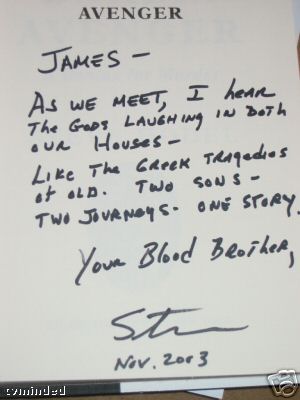
My goodness, one never knows what will turn up on Ebay. This morning I found a copy of “Black Dahlia Avenger” inscribed by Steve Hodel to James Ellroy, who wrote the introduction to the paperback, praising Hodel’s work and endorsing his solution.

And bidding started at $19.99.

Nice way to treat your “blood brother,” James. I don’t know whether the gods are laughing–but I am.

Lmharnisch.com

Lmharnisch.blogspot.com

But wait!

Can it be?

Here’s the paperback version of “Avenger” inscribed to Ellroy, which carries Ellroy’s forward to the case!

With bids starting at $19.99? That’s only $5.04 over the original price. I just have to put in a 50-cent bid on this puppy. The happy face alone is worth it.

Posted in 1947, Black Dahlia, Books and Authors, Cold Cases, Crime and Courts, Homicide, LAPD, Uncategorized | Tagged , , , | 1 Comment

A Labor Day Oration

Sept. 3, 1907
Editorial, Los Angeles Times

“I have no patience with the prejudices which exist between alleged classes when the classes themselves do not exist. There is no reason for hostility between employer and employee, between capitalist and wage earner. A condition of class hatred, such as has developed in Colorado, is a curse to this country.”

The utterer of these excellent sentiments was W.R. Hearst, orator of the day at the Jamestown Exposition yesterday—whose string of yellow socialistic newspapers and magazines has done more than any other agency existing to foment prejudice and class hatred and arouse reasonless hostility between capitalists and wage earners.

The first few hundred words of Hearst’s speech read like a prelude to a scathing arraignment of the New York Journal and American for their persistent efforts to teach the working people of America that they are the slaves of the “predatory rich”; that every corporation is a conspiracy to rob; that all capitalists are brainless brutes; that the government of the United States is a corrupt glutocracy; that the non-union laborer is a pest to be exterminated; that a “captain of industry’ is a pirate and that the only hope of salvation for downtrodden labor in this country lies in revolution and the “speeding to Washington of the bullet that killed Goebel.”

In a stern rebuke of his own editorial writers and cartoonists, Mr. Hearst said:

We have no aristocracy save that of intellect and industry, and the proudest title of our most successful millionaire is “captain of industry.”

The true captain of industry is the general of our industrial army. He cannot do without soldiers, and yet, no matter how well the soldiers fight, the victory depends very largely on the general’s skillful conduct of the campaign.

lmharnisch.com

lmharnisch.blogspot.com


Posted in 1907, Black Dahlia, Books and Authors, LAPD, Streetcars | Comments Off on A Labor Day Oration

A Nation of Vice

Aug. 31, 1907
Los Angeles

The ugly statistics should dishearten even the most ardent temperance worker. According to federal tax data for the last fiscal year, distillers produced 20 gallons of beer and 1.4 gallons of whiskey for every man, woman and child in America, a 5% increase and 8% increase respectively over 1906.

Cigar, cigarette and snuff production also showed similar increases. “The country being prosperous, cigar smoking grew at an amazing pace,” The Times said. Referring to cigars weighing more than 3 pounds per thousand, The Times said: “The public smoked about a billion and a third more of these cigars in the fiscal year just ended than it did the year before.”


Statistics for cigarettes are even worse: Americans smoked 5,151,862,120 in the last fiscal year. “It is small wonder that the tobacco trust has thrived,” The Times said.

And then there’s the apparently distressing use of oleomargarine instead of butter, 68,988,850 pounds.

Lmharnisch.com


Lmharnisch.blogspot.com

Posted in 1907, Black Dahlia, Books and Authors, LAPD, Streetcars | Comments Off on A Nation of Vice

Dreams of Higher Learning


Aug. 30, 1907
Los Angeles

Led by Rabbi Alfred Arndt of Congregation Beth Israel, the local Jewish community hopes to open what The Times describes as “the only Hebrew university within the entire United States.”

Noting the increased immigration to Southern California (the estimated number of Jews in the state went from 28,000 in 1905 to 42,000 in 1907), The Times said: “For a decade there has been a rapidly increasing Hebrew population in Los Angeles and other sections of Southern California. There is scarcely a place of any prominence within the seven southern counties which has not received a large quota of Hebraic citizens, especially within two or three years.”

Arndt told The Times that he hoped to open the new university soon after Rosh Hashanah, which began at sundown Sept. 8, 1907. The Times notes that Cantor J. Weinstock has been engaged for Rosh Hashanah services of the Independent Sons of Israel.

Unfortunately, there are no follow-up stories about the attempts to found a Hebrew university and very little information about Arndt, except for the footnote that in 1911 he performed a marriage between a Muslim bride (Fanny Alishabron) and a Jewish groom (Charles Levin).

We also know that Rosh Hashanah services were held at Temperance Temple, operated by the WCTU, at Broadway and Temple, a site now occupied by a generating station across from the Cathedral of Our Lady of the Angels.

Jewish Institutions in Los Angeles, 1908-1920

American Jewish Yearbook 5669 (1908-1909)

Lmharnisch.com

Lmharnisch.blogspot.com

Posted in 1907, 1908, 1909, 1911, Black Dahlia, Books and Authors, Immigration, LAPD, Religion, Streetcars | Comments Off on Dreams of Higher Learning

Firefighters’ Pranks


Aug. 29, 1907
Los Angeles

Around Engine Co. 20 at Sunset Boulevard and Mohawk Street, Lt. Samuel Dodd is something of a practical joker, so when he left on his honeymoon with his bride, Juanita, his fellow firefighters decided to get even.

They did such a good job plastering the house across the street at 2149 Sunset Blvd. with signs and old shoes that passing streetcars stopped so passengers could get a look.

The Times said: “The cottage is festooned with shoes—shoes of all sizes and kinds, men’s shoes, ladies’ shoes, babies’ shoes and boots. It’s a startling sight. But this is not all. It is also covered with signs—and such signs!

“Don’t Worry, Watch Our Family Grow.”

“Look in Papa’s Eyes and Say Goo-Goo.”

“Compliments of Engine Company No. 20.”

Were the newlyweds upset? After a trip to Coronado and Trabuco Canyon, not at all.

“The young couple stood for a moment and looked,” The Times said. “Then the bride laughed. It was catching. It won the hearts of Engine Company No. 20 on the spot.”

Samuel H. Dodd, retired assistant chief of the Los Angeles Fire Department, died in June 1953, survived by his wife Hazel; sons Samuel H. Dodd Jr. and Donald W. Dodd; and two grandchildren.

Today, 2144 W. Sunset Blvd. is home to Fire Station 20.

Lmharnisch.com

Lmharnisch.blogspot.com

Posted in 1907, Black Dahlia, Books and Authors, LAPD, Streetcars, Transportation | Comments Off on Firefighters’ Pranks

A Fun Question

Where do most Black Dahlia freaks live? According to Google’s trend search, Irvine, Calif., leads the world in searches about the Black Dahlia, followed by Los Angeles and San Diego. Who knew there was noir behind the Orange Curtain? Can “Fullerton Confidential” be very far away? Maybe it’s all those hits from UCI Medical Center. Hmmmm.

The top 10 Dahlia freak locations:

1. Irvine, Calif.

2. Los Angeles, Calif.

3. San Diego, Calif.

4. San Antonio, Texas

5. Tampa, Fla.

6. Phoenix, Ariz.

7. Salt Lake City, Utah

8. Chicago, Ill.

9. Philadelphia, Pa.

10. Orlando, Fla.

Top three cities in searches for Elizabeth Short:

1. Los Angeles, Calif.

2. New York, N.Y.

3. London, U.K.

Top 10 cities for James Ellroy freaks:

1. Los Angeles, Calif.

2. Paris, France

3. Montreal, Canada

4. Stockholm, Sweden

5. Helsinki, Finland

6. Melbourne, Australia

7. New York, N.Y.

8. Milan, Italy

9. Rome, Italy

10. San Francisco, Calif.

Lmharnisch.com

Lmharnisch.blogspot.com

Posted in Uncategorized | Comments Off on A Fun Question

He Lives


Manhattan Beach
Aug. 27, 2006

Retired Episcopal minister the Rev. John Jewett, 83, wanted to die, so while staying with his son-in-law, J.D. Porter, he slit his throat with a razor.

The undertaker was called, but when he arrived with his hearse, Jewett was still alive, although death was imminent. The undertaker went back to his funeral home to wait.

Later that day, the undertaker got a second call to go out to Manhattan Beach and get the body of a suicide victim. When he got there, Jewett was still alive.

“At 9:30 o’clock tonight Jewett was alive and able to talk,” The Times said. “Jewett made a bungling job in attempting to cut his throat. He is in great pain, but will survive, it is now thought.”

The Times said: “No reason is given for wanting to end his days. It is thought his mind has become temporarily impaired.”

California public records list the death of a John M. Jewett in June 1911 at the age of 87.

Lmharnisch.com


Lmharnisch.blogspot.com

Posted in 1908, 1911, Black Dahlia, Books and Authors, LAPD, Streetcars | Comments Off on He Lives