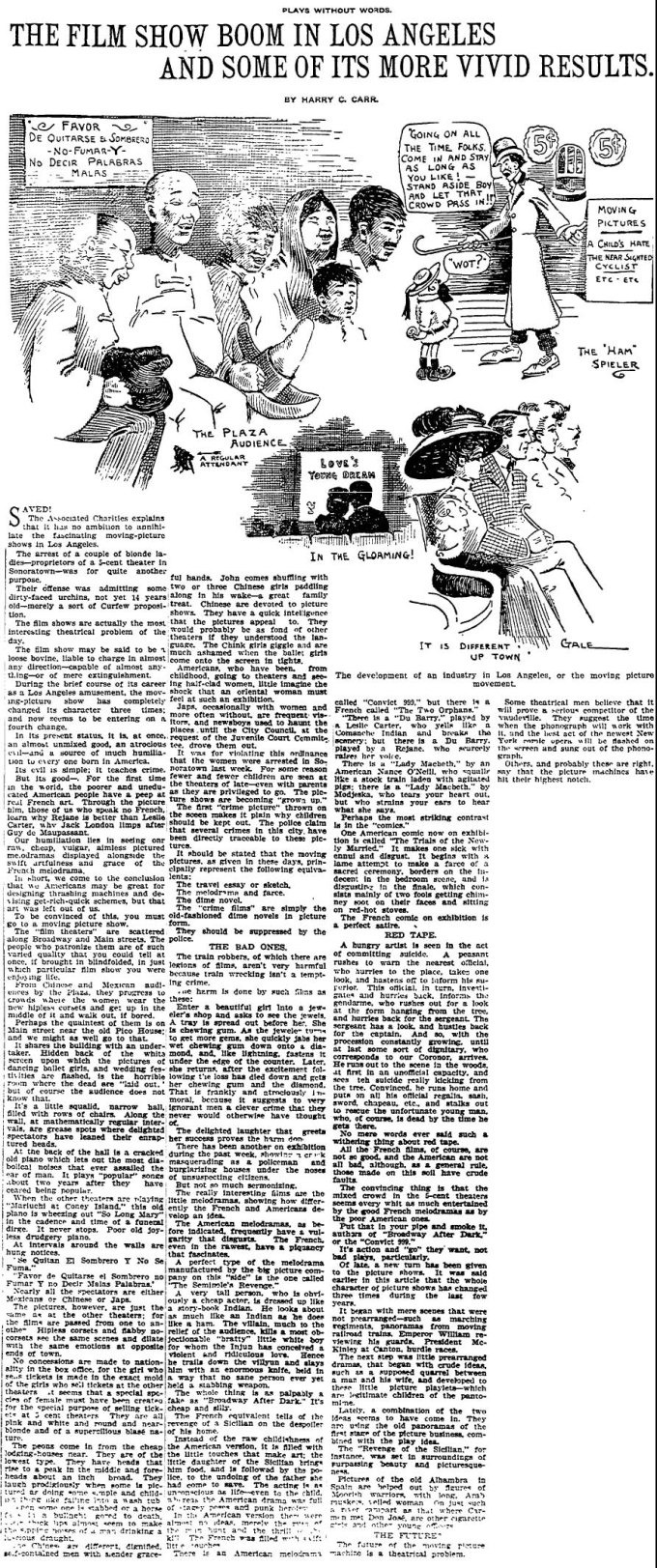
An Artist Makes His Point

Oct. 18, 1907
Los Angeles

For the last month, the pages of The Times have been peppered with pen-and-ink cartoons signed Gale—in fact some of them have already appeared in the blog, with Nathan’s post on Japanese hobos and mine on Marco Vessella. But that was only the beginning. By the end of the month, Gale’s cartoons have become a regular feature of The Times, usually paired with text by Harry Carr. Gale specializes in ethnic caricatures: Chinamen with long queues, bucktoothed Japanese, Mexicans with sombreros—and don’t even ask how he draws African Americans.

His name was Edmund Waller Gale, but he was known as Ted or “Cartoonist Gale” and he was an institution at The Times, drawing editorial cartoons for decades, on an irregular basis before they became a daily feature in 1922.

“I am not an artist,” he said in 1933.”I never thought I was and never tried to be one. The first work I ever did was cartooning and in this work it is the idea, not the drawing, that counts. Once I get my idea, my day’s work is practically done, for I put it on paper as fast as I can. I often spend six or eight hours figuring out my subject and one hour doing the drawing. I don’t think the actually task of transferring an idea to paper ever took me more than three hours.”

One of Gale’s more enduring creations was “Miss Los Angeles,” an attractive young Latina that provoked a great deal of criticism at one time, mostly for his inattention to detail.

“Funny how fussy people are about drawing, even in cartoons,” he said. “I really didn’t go through any brainstorms when I created Miss Los Angeles. I just dashed off a girl of a Spanish type to typify this part of the country and imagine my discomfiture when her appearance was greeted with a shower of sarcastic letters, informing me that no Spanish lady wore a bullfighter’s vest and a bolero and that the high comb was entirely wrong and the lady was just the same as nude unless I added a mantilla.” I’ll leave it to another historian to trace the history of Miss Los Angeles from Anglo to Latina. Here’s one version from 1929.

A left-handed Santa Claus (he claimed he didn’t even notice) and flags with the wrong number of stars and stripes were also Gale’s bugaboos. “Thousands of people seem to have nothing to do but count the stars and stripes and their ideas of what constitutes an insult to the colors is simply beyond belief,” he said.

Of his first cartoons, he said: “Times have changed a lot since those early days and the style of cartoons has altered too. Nowadays public opinion is molded rather than led and there is little or none of the vicious element that was deemed essential in the cartoons of former years.”

Gale quit The Times in 1934 in a disagreement over its editorial policies and went to the competing Examiner. He died in 1975.

Lmharnisch.com
Lmharnisch.blogspot.com

Posted in 1907, African Americans, Black Dahlia, Books and Authors, Columnists, LAPD, Streetcars | Tagged | 1 Comment

Unsportsmanlike Conduct

Oct. 17, 1907
Los Angeles

Mr. Woolin, left tackle of the USC team, took great exception to be tackled by one of the black players on the Whittier State team (one of Whittier’s five black players) and voiced his displeasure, emphasizing his point with his fist.

Whittier’s coach, Mr. McLouth, rushed to intervene, whereupon Mr. Woolin further expressed his disdain by striking him in the face. Coach McLouth responded in kind. Peace was eventually restored until Whittier’s water boy came onto the field and retaliated against Mr. Woolin, and had the Whittier team not retreated from the field, the unpleasantness might have continued.

As the score was 37-0 in favor of USC and the visiting Whittier team needed to catch the streetcar home, the game was halted 15 minutes into the second half.


Here’s to Brice Union Taylor, who in 1925 became USC’s first All-American player. He was later a pastor at First African Methodist Episcopal Church in Los Angeles. By the way, he only had one hand.


Lmharnisch.com

Lmharnisch.blogspot.com


Posted in 1907, African Americans, Black Dahlia, Books and Authors, LAPD, Streetcars, Transportation | Comments Off on Unsportsmanlike Conduct

A Man Ray Jigsaw Puzzle


The Detroit News has published an article on book dealer John K. King, who is offering “Man Ray: Photographs 1920-1934 Paris” inscribed by Man Ray to Dr. George Hodel. The book sold Sept. 14, 2006, for $4,600 in an auction by PBA Galleries.

King is offering it for $8,500. Not a bad profit. Of course it would be worth even more if Man Ray had said something incriminating like, “In fond memory of our murderous little rampage across Los Angeles, you evil genius, you.”

Lmharnisch.com
Lmharnisch.blogspot.com

Solve this as a jigsaw puzzle. (Note: The link is broken)

Posted in 2006, Black Dahlia, Books and Authors, Photography | Tagged , , , , | 5 Comments

Matrimonial Accounting

Oct. 16, 1907
Santa Ana

George S. Best is a great believer in marriage and strongly opposes divorce, which is why he has three of one and none of the other.

His most recent troubles began when his wife Anita discovered that he had married young Cecile Fleming, the daughter of a prominent local businessman. Upon investigation, Anita Best of Los Angeles and Charles Fleming of Santa Ana discovered that Best had married Cecile in back of the county clerk’s office. After returning to Los Angeles long enough to get his belongings, avoiding his mother and his wife Anita, Best and Cecile left for San Francisco, where he was arrested for bigamy.

When Best went before the judge, he explained it this way: His wedding to Anita Best was actually invalid because he already had a wife, Bertha, whom he married in 1900. Bertha had died since then, Best said, so his marriage to Cecile was, at least in his mind, legal.

“My intentions were honorable, your honor,” Best said.

Bertha, however, was found to be quite alive and presumably well-rid of her husband, who was sentenced to a $1 fine and 10 years at San Quentin.

lmharnisch.com

Lmharnisch.blogspot.com


Posted in 1907, Black Dahlia, Books and Authors, LAPD, Streetcars | Comments Off on Matrimonial Accounting

Test Posting

Here’s a little game. Let’s see if it works.

Here’s another one.

Posted in Uncategorized | 1 Comment

Fire Threatens Orpheum

Oct. 15, 1907
Los Angeles

On a rainy night in Los Angeles, a fire broke out in the four-story brick office building at 235 S. Spring St. housing the Orpheum Theater and the Elks Hall, which was engulfed in panic as visitors at a Japanese festival rushed for the exits. The second-floor hallways were so jammed that members of the Elks Club rushed to the rear of the building to use the fire escapes.

At Orpheum, on the floor above the Elks Club, veteran actress Minnie Seligman calmly made the smoke and the sound of fire engines part of her skit. Rushing offstage for a moment, she returned covered with soot and announced: “Oh the gasoline stove exploded. It will break up housekeeping for good!”

The audience was dismissed and except for a few people in the rear who called “fire!” theatergoers remained calm. After leaving the building, they stood across the street in a light rain to watch.

The Times noted that the toll could have been much worse. “Had the firemen allowed the flames to get through the ceiling of the [first-floor] store and get a hold in Elks Hall they would have swept along the second floor, cutting off the exit of the Orpheum gallery and might have made their way through that gallery.”

Assistant Fire Chief O’Donnell cut his hands and knees crawling into the jewelry store below the Elks Club, where the fire apparently started in the faulty wiring of an electric motor. He continued to fight the fire and only later was treated at the Receiving Hospital.

Two engine companies rushing to the fire also suffered accidents. One of the horses pulling an engine slipped while turning from 1st Street onto Spring and was dragged for some distance, nearly overturning the fire engine. Another horse pulling an engine was badly cut when it fell on the slippery pavement at 3rd Street and Spring.

The jewelry store, an optical shop and a clothing store reported significant smoke damage and a cafe in the basement suffered water damage.

Bonus facts: First Orpheum Theater–Main and 1st Street.
Second Orpheum Theater–229-235 S. Spring St. Renamed the Lyceum, demolished in 1941.
Third Orpheum Theater–630-636 S. Broadway. Renamed the Palace.
Fourth Orpheum Theater–842-844 S. Broadway.


Lmharnisch.com

Lmharnisch.blogspot.com

Posted in 1907, Black Dahlia, Books and Authors, LAPD, Streetcars, Theaters | Comments Off on Fire Threatens Orpheum

Nine out of Ten


Oct. 14, 1907
Los Angeles

“In nine cases out of ten, where there is a shooting, there is also a woman,” said The Times.

In this case, there was Oscar E. Otto, a young chauffeur with a hot temper and a gun. There was his 19-year-old wife, the former Irene E. Jester, “a silly little creature with futile tears and French heels.” And there was J.C. Henderson, another chauffeur with a gun and better aim or more luck.

Untangling the story of this fatal triangle—at least it was a triangle in the mind of Mr. Otto if no one else—is difficult, in part because of the charges and countercharges and partly because the presses weren’t properly inked and much of the text is faint.

But a few things seem clear: In May, about the time of the Ottos’ first anniversary, Henderson was hired to take a man and two women from the Saxonia apartments to Fred Ward’s roadhouse on Mission Road, otherwise known as the East Side Athletic Club.

“Both women were introduced to him as single women and it was not until their return to the city, when one of the women refused to ride down Pico Street, that Henderson suspected she was married,” The Times said.

The next day, Henderson said, he received a phone call from Mrs. Otto, asking to meet him on Main Street. He said he barely recognized her because her face was swollen from a vicious beating. She asked him for $10 ($205.24 USD 2005), explaining that after her husband beat her, he ripped up her clothes and threw her out of the house.

Sometime later, she barged into Henderson’s hotel room and darted into a closet, claiming that her husband was out to kill her. Mr. Otto, although he was a smaller man, followed and beat Henderson viciously.

Of course, Mr. Otto had a different story. He sued Henderson for alienation of affection in August, charging that his wife and Henderson had gone for many long drives, and visited resorts and cafes, where his wife “drank intoxicating liquors to excess,” The Times said.

Since then, witnesses at the murder trial said, Otto had talked constantly of revenge. On the night of the killing, a friend said, the two of them had gone for a drive to East 9th Street and Tennessee, where Otto said he had an appointment with a man.

Finding Henderson (at right) at the garage at 9th and Tennessee, Otto said: “There’s the _______,” according to The Times. Although it was too dark to see much, the friend said, he noticed a man backing away from Otto, who cried out: “I am shot!” Otto ran back to the car, drove almost two blocks and collapsed, saying, “Get a doctor.”

Henderson testified that he had been driving down Broadway when Otto jumped on the running board and threatened to kill him before jumping off at 9th Street. Henderson said he took his car to the garage on Tennessee Street and spent about 15 minutes putting it away when Otto arrived.

As Otto jumped out of his car, Henderson said, he saw a flash of light and was sure that Otto had fired at him. He was afraid to run because Otto might shoot him in the back, so Henderson stood with his hand on the pistol in his pocket until Otto got close.

“He called out as he came near and as I kept backing away, ‘Pull it out, you _______. That’s just what I want. Pull it out,’ ” Henderson said.

“I backed as far as I could, and then, as he reached out his left hand and struck me on the face, I fired. I did not dare to take my hand away from my gun as I thought it was his intention to provoke me into doing so and that then he would shoot me.”

“I did not think that I had hit him and it was not until he had run back to within 15 feet of his auto that I heard him say, ‘I’m shot.’ Still, I thought he had only been hit slightly. I did not fire but once as I was satisfied when I saw him retreat.”

The jury in Henderson’s murder trial returned a verdict in two minutes: Not guilty.

And in an intriguing but unexplained footnote to the story, shortly before he died, Otto asked to see Miss Jossie Golman. She said he was nothing to her but a friend and refused to go.

Lmharnisch.com

Lmharnisch.blogspot.com

Posted in 1907, Black Dahlia, Books and Authors, Homicide, LAPD, Streetcars | Comments Off on Nine out of Ten

2 Die in Tong War


Oct. 13, 1907
Los Angeles

Gunmen imported from out of town by the Hop Sing Tong entered the tailor shop of Lem Sing at 806 Juan St. in Chinatown and under the pretense of having some clothing made, wounded him when he turned to reach for some material. The men also killed Wong Goon Kor, who was, according to The Times, “lying in a bunk under the influence of opium.”

The three fleeing men threw away their revolvers as they ran down Marchesault Street, through Stab in the Back Alley to Apablasa Street, where they got into a vegetable wagon that took them away.

But apparently unfamiliar with Chinatown, the gunmen went into the wrong business, mistaking it for the shop at 802 Juan St. run by Joe Fong.

At the hospital, Sing told police: “I owe Chan Mon money. He asked me for it today. Then he sent Deputy Constable McCullock to collect it. I could not pay. Then three Hop Sing Tong men came to my store and asked for clothes. When I turned around, they shot me and my tailor. I fell upon the floor and remember no more until I was brought in here.

“One of the men was about 20 years old, had no queue and was about 5 feet, 6 inches tall and wore American clothes. The second man was about 30 years old and had chin whiskers, and the third man was about 43 years old and wore a queue. He did the shooting.”

Gravely wounded, Sing died the next day after identifying three men as the assailants, although his statement was questioned because he had previously identified three different men.

A few days later, an arraignment was held for Charley Wing of Portland, Ore., a man of mixed ancestry described by The Times as “a man of good education, speaks English fluently and is a power among the yellow men. His hair is brown, his mustache light brown and there is but little appearance of the Oriental in his makeup. In court yesterday, he looked more like some student of theology than like a murderous highbinder.”

Charges were also filed against Charley Sam Foo Ling, known as “the Bakersfield Kid,” and Wong Chung.

The Times noted: “Chinese tong men yesterday buried the dead tong gladiators. From the Pierce Brothers’ morgue, a dismal procession wended its way to the Chinese Cemetery in Boyle Heights. There, the Chinese were interred, money being thrown into the caskets, together with food and paper prayers to see them safe on their journey to heaven.

“On top of the grave, other food was placed to attract the attention of evil spirits lingering near. The chief dish was a fine roast chicken. As soon as the Chinese left the cemetery, evil spirits in the form of barefooted Negro youngsters swarmed down upon the grave and carried off the roast fowl as a prize.”

Historic details like that are certainly vivid, and it’s nice to have them, but they make me wince at the same time.

Unfortunately, there is no further information on the three defendants in the tong killing.

Bonus fact: Apablasa Street was named for the owner of the rancho where the original Chinatown (now the site of Union Station) was built.

Read the Marsakster’s posts on the tong war here and here and here.

Lmharnisch.com

Lmharnisch.blogspot.com

Posted in 1907, Black Dahlia, Books and Authors, Crime and Courts, Education, Food and Drink, Homicide, LAPD, Streetcars | Comments Off on 2 Die in Tong War

A Foul Wind Blows Over Boyle Heights

A Foul Wind Blows Over Boyle Heights

Oct. 12, 1907
Los Angeles

After repeated complaints to police because half a dozen dead dogs had laid in the streets for two weeks,  the health department tried to charge C.T. Hanson, who held the contract for removing carcasses. But according to the city attorney,  Hanson was only guilty of not abiding by his contract and nothing more.

In fact, Hanson had tried to get out his contract, claiming that he was losing money, but the city refused. “The opinion expressed at the City Hall is that Hanson has grown lax in the collection of carcasses, thinking that he may be able to force the city to more favorable terms,” The Times said.

Hanson also operated a fertilizer company plant in Boyle Heights, drawing the fury of neighbors. He apparently used the issue of not removing dead animals as a bargaining chip in deflecting attempts to close his fertilizer plant.

“I don’t blame those Boyle Heights people for kicking,” Mayor Harper said after visiting the plant. “The stench from that so-called factory is awful. I wouldn’t live on Boyle Heights to the windward of that plant if they would give me the whole hill.”

Unfortunately, no further information is available. Removal of dead animals is now handled by the Bureau of Sanitation.

Lmharnisch.com
Lmharnisch.blogspot.com

Posted in 1907, Black Dahlia, Books and Authors, City Hall, LAPD, Streetcars | Comments Off on A Foul Wind Blows Over Boyle Heights

Death of a Millionaire

Oct. 11,1907
Los Angeles

Perhaps John Bryson’s early life was something out of Horatio Alger, but the death of the Los Angeles developer and self-made millionaire could have easily been taken from the pages of Charles Dickens.

Born in Lancaster, Pa., in 1819 and one of 13 children, Bryson served an apprenticeship as a carpenter and cabinetmaker. Lured by the opportunities of the West, Bryson and his wife, Emeline, moved to Ohio in 1845. From there, the couple moved to Muscatine, Iowa, and then to Los Angeles.

Arriving about 1879, Bryson used his knowledge of construction and the lumber industry to begin as a developer. One of his main projects was the Bryson Block on the northwest corner of Spring and 2nd Streets, a site now occupied by the Los Angeles Times. Active in local affairs, he was elected mayor in 1888 and served one term.


But by 1907, his life had unraveled. Aged and ill, he had separated from his wife and was almost constantly in the company of his longtime nurse, Gladys Lamberton. At odds with his family, Bryson fought constant legal battles with his wife and children, who were seeking to declare him mentally incompetent and under Lamberton’s control so they could obtain control of his vast financial holdings.

Granting an interview to reporters from his bed at the Hotel Alexandria, Bryson answered when asked about Lamberton’s purported influence over him:

“Why, what on earth do you think I am?” Then, bending forward and shaking a bony finger at the reporter, he said: “I paid her for what work she did and for things she purchased for me and not one cent more. To tell the truth, I lived cheaper with her than I did before I left my wife. It used to cost me at the least estimate $1,000 ($20,523.57 USD 2005) a month to run the house before my separation from my wife, and afterward less than $400 a month covered my expenses.

“Hell, man, this thing makes me mad. Here I have lived in this city for over 25 years and have been spoken of as having the usual amount of common sense. The people of Los Angeles elected me mayor. I have amassed a comfortable competence in this city and then someone says that a woman makes me follow her about like a dog and that I take orders from her, and, in short, that I am crazy and a fool. Well they will find out that I am not. I made my money and I am going to keep it to the end.”


I don’t claim to be intimately familiar with Alger’s works, but I doubt his heroes talk this way.

Sadly, the fighting between the nurse and the family continued after Bryson’s death. He was hurriedly buried in a secret ceremony at Rosedale Cemetery.

Lmharnisch.com

Lmharnisch.blogspot.com

Posted in 1907, Black Dahlia, Books and Authors, LAPD, Streetcars | Comments Off on Death of a Millionaire

The Want Ads

Posted in Black Dahlia, Books and Authors, LAPD, Streetcars | Comments Off on The Want Ads

The Confidence Woman


Oct. 9, 1907
Los Angeles

She was known as Trellis C. Harris or Trellis Blessing—or Edna Hall. But her method was always the same. She would commit some theft, then fake an epileptic fit, spitting up blood from a capsule hidden in her mouth.

On a train to Los Angeles, Harris stole claim checks from another woman and made off with two trunks. When officers tracked her down in Pasadena, she fainted and was taken to a physician. At the doctor’s office, she faked one of her fits and was transported to the county hospital. She finally admitted taking the trunks, but blamed the theft on her illness and pleaded with authorities to send her to Kansas City.

Police discovered that Harris was well-known to authorities and had worked her scam in Arizona, with stops in Phoenix, Bisbee and Prescott, and in Kansas City.

“In Prescott, she secured from oversympathetic persons considerable money,” The Times said. “It is stated that she spilled blood over herself and the bedclothes in her room and then sent for a physician. After she had gone, it was learned that she had secured a bucket of blood from a butcher shop.”

In fact, Harris had staged a scam in Los Angeles several months earlier. In February 1907, she claimed to have been hurt by a trolley at 4th and Spring streets, but ran away from county hospital, charging that doctors kept her under the influence of opiates.

“Suffering from an operation made necessary by the accident,” The Times said, noting that she had no money, “the young woman applied to the police yesterday afternoon for help. She had been vomiting blood and was put to bed in the women’s ward of the Receiving Hospital.”

After her latest fraud, Harris was taken from the hospital to the County Jail, but there is no further word on her fate.

Lmharnisch.com

Lmharnisch.blogspot.com

Posted in 1907, Black Dahlia, Books and Authors, City Hall, LAPD, Pasadena, Streetcars | Comments Off on The Confidence Woman

White Croaker


Oct. 8, 1907
Los Angeles

Health officials and a deputy district attorney have joined to urge the Board of Supervisors to ban fishing within a half-mile of the city’s Hyperion line that pours sewage into Santa Monica Bay.

“It is claimed that the city markets are flooded with fish taken near the sewer outlet,” The Times says, “and that they have fed upon sewage until they are unfit for food and spread disease among fish-eaters.”

Question from 2006: Is it safe to eat fish caught in Santa Monica Bay?

Lmharnisch.com

Lmharnisch.blogspot.com

Posted in 1907, Black Dahlia, Books and Authors, Food and Drink, LAPD, Streetcars | Comments Off on White Croaker

The Curious Dreamer


Oct. 5, 1907
Los Angeles

Hilliard Stricklin is a man with an urgent desire to do something for his fellow African Americans. He says that he came to Los Angeles from Chattanooga, Tenn., about 1895 with a few dollars in his pocket, worked hard and saved his money until he opened a grocery store at 2053 Santa Fe Ave.

What he wants most is to build a facility for the elderly and for orphaned children, naming it the Stricklin Memorial Home for the Aged in honor of his mother.

Two years earlier, Stricklin bought the old Pertinico Winery on Vermont Avenue just south of Pico, paying about $10,000 ($205,235.70 USD 2005). The white neighbors in Pico Heights assumed Stricklin was bluffing with his talk about helping the elderly until the day piles of lumber and a crowd of workmen appeared on the site.

And then they were furious at the idea. Neighbors accused Stricklin of extorting an extravagant price for the property under the threat of bringing blacks into the area.

[Warning: Dialect ahead]

“Followed numerous interviews with Stricklin,” The Times said. “Citizens expressed themselves vigorously. Stricklin sorry that they didn’t like his plans; but somehow the site just seemed to suit him and he kind o’ thought the ol’ folks could be real comfo’ble out there. Reckoned he’d just go ’long with the work.

“Citizens stormed; but Stricklin calmly squinted at the frame of the structure and dropped remarks about the great need of charity and the good he hoped the memorial home would do his brethren and sisters.

“Finally, a great light seemed to dawn. Hilliard Stricklin conceived the idea—remarkable feat—that perhaps the white people of the neighborhood would like to buy him out!”

In fact, according to Mayor Harper, Stricklin made a modest profit on the property, selling it for $13,000. His plan was to duplicate the Vermont Avenue building “in a quarter where it appropriately belongs,” according to The Times.

The location, however, is vague. Some stories say it was at Alamo and Santa Fe, while another lists Alma and St. Elmo, just off Santa Fe, but unfortunately I can’t locate either of them on any of my old maps, which only go back to the 1930s.

Stricklin took out ads for his second project and raised money, but nothing ever came of it except for a lawsuit by the guardian of one of his donors accusing Stricklin of fraud.

“The founder appears to be in hard luck,” The Times said. “His little grocery store at No. 2053 Santa Fe Ave. is tied up under an attachment. He is very discouraged over the collapse of his pet scheme. He lays the blame on poor solicitors but admits his lack of business judgment.”

“If a home for colored people is ever established,” The Time said, “it is believed it will be necessary to purchase ground outside the city limits. To establish such an institution in any residential part of the city would meet with strong opposition from property owners.”

Lmharnisch.com


Lmharnisch.blogspot.com

Posted in 1907, African Americans, Black Dahlia, Books and Authors, LAPD, Streetcars | Comments Off on The Curious Dreamer

On the Frontiers of Medicine


Oct. 2, 1907
Los Angeles

If you have back problems, you might try this method, used by “Dr.” Thomas H. Storey, an unlicensed chiropractor : Have the patient lie down with his head on one chair and his knees on another. Then get on the patient’s back so all your weight is resting on the spine. Next, put your knee in the small of the patient’s back. Then twist the patient’s neck.

And for good measure, you might put a drill between the vertebrae and whack it with a mallet a few times.

Unfortunately, this treatment didn’t help a San Bernardino farmer named Dominick Premus. In fact, it killed him, according to his widow and the California State Medical Board.

But Storey said: “Just allow me to give a practical demonstration of my simple apparatus. I will show that a treatment could not be injurious. I do not use heavy tools. The mallet with which I drive back adhering vertebrae does not weigh more than half a pound. It really doesn’t hurt to any great extent. I have a drill covered with rubber. That is laid against the vertebrae that are pushed up and a blow with the mallet sends the offending ones back into place. In the Premus case, his vertebrae were apparently immovable. I worked on him for some time but, unfortunately, was unable to dislodge the vertebrae.”

“Why is it any worse to tap a man’s spine lightly with a drill and a mallet than it is to use the knife?”

Storey also noted that another doctor was the last one to treat Premus, giving him an injection close to the heart.

“I do not fear prosecution or persecution,” he told The Times. “Jealousy of other doctors has caused me much annoyance, it is true.”

Storey took an impromptu vacation in Mexico and didn’t return to Los Angeles until the next year, when he surrendered to authorities. He was ordered to pay a $500 fine and serve 60 days in jail for practicing medicine without a license, but the sentence was overturned on appeal in 1909.

Lmharnisch.com

Lmharnisch.blogspot.com

Posted in 1907, 1909, Black Dahlia, Books and Authors, LAPD, Streetcars | Comments Off on On the Frontiers of Medicine

Bob Belden, Black Dahlia, "Genesis"

Posted in 1947, Black Dahlia, Books and Authors, Cold Cases, Crime and Courts, Homicide, LAPD, Uncategorized | Tagged , , , | Comments Off on Bob Belden, Black Dahlia, "Genesis"

Bob Belden, Black Dahlia

Posted in 1947, Black Dahlia, Books and Authors, Cold Cases, Crime and Courts, Homicide, LAPD, Uncategorized | Tagged , , , | Comments Off on Bob Belden, Black Dahlia

That Energetic Brown Fox


Sept. 30, 1907
Los Angeles

Who says research can’t be any fun? I wonder what the WCTU would say about five dozen liquor jugs.

Dr. J.Z. Quack? Not a reassuring name, is it?

Bonus factoid: In French, it’s “Voyez le brique geant que j’examine pres du wharfe.”

Lmharnisch.com


Lmharnisch.blogspot.com

Posted in 1907, Black Dahlia, Books and Authors, LAPD, Streetcars | Comments Off on That Energetic Brown Fox

Loud Pipes Save Lives

Sept. 28, 1907
Los Angeles

Members of the Los Angeles Motorcycle Club have written to officials in support of a measure banning loud exhaust pipes on motorcycles.

“The motorcycle club says that it has been making a direct crusade against open mufflers and that all members of the club are forbidden to open their cycle mufflers within any city or town limits,” The Times said.

“We wish it generally understood that those riders of motorcycles making this ‘popgun’ noise, which causes so many complaints, are not members of the Los Angeles Motorcycle Club,” the group said.

Lmharnisch.com


Lmharnisch.blogspot.com

Posted in 1907, Black Dahlia, Books and Authors, LAPD, Streetcars | Comments Off on Loud Pipes Save Lives

The Public Guardian


Sept. 27, 1907
Los Angeles

Ringling Bros. manager Charles Davis said farewell to Los Angeles, leaving $50 ($1,026.18 USD 2005) and some choice words for local authorities.

Child welfare officer Robert W. Reynolds spent several days attending the circus to ensure that there were no performances by underage children (The Times is a bit vague, saying younger than 16 in one story and younger than 12 in another).

“I went out to the circus grounds Monday night and saw several children I believed less than 16 years old performing,” Reynolds said. “Of course, I had no proof that such was the case, however, and as the district attorney had warned us to be careful of our cases before making a complaint I did nothing at that time.”

Reynolds returned to the circus and asked the parents about their children’s ages. “I was ordered from the grounds, but Mr. White [it isn’t clear who this is—lrh] came along and, on being informed who I was, gave orders that I be allowed to go where I pleased.”

The children were withdrawn—all but one of them.

“In the evening I came out and saw Manager Davis before the performance began,” Reynolds said. “He told me that if he took off the little Jap the performance would be spoiled. I told him that I did not want to do that but that I was there to see that children under 16 years of age did not appear.

“I stayed that night and saw several children whose parents said that they were underage.”

Davis had his own side of the story—and he was not alone. Davis complained that Los Angeles authorities waited until the circus was about to leave town before bringing charges, forcing him to pay the fine or remain behind to contest the allegations.

“The little ones accompany their parents and are properly cared for,” Davis said. “They receive training in the business they are to take up. Circuses have had children performers for years and years. Anyone with a thimbleful of sense knows that there are always children with a circus.”

“This is the second time Reynolds has taken such action at the eleventh hour,” The Times said, “and local theatrical managers have wired East, warning companies booked for the winter season of the treatment they may expect.”

“Many of the Eastern managers are refusing to book shows for Los Angeles this winter because of the fact that they are treated in such an unfair manner,” one theater executive said. “The prettiest plays are those with children in them, but Los Angeles may be cut from the list if this sort of treatment continues.”

Jackie Coogan thanks you.

Screen Actors Guild information for young performers
.

Lmharnisch.com


Lmharnisch.blogspot.com


Posted in 1907, Black Dahlia, Books and Authors, LAPD, Streetcars, Theaters | Comments Off on The Public Guardian