Ecclesiastes 1:9

Dec. 22, 1907
Los Angeles

As Police Capt. Flammer approached Yuma, Ariz., to take custody of George White, he noticed the smoke of hundreds of campfires made by hobos burning old railroad ties.

The hobos, Flammer learned, were avoiding Yuma because the marshal meted out hard justice to vagrants, as he warned in posters all over town. But Flammer also learned all those homeless men were heading for Los Angeles.

“The chief of detectives pictured in his mind another winter of lawlessness,” The Times said. “Last week 130 hobos were on the chain gang, working from eight to 10 hours a day, but thousands more were coming.”

The city of Los Angeles printed thousands of posters that were placed along railway lines from the coast to the desert warning hobos: “The police of this city are waiting for them and that they will be put to work as soon as they arrive here.”


The Times also noted that the city planned to build a stockade to accommodate all the tramps who were expected. Not so simple a task, however. While one faction wanted a stockade in the riverbed, another thought it should be in Chavez Ravine. Still others wanted to use the money for a new automobile for officials.

The council was eventually split between putting the stockade in Chavez Ravine or next to the jail on Hill Street. Police, meanwhile, backed a proposal to add cell space by cutting the jail’s existing “bull pen” horizontally with a new floor halfway up the wall.

Eventually, it was noted that the state penal code called for a $5,000 fine and imprisonment for inhumane treatment of inmates; the grand jury began looking into the situation.

By the end of January 1908, city officials rejected the idea of a stockade in favor of a new jail or workhouse. Meanwhile, a public works program was begun for unemployed men with families to build a boulevard between Griffith and Elysian parks.

In February 1908, the council reversed itself and put out bids for a stockade “near the sand pits east of Elysian Park.” But by the time the stockade was finally built in June 1908, “hobo season” was over and there were few occupants.


Ecclesiastes 1:9 “There is nothing new under the sun.”


Lmharnisch.com

Lmharnisch.blogspot.com

e-mail: lmharnisch (AT) gmail.com

Posted in 1907, 1908, Black Dahlia, Books and Authors, LAPD, Parks, Streetcars | Comments Off on Ecclesiastes 1:9

South Hope

Dec. 21, 1907
Los Angeles

Lillian Poelk was new to Los Angeles, with no friends and little more than a job as a waitress that didn’t quite cover the rent of her room at 831 S. Hope.

“While other girls were getting pretty things and preparing for a pleasant Christmas, she was shut up in a cheerless room,” The Times said.

Poelk went to visit an acquaintance at a rooming house at 138 N. Spring St. On her way to the woman’s room, Poelk passed the quarters of Mary Del Rose, who had left her door open. Seeing two $5 gold pieces on the dresser, Poelk impulsively took the money.

Apparently instead of visiting, Poelk left the rooming house but was overcome with guilt and fear of being arrested. She went into a department store and threw “the money into the toilet room,” The Times said.

The rooming house’s janitor saw the theft and reported it to police. When Poelk was arrested, she begged for mercy. Police Capt. Auble said: “if we find that Miss Poelk is a good girl we will do all we can to secure her release. A girl living by herself is beset with enough trials and temptations to wreck a saint.”

There are no further stories on Poelk, so we don’t know what became of her. Nor do we know if Del Rose received restitution for her money ($205.24 USD 2005). We can only hope for the best.

Lmharnisch.com

Lmharnisch.blogspot.com

e-mail: lmharnisch (AT) gmail.com

Posted in 1907, Black Dahlia, Books and Authors, LAPD, Religion, Streetcars | Comments Off on South Hope

OMG

Dec. 20,1907
Los Angeles

Mr. C.D. Roberts of 1900 E. Main was feeling a bit unwell. He had bad headaches, an irregular appetite, saw dark spots before his eyes and felt as if something in his stomach was alive.

Not sure what to do, Roberts consulted the European Medical Experts at 745 S. Main St., where he was treated with the secret cure of “The Great Fer-Don.” “He was prevailed upon to try it, with the result that his system was quickly relieved of this monster scores of feet in length,” surely the Loch Ness creature of internal parasites.

Mr. Fred Schaffer, 125 W. Colorado in Pasadena; Albert Crist of the Parker House on 5th Street; and others have been similarly cured, the ad in The Times says. The European Medical Experts miraculously used bloodless surgery to treat Mrs. M.J. Brenner of San Gabriel, relieving her of gallstones; removed a tumor from Mrs. Jack Rowell of 303 Central Ave. without an operation and treated half a dozen people for deafness.

One might wonder, since Main Street runs north and south, where “1900 E. Main” might be. More to the point, who is the Great Fer-Don?

One ad says, “He is a man of large build, has dark hair tinged with silver gray. His flow of speech is pleasing and magnetic. In his lecture and demonstration Fer-Don said: ‘I came to your city to introduce my medical compound discovery and bring with me some of the methods of the old world, which will be demonstrated to the public by the staff of European Medical Experts.”

Fer-Don is not a registered doctor with the state of California, but the staff members are, the ad says. And what miracles they worked: little lame children walked again and cancer was removed without a trace. He was a philanthropist too: Not only did the Great Fer-Don treat a poor Pasadena woman without charge, he gave her $50.

Above, Vivian Edwards and his transcontinental goat team.


Among those providing testimonials was Capt. Vivian Edwards, who apparently won fame for crossing the country in a buggy pulled by goats. “I was in so great pain that I would have tried anything,” he said. “I would have suffered being cut open or would have drunk molten lead if I had thought it would bring relief.”

Three doses of medicine from the European Medical Experts was sufficient, however. “Like electricity, it went through my system,” he said. “In five minutes I knew I was going to find an end to pain. With the next dose I felt still better and the next morning with the third and last dose of this medicine I was relieved of a large number of gallstones.”

Before long, the Great Fer-Don was giving free lectures on a lighted platform in the vacant lot at 7th and Spring streets. The Diamond Cluster Band preceded his carriage and performed for 15 minutes before lectures. Eventually, Fer-Don added acts until he had an entire vaudeville show.

The Great Fer-Don said that he would leave Los Angeles on Jan. 1, 1908. But after announcing that he was staying indefinitely, the Great Fer-Don and his medical experts disappeared in May 1908.

When next heard from, James M. Fer-Don and his wife were being sought on a felony warrant from Sacramento. It seems that his $100 medical cure was nothing more than colored water. He appears to have been in Oakland about 1909 before vanishing permanently from the historic record.

Lmharnisch.com

Lmharnisch.blogspot.com

e-mail: lmharnisch (AT) gmail.com

Posted in 1907, 1908, 1909, Black Dahlia, Books and Authors, LAPD, Pasadena, Streetcars | Comments Off on OMG

It Wasn’t His Fault

Dec. 19, 1907
Los Angeles

What you have to understand first about George White is that he isn’t to blame. Oh he’ll take his prison sentence for robbing the Hot Rivet Saloon, 1006 N. Main St., but it’s not his fault; he fell in with the wrong man. He just hopes that when he’s released he won’t be turned over to the Army as a deserter.

“The best and worst thing that ever happened to me was the Army,” White says. That’s where his problems began, you see. That’s where he got the habit of never staying too long in one place. And that’s where he got in trouble with a tough, cocky lieutenant who was always riding him.

White was used to serving in the Philippines, where life was “swift and rather free,” but he was transferred to the East Coast. One day the lieutenant ordered White, who was trained as a carpenter, to do some carpentry work but White refused and fled after beating up his superior officer. That wasn’t his fault; the lieutenant shouldn’t have been giving him such a hard time.

He began wandering: London, Scotland and all over the U.S. But not as a freeloader, for he always earned a living. “I worked most of the time,” White said. “I would get a job and stick at it a while and then I would get this itch to go someplace else.

“I have done everything that you can do to earn money at except law, theology and medicine; and I could make a pretty good bluff at those if I had too. All during this life of wandering I had definite ambition. I wanted to study law. In fact, I did read law for 10 months. But I never could get far enough ahead to do anything much.”

White was in Portland, Ore., and doing fairly well, he says, when he met a down-and-out ex-soldier. White says he felt sorry for the man and loaned him $5. Nothing wrong with that, you know, for there’s a unofficial fraternity among former military men.

And then White got that itch to travel and decided to come to Los Angeles. Of course he was broke and he ran into his old friend from Portland. The friend didn’t have much money, and certainly couldn’t repay White, but he knew about the Hot Rivet Saloon, and how it would be full of ironworkers who had just been paid, so a robbery would be easy pickings.

Robbing a crowded saloon might frighten most men, but the Army teaches you not to be afraid and how to handle a weapon, White says. It wasn’t his fault; the military taught him how.

So on Nov. 16, 1907, a little after 11 p.m., White walked into the Hot Rivet with two pistols drawn and said: “Get into the back end of the barroom or I will plug you.” His partner, who had entered the saloon half an hour before and had several drinks, emptied the cash register of $103 ($2,134.45 USD 2005) and an $85 paycheck, scooping the money into his hat. It wasn’t White’s fault that neither man wore a mask, so they were easy to identify. The plan was to leave town immediately.

“I would know that big fellow a year from now if I met him on the street,” one witness said. “His eyes are as black as coal and his chin is square set. The other fellow is a smooth talker and it surprised me when he walked behind the bar and started to get the money. I had three drinks with him.”

White hit the rails, but was caught in Yuma by a Southern Pacific detective who was rousting a hobo camp and thought White resembled one of the robbers described in a police bulletin. White denied the charges, but the railroad detective had him photographed and sent the picture to the Los Angeles Police Department, where it was identified by half a dozen holdup victims.

Naturally, White says his partner cheated him out of his fair share of the money. That wasn’t his fault, either, but he refused to tell police the man’s name. In fact, he wouldn’t have been arrested if the detective hadn’t found his revolver. You see, he needs to carry a gun because the railroad brakemen shake down hobos riding the rails and if they can’t pay, they’re thrown off, sometimes while the train is moving. It’s not his fault.

“I’ve got to go to prison now,” White told The Times. “A fellow only has one life to live and it’s pretty hard to know he has wasted that. It’s all off with my ever becoming a lawyer now. The best of my life will be caged up. It will be all the way from five to 15 years before I ever see outdoors again.”

It’s impossible to tell what became of White after he served his prison sentence. He told police he had a wife and baby but hoped they wouldn’t learn of his crime. But it wasn’t his fault.

Lmharnisch.com

Lmharnisch.blogspot.com

e-mail: lmharnisch (AT) gmail.com

Posted in 1907, Black Dahlia, Books and Authors, Crime and Courts, LAPD, Photography, Streetcars | Comments Off on It Wasn’t His Fault

A Walk in L.A., 1951

http://video.google.com/googleplayer.swf?docId=-5648072079597433866&hl=en

Posted in Uncategorized | Comments Off on A Walk in L.A., 1951

Whats in That Embalming Fluid?


Dec. 18, 1907
Los Angeles

Los Angeles County Coroner Roy S. Lanterman was arrested on charges of being drunk and disorderly at the Navajo, a bordello run by Ida Hastings, 309 Ord St. Hastings called police, who arrested Lanterman.

A Mills Seminary graduate nicknamed “Suicide Ida” because of her attempts to kill herself “every time she has a serious setback in her numerous ‘love’ affairs,” Hastings had contacted police earlier in the evening, asking for protection from Lanterman, saying that he had attacked her. Hastings notified police when Lanterman, who was married, returned to the bordello, went to her bedroom and after a fierce fight, removed several photographs of himself as well as a letter.

Upon arriving, police found Lanterman hiding in a bathroom and refusing to come out. When officers finally took him into custody, they discovered he was drunk and armed with two revolvers. They also seized the photographs and the letter Lanterman had taken from Hastings.

“The Hastings woman refused to make any statement of the affair when seen early this morning. She said the facts would probably come out in court,” The Times said.

Lanterman contended that he was summoned to the bordello because a woman was in hysterics and while attending her, he was arrested by a new and apparently inexperienced police officer.

The desk sergeant said: “He was drunk; good and drunk.” An observation corroborated by the arresting officers, the night jailer and several others at the police station.

Lanterman hired famed defense attorney Earl Rogers, but Hastings refused to appear in court to press charges, so the case was dropped. However, charges were later brought by prosecutor E.J. Fleming under an 1880 law demanding the dismissal of any official who is intoxicated while on duty.

Officials closed the Navajo, and in January 1908, Lanterman resigned as coroner. He was soon indicted on charges of making false statements about his election expenses and submitting fraudulent travel expenses to the Board of Supervisors. In April 1908, he was sentenced to a year in prison, but his conviction was overturned on appeal in 1909.

Lanterman’s legal troubles were far from over, however. He was freed on a technicality after being indicted in 1916 on charges of performing an abortion on 17-year-old Elizabeth Johnson. The Times said: “Dr. Lanterman has practiced in Los Angeles for many years and is one of the best-known members of the local medical fraternity. He has offices in the Grosse Building.”

He was arrested in 1917 on charges of performing a fatal abortion on Mrs. “Reggie” Regina Greenburg Evans of San Francisco, which he claimed was “spite work” by his political enemies. In her dying declaration, Evans told her brother that Lanterman performed the abortion, but she told others at County Hospital that she tried to perform it herself. He was found not guilty and after a petition drive, regained his medical license in 1921.

In 1918, he was accused of contributing to the delinquency of a minor, 20-year-old Marjorie Woodbury, during an outing to Malibu.

He and Dr. Paul Traxler were accused of murder in the 1929 death of film actress Delphine Walsh during an abortion. He was found not guilty, but lost his medical license for a second time.

He died in 1948 at the age of 79 in his home, 4420 Encinas Drive, La Canada, survived by his wife, Emily; and sons Lloyd and Frank. His services were conducted at Church of the Lighted Window, which his family helped found. The Lanterman mansion was turned into La Canada’s City Hall in 1985.

Bonus facts: His father, F.D. Lanterman, bought Rancho La Canada from the Verdugo family in 1875. The portion of the Glendale Freeway between the Ventura Freeway and La Canada is known as the Frank Lanterman Freeway in honor of the late state legislator, who served in the Assembly from 1950 to 1978.

Lmharnisch.com

Lmharnisch.blogspot.com

e-mail: lmharnisch (AT) gmail.com

Posted in 1907, 1908, 1909, Black Dahlia, Books and Authors, City Hall, Crime and Courts, Film, Freeways, Hollywood, Homicide, LAPD, Photography, Streetcars | Comments Off on Whats in That Embalming Fluid?

Green Eyes

Dec. 16, 1907
Los Angeles

And what ran on the sports pages in 1907? We certainly didn’t have the Lakers. How about a cat show at Chutes Park at Grand and Washington? I can just imagine the reaction of my distinguished colleagues on the other end of newsroom to this:

“In the class of white neuters, Col. Dunham Jr. was awarded the first place, and Tootsie, owned by Mrs. E.H. Coane, was a very close second. Mr. [Frederick] Story said he had never had to decide between two cats having so many equal points. The colonel was the finer and best furnished. The eyes and head of Tootsie were better than those of the colonel.”

Now this is intriguing:

“Judge and Mrs. Frederick Story will return to their home in Chicago in a few days. They brought out with them a fine cat for Mrs. H.A. Stearns of the Los Robles kennels. Mr. Stearns presented the cat to his wife, who owns several fine specimens. The new cat, a blue female, comes of an exceptionally fine strain. Her dam was Penelope, the famous Lincoln Park cat, known all through the East as a direct descendant from Spangles. The renowned Spangles is the cat that crossed the Great Sahara Desert upon a camel’s back and was later imported to the United States.”

Now I know nothing about the famous Spangles, but the image of a cat swaying on the back of a camel is too good to ignore. Let’s see what we can find. Alas, Proquest and Google are silent about Spangles the cat and its desert trek. We’ll just have to use our imaginations.


Bonus facts: The Times says that the cat with the greenest eyes was Amboy Lina Snow, owned by Miss A. Trahn.


Lmharnisch.com

Lmharnisch.blogspot.com

e-mail: lmharnisch (AT) gmail.com

Posted in 1907, Black Dahlia, Books and Authors, LAPD, Streetcars | Comments Off on Green Eyes

Adios Judy!


Judith Regan, the publisher of Donald H. Wolfe’s “The Black Dahlia Files,” has found a way to make Page 1 of The Times: Get fired by HarperCollins. (The New York Times story is here.)

I’m trying not to gloat. But it’s a challenge. As we used to say at my little old paper, The Arizona Daily Star, in a riff on the standard line in fire stories: “Champagne corks flew hundreds of feet into the air and could be seen for miles.”

By the way, I’m still waiting to hear from Wolfe about his bogus document.

Posted in 1947, Another Good Story Ruined, Black Dahlia, Books and Authors, Cold Cases, Crime and Courts, Donald Wolfe, History, Hollywood, Homicide, LAPD | Tagged , , , , , , | Comments Off on Adios Judy!

L.A. Rising


Dec. 15, 1905
Los Angeles

Anybody who sets out to study the development of the city’s neighborhoods can expect to do lots of driving. My recent travels have taken me to an obscure area of South Los Angeles to look for 1907-era houses mentioned in the Dec. 8 issue of The Times: one in the vicinity of 4615 Wesley Ave. and another around 124 W. 52nd St. (Bonus fact: Broadway in that area used to be known as Moneta).

I’ll post some pictures later. The buildings on Wesley are a mix of single-family homes and two-story apartments. As for preservation, you might as well call this neighborhood Stucco Heights.

The Dec. 15 issue pays another visit to South Pasadena and as these buildings involve a short walk rather than a long drive and time is short; well, you get the idea.

The Times says: “South Pasadena, just to the northeast, crowded by the bustling life of the great city to the south and penned in by the no less prosperous Pasadena on the north is one of the best examples of a suburban city…. South Pasadena has more handsome homes within the same area, about a mile and a half square, than any other similar place in the country. There are several modern business blocks also being erected, and a new library building.”

The Times notes 299 building permits in South Pasadena in the last year with a total valuation of $357,036 ($7,327,653.44 USD 2005).


One of the buildings noted is the First National Bank of South Pasadena at Mission and Diamond, now home to an antique store. And then there’s the library, where people are out doing Tai Chi every morning. I’ll post pictures when I get the film developed. We are old school around here….

Lmharnisch.com

Lmharnisch.blogspot.com

e-mail: lmharnisch (AT) gmail.com

Posted in 1907, Black Dahlia, Books and Authors, Education, Film, Hollywood, LAPD, Pasadena, Streetcars | Comments Off on L.A. Rising

No Christ in Christmas? Good Lord!

Dec. 14, 1907
Los Angeles

The madman who calls himself the superintendent of the Los Angeles schools has touched off an absolute firestorm of anger by ordering teachers not to mention Christ during Christmas pageants or other festivities.

“The town was agog with it yesterday,” The Times said. “It was the talk among both ministers and laymen of the 200 and more churches in Los Angeles.”

The order produced what a teacher called “a pagan celebration.” The Times said: “One little girl went home crying and said to her mamma: ‘We’re not to sing anything about Christ; there might be some little children there who do not believe in Christ, and so we’re not to sing anything about Him.’ ”

The superintendent’s order was not written, but made in a statement during the Dec. 5 meeting of school principals. An anonymous school official told the paper: “He said we were to make [Christmas] an occasion of good cheer; that the city schools are not Sunday schools. He did not say it in so many words, but the interpretation of myself and practically all the principals was that we were to see to it that no reference was made to Christ.”

“The supervisor of music in the city schools rose to her feet and stated that she did not know that such was the position of the managers of the schools; that she had been explaining ‘The Messiah’ to the children, not thinking it possible that there could be any objection to it, and she wished to know what she should do.

“To this the superintendent made reply: ‘Well, you must use nothing that will give offense to anyone.’ It was apparent all the way through what he meant to convey, and many principals, like myself were almost afraid to say anything yesterday.”

The Boyle Heights Men’s Meeting issued a resolution, calling the order “unnecessary, uncalled for and therefore a gratuitous insult to the faith of a great majority of the patrons of our schools” and urged the board of education to ensure that such an affront never occurred again.

The Times raged in a news story, describing the offense: “That the superintendent of the Christian schools of a Christian city in a Christian nation should unwarrantably forbid the teachers to make the Messiah a feature of the exercises celebrating His birthday—that the Christ significance must be left out of Christmas in exercises not a part of the legal school curriculum, but coming after the close of school—it was this that aroused the Christian people of Los Angeles to indignation.”

The superintendent replied, charging the newspaper with false accusations, explaining that there was feud between him and Gen. Otis of The Times. The superintendent, in editing a guide book for Los Angeles, had edited the general’s essay on “industrial freedom” so that it was suitable for print. Otis retorted that “no one should edit his material but himself.”

As for what was construed as an order, the educator said: “I did make a request, which from year to year has been made in the city and which, I understand, is made in practically every city of the land that the teachers should, in arranging their exercises remember that the public schools are secular schools and that only those forms of religious reference which give offense to no one have any place in them.” He also cited the California Constitution’s ban on the use of public money for a sectarian or denominational school.

The superintendent survived this crisis and lasted three more years at the Los Angeles schools. In 1918, he was inaugurated as head of the Los Angeles State Normal School, the beginnings of what became UCLA. Eventually a campus building was named for him.

And when Ernest Carroll Moore died in 1955, he was eulogized by The Times, which once called him “erratic and untruthful” with “long, dull, callous ears,” as a distinguished educator and scholar.

Moore resigned as UCLA’s provost in 1936 so that “I can spend my last days in teaching.”

Lmharnisch.com

Lmharnisch.blogspot.com

e-mail: lmharnisch (AT) gmail.com

Posted in 1907, Black Dahlia, Books and Authors, Education, LAPD, Music, Religion, Streetcars | Comments Off on No Christ in Christmas? Good Lord!

Dissecting ‘Messiah’

Los Angeles
Dec. 13, 1907

What do we find in music criticism of another era? Let’s take a good look.

“ ‘The Messiah’ was presented at Shrine Auditorium by the Apollo Club last night, and the production, which moved expeditiously, apparently gave pleasure to an audience numbering nearly 3,000 persons.”

Not a good beginning for our anonymous critic. First, the title is wrong (it’s “Messiah”) and he or she dodges any complaints by stating up front that the audience had a good time. We’re clearly not going to get any first-rate writing or telling insights; at best, we can expect a workmanlike cataloging of who was there and what happened. And I’ll save you the trouble of wondering whether the critic mentions that “Messiah” is by Handel. The answer is no, so we’ll drop our expectations even further.

“The most delightful feature of the evening was the singing of Mrs. Genevieve Clark-Wilson, who proved fully her claim to rank among the great oratorio sopranos of the present day.

“From the first pure, deliberate superbly sustained note, casually filling all the reaches of even this immense audience chamber, Mrs. Wilson’s complete mastery of her specialized art was in full evidence. Seldom has any singer, either man or woman [illegible] here such real [illegible] or oratoric style, which is a species of lyric poetry, a constantly [illegible] tranquility.”

“A large woman, she has a large voice, a voice conveying a most restful sense of reserve power and ample breadth and volume. She sings at all times with the most delightful ease and utterly without the vocal and physical rigidity which is deemed a necessary part of dramatic expression by too many of today’s recital stars. Her interpretations of the [illegible] airs and recitatives were [illegible] full of meaning and apparently as near classic tradition as she could bring her director’s tempo.

“Further hearing of Mrs. Wilson would be a [illegible] event indeed.”

Translation (minus all the padding): She’s a big woman with a huge voice who can fill a barn like Shrine Auditorium, which seats 3,000, without amplification. That’s a serious instrument, folks. And she mostly followed the conductor but not always.

I’ve never heard of Wilson so let’s see what Proquest says about her. Hm. Not much. Apparently she was based in Chicago and was a fairly prominent soloist in liturgical music. I’m a bit curious about “From the first pure, deliberate superbly sustained note” because the soprano’s initial number is “There Were Shepherds.” Ah well.

But this is interesting, and perhaps the most telling item in the entire review:

“The Messiah” has become hackneyed in Los Angeles. Great as the work is [now here would be a fine place to mention that it was by Handel, but alas, no], reverenced as it is by hundreds of intelligent [illegible] there is no [illegible] that statement. It has been a yearly event of late and has even been vulgarized by the most blatant [illegible]. It has not always been well sung. So many things have happened to it, in fact, that it is to be hoped that it is shelved at least for a [illegible] term and that opportunity will be given for the hearing of new works.”

This would have been a good opportunity to note that although “Messiah” is usually done around Christmas, what we frequently hear is a truncated version and that the entire work deals with much more of Christ’s life (take “Worthy Is the Lamb,” for example). This distinction is going to be lost on our local critic.

“The Apollo Club, as it stood last night, contained but a few more than 100 persons—a sufficient number, of course, had all the units been of reliable powers. The body of tone as a whole was a pleasing musical quality but the climaxes lacked in vigor and life. The production was not a satisfying one.

“The cold critical discussion of an organization whose members sing for music’s sake, and not for hire, is always a hard and dubious matter. Yet while [illegible] the spirit of the Apollo Club members, who certainly are to be [illegible] for their devotion to the art-cause, candor compels the statement that the organization appears to have lost many of its old-time supports during the past year, and is really in need of sound, new timber to complete and solidify its melodious fabric.”

Translation: This is a community chorus so I don’t want upset anyone by being too hard on it. Some of the singers are iffy.

“Mr. [Eugene] Davis [presumably the conductor, although we are not told—ah, yes, he is] demonstrated one talent last night which calls for comment: It was the unvarying precision of his orchestral beat, certainly a delight to the 30 or 40 players grouped in front of the singers. Hitherto our oratorio conductors, or the most of them at least, have indulged in fanciful gyrations, which, while perhaps patent to the well-drilled singers, threw the [illegible] ranks into dreadful confusion and eventual panic.

“His interpretations were much slower than the metronome tempo indicated on the generally accepted scores of the work—save in one exceptional instance, the ‘Rejoice Greatly,’ whose dripping measures were rushed in one place almost to the danger limit.”

This raises an interesting question: What did performers do in the era before ubiquitous reference recordings? Apparently our critic, at least, could read music and had access to some copy of “Messiah.” I don’t happen to recall tempo markings in scores of “Messiah,” but I’m far from an expert and I don’t have a copy handy to check. “Dripping measures” in “Rejoice Greatly”? Yes, that’s what he or she wrote.

“The other three soloists, Miss [Estelle Catherine] Heartt, Mr. [Charles A.] Bowes and Mr. [Abraham] Miller, are locally well known and their work is such a familiar quantity that it does not call for extended comment. Mr. Miller’s unusually finished style and smooth delivery were again in evidence. Miss Heartt was at times covered by the orchestra and at other times sharped a little but in the main sang with much taste and intelligent interpretation. Mr. Bowes is more of a baritone than a bass but in one air succeeded in impressing with bass virility and resonance of voice.”

Translation: The critic takes a pass on saying anything about the other soloists. What’s the bass air in question in the preceding paragraph? We don’t get to find out.

“The car service was poor and the building was cold and draughty. But heaters will be installed today—and Mr. Behvmer vows that Calve’s concert will be afforded at least three-minute attention by the Huntington lines.”

And there you have it, “Messiah” in the big, cold, drafty Shrine Auditorium, as it was reviewed in 1907. There’s much fodder here for the question of what purpose is served by music reviews—at least those of this kind. And it is worth noting that even 99 years ago, some people were tired of hearing Handel’s most popular oratorio. But I won’t get into any of that here. I’ll just remember what The Times’ Martin Bernheimer once told me: “I know that my redeemer liveth.”

Click here for a photo of the 1920 Shrine Auditorium fire.

Lmharnisch.blogspot.com
e-mail: lmharnisch (AT) gmail.com

Posted in 1907, Black Dahlia, Books and Authors, LAPD, Music, Religion, Streetcars | Comments Off on Dissecting ‘Messiah’

Where Children Played


Dec.12, 1907
Los Angeles

In the gritty, industrial heart of the 8th Ward at Holly Street and St. John, officials are planning a large recreation facility “as an oasis in the wilderness,” The Times says. The building, designed by the firm of Hunt, Eager and Burns, will offer an alternative to “those who have no pleasure grounds but the streets and the saloons,” The Times says, noting: “Happy people are nearly always good people.”

The center was to include a gymnasium, baths, bowling alleys, clubrooms, a stage, a regulation running track and organized athletics “to counter the influences of pool rooms [and] saloons,” The Times says.

The city’s habit of renaming streets makes it difficult to locate the center precisely. As best as I can tell, it was at 1546 St. John, a street that has disappeared but would be the northern continuation of Magdalena past Leroy. The facility survived at least into the late 1920s, according to news accounts.

Bonus fact: Hunt, Eager and Burns also designed the Los Angeles Country Club in 1910.

Lmharnisch.com

Lmharnisch.blogspot.com

e-mail: lmharnisch (AT) gmail.com

Posted in 1907, 1910, Black Dahlia, Books and Authors, LAPD, Streetcars | Comments Off on Where Children Played

Wachet Auf!

Part 1

Posted in Uncategorized | Comments Off on Wachet Auf!

The .45-Caliber Ombudsman


Dec. 12, 1907
Los Angeles via the Associated Press

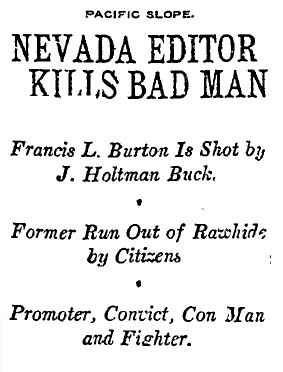
Goldfield, Nev.—J. Holtman Buck, editor of the Western Nevada Miner in Mina, Nev., shot Francis L. Burton to death during a fight over a scathing editorial in which Buck said Burton should be run out of town.

Burton had a long record of fraud and was paroled from a Montana penitentiary after he conned the warden out of $7,000 in one of his investment schemes. In another case, Burton disguised himself and robbed his own bank, and he barely escaped being lynched after bankrupting an entire mining camp in a fraudulent scheme.

More recently, Burton had been in Mina, “jumping town lots and raising trouble generally. He was mixed up in … quarrels and in court continually,” The Times says. A mass meeting was held as soon as he went to Rawhide, and the miners ran him out of town.

The fatal fight was provoked by Buck’s editorial, which said that if the people of Mina had the nerve of those in Rawhide, “Burton would not be anywhere within a thousand miles of the place.”

Apparently all charges against Buck were dropped. The Western Nevada Miner stands by its story.

Lmharnisch.com

Lmharnisch.blogspot.com

e-mail: lmharnisch (AT) gmail.com

Posted in 1907, Black Dahlia, Books and Authors, Crime and Courts, LAPD, Streetcars | Comments Off on The .45-Caliber Ombudsman

Uh-Oh

Dec. 10,1907
Los Angeles

Mayor Arthur C. Harper happens to be in all sorts of trouble. He’s telling the newspapers that he has had enough of politics and won’t seek another term. The district attorney is trying to shut down the local red light district and eventually these efforts will reveal allegations of City Hall corruption involving Harper, Police Chief Kern, a police commissioner, a police captain named Broadwood and Nicholas D. “Nick” Oswald, one of the biggest leaders of the city’s underworld.

The 1909 Broadwood case is complicated (he was found not guilty, by the way, despite accounts of payoffs from the earnings of Los Angeles bordellos) and in researching the mayor’s life, I came across the following incident.

The word “homosexual” is a rarity in The Times, appearing exactly twice in editorial content between 1900 and 1940: a 1912 review of “The Candle and the Flame” by George Sylvester Viereck; and a 1939 health column by Dr. William Brady.

So what does the paper do when “purity squad” raids the former mayor’s home, 1128 W. 28th St.? Like this, from Feb. 1, 1920:

“Twenty Los Angeles men, some said to be prominent in social and business circles, were arrested last night by police at a stag party in the home of former Mayor Harper and were booked at the police station on the charge of social vagrancy.

“Seven of the men, including the host, Joseph Harper, 24 years old, are alleged by the officers making the raid to have been gowned in feminine apparel.”

After a few paragraphs, the paper says: “According to Police Sergeant Gifford and the officers of the ‘purity squad’ who conducted the raid, a degenerate orgy was in progress when they entered the house.”

The men were taken to jail as they were dressed, meaning that some of them spent the night in women’s clothing. Early the next morning, The Times says, the dresses were taken into evidence, so some of the men were given bathrobes and others draped themselves with jail blankets. Of the 16 arrested, four were released to the Navy (they were in uniform, The Times said) and eight were held in custody because they tested positive “for infectious disease.” And yes, their names or pseudonyms, addresses and occupations were published.

When asked about his son Joe, the former mayor said: “The only party he has given lately that I know of was given by him on Halloween night. His mother was present that night and among the guests during the evening, so I know nothing wrong took place.”

One of the sailors said: “I came in for my liberty and met a fellow at a downtown street corner. He asked me if I’d like to attend a nice party with dancing and girls and refreshments and said for me to bring some of my friends along.”

The Times said: “The sailors declare they did not know for a long time that the ‘girls’ were men and when they did learn of the fact, some thought it was just a good-natured masquerade ‘stunt.’ ”

A later story says: “All the men are charged with lewd and dissolute conduct. Seven were dressed as women and the police say their acts were such that the charges against them can be upheld in court.”

Police said that officers learned about the party several weeks ago. “Arrangements were made to have some of the officers in the house,” The Times said.

“The raiding officers in plain clothes gained entrance to the house and mixed with the strange guests. Several other officers climbed into the house by way of a rear window and concealed themselves beneath beds. After watching the ‘party’ for over two hours, whistles were blown and the raiding party rushed into the residence.”

Two months later, the case against the “Lady Men” was dismissed.

Bonus fact: One of the earliest occurrences of “gay bar” in The Times appears in a Oct. 15, 1953, story about the extortion trial of Jimmie Tarantino and refers to a bar on Market Street in San Francisco.

Lmharnisch.com

Lmharnisch.blogspot.com

e-mail: lmharnisch (AT) gmail.com

Posted in 1907, 1909, 1912, Black Dahlia, Books and Authors, City Hall, Crime and Courts, Downtown, LAPD, Streetcars | Comments Off on Uh-Oh

Not a Coward


Dec. 9, 1907
Los Angeles

Mayor Harper has restored E.J. Bowen to his old job in the Fire Department after the rookie police officer was fired for allegedly being a coward—a charge that Bowen, who is black, blames on racism.

Bowen transferred to the Police Department almost six months ago and his probationary period was almost over when he was accused of cowardice in two instances. In the first incident, Bowen allegedly refused to enter a house where burglars had been reported and in the second, he would not enter an unlocked store until another officer accompanied him.

He gave the following accounts: Two daughters of an attorney named Sturgis [possibly Alonzo A. Sturgis] thought they heard burglars in their home on Chicago Street, which was apparently in Boyle Heights. They ran out of the house and told a streetcar crew, who reported the incident to Bowen. Bowen allegedly was afraid to go into the house unless a streetcar motorman accompanied him, but the officer said he went to the home at once and searched it. The motorman came along on his own initiative, Bowen said.

He also said that while patrolling his beat, he found an unlocked cigar store, but refused to enter until another officer arrived, not out fear, but because he was afraid that if anything was missing, he would be accused of theft.

After the allegations were made, the streetcar motorman and the second officer from the cigar store incident visited Mayor Harper, saying that Bowen was being “jobbed” out of the department.

Police officials told The Times that Bowen wasn’t actually found guilty of cowardice, but lack of aggression and being too timid about taking responsibility.

Lmharnisch.com

Lmharnisch.blogspot.com

e-mail: lmharnisch (AT) gmail.com

Shout out to Nathan—Happy birthday, crime buddy!

Posted in 1907, Black Dahlia, Books and Authors, Crime and Courts, LAPD, Streetcars, Transportation | Comments Off on Not a Coward

Whereabouts Unknown

Dec. 8, 1907
Los Angeles

I’ll apologize now, for this is an account with more questions than answers; a story of heartbreak and hope without an ending.

The Times features three members of the Schiffman family who are Jewish refugees from Baku, Russia (now part of Azerbaijan): Sigmund, the father; Benjamin, the 15-year-old son, and Emella [or Emelia], the 10-year-old daughter. The Schiffmans have been brought to Los Angeles as part of the Galveston Plan, in which Jews were taken to Galveston, Texas, for dispersal throughout the West because New York was overcrowded.

Although Sigmund is quite a scholar, speaking German, Russian, Polish, Greek, Latin and, of course, Hebrew, he is making a living as a door-to-door salesman. Benjamin, according to The Times, has had to abandon his education to work in tailor shop. “He is a faithful worker but his youthful spirit rebels at the change from study to ‘rubbing clothes,’ ” The Times says.

Emella is described as “one of the prettiest Jewish maids who has ever come out of Russia.” She is attending the California Street School, where she is studying English. So far, her knowledge of the language is limited to a useful American phrase: “Hurry up.” However, she is quite expressive in German and when told that The Times wanted to take her picture, said: “I must be a very important personage for the newspaper to desire my picture.”


The elder Schiffman tells of the horrific conditions in Baku at the hands of the Cossacks. “All people in Russia have the greatest fear of the ‘Black Hundred,’ ” he says, “which is not a single hundred but bands of the lowest and most brutal Cossacks, nightly let loose to work their will upon any person supposed to have thought adverse to the government. They lie around, stupid and asleep in the daytime. In the evening they are plied with vodka and drink-crazed, brutalized, are set to raid homes. They enjoy government immunity for any deed committed.”

What became of the Schiffmans? We simply have no record of them. Not in The Times, not in online public records—nowhere. Perhaps they changed their names or perhaps they left Los Angeles.

All we do know is that the local Jewish organizations, B’nai B’rith, the Hebrew Benevolent Society, the Jewish Women’s Foreign Relief Association and the Jewish Sisterhood helped them. Sigmund Schiffman was supposed to address a group about “Governmental Conditions and Methods of Persecution in Russia,” but The Times apparently did not cover his talk.

Lmharnisch.com

Lmharnisch.blogspot.com

e-mail: lmharnisch (AT) gmailcom

Posted in 1907, Black Dahlia, Books and Authors, Education, LAPD, Religion, Streetcars | Comments Off on Whereabouts Unknown

The Confession of Morris Buck

Dec. 7, 1907
Los Angeles

“I asked if she received the letter. She said she had. I asked her if she would loan me a sum of money to be paid back monthly and I was going to open a bakeshop.

“She said that she had so many—several calls for money, that she didn’t see how she could loan me any and she says: ‘Why can’t you work?’

“I said I had been working but I never got anything ahead to start up in business. She says: ‘Have you any relations? Can’t you borrow any money from Will?’

“He is my brother. I told her that he was poorer than I was.

“I told her I was different from the others.

“She says: ‘You wait here’ and she went in the hall and she came out again. I was standing up.

“She came over toward me and I says: ‘Who did you ring up?

“She says: ‘I rang James, the coachman.’

“At the same time, she placed her hand in her vest and I moved to the left….

“As soon as I saw her hand in her vest I turned to the right and I pulled my gun and I says: ‘Throw up your hands.’

“And she says: ‘Put down that gun’ and she turns and says ‘Go back, he has got a gun’ and she would not put her hands up.

“And I says: ‘Would you strike an old man?’

“And she says: ‘Yes.’

“I says: ‘Would you put me into an asylum?’

“And she says: ‘Yes.’

“And I pulled the trigger and she hollered: ‘Help!’

“I pulled the trigger the third time. It only went off twice. I pulled it twice and then I pulled it the third time and it wouldn’t fire. I was about two feet from her. I was afraid of my own life. I didn’t see any weapon that she had. But I didn’t want to take any chances.”

…. “She fell and I said something over the body. I don’t remember what.

“Then I went toward the railing and I saw a lot of men in the road and I put the gun up to my head and I said: ‘Gentlemen, must I blow it out?’

“Nobody said anything that I could hear. I said: ‘Gentlemen, it relies on you.’

“Somebody says: ‘Who has got a gun? Shoot him.’ And then somebody says: ‘Give me the gun.’

“I was sitting down on the rocking chair. Then I got up and I says… I was sitting down and says: ‘Don’t any of you shoot. Let an officer take charge of this.’

“Then they says: ‘Kill him. Hang him.’

“And I got up and I pulled my gun. I had two guns. And they says: ‘Look out, he has got another gun.’

“I stepped back and I run. I jumped over the rope on the side porch and run to the next corner. I must have lost my other gun. It dropped out of my pocket. I ran down on 4th Street and then down as far as Westlake.”

… “I run into the ice cream parlor and I says; ‘There is a fellow after me.’ And I says: ‘Close the door and don’t let him in till an officer comes.’

“And he says: ‘We know it. Lean over’ and she [he?] shut the door. And an officer came and brought me here.”

Morris Buck was convicted in the Jan. 27, 1906, slaying of his former employer, the wife of Charles A. Canfield, an oil executive and partner of E.L. Doheny, at the Canfield home at 8th and Alvarado. According to The Times, Buck shot her once after she refused to loan him $2,600, and her young daughter screamed and ran into the house. The wounded woman wrestled with Buck as he shot her again.

Buck claimed that he was insane, having once been kicked in the head by a horse. He had been held in the mental ward at the County Hospital for two months in 1903, but the insanity plea was rejected as a ruse.

An expert on Bertillon criminology said: “Buck is one of the most interesting criminals I ever saw. I do not believe he is insane; he is, in my opinion, a low degenerate from the effect of vicious personal habits.

“His eyes are dull and perfectly lifeless; his lower jaw lops open and his scrawny, limp body seems to be giving away at the knees. It seems as though there is not a drop of real life in him.”

The criminologist warned: “If that man is ever hanged you can be prepared for something horrible. I have seen men of just his stamp hanged—weak degenerates. Awful! They break down and are dragged to the gallows weeping and sobbing like children and are held up to have the noose put on.”

In fact, Buck went quietly:

“This morning, he awoke early, and after dressing himself in the clothes in which he was to be executed, he ate a hearty breakfast,” The Times says. “Father Callopy remained with him until he was declared dead.”

“A few moments before the time set for the execution, the warden entered the condemned cell and read the death warrant. Buck’s hands were then strapped to his sides and the march to the gallows was begun at 10:50. Warden Hoyle took the lead, then came the priests, chanting prayers for the dying and following came the condemned man, a guard on each side.

“He then stood upon the trap. Guard Albrogast placed the rope around his neck, drew the black cap, the signal was given and his body dropped.

“Below the trap stood the prison physician, Dr. Stone, and Dr. Galehuse of San Rafael. In 14 minutes, the condemned man was declared dead. The body was cut down and placed in a prison coffin.”

In an interesting footnote, five of Canfield’s children received $500 a piece from her estate. Another woman named Hattie Elizabeth Bryant or Dorothy Canfield was given $5. “It is not my desire that she be recognized as one of my children,” Canfield’s will said. Years later, it was revealed that Dorothy was a foundling taken in by the Canfields.

In 1911, Canfield’s son, Charles, fled to Mexico after passing worthless checks. His father said: “I don’t know where he is and I don’t care.”

In 1917, the five Canfield daughters, as trustees of $100,000, sought to sell their late father’s real estate to establish a school for girls.

In 1933, daughter Daisy Canfield Moreno died when the car in which she was riding plunged off Mulholland Highway on her way home from a late-night party at the Beverly Wilshire Hotel.

In 1972, the Canfield Foundation dissolved, giving $700,000 to Mills College and $1 million each to Pepperdine and Stanford.

And nowhere, in any of these news stories, do we learn Mrs. C.A. Canfield’s first name. It is almost beyond belief.

Lmharnisch.com

Lmharnisch.blogspot.com

e-mail: lmharnisch (AT) gmail.com

Posted in 1907, 1908, 1911, Black Dahlia, Books and Authors, Education, LAPD, Real Estate, Streetcars | Comments Off on The Confession of Morris Buck

Note to "Dahlia Avenger" Fans


Here’s a publicity still of “Maddy” Comfort from “Kiss Me Deadly” for sale on EBay. Her name is also spelled “Mattie” and “Mady.”

Comfort is referred to in the Los Angeles County district attorney’s files on George Hodel. Investigators checking on his possible involvement in the Black Dahlia murder discovered two photos of her, one by herself in which she is nude and another in which she and George Hodel are holding a cat.

When shown the photos
, Hodel’s former wife Dorothy was unable to identify the model. But she is identified elsewhere in the district attorney’s files as “Mattie Comfort, 4028 W. 28th St. RE 2-0207 HO 4-0266.”

By the way, the woman in one of the photos that Steve Hodel claims shows Elizabeth Short has positively been identified as Marya Marco a.k.a. Maria San Marco. Just as I’ve been saying from Day One. I don’t read Steve Hodel’s website, but people who do informed me that Hodel says Marco recognized herself in publicity photos about the case and contacted him. As with all the important witnesses in “Avenger,” she is given a phony a name.

Here’s another picture of Comfort in a screen grab from “Kiss Me Deadly.”

And another photo for sale on EBay:


Lmharnisch.com

Lmharnisch.blogspot.com

Posted in 1947, Black Dahlia, Books and Authors, Cold Cases, Crime and Courts, Found on EBay, Homicide, LAPD, Streetcars | Tagged , , , | 2 Comments

Shout Out to Nathan

Posted in Black Dahlia, Books and Authors, LAPD, Streetcars | Comments Off on Shout Out to Nathan