You have got to be kidding me


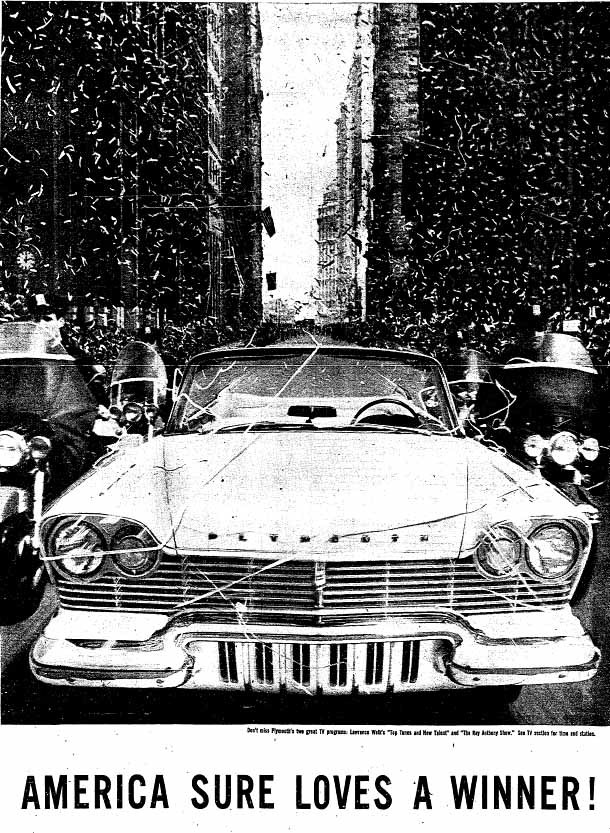
Tulsa buries a 1957 Plymouth in a time capsule.

Email me

Posted in #video, 1957, Television | 2 Comments

Con game

April 18, 1957
Los Angeles

By Matt Weinstock

 Dist. Atty. William O. Weissich of Marin County has announced that he plans to ask all persons with access to San Quentin’s death row to take lie-detector tests to find out how Caryl Chessman smuggled out a book manuscript, his fourth.

Six persons already have taken the test, but one of the four prison chaplains has refused, saying, “If the word of a man of God is not enough, he might as well take off his clerical gowns and bury them.”

A man now working in L.A. who served some time in San Q. is irked by the D.A.’s announcement. It is not only a grandstand play, he says, but silly and stupid.

And he told me how a man in condemned row when he was up there got out mail at will, without help from the prison staff. He is certain Chessman, who expertly writes Gregg shorthand, uses the same method.

Men on the row can buy tobacco, candy and cookies from the commissary out of their allowance of about $15 a month ($107.48 USD 2006).

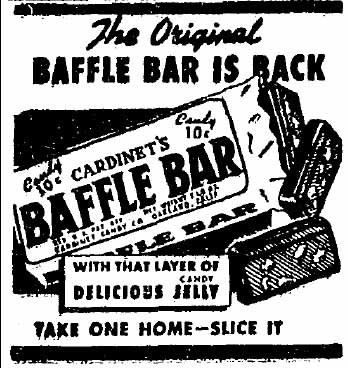
The man in question wrote his letters on the inside of candy bar wrappers. These were swept out each morning with the other trash–cigarette wrappers, newspapers, magazines. A guard escorted it downstairs, where a trash cart worker picked it up and it was hauled to the incinerator and ostensibly burned.

But one of the cons, perhaps the one at the incinerator, would pick out the candy bar wrappers and give them to another con, perhaps a typist clerk. From this point it was no trick at all to smuggle a letter out of prison. Remember, several hundred men work outside the prison–at the hog ranch, doing road work, cleanup jobs. The trick was getting the letter out of condemned row.

To make it easy for his cooperative pals, the man in question always used the same candy bar wrapper–ironically, a Baffle bar.

Posted in 1957, Caryl Chessman, Columnists, Matt Weinstock | Comments Off on Con game

“My Father, My Son”


April 18, 1957
Los Angeles


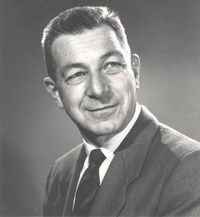
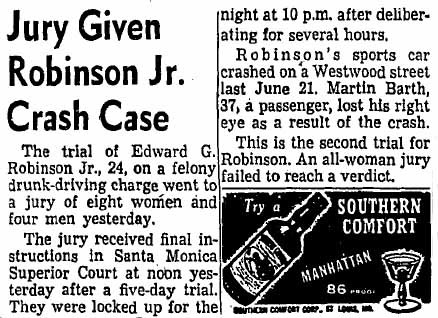
Someone at The Times had a sense of humor to place a story about a drunk driving case next to an ad for Southern Comfort. There really wasn’t much news to it, just the son of a Hollywood star, in trouble for being drunk once more.

The arc of his life is not a pretty one. The Times’ earliest stories are about birthday parties with other children of other celebrities. Then the stories turn dark: Injuring himself slightly when he was 16 and out in his expensive convertible, hitting two cars at Willoughby and Hudson avenues in Hollywood.

At 19, he eloped to Tijuana with the first of his three wives. His furious father threw him out of the house at 910 N. Rexford Drive and cut off his $70 weekly ($524.97 USD 2006) allowance. He and his wife split up and reconciled several times until she finally divorced him three years later.

He was arrested for drunk driving, being drunk and disorderly, and charged with holding up cabdrivers, although the jury deadlocked  in that case.

Here and there, he turned up in a few movies and TV shows: “Screaming Eagles” and “Tank Battalion”; “Laramie,” “Wagon Train” and “Gunsmoke.”

And he appears as Johnny Paradise with George Raft in “Some Like it Hot” in scenes set at a resort that was actually the Del Coronado.

By the time he was 38, he was so ill that his lawyer warned the judge he might not survive a 90-day jail sentence for drunk driving.

And in February 1974, at the age of 40, Edward G. Robinson Jr. was dead.

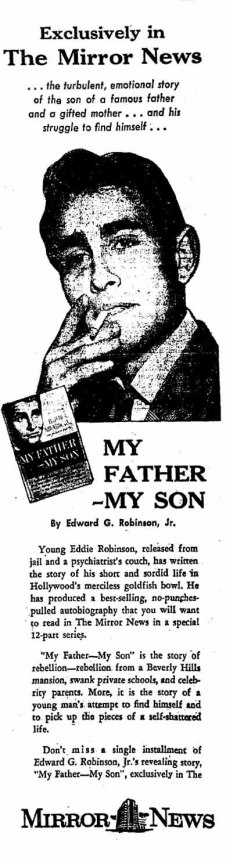
Somewhere in the midst of all his arrests, Robinson found time to write a book, “My Father/My Son,” which was serialized in the Mirror, despite terrible reviews.

In a biting commentary, Robert R. Kirsch wrote: “If Edward G. Robinson Jr. ever reads this book with the eyes of an adult it should seem apparent to him  that at least some of his difficulties stemmed from his unwillingness or incapacity to make his own way. Though he deeply resents it, he has done very little to prepare himself for what he says are his ambitions and ideals.

“He might try changing his name and making his own way as a start.”

Email me


Posted in 1957, Hollywood | Comments Off on “My Father, My Son”

Voices


Cliff Dektar was a copy boy for The Times in 1943. He worked for the Mirror from 1950 to 1956, when he left for ABC-TV.

On Jan. 2, 1951, Photographer Bud Gray and I were working the overnight Mirror radio car 91… after 2:30 a.m. the streets really are quiet until around 5 a.m. We had stopped at Hollywood Receiving Hospital and were headed north on Wilcox…I was driving.

The police radio came alive…69 meet 66 at Hollywood and Vine. Well, 69 was a sergeant and 66 was a district radio car and this was a most unusual call at 4:30 a.m. … so I decided to drive by since it was only a few blocks away.

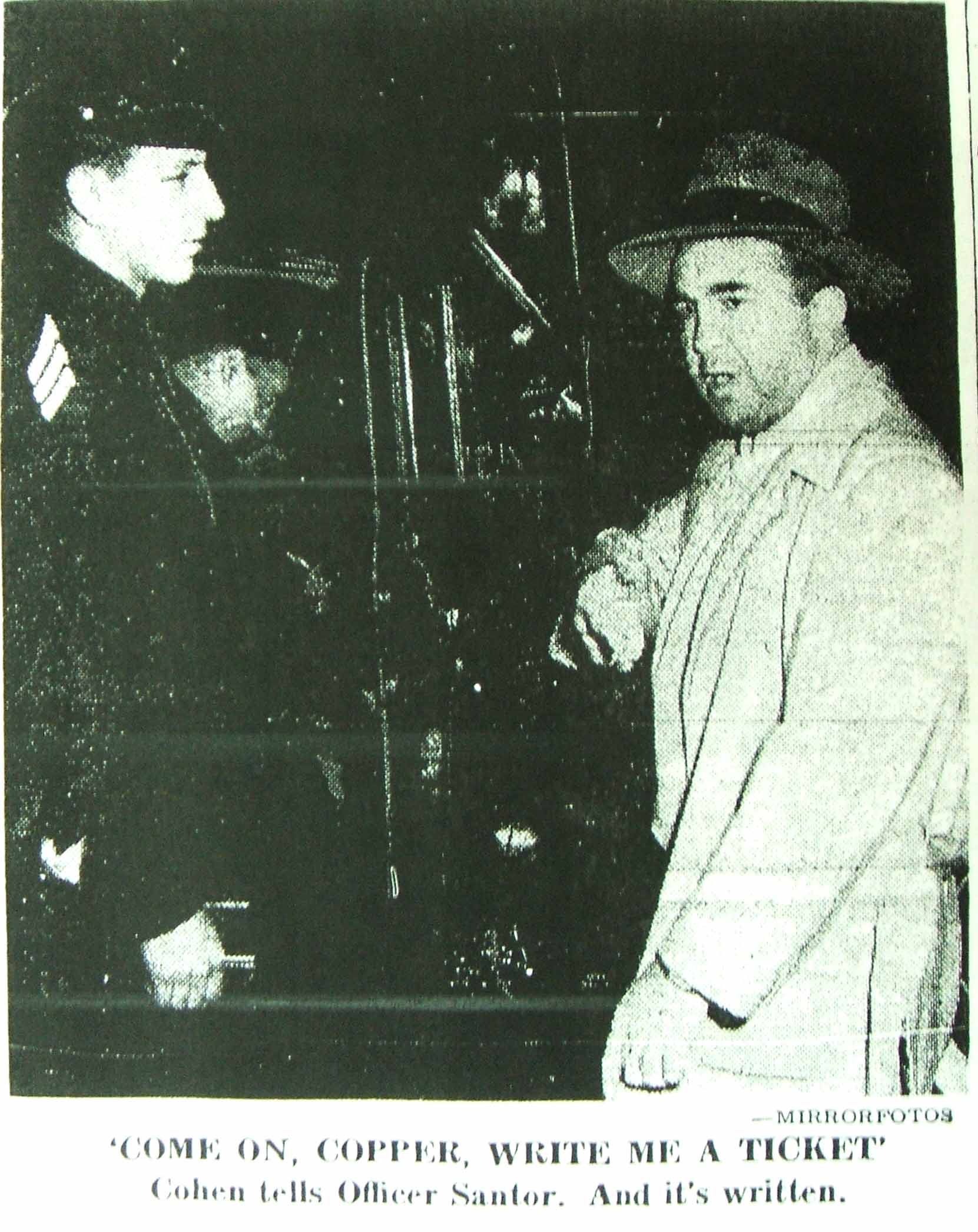
Amazing… standing on the corner by the  Broadway Hollywood was Mickey Cohen… wearing his hat as usual… and waving his hands with an LAPD Officer Tommy Hutton.  He was agitated.

I nudged Bud, made a U-turn on Vine and parked across the street in front of the Owl drugstore.

I turned off the ignition and strolled across Vine and listened… no note taking.

“If you’ll take off your badge and come into the alley and fight me fair and square, I’ll give you my wife and my car,” growled Mickey.

(The blue Cadillac and his wife were parked a few feet away).

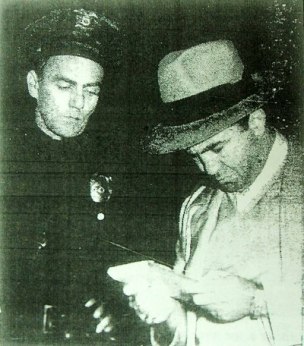
Officer Hutton had written Mickey a traffic citation for not proceeding on a green light–he had stopped to purchase a newspaper.

Mickey refused to sign the ticket.

The sergeant arrived and explained to Mickey that by signing, he did not admit guilt, only to appear.

“If  you don’t sign, Mickey, we will take you to jail,” the sergeant explained.

Finally, Mickey signed, walked and entered his car, and drove south on Vine.

Meanwhile Bud Gray had set his Speed Graphic so he could shoot from the hip without focusing.

Bud shot four photos… all were excellent.

We jumped back into the radio car, called the office and sped to 2nd and Spring with the photos.

By the time  reporters in the police press room heard about  the incident, everyone  was gone, Mickey, the police and the few spectators.

We had a real beat… four good photos and details… all Page 1.

I thought of how wild Aggie Underwood, city editor of the Herald-Express, would be, as the Mirror guys had beat her team, again.

Email me


Posted in Hollywood Division, Mickey Cohen | Comments Off on Voices

A lack of curiosity

April 16, 1957
Los Angeles


Everyone seems to be wondering what became of Evelyn–everyone except her husband, Leonard. The way he tells it, on May 8, 1955, they took a car for a test drive along Mulholland, came back to their home at 217 N. Bentley Ave. in Bel-Air and she asked him to go to the store and get some tooth powder.

When he got back, she was gone. He found her car a few days later and decided he might as well sell it. He also figured that since Evelyn, at least in his version, used to disappear frequently on drinking binges, there was no point in filing a missing persons report.

Her friends and her brother, E. Raymond Throsby, began asking questions about where Evelyn might be, but never got any answers. Finally, they went to the district attorney’s office with a complaint.

The questions became more awkward, and eventually the police were asking what had become of Leonard, who was released from custody even though he was under indictment for murder. His car, a 1948 maroon coupe, was found May 5, 1956, at 2214 Washington Ave., with a bullet hole in the windshield in front of the driver’s seat and another in the interior.

At first, it seemed that Leonard had met an unfortunate fate. Police were unconvinced, however, since it was clear that the bullets had been fired from inside the car, and the search for L. Ewing Scott was on.

Scott remained a fugitive until April 15, 1957, when he was arrested in Windsor, Canada, while returning from Detroit with a new car. He had been passing himself off as Lewis E. Stewart and a customs agent noted that he had the same initials as the fugitive. Under Canadian law, an individual doesn’t have to give fingerprints unless he is charged with a crime, so Scott refused and his identification was delayed briefly.

He hadn’t been idle while he was on the run. As Leonard Spencer, he had been courting a teacher in Barrie, north of Toronto, police said. He had also been living in Ontario, Montreal and Oakville, sometimes using the name R.E. Scott.

To be continued…

Posted in Homicide | Comments Off on A lack of curiosity

Like gonesville

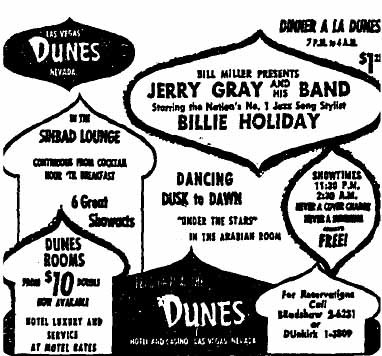
Billie Holiday, 1957, “Fine and Mellow”

Email me

Posted in #Jazz, #video | Comments Off on Like gonesville

The case of the new courthouse


April 15, 1957
Los Angeles

The Times features the new courthouse rising at 1st Street and Hill in the Civic Center.  After cataloging  the materials (Italian  marble,  red granite from Texas  and ceramic veneer from Springfield, Calif.)  The  Times’ Ray Herbert notes the architects, who include Paul Revere Williams, J.E. Stanton and Adrian Wilson, and says the building is designed to last 250 years.


Did The Times note that Williams was first African American west of the Mississippi to be a certified architect? No. Did The Times note that Williams was the first black member of the American Institute of Architects? No.

Let’s move on.

The Times says that the Los Angeles County Board of Supervisors approved a proposal for a new courthouse the day after the Long Beach earthquake in 1933.  Bureaucracy being what it is, in addition to a lack of money, disagreement over the location and World War II, the groundbreaking was delayed until March 26, 1954.

One of the most interesting aspects of the new courthouse is the massive civic works project to lower Bunker Hill. The Times says that 520,000 cubic yards of dirt was removed in excavating the site of the courthouse. But it also says the Grand Avenue entrance will “abut on 15 feet of solid earth under Grand Avenue until the street is lowered.”

I have heard all sorts of figures thrown about for how much Bunker Hill was lowered–anything from 30 feet to 90 feet. This is the first reliable figure I’ve come across.


The courthouse formally opened Oct. 31, 1958.

Of course, I always think of the building as an establishing shot for “Perry Mason.” But that’s just me. (And no, there aren’t any windows like the one used in this opening sequence for the TV show).

Posted in Downtown | Comments Off on The case of the new courthouse

Forest Lawn


Easter Sunday seemed like a good time to drive over to Forest Lawn and visit a few graves. I bought some flowers and went off to find Norma McCauley and Caren Lynn "Sande" Crabbe.

The woman at the front gate was extremely professional and helpful, and she gave me precise directions. Norma is in the Columbarium of Sunlight and Sande is in the Sanctuary of Celestial Peace. I was surprised at how many people were simply spending time at the hillside graves, with folding chairs and flowers. A couple of young men were partway up a hillside with a Marine flag.

The Columbarium of Sunlight is quite pretty and I had it entirely to myself. While I was in the area I found the graves of Earl Carroll and Beryl Wallace, who died in a plane crash, Mary Pickford and Atwater Kent, which reminded me of "Millionaires’ Row" up at Mountain View Cemetery in Oakland.

The Sanctuary of Celestial Peace was a bit different. I went in the wrong door and in wandering around, stumbled across the crypt of Art Tatum.

In fact, it was quite a day for musicians, as I also found Alfred Newman and Max Steiner, who had been sent a large floral wreath. There were roses on the crypt of William "Hopalong Cassady" Boyd.

"Sande" Crabbe is partway up the wall and while I was getting water for the flower I ran into a couple of women. It turns out  Paramahansa Yogananda of the Self-Realization Fellowship is in the same building and they were meditating in front of what appeared to be his crypt. I didn’t want to interrupt them to find out.


One of the crypts was elaborately decorated for an Easter egg hunt. I have seen all sorts of grave decorations in searching for Los Angeles history, but this was a first and very nicely done.
Email me

Posted in Cemeteries, Forest Lawn | 1 Comment

Voices

          In 1957, saxophonist Dave Pell was the leader of the Dave Pell Octet, the house band at the Crescendo on the Sunset Strip. He recently reminisced about performing there with comedian Lenny Bruce. Pell performs once a week with Johnny Vana’s Big Band Alumni at Los Hatos in the San Fernando Valley. Lenny Bruce died Aug. 3, 1966, at 8825 Hollywood Blvd. at the age of 40.
  

Well I was lucky, very lucky. I was there for five years and Lenny was there for almost the same amount of time. It was one of greatest moments of my life. He was quite a man. Incredibly funny, loving, kind, sweet… all the things that nobody ever knew about him. Nobody took the time to know about him. He was really a lovely guy, a lovely man, a funny man. We had a guy named Jack Sheldon in the band. Sheldon was the phenom of our time. A very funny cat. He and Lenny were dear friends. They used to do crazy things together.


We were a Be-Bop band that played for everybody.

Gene Norman (the nightclub owner) … says: “You have a home here… Stay as long as you wish.” It was the time where Mickey Cohen used to hang out at the club. He used to have his boys there. They were dear men. As big as gangsters as there ever were. He loved Lenny. He was their favorite of all.

We played for all the acts. Johnny Mathis and we played for the Mills Brothers and, you know, people of that nature. People played the club with us…. Lenny was in and out of jail every other day. He was there.

Then the narcotics people were hanging out. They were dear friends. They were after the guys selling to the band and Mickey was there every night. With Lenny there; he was changing the show every night and the band was absolutely loving it. Most comedians worked to the bands because they gotta hear the same material night after night. If they could make the band laugh then they knew they were funny… Lenny played to us. He and Jack Sheldon would do dialog together.

Lenny would say: “Did you see Mickey’s here tonight?” We’d be on the floor. A very hip band: Marty Paich on piano, Mel Lewis on drums, Buddy Clark on bass. It was the best band in town by far. We’d play the dumb Mills Brothers. We’re playing “You Want a Paper Doll.” Playing almost back to Dixieland and playing it straight. And Bobby Darin. Just an incredible thing.

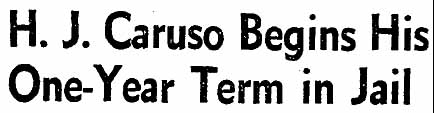
The funniest thing. Lenny Bruce and Jack Sheldon decided to go on the amateur hour…. Do an Al Jolson song. Something was all set up and they’d play it and wear black makeup. They did the show… it was a car dealer that had the show … I wish I could remember. On Sunday morning… Jack and Lenny were going to be on and we were all set up to watch it. (This was apparently Compton car dealer H.J. Caruso, who was indicted on charges of forgery and grand theft in June 1957).

 They got on. They didn’t do the show they auditioned with. It got a little dirty and funnier and funnier and Lenny is yelling “Caruso is a thief!” “He doesn’t give good deals on cars!” They couldn’t get him off soon enough. They said, “This isn’t the way they auditioned.” They finally figured out it was Lenny Bruce.
I never got over that one. Funniest thing that ever happened with the band.
Every night, Lenny was a magnificent mind. If he took off, we had Mort Sahl. He would do a half-hour on Lenny Bruce. And they put him in jail and he’d try to behave. He got put in jail 50 times because they were trying to clean up the nightclub circuit.

Just the greatest time of our lives.

Lili St. Cyr, a  beautiful lady. Harry Betts was a trombone player with Kenton. He said, “Well you know she has this one little piece that needs a violin.” So we made him bring a violin. He played a solo behind her (Pell hums something from Tchaikovsky’s “The Nutcracker”). Lenny would come up just to see the guys laughing… He didn’t play the violin well. She was dancing with all these lights. She was never naked, she wore a skin thing. We weren’t going to see nothing. Lenny Bruce made so much of it. God he was funny.

Between sets, they turned over people so fast, we’d go downstairs and play poker for an hour.


Johnny Mathis was doing seven or eight shows a night. People were around the block. Gene Norman had signed Johnny Mathis 10 months before he had a hit. He comes up with all his hits in one short time…. He was working for $350 a week… around the block crowds are waiting to get in. We would do a fast 20-minute or 30-minute show and the next one would start. They’d empty the house and do another one.

And of course Lenny … He’d say: “I can’t be very funny tonight I’m down to 10 minutes.”  So hip and so sharp… and I look back. Damn that was fun. Lenny was a marvelous cat and got in trouble and couldn’t handle it and died very young. His wife a very nice gal and a homemaker and tried to make him straight.

Jack Sheldon and Lenny Bruce. Jack almost started his career with Merv Griffin… doing comedy. All the timing he got from Lenny….

Five years. We had a ball… a lot was happening then.
When Lenny Bruce was downstairs, Mort Sahl was upstairs. When Lenny had to go to jail we got Mort Sahl… He’d read tabloids, and then do a show.

It was sensational. Edie Gorme, all the good singers. Everybody who was hot at the time was there with us. Marty Paich, in 1957 he couldn’t have been over 21 years old. Marty turned out to be one of the most successful jazz and big band arrangers of that time. We had him and Shorty Rogers and we never had the same band two nights in a row. The deal was you could take off any time as long as I approved the sub. We had record dates so there was a different band every night….

Bobby Darin says, “The band is sensational. It’s the best band I ever had.” He comes in the next night, it’s totally different. “The band is sensational.” Half the band was back the third night… He says “Dave I can’t handle it.  I can’t kid with the band, it’s never the same guys twice.” They’re playing for scale, so I say, “They can take off anything they want as long as they are the top guys.” The best band I’ve ever had….

Those things were so much fun… That whole club situation….

The club was on Sunset in the Playboy Building…. and then we were right at the middle of the strip. Across the street was Ciro’s, right across the street. Little nightclub on the West Coast. Ben Polack (?) had a Dixieland club that ran strippers. He had a good Dixieland band. Great players. We’d play the opener or closer. “Mountain Greenery.”

He booked smart in those days, three or four shows a night….
 

I
t was a great home for me. I was working at a record company during the day. It would be the Dave Pell band and I’d be at a record date. Gene Norman and I went to high school together (so that wasn’t a problem).

It was a record company. I’d record in the afternoon and rush over to play the first gig at the club. I’d be tired but had a such a good time… such an incredible time. Not a dumb gig at a nightclub, it was the hit nightclub and Lenny being there with us killed us.

It was the funniest thing going day by day. Mickey Cohen…. Lenny would come and play to them. Call them the stars of the government…. highest government officials in town and Mickey Cohen… everything was so cool.

I used to be in  the record business. Sold them in the supermarkets for 99 cents. I’d record “Dave Pell Plays Benny Goodman,” “Dave Pell Plays whatever.” I must have made 50 albums, “The Best Songs of Italy.” I’d go to England for a couple weeks and record 20 albums. Put them in Kresge, Woolworth, the same albums but change the songs on each one…. It was the beginning of the compilation disc.

I’d have 75 string players over in England. The albums were gorgeous… The label was TOPS records… I put out 20 other labels for everybody else. Everybody had their labels. You’d go into Sears and there’d be a rack near the door. I sold millions. People never had to go to the record store.

I’d work at night.. Edie Gorme would come to sit in. People didn’t realize it was her. Didn’t recognize her… They’d wonder who is singing with the band?


It’s marvelous, at 10:30 every Tuesday morning… at Los Hatos at Balboa and Nordhoff… They can’t get in the joint. Oversold every Tuesday morning. We play till 12:30. The band is excellent… Johnny Vana’s Big Band Alumni… Everybody played with the big bands, Stan Kenton, Buddy Rich…. producing a new album we did live a couple of weeks ago…

Lots of bands out there… They say we’re the Glenn Miller Band, or the Harry James band. All picked up for the night. They sound fair. This band plays all the bands… We have a great band… One of the guys got sick, so they asked “Pell, would you like to play?” Love to. I don’t have to set up, don’t have to bring mikes. Just sit in the band. I love it.

The other day they gave me a red tie that I can keep so when I play around town I don’t have to borrow a tie… It’s a good band.

A guy came in and recorded it… We only get a one-hour set and then a 20-minute set. He figured he could do an album in two days… The album was almost really done the first morning it was so good. It was fun and we go out and do the shows and the band is very happy. We call it a rehearsal, so the guys can keep their chops up.

Lots of clubs tried to do that but they don’t seem to get the crowds that this thing does. People still really want to dance, do the jitterbug. It’s not rock ‘n’ roll.

Sound clips courtesy of Davepell.com

Email me.

https://ssl.google-analytics.com/urchin.js    _uacct=”UA-18065-1″; _uanchor=1; urchinTracker(); if (typeof(setPostToken) != “undefined”) { setPostToken(‘J7Yb6xEBAAA.kuAnviL6EEcCqPetJxhIoz0GE4tc5seI6T4hOe2ubVA.-wXbyJhuyf1R-OLPfm6rvA’); }

html hit counter

Posted in #Jazz, Mickey Cohen, Nightclubs, Sunset Strip | 5 Comments

The Wife-Saving House

April 13, 1957
Los Angeles

By Larry Harnisch

Step back with me for a moment to that 1950s home the McCauleys built, one of those futuristic places that practically took care of itself and just needed a little soap and water. You know, tall ceilings, lots of glass, a big brick fireplace in the living room and radiant heating in the slate floor.  The walls and ceilings are birch that never has  to be painted. When it was written up in The Times, they called it “The Wife-Saving House.”

Don’t rush over to 1100 Somera Road to look for it. The home is gone now; torn down by 1967 and maybe it’s just as well.


It’s the middle of the night and quiet now. July 5, 1955.  Come on in. They never lock the doors around here. Everybody–well almost everybody–is asleep. The three boys are in their bedroom, where the bedspreads, with pictures of the circus, match the drapes. There’s a maid, too, somewhere around here, and the family dog, Cinders.

Nice, modern home, isn’t it? Just the kind you’d expect for a wealthy Los Angeles contractor to build for his daughter. Let’s push open the door to the bedroom. Look at those big windows. Quite a view. Be careful of all the blood.

There she is. Don’t touch anything. Just look. They’ll find her soon enough. That’s her quilted silk robe across the foot of the bed.  She never made it.

Oh, that’s the dog howling. Here comes the maid to let it out. She’s going to go back to bed as if nothing is wrong.

The woman lying there is named Norma and she was 33. She’s still wearing the red cocktail dress from the Fourth of July barbecue at her parents’ house. That thing knotted around her neck is a white lace stole beaded with pearls. She was stabbed 11 times, but the one in the left chest, just below the collarbone, is the one that killed her. It went all the way into her lung. Most of the rest are from trying to protect herself.

That’s how she landed, face-down on the chaise longue with her knees on the floor.

Norma’s father is J.A. Thompson and he’s a big builder here in Los Angeles. She went to USC and was an Alpha Gamma. Married? Not any more. Her husband was named Frank McCauley, a former Army Air Forces major and a flying ace with the 56th Fighter Group. They got married in 1945; a big society affair. They started having children: Craig, who’s 7; Kirk, who’s 5; and Kevin. He’s 2 years old. She was raising her boys and was in a couple of women’s clubs that did charity work.

I guess she had her hands full with a house and a husband and the kids. Norma got the idea of hiring a UCLA student to help around the home. His name was John Russell Crooker, a very bright law student.  He worked on the school paper at Pepperdine and won a journalism award. He’s not a kid, though. John is 34 and separated from his wife. Has a couple of children. His wife said he practiced his cross-examination technique on her until she was afraid to say anything to him.

There’s a stack of his love letters over there. Leave them alone; the police will find them in a couple of hours. When the detectives go to pick him up at his apartment, they’ll find another stack of letters that she wrote to him.

One of hers says: “Hello, Sweetheart, I love to think of the times we held hands, listened to KFAC dinner music  and looked at candlelight. Love me as I love you, darling and it will work. N”

Down the road at his murder trial, a cocktail waitress is going to testify that Norma and John were quite the romantic couple in the fall of 1953 and early 1954. Another thing that will come out in court is that she got a divorce in March 1955 after a year of bitter legal disputes. I’ll let you do the math.

The detectives are going to question John for 14 hours straight until he writes a confession in longhand on a yellow legal pad.  He’s got some legal training so he won’t tell them anything to start, but eventually John is going to crack.

He’ll say that he drove up to the house yesterday afternoon and saw Norma and her brother, J.A. Thompson Jr., leave for a Fourth of July party at her parents’ house, 773 Stradella Road, in Bel-Air. Since her parents were out of town, Norma was hostess for the party. While everybody was gone, John drove down to UCLA and parked his car, then hired a cab to take him back.

Remember how they never lock the doors around here? He hid in the closet of the boys’ bedroom and waited. About 9 p.m., she came back and put the children to bed, then returned to the party with a family friend who brought her home around midnight and left right away.

A little while ago, John slipped out of the closet and went into Norma’s bedroom. John said they talked.

Things between Norma and John had deteriorated since their romantic days. She told friends she was afraid of him and had been giving him money; a little bit here and there and $300 more recently.

They talked for an hour, then Norma fell asleep.

John will write in his confession: “When I tried to wake her up to continue our talks I could not arouse her and I became incensed. I started to shake her and choke her with both hands. She started to scream. I put my left hand over her mouth to muffle the scream and reached in my right-hand coat pocket for a knife. I had found this earlier in the room. I stabbed her several times with the knife as she tried to fight me off. She bit my left hand and scratched my chin.

“I then knotted the stole and twisted it with both hands until I was sure she was dead.”

John didn’t leave right away after he killed Norma. He sat here for an hour, thinking about the future.

Finally, covered with blood, he walked back to his car at UCLA. He drove home, and he’s probably burning his clothes in the incinerator right now.

At his trial, he’s going to say that the detectives hit him in the stomach. He’s going to say that he was trying to protect Norma from blackmailers because he knew she’d gotten an abortion a month ago and that her ex-husband would use it against her to try to get custody of the children.

Her parents are going to say that John was only blackmailing her. After Norma let him go, they hired him as a houseboy. They say they were merely trying to help him out.

  The judge is going to sentence John to the gas chamber. They were about to execute him on April 12, 1957, then granted him a delay. In fact, he will  never be executed. Gov. Pat Brown is going to commute his sentence to life without the possibility of parole. John will eventually be freed and Brown is going to call him a reformed man.

Well, it’s morning already. Norma’s son Kirk is going to wander in here in a moment to check on his mother. He’s going to tell the maid, “Mommy’s not feeling very well.” The maid will call Norma’s sister-in-law and she’ll call Norma’s brother. And he will call the police.

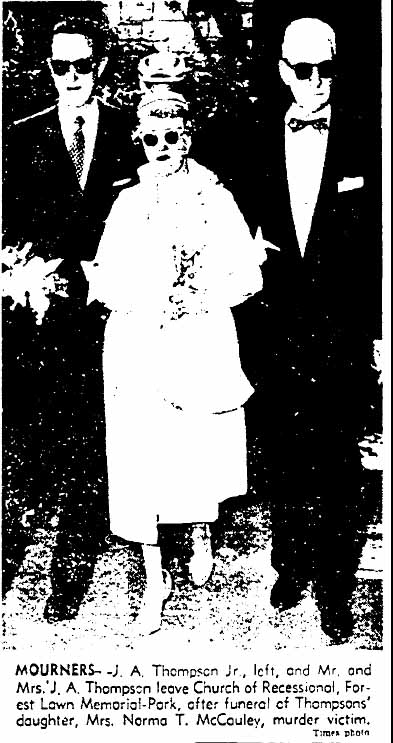
They’re going to fix her up for her funeral at Church of the Recessional at Forest Lawn Memorial-Park. Open casket. Norma will be in a white dress with a blue net stole and she will be holding a bouquet of orchids. The Rev. Haven N. Davis of Westwood Presbyterian Church will say:  “To know her was to love her. She was always considerate and thoughtful of others.”

Ready? Let’s go, then, and  watch the tragedy unfold. Maybe we should stop by Westwood Presbyterian on the way back.
Email me

Posted in Homicide | Comments Off on The Wife-Saving House

Strictly: Human Interest

April 8, 1957
Los Angeles
 

Latin Holiday
by Pepe Arciga

1957_arciga_3Here's how the anguished voice of a stricken lady, Norberta Venegas, pleaded for what should not be perhaps a lost cause. This she said to me in hesitant Spanish:

"Senor Arciga… I do not know how to begin. My name is Norberta Venegas and I live alone here at 2827 Rokeby St. in Los Angeles.

"One week ago my daughter, Maria, she is 21 years old, and I had a disagreement. Not very serious, Senor Arciga, and now she has gone. I don't know where.

"The other day I believe I had an attack of the heart. Now I am in bed and cannot move. My husband, Vicente Herrera, is far away. I think in Mendota.

"Perhaps you can say something in your radio program or in your column so that my Maria returns. I will forgive her, of course. Now please tell me how much I owe you for this service."

And there you are. Words of a mother who prays so that family spats shouldn't be home-breakers. As this goes to press, wandering Maria (last named Rivera) was being sought all over.

WANTED: A MARIACHI BAND

Now the voice of Senora Julia Ramirez, daughter of a prominent mortician in East Los Angeles. Dona Julia, always cocking a sharp eye when someone's welfare is at stake, delivers her message to Arciga:

"My good friend, Senora Muriel Scott, who lives in Rivera and is very active with the American Legion Post there, wants to do her bit, on April 16, at the Long Beach Veterans Hospital.

"She wishes, Pepe, to take over there a band of mariachis and serenade those unfortunate GIs. Do you think, Pepe, there's a mariachi band that would want to go see them and play for a while? Mrs.  Scott can be reached evenings at OX 9-2075."

That, Senora Ramirez, is a most noble idea. As to the availability of mariachi bands, it's been said that outside of Mexico City and Guadalajara, this li'l old pueblo of ours is the world's third-ranking mecca for mariachi balladeers.

The question, now, who'll volunteer? Please raise your right hand.

Note: The Daily Mirror is pleased to introduce another generation of readers to Joseph "Pepe" Arciga, a writer for the Mirror and The Times, and a personality on Spanish-language KALI-AM. Writing in a chatty, familiar style, completely different from Paul Coates or Matt Weinstock, Arciga vividly captures a portion of L.A. that was mostly ignored by the mainstream press.

ps: Maria, go home!

Update: Mrs. John Jamar, 621 Venice Way, Inglewood, like una buena Samaritana, puts in her dos centavos' worth en la siguiente forma:

"That story of yours about the stricken lady Norberta Venegas and the squabble she had with her daughter…. I know what this is like…. I sincerely hope she is reunited with her daughter."

Por fortuna, Senora Jamar, all is now well. Not only have they reunited, but last reports indicate that both mother and daughter plan a free-for-all taco shindig for the buenos vecinos of the neighborhood.
Signed, Pepe.

https://ssl.google-analytics.com/urchin.js
// <![CDATA[
_uacct="UA-18065-1";
_uanchor=1;
urchinTracker();
if (typeof(setPostToken) != "undefined") {
setPostToken('8MsDDxIBAAA.kuAnviL6EEcCqPetJxhIoz0GE4tc5seI6T4hOe2ubVA.dd9EjrOuQC2z4gQFkpxT8A');
}
// ]]>

Posted in 1957, Columnists, Pepe Arciga | Comments Off on Strictly: Human Interest

Silver Spoon

April 12, 1957
Los Angeles


By Larry Harnisch

Those who say you can never be too rich or too thin never heard of Caren Lynn Crabbe, the daughter of "Flash Gordon" star Buster Crabbe, a young woman of wealth and privilege who weighed 60 pounds when she died at the age of 20.

Crabbe, who was nicknamed "Sande," died at the home of her grandparents, Mr. and Mrs. Thomas Held, 840 Napoli Drive, Pacific Palisades.

A 1954 graduate of the Marlborough School for Girls, Sande had been attending USC and was a member of Kappa Alpha Theta, the Ticktockers of the Los Angeles Charity League and Silver Spoons of California Babies and Children’s Hospital. She dropped out of college in March, because "she just couldn’t make it," her father said.

Anorexia nervosa was apparently a mysterious affliction in 1957. The Times reported that she died of "malnutrition brought on by an emotional disturbance." The family said Sande had been losing weight for about a year. Still, her death was unexpected, her doctor said.

"It was a complete surprise," said Dr. Carl D. Strouse. "That is why I didn’t sign the death certificate."

After an elaborate funeral at Little Church of the Flowers, Sande was buried at Forest Lawn wearing a peach pink nylon gown, The Times said.

"The coppertone metal casket bearing the girl’s body was blanketed by a profusion of floral sprays and wreaths–more than 75, mortuary attendants said," according to The Times.  "Following the playing of the ‘Ave Maria,’ the casket was taken to Forest Lawn for emtombment. Members of the family entered the mausoleum but they remained only a few minutes."

Sande was survived by her parents; sister Susan Allen Crabbe, brother Cullen Held Crabbe, who was appearing in the TV show "Captain Gallant of the Foreign Legion"; grandparents Mr. and Mrs. Thomas Held, and grandmother Agnes Akins.

Email me

Posted in anorexia, Forest Lawn | Comments Off on Silver Spoon

Look to the Skies!

April 11, 1957
Temple City

By Larry Harnisch

Early that morning, about 4:40 a.m., a sonic boom that was perhaps from some secret aircraft shook the San Gabriel Valley awake, setting off burglar alarms and breaking a window at 275 N. Hill Ave. in Pasadena. It was, the Mirror noted, "the first sonic blast reported in the metropolitan area at night."

It was another day of anxiety for Los Angeles residents worried about a Soviet attack. Hadn't they been just been warned that 90% of the people in the metropolitan area would not survive a nuclear blast?

As he left for school that morning, 10-year-old Patrick Murphy noticed a crater 2 feet deep in the backyard of his home at 8831 Greenwood in Temple City, but he didn't say anything to his parents, Oscar, a venetian blind salesman, and Virginia, until that evening when he got home.

At 2 a.m., Capt. Robert Jackson of 551st Ordnance Detachment arrived with three enlisted men and two sheriff's deputies. Jackson's verdict: Possibly a small missile or a meteorite.

Jackson dismissed the notion that the crater was the work of neighborhood children. "If a child had dug it, we'd know it by now," Jackson said. "There would have been knee marks around the crater."

So the men began to dig–carefully, since what was down there could be an unexploded bomb.

More military officers arrived, including two men from Air Force intelligence who said very little, according to The Times, except: "There's definitely a hole in the ground."

The excavation turned up a chunk of concrete marked with yellow paint that was unrelated to anything military, experts at Fort MacArthur said. The men found a rusty baby buggy, a long piece of garden hose and a tin can. After digging in loose, sandy soil for several days, the soldiers excavated a hole 15 feet deep and 10 feet in diameter. Using sensors and a mine detector, they determined that there was nothing of interest to a depth of 10 feet beyond the bottom of the hole.

Although they abandoned the search, Lt. T.D. Smith and Jackson insisted: "Whatever it was, it came from the sky." Smith later said the crater "was probably made by a small meteor which disintegrated after it burrowed into the sandy soil."

Note: Some news accounts give the location as 8831 Greenwood while others report 8331 Greenwood, an address that does not exist.

Email me

Posted in 1957, Temple City, UFOs | Comments Off on Look to the Skies!

The Education of Mrs. Snethen

April 10, 1957

Los Angeles

By Larry Harnisch

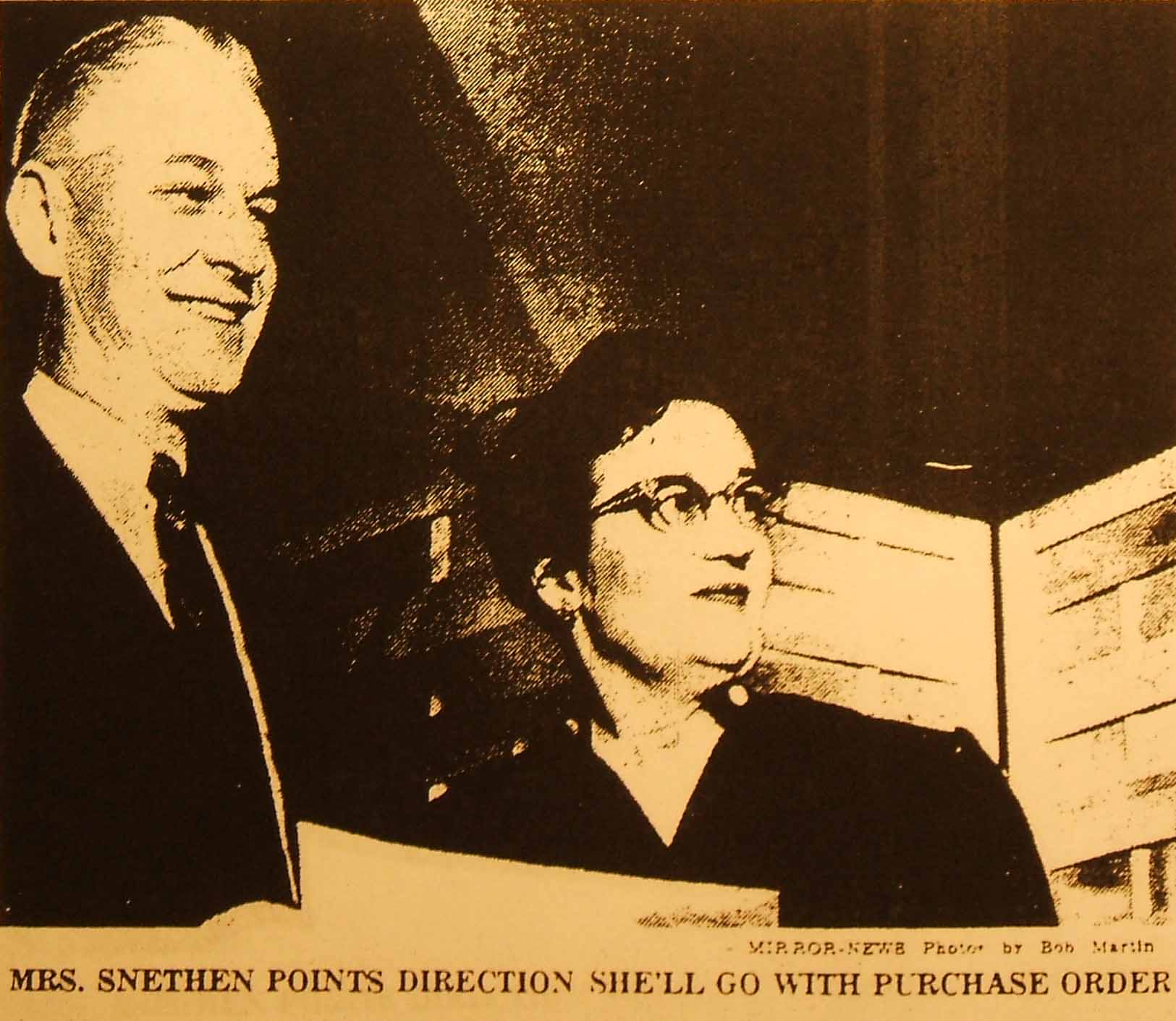
Mrs. Andrew Snethen, 39,  of Lakewood (remember this is the era when married women had no first names), a recent arrival from Omaha, Neb., had never been to downtown Los Angeles, had no intention of ever visiting downtown Los Angeles and said exactly that–to Newsweek magazine for a feature story on suburbia.

The next thing she knew, Snethen, a comptometer operator for a Long Beach dairy, was being whisked downtown via limousine along with a companion, Mrs. Dalbert Clodfelder, as guests of the Downtown Businessmen’s Assn.

"Why, I never realized it was so easy to get downtown on the freeway," Snethen said. "I was impressed, too, by the selection available in the downtown stores."

Accompanied by Burton C. Rawlins, above, head of the businessmen’s group, Snethen was taken to lunch and  escorted to the roof of the Union Bank  Building at 8th Street and Hill for an 11th-floor view of the city–recall that in 1957, no building could be taller than City Hall.

Not bad, Snethen said, noting that Omaha and Los Angeles were much the same, although Los Angeles was much bigger. She also pointed out that Omaha’s Medical Arts Building was 17 stories high. And because Omaha had converted to buses, Snethen asked: "Do they have streetcars here?"

Snethen, the mother of five children and the wife of a bakery route driver living at of 4016 Camerino St., was given a $50 ($358.26 USD 2006) gift certificate. Since it was only valid at a downtown store,  the  businessmen’s association ensured a second trip.
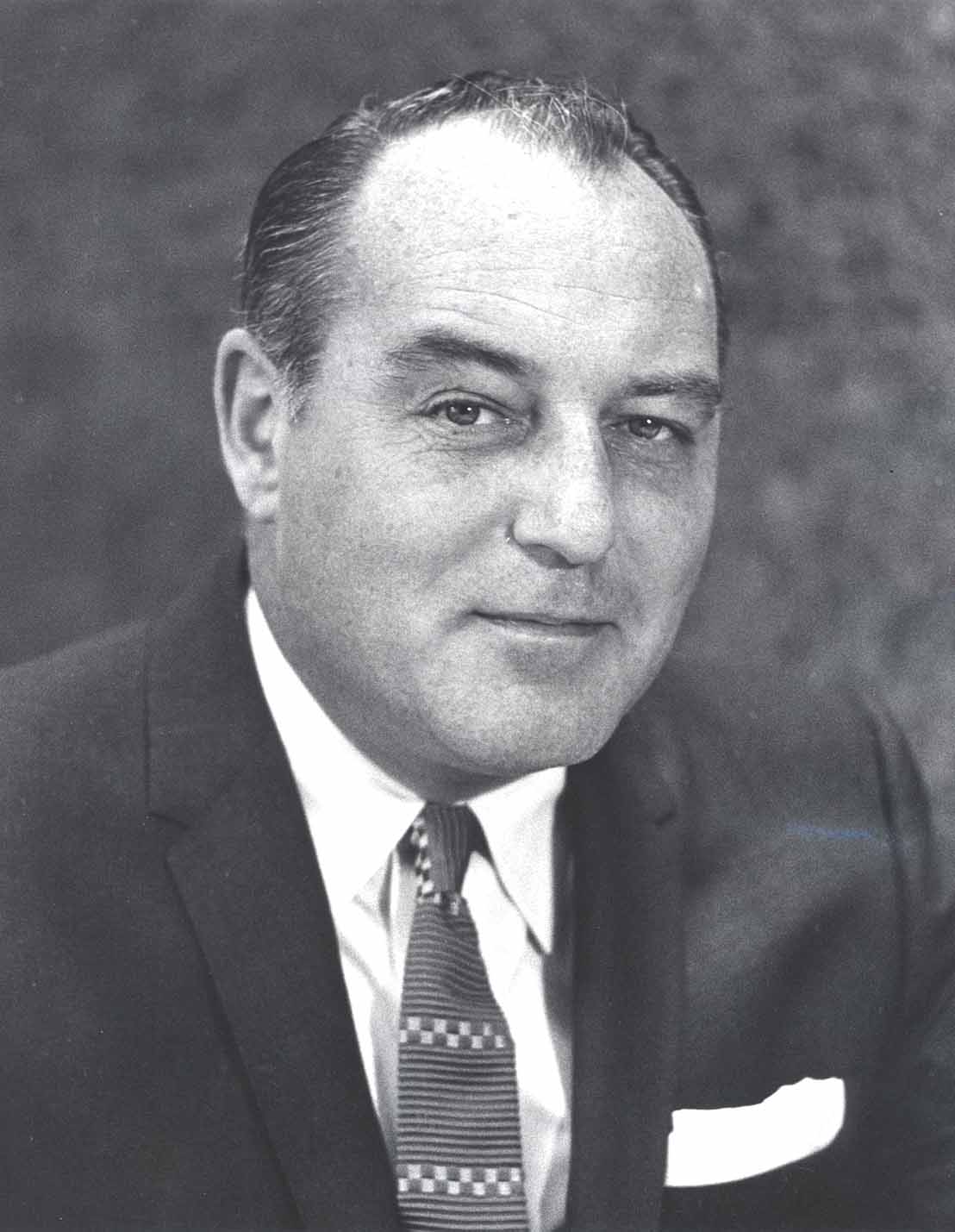
Burton C. Rawlins died March 24, 1974, at the age of 67. There is no further information on Mrs. Andrew Snethen.

Email me

Posted in Downtown | Comments Off on The Education of Mrs. Snethen

Smog Is a Four-Letter Word

Paul V. Coates
Confidential File


April 10, 1957

And it is a comparatively new word in the American vocabulary.

The 1953 Webster in my office defines smog as "a fog made heavier and darker by the smoke of a city."

But already it's an outdated definition.

Because every day we're learning more about it–it's moving that fast.

It has reached a point today where "smog" jokes here have lost their funny flavor.

And technically worded newspaper articles–with a hundred accused causes and a thousand questionable cures–have become painfully required reading to the man on the street.

He's read quotes, optimistic and pessimistic, from doctors, manufacturers, incinerator salesmen and weather experts.

And he, if he's anything like me, must get a little confused by all the double talk and plain nonsense being circulated.

I did, however, read a couple stories in the past week which sounded authentic.

One quoted Dr. Francis M. Pottenger Jr., chairman of the county medical association's smog committee.

The other quoted Dr. Leroy E. Burney, our nation's surgeon general.


BREATH OF DEATH

If these two men know what they're talking about–and I assume they do–their remarks add up to a singularly terrifying story.

Dr. Pottenger revealed the results of a county medical association survey stating that more than 90% of 1,181 surveyed doctors have detected symptoms of a smog complex in their patients here.

He said 40.7% of the doctors stated that they had recommended to certain patients that they leave the so-called smog belt.

These statistics are unpleasant but the doctor's next comment was thoroughly frightening.

He said that physicians closely associated with neoplastic (cancer) diseases were overwhelmingly of the opinion that air pollution contributes to malignancies.

In the simplest, most awful terms, that means smog causes cancer.

This is the belief of pathologists (83%) X-ray men (81%) and physicians specializing in cancer treatment (80%).

An appalling conclusion such as that would immediately make you think that we're running out of time.

That we have to mobilize the forces of scientific research to end the menace in our atmosphere. That we have to do it quick. And that we have to do it at any cost.

But yesterday, Dr. Burney's statement was released to the press.

If the people of Los Angeles think they can get rid of smog, he implied, they're just kidding themselves.

He added that in his opinion there was no immediate hope of even partial relief.

And when you tally those two stories up, they equal this:

"If you want to live a few years longer, get out of town."

The surgeon general's direct quote, from a letter to congressman Joe Holt, was:

"To be realistic, the people of Los Angeles should be candidly informed that there is no practical way to eliminate smog. There is little probability of alleviation in the immediate future."

WHY GIVE UP?

These are cold-blooded words.

The only hope we have is in continued research until we find the antidote for this posion.

But the good doctor seems to suggest that we give up trying to hard and reconcile ourselves to existing in a filthy haze.

I think it's a lousy suggestion.

If we take it, if we give up the battle against smog, then the findings of the county medical association's committee are too awesome to contemplate.

Note: Dr. Francis M. Pottenger, an Ohio physician, moved to Monrovia after his wife developed tuberculosis and he dedicated his life to finding a cure after she died in 1898.  He  founded the Pottenger Sanatorium and was president of the American College of Physicians. He died in 1961 at the age of 91.

His son, Dr. Francis M. Pottenger Jr., who also worked at the sanatorium, died in 1967 at the age of 65. Shortly before his death, he wrote a letter to The Times advocating electric autos.

Email me

Posted in 1957, Columnists, Environment, Paul Coates | Comments Off on Smog Is a Four-Letter Word

15 Minutes

April 9, 1957
Los Angeles


By Larry Harnisch

He was 4. His mother dressed him in a coat and tie, and took him to the airport. Out to the airplane. There were lots of people there. Men with cameras. A lady with black hair, all dressed up, came down the steps from the plane. They took her picture. She went back up and did it again. They took more pictures.

Someone handed him flowers and told him to give them to the lady with black hair.

He went up to her and gave her the flowers. She smiled and messed his hair. She rubbed his cheek and touched him under the chin.

Now what? Someone signaled to him to kiss the lady. So he did. The photographers took his picture. Then the young man wiped his mouth with the back of his hand as he walked back to his mother. He didn't see it, and he certainly didn't understand it, but the lady gave him a "wait till he grows up look," The Times said. Then she began talking to reporters in less than perfect English.

And so  went the encounter between  4-year-old John Minervini, on behalf of the  Italian Women's Club, and 22-year-old Sophia Loren, who had come to Hollywood to film "Desire Under the Elms." (Her first American movie, "Pride and the Passion," had been shot in Spain, and the next, "Boy on a Dolphin," was filmed in Greece.)

She was happy to slink and pose for photographers, and engage reporters in a fractured conversation. In the Viking Room of SAS, Loren "held court in a deep chair that pivots. She crossed her legs and  pivoted  languorously," The Times said.


She dispelled many of the statements in her official biography.

"No, she does not eat spaghetti every day. No, she does not owe her voluptuous figure to the chocolate bars GIs gave her when she was a skinny kid of 8."

What did she plan to do when she wasn't working?

"When do I not work?" she asked.

One of the reporters asked if she had read "Desire Under the Elms,"  Eugene O'Neill's play, adapted for the film by Irwin Shaw.

"She said yes," The Times reported.

A year later Loren told writer Joe Hyams (who noted her measurements as 37 1/2-22-36) that she wished she could "get rid" of her body. "It is a distraction to photographers," she said. "I would like all pictures taken of me in the future to be of my head only."

And what of John Minervini? Let's see if I can find him. Stay tuned.

Update: John Minervini e-mails he remembers meeting Loren (not bad for the age of 4) and adds that they also made Life magazine. Thanks, John!

Email me

Posted in 1957 | Comments Off on 15 Minutes

Silver Starlight of G. Louis Gabaldon

April 8, 1957

Paul V. Coates

Confidential File


I found another hero today, a local boy who made good in battle.

What he did on the island of Saipan perhaps equals in achievement and guts any story of any man in any war.

His name is Guy Louis Gabaldon. He’s an American of Mexican descent. He grew up on the Eastside, one of a family of seven children. But at 11, he decided that he wasn’t getting enough attention at home.

So he quietly checked out.

He moved in with a Japanese American couple, parents of a friend of his. They gave him the attention he wanted and kept him attending school.

The next few years were fairly pleasant ones for Guy. He even learned to speak Japanese.

But when he was 16, the United States went to war with Japan. And Guy’s "foster parents" were taken away from him to an internment camp.


He was on the streets again and not having much fun, so finally he joined the Marines. He was 17 and just tall enough to meet the Corps’ height requirement.

At 18, he went ashore on the third wave of 2nd Marine Regiment troops to invade Saipan.

He had a Browning automatic rifle in his hands and military records show he used it to kill 33 Japanese soldiers the first day.

But after the landing, because he could speak Japanese, he was pulled back to work with regimental intelligence.

Guy found it awfully dull. And the next morning he sneaked off into the jungle by himself. He came back with five prisoners.

His achievement made him a minor hero and his superiors ignored the fact that he’d disobeyed orders by leaving and then thrown his rifle and helmet away to replace them with a lighter carbine and a more comfortable Seabee cap.

Japanese soldiers didn’t surrender easy and Guy was pretty proud. So he slipped off the following morning and returned with 10 more.

His knowledge of East Los Angeles Japanese was paying off. "Usually," he said, "I’d flush ’em out. But sometimes I’d just walk through the jungles and call out and promise ’em things."

From that day, Guy became a one-man Marine Corps and a legend. His daily collections of prisoners ran as high as 30 and his buddies would make bets every morning on how many he’d bring back.

"I kept going out and hoping I’d get killed and get a medal," he said. "so they could send it home to show people I did something good."

After a month of lone forays, he hit a bigger jackpot.

He sneaked up on six Japanese soldiers in an open field and got the drop on them. While their hands were over their heads, he talked to them. He told them they were going to be treated well and given water and food and medical care.

"I’m keeping three of you here," he said. "The other three can leave and bring some friends back."

But if they didn’t come back, he warned, he’d blast the hell out of the three left behind.

They came back with half a dozen more prisoners, but Guy wasn’t satisfied. Again, he sent half of the group out. They came back with more and still more were sent out.

In seven hours, Pfc. Gabaldon was surrounded by 800 prisoners.

Two patrolling Marines spotted the operation through field glasses and went to the scene. Guy dispatched them for more aid and trucks and his day’s work was done.

A couple weeks later, Guy was shot in the arm and hand on a similar mission and his fighting career ended.

As recognition, he received the Silver Star.
"For the capture of over 1,000 enemy."

This is where the story should end, but of course it doesn’t.

Guy returned to the States, went AWOL, was forgiven because of his record and then discharged.

Since then, he married, settled down a bit, had three children.

He jumped from job to job–fisherman, truck driver, TV repairman, farmer. He never owned much, never did much, he admits.

And debts started piling up.

A couple weeks ago, on his 31st birthday, Guy Gabaldon started proceedings to declare himself bankrupt.

Note: The Daily Mirror is pleased to introduce a new generation of readers to Paul Coates, a regular in the Mirror, The Times and on TV, who died in 1968 at the age of 47. Look for more Coates columns in the future. 

Posted in Columnists, Paul Coates | Comments Off on Silver Starlight of G. Louis Gabaldon

Officer-Involved Shooting


April 8, 1957

Los Angeles

 By Larry Harnisch

Off-duty Police Officer Dallas W. Walters, 32, was leaving a Wilmington liquor store at 2 a.m. after visiting the clerk when two young gunmen stepped from the shadows at 1109 W. B St. and ordered: "Back into the store. Both of you."

"Oh no, we won’t," Walters replied, and as clerk Albert Estrada, 19, of 1522 Island St., dropped to the pavement, the officer drew his pistol and fired.


In a moment, Walters, of 3250 N. Woodruff Ave., in Lakewood had been shot in both legs and one arm, Lucious Claude Williams, 21, of 150 E. 108th St. was dead and Charles Hawkins, 18, of 4511 Staunton Ave. had been shot in the chest.

The apparent getaway driver, Sonjalee (or Sonjale) Whitmore, 21, of 1192 E. 43rd St., picked up Williams’ gun, carried Hawkins to a car and sped to Harbor General Hospital, where he left his wounded companion, The Times said. Whitmore fled from the hospital but ran the car into a ditch at 66th Street and Arlington Avenue.  He  went to Hawkins’ home and told the family that Hawkins was in Harbor General. The family and Whitmore returned to the hospital and while the family was looking for Hawkins, Whitmore hid in the trunk.

Police eventually found Whitmore and took him and Hawkins to the prison ward of General Hospital. In the meantime, doctors at Good Samaritan Hospital grafted an artery into Walters’ leg in an attempt to save it. Investigations were planned to determine whether Walters killed Williams or if he had been killed by gunfire from his companions, police said.

My big question was whether Williams, Hawkins and Whitmore were black. In the 1940s, the newspapers referred to African Americans as "John Jones, Negro," so there was never any doubt. But by 1957, this practice seems to have disappeared.

Figuring that other newspapers might shed some light on the question, I looked up the killing in the morning Los Angeles Examiner and the afternoon Herald-Express.

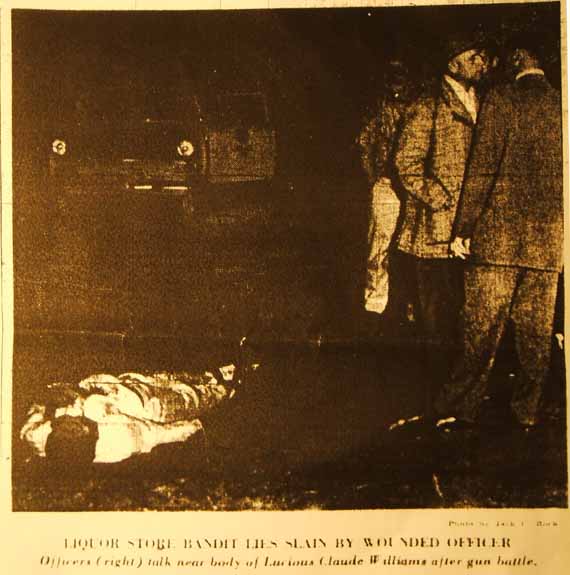
The Examiner had a few more details (Walters had diabetes and was the father of four children: Sharon, Larry, Pamela and Peggy), plus a photo of  officers standing next to Williams’ body sprawled on the pavement and Bill Brunk’s picture of Walters and his wife, Eulyne, at the hospital. Det. Lt. Ralph Weyant told the Examiner that the three men were suspected of other holdups in the Harbor area.

Then, out of curiosity, I pulled the Los Angeles Sentinel, the weekly serving the African American community. Although the Sentinel didn’t identify the men as being black, the treatment of the story is a fair indicator that they were. The Sentinel noted that Williams was "still clutching a .25-caliber revolver [probably a semiautomatic-lrh] in his right hand."

Interestingly enough, the Sentinel led its front page with a story about the fatal stabbing of Ola Williams, whose body was found in the offices of Jimmie’s Transfer and Storage, 1720 W. Jefferson.  And no, The Times didn’t even cover it.

Police Chief William Parker presented Walters with the Military Order of the Purple Heart in 1959 for his actions during the botched robbery. Records show he retired from the LAPD on Jan. 3, 1965 and died March 21, 1983. There was no further word in The Times on the fate of Hawkins or Whitmore.

Rest in peace, Lucious Claude Williams, above left, who was born March 11, 1936, in Louisiana, and died in the streets of Wilmington, April 7, 1957, with a gun in his hand. He had just turned 21.

Email me

Posted in Harbor Division, Robberies | Comments Off on Officer-Involved Shooting

Deal Me a Card, HAL

April 7, 1957
Los Angeles

By Larry Harnisch

In a gathering for newsmen, Caltech staged a demonstration of its "electronic brains." Charles Ray showed off the Royal Precision Electronic Computer LGP-30, a 740-pound "desk computer" with 113 vacuum tubes and 1,350 diodes.

Reporters also saw the enormous direct electric analogy computer, which was being used to simulate a DC-8 jetliner.  

But the star of the show, as displayed by Joel Franklin, was a ElectroData Datatron 205, which, like the LGP-30, had been programmed to play games, in this case, blackjack.

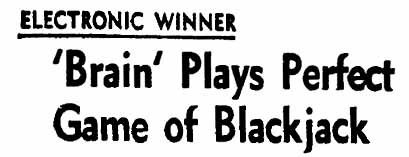
After running through the calculations for a nuclear reactor, Datatron asked: "How many suckers–I mean players?" "The machine dealt four hands by marking the names of the cards down on its typewriter," The Times said. To help the humans determine whether they should ask for another card to fill out their 21, Datatron politely–and without being asked–told them their chances of drawing a card and not going over 21."

Like the serious student who becomes a handsome movie star by removing his horn-rim glasses, the Datatron computers found real fame not by their work in the Boston Navy Yard or a drab insurance office in Minnesota, but on TV and in films.

The Bat Computer? A Datatron. "Lost in Space?" A Datatron. "Angry Red Planet?" "Fantastic Voyage?" "The Computer Wore Tennis Shoes?" All the Datatron. And don't even ask about "Dr. Goldfoot and the Bikini Machine."

Vincent Price, as Dr. Goldfoot, with tape drives from the Datatron, later renamed the Burroughs 205.

One of the Datatron's latest screen appearances? Some of the tape drives turned up in "Austin Powers: The Spy Who Shagged Me."

Read about Caltech's Computer Center here.
Here's the manual, in case you have a B205 in the garage.
And here's the handbook.
Thanks to Burroughs 205 website for some of this information.
ps. I dropped a note to Joel Franklin at Caltech to see if he'd like to share some recollections of the Datatron. I'll let you know what he has to say.
Email me

Posted in 1957 | Comments Off on Deal Me a Card, HAL

Silk-Stocking Slayer


April 6, 1957
Los Angeles

By Larry Harnisch

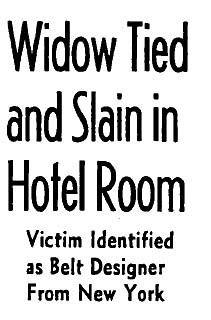
Ruth Newgarden Goldsmith, 52, a New York fashion designer, had been dead about 12 hours when she was found after 3:30 p.m. by two maids in a $25-a week room at the Hollywood Algiers Hotel, 445 N. Rossmore Ave. on the edge of the Wilshire Country Club.

Goldsmith, a widow who gave her address as 15 Christopher St., New York, N.Y., had checked into the Algiers a month earlier. According to police, she made frequent business trips to Los Angeles, selling belts out of her hotel room. Her hands were tied with a silk stocking and she apparently suffocated on a washcloth forced into her mouth and held in place with another silk stocking.

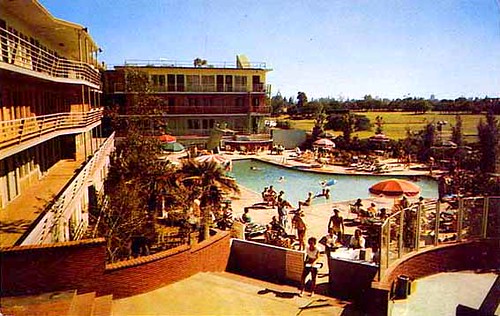
The Hotel Algiers, formerly the Casablanca and the Country Club Hotel


There were traces of cold cream on her face, leading authorities to believe she was getting ready for bed when she was killed. Her light green negligee was "disarranged," but there were no outward signs of a "criminal attack," The Times’ delicate term for a brutal crime. The only sign of a struggle was shoe prints on the rumpled bed, Detective James Close said.

Investigators found that her wallet was empty and although acquaintances at the hotel said she had expensive-looking jewelry, nothing was found in a search of her room. Her bank books showed that she sometimes withdrew as much as $2,000 ($14,330.57 USD 2006). Police said she had frequent business callers and kept a display of belts in her room.

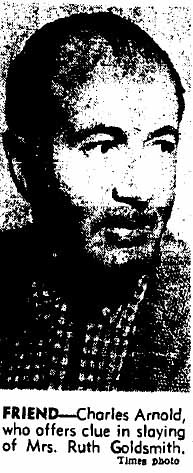
Marine Pvt. Brad Arnold and his father, Charles, who had a room a few doors down, said Goldsmith was a quiet woman of excellent character.  In an interview, Charles Arnold said Goldsmith was trusting and "took everyone at face value. If someone came to her door she would have let them in." He added, "She had no enemies and lived very quietly. She usually went to the movies by herself."

Her only apparent survivor was a son named Walter, described as a Korean war veteran who was studying law at New York University.


The Internet can tell us a few more things about Goldsmith. She was born Dec. 28, 1904, her father’s last name was Newgarden and her mother’s maiden name was Schwartzenberg. The New York Times appears to list an engagement announcement of Walter George Goldsmith and Ruth Newgarden, daughter of Dr. and Mrs. Albert Newgarden, 151 W. 86th St., on Oct. 4 and Oct. 11, 1925. The New York Times also shows a company called Coordinated Accessories of 15 Christopher dealing in belts and accessories declaring bankruptcy in May 1957 under the name Benjamin Weintraub.

A little more digging shows that Albert Newgarden had a brother George J. Newgarden, whose obituary appeared in the New York Times on June 5, 1931. According to World War I draft records, a man named Walter George Goldsmith lived in Essex, N.J., but it’s unclear if was her husband.

All right, armchair sleuths, there’s a real unsolved case from the archives with everything available from the initial reports in The Times and the Mirror.

Maybe it’s just me, but something doesn’t add up here. We have a quiet, well-behaved woman of excellent character who goes to movies by herself and yet has an extraordinary number of business clients who visit her hotel room ostensibly to buy her custom-designed belts. I would suspect something else, but according to the bankruptcy filing, there was a belt company at the address she gave.

One curious note: In 1950, a judge ruling in a case brought over alterations done without the proper permits said the Algiers looked like "a glorified quickie motel."

Email me

Posted in Uncategorized | Comments Off on Silk-Stocking Slayer