
Here’s another little nugget of information I found going through the archives.
Guess what kind of car Mickey Cohen had after he gave up bulletproof Cadillacs?
Go ahead, guess.
Here’s another little nugget of information I found going through the archives.
Guess what kind of car Mickey Cohen had after he gave up bulletproof Cadillacs?
Go ahead, guess.
Nov. 14, 1957

I’m an old-fashioned boy. I don’t like changes.
That’s why i was more than slightly disturbed at the recent rumbles that Ciro’s might close forever.
Such a thing, if it happened, would be a catastrophe on the Sunset Strip. It would end a damned colorful era of Hollywood life.
Ciro’s is a landmark.
It’s pudgy boniface, Herman Hover, nursed it into one of the most famous cabarets in the world.
Within its plush, velvet walls, every top star has either performed, got tight or had a fistfight.
(Hover had a standing rule that any male movie star was entitled to two
fights at Ciro’s. But he was barred after the third time.).
The cafe was the proving ground for Kay Thompson, Nat Cole, Mitzi Gaynor, Sammy Davis Jr. and Liberace.
Its star attractions have included Peggy Lee, Martin and Lewis, Danny
Thomas, Xavier Cugat, Carmen Cavallaro, Veloz and Yolanda, Joe E. Lewis
and the indestructible Sophie Tucker.
It’s been the scene of lavish parties. The setting for Darryl Zanuck’s historic trip on a flying trapeze.
Ciro’s cigarette girls have included a future Mrs. Tommy Manville, a
future Mrs. Huntington Hartford Jr. and the present wife of Sir Cedric
Hardwicke.
Hover himself has been a curiously colorful addition to his own room. A
graduate of Columbia Law School, he took his degree, passed the bar and
promptly got a job as a chorus boy in Broadway musicals.

After that, he worked as an attorney for the federal government and later as an executive of the Earl Carroll enterprises.
But he’s a buck-and-wing dancer at heart.
No act can be sure of having their option picked up unless they invite
him on stage to dance at least once during their appearance.
"I can dance as well as Fred Astaire for a couple of minutes," he assured me yesterday.
So it’s been rather sad to see Ciro’s get clobbered in recent months. But fortunately, Hover is a showman who bounces back.
Instead of closing, as the rumors have had it, he’s going strong the
other way. Next month he’ll bring in the entire Katherine Dunham
troupe, which is maybe two short of a battalion of dancers.
On Nov. 22 he’s presenting the complete Minsky revue with a company of 24.
And with that I can relax. It sounds like the good old days are
returning to that beloved scene of my childhood–the Sunset Strip.
[Note: Ciro’s closed in early 1958. The exact date is a little unclear–lrh].
Check it out: The Fed cuts interest rates to 3%! And a future Superfund site is dedicated!

Michael "Mickey" Cohen needed a new bulletproof Cadillac for several reasons: His home was bombed in February 1950 and his previous Cadillac acquired some bullet holes outside Sherry's Restaurant, 9039 Sunset Blvd., on July 20, 1949.

Photograph by Clay Willcockson / Los Angeles Times
In honor of the Los Angeles International Auto Show, here are some car photos I found in the archives.
Who owned this bulletproof Cadillac? And why did he need one?

Photograph by Howard W. Maxwell / Los Angeles Times
Nov. 13, 1957
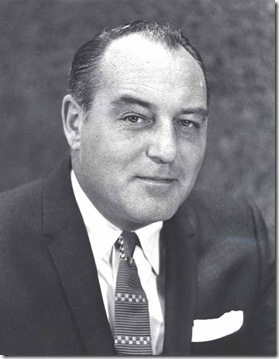 For Joseph Szabo, bravery has been an expensive trait.
Its cost has included starvation and dungeons and tortures, like these (I’ll give them to you in Szabo’s words):
“Every day they were to take me and put me on a desk. Three people sit on my back and legs.
“Other people have a rubber club.
“They hit at the bottoms of my feet.
“They tell me to count after each hit…
“…One, two three…. Once I count to 251 for them. Continue reading

My friends at the 1947project have announced that demon dog James "I will never again publicly discuss the Black Dahlia murder or my mother’s death" Ellroy will be hosting a bus tour on Dec. 22.
For a mere $60 you can hear my old pal James not discuss his mother’s murder as the bus visits Arroyo High School in El Monte and other sites in L.A.
Woof, Daddy-o.
(At right, as sold on EBay: "Black Dahlia Avenger" autographed by Steve Hodel and inscribed to James Ellroy, who provided the introduction to the book, endorsing Hodel’s contention that his father killed Elizabeth Short).

Nov. 13-14, 1957
Los Angeles
Just as I suspected.
Although The Times was too squeamish to even allude to homosexuality in the Trick or Treat murder of Peter Fabiano, the Mirror was a bit more brave.
A bit.
It’s fairly evident that the Mirror expected people to read between the lines and figure out this story:
“Strange and unpredictable passions were probably responsible for the trick or treat murder of a Sun Valley beauty shop owner on Halloween, police said today.
“This cryptic comment was all that came from Valley Detective Sgts. Pat Kealy and Charles Stewart after they booked a 40-year-old woman freelance photographer on suspicion of murder.”
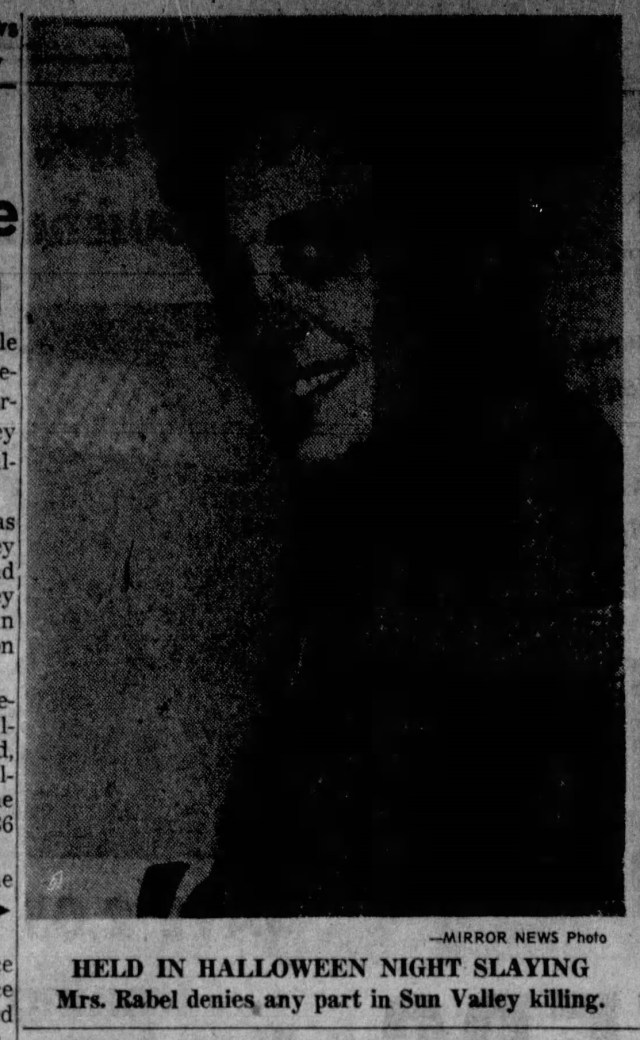
The Mirror helpfully provides a few more facts about Rabel: She was a Lithuanian immigrant, had a police record for burglary and violating liquor laws, and she had been divorced for a year.
Let the record show that the word “lesbian” appeared only once in a Times news story in 1957 and that was in a direct quote from a prosecution brief against L. Ewing Scott, referring to his fabricated excuses for his wife’s disappearance.
ProQuest shows that the word “lesbian” also appeared twice in classified ads, but I suspect these are “false positives” that sometimes confuse the software’s search engine.
Stay tuned and I’ll go over the ads to see if I can find out what’s up.
But why should I have all the fun? Click below to see two pages of Times classified ads that ProQuest says contain the word “lesbian.”


Nov. 13, 1957
Point Mugu
Let’s suppose you are the Ventura County coroner. The body of a man in
his 20s is found washed up on the beach near Point Mugu, below Mugu Rock,
according to news accounts. He’s wearing a sports coat, sports shirt
and slacks, but the pockets have been ripped out of his trousers and
any means of identification have been removed from his clothing.
Ventura County sheriff’s detectives say that the man was murdered,
noting that the cuts on his face and head were inflicted before he
died.
A foreign auto abandoned near the beach is traced to USC engineering student Clement Bosley, 23, 2403 Garth Ave.
Bosley’s roommate, Marion Dudek, a UCLA engineering student, says he
and Bosley came out together from Detroit the year before and work part
time at Hughes Aircraft. Dudek says Bosley "didn’t have an enemy in the
world."
Dudek says Bosley vanished from their apartment Nov. 10, a Sunday, and
had no reason to commit suicide. "It had to be an accident," Dudek says.
Maybe I’m just the suspicious type, but Ventura County Corner Virgil
Payton was not. His decision: No inquest. Bosley’s death was a
"probable accident."
I can find no further information in The Times about Bosley or Dudek.
But I have to feel that some part of the puzzle is missing.
Deke Houlgate writes about covering the loss of the Pan Am Stratocruiser "Romance of the Skies" (the lost plane in a publicity shot, below right):

That story was a real panic operation. I came to work for my 3 to
midnight shift, and all day long other, more experienced reporters were
lobbying for that assignment. Fortunately, I don’t remember any names,
because I learned later that my selection wasn’t popular among the
staff. I didn’t even know about it till Bill Bastedo called me up to
the city desk and told me to get ready to go. Larry Sharkey took me
home to my Silver Lake apartment, where Olga had just returned after
watching an SC football game with my parents. Larry told Olga to pack
me enough clothes to be gone 10 days. I didn’t even own that much
underwear, but luckily I had a wad of cash from George Rice, the
auditor (I got back at him that time), and I bought clothes at the
commissary on board the aircraft carrier.
This
was a big deal at the time. Life send a photog, a cocky redhead named
Bill. In those days they were all cocky, red headed and didn’t lack for
confidence. AP Photo sent Hal Filan, an old friend from my childhood.
No other L.A. newspapers accepted the Navy’s invitation to make the
trip. I had one competitor, as the San Diego Union-Tribune sent a young
copy editor named Gerald Warren. (Gerry became a lot more famous than I
did, serving as Nixon’s press aide in the final days of Watergate.) I
was used to working around the clock in my old job at the Las Vegas
Sun. So instead of hitting the officers club I went right to work in
the radio room in the fantail of the ship. The enlisted men back there
and I got along famously. I was told we would be out of radio range at
about 300 miles, but I was still sending copy three days later 1,000
miles out. I don’t know what they did to accomplish that, but I found
something to write about almost every hour of the day. It must have
driven the city desk bonkers. Marvin Miles was doing the rewrite and
staying in touch with Pan-Am. He was the real backbone of our team.

Each day I filed stories AP picked
them up under my byline, and news agencies all over the world were
getting pissed off. The Navy, through my high-ranking friend, the
captain of the ship, had clamped a news blackout on the story and was
letting only my copy and Gerry’s go out. That gave me an idea. We would
probably find something in the water, and I needed to control the
story. So I made a deal with Gerry to work as a team. I had seen plenty
of corpses and debris in my young, misspent life. So I gave that chore
to Gerry and I manned the rewrite desk for both our papers. When we
found corpses, I relied on Gerry for the words and wrote take after
take of copy, 18 hours in all. Around the country news agencies were
doing a slow burn. I don’t know what was going on in San Diego, but my
AP buddies in L. A. were bylining me on every new development. I
believe we filed 30 takes or so. Every one a new development.

After
24 hours of exclusive eyeball coverage the captain or his fleet admiral
ended our adventure. But we were still 1,200 miles out to sea, and
there was no way any news agency could reach the ship till we got back
to Long Beach. Heaven! The wire services and networks could communicate
with the ship, but we were days ahead of all of them. A lot of stories
in Las Vegas were panic button pieces, and organizing the enlisted men
on this huge WW II aircraft carrier was a piece of cake. They didn’t
like the redhead from Life. So as he swamped them with negatives, they
put slow fix to work on them. He was the last newsman to leave the ship
in Long Beach. Filan, a wily old veteran, had his negs quick-fixed,
said nothing to anybody about it and loved his experience.
When
I came ashore, I learned how Marvin tickled my copy and made me a hero.
The head of the USC journalism department nominated me for an SDX
prize, but I didn’t win that either. Didn’t deserve it. Marvin Miles
made me look good. I still have no idea how much of my copy ran,
before or after the body count, but I couldn’t go anywhere for the rest
of the year but somebody would tell me they read my stories.
My
heroes were those incredible radio guys in the fantail who kept me in
touch with the city desk for almost 900 miles farther than they were
supposed to. This is my first chance finally to thank them, 50 years
later.
[Note: Deke doesn’t like to brag, but The Times nominated him for a Pulitzer for his coverage of the crash–lrh]
Here’s an account of the search operation by a former Navy captain, from the Philippine Sea’s website.


 Nov. 12, 1957
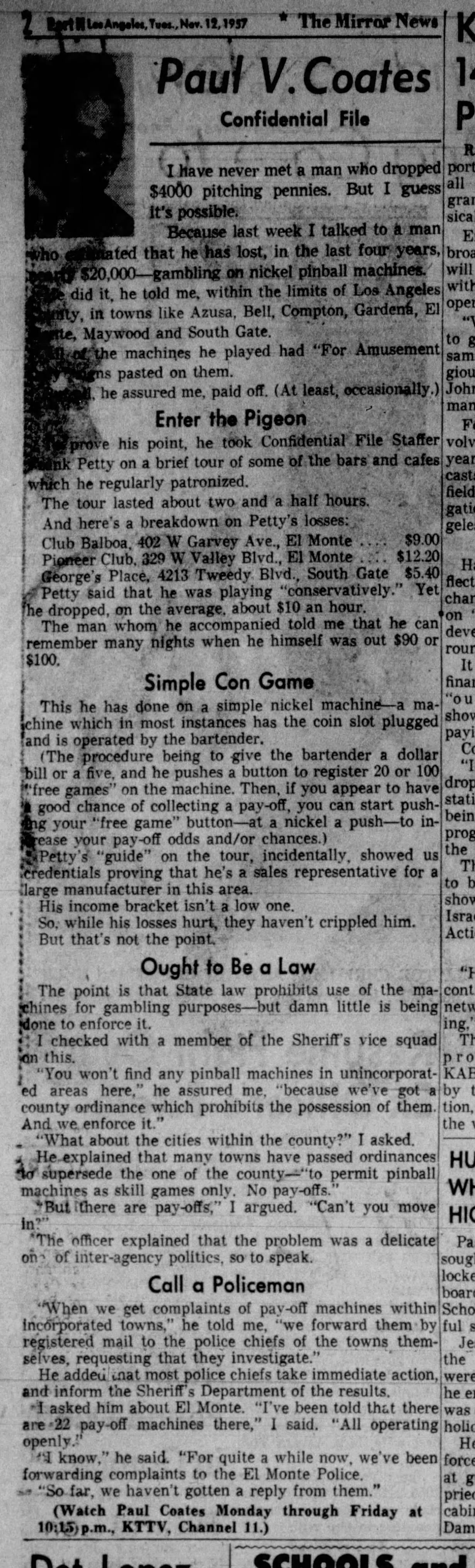
I have never met a man who dropped $4,000 pitching pennies. But I guess it’s possible
Because last week I talked to a man who estimated that he has lost, in
the last four years, nearly $20,000–gambling on nickel pinball
machines.
He did it, he told me, within the limits of Los Angeles County, in
towns like Azusa, Bell, Compton, Gardena, El Monte, Maywood and South
Gate.
All of the machines he played had "For Amusement Only" signs pasted on them.
But all, he assured me, paid off. (At least, occasionally).
To prove his point, he took Confidential File Staffer Frank Petty on a
brief tour of the bars and cafes which he regularly patronized.
The tour lasted about 2 1/2 hours.

And here’s a breakdown on Petty’s losses:
Club Balboa, 402 W. Garvey Ave., El Monte, $9.
Pioneer Club, 329 W. Valley Blvd., El Monte, $12.20.
George’s Place, 4213 Tweedy Blvd., South Gate, $5.40.
Petty said that he was playing "conservatively." Yet he dropped, on the average, about $10 an hour.
The man whom he accompanied told me that he can remember many nights when he himself was out $90 or $100.
This he has done on a simple nickel machine–a machine which in most
instances has the coin slot plugged and is operated by the bartender.
(The procedure being to give the bartender a dollar bill or a five and
he pushes a button to register 20 or 100 "free games" on the machine.
Then, if you appear to have a good chance of collecting a payoff, you
can start pushing your "free game" button–at a nickel a push–to
increase your payoff odds and/or chances).
Petty’s "guide" on the tour, incidentally, showed us credentials
proving that he’s a sales representative for a large manufacturer in
this area.
His income bracket isn’t a low one.
So, while his losses hurt, they haven’t crippled him.
But that’s not the point.
The point is that state law prohibits use of the machines for gambling purposes–but damn little is being done to enforce it.
I checked with a member of the sheriff’s vice squad on this.
"You won’t find any pinball machines in unincorporated areas here," he
assured me, "because we’ve got a county ordinance which prohibits the
possession of them. And we enforce it."
"What about the cities within the county?" I asked.
He explained that many towns have passed ordinances to supersede the
one of the county–"to permit pinball machines as skill games only. No
payoffs."
"But there are payoffs," I argued. "Can’t you move in?"
The officer explained that the problem was a delicate one of inter-agency politics, so to speak.
"When we get complaints of payoff machines within incorporated towns,"
he told me, "we forward them by registered mail to the police chiefs of
the towns themselves, requesting that they investigate."
He added that most police chiefs take immediate action and inform the Sheriff’s Department of the results.
I asked him about El Monte. "Ive been told that there are 22 payoff machines there," I said. "all operating openly."
"I know," he said. "For quite a while now we’ve been forwarding complains to the El Monte police.
"So far we haven’t gotten a reply from them."

Nov. 12, 1957
Los Angeles What makes a killer? Do children arrive in the world planning to take
someone’s life or is it whatever befalls them as they grow up?
Read about John Lawrence Miller and let me know what you think.
A convicted killer at 15, John told reporters that he had wanted to
murder someone since he was 7 or 8 years old. "I always wanted to kill
somebody. I was always meeting somebody, some man I didn’t like and
wanted to kill," he said. When he was quite young, he got the notion
of killing his father. "I didn’t kill him, though, because there’d be
no money coming in," he said.
Eventually, John did kill his father–just as he’d always wanted–and
murdered his mother as well. But that was 18 years after he smothered a
little girl in Rolling Hills Estates.
John was born about 1942 to Harold A. and Lela Miller of Long Beach.
The Times wrote very little about the Millers except that they had a
daughter, and an extended family in the area. Long Beach juvenile
officers called John "a lone wolf," and news stories said his first
arrest was Feb. 18, 1955, for burglary. In April 1955, he was "picked
up for being improperly supervised at home," The Times said.
In 1957, he was sent to the Fred C. Nelles School for Boys in Whittier for burglarizing a house and stealing a car in San Bernardino.
His rampage began after his parents picked him up on on a 10-hour pass.
Harold and Lela stopped at a Whittier restaurant for dinner before taking him
back. John ran off and headed for the home of a family friend, Stafford
Thurmond, 26467 Dunwood Road.
The link between the Millers and the Thurmonds is unclear, but John
said he had known them all his life. His plan was to break in and steal
money and a pistol from the Thurmonds’ gun collection.
When he got to the house the next day, he discovered that the Thurmonds
weren’t home and found a neighbor’s 22-month-old daughter, Laura Joan
Wetzel, playing in the frontyard. He lured Laura into the house and
killed her.
Her parents, Air Force Capt. Charles W. Wetzel and his wife (recall that this is an era when married women had no first names), 26501 Dunwood Road,
began looking for Laura. Another neighbor couple, Francis King and his
wife, joined the search. Mrs. Wetzel went into the Thurmonds’ yard, but
fled after confronting John, who was armed with a knife and a gun.

"I went into the yard," King said. "There was a young man standing in
the doorway with a knife and a gun. It was a kitchen knife and the gun
looked like a .22-caliber target pistol. He was very agitated and he
waved the weapons and ordered me into the house. My wife was right
behind me and she yelled for me to get away.
"I told the kid to take it easy, that we were just looking for a little
girl who was lost. The kid slammed the door in my face. I yelled to
Mrs. Wetzel to call the police."
Sheriff’s deputies searched the Thurmonds’ house but didn’t find the
body. It was only when another neighbor, Carolyn West, looked in the
children’s bedroom that she discovered Laura under a pile of blankets.
In the meantime, John escaped on a stolen bicycle and rode to Redondo
Beach, where he took a car and began driving north. A service station
attendant in Salinas, Calif., called police and gave them the license number of
the stolen car after John drove away without paying for a tank of gas.
San Francisco police found the the abandoned car, out of gas and dented
from a crash. A map of California was spread out on the front seat.
John stole another car, backtracked to San Mateo and took $77 in the
robbery of a market. He planned on taking the bus, but saw a new
Plymouth with the keys in the ignition. He hit road, going to Eureka,
Calif., Crater Lake and Klamath Falls, Ore.
In Klamath Falls, John picked up hitchhiker Lloyd DeFani. John planned
to go to Boise, Idaho, but the road was covered with snow and John didn’t
have tire chains. Instead, they headed for Reno, where DeFani left
John and called police, having recognized him from radio broadcasts.
At 2 a.m., a Reno taxi driver who had been listening to the police radio saw John and reported him.
He was arrested and extradited to Los Angeles for the murder. John
showed absolutely no remorse, The Times said. He told reporters he
wasn’t sorry. "Why should I be?" he asked.
"I don’t care what happens to me," he said before his trial. "I’m sick
of this life anyway. I hate confinement and I’m not happy anywhere. I
don’t want to see anybody I know. Not anybody."
The father of the murdered girl said: "We don’t want revenge. We just
want to see him put behind bars for the rest of his life. He’s a sick
soul."
John was tried as an adult and pleaded guilty to first-degree murder.
Deputy Dist. Atty. Ted Sten called him "vicious, treacherous and
coldblooded. Here is a person devoid of feeling, an ill-tempered wild
animal who wanted to kill someone to see how it felt."
Eighteen years later, after two months of freedom, John committed the
murder he’d dreamed about as a boy of 7. He killed his father and
mother who by then were living at 5460 Flagstone St. (This looks like a
mistake as it’s in the middle of Bellflower Boulevard). He stole a
neighbor’s car at gunpoint and abandoned it in a parking lot, but was
arrested after a bank robbery in Downey in which he held the manager as
a hostage.
Deputy Dist. Atty. Allen Field said John told his probation officer
that he couldn’t cope with the outside world after being released from
prison. He said his parents had mistreated him and blamed his father
for being sent to prison in Laura’s death.

On April 19, 1976, John told Judge Carroll M. Dunnum that he didn’t
have the courage to kill himself and asked to be sent to the gas
chamber, which at that point hadn’t been used since 1967.
I can find no further trace in The Times about John Lawrence Miller. A
man by that name, who was about the same age, died in Alameda County on
July 12, 1987, at the age of 45, according to California death records.
Laura Joan Wetzel was cremated after services at Palos Verdes Neighborhood Church.
"The tiny white-covered casket was not in the flower-banked room but
remained in an alcove," The Times said. "In it, little Laura was
dressed in a simple, light blue frock. Her hands clasped a nosegay of
Cecil Brunner roses and she appeared like all the sleeping little
children in the world."
And that is the story of John Lawrence Miller. What made him a murderer? You tell me.
Richard Hultman writes:
You didn’t mention a certain landmark location on your Main Street blogs.
Don’t know if the L.A. Conservancy tour mentioned it, but about a block
further up Main Street at 318 1/2 S. Main was the Main Street Gym.
I
checked the address on Windows Live Local and saw a big parking lot across
from what I guess is the Ronald Reagan Office Building so it must be
gone. Nothing there for even a Conservancy tour.

The Main Street Gym
was the mecca of boxing in Los Angeles. The place all
the greats went to
train or workout when they were in Los Angeles. Joe
Louis (above, 1963), Ray Robinson,
Muhammad Ali, and a host of lesser lights all trained
there when they had
fights in Los Angeles or were in L.A. for other reasons.
The Rocky movies
had location scenes shot there.
Cecelia Rasmussen wrote a column in The
Times about one of its owners, Howie
Steindler, that was later reprinted in
her book "LA Unconventional". The man
was murdered in 1977 in a case that
was never solved.
Main Street must have been a lively place at one time
with all the burlesque
theatres, and the trolleys and interurbans going up
and down the street.
And the Main Street Gym between 3rd and 4th.
–Thanks for sharing!
–Larry

Nov. 11, 1957
This seems like a perfectly straightforward story in The Times.
But it’s not.

First of all, our friend Mr. Tophia lived a block and a half from the
Nickerson Gardens housing project in Watts. The shooting
occurred–well, wait, where exactly did the shooting occur?
Google maps is most unhelpful in locating 1722 E. 102nd St. In fact,
the address doesn’t exist today. A trip to the Daily Mirror’s 1946
Thomas Bros. Guide shows the street was once there, so we’ll have to
assume something happened to that neighborhood. Without a field trip,
it’s a bit unclear as to what. But we can tell the shooting occurred a
few blocks west of the Jordan Downs housing project.
The online Los Angeles city directory from 1956 tells us that the bar in question was apparently Paul’s Place, 1723 E. 102nd St. At least that part of the story seems correct.
However, the directory is most unhelpful in identifying the church at 1722 E. 102nd, as is The Times.
Let’s look at the street:
1716 E. 102nd is a couple of apartments.
1720 E. 102nd is Watts Auto for Hire and Taxi Co.
1720 1/2 E. 102nd is Campbell Garrett Plumbing.
1722 E. 102nd is the reported site of shooting.
1750 E. 102nd is the South L.A. Mortuary.

Maybe you’re starting to think: Taxi company… plumbing company…
church… mortuary… Wait a minute. Shouldn’t there be some sort of
zoning regulation prohibiting a bar across the street from a church?
You’d think. I don’t happen to have a copy of the city of Los Angeles
zoning regulations for 1957, so this is not a question I can answer at
the moment.
But let’s keep digging and look at the street directory for 1960.
Paul’s Place has become Bob’s Place.
What’s this?!
The Watts Auto for Hire and Taxi Co. has been replaced by Mount Calvary Assembly Apostolic Faith. I’m starting to wonder if this was a storefront church, which might explain my question about zoning.
The 1700 block appears in the 1963 city directory, but the 1964 and 1965 city
directories show a gap between the 1500 and 2000 blocks of East 102nd
Street. I know what you’re thinking. But the Watts riots were in August
1965 and the city directory dates from April 1964.
The unidentified reporter who turned out this three-paragraph brief
seems to have been an incurious sort–and it makes a grimly amusing
story for a woman in church to be an unintended victim of a bar fight.
The name of the church must have seemed irrelevant.
Unfortunately, getting more answers would involve a trip to the library
to check the other papers (especially the California Eagle and the Los
Angeles Sentinel) and that’s beyond the call for this small item (as
I’ve said before, there are so many stories and only one Larry
Harnisch).
But sometimes, you just have to wonder. At least I do.
According to California death records, Thomas J. Tophia died Jan. 19, 1981, at the age of 63.


