LA turns 157, September 5, 1938


At Plummer Park, Eugene Plummer shows Joaquin Murietta's revolver

Capt. Eugene Plummer is featured in a story about Plummer Park in West
Hollywood
. According to the caption, the revolver he’s holding belonged to Joaquin Murietta.


Los Angeles celebrates its birthday

Davis Cup results, 1938


At left, Mayor Frank Shaw and actor Leo Carrillo help celebrate Los Angeles’ 157th birthday. The activities include a 28-mile marathon around the perimeter of the original settlement as well as a national radio broadcast from the Avila Adobe.

Speaking of Frank Shaw, you would never know from The Times that he was facing a recall election. The only mention is on the editorial page: "The recall fight has to stoop to get under the subway." 


Joaquin Murietta's revolver
Take a look at Joaquin Murietta’s revolver. It appears to be a 12-shot.


In sports, Times columnist Bill Henry files a report from the 1938 Davis Cup in Philadelphia. Henry writes about the bad luck of Pomona’s Joan Bigler, who injured her eye with a curling iron on the eve of her semifinal match with Helen Bernhard … Ben Hogan and Vic Ghezzi take the Hershey tournament with Paul Runyan and Sam Snead finishing second. It’s the first of Hogan’s 64 career tournaments.

Aviator Douglas "Wrong Way" Corringan takes an at-bat from Charlie Root during a game between the Cubs and the Reds at Crosley Field in Cincinnati, hits a foul ball–and runs to third base.


Posted in #games, @news, broadcasting, City Hall, Current Affairs, Downtown, Front Pages, Hollywood, Music, Parks and Recreation, Politics, Sports | Comments Off on LA turns 157, September 5, 1938

Barack Obama, Harvard Law Review editor, March 19, 1990


Barack Obama’s Law Personality:

Harvard Law Review’s first black
president plans a life of public service. His multicultural background
gives him unique perspective.


By Tammerlin Drummond
Times Staff Writer


Barack Obama stares silently at a wall of fading black-and-white
photographs in the muggy second-floor offices of the Harvard Law
Review. He lingers over one row of solemn faces, his predecessors of 40
years ago.

All are men. All are dressed in dark-colored suits and ties. All are white.

It is a sobering moment for Obama, 28, who in February became the
first black to be elected president in the 102-year history of the
prestigious student-run law journal.


The post, considered the highest honor a student can attain at Harvard
Law School, almost always leads to a coveted clerkship with the U.S.
Supreme Court after graduation and a lucrative offer from the law firm
of one’s choice.


Yet Obama, who has gone deep into debt to meet the $25,000-a-year cost
of a Harvard Law School education, has left many in disbelief by
asserting that he wants neither.


"One of the luxuries of going to Harvard Law School is it means you
can take risks in your life," Obama said recently. "You can try to do
things to improve society and still land on your feet. That’s what a
Harvard education should buy-enough confidence and security to pursue
your dreams and give something back."


After graduation next year, Obama says he probably will spend two
years at a corporate law firm, then look for community work. Down the
road, he plans to run for public office.


The son of a Kenyan economist and an American anthropologist, Obama is
a tall man with a quick, boyish smile whose fellow students rib him
about his trademark tattered blue jeans.


"I come from a lot of worlds and I have had the unique opportunity to
move through different circles," Obama said. "I have worked and lived
in poor black communities and I can translate some of their concerns
into words that the larger society can embrace."


His own upbringing is a blending of diverse cultures. Born in Hawaii,
where his parents met in college, Obama was named Barack (blessed in
Arabic) after his father. The elder Obama was among a generation of
young Africans who came to the United States to study engineering,
finance and medicine, skills that could be taken back home to build a
new, strong Africa. In Hawaii, he married Obama’s mother, a white
American from Wichita, Kan.


Two years later, Obama’s parents separated and he moved to a small
village outside Jakarta, Indonesia, with his mother, an anthropologist.
There, he spent his boyhood playing with the sons and daughters of rice
farmers and rickshaw drivers, attending an Indonesian-speaking school,
where he had little contact with Americans.

Every morning at 5, his mother would wake him to take correspondence classes for fear he would forget his English.


It was in Indonesia, Obama said, where he first became aware of abject poverty and despair.


"It left a very strong mark on me living there because you got a real
sense of just how poor folks can get," he said. "You’d have some army
general with 24 cars and if he drove one once then eight servants would
come around and wash it right away. But on the next block, you’d have
children with distended bellies who just couldn’t eat."


After six years in Indonesia, Obama was sent back to the United States
to live with his maternal grandparents in Hawaii in preparation for
college. It was then that he began to correspond with his father, a
senior economist for the Kenyan finance ministry who recounted
intriguing tales of an African heritage that Obama knew little about.


Obama treasured his father’s tales of walking miles to school, using a
machete to hack a path through the elephant grass-the legends and
traditions of the Luo tribe, a proud people who inhabited the shores of
Lake Victoria.


He still carries a passbook that belonged to his grandfather, an
herbalist who was the first family member to leave the small Kenyan
village of Alego, move to the city and don Western clothes.


"He was a cook and he used to have to carry this passbook to work for
the English," Obama recalls. "At the age of 46 it had this description
of him that said, `He’s a colored boy, he’s responsible and he’s a good
cook.’ "


Two generations later, at the most widely respected legal journal in
the country, the grandson of the cook is giving the orders.


Yet some of Obama’s peers question the motives of this second-year law
student. They find it puzzling that despite Obama’s openly progressive
views on social issues, he has also won support from staunch
conservatives. Ironically, he has come under the most criticism from
fellow black students for being too conciliatory toward conservatives
and not choosing more blacks to other top positions on the law review.


"He’s willing to talk to them (the conservatives) and he has a grasp
of where they are coming from, which is something a lot of blacks don’t
have and don’t care to have," said Christine Lee, a second-year law
student who is black. "His election was significant at the time, but
now it’s meaningless because he’s becoming just like all the others (in
the Establishment)."


Although some question what personal goals motivate Obama, his interest in social issues is deeply grounded.


At Occidental College in Los Angeles, Obama studied international
relations and spent much of his time helping to organize anti-apartheid
protests. In his junior year, he transferred to Columbia University,
"more for what (New York City) had to offer than for the education," he
said.


After graduating, Obama landed a job writing manuals for a New
York-based international trade publication. Once his college loans were
paid off, he took a $13,000-a-year job as director for the Developing
Communities Project, a church-based social action group in Chicago.


There, he and a coalition of ministers set out to improve living
conditions in poor neighborhoods plagued by crime and high
unemployment. Obama helped form a tenants’ rights group in the housing
projects and established a job training program.


"I took a chance and it paid off," he said. "It was probably the best education that I’ve ever had."


After four years, Obama decided it was time to move on. He wanted to
learn how to use the political system to effect social change. He set
his sights on Harvard Law School, where he quickly distinguished
himself as a top student. He was soon chosen through the strength of
his writing and grades to serve as one of 80 student editors on the law
review.


Unlike many peer-review professional journals, the law review is run
solely by students. It is widely considered the major forum for current
legal debate and consequently is watched closely by courts around the
country.


In his second year at law school, Obama decided to run for law review president after a conversation with a black friend.


"I said I was not planning to run and he said, `Yes you are because
that is a door that needs to be kicked down and you can take it down.’ "


It was a marathon selection process, an arcane throwback to the early
days of the review. The students editors deliberated behind closed
doors from 8:30 a.m. until early the next day. The 19 anxious
candidates took turns cooking breakfast, lunch and dinner for the
selection committee, whose members emerged with a historic decision.


"Before I could say a word, another black student who was running just
came up and grabbed me and hugged me real hard," Obama recalled. "It
was then that I knew it was more than just about me. It was about us.
And I am walking through a lot of doors that had already been opened by
others."


But few students at the law review were prepared for the deluge of
interview requests for Obama from newspapers, radio and television
stations. Strange letters of congratulations began arriving.


Shortly after the elections, a package turned up at the law review
office with no return address. Obama said he hesitated to open it
because of the spree of recent mail bombings targeted at civil rights
activists nationwide. When the package was finally opened, inside were
two packages of dim sum, with no explanation. Some students made light
of the media invasion, posting a memo titled "The Barack Obama Story, a
Made for TV Movie, Starring Blair Underwood as Barack Obama."


Yet tensions were building. White students grumbled about the
attention paid to Obama’s race. Black students criticized him for not
choosing more blacks for other top positions at the review. Caught in
the cross-fire, Obama, who has a tendency toward understatement,
downplayed his own achievements.


"For every one of me, there are thousands of young black kids with the
same energies, enthusiasm and talent that I have who have not gotten
the opportunity because of crime, drugs and poverty," he said. "I think
my election does symbolize progress but I don’t want people to forget
that there is still a lot of work to be done."


Describing Obama, fellow students and professors point to a
self-confidence tempered by modesty as one of his greatest attributes.


"He’s very unusual, in the sense that other students who might have
something approximating his degree of insight are very intimidating to
other students or inconsiderate and thoughtless," said Laurence Tribe,
a constitutional law professor. "He’s able to build upon what other
students say and see what’s valuable in their comments without
belittling them."


But what truly distinguishes Obama from other bright students at
Harvard Law, Tribe said, is his ability to make sense of complex legal
arguments and translate them into current social concerns. For example,
Tribe said, Obama wrote an insightful research article showing how
contrasting views in the abortion debate are a direct result of
cultural and sociological differences.


As law review president, Obama is the last person to edit student
articles, as well as longer pieces by accomplished legal scholars. The
review publishes eight times a year and receives about 600 free-lance
articles each year.


Referring to his fellow students at the review, whom he edits, he
said: "These are the people who will be running the country in some
form or other when they graduate. If I’m talking to a white
conservative who wants to dismantle the welfare state, he has the
respect to listen to me and I to him. That’s the biggest value of the
Harvard Law Review. Ideas get fleshed out and there is no party line to
follow."


Obama spends 50 to 60 hours each week on law review business. The
full-time volunteer job leaves little time for an additional 12 hours
of class, plus homework. When it comes to choosing between the two, as
it often does, Obama usually misses class.


One of Obama’s most difficult tasks as editor in chief is keeping the peace amid the clashing egos of writers and editors.


"He is very, very diplomatic," said Radhika Rao, 24, a third-year law
student from Lexington, Ind. "He is very outgoing and has a lot of
experience in handling people, which stands him in good stead."


Tina Ulrich, 24, a third-year student, wrote an article for the review
that went through several editors before her final draft landed on
Obama’s desk.


"When he sent it back, it had lots of tiny print all over it and I was
just furious," she said. "My heart just sank. But it was accompanied by
specific examples of how parts could be made better. He wound up
getting an enthusiastic response from a very tired writer."


Outside the review, other blacks at Harvard are skeptical that Obama’s
appointment will change much at the Ivy League institution, where 180
out of 1,601 law students are black.


"While I applaud Obama’s achievement, I guess I am not as hopeful for
what this will mean for other blacks at Harvard," said Derrick Bell,
the school’s first black tenured law professor.


"There is a strange character to this black achievement. When you have
someone that reaches this high level, you find that he is just deemed
exceptional and it does not change society’s view of all of the rest."

Posted in #courts, Current Affairs, Politics | 15 Comments

McCain describes Vietnamese prison camp, April 5, 1973


1967_1028_mccain

Oct. 28, 1967: The Times reports Lt. Cmdr. John S. McCain III has been shot
down over Hanoi. Note that the lede calls him "McClain." Ouch.

John McCain describes brutality in Vietnamese prison, April 5, 1973

Posted in @news, Current Affairs, Politics | 1 Comment

Attorney general runs for governor, Dodgers win against Giants 5-3, September 4, 1958


1958_september_04_luke


1958_september_04_cover


Democratic Atty. Gen. Pat Brown announces that he will run for governor of California. His first promise is to ensure equal job opportunities. Brown also denounces Proposition 18, a right to work measure. Brown rejects Republican Sen. William F. Knowland’s challenge to a debate.

In sports, baseball Commissioner Ford Frick is asking club owners to approve expansion of the National and American leagues to 10 teams.

The Dodgers beat the Giants 5-3 with a two-run homer by Duke Snider. Sandy Koufax (10-9) says it’s his best game since being injured July 5 in a collision at first base with the Cubs’ Jim Bolger.

1958_september_04_brown


1958_september_04_sports


1958_september_04_council

The Times publishes the city’s annual report. Above, the City Council, 1958

1958_september_04_lapd

Ratio of police to population is lowest since WWII. Major crimes are up 15%.


Posted in City Hall, Current Affairs, Dodgers, Film, Front Pages, Hollywood, Homicide, LAPD, Politics | 1 Comment

Player quits Rams to join Celtics, September 3, 1958


1958_september_03_aragon


1958_september_03_sportsBy Keith Thursby
Times staff writer

K.C. Jones could have been a Ram.

The Hall of Fame guard with the Boston Celtics tried pro football during 1958 but apparently decided to stay a one-sport athlete. Jones played defensive halfback and apparently had a shot at the NFL. The Times’ Cal Whorton wrote that  Jones "in the minds of many camp followers stood an excellent chance of being among the 35 players to make the squad."

Jones was an all-city high school football player in San Francisco and had been drafted in the 30th round by the Rams. He attended the University of San Francisco and played with his future Boston teammate, Bill Russell, on NCAA championship basketball teams in 1955 and ’56. He also won a gold medal with Russell on the U.S. basketball team in 1956.

"Jones’ decision was entirely his own," Rams general manager Pete Rozelle told Whorton. "We’re still keeping him on our reserve list in case he doesn’t make the grade with the Celtics and decides he wants to rejoin us next season."

Looks like Jones made the right call, having won NBA titles as a player and a coach. He also was an assistant coach for another former Celtic, Bill Sharman, on the Lakers’ 1971-72 championship team.

keith.thursby@latimes.com


Posted in Dodgers, Front Pages, Sports | 2 Comments

Comic artist Al Capp visits LA, House panel questions Red official, September 3, 1958

Li'l Abner, Zoot Suit Yokum, 1943

A panel from Al Capp’s "Li’l Abner," April 25, 1943.

September 3, 1958, Los Angeles Times

During a visit to Los Angeles, "Li’l Abner" cartoonist Al Capp says he once again has the freedom to satirize American institutions "lovingly and savagely," after being limited during what The Times calls the "postwar period of international jitters."

Dorothy Healey, head of the local Communist Party, appears before a closed hearing of the House Un-American Activities Subcommittee. The House panel is trying to draft new measures after Supreme Court decisions in the Nelson and Yates cases.

And registration of elementary school students at L.A. Unified is expected to set a record–thanks to the postwar baby boom.   


Posted in #courts, @news, art and artists, books, Current Affairs, Film, Front Pages, Stage | 1 Comment

Italy orders Jews out; Hollywood Legion Stadium opens, September 2, 1938


1938_september_02_stadium


Hollywood Legion Stadium: 1938 – 1959
1938_september_02_jews

1938_september_02_sports

All Jews who moved to Italy since World War I (or the World War, as it was then known) have six months to leave Italy and many of its colonies, including Libya and the Aegean Isles–but not Ethiopia, Eritrea and Italian Somaliland. The order affects about 10,000 of the 44,000 Jews living in Italy, the AP story says.

The Fleischers’ "Sinbad the Sailor Meets Ali Baba and the Forty Thieves" wins the award as best animated cartoon at the Venice Film Festival. "The River," "Jezebel," "Vivacious Lady," "The Rage of Paris" and "Goldwyn Follies" also receive awards. 


In sports, the Hollywood Legion Stadium opens with a bout between Quentin "Baby" Breese and Georgie Hansford. The stadium was the site of countless prizefights and wrestling matches until it was gutted in 1959 and turned into a bowling alley.

Babe Ruth gets a single in an exhibition game between the Mid-Atlantic League’s Dayton Ducks the Brooklyn Dodgers. Ruth played first base for five innings … Sports columnist Bill Henry discusses the switch from the field judge’s stopwatch to the electric clock, which was the standard at the Big Ten.


Posted in @news, Columnists, Current Affairs, Dodgers, Film, Front Pages, Hollywood, Music, Sports | Comments Off on Italy orders Jews out; Hollywood Legion Stadium opens, September 2, 1938

LA history–Little Tokyo


1938_september_02_nuestro

Above, as published in The Times, Sept. 2, 1938, and below, via Google maps’ street view.


Posted in Downtown, Nuestro Pueblo | Comments Off on LA history–Little Tokyo

Reporter: Ed Guthman, August 22, 1965


Ed Guthman on the aftermath of the Watts Riots


Aug. 22, 1965–The late Ed Guthman writes in the aftermath of the Watts Riots:

"We have all seen enough to know we must make it possible for whites and Negroes to live in a large city in peace and human dignity or this city and this nation are for a very difficult and costly time."

Essays on the Watts Riots, 1965

Also in The Times Opinion pages: Theodore White writes, "What the four-day festival of hate taught was that too much current American thinking on civil rights, as they apply to our great cities, is dogma–and dogma so far out of touch with reality as to touch on absurdity."

And Robert Richardson’s first-person piece
: "My legs are knocked out from under me, and my face is going straight to the pavement. I start to protest, but a knee goes into my back and my mouth opens in a cry of pain.

"Suddenly, my hands are behind my back — handcuffed."

Posted in @news, Countdown to Watts, Front Pages, LAPD | 1 Comment

Movie star mystery photo


2008_0901_mystery_pix

Los Angeles Times file photo

OK, who are they?

Of course, it’s Mickey Rooney on the left. His boxing partner is Art Aragon, as guessed by Kip Brown (who thought it might have been Mickey Knox), Howard Decker, Michael Ryerson and Lee Rivas. Information on the back of the photo says this is a scene from "Military Policemen" (also known as "Off Limits"). The date is difficult to read, but appears to be Jan. 29, 1953. Nice guessing, folks!

2008_0825_mystery_photo


Update: This woman is not Veda Ann Borg. Her photo was placed in that file by mistake. Any ideas?
Who is eating dinner with the Reagans? And who is the Reagans’ mystery dinner companion?

Hint: Hoosier hoopster. NBA. Now ask yourself, does this gent look like an athlete? Someone said something about the Pacers…. You’re red hot!

Posted in Film, Hollywood, Mystery Photo, Sports | 20 Comments

Portrait of the American stage in black and white


1938_august_20_heath_3
On Aug. 20, 1938, The Times noted the passing of Thomas K. Heath, who was once one of vaudeville's biggest stars. A little research showed that he and his partner Jim McIntyre performed in blackface for many years after they teamed up in 1874. I'd never heard of them, so I wondered who they were. 

1895_1224_williams

Dec. 24, 1895.

Then in researching Heath and McIntyre, I ran across another team, perhaps not as well known: Bert Williams and George Walker.  But instead of two white comedians pretending to be black, Williams and Walker were African American. Better yet, according to The Times, they were from Los Angeles. These fellows sounded fairly interesting and worth investigating.


Once extremely popular, blackface minstrel shows vanished from the American stage decades ago, and only survive in a few jarring clips from old movies, like one of the sketches in "Yankee Doodle Dandy." So here's a brief history of minstrel shows from New York Sun, republished in The Times:

1897_0509_minstrelry


Mcintyre_heath_nd_crop
Los Angeles Times file photo

Above, McIntyre and Heath in a publicity photo without makeup.

Mcintyre_heath_1937_crop
Los Angeles Times file photo

And here are Heath, left and McIntyre in character. Personally, I find this photo grotesque and shocking, but this kind of entertainment was a sensation in its day.


Bert_williams_1919_crop
Los Angeles Times file photo

Unfortunately, I wasn't able to locate any photos of Williams and Walker as a team, but here's Bert Williams as a solo performer after Walker's death in 1911. And would I like to see him perform? Absolutely.

Both teams appeared many times in Los Angeles, almost always at the Orpheum (which would have been second Orpheum on South Spring Street). Curiously enough, in May 1898, in some quirk of booking, they appeared on the same bill: McIntyre and Heath, "the great Blackface Comedians," and Williams and Walker, "the real Colored Comedians."


1898_0501_mcintyre_heath


1914_0106_ham_tree_3

"The Ham Tree," Jan. 6, 1914.

McIntyre and Heath's most famous routine was "The Ham Tree," a sketch that was so well known The Times never described it.  The general premise is the misadventures of two men after one talks the other into quitting his job at a livery stable so they can go on the road in a minstrel show.


1897_0822_williams

Aug. 22, 1897.

1897_0801_williams

Above, Williams and Walker also had a popular saying that they turned into a song: "You Ain't So Warm." At left, in an 1897 Times interview, Williams describes how he explained the act to British audiences.


Click on the play button to hear "You Ain't So Warm" and other tunes of the era.
http://www.archive.org/flow/FlowPlayerLight.swf


1898_0503_williams_mcintyre_2
Then, in 1898, the two teams shared the stage of the Orpheum. At left, the May 3, 1898, Times review of the show featuring the blackface act of McIntyre and Heath and the African American team of Williams and Walker.

"Williams and Walker, the two darky Angelenos, are back from triumphs in foreign lands and eastern cities to the scene of their initial success and were given an ovation," The Times says.

"They are as funny a pair of mokes as their race has ever given to the comedy sketch, and the cake walk which concludes their act, which comprises in addition to the two principals a pair of dusky damsels who are high-steppers, and a band master who twirls the baton with fine skill, is the very poetry of darky motion."

"As for McIntyre and Heath," The Times says,  "those who in other days have seen this pair of darky impersonators need be told but little…. Last night's audience laughed at these two until there was not a dry eye or a side without a pain in it upstairs or down; indeed, the audience did not simply laugh, it yelled and shrieked in its ecstasy of merriment and the curtain went down with the roar of its cachinations still echoing among the rafters."   


The Times interviewed the Williams and Walker again in 1898. It's wonderful to stumble across these first-person accounts. How about this quote from Feb. 14, 1898, the year before Scott Joplin published "The Maple Leaf Rag": "Ragtime has been overdone and the public is getting tired of it." Or the observation that many tunes by African Americans were written to a preconceived idea, presumably that of white publishers. 

1898_0214_bert_williams


1911_0107_walker Although McIntyre and Heath performed for many years in vaudeville, Williams and Walker did not survive very long. George Walker died Jan. 6, 1911, in a New York sanitarium, having been ill for a year. The Times didn't even report his death; the above clipping is from the Chicago Tribune. According to the New York Times, he was buried in Lawrence, Kans. Born in 1873, he was 37 or 38.
1922_0306_williams_hed

Egbert Austin "Bert" Williams died March 5, 1922, at the age of 48, and his obituary appeared on the front page of The Times. His father was a Danish envoy in Nassau, the Bahamas, and his mother was "part Spanish and part African," The Times said. He graduated from high school in San Pedro.

Williams obituary, part 1

Williams obituary, part 2

1938_1113_black_theater_2
In November 1938, Flournoy E. Miller, another famous African American performer who was one of the writers of "Shuffle Along," looked back at the days of Williams and Walker and said there was a need for "clean old real Negro shows."


1925_0517_mcintyre

May 17, 1925: A review of McIntyre and Heath at Orpheum on their farewell tour. They also staged a final performance in Philadelphia in 1934. McIntyre died Aug. 18, 1937, at the age of 89. Heath died exactly one year later at the age of 85 without ever being told that his partner was dead.

Postscript: These performers may seem like nothing more than forgotten relics of an ancient past. But they shared the stage with actors who are influential even now. McIntyre and Heath, for example, signed the autograph book of young vaudeville performer Buster Keaton and wished him well in his career. McIntyre and Heath also appeared at the Orpheum in January 1902 with a young "eccentric juggler" named W.C. Fields. (Fields had previously performed in Los Angeles in 1900). 

1902_0105_mcintyre_heath

McIntyre and Heath and W.C. Fields at the Orpheum, Jan. 5, 1902.


Posted in 1895, 1897, 1898, 1911, 1914, 1925, 1938, Film, Hollywood, Music, Stage | 2 Comments

Dodger quiz, 1958


1958_september_01_sports
By Keith Thursby
Times staff writer

Quiz time: Who was the Dodgers’ most valuable player of 1958?

You could make a case for several players. Gil Hodges and Charlie Neal tied for the team lead in home runs with 22.  Duke Snider, despite injuries and struggles adjusting to the dimensions of the Coliseum, hit .312 with 15 home runs.  Johnny Podres led the Dodgers with 13 victories, following closely by Don Drysdale (12) and Sandy Koufax (11).

The winner, according to The Times’ Frank Finch, was infielder Jim Gilliam.

"Without Gilliam and with just another journeyman infielder occupying Junior’s place on the roster, the Dodgers proably would be dead last or no better than seventh right now," Finch wrote. He added that his Mirror colleague, "Sir Charles Park," also voted for Gilliam.

Oh course, you can tell how badly a team is doing if the writers are discussing most valuable players at the start of September. But Gilliam certainly was a first-rate player. He was the National League’s rookie of the year in 1953.

Finch credited Gilliam’s durability and versatility on a team overwhelmed by injuries. "While operating with equal efficiency in the outfield, third base or second base, he has played in more games than any oher Dodger," Finch wrote.

Gilliam stayed with the Dodgers after retiring in 1965. In September of 1978, the first-base coach collapsed at his home and suffered a brain hemorrhage. He was only 49 when he died in October.

"He was a father to some of us, a brother to others and a friend to us all," Davey Lopes said at Gilliam’s funeral.

keith.thursby@latimes.com

Posted in Dodgers, Sports | 1 Comment

August 31, 1958: Woman kills husband as children sleep, Giants win over Dodgers

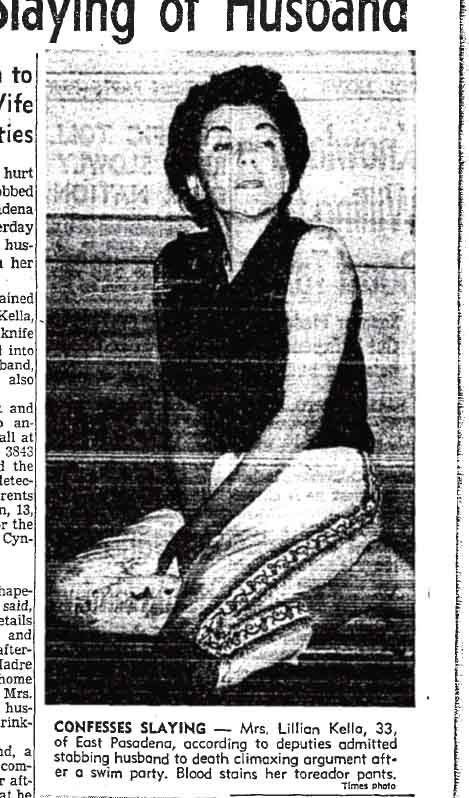
August 31, 1958: Lillian Kella admits stabbing her husband to death after a swim party. Woman with short hair in sleeveless top, blood on her toreador pants. Lillian loved Ed. She loved him even though he beat her. She loved him even though he was on probation for beating her. And she loved him even when he lay dying on the kitchen floor after she stabbed him in the heart. “I didn’t want him to hurt me anymore,” she said.

On the night of the killing, Lillian and Ed had hired a babysitter for their two children and gone to a party in Sierra Madre. By the time they left, both had been drinking heavily.
Continue reading →

Posted in #courts, @news, Columnists, Dodgers, Front Pages, Homicide, Sports | 1 Comment

Los Angeles history–Nuestro Pueblo


1938_august_29_nuestro_2

Below, Western and Los Feliz, as seen in Google maps’ street view.


Posted in Nuestro Pueblo | 4 Comments

Dodgers coach to manage Padres, August 30, 1968


1968_august_30_sports
By Keith Thursby
Times staff writer

The Angels weren’t the first team to fill their coaching staffs with former Dodgers.

Preston Gomez was named the first manager of the San Diego Padres, who would begin play the following spring. Buzzie Bavasi had quit as the Dodgers’ general manager to run the Padres and it could not have been much of a surprise that he picked a familiar face. Gomez had been the Dodgers’ third base coach since 1965.

The Angels can trace the beginnings of their recent success to the hiring of Mike Scioscia as manager. The former Dodger catcher filled his staff with former Dodgers such as Mickey Hatcher, Alfredo Griffin, Ron Roenicke and Dino Ebel.

The first Padre coaching staff also had a Dodger feel to it. According to a list on the Padres’ website, at least three of the 1969 staff could bleed a little Dodger blue: Roger Craig, Wally Moon and Sparky Anderson.

Of course, that first Padre team didn’t have the success Scioscia and Co. are enjoying in Anaheim. San Diego finished with a 52-110 record. Nate Colbert and Ollie Brown led the team in home runs and Al Santorini and Joe Niekro each had eight victories to lead the pitching staff.

Gomez managed in San Diego into the 1972 season before being replaced by another former Dodger, Don Zimmer. Gomez later managed the Astros and Cubs. He spent several years in the Angels’ organization, most recently as a special assistant to the general manager. He was seriously injured in March on his way home from spring training when he was hit by a truck in a gas station in Blythe.

keith.thursby@latimes.com 

Posted in Dodgers, Front Pages, Sports | Comments Off on Dodgers coach to manage Padres, August 30, 1968

Dodgers Labor Day weekend TV schedule, August 30, 1958


1958_doggett_scully_glue

Los Angeles Times file photo(s)

Check it out! Jerry Doggett and Vin Scully are glued together! GLUED!! Published in The Times on Sept. 2, 1958. Glue and all. Oh you photogs (or more likely the guys in the art department, sez Howard Decker). As Gary Metzker would say: "They are out of control." When I showed this to Davan Maharaj, he called it "X-acto Shop." Anybody who did this today would be out on their ear.

1958_august_30_tv_listings
By Keith Thursby
Times staff writer

Channel 11 was bringing in reinforcements for the Dodgers’ Labor Day weekend series against the Giants.  The Times’ Don Page wrote in his Sportslook column that Channel 11 would use 15 cameramen in an effort to finish the Dodgers’ first season in Los Angeles with improved coverage.

"The station spent the better part of last week at the Coliseum going through dry runs," he wrote. "In its telecasts from San Francisco earlier this year the station was open to criticism over failure to keep up with the action at times."

Sounds like some hockey games I’ve watched.

Vin Scully and Jerry Doggett would alternate between KMPC radio and Channel 11. Baseball teams may have too many announcers now, but that seems like a lot of work for only two guys.

Page also discussed the use of some new technology to bring college football games to local television.

USC and UCLA home games would be shown on Sunday afternoons "via the videotape recording process," Page reported. Videotape "could maintain the live quality of the original telecast," he promised.

I don’t remember this era of televised sports, but I do remember when a game on TV was a big deal. It doesn’t seem like that long ago that baseball’s Game of the Week was worth arranging your Saturday morning around.  After all, it was your only chance to see baseball from some exotic destination like Chicago or Pittsburgh.

Of course, it was that long ago.

keith.thursby@latimes.com 

Posted in #Jazz, @news, broadcasting, Columnists, Dodgers, Film, Front Pages, Hollywood, Music, Sports, Television | 2 Comments

Movie star mystery photos


2008_0825_mystery_photo

Photograph by the Los Angeles Times

Update: The woman below is indeed Veda Ann Borg. The above photo was put in her folder by mistake and I didn’t notice when I was scanning the pictures! She’s not Veda Ann Borg. Any guesses as to whom she might be?

2008_0827_mystery_photo

Los Angeles Times file photo

Veda Ann Borg in a 1941 photograph taken while she was making "Two Yanks in Trinidad."

OK, who is she?

Is it Veda Ann Borg? (L.C.) Absolutely! Congrats!

Can you guess the identities of our mystery Hollywood movie stars

2008_august_11_mystery_photo

Betty_healy_ted_healy

We have a correct answer! Betty Healy? (D. Webb).

Yes, this is Betty Braun (or Betty Healy) with Ted Healy of Ted Healy and His Stooges. She was sometimes known as the "girl stooge."

1926_0405_healy

She came out of retirement to play Stan Laurel’s wife, Bubbles, in "Our Relations."

Can you guess the identities of our mystery Hollywood movie stars

2008_0730_mystery_pix

To recap: Our mystery guest was brought to Hollywood to appear in "Murder at the Vanities." However he is NOT listed the imdb entry for the movie. To make it even more difficult, his name is misspelled in the listing of the Broadway production of "Murder" so he’s even harder to find. 
1951_0314_gerrits

Wait! Wait! This just in: Paul Gerrits? (Alexa Foreman). Yes, this is skater Paul Gerrits (or Gerrish in ibdb), who was a sensation in the Broadway version of "Murder at the Vanities." He appeared in several movies and worked in Los Angeles as a master of ceremonies, often for Earl Carroll.

Nice work, Alexa!

Can you guess the identities of our mystery Hollywood movie stars

Gail_russell_sig

The identity of our mystery artist was guessed by Nathan Marsak: Actress Gail Russell, star of "The Angel and the Badman."  Congratulations, Nathan!

Below left, the signature of Gail Russell. The Daily Mirror thanks Jackie Lugo of the Hollywood Chamber of Commerce for the picture of Russell’s painting. After Russell died, her brother gave the painting to Johnny Grant. Upon Grant’s death, the picture passed to Lugo.

I have no idea how many other Gail Russell paintings there are. I suspect not too many.

Who is eating dinner with the Reagans? And who is the Reagans’ mystery dinner companion?

Hint: Hoosier hoopster. NBA. Now ask yourself, does this gent look like an athlete? Someone said something about the Pacers…. You’re red hot!

Posted in Film, Hollywood, Mystery Photo | 11 Comments

TV game show is faked, player says, LA bids for Olympics, August 29, 1958


1958_august_29_cover


1958_august_29_runover

 
1958_august_29_sports

 
New York Dist. Atty. Frank S. Hogan announces the investigation of charges brought by Herbert Stempel that the NBC game show "Twenty-One" was rigged. NBC says it investigated the same charges a year before a found them without merit.

According to the New York World-Telegram and Sun, Stempel said  producers told him he could "make a pile of money" by "playing ball." He said he was instructed on how to "bite my lips, clench my fists and look agonized."   

Los Angeles contestants Wade Ruby of Pepperdine and Deputy Kermit Kynell (remember him from the Norwalk plane crash?) said they weren’t coached before their winning appearances on the show.

In sports, the Rams and the Browns prepare for a game at the Coliseum. The Browns are 1-1 in exhibition games, having beaten the Steelers 10-0 and lost to the Lions 17-7. The Rams have beaten the Redskins 31-10 and the Giants 38-10. The Rams starting quarterback is Jim Ninowski … The Braves beat the Giants 3-0, stretching their National League lead to 7 1/2 games … And Councilwoman Rosalind Wyman introduces a resolution to seek the 1964 Olympic Games.


Posted in #courts, broadcasting, Dodgers, Front Pages, Sports, Television | Comments Off on TV game show is faked, player says, LA bids for Olympics, August 29, 1958

US relaxes immigration law for Jewish refugees, Greenberg leads Babe Ruth, August 29, 1938

Sheriff guards Trojans' trophies

I’ve never made a scientific survey, but it wouldn’t surprise me if Eugene Biscailuz were the most photographed sheriff in the history of Los Angeles County. The man certainly knew how to get his picture in the paper. The trophy is being held by USC low-hurdle star Earl Vickery, left, and pole valuter Kenny Dills. 
US relaxes immigration laws to accept Jewish refugees
Greenberg leads Ruth in home runs
At left, the U.S. is accepting Jewish refugees from Europe at the rate of 100 a day. The AP story notes that the refugees have no money but are being assisted by Jewish aid groups.

Also note: Germany’s Catholic bishops denounce the Nazis, though not by name. The bishops say all Catholic books are censored, banned or confiscated. 


African Americans in sports
Above, if you look hard enough you really can find African Americans in The Times.


In sports, the Angels beat the Stars in the final double-header of the "Civil War series" … Hank Greenberg hits his 45th homer of the season as Detroit wins against Boston, 4-3 … Greenberg’s run in the Tigers’ 118th/119th game puts him ahead of Babe Ruth’s 1927 season, when Ruth had hit 39 runs in 118 games.   

Posted in #games, @news, Countdown to Watts, Current Affairs, Dodgers, Front Pages, Sports | Comments Off on US relaxes immigration law for Jewish refugees, Greenberg leads Babe Ruth, August 29, 1938

August 28, 1958: Intruder kills former actress

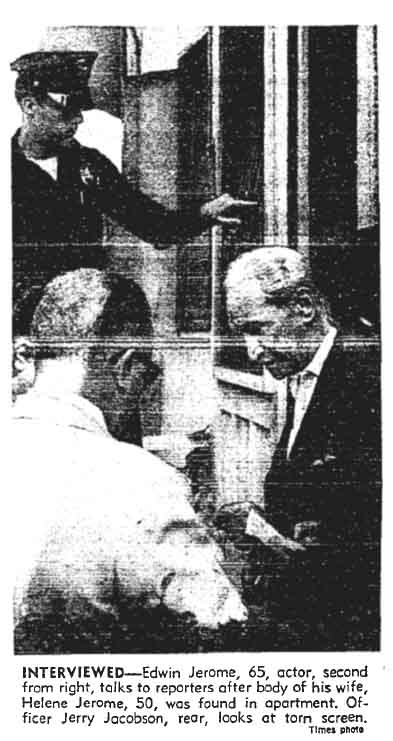
August 28, 1958: Edwin Jerome talks to police after the discovery of his wife's body.

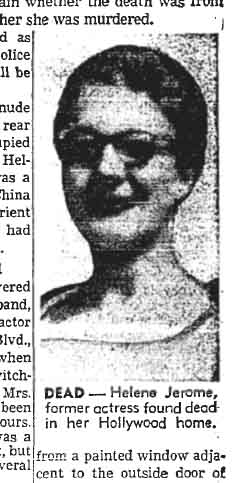
August 28, 1958: Photo of Helene Jerome, found dead in her Hollywood home. Her hair is pulled back and she is wearing glasses. She is one of those cold cases that leave all kinds of unanswered questions even when the killer is finally caught, convicted and sent to prison. Nothing about it passes the sniff test.

We know her name was Helene Funk Jerome, born in New York on March 12, 1908, which makes her 50 at the time of the killing. She was living in a rear apartment at the Las Palmas Hotel, 1738 N. Las Palmas. That’s the one used in “Pretty Woman.”

She was supposedly a retired actress, but her credentials are rather vague. The Times said she was a graduate of either the Royal Dramatic Academy or the Royal Dramatic Society in London, so I’m guessing it was the Royal Academy of Dramatic Arts, which has no record of her — at least online.

Most of her career was spent on the stage in China, The Times said. She never made any movies and shouldn’t be confused with Helene Jerome Eddy, who died in 1990.

Continue reading →

Posted in #courts, @news, Cemeteries, Dodgers, Film, Forest Lawn, Front Pages, Hollywood, Hollywood Division, Homicide, LAPD, Sports | 1 Comment