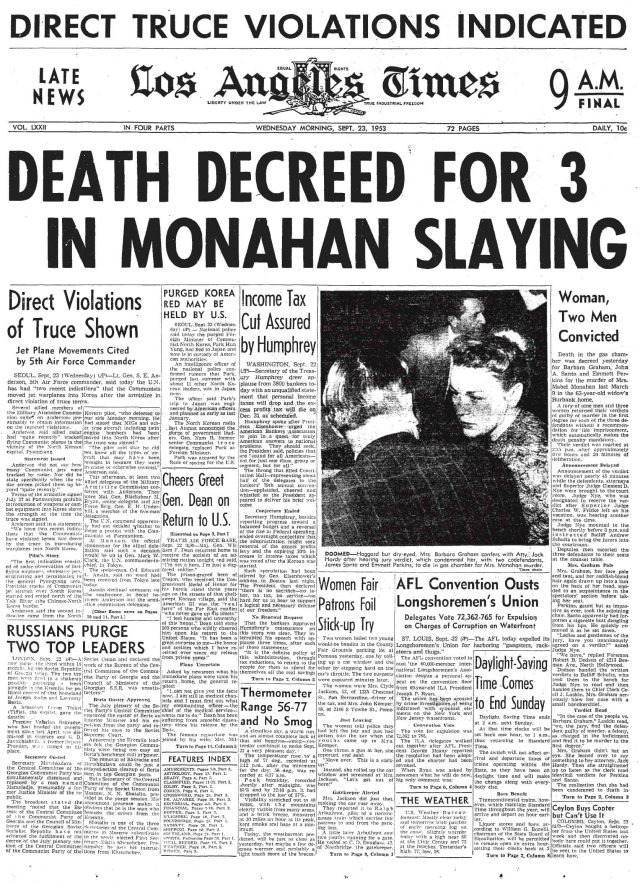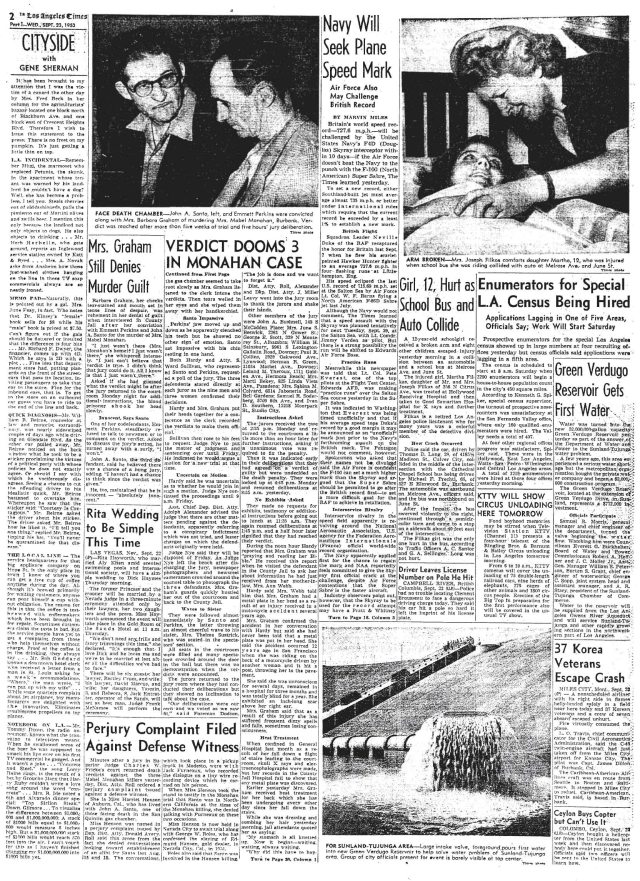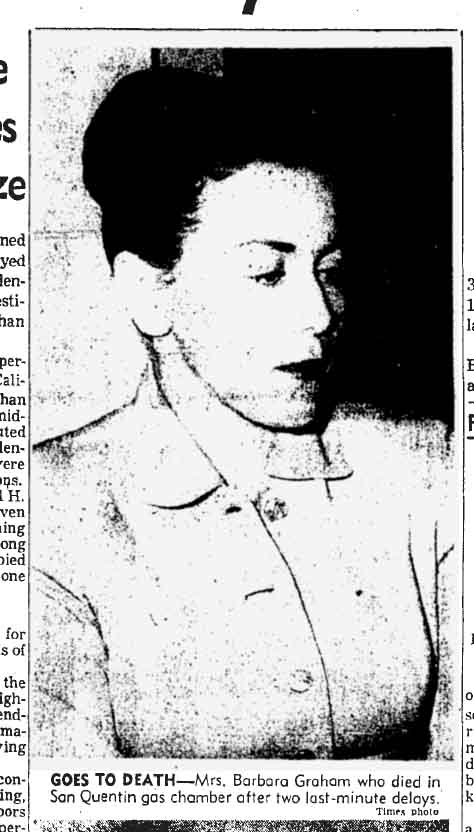
I Want to Live — The Barbara Graham murder case, November 16, 1958

Above: Barbara Graham, one of four women to be executed in California, along with Juanita “the Duchess” Spinelli, Louise Peete and Elizabeth Duncan.

The trailer–dig those bongos!
Gerry Mulligan!
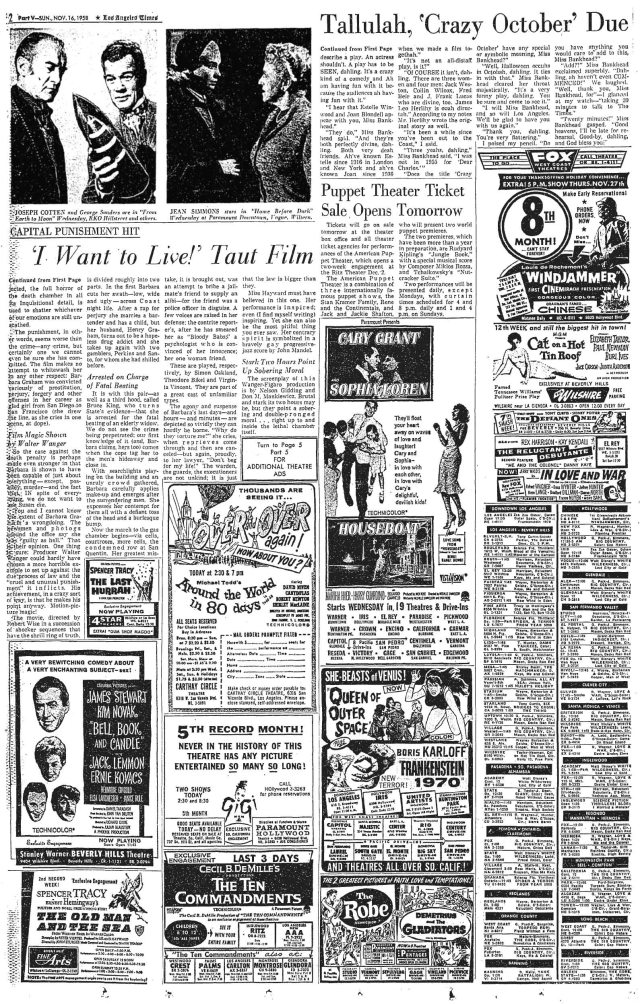
Five years after the execution of Barbara Graham in the Mabel Monahan killing, the story comes to the screen in the Robert Wise film “I Want to Live!” by Nelson Gidding and Don Mankiewicz, starring Susan Hayward in an Oscar-winning performance.

Graham and accomplices John Santo and Emmett Perkins were convicted of killing Monahan, 63, who was found strangled and beaten in her Burbank home, which had been ransacked. Another accomplice, John True, testified for the prosecution under a grant of immunity. True said they were looking for $100,000 supposedly hidden at the home by Monahan’s former son-in-law, a Las Vegas gambling operator.

“Mrs. Graham didn’t bat an eye.” “I just can’t believe that verdict is true.”
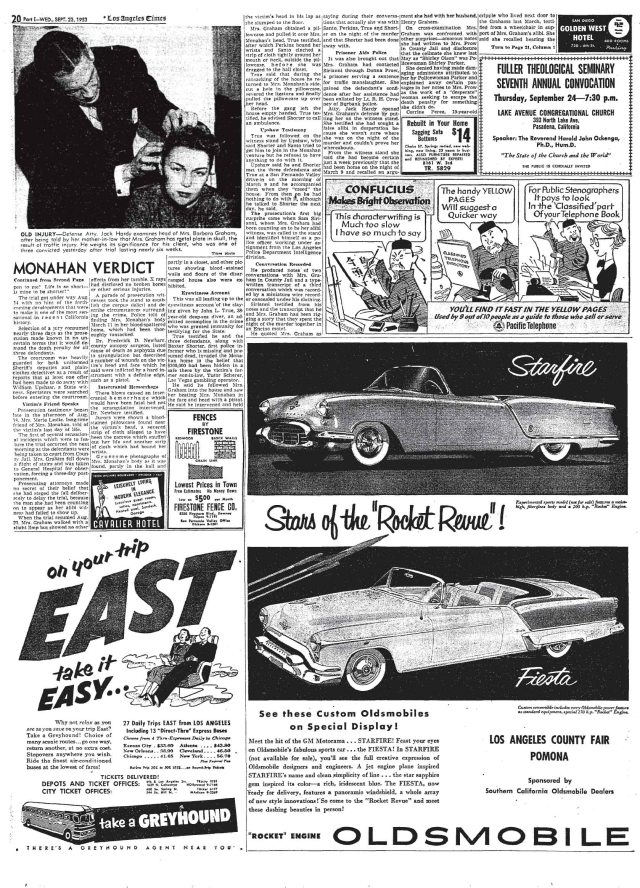
“Life is so short. Is mine to be shorter?” “As long as they found me guilty of something I didn’t do, I’d rather take the gas chamber.”
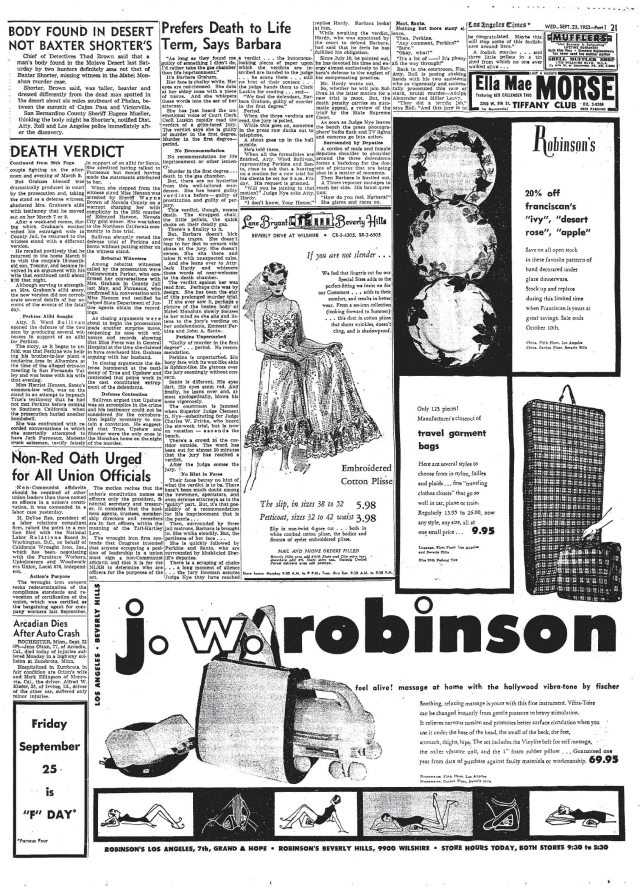
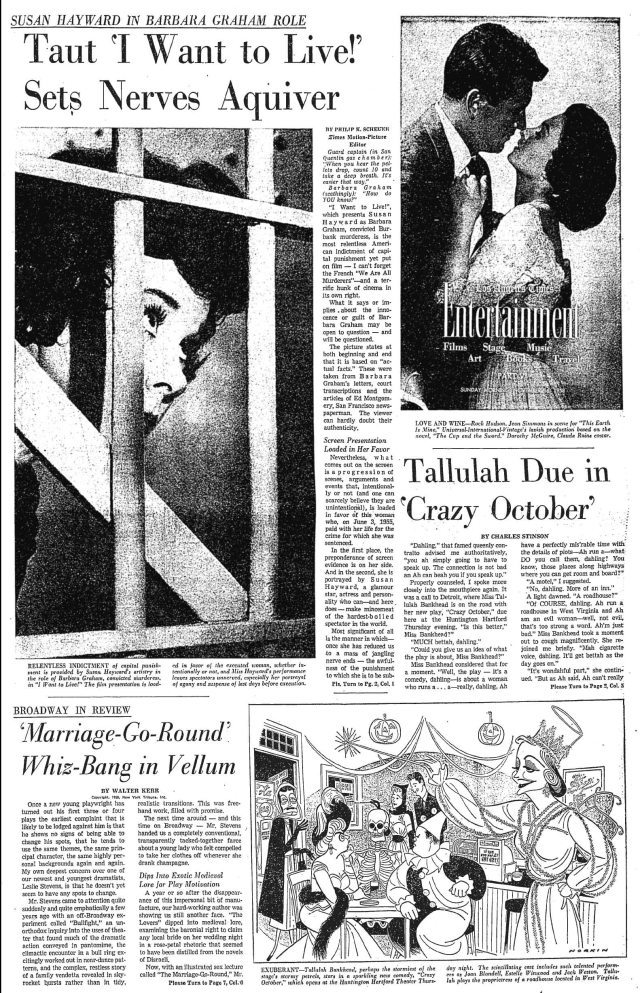
“When you hear the pellets drop, count 10 and take a deep breath.” “The newsmen and photogs around the office say she was ‘guilty as hell.’ “
Posted in #courts, Film, Front Pages, Hollywood, Homicide, San Fernando Valley | 10 Comments

Beverly Boulevard –Nuestro Pueblo


1938_1116_nuestro

Above, 1801 Beverly Blvd. and below, the 1800 block of Beverly shown in Google maps’ street view.


Posted in Architecture, Nuestro Pueblo | Comments Off on Beverly Boulevard –Nuestro Pueblo

A. Victor Segno — “How to Live 100 Years”

Segno_100_crop
"The proper selection of underwear is of great importance. Some people advocate the use of woolen the year round while others think only cotton should be worn. In my experience I have found that there are objections to both."

–A. Victor Segno,
"How to Live 100 Years,"
Los Angeles, 1903


Posted in books, health | Comments Off on A. Victor Segno — “How to Live 100 Years”

DVD revival — Buster Keaton’s The General

1927_0312_general

1927_0312_general_review

I am unfamiliar with the reviews of Katherine Lipke, a movie critic for The Times from 1922 to 1927. (She also wrote a novel published in 1932, "Rain on the Roof"). Given her tepid review of Buster Keaton’s "The General," it’s probably not a subject I’m going to explore too much.

To be fair, Lipke had no idea she was seeing what we now consider one of the great movies of the 20th century. Beyond that, I’ll let her speak for herself.

But let it be noted that "The General" is being released by Kino International in a two-disc DVD edition. The DVD offers a choice of three soundtracks: One by Carl Davis that I would expect to be pretty good; one by prominent movie organist Robert Israel; and another by Lee Erwin. It lists at $29.95. You can ferret out reviews of the DVD here.


Posted in Film, Hollywood | 2 Comments

Vintage Children’s books — Bullock’s Wilshire, 1929


Miss_pert_ebay

J. Paget-Fredericks’ "Miss Pert’s Christmas Tree," 1929.
Here’s someone’s Christmas present from Bullock’s Wilshire, listed on EBay. Bidding starts at $19.99.

A companion book sold by Bullock’s Wilshire, Paget-Fredericks’ "Green Pipes," is also listed for $17.99.


Posted in art and artists, books | Comments Off on Vintage Children’s books — Bullock’s Wilshire, 1929

Our rural past — farming in Torrance

Torrance1
By Russ Parsons

You would hardly know it today, when South Bay towns like Torrance and Gardena
seem composed of little but suburbs and strip malls, but it wasn’t so
long ago that this broad, flat plain included some of the choicest
agricultural land in California.

Beginning
in the 1880s (even before if you count the cattle-running ranchos) and
continuing until as recently as the 1950s, there were thriving farms
producing strawberries, beans, sugar beets and dairy cattle, among many
others.

Torrance author Judith Gerber beautifully captures this history in
her new book "Farming in Torrance and the South Bay," part of the
wildly popular "Images of America" series run by Arcadia Publishing.

Read more >>>

Posted in Animals, books, Food and Drink, Real Estate | 2 Comments

Film tells story of 1920s Jewish athletes


2008_1109_jewish_hoops

Photographs from Laemmle/Zeller Films

A Jewish basketball team from 1921-22.

‘First Basket’ honors Jewish athletes

Film documents the early days of organized basketball.

By Gary Goldstein

November 9, 2008

2008_1109_hoops_lautman
Inky Lautman of he Philadelphia SPHAS,
about 1939-40.

Did you hear the one about the Jewish basketball legends?

No, that’s not the intro to a Jackie Mason joke or fodder for a Mel Brooks movie, but the basis of the perception-altering new documentary "The First Basket," opening Friday in Los Angeles.

Produced and directed by David Vyorst, the movie takes a comprehensive look at the early days of basketball and the profound influence that Jewish players, mostly sons of Eastern European immigrants, had on what is now considered the world’s second most popular sport (soccer is first). As narrator Peter Riegert asks at the start of the film, "Who knew?"

The movie features a wide range of nostalgic archival footage and memorabilia, plus interviews with such "hardwood heroes" as original New York Knickerbockers Ralph Kaplowitz, Sonny Hertzberg and Ossie Schechtman (who is credited with shooting the first basket in the NBA). It also examines such key cultural issues as anti-Semitism; the social factors that led waves of inner-city Jewish kids to basketball and the sport’s aid in their American assimilation; how suburban migration shrank the Jewish presence in basketball after 1950; and the sport’s latter-day resurgence in Israel.

Vyorst, a policy and public relations specialist, committed to documenting this multilayered subject more than 10 years ago. "I was rediscovering my Jewish roots and my love of basketball at the same time and the two had become powerful motifs in my life," Vyorst said by phone from his Washington, D.C., office. "Then I heard a radio interview with the 1946 Knicks and some of the original NBA players, all of whom were Jewish, and I just knew there was an important story to be told."

The first-time filmmaker, however, didn’t anticipate some of the ambitious project’s inherent challenges. "I didn’t realize how hard getting images for every detail in the film and licensing each image would turn out to be," Vyorst said. With the help of various researchers and consultants he employed a "by-all-means-necessary approach" to unearthing and securing the vast archival material, a lengthy process that contributed to the movie’s six-year assemblage.

Tracking down the surviving former pro players and coaches was also time-consuming, although infinitely rewarding. "They were the nicest old guys in the world. I wish they would’ve adopted me as their grandson," joked Vyorst. He added, "Getting to know [ex-Boston Celtics coach] Red Auerbach was one of the greatest times of my life." (The irascible Hall of Famer died in 2006.)

Read more >>>


Posted in Film, Hollywood, Religion | 2 Comments

A plan for Dodger Stadium


Dodger_stadium_1962_0411_paste

Photograph by Ray Graham / Los Angeles Times

Dodger Stadium under construction in a photo published April 22, 1961. (No, this image hasn’t been Photoshopped. It’s a large print so I had to scan it in two pieces and paste it together–lrh).

By Keith Thursby

Dodger_stadium_1958_1211_crop

Photograph by Ray Graham / Los Angeles Times
Project manager Ted Little stands at the edge of the bowl being excavated in Chavez Ravine, Dec. 11, 1958,

Turns out the Dodgers considered some Space Age concepts when
building Dodger Stadium. Anyone for a ride on the Dodger monorail up to
the ballpark? George Jetson would have been right at home.

Dick Walsh, a former Angels general manager who was director of
stadium operations for the Dodgers during the stadium’s construction,
has a revealing interview with Robert Schweppe on walteromalley.com
that includes details about what might have been.

How wild were some of the ideas? Several involved
transportation–along with the monorail the Dodgers considered a bridge
overpass and a stadium tram. And don’t forget the drive-in ticket
window.

Inside the ballpark, they considered placing advertising on the
outfield fences and infrared heating for seats on the field level.
According to Walsh, outfield ads were rejected because Walter O’Malley
decided, "We’re going to keep the stadium pure."

Putting some seats on rollers to accommodate football was another
idea. Walsh told Schweppe that Rams owner Dan Reeves "had talked to us
about having his football club play in the stadium. Big discussions
about that went on. Walter’s position was that ‘it was a baseball
stadium. I’m not going to do that.’ "

How about a series of Dodger monuments similar to the tributes in
Yankee Stadium? Location and visibility problems made that difficult,
Walsh said.

It’s fun to think of the possibilities, but one of Dodger Stadium’s
best assets has been its simplicity. I’m showing my age here, but I’ve
never been a fan of ballparks that bombard you with everything but the
ballgame. But I sure would have liked that monorail.

Here’s a link to the story. http://www.walteromalley.com/feat_walsh_index.php


Posted in Architecture, Dodgers, Downtown, Sports | 3 Comments

Movie star mystery photo

2008_1110_mystery_photo
Our mystery guest has nearly 50 credits on imdb.  Update: Yes, she’s Jean Porter … "she has just completed ‘Abbott and Costello in Hollywood’ and ‘Early to Wed,’ " according to the caption information on the back of the photo.

Dewey Webb is the first to guess the identity of our mystery actress. Stay tuned for more photos!

2008_1112_mystery_photo
Los Angeles Times file photo
Many people have correctly guessed our star’s identity: Claire Lockhart, Steven Bibb, Jeff "jjm332," jimlib1900 (calling himself "Waldo Lydecker," obviously a fan of "Laura") and Alexa Foreman. Congrats! 
2008_1113_mystery_pix
Los Angeles Times file photo
Here’s our mystery guest with a second mystery guest…. Update: As many people guessed, this is Jean Porter and Virginia Weidler from "The Youngest Profession."
2008_1114_mystery_photo

Los Angeles Times file photo
Jean Porter, shown at left in "Till the End of Time," directed by her future husband, Edward Dmytryk, one of the Hollywood 10.
Posted in Film, Hollywood, Mystery Photo | 24 Comments

Vintage architecture — Richard Neutra

Neutra_barsha_crop
Photograph courtesy Crosby Doe Associates

Richard Neutra’s Leon Barsha Residence, 302 Mesa Road, Pacific Palisades, CA 90402


From the Realty company’s website
:

The Leon Barsha Residence, 1938. Originally saved from destruction by the Hollywood Freeway expansion with its relocation to Santa Monica Canyon, the Barsha Residence has been saved once again by designer Scott Lander. Museum-quality 1930s interiors showcase Neutra’s panache for simplicity, sophistication and sheer elegance during this earlier part of his storied career. Fully restored, including all major systems, the residence now incorporates three bedrooms, two bathrooms, an open living room with restored window fenestration and a two-car garage with direct entrance into the walled, landscaped grounds. $2.495 million.

Posted in Architecture, Real Estate | Comments Off on Vintage architecture — Richard Neutra

Found on EBay — From Silverwood’s

Silverwoods_ebay Now here’s a vintage cashmere jacket from Silverwood’s, a longtime men’s store in Los Angeles that folded in the early 1990s, that might come in handy if you’re playing Nathan Detroit. On EBay with bids starting at $14.99.


Posted in Fashion | Comments Off on Found on EBay — From Silverwood’s

Lasorda’s Dodger forecast, November 13, 1968

1968_1113_therese

Above, "Therese and Isabelle," 1968.

1968_0701_therese

"Reminds us anew that there’s nothing quite so puritanical as a dirty picture."
— Kevin Thomas

Some clips on YouTube for the curious.,,,


1968_1113_sports Part of the pleasure in plowing through old sports stories is reading about the future and knowing how things really turned out.

It’s like the familiar movie plot where the character time-travels with a handy newspaper so he can bet on last year’s big game. Of course, no money was waged in researching this post.

John Hall’s column in The Times devoted a section to Tom Lasorda, then a manager in the Dodgers’ minor league system, who called the columnist to defend the organization’s prospects. Lasorda had been working in the Arizona instructional league.

"Remember these names," he told Hall. "Ted Sizemore, Billy Buckner, Steve Garvey and Bob Valentine. They’re all eventually going to be tremendous hits in Los Angeles."

How’d Lasorda do? All four had a big impact on the Dodgers. Three of the four were involved in big trades.

Sizemore was rookie of the year in 1969 but was traded with another player a year later to St. Louis for Dick Allen. Buckner was traded to the Cubs in 1977 in a deal that sent Rick Monday to the Dodgers. Valentine was part of a big swap with the Angels in 1972 that included Andy Messersmith, Frank Robinson and Ken McMullen, among others.

Garvey had the longest career with the Dodgers, leaving in 1982 to sign as a free agent with the Padres.

To be fair, Lasorda didn’t pitch a perfect game with his predictions. "Besides the kids, I’ve also got Bill Sudakis, Willie Crawford and Paul Popovich with me in Arizona and they’ve been looking great," he said. "Sudakis is for real."

— Keith Thursby

Posted in #gays and lesbians, Columnists, Dodgers, Film, Front Pages, Hollywood, Sports | 1 Comment

Found on EBay — Batchelder tile

Batchelder_ebay_02
Here’s a piece of Batchelder tile listed on EBay with bids starting at 99 cents. (Yes, there is a reserve). It’s signed "Batchelder Los Angeles."


Posted in Architecture, art and artists, Real Estate | 1 Comment

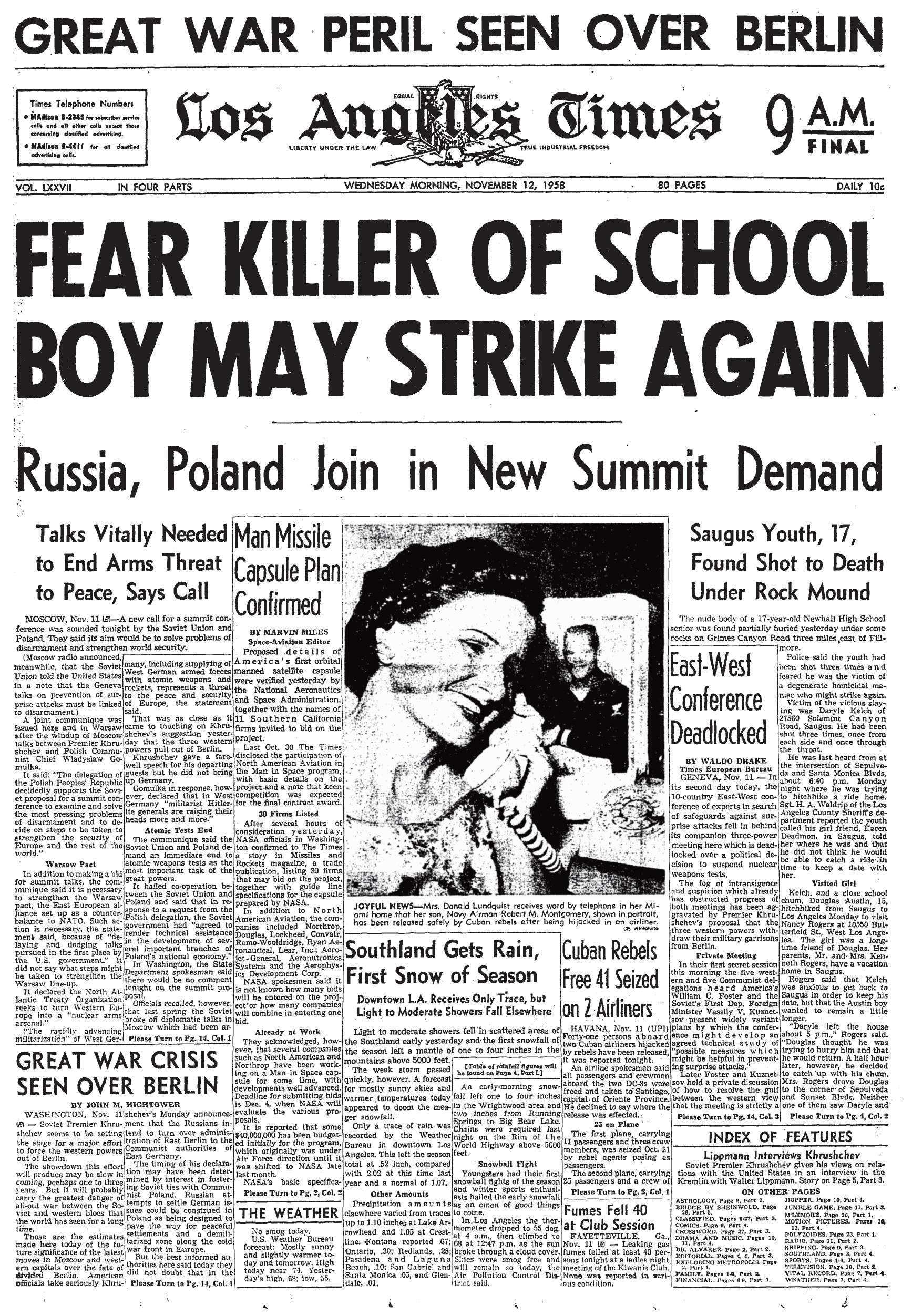
November 12, 1958: Teenage hitchhiker killed

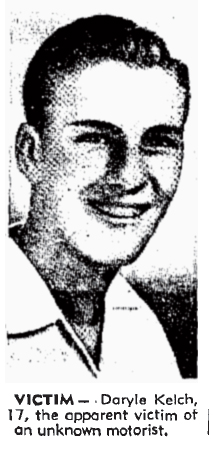
November 13, 1958: Daryle Kelch photo

November 12, 1958: Los Angles Times cover: Fear Killer of School Boy May Strike AgainDaryle Kelch was one of the most popular seniors at William S. Hart High School. He had a good friend, Douglas Austin, and a girlfriend, Karen Deadmon. And he was a dependable boy, according to the eulogy delivered by the Rev. Fred Dawson of Foursquare Gospel Church in Newhall.

He was from a big family, The Times said, with four sisters and two brothers. His parents were separated and he lived with his mother, Gladys.For all the good things about Daryle, the 17-year-old had one bad habit: hitchhiking. And however many times he caught a ride with some stranger, it was once too often.

On Monday, Nov. 10, 1958, Daryle and Douglas decided to hitchhike to Los Angeles to see Douglas’ friend, Nancy Rogers, whose parents had a vacation home in Saugus. For those who are unfamiliar with Los Angeles geography, that’s about 32 miles and although that area of Santa Clarita is developed today, it would have been remote in the 1950s.
Continue reading →

Posted in Front Pages, Homicide, LAPD, Obituaries | 3 Comments

Voices — Jay Fiondella


1983_0526_jay01

Above, Jay Fiondella sets off to look for World War II planes
that crashed in Greenland.

1983_0526_jay02

"My Holy Grail."
1983_0526_jay03
"Adventure is out there."
Posted in broadcasting, Film, Food and Drink, Hollywood, Obituaries, Television | Comments Off on Voices — Jay Fiondella

Sid Hughes dies at 50; the Daily Mirror mourns


Sid_hughes_03_crop

Los Angeles Times file photo

Sid Hughes, Los Angeles newsman.

1958_1118_sherman


Sid Hughes, who owned the badge that is the Daily Mirror’s icon,
worked at nearly every newspaper in Los Angeles: The Times, the
Record, the Express, the Herald, the Examiner and the Mirror News.
He somehow missed the Daily News.

1958_1111_sid_hughes


Posted in @news, Food and Drink, Front Pages, Obituaries | Comments Off on Sid Hughes dies at 50; the Daily Mirror mourns

Found on EBay — vintage golf club

1929_0129_dyas

Above, golf equipment at B.H. Dyas Co., Jan. 29, 1929.

Antique_club_ebay

This is a Walker Cup "rainbow face" driver that was sold at the B.H. Dyas store in Los Angeles. Bidding starts at $9.99. The B.H. Dyas Co. opened in 1914 at 321-325 W. 7th St. as "one of the finest sporting stores in America," according to The Times.


Posted in Sports | 1 Comment

Peace — November 11, 1918


1918_1111_cover


Boekenoogen_1918_1118_envelope
In February 1993, I found a box of old letters at the Salvation Army store in Pasadena. The price — $148 — was based on the alleged value of the stamps, which were quite ordinary. The letters turned out to be a collection of carefully preserved notes between Earl Boekenoogen, a young serviceman, and Estella Bennett, a Pasadena nurse.

This is Estella’s Nov. 18, 1918, description of the armistice celebration in Pasadena.

Boekenoogen_1918_1118_01_crop
"I been sick for a week with the ‘Flu.’ "
Boekenoogen_1918_1118_02

"I suppose you celebrated Peace Day ‘over there. ‘ "

Boekenoogen_1918_1118_03_crop

"Everyone had a tin pan or something to make a noise."

Boekenoogen_1918_1118_04

"They had a big parade Monday."

Boekenoogen_1918_1118_05

"I still have an awful cough."

Boekenoogen_1918_1118_06_crop

"Eliza went with Mrs. [illegible] to All Saints Church tonight. Do you remember the night we went there?"

Boekenoogen_1918_1118_07

"It’s a puzzle to me to know what to send you for Christmas."

Boekenoogen_1918_1118_08

"I guess it has been everyplace, but they couldn’t seem to find you. They even sent it to France."


Posted in @news, Front Pages | 2 Comments

Rams win against Falcons, November 11, 1968


1968_1111_movies

"Oh! What a Lovely War," 1969


1968_1111_sports
The 1968 Rams weren’t known for their offense and things hit a low
point at Atlanta. But the Rams had enough defense to edge the Falcons,
17-10. It just wasn’t pretty.

Jack Pardee returned an interception 29 yards for a score that gave
the Rams a 7-3 halftime lead. Roman Gabriel’s touchdown pass to Jack
Snow in the fourth quarter broke a 10-10 tie.

Gabriel fared a little better than Atlanta quarterback Bob Berry,
who took a forearm in the head from Deacon Jones. Berry’s helmet came
off but made it back into the game eventually.

"I never thought Berry would come back," Jones told The Times’ Bob
Oates "If his helmet doesn’t come off his head does. It was beautiful."

–Keith Thursby


Posted in Film, Front Pages, Hollywood, Sports | Comments Off on Rams win against Falcons, November 11, 1968

Dodgers cut back on day games — November 11, 1958


1958_1111_cover


1958_1111_sports
It took only one season in Los Angeles for the Dodgers to shift their hours later.

The team’s 1959 schedule almost eliminated day baseball at the
Coliseum. The Times’ Frank Finch said the team would have a record
number of night games with "possibly only the Sabbath and holiday tilts
falling in the matinee category."

Hard to blame the Dodgers. Only six games in 1958 failed to draw at
least 10,000 fans to the Coliseum–and all those games were on
weekdays. The Coliseum was a tough enough place for a baseball fan to
watch a game, but sitting there with so many empty seats must have made
for one lonely stadium.

Another change in 1959 would be reducing doubleheaders from six to
only one. Season tickets would remain the same, however. According to
The Times, box seats were $2.50 a game and reserved seats $1.80.

–Keith Thursby

Posted in Dodgers, Downtown, Sports | 2 Comments