A World War II Thanksgiving, 1943


1943_1114_thanksgiving

Above, a World War II recipe for meatless mince pie.


"The larders are war-shorn, but let the heart be grateful for the gift
of fertile lands, for the riches of the earth and the sea and the
privilege to share our all-American feast. We give thanks for an
abundance of grain.

"If we skimp today, for the less, ‘Lord make us duly
thankful.’ "


The Times advises readers to be flexible in making substitutes because many items in the traditional Thanksgiving meal are scarce or unavailable. Turkeys are smaller in 1943, The Times says, because feed supplies are low. Many of the birds are being sent to soldiers overseas, so the home front has to make due with chicken, which isn’t rationed, unlike red meat. And if you can’t get a chicken, try pork shoulder.

Instead of butter, use margarine or chicken or bacon fat. Sage, most of it from Dalmatia, is unobtainable, so try using oregano in your dressing. Oysters are also scarce because the men who would have harvested them are at war.

"After the war, we can eat the oysters we can’t get today," The Times says.


Posted in @news, Food and Drink, Front Pages | Comments Off on A World War II Thanksgiving, 1943

Writer arrested for threatening wife with butcher knife, November 21 1958


1958_1121_oconnell


1959_1018_chamales_2

"Suddenly it seemed the whole panorama of his life was a race and he was running last…. There was something in him that had to come out. He had to find a way to get it out, to free himself of it. Something that would give him a chance to feel and know things. To blend all of the things which were in him: the matter, the spirit, the flesh."

–Thomas T. Chamales, "Go Naked in the World."

"Chamales is a writer who can and must write. Even his partial failures
are more impressive than some fancy-Dan success we’ve seen in recent
years."

–Robert Kirsch


If you were ever looking for a prototype of the alcoholic, brawling, self-destructive author, you might consider Thomas T. Chamales,
a veteran of the OSS who wrote the 1957 bestseller "Never So Few,"
which The Times’ Robert Kirsch called, "Easily one of the best novels to
come out of World War II."

Before he died at the age of 35 when
he was trapped in a burning apartment, Chamales wrote "No Rent in His
Hand," an unpublished novel; another novel, "Go Naked Into the World";
a play, "Forget I Ever Lived"; an outline for screenplay, "The Mill";
and 550 pages of an unfinished novel titled "Run and Call It Living." 

He
also spent a fair amount of time in jail during his stormy marriage to
big band vocalist Helen O’Connell, whom he married in 1957, with
novelist James Jones as best man.

In October 1958, Chamales
and O’Connell had a violent argument at a Wilshire Boulevard
restaurant, but police said she refused to press charges. A month
later, O’Connell’s 14-year-old daughter from a previous marriage called
police from the family home at 445 Homewood Ave., to report that
Chamales had threatened O’Connell with a butcher knife. While he was in
jail on those charges, he was accused of passing a bad check in Florida.

In
June 1959, he was fined $500 and given two years’ probation for
wife-beating and the next month, five LAPD officers showed up at the
home to evict him.

He lived hard! He fought hard! And he fell hard!

And then, on the night of March 20, 1960,
Chamales smoked his final cigarette. He was living in a fourth-floor
apartment at 1441 S. Beverly Glen Blvd., and evidently fell asleep. The
cigarette set the sofa on fire and soon the apartment was in flames.
Firefighters found him on the floor in his shorts; blackened hand
prints on the walls of the apartment showed where had desperately tried
to find the door.

He was survived by a daughter from his marriage with O’Connell and two sons from a previous marriage.

Curiously, and perhaps tragically, Chamales’
novels appear to be largely forgotten. "Never So Few," was made into a
movie with Frank Sinatra, but the book is long out of print after being
reissued in 1972.

The Wall Street Journal published this story about Gerald Chamales, one of the novelist’s children, in 1998.

Update: The only copy of any of Chamales’ books in the Los Angeles Public Library is in Spanish!


Posted in #courts, books, Film, Front Pages, Hollywood, LAPD | 1 Comment

Coming attractions — Maltese Falcon

Bogart_maltese
"The Maltese Falcon" will be shown at the Warner Grand in San Pedro at 7:30 p.m. Saturday, Nov. 22, 2008. Tickets are free for L.A. Conservancy members–while supplies last. If you’re a member of the Los Angeles Conservancy, RSVP to Deandra Rosales or Debra Espinoza at 310.548.2493 by 5 pm on Friday, November 21, or bring your membership card to the box office on Saturday after 3 p.m.

Tickets for non-L.A. Conservancy members are $5/$10 and can be purchased at www.warnergrand.org

Posted in Coming Attractions, Film, Hollywood | 2 Comments

Found on EBay — Vintage film poster

Selig_ebay02
At left, a poster from the 1912 Selig film "The Peculiar Nature of the White Man’s Burden" is on EBay. Bidding starts at $9.95 or buy it now for $150.
Posted in Film, Hollywood | Comments Off on Found on EBay — Vintage film poster

Thanksgiving, 1936

1936_1117_thanksgiving
Recipes for "modern" stuffing from The Times, 1936. Please note that this item has not been put through the Daily Mirror test kitchen (our Le Creuset has been gathering cobwebs of late). These recipes are for entertainment value only.
Posted in Food and Drink, Front Pages | Comments Off on Thanksgiving, 1936

November 20, 1958: Valley man killed with hammer

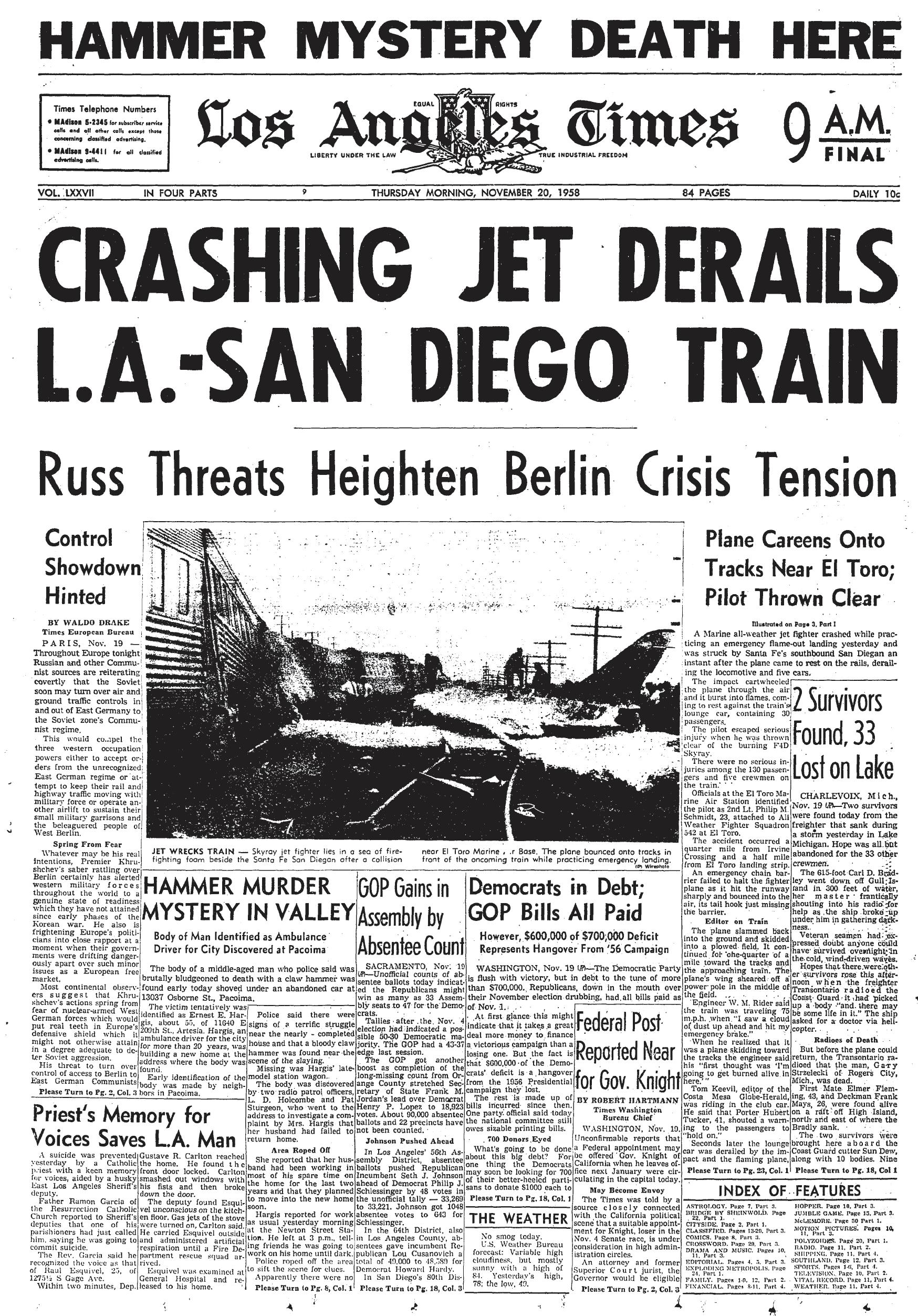
November 20m, 1958: Los Angeles Times cover: Crashing Jet Derails L.A.-San Diego TrainThe crash of a Marine plane near El Toro derails the Santa Fe’s San Diegan, but no serious injuries are reported.

Ernest E. Hargis, who had been a city ambulance driver for 20 years, is found beaten to death with a hammer and shoved under an abandoned car at 13037 Osborne St., Pacoima. Hargis was building a home at the site, The Times said.

Further investigation found that Hargis had been hiring former jail trustees and itinerant laborers to help him on his house. James Edgar Holmes, a former psychiatric patient, was accused of the killing. Holmes admitted killing Hargis but said it was in defense during an argument over a star drill he was using to bore holes in concrete.

Posted in 1958, Front Pages, Homicide | 1 Comment

Found on EBay — Bullocks Wilshire

Bullocks_wilshire_ebay Here’s an outfit with lots of sequins from Bullocks Wilshire. Now listed on EBay. Buy it now for $149.99.
Posted in Uncategorized | Comments Off on Found on EBay — Bullocks Wilshire

Found on EBay — Williams and Walker


Posted in art and artists, Music, Stage | 1 Comment

Thanksgiving, 1928


1928_1127_thanksgiving

Above, Chef Wyman’s recipes for Thanksgiving, 1928. And thanks to Mary McCoy of This Book Is for You and On Bunker Hill for the tip.

Thanksgiving Family Secrets

What’s Bread in the Coffee Can


RAISIN BROWN BREAD

1 cup milk
1 tablespoon white vinegar or lemon juice
1/2 cup rye flour
1/2 cup cornmeal
1/2 cup whole-wheat flour
1/2 cup raisins
1 teaspoon baking soda
1/2 teaspoon salt
1/4 teaspoon ground ginger
Ground cloves
1/3 cup molasses

In bowl mix milk with white vinegar. Let stand at room temperature 10 to 15 minutes.

Mix
rye flour, cornmeal, whole-wheat flour, raisins, baking soda, salt,
ginger and dash cloves in large bowl. Stir in molasses and milk. Blend
well.

Butter clean 12-ounce coffee can. Pour in batter. Cover
mouth of can with foil and place in deep pot. Add boiling water halfway
up can. Cover pot and steam over moderate heat, replacing water if
necessary, until straw inserted to middle of bread comes out clean,
about 1 1/2 to 2 hours.

Remove from heat and let stand on rack
10 minutes, then unmold. While still hot, slice by drawing string
around bread, crossing, and pulling ends. Can be reheated in 300-degree
oven. Makes 10 servings.

Each serving contains about: 126 calories; 136 mg sodium; 2 mg cholesterol; 1 grams fat; 28 grams carbohydrates; 3 grams protein; 0.33 gram fiber.


Thursday November 17, 1994

By CHARLES PERRY,
TIMES STAFF WRITER

Most of my family was living in California by the 1880s, and their various culinary heritages–New England, Southern and Midwestern–had begun to take on a uniform Californian quality by the time I was on the scene. But not my Perry grandfather, the only one of my grandparents not born out here. He came from a rather New England-y part of upstate New York, where Perrys westering in from Massachusetts had been thick on the ground since the early 18th Century, and a mere 60 years of living in California hadn’t altered his tastes.

The rest of the Thanksgiving meal was a menu a lot of people would recognize: turkey with sage stuffing, cranberry preserves, mashed potatoes, candied yams (possibly due to my Southern grandmother’s influence), succotash, green and Jell-O salads, corn bread and hot rolls. But for Granddad’s sake, we always had brown bread.

Insofar as people outside New England know of brown bread, they think of it as something to make canapes and cream cheese sandwiches with, and possibly to eat with baked beans. To Granddad, and consequently to us, it was a bread–a dark, sweet, dessert-like bread you ate at Thanksgiving and Christmas.

*

Brown bread is more like an English steamed pudding than an oven bread. The traditional shape is cylindrical, because for many decades people have usually steamed it in an empty coffee can, rather than a pudding mold.

One theory is that New Englanders invented brown bread because they couldn’t make an English risen loaf with cornmeal, and wheat often didn’t do as well in the local climate as rye. Meanwhile, New Englanders always had a lot of molasses on hand due to their trade contacts with the Caribbean, so why not make pudding?

For Thanksgiving Grandmother often made her own starchy brown pudding from graham flour, which was like a cross between brown bread and fruitcake. When both were served at the same meal, we sometimes felt we’d reached the limit of how much dense, spongy, sweet brown stuff a person could eat. But it wouldn’t have been Thanksgiving without brown bread.


Posted in Food and Drink, Front Pages | Comments Off on Thanksgiving, 1928

Voices — Tom Daschle, 2001


Daschle_21

Photograph, Getty Images

President-elect Barack Obama has asked former Sen. Tom Daschle
to serve
as secretary of Health and Human Services, and the
South Dakota
Democrat has accepted the offer.


Daschle Finds Himself in Another Tight Spot

Profile: No stranger to slim victories, his new role will tax his skills as a coalition builder. Even rivals had kind words.

Friday May 25, 2001

By NICK ANDERSON,
TIMES STAFF WRITER

WASHINGTON — Sen. Tom Daschle, soon to become the nation’s highest-ranking Democrat as leader of a razor-thin Senate majority, should be expert by now at squeezing the most power from the barest of margins.

The South Dakotan won his first race for Congress in 1978 in a manner that President Bush might appreciate–by a mere 110 votes after a hand recount and a yearlong legal dispute that reached the state Supreme Court.

He won a contest for Senate minority leader in 1994 on a 24-23 vote of his Democratic peers–and one of his backers bolted soon afterward to the Republicans.

Now Daschle will become Senate majority leader when Sen. James M. Jeffords of Vermont quits the Republican column in coming days to become an independent, giving Democrats a breathtakingly precarious edge: 50-49-1.

A New Role for Capitol Insider

Having pulled off a stunning coup with the Jeffords defection, Daschle will move into a new role that will tax his considerable skills as a Capitol insider: building legislative coalitions with Republicans loyal to Bush.

The man he edged out in 1994 for the party leadership said Daschle can do it.

"This will be a seamless move for him," said Sen. Christopher J. Dodd (D-Conn.). "He’s respected and thought of very kindly by Republicans."

Dodd predicted Daschle would be in the mold of former Sen. Howard H. Baker Jr. (R-Tenn.), a well-regarded majority leader during the 1980s. For Baker, Dodd said, "the party came second and the Senate came first."

Most Republicans, naturally, were not rushing to praise Daschle on an extraordinary day when their majority had been pulled out from under them. But some had kind words for him.

Sen. John McCain (R-Ariz.), a maverick, said he has "a close personal relationship" with Daschle and praised his "fairness." Sen. Phil Gramm (R-Texas) called him "able." And Sen. Fred Thompson (R-Tenn.) said: "I think Tom has real potential in being a good majority leader. . . . Essentially, he’s a fair-minded man."

Daschle’s ascension also is sure to intensify speculation about his prospects as a presidential candidate. He has not scotched such talk, while insisting his focus is on building his base in the Senate.

Daschle, 53, a native of Aberdeen, S.D., is a liberal populist who is married to a Washington lobbyist. He served four terms in the House after his close 1978 election, then won his Senate seat in 1986.

He became a protege of former Senate Majority Leader George Mitchell (D-Maine). When Mitchell announced his retirement in 1994, Daschle vaulted from being a relatively little-known Senate insider to becoming the chamber’s top link to the Clinton administration.

This January, Daschle served for 17 days as majority leader when the new 50-50 Senate convened before George W. Bush became president and his vice president, Dick Cheney, became the tie-breaking vote. Now Daschle will have the majority post for more than a brief turn–assuming that none of the 50 Democratic-held seats change hands soon.

Position Powerful, but Misunderstood

The position Daschle is about to attain is powerful but often misunderstood.

Unlike the speaker of the House, who has vast authority to dictate what legislation may reach the floor and when, the Senate majority leader is forced by the chamber’s rules and customs to consult frequently with the opposing party.

What’s more, major legislation in the Senate usually requires a 60-vote super-majority to cut off debate–meaning neither the Democrats nor the Republicans in this Congress can roll past the other party without gaining a significant amount of crossover support.

But the majority leader does have one privilege that elevates him above the other 99 senators: The right to speak first in a given session.

That right enabled Sen. Trent Lott (R-Miss.), the current majority leader, to control the timing of debate on Bush’s tax cut and other priority legislation for the new administration. Now Daschle will be able to steer debate toward Democratic goals.

Daschle, in a telephone interview Thursday, said he hoped to encourage Senate proceedings that would give Democrats and Republicans the chance to offer the full range of amendments they want–something akin to the freewheeling debate on campaign finance reform that drew national attention two months ago.

He also said the close margins of victory in his career’s key contests have honed his political skills.

"I really believe it’s made me a better politician and made me a better leader," Daschle said. "What it has done is force me to listen and be sensitive to people who may not hold my view initially–and to be inclusive and to recognize that I’ve got to build my base, build out from whatever core base I have. That has been therapeutic for me."

Building his base by one seat in the 50-50 Senate–the Jeffords defection from the GOP–was an amazing stroke. A Senate source familiar with the move credited Daschle for being one of the senior Democrats who wooed Jeffords but also for giving the wavering Republican enough breathing room to make his own decision.

Daschle "simply reached out without asking the question," the source said. "He never pushed it, never said, ‘Are you going to do this?’ or ‘Is it imminent?’ or ‘Can you do it now?’ They [Daschle and his allies] were patient."

And Jeffords came around.

Daschle also has made sure to pay attention to the spectrum of views on the Democratic side. Sen. Zell Miller (D-Ga.) has voted more often than not against Daschle and was an early supporter of the Bush tax plan. But Miller remains in the party’s fold despite the urgent efforts of Republicans to convert him. So does Sen. Ben Nelson (D-Neb.), another frequent crossover vote.

And Sen. John B. Breaux (D-La.), a key centrist who has worked with Bush and Republicans, is a Daschle-appointed member of the party’s leadership and attends weekly strategy meetings.

To be sure, Daschle as minority leader often struck a hard-edged tone toward the Bush administration. His rhetoric against the bill to cut taxes by $1.35 trillion over 11 years, which Congress seems about to approve, has been fierce. He denounced Bush’s pick of John Ashcroft as attorney general. He has criticized Bush’s environmental policies and this month called a Pentagon proposal to develop a military strategy for outer space "the single dumbest thing I’ve heard so far from this administration."

Dealings With Bush Have Been Strained

In his interview, Daschle acknowledged dealings with the new president this year have been strained. But he said: "I’m thinking that there may be more opportunity for us to have a better relationship."


Posted in @news, Current Affairs, Politics | Comments Off on Voices — Tom Daschle, 2001

Air Force Academy gets youngest cadet, November 19, 1958

1958_1119_cover
Iven Kincheloe III, the 1-year-old son of a distinguished X-15 pilot who died in July 1958 in the crash of a jet fighter at Edwards Air Force Base, is recommended for an appointment to the Air Force Academy in 1972.

An Air Force Base in Michigan was named for the elder Kincheloe in 1959. An award for test pilots is also named after him .

Whether his son pursued a flying career is unclear at this point. There’s nothing further in The Times about him.


Posted in Front Pages, Science, Transportation | Comments Off on Air Force Academy gets youngest cadet, November 19, 1958

Found on EBay — From Haggarty’s

Ebay_haggarty
Here’s a vintage number from Haggarty’s, an upscale store in Los Angeles and Beverly Hills. Now listed on EBay with bidding starting at $24.


Posted in Fashion | Comments Off on Found on EBay — From Haggarty’s

Voices — Eric Holder, 1994


Ericholderagap1

AP photo

Eric Holder, deputy attorney general under Janet Reno and likely attorney general under President-elect Barack Obama.

Prosecutor Has Made Jury Study a Specialty


Wednesday June 1, 1994

By ROBERT L. JACKSON,
TIMES STAFF WRITER

WASHINGTON — Although he says he wants his day in court, Rep. Dan Rostenkowski (D-Ill.) may well meet his match if Eric H. Holder Jr., the prosecutor who obtained his indictment, chooses to try the case himself several months from now.

Holder, 43, the first black U.S. attorney in the nation’s capital, is a tall, stately man with a polished courtroom manner and 18 years of experience in public corruption cases. He also has made a study of how to appeal to juries.

"He understands juries here and he certainly understands politicians," says a former colleague on the District of Columbia Superior Court, where Holder served five years before President Clinton appointed him as this city’s top federal prosecutor last July.

A confident, easygoing man, Holder has said that he wants to develop a better relationship between his office of 300 attorneys, who are disproportionately white, and the predominantly black population of the district from which juries for his cases are drawn.

During his years as a judge, he said that he winced when he saw prosecutors lose trials that they should have won because they failed to relate to jurors.

Holder won the respect of his new colleagues when he took over the Rostenkowski investigation after his swearing-in last October. At the time, Jay B. Stephens, his Republican predecessor, criticized the Clinton White House for replacing him–at a time when it was replacing other U.S. attorneys across the country–in the midst of a highly sensitive investigation.

Rather than duck the criticism, Holder met it head-on. "The idea that a Democratic U.S. attorney is going to do something different than a Republican U.S. attorney is pretty close to ridiculous," he said. Instead of shortening or curtailing the inquiry, he decided to expand it by asking for the appointment of a new federal grand jury to replace the old jury, which faced expiration on Oct. 31, 1993.

Despite his short time as top prosecutor, Holder has had ample experience investigating public corruption. He spent a dozen years as a lawyer in the Justice Department’s public integrity section, where he had a hand in the congressional bribery prosecution of former Rep. John W. Jenrette (D-S.C.).

"In some ways, I came in as prepared as I could have been because of my 12 years in public integrity," he told the Washington Post earlier this year. "I think potentially I’m a better U.S. attorney now than I was then, from being on the bench for five years and presiding over hundreds of criminal trials."

The son of a secretary and a real estate agent, Holder spent the summer of 1974 as a law clerk for the NAACP Legal Defense and Education Fund and the summer of 1975 as a law clerk in the Justice Department. He received his law degree in 1976 from Columbia University.

He has never been active in local politics, has never run for public office and has never played a role in anyone else’s campaign, he told the Senate Judiciary Committee last year on the eve of his confirmation.

In describing the Rostenkowski charges to reporters, Holder said: "The vast majority of members of Congress are decent and honorable public officials who work incredibly hard and follow all the rules."

He quickly added, "But the criminal acts of a few feed the cynicism which increasingly haunts our political landscape."


Posted in @news, Politics | Comments Off on Voices — Eric Holder, 1994

Thanksgiving, 1908


1908_1122_thanksgiving

Above, Thanksgiving, 1908

"Did the Pilgrim Fathers have salads at their Thanksgiving feasts? Nay, verily!"

How Did Thanksgiving Get to Be Turkey Day?

History: The All-American feast took its time becoming the holiday we all celebrate today.

Thursday November 15, 1990

By CHARLES PERRY,
TIMES STAFF WRITER

1908_1120_harris
Thanksgiving didn’t come into the world fully formed. We don’t even know when the first Thanksgiving Day took place, only that it was sometime between Sept. 21 and Nov. 9, 1621.

The Pilgrims certainly had no idea of founding an annual holiday, either. The first Thanksgiving was strictly a one-shot event. Similar ad hoc days of thanksgiving were proclaimed from time to time in Massachusetts over the next 50 years–usually by the churches, rather than by the civil authorities–but it was Connecticut that made Thanksgiving an annual event, starting around 1647.

The custom of having an annual Thanksgiving Day spread throughout New England in the 17th Century, but as yet it did not include any idea of commemorating the First Thanksgiving. If anything was commemorated, it was a later Thanksgiving when the crops had failed and the Massachusetts Bay Colony came very close to starvation.

In 1631, everybody was down to a daily ration of just five grains of corn when a day of fasting and prayer was proclaimed for Feb. 22. Miraculously, on that day a ship returned from England with food supplies, the colony was saved and the fast day turned into a feast. There is a very old New England custom, now mostly forgotten, of serving every diner five grains of corn before the meal in memory of the hardship and the deliverance of that year.

The holiday actually met a certain amount of resistance as it spread. Since the "pagan" holiday of Christmas was not celebrated in Massachusetts until the 19th Century, Thanksgiving was often thought of as essentially a Puritan substitute for Christmas.

Thanksgiving made no headway in the South, for instance, and probably it was only because the Dutch colonists had celebrated what they called Thankday that it was accepted in New York. When the British governor of Rhode Island proclaimed Thanksgiving in 1687–doubtless thinking he was doing his subjects a big favor–Puritan-hating religious dissidents celebrated the holiday so contemptuously he threw some of them in jail. Rhode Island didn’t start celebrating Thanksgiving until 1776.

In 1776, of course, Thanksgiving was not a Puritan but a Patriot holiday. That year and every year throughout the Revolutionary War, the Continental Congress declared a national Thanksgiving to boost morale. George Washington also declared Thanksgivings as President in 1789 and 1795, as did the following Presidents occasionally until about 1815.

Still, the holiday did not catch on. That took two things: the migration of New Englanders throughout the Northern states, enthusiastically taking their holiday with them, and one very determined lady, Sarah Josepha Hale.

Sarah Hale was born in Maine in 1788 and had powerful childhood memories of Thanksgiving. In 1826 she published a novel containing a plea for a national Thanksgiving holiday. In 1846, as editor of the influential Godey’s Lady’s Book, a combination fashion and literary magazine, she began her campaign in earnest. From then on, she wrote at least two editorials a year on the subject and deluged public figures with correspondence about the need for Thanksgiving. She even included a chapter on the campaign for a national Thanksgiving in her book on etiquette.

The South dragged its heels for a while–when the governor of Virginia considered the idea in 1855, it was denounced as a relic of Puritan bigotry (probably a code word for Northern abolitionism), but the next year his successor just proclaimed the holiday without soliciting advice, and it was a success.

In 1859, Thanksgiving was celebrated in every state of the Union except Delaware, Missouri and recently admitted Oregon, and Sarah Hale expressed the hope that the holiday could unify the country against the gathering clouds of the Civil War.

That didn’t happen, of course, but during that war she persuaded Abraham Lincoln to declare a national Thanksgiving Day, intended to be celebrated annually. He established the date we follow now, the fourth Thursday in November. After the Civil War, Thanksgiving was encouraged as a way of healing the wounds of the struggle.

The menu at the first Thanksgiving in 1621 was simply whatever the Pilgrims, with the help of the friendly Wampanoag Indians, could put together: venison, wildfowl (mostly turkeys and ducks), fish and cornmeal. Even today, the Thanksgiving table is supposed to groan with abundance, but in the 19th Century it really groaned. Sarah Hale–whose vision obviously influenced how we celebrate Thanksgiving–described one table loaded with chicken pies, goose, ducklings and three kinds of red meat as well as turkey, and another crowded with plum puddings, custards and pies of all sorts.

She was emphatic, however, that turkey held pride of place among the meats and pumpkin among the pies, and these are still the essential Thanksgiving dishes for most people. How did they get this status?

It’s a little hard to say. As the largest bird available, turkey is certainly a prime candidate for a feast. In the course of the 19th Century, it became the absolute essence of what we call "Turkey Day," partly because it was a time of culinary nationalism when Americans boasted that they had the best ingredients in the world and therefore the best food; the native bird was obviously the right one for the native feast. In his 1878 book "A Tramp Abroad," Mark Twain describes getting homesick for American food in Europe and lists about 75 American specialties. Prominent among them are "Roast turkey, Thanksgiving style. Cranberries, celery."

Cranberry sauce was already strongly associated with turkey. As early as 1663 a visitor to New England had written, "The Indians and English use them (cranberries) much, boyling them with Sugar for Sauce with their meat, and it is a delicate Sauce." Nineteenth-century cookbooks throughout the country recommend serving turkey with cranberry sauce (sometimes cranberry jelly or, as in the original Fanny Farmer cookbook, cranberry punch), even in non- holiday contexts. It must have been the universal American taste, helped by the fact that cranberries keep well and could be shipped easily.

The necessity of pumpkin pie is a little harder to explain. In the 1650s, a visitor to New England noted that the colonists were eating apple, pear and quince pies like Englishmen, and had largely given up pumpkin pie. Maybe the homely pumpkin pie made a comeback in the late 18th Century when New England developed a taste for "plain fare," rather than fashionable European dishes. They kept their English plum puddings and apple and mince pies, but elevated the homespun pumpkin over them.

The New England menu was profoundly influential, but of course it had to be adapted to local circumstances. It was hard to start a meal with oysters in the Midwest. Certain new food habits might invade the menu, too. Olives and gelatin salads were gourmet novelties in late 19th-Century America. On the whole, though, our Thanksgiving dinners are simpler than our ancestors’. The effect has been to reinforce the special status of turkey with cranberry sauce and pumpkin pie.

At the same time every group in the country has tended to add its own traditional feast day specialties to the menu, perhaps gumbo crowding out New England’s creamed onions and chocolate cake the non-pumpkin parts of the dessert. The process continues today; in many households, turkey is accompanied by pasta or enchiladas.

It has often been pointed out that the First Thanksgiving was not the first thanksgiving in this country. There had been thanksgiving feasts in Virginia and the short-lived Popham Colony in Maine, years before the Pilgrims came.

We celebrate what is basically a New England Thanksgiving because New England made the festival its own. Its people had not come here as Englishmen and agents of the king, but to found a new society. In 1896 Edward Everett Hale, author of "The Man Without a Coun
try," wrote of the first Thanksgiving: "The Festival itself was a reminder that they had turned over a new leaf. It was a thick leaf, too, and nothing could be read which had been written on the other side."


Posted in Food and Drink, Front Pages | Comments Off on Thanksgiving, 1908

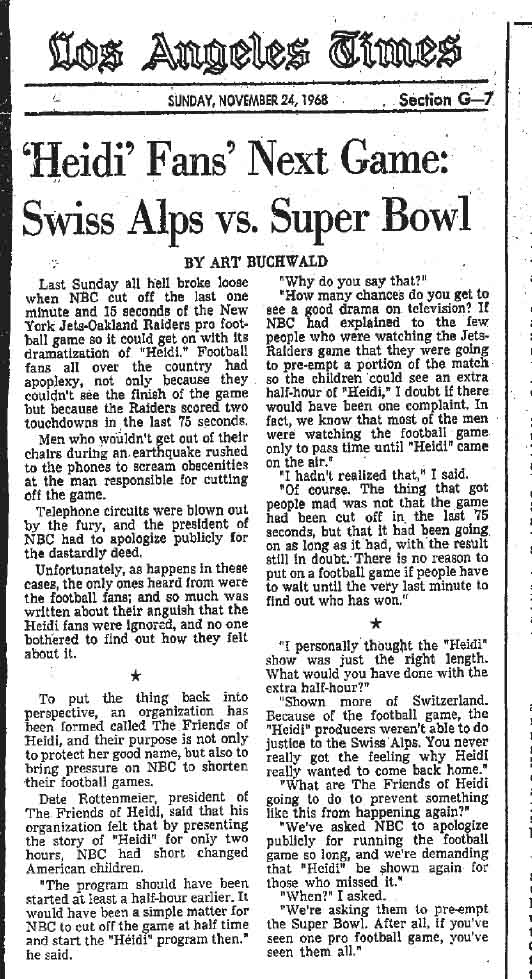
November 17, 1968: The ‘Heidi Game’ remembered

November 24, 1968, the Heidi game

Big Scream TV

Today is the 30th Anniversary of ‘The Heidi Game’, a Landmark Moment in Television Sports History

Timeline

1:05: Jets take a 32-29 lead on a 26-yard field goal by Jim Turner. Raiders’ Charlie Smith returns kickoff to Raider 22-yard line.

:50: Raider quarterback Daryle Lamonica hits Charlie Smith on a 20-yard screen play. With a 15-yard facemask penalty tacked on, the ball moves to the Jet 43.

NBC Cuts Away to Heidi

:42: Lamonica to Smith on a 43- yard TD pass. Oakland leads, 36-32.
Continue reading →

Posted in 1968, Blues, broadcasting, Sports, Television | 4 Comments

Rams tie San Francisco, November 18, 1968


1968_1118_bike_boy


1968_1118_sports
The Rams escaped from San Francisco with a 20-20 tie and quarterback Roman Gabriel realized it could have been a lot worse.

Gabriel waved off the Rams’ field goal unit for one more chance to
score a touchdown that would win the game. His pass to Bill Truax was
good for a score, but the play was called back because of a penalty.
Bruce Gossett then kicked the tying field goal with 17 seconds left.
This was the NFL before the overtime rule, so a tie was a tie.

"I was not satisfied to get a tie," Garbiel told The Times’ Mal
Florence. "I was confident that we would get a score. … As it turned
out I was right but, basically, I was very wrong when I think of it
now. If that pass had been incomplete or intercepted I would have been
the goat."

–Keith Thursby


Posted in Film, Front Pages, Hollywood, Sports | 5 Comments

Sports columnist on golf in Cuba, November 18, 1958

1958_1118_page1
 

1958_1118_sports Times columnist visits Cuba and reports about golf. Golf?

"The Cuban rebel leader, Fidel Castro, has dealt the tourist business in Havana an awful blow," Braven Dyer wrote, adding that the incoming revolt didn’t stop the celebrity golfers from having a great time.

According to Dyer, his party was stopped by soldiers as they drove from the Havana Hilton to the golf course. Johnny Weissmuller, an Olympic athlete who became famous again in a second career as Tarzan, "let out his jungle yell and the gendarmes promptly lowered their rifles, smiled and yipped ‘Tarzan’ as they waved us on."

Other celebrities of the era along for the trip included Buddy Rogers, Hoagy Carmichael and Bob Crosby.

Readers learned that the Havana Hilton had only five floors open because "the rebels have scared people away." Dyer detailed dinner one night: "You never saw such food. The most popular drink with tourists is the frozen Daiquiri, made of rum so light you hardly know you’ve had it until the roof caves in."

I realize this was a different era, with different standards, but a golfing trip to the Cuba during the revolution? Maybe there’s a hard-hitting piece from this trip I haven’t found yet. I’ll keep looking. This story just read like a travel brochure and should have been spiked.

The rebels took control of Havana on Jan. 1, 1959. Probably plenty of available tee times that day.

–Keith Thursby


Posted in Columnists, Current Affairs, Politics, Sports, travel | 2 Comments

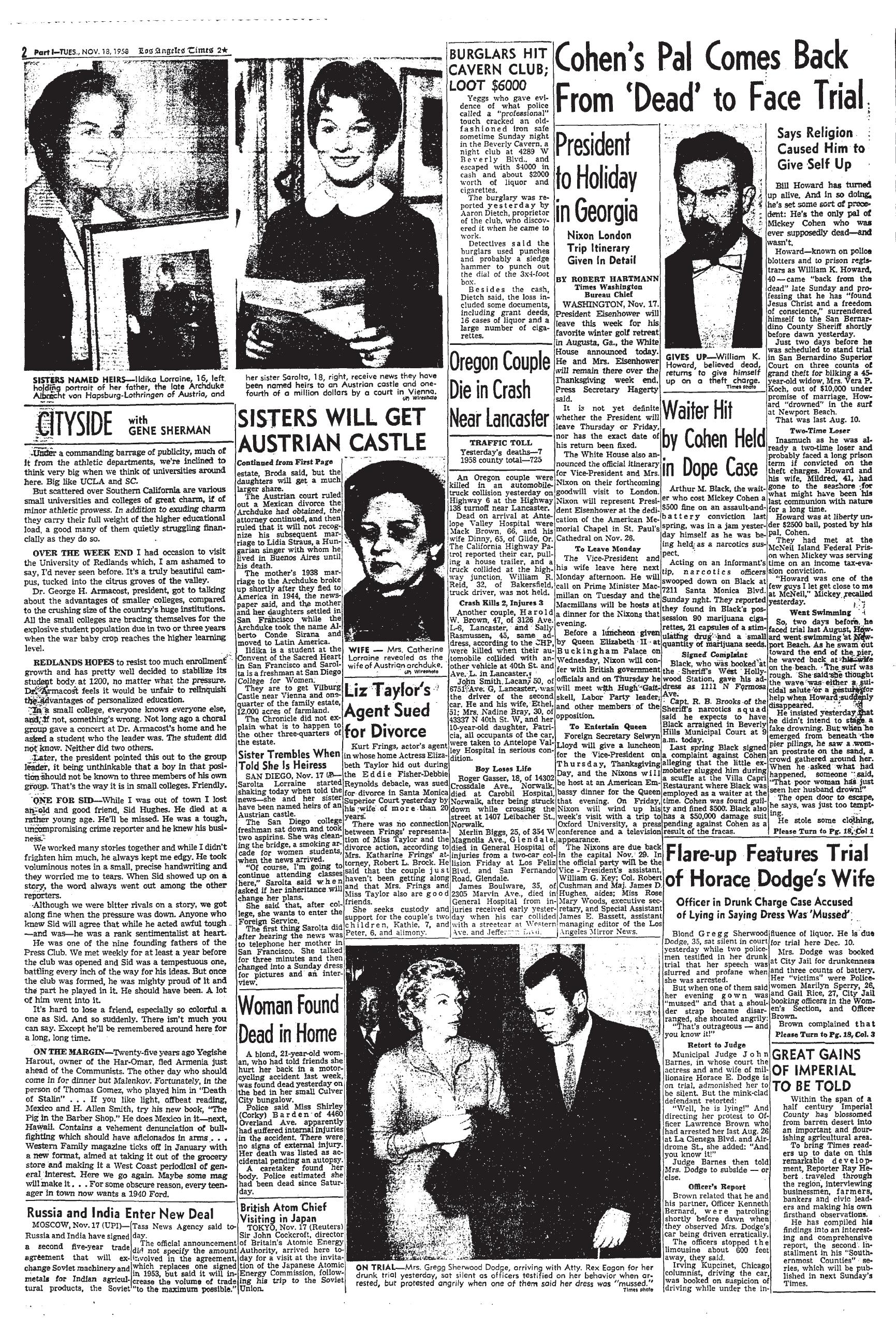
November 18, 1958: Mickey Cohen pal back from the dead

November 18, 1958: Mickey Cohen pal back from the dead
Here’s an amusing little wrap-up of crime news: Mickey Cohen’s pal comes back from the dead and a minor actress figures in a major trial about drunk driving. It never ceases to amaze me how much publicity celebrities were willing to endure in the old days in an attempt (often futile) to fight a drunk driving charge. The incredibly colorful Gregg Sherwood Dodge lost this case and paid a $100 fine. With luck I’ll post more about her later.

Note: Since the fires began, the Daily Mirror HQ has been without dsl. I’m not in the fire zone, thankfully, but putting out the DM on an ancient laptop at Starbucks is less than ideal.
Mr. Tecra 8000 is so thrilled to have an Internet connection that he’s downloading a bazillion updates, slowing everything to a crawl. Until dsl is restored, posting at the DM is going to be sparse. Stay tuned. And keep the fire victims in your prayers.

Larry Harnisch

Posted in #courts, 1958, Film, Front Pages, Hollywood, Mickey Cohen | Comments Off on November 18, 1958: Mickey Cohen pal back from the dead

Rams win over Packers, November 17, 1958

1958_1117_sportsSid Gillman’s high-powered Rams had just enough to beat the lowly Green Bay Packers, 20-7. Cal Whorton’s thorough report in The Times had everything you needed to know about the game and then some, but mostly I was interested in the Packers.

Rarely have the Packers been bad for long, but this team was dreadful.

Quarterback Bart Starr, who would lead the Packers to greatness and even one day coach the franchise, made a brief appearance late in the game after the starter, Babe Parilli, threw three interceptions and coughed up a fumble. Whorton said the Rams’ defense was tough enough that Starr "was lucky to get away with his head still on his shoulders."

The Packers finished the season 1-10-1 and Coach Ray McLean would be replaced by Vince Lombardi. And the Rams rarely had such an easy time again in Green Bay.

— Keith Thursby

Posted in Front Pages, Sports | Comments Off on Rams win over Packers, November 17, 1958

Police chief quits; Nazi fears drive Jews to suicide, November 17, 1938

1938_1117_cover

Voice of executed man speaks from Tijuana grave.

1938_1117_citadel

At left, the current film "The Citadel," with Rosalind Russell and Robert Donat.

Police Chief James Davis, who figured in the Gordon Northcott "Changeling" case, says he’s stepping down to protect his pension.

A United Press story datelined Berlin says without elaborating that "many" German Jews have committed suicide over fears of more Nazi terrorism before the "martyr’s funeral" of Ernst von Rath. A Nazi diplomat serving in Paris, Rath was killed by Herschel Grynszpan, a Polish Jew. 

"Hundreds of thousands of Jews have ‘disappeared’ from every town of any size, swelling the total of arrests to an estimated 50,000 [that’s what it says–lrh], including many prominent and wealthy Jews held as ‘hostages,’ " the UP story says.

1938_1117_runover
Jewish police officers to guard Nazi officials during visit to New York.
1938_1117_page5
Religious leaders and government officials call on the U.S. to accept Jewish refugees.
1938_1117_page6
Grand jury plans to indict Joe Shaw
in city corruption …  Cesar Romero endorses Safeway’s beef.
1938_1117_sports
Salary for UCLA football coach: $13,000 ($189,494.37 USD 2007)
Posted in Changeling, City Hall, Downtown, Film, Front Pages, Hollywood, LAPD, Sports | Comments Off on Police chief quits; Nazi fears drive Jews to suicide, November 17, 1938