Paul Coates — Mikoyan interview, January 13, 1959


Interview With Coates

Russian Stars on TV Show

By Paul V. Coates, Mirror News Columnist

Paul_coates
When President Eisenhower sits down with Soviet Deputy Premier Anastas Ivanovich Mikoyan on Saturday to plan give-and-take with West Berlin and Germany, it’ll be Ike who’ll have to do the giving.

This, Mikoyan made clear to me in an exclusive interview last night.

"We have advanced our proposals," the traveling trouble-shooter from the Kremlin said. "Now it is up to your side."

About West Berlin

The latest Russian "solution" to the current tensions that West
Berlin be made an unarmed "free" city until the eastern and western
divisions are united, that Red China should have a voice in any final
decision and that all foreign troops should be removed within one year.

"Do you think that the Berlin dispute could ignite a war between your country and mine?" I asked.

Quick Reply

The deputy premier threw back an immediate answer.

"We," he stressed, "do not want any war."

Mikoyan sandwiched his stern warning to the White House between small
talk which included the revelation that his daughter-in-law, Zena, was
one of theMoiseyey
ballet troupe which so successfully visited the United States last
year, and a confession that he was becoming slightly weary of the
zealous protection offered him by our police and State Department on
his current national barnstorming tour.

Previous U.S. Tour

1959_0113_mirror_cover_2

"I spent two months traveling around the United States in 1936," he pointed out during our KTTV interview last night. "Your State Department sent one very fine representative to accompany me.

"This
time," he continued, "let me just say that I would certainly enjoy
having a cocktail with each of these men who are assigned to me,
individually.

"But," he added, "I prefer to travel alone."

The
deputy premier arrived at the studio for his U.S. television debut in a
roaring caravan heavily guarded by Los Angeles police and federal
agents.

His main concern before air time was what type of commercial would be inserted in the program.

Not quite understanding, I explained that they’d probably be automobiles, rugs, food — some similar products.

"I can check and tell you exactly," I said.

An aide in the party shrugged. "What we mean," he said, questioningly, "there will be no political advertisements?"

Second to Khrushchev

Mikoyan also made the suggestion that no questions be asked pertaining to his position as the USSR’s No. 2 citizen.

"To answer that would put me in the position of being immodest," he explained.

But on camera, he was smiling and ready with glib replies.

Through his official interpreter, Oleg Troyanovski,
son of the Soviet Union’s World War II ambassador to the United States,
he touched on his childhood, "humble" background, lack of a college
education and favorable impression of the American "common man."

"I
have found that the mass of people this time are as friendly to our
country as they were the first time I visited," he said. "The American
people want peace."


1959_0113_bergholz
Roy Rogers and Dale Evans adopt a Korean orphan and the U.S. is investigating the Dodgers.

He was favorably impressed by Sen.
Humphrey’s recent visit to Moscow; he acknowledged U.S. progress in
building roads and bridges, and in our industrial plants and housing;
and he felt — a feeling which he’s been most vocal on since his
arrival here — that more trade between the United States and Russia
could quickly stimulate a better relationship.

"There Is No God"

Only once did the "goodwill" ambassador permit his careful guard to relax.

I
asked him: "As a former seminary student, do you feel that Marx was
right in saying that religion is the opiate of the people?"

"I do," he answered immediately. "At the time of the revolution, I became convinced that there is no God.

"I did it in spite of what my teachers tried to tell me."

When the television interview was finished, Mikoyan seemed particularly anxious to know if I had been pleased with it.

Interview Success

"Tell
him," I told the interpreter, "that I thought it was a very successful
interview, and that I certainly am pleased with it."

1959_0113_flying_car

The interpreter translated my remark to the deputy premier.

Fingering
the gold star on his lapel —  a medal which he received in World War
II for his efforts "in supplying the front" — he considered it. Then
he said something in Russian toTroyanovski. 

Russian Adieu

"Mr.
Mikoyan thanks you," the interpreter told me. "But he would like to
know if you are just saying this to be kind, or if you really mean it."

"Please tell the deputy premier," I replied, "that I really mean it. I don’t say things that I don’t mean just to be nice."

The information was duly reported to Mr. Mikoyan.

He received it, beamed, got up, shook my hand and said — I guess — the Russian equivalent of "Good night."

Posted in @news, broadcasting, Columnists, Current Affairs, Dodgers, Hollywood, LAPD, Paul Coates, Politics, Religion, Television | Comments Off on Paul Coates — Mikoyan interview, January 13, 1959

Voices — Jerry Cronin

Keith Thursby writes: Ned Cronin was a columnist at The Times until his death in 1958 and his work has been featured often in the Daily Mirror. His son, Jerry, recently discovered the blog and we started an e-mail conversation. I asked him if he’d be willing to share some memories of growing up in Southern California and his dad. Here is a recent e-mail:

1958_0820_cronin01 I have been thinking about writing a book about growing up in L.A. at that period of time in the days of the values of Ozzie and Harriet. Coincidentally, my mother’s name was Harriet and she was also a housewife like the role Harriet Nelson portrayed on their television show.

In those days, the male was the breadwinner and the female was the domestic engineer in charge of running the household. This created a major problem when my dad died when he was 48 years old. My mother had never had to work and I was their only child going to Loyola.

My father’s death created a financial strain on my mother so she sold our house near Olympic and La Cienega and we moved downtown to a small studio apartment where I slept on a sofa and she slept on a cot next to the stove. She went to Sawyer’s Business School to become a secretary, which took a year. She  finished in June at the end of my school year and we moved back to the hometown of my father and mother in Pendleton, Ore.

My father was a workaholic. He wrote a humorous daily column about sports figures, but he also wrote columns seven days a week under the byline of Dick Kidson called the Farmers Market Today promoting the different businesses at the classic landmark.

When I was 14, I worked for Magee’s cutting up fresh fruit for their salads in a warehouse across the street on Fairfax near Canter’s Delicatessen. Then, during the other vacations from school, I was promoted to washing pots and pans in the rear of their stall at their main location. I was the only non-Hispanic and learned supplementary vocabulary words that I could not use in my Spanish I class. The quality of food has not changed in 50 years.

I mention the Farmers Market because my father used to take me with him on occasion on his daily rounds. He would go the Farmers Market and interview a vendor. We would get gasoline at the Gilmore’s first Self Serve gas station in the country next door.

He would sometimes go visit his friend, Danny Goodman, at Gilmore Field, which was the home of the Hollywood Stars baseball team. Danny Goodman was a generous man who always sent crates of sodas over to our house. Those were the days of delicious sugary Nehi soda.

When the Dodgers moved to L.A. in 1958, the year my father died, Danny Goodman was in charge of concessions at Dodger Stadium. The rest is history considering how much the organization makes a year in concessions.

He had years of experience promoting events at Gilmore Field. The press box at Gilmore Field was incredible and I don’t mean that in a good way. You had to walk across a catwalk above the fans in order to get to the tiny press box. However, it was always filled with hot dogs and drinks and Danny knew how to take care of the sports writers. The most excitement occurred when the Hollywood Stars played the crosstown rival, the Los Angeles Angels.

It was an insane atmosphere.  In one game, the Angels manager promised a cashmere suit to the first Angels player to start a fight with a member of the opposing team. If you were a witness to this mayhem, it was the best entertainment in the city. By the fifth inning the fans were drunk and huge fights would erupt right underneath the press box. People would hurl cups of beer into each other’s faces. It doesn’t get any better than that.

The Pan-Pacific was another venue that my father visited frequently. He always gave me tickets to take my girlfriends to the Ice Capades and Ice Follies. It was more fun to go see the Harlem Globetrotters and my father got me an autographed picture of their "Clown" Goose Tatum who had a 7-foot arm span from fingertip to fingertip. I also enjoyed the Sportsmen’s Show where I had my first trout fishing experience out of a stocked tank. They would always have a daredevil climb up a narrow tall ladder and dive into a 10-foot tank.

1958_0820_cronin02Getting back to the routine of accompanying my father, we would then go down 6th Street toward downtown. His first stop was a visit to his doctor, Joe Zeiler, whom he gave boxing tickets and racetrack tickets in exchange for medical services.

He got into trouble once when he took the season pass tickets to Santa Anita from another employee’s mailbox at the Daily News and gave them to his doctor. The employee raised a stink and called the police not knowing that it was my dad who took the tickets. His doctor was arrested when he showed at Santa Anita to enter the horse races.

Needless to say, it was embarrassing for everyone involved. My father had cirrhosis of the liver, an occupational hazard of Irish sports writers in those days. My almost died once and was saved when the UCLA football team donated 10 pints of blood to save him. Somehow, his doctor kept him alive despite many relapses.

My father would take me to the Daily News at Pico and Los Angeles streets. There was such a cast of characters at the Daily News. They were talented and very funny despite working in deplorable conditions. Those were the days when you couldn’t simply e-mail or fax in your columns. As a result, they spent a lot of time interacting with each other with great camaraderie. The sports department consisted of a bunch of hard drinking rowdies. 

My father’s primary goal in my upbringing was to have me become a professional football player. He facilitated this process by taking me to UCLA football practices where his friend, Red Sanders, gave me advice and my own blocking dummy to take home and set up in my backyard. I am an only child so there was not much resistance when I would hit it.

Their punter taught me how to punt a football. He set up an appointment with "Toeless" Ben Agajanian, the famous kicker from the New York Giants. It was embarrassing because my father expected me to kick 50-yard field goals and I was so nervous that I would top the football and it would not go airborne but bounce down the field. Ben’s brother, J.C. Agajanian, was a famous race car owner with his famed No. 98 race cars.

The next arranged event took place on the football field of Los Angeles High School. My father has set up a date with Hall of Fame Quarterback, Bobby Lane, who led the Detroit Lions to their last championship for 50 years.  I nervously got out of my car and spied Bobby Lane running a lap around the track and a bag of footballs next to a bench.

1958_0821_croninHe told me to run a fast lap to warm up. I was a sprinter on the track te
am but not in shape to race a record breaking 440. I was breathing hard before we even started the workout. He then had me run patterns for 30 minutes until I thought I was going to drop dead from exhaustion. He was a party animal who kept himself in great shape. He even challenged the boxer, Art Aragon, to see who had more endurance by showing up early one morning when Aragon did his roadwork. He outlasted Aragon.

I had never seen such precise throwing accuracy in my life. Of course, he always gave me a substantial lead to make me run harder to make the catch. It was a great experience. I just wish that I had not been so nearsighted that I could barely see the ball.

To continue the theme of my apprenticeship to football, my father decided when I was 14 that I was not mean enough. It is difficult to take an easygoing person and turn them into "Mean Joe Green". Nevertheless, he decided that I needed to get toughened up by making an appointment with one of his wrestler friends, Sandor Szabo, who had a wrestling school near Westwood Boulevard and San Vicente.

As usual, my dad was playing golf on this particular Saturday so he made my mother take me to the gym. All the other guys had scars all over their faces and bodies and looked as if they were fugitives found in a rogue’s gallery. Most of them were in their 20s with aspirations to become professional wrestlers which paid good money in those days.

I tried to retreat to the area in back and try to avoid having to go into the ring with one of hoodlums. Finally, I was spotted and forced to get into the ring. After 10 minutes of being thrown all over the ring and mat burns all over my face, I was allowed to get out of the ring. I had to go there 3 times and was starting to get a cauliflower ear, so my mother convinced my dad that it was inconvenient for her to drive me over there and wait for an hour while I got the crap beat out of me.

Anytime my dad invited anyone over to the house, I would go hide in my room. You would think that I would be anxious to meet a celebrity and enjoy the experience. The reason for my reticence was that he would introduce people to me, I would shake their hands, and then he would make me do push ups in front of them to show them how athletic I was. He would have them punch me in the stomach to show the strength of my stomach muscles.

1960_1021_croninThe worst experience would be when he would take me to the Wilshire Country Club to accompany him while he played golf.

The first time I went, I looked forward to the event because it was fun to ride around in the golf cart which I might be able to drive. The actual fun ceased after about the 4th hole. My father would then stop the cart and make me get out. He would then take off in the cart and make me run full speed to catch it to illustrate to his friends that I could run fast.

When he took me to a celebrity golf tournament where he was invited to play, he made Dean Martin feel my bicep.

I could go on but you get the idea. You now know the "Good, Bad, and the Ugly." Unfortunately, two years after he died, I received a football scholarship from Stanford and had an unusual experience that had an impact on why I did not realize my father’s dream.

It was winter term of my freshman year and I was playing rugby to stay in shape as well as lifting weights. I was on my way to the weight room when I ran into my football coach with whom I had no contact since the season ended. He didn’t even provide comfort to the players after one of my teammates shot and killed himself in the soccer field.

Nevertheless, I put a smile on my face and greeted him. When he finally got next to me, instead of shaking my hand, he grabbed my bicep and asked me if I was lifting weights and working on building up my strength. At that point, I felt as if I were a slab of beef on a hook in a Rocky movie. I had a great Spring Alumni Game to prove to myself that I could play linebacker aggressively and then told them that I would not be back the following year.

I played rugby at the University of Oregon for fun and was selected to be a participant in the University People to People Student Ambassador Program in Western Europe. This experience changed my life and I joined the Peace Corps and served two years in Colombia promoting Community Development. I have traveled throughout Europe, South America , Mexico and the U.S. I have been in charge of all the services at ARCO’s Prudhoe Bay Operations Center in the Arctic and in charge of Technology for all 25 K-12 schools in Watts.

I broke the trend among Cronin men to not die in their 40s. That is not to say that I am in the pillar of good health as I had a heart attack 18 months ago and died twice after a bypass operation. I am going to be 67 on December 12th so I may not have achieved fame as an athlete but I have had an interesting life filled with unique challenges and rewards.

Jerry Cronin

Posted in Columnists, Sports | Comments Off on Voices — Jerry Cronin

Jets win Super Bowl, 16-7, January 13, 1969

1969_0113_sports

1969_0113_runover The New York Jets upset the Baltimore Colts, 16-7, to win the Super Bowl and become one of the most surprising champions in modern sports history.

How surprising was it? Here’s the game according to Jim Murray: "On Sunday afternoon, the canary ate the cat. The mailman bit the police dog. The minnow chased the shark out of its waters. The missionaries swallowed the cannibals. The rowboat rammed the battleship. The mouse roared, and the lion jumped on the chair and began to scream for help."

— Keith Thursby

Posted in broadcasting, Columnists, Front Pages, Sports, Television | Comments Off on Jets win Super Bowl, 16-7, January 13, 1969

Found on EBay — 1956 Thomas Bros. Guide

Thomas_bros_ebay_02 A 1956 Thomas Bros. Guide for Los Angeles and Orange counties has turned up on EBay. These are useful for anyone interested in Los Angeles history. Bidding starts at $13.99.


Posted in books, Freeways, Transportation | Comments Off on Found on EBay — 1956 Thomas Bros. Guide

Voices — Richard Bergholz

1959_0112_bergholz

Here’s a story by legendary Times political reporter Dick Bergholz, who died in 2000.

From his obituary: When Richard Nixon lost his race for California governor and delivered his famous promise, “You won’t have Nixon to kick around anymore,” every reporter in the room knew who “you” was. It was Richard Bergholz.

Read more >>>

Posted in Current Affairs, Politics | Comments Off on Voices — Richard Bergholz

Matt Weinstock — January 12, 1959


Taxing Times

Matt_weinstockd_2
A young lady singer is very angry at the Internal Revenue Service.

Her federal income tax last year came to around $380. She had paid all but about $70.

Christmas week the revenuers attached the amount from her checking account in a Hollywood bank.

She
received no notification that this was to be done. In fact, she learned
of it from the bank after the money was taken. Furthermore, she was
embarrassed as she had checks written for the money.

She thinks the action is an outrage, an invasion of privacy and discrimination against people in the entertainment business.

Now the rebuttal.

1959_0112_fight
A PERSON
whose
income tax payments are delinquent is notified that he owes the money.
Ten days later, if it has not been paid, the revenue service has the
authority to collect it, under Section 6331, Levy andDistraint, Public Law 591. Distraint means to seize or confiscate. Notice is given that it is going to be seized or when. 

Revenue
men are accustomed to being called Uncle Scrooge and worse but they
insist they do not deliberately create hardships for debtors. On the
contrary, they say when they find leniency is in order they give
debtors every opportunity to come clean. They wish they received more
co-operation.

However, the rule book is very decisive, so beware.

* *

ONLY IN L.A. —
A woman attending a funeral a few days ago was introduced to another
woman who, after a few minutes of solemn conversation about the
deceased, asked bluntly, "Would you like to buy two lots here?"

The first mourner, aghast at the impropriety of the question, replied, "No, but I’m curious- why do you want to sell them?"

"Well, for one thing, I’ve decided to be cremated," was the serious reply, "but the main reason is that I need the money."

* *

SILENT MARCHERS
I’ve taken in my last parade,
I find it too dismaying.
It makes no difference where I stand,
That’s where the band stops playing.
– ROBERTA MORGAN

* *


1959_0112_glenn_gould_2

Glenn Gould gives a quirky — but incomparable — performance
in Pasadena.

"This young man not only risks (virtuoso fingerings and hand-crossings
in Bach’s "Goldberg Variations") he brings them off in what became a
staggering set of symphonic etudes."

–Raymond Kendall


A DISHEVELED wretch accosted Herb Stinson on Spring Street and said, "Mister, can you spare a dime toward a bottle of wine?"

No beating around the bush, just a nice, clean, honest bite. It can almost be assumed that normalcy has returned.

* *

ANY TIME NOW Al
Gordon, radio newsman expects to learn that his son has been depicted
all over Russia as an example of American incorrigibility.

Not
long ago the boy got into a fight with another boy at Selma Avenue
School. As a teacher tried to stop them the Russian social security
delegation, visiting L.A. at the time, walked in and one of the group
with a camera quickly snapped the picture.

* *

AT 2:30 P.M. the other day Bob Cushnir
went into a Vermont Avenue bank to cash a $500 check. At first the
answer was no but six tellers scraped the bottoms of their tills and
finally made it. The explanation is simple. Since the market strike
more people are cashing checks at banks. Along about closing time
depletion sets in.

* *

WHILE IN San Francisco last week Buddy Gorman
stopped in the downtown section at a stand emblazoned with "Going Out
of Business" and "Everything Must Go" signs. He selected a hand-carved
object priced at $5.99 but the man said he could have it for $1.50.
Buddy asked how come the big markdown.

"I’m closing up," the owner beamed happily. "I just finished my parole!"

* *

LOOSE ENDS — A
reader suggests the Society for the Elimination of Obsolete Signs take
up at the next meeting the "No on 16" and other political stickers
still on some cars . . . What baffles Oscar Kantner is that the horses
in TV westerns are never given a drink or the old nosebag after a
three-day trek through the desert . . . Among things that bore Walt Hackett: The twin fins and the Finn twins. 


Posted in classical music, Columnists, Film, Hollywood, Matt Weinstock, Music | Comments Off on Matt Weinstock — January 12, 1959

Paul Coates — Confidential File, January 12, 1959


CONFIDENTIAL FILE

Batista Death Plot Laid Here

Paul_coates_3
When Fulgencio Batista fled Cuba last week, a fantastic plot by an American war hero to assassinate the dictator died in the planning.

The
initial secret meeting between the much-decorated World War II Marine
and agents of rebel chieftain Fidel Castro was held here in Los Angeles
14 months ago.

And the reason the scheme was never enacted was because of the indecision of the rebels themselves.

Details of the plan were revealed to me today.

The ex-Marine "soldier of fortune" who contacted Castro’s 26th of July movement here and proposed to shoot Batista personally is Guy Louis Gabaldon, a Silver Star winner for valor on the Island of Saipan.

According to his award citation, Gabaldon,
32, captured more than 1,000 Japanese in the fighting. Then, still in
his teens, he conducted a series of lone-wolf forays into enemy
territory to bring back prisoners before he eventually was wounded and
evacuated.

In 1957, a network television show was devoted to his exploits and currently a motion picture is being planned on his life.

The assassination plot which Gabaldon presented to the Castro agents was basically this:

1960_0829_eternity
He
would go to Cuba as a "tourist." Capitalizing on his "war hero"
reputation, he would attempt to get "in" with military and civil
officials in Batista’s government and, finally, to reach the
well-guarded dictator himself.

Maps and diagrams of Batista’s
offices and his residence were reportedly brought from Havana to Los
Angeles by rebel couriers and studied in great detail at meetings
between Gabaldon and Castro agents. 

Additional plans which laid out the route by which Gabaldon
would reach Havana, the hotel where he would register, and methods of
his keeping contact with the underground were also reportedly ready to
be put into effect.

For a period last year, there was almost daily contact between movement leaders in Cuba, Miami and Los Angeles.

Why the rebels never gave the scheme the "go" signal still isn’t known.

One problem, supposedly, was money. It’s possible that Gabaldon wanted more than the rebels felt they could afford.

Then
there’s the question of what effect Batista’s assassination by a
foreigner would have on the Cuban people. And would the dictator’s
death automatically assure Castro’s rise to power?

At one point, an alternative plan, to be masterminded by Gabaldon and carried out by two fanatics willing to sacrifice their lives for the rebel cause was also allegedly discussed.

Reared in East Los Angeles

Gabaldon,
one of seven children, was brought up in East Los Angeles. At the age
of 11, he left home. He was raised by the parents of a
Japanese-American school friend of his until, in 1942, they were herded
into an internment camp.

Then, barely tall enough to meet the
height requirement, he enlisted in the Marines. The knowledge of
Japanese which he had picked up from his "foster parents" aided him
immeasurably in his one-man raids on the enemy.

After receiving the Silver Star for his "impossible" achievements, he was quoted:

"I
will keep going out and hoping I’d get killed and get a medal, so they
could send it home to show people I did something good."

Following
his discharge, he worked variously as a fisherman, truck driver, pilot,
TV repairman, farmer and interpreter. In addition to English, he speaks
Japanese, Russian and Spanish.

Married, with three children, he is self-employed in television repair work and charter flying.


Posted in #East L.A., @news, Columnists, Film, Hollywood, Paul Coates, Politics | Comments Off on Paul Coates — Confidential File, January 12, 1959

Voices — Christine Collins, 1931


1931_1220_parole01_01
1931_1220_parole02_01

1931_1220_parole03_01
1931_1220_parole04_01
1931_1220_parole05_01

Posted in #courts, Changeling, Film, Hollywood, LAPD | Comments Off on Voices — Christine Collins, 1931

January 12-13: Soviet leader visits Los Angeles

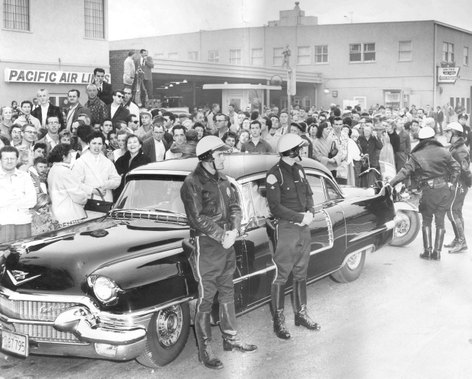
January 12, 1959: LAPD officers next to limousine as crowds gather before Anastas Mikoyan arrives at LAX.
LAPD officers keep control as a large crowd gathers at LAX in anticipation of the arrival of Deputy Soviet Premier Anastas Mikoyan. His plane was diverted to Burbank, where he landed without incident, The Times said.


Today, Anastas Mikoyan (1895-1978) is hardly a household name and his trip to Los Angeles is mostly a footnote to history. His AP obituary didn’t even mention that he had visited the city. With the nation’s fears about communism and the Soviet Union, public sentiment was far different and his brief stay received wide publicity. Continue reading →

Posted in @news, broadcasting, Film, Front Pages, Hollywood, LAPD, Politics | 2 Comments

East wins Pro Bowl, 28-21, January 12, 1959

1959_0110_lonelyhearts
1959_0112_sports Former USC star Frank Gifford returned to the Coliseum and led the Eastern Division team to a 28-21 victory in the Pro Bowl. Gifford, a star for the New York Giants, played halfback but did much of his damage in the air by passing for 75 yards and a touchdown.

The Pro Bowl in its current format has been held in Hawaii since 1971, so that must mean at some point Los Angeles was considered an exotic getaway to lure the players for an all-star game. Interesting that the ’58 game drew a then-record 72,250, another sign that L.A. once was a pretty fair pro football town.

–Keith Thursby

Posted in Film, Hollywood, Sports | 1 Comment

Found on EBay — Catalina Tile

Catalina_tile_ebay02
Catalina_tile_table_ebay

This is a table with an image from Catalina Tiles embedded in the top. It’s listed on EBay with a starting bid of $500. I have no idea what the going rate is for a genuine Catalina Tile table, as all I’ve seen so far are the more dubious ones. As always, check the vendor and the item carefully before spending that kind money.

Posted in Architecture, art and artists, Real Estate | Comments Off on Found on EBay — Catalina Tile

Demonstators protest arrival of Soviet leader; Dodger turns to acting, January 11, 1959

1959_0111_cover

Soviet Deputy Prime Minister Mikoyan provokes demonstrations in San Francisco en route to his visit to Los Angeles. Recall that Soviet leader Nikita Khrushchev will come to Los Angeles later in the year. And a federal court strikes down a regulation used to keep Georgia’s college campuses segregated.

1959_0111_jazz

1959_0111_nba_riots

At left, a jazz concert featuring George Shearing, Shelly Manne, Anita O’Day and Andre Previn. I’m not sure how the Kingston Trio got mixed up with Shearing–must have been interesting. Previn had quite a career as a jazz pianist and film composer before he became a serious conductor.   

At left, Andre Previn and Oscar Peterson.

1959_0111_snider Found a rather extensive photo package about the Dodgers’ Duke Snider trying his hand at acting. Snider had a role in an episode of "The Rifleman," which starred former Brooklyn Dodger (and very briefly, former Boston Celtic) Chuck Connors.

According to Leslie Lieber, Connors invited Snider to try acting while they were at a Dodgers’ practice (maybe he meant in the outfield before a game). Leiber referred to Snider as "the great clouter" and "pride of the Los Angeles Dodgers" but said as an actor he "has the most retiring gun in the Wild West–it hardly gets out of the holster."

Connors had no regrets about quitting baseball. "Tell me how much would I have had to hit last year to make $41,000 in baseball," Connors told The Times’ Frank Finch in a story published later in January. "Well that’s what I made last year in front of the TV cameras and it’s only the beginning."

–Keith Thursby

Posted in #Jazz, broadcasting, Dodgers, Downtown, Front Pages, Hollywood, Music, Television | 1 Comment

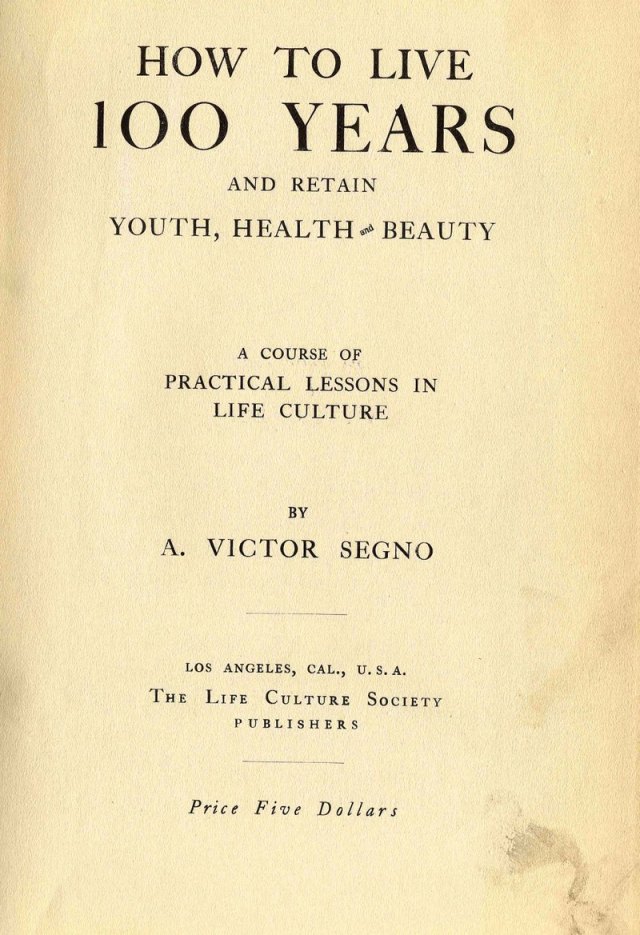
A. Victor Segno — “How to Live 100 Years”

“Many people think that by boiling water they purify it. This is a mistake. The germs of disease are partially killed but the decaying carcasses of the germs remain to be taken into the system. Water cannot be purified by filtering it.”

–A. Victor Segno,
“How to Live 100 Years,”
Los Angeles, 1903
Posted in books, health | Comments Off on A. Victor Segno — “How to Live 100 Years”

Found on EBay — J.W. Robinson’s

Adrian_ebay
Adrian_label_crop

Adrian_jw_robinson_label_crop

Here’s an Adrian-designed outfit sold at J.W. Robinson’s in Los Angeles, listed on EBay. Bidding starts at $75.

Posted in Fashion | Comments Off on Found on EBay — J.W. Robinson’s

Matt Weinstock — January 10, 1959


Chinese Puzzle

Matt_weinstockd
On a recent
excursion to San Francisco, a Hollywood press party with TV executive
Ted Galenter as host went to a Chinese restaurant. The food was
wonderful but a writer named Jim didn’t eat. He said he wasn’t hungry.

Afterward
the party went to a Chinese nightclub and in the swirl of music and
dancing Galenter observed that an incredible repast, enough for half a
dozen persons, had been placed in front of Jim at the far end of the
table and he was eating.

Galenter called the waiter and asked
who had ordered it. The waiter shrugged. Galenter asked him to inquire
if Jim had ordered it.

THE WAITER WENT to the end of the table, said something, and Jim nodded in approval.

Next
day, still puzzled, Galenter asked Jim, "How come you didn’t eat that
fine food at the first place and you ordered all that stuff at the
second place?"

1959_0110_red_streak
"I didn’t order it," Jim replied, "I thought you did."

"No," Galenter said, "I sent the waiter over to ask and you shook your head."

"Now wait a minute," Jim said. "All he asked was ‘Are you enjoying the show?’"

Inscrutable, those fellows.

* *

DURING THE recent American Physical Society meeting at UCLA
a man came into the press room, announced he was a physicist from
Greece and said, "I want an interview."

Tom Tugend, handling
press arrangements, started to introduce him to reporters but the
newcomer said, "No, no, I don’t want to be interviewed — I want an
interview, for a job!"

Thud.  

* *

THE LAST LAUGH

The writers of science fiction
Are daring in their depiction.
Logic says that we must doubt them
But where would we be without them?
– JOSEPH P. KRENGEL

* *


AT THE ANNUAL carpenters’ picnic a man named Joe was
having phenomenal luck at the games of chance, knocking down prize
after prize — until he came to the booth where the prize was a wooden
hammer. Try as he might, he couldn’t ring one with the hoops. The
disappointment showed on his face so much that the booth attendant
tried to comfort him by saying, "Just remember, Joe, you can’t win a
mall."

* *

1959_0110_schulz

JAPAN HAS its problems with drunks, too, Newsweek reports,
and to curb them Mayor Takayama of Kyoto has devised a diabolical
punishment. Tape recorders are being placed in jail cells and
inebriates will be forced to listen to their own wild ravings the next
morning.

Mike Molony, the Socrates of Spring Street, came upon
an even more fiendish torture the other day in a downtown bar. Two gay
blades were working on a friend who had overindulged.

"The best thing for a hangover," one said authoritatively, "is a hot buttered muscatel on the rocks."

"Only," the other put in, "if you add a cold pork gravy float."

* *

A COPY BOY, discussing the SC ban, made a man on the copy desk starkly aware that he was getting old.

"I’ve followed the Trojans all my life," the young boy said. "Even as a little boy I watched them on TV."

* *

FOOTNOTES — The space-saving apartment-for-rent ads in
another paper were lively the other day. One was, "$95, if decorate 3
crummy rooms w/character." Another, "$57.50. Clean Single Child" . . .
Whenever Mattie Rae sees them bury another corpse on "Gunsmoke" she
wonders if Marshal Dillon and Chester consider it duty of the beyond
call . . . Bill Crago has to watch himself whenever he has to say
"Internal Revenue" or it will come out "External." Mental block,
aggravated by tax consciousness, he figures . . . Revised smile: As
certain as death and taxes and automobile insurance going up.

Posted in art and artists, Columnists, Matt Weinstock | Comments Off on Matt Weinstock — January 10, 1959

Paul Coates — Confidential File, January 10, 1959


CONFIDENTIAL FILE

Mash Notes and Comments

"Dear Paul Coates:

Paul_coates_2
"We
can’t forgive you for using the objective case instead of the
possessive or genitive case with your verbal nouns or gerunds.

"You’re
an educated man, so please clean up this little error in grammar and be
an example for us in language as well as in tolerance and big
mindedness.

"The rule is (Scribner’s Handbook of English): ‘A noun or pronoun PRECEDING AND GOVERNING a gerund is usually in the genitive case.’

"One indication of correct speech is the use of the possessive form before certain words ending in ‘ing.’

"The uneducated and even many educated persons make this mistake:

"’What did you think of HIM leaving you?’

"But it’s not what you think of HIM, but rather what you think of HIS leaving that you want to know." (signed) Ruth E. Peters, P.O. Box 308. Hemet.
-I’m just sorry to hear they broke up.

* *

1959_0110_mathis"Dear Sir:

"Confidential Service of Mexico is primarily an efficient, effective correspondence club and translation service.

"Its
most important asset is the quick satisfying results it gets for its
members, results that begin from the very first moment they receive
their first letter from a prettyCSM girl. 

"CSM can get these same results for you too, a potential new member.

"If
you are tired of the lonely life and if you are seeking a wife with
whom to settle down and raise a family, this letter could be the most
important one you will ever receive.

"If, however, you already
have a wife or seek none, then you are just wasting your time reading
this letter." (signed) Luz ElenaNorte, Director, Confidential Service of Mexico, P.O. Box 2617, Palm Springs, Calif. 

-Let’s put it this way. I already have a wife but she doesn’t understand me, dear.

* *


BULLETIN (in
a manner of speaking), Herman Hover, who’s been suffering from chronic
frustration lately, had another attack of it last night.

The
portly cafe impresario, who made Ciro’s one of the world’s outstanding
supper clubs, only to see it all dissolve in last year’s slump that hit
the Sunset Strip, has spent his every waking hour in a battle to reopen
the doors.

He came close a number of times but at the 11th hour some obstruction — usually a disgruntled creditor — would get in the way.

Again
last night, Ciro’s was scheduled to reopen. This time, as a private
with some 600 freshly paid-up members. And again, at the 11th hour —
or more precisely, at 6:30 yesterday evening — Hover had to get on the
phone and frantically call off his invited guests.

"Everything," he explained to me, "was ready. The lights were on. The bar was stocked. But I forgot to get an edible license.

"If you don’t have an edible license," he added sadly, "nobody can eat. So, we’ll open Monday instead."

I’ll
wait. But only till Monday. If it doesn’t open then, I’m going to let
my hair grow and start hanging around in coffee houses.  

Posted in Columnists, Paul Coates | 2 Comments

Voices — Christine Collins, June 30, 1931

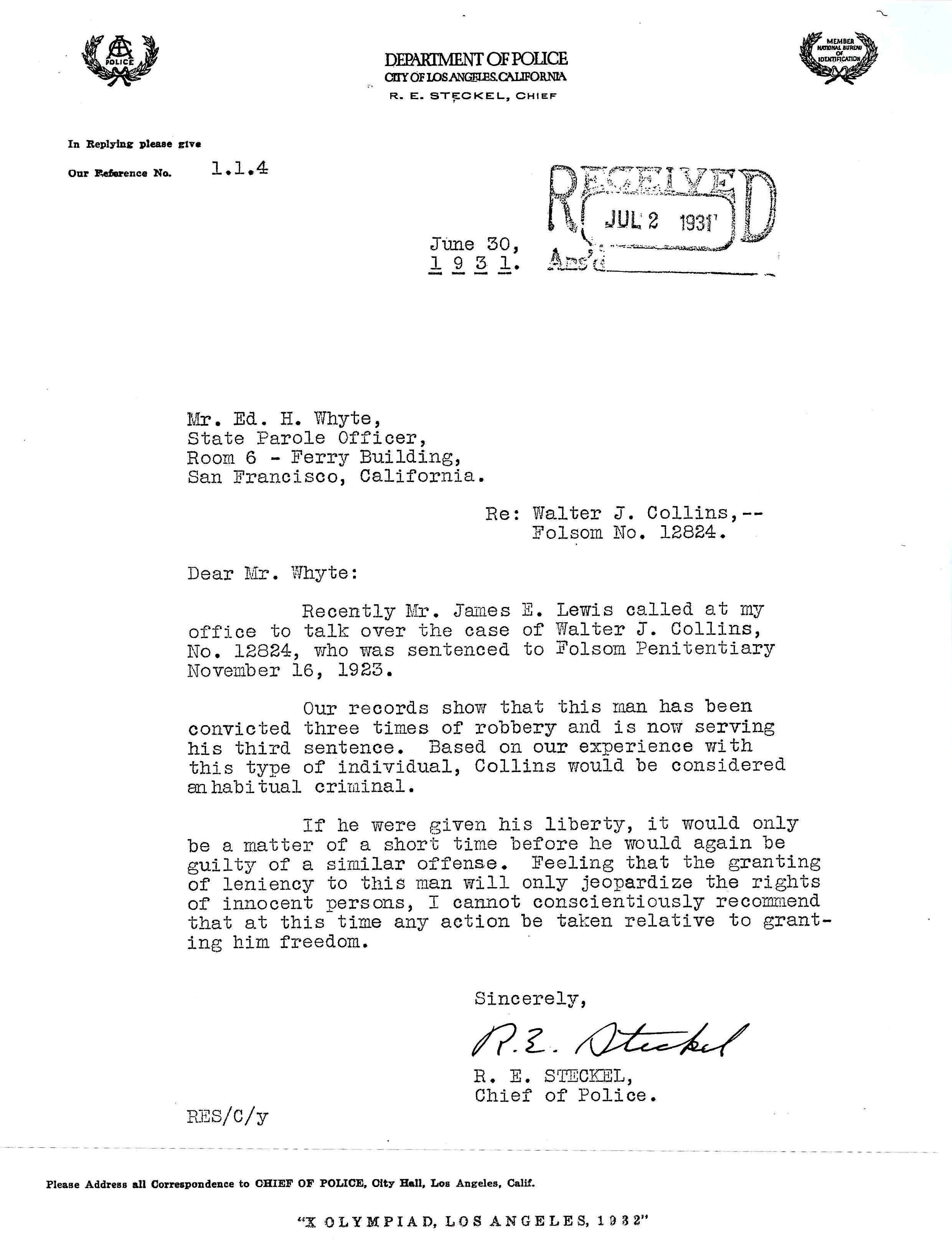
June 3, 1931: Police Chief R.E. Steckel tells the parole board that Walter Collins should be considered a habitual criminal.

Posted in #courts, Changeling, Christine Collins, Film, Hollywood, LAPD | 1 Comment

Dodgers move outfield fence, January 10, 1959

1959_0110_coliseum

1959_0110_sports_2

1959_0110_sports_ro

The Dodgers announced they were moving the Coliseum fences in and The Times saw it as a victory for Duke Snider.

The dimensions were reduced in center (425 feet to 410) and
right-center fields (440 to 385). The short porch and tall screen in
left field weren’t changed. The Times’ Frank Finch noted that Snider
hit 40 or more home runs in five consecutive seasons but hit only six
home runs in the Coliseum in 1957.

"Time after time enemy outfielders camped under drives by Duke which
would have been home runs in other National League parks," Finch wrote.

But Snider, in a story last year by The Times’ Ross Newhan, blamed a
1957 knee surgery more than the Coliseum for his power decline. "That
was before arthroscopic surgery and the knee was never the same,"
Snider said. "I was never the same hitter, I had to change my whole
style. I
had to try to be more of a contact hitter, a tough adjustment
when you’ve been a free swinger your entire career."

Snider was no fan of the ballpark, however. "Baseball deserves its
own identity," he said. "It shouldn’t ever be piecemealed into a
football and track stadium, which is what the Coliseum is."

One strange thing about the original story: General manager Buzzie
Bavasi said the Dodgers wanted to get Manager Walt Alston’s approval
before making the changes official.

–Keith Thursby

Posted in Dodgers, Downtown, Front Pages, Sports | 1 Comment

Another Nixon story challenged, January 10, 1959

1959_0110_strike_2

A strike at a Hollywood supermarket turns into a management lockout involving 1,000 grocery stores across Southern California that lasts for 28 days. The union negotiator charged that the lockout was aimed at crushing the clerks’ union and forcing smaller markets out of business in favor of the "Big Dozen."

1959_0110_metro_2

Richard Nixon’s memoirs famously begin "I was born in the house my father built." But his mother told The Times he was born in a hospital!

1959_0110_crikelair_3

1959_0110_lapd_3
Above, a father commits suicide on the grave of his young son and a driver gets six months for killing an LAPD officer.

Robert Mangrum admitted running a red light and broadsiding the patrol car of Officers Joseph Bennett and George Burgoon. The impact threw both officers out of their vehicle. Bennett was killed when hit a utility pole 35 feet away and Burgoon was injured when he was thrown under a parked car. Mangrum told police he was doing 35 mph in a 25-mph zone.

1959_0110_deseg_2
Federal courts rule Atlanta’s bus segregation laws are illegal.
1959_0110_rifle
Back when you could order a World War I 03 Springfield or Colt Government Model ($281.24 USD 2007) by phone–like a pizza!

Update: I stand corrected. The ad says handguns had to be purchased in the store. Evidently only rifles and shotguns were available C.O.D. by phone–like a pizza. So much for my fantasy: "I’d like a Union Switch & Signal .45 in original finish, no anchovies, please."

Posted in Countdown to Watts, Front Pages, LAPD, Politics, Suicide | 1 Comment

Found on EBay — Oviatt’s

Oviatt_jackett_eisenhower

Oviatt_jackett_eisenhower_label

Oviatt_label_lbj_02

Here’s what appears to be an Eisenhower-style herringbone jacket from Oviatt’s, listed on EBay. Bidding starts at $99.99. The Vintage Fashion Guild’s label guide has nothing for Oviatt’s, but the label, below left, contrasts with a known label from 1955, above. I would suspect it’s more recent.

Posted in Fashion | 1 Comment