Voices — Richard Bergholz

1959_0112_bergholz

Here’s a story by legendary Times political reporter Dick Bergholz, who died in 2000.

From his obituary: When Richard Nixon lost his race for California governor and delivered his famous promise, “You won’t have Nixon to kick around anymore,” every reporter in the room knew who “you” was. It was Richard Bergholz.

Read more >>>

Posted in Current Affairs, Politics | Comments Off on Voices — Richard Bergholz

Matt Weinstock — January 12, 1959


Taxing Times

Matt_weinstockd_2
A young lady singer is very angry at the Internal Revenue Service.

Her federal income tax last year came to around $380. She had paid all but about $70.

Christmas week the revenuers attached the amount from her checking account in a Hollywood bank.

She
received no notification that this was to be done. In fact, she learned
of it from the bank after the money was taken. Furthermore, she was
embarrassed as she had checks written for the money.

She thinks the action is an outrage, an invasion of privacy and discrimination against people in the entertainment business.

Now the rebuttal.

1959_0112_fight
A PERSON
whose
income tax payments are delinquent is notified that he owes the money.
Ten days later, if it has not been paid, the revenue service has the
authority to collect it, under Section 6331, Levy andDistraint, Public Law 591. Distraint means to seize or confiscate. Notice is given that it is going to be seized or when. 

Revenue
men are accustomed to being called Uncle Scrooge and worse but they
insist they do not deliberately create hardships for debtors. On the
contrary, they say when they find leniency is in order they give
debtors every opportunity to come clean. They wish they received more
co-operation.

However, the rule book is very decisive, so beware.

* *

ONLY IN L.A. —
A woman attending a funeral a few days ago was introduced to another
woman who, after a few minutes of solemn conversation about the
deceased, asked bluntly, "Would you like to buy two lots here?"

The first mourner, aghast at the impropriety of the question, replied, "No, but I’m curious- why do you want to sell them?"

"Well, for one thing, I’ve decided to be cremated," was the serious reply, "but the main reason is that I need the money."

* *

SILENT MARCHERS
I’ve taken in my last parade,
I find it too dismaying.
It makes no difference where I stand,
That’s where the band stops playing.
– ROBERTA MORGAN

* *


1959_0112_glenn_gould_2

Glenn Gould gives a quirky — but incomparable — performance
in Pasadena.

"This young man not only risks (virtuoso fingerings and hand-crossings
in Bach’s "Goldberg Variations") he brings them off in what became a
staggering set of symphonic etudes."

–Raymond Kendall


A DISHEVELED wretch accosted Herb Stinson on Spring Street and said, "Mister, can you spare a dime toward a bottle of wine?"

No beating around the bush, just a nice, clean, honest bite. It can almost be assumed that normalcy has returned.

* *

ANY TIME NOW Al
Gordon, radio newsman expects to learn that his son has been depicted
all over Russia as an example of American incorrigibility.

Not
long ago the boy got into a fight with another boy at Selma Avenue
School. As a teacher tried to stop them the Russian social security
delegation, visiting L.A. at the time, walked in and one of the group
with a camera quickly snapped the picture.

* *

AT 2:30 P.M. the other day Bob Cushnir
went into a Vermont Avenue bank to cash a $500 check. At first the
answer was no but six tellers scraped the bottoms of their tills and
finally made it. The explanation is simple. Since the market strike
more people are cashing checks at banks. Along about closing time
depletion sets in.

* *

WHILE IN San Francisco last week Buddy Gorman
stopped in the downtown section at a stand emblazoned with "Going Out
of Business" and "Everything Must Go" signs. He selected a hand-carved
object priced at $5.99 but the man said he could have it for $1.50.
Buddy asked how come the big markdown.

"I’m closing up," the owner beamed happily. "I just finished my parole!"

* *

LOOSE ENDS — A
reader suggests the Society for the Elimination of Obsolete Signs take
up at the next meeting the "No on 16" and other political stickers
still on some cars . . . What baffles Oscar Kantner is that the horses
in TV westerns are never given a drink or the old nosebag after a
three-day trek through the desert . . . Among things that bore Walt Hackett: The twin fins and the Finn twins. 


Posted in classical music, Columnists, Film, Hollywood, Matt Weinstock, Music | Comments Off on Matt Weinstock — January 12, 1959

Paul Coates — Confidential File, January 12, 1959


CONFIDENTIAL FILE

Batista Death Plot Laid Here

Paul_coates_3
When Fulgencio Batista fled Cuba last week, a fantastic plot by an American war hero to assassinate the dictator died in the planning.

The
initial secret meeting between the much-decorated World War II Marine
and agents of rebel chieftain Fidel Castro was held here in Los Angeles
14 months ago.

And the reason the scheme was never enacted was because of the indecision of the rebels themselves.

Details of the plan were revealed to me today.

The ex-Marine "soldier of fortune" who contacted Castro’s 26th of July movement here and proposed to shoot Batista personally is Guy Louis Gabaldon, a Silver Star winner for valor on the Island of Saipan.

According to his award citation, Gabaldon,
32, captured more than 1,000 Japanese in the fighting. Then, still in
his teens, he conducted a series of lone-wolf forays into enemy
territory to bring back prisoners before he eventually was wounded and
evacuated.

In 1957, a network television show was devoted to his exploits and currently a motion picture is being planned on his life.

The assassination plot which Gabaldon presented to the Castro agents was basically this:

1960_0829_eternity
He
would go to Cuba as a "tourist." Capitalizing on his "war hero"
reputation, he would attempt to get "in" with military and civil
officials in Batista’s government and, finally, to reach the
well-guarded dictator himself.

Maps and diagrams of Batista’s
offices and his residence were reportedly brought from Havana to Los
Angeles by rebel couriers and studied in great detail at meetings
between Gabaldon and Castro agents. 

Additional plans which laid out the route by which Gabaldon
would reach Havana, the hotel where he would register, and methods of
his keeping contact with the underground were also reportedly ready to
be put into effect.

For a period last year, there was almost daily contact between movement leaders in Cuba, Miami and Los Angeles.

Why the rebels never gave the scheme the "go" signal still isn’t known.

One problem, supposedly, was money. It’s possible that Gabaldon wanted more than the rebels felt they could afford.

Then
there’s the question of what effect Batista’s assassination by a
foreigner would have on the Cuban people. And would the dictator’s
death automatically assure Castro’s rise to power?

At one point, an alternative plan, to be masterminded by Gabaldon and carried out by two fanatics willing to sacrifice their lives for the rebel cause was also allegedly discussed.

Reared in East Los Angeles

Gabaldon,
one of seven children, was brought up in East Los Angeles. At the age
of 11, he left home. He was raised by the parents of a
Japanese-American school friend of his until, in 1942, they were herded
into an internment camp.

Then, barely tall enough to meet the
height requirement, he enlisted in the Marines. The knowledge of
Japanese which he had picked up from his "foster parents" aided him
immeasurably in his one-man raids on the enemy.

After receiving the Silver Star for his "impossible" achievements, he was quoted:

"I
will keep going out and hoping I’d get killed and get a medal, so they
could send it home to show people I did something good."

Following
his discharge, he worked variously as a fisherman, truck driver, pilot,
TV repairman, farmer and interpreter. In addition to English, he speaks
Japanese, Russian and Spanish.

Married, with three children, he is self-employed in television repair work and charter flying.


Posted in #East L.A., @news, Columnists, Film, Hollywood, Paul Coates, Politics | Comments Off on Paul Coates — Confidential File, January 12, 1959

Voices — Christine Collins, 1931


1931_1220_parole01_01
1931_1220_parole02_01

1931_1220_parole03_01
1931_1220_parole04_01
1931_1220_parole05_01

Posted in #courts, Changeling, Film, Hollywood, LAPD | Comments Off on Voices — Christine Collins, 1931

January 12-13: Soviet leader visits Los Angeles

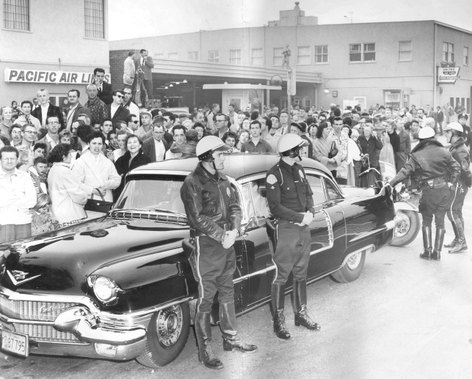
January 12, 1959: LAPD officers next to limousine as crowds gather before Anastas Mikoyan arrives at LAX.
LAPD officers keep control as a large crowd gathers at LAX in anticipation of the arrival of Deputy Soviet Premier Anastas Mikoyan. His plane was diverted to Burbank, where he landed without incident, The Times said.


Today, Anastas Mikoyan (1895-1978) is hardly a household name and his trip to Los Angeles is mostly a footnote to history. His AP obituary didn’t even mention that he had visited the city. With the nation’s fears about communism and the Soviet Union, public sentiment was far different and his brief stay received wide publicity. Continue reading

Posted in @news, broadcasting, Film, Front Pages, Hollywood, LAPD, Politics | 2 Comments

East wins Pro Bowl, 28-21, January 12, 1959

1959_0110_lonelyhearts
1959_0112_sports Former USC star Frank Gifford returned to the Coliseum and led the Eastern Division team to a 28-21 victory in the Pro Bowl. Gifford, a star for the New York Giants, played halfback but did much of his damage in the air by passing for 75 yards and a touchdown.

The Pro Bowl in its current format has been held in Hawaii since 1971, so that must mean at some point Los Angeles was considered an exotic getaway to lure the players for an all-star game. Interesting that the ’58 game drew a then-record 72,250, another sign that L.A. once was a pretty fair pro football town.

–Keith Thursby

Posted in Film, Hollywood, Sports | 1 Comment

Found on EBay — Catalina Tile

Catalina_tile_ebay02
Catalina_tile_table_ebay

This is a table with an image from Catalina Tiles embedded in the top. It’s listed on EBay with a starting bid of $500. I have no idea what the going rate is for a genuine Catalina Tile table, as all I’ve seen so far are the more dubious ones. As always, check the vendor and the item carefully before spending that kind money.

Posted in Architecture, art and artists, Real Estate | Comments Off on Found on EBay — Catalina Tile

Demonstators protest arrival of Soviet leader; Dodger turns to acting, January 11, 1959

1959_0111_cover

Soviet Deputy Prime Minister Mikoyan provokes demonstrations in San Francisco en route to his visit to Los Angeles. Recall that Soviet leader Nikita Khrushchev will come to Los Angeles later in the year. And a federal court strikes down a regulation used to keep Georgia’s college campuses segregated.

1959_0111_jazz

1959_0111_nba_riots

At left, a jazz concert featuring George Shearing, Shelly Manne, Anita O’Day and Andre Previn. I’m not sure how the Kingston Trio got mixed up with Shearing–must have been interesting. Previn had quite a career as a jazz pianist and film composer before he became a serious conductor.   

At left, Andre Previn and Oscar Peterson.

1959_0111_snider Found a rather extensive photo package about the Dodgers’ Duke Snider trying his hand at acting. Snider had a role in an episode of "The Rifleman," which starred former Brooklyn Dodger (and very briefly, former Boston Celtic) Chuck Connors.

According to Leslie Lieber, Connors invited Snider to try acting while they were at a Dodgers’ practice (maybe he meant in the outfield before a game). Leiber referred to Snider as "the great clouter" and "pride of the Los Angeles Dodgers" but said as an actor he "has the most retiring gun in the Wild West–it hardly gets out of the holster."

Connors had no regrets about quitting baseball. "Tell me how much would I have had to hit last year to make $41,000 in baseball," Connors told The Times’ Frank Finch in a story published later in January. "Well that’s what I made last year in front of the TV cameras and it’s only the beginning."

–Keith Thursby

Posted in #Jazz, broadcasting, Dodgers, Downtown, Front Pages, Hollywood, Music, Television | 1 Comment

A. Victor Segno — “How to Live 100 Years”

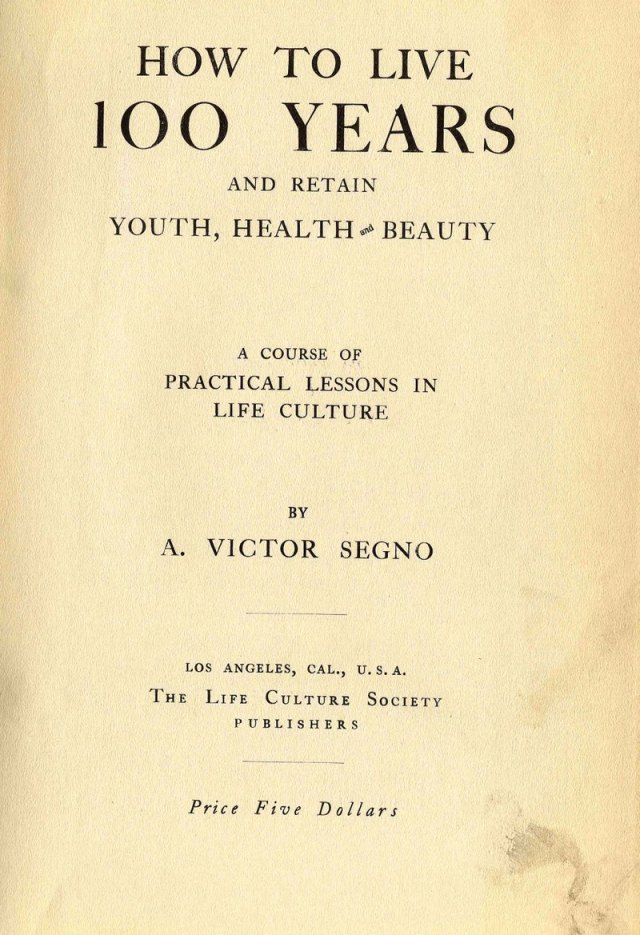
“Many people think that by boiling water they purify it. This is a mistake. The germs of disease are partially killed but the decaying carcasses of the germs remain to be taken into the system. Water cannot be purified by filtering it.”

–A. Victor Segno,
“How to Live 100 Years,”
Los Angeles, 1903
Posted in books, health | Comments Off on A. Victor Segno — “How to Live 100 Years”

Found on EBay — J.W. Robinson’s

Adrian_ebay
Adrian_label_crop

Adrian_jw_robinson_label_crop

Here’s an Adrian-designed outfit sold at J.W. Robinson’s in Los Angeles, listed on EBay. Bidding starts at $75.

Posted in Fashion | Comments Off on Found on EBay — J.W. Robinson’s

Matt Weinstock — January 10, 1959


Chinese Puzzle

Matt_weinstockd
On a recent
excursion to San Francisco, a Hollywood press party with TV executive
Ted Galenter as host went to a Chinese restaurant. The food was
wonderful but a writer named Jim didn’t eat. He said he wasn’t hungry.

Afterward
the party went to a Chinese nightclub and in the swirl of music and
dancing Galenter observed that an incredible repast, enough for half a
dozen persons, had been placed in front of Jim at the far end of the
table and he was eating.

Galenter called the waiter and asked
who had ordered it. The waiter shrugged. Galenter asked him to inquire
if Jim had ordered it.

THE WAITER WENT to the end of the table, said something, and Jim nodded in approval.

Next
day, still puzzled, Galenter asked Jim, "How come you didn’t eat that
fine food at the first place and you ordered all that stuff at the
second place?"

1959_0110_red_streak
"I didn’t order it," Jim replied, "I thought you did."

"No," Galenter said, "I sent the waiter over to ask and you shook your head."

"Now wait a minute," Jim said. "All he asked was ‘Are you enjoying the show?’"

Inscrutable, those fellows.

* *

DURING THE recent American Physical Society meeting at UCLA
a man came into the press room, announced he was a physicist from
Greece and said, "I want an interview."

Tom Tugend, handling
press arrangements, started to introduce him to reporters but the
newcomer said, "No, no, I don’t want to be interviewed — I want an
interview, for a job!"

Thud.  

* *

THE LAST LAUGH

The writers of science fiction
Are daring in their depiction.
Logic says that we must doubt them
But where would we be without them?
– JOSEPH P. KRENGEL

* *


AT THE ANNUAL carpenters’ picnic a man named Joe was
having phenomenal luck at the games of chance, knocking down prize
after prize — until he came to the booth where the prize was a wooden
hammer. Try as he might, he couldn’t ring one with the hoops. The
disappointment showed on his face so much that the booth attendant
tried to comfort him by saying, "Just remember, Joe, you can’t win a
mall."

* *

1959_0110_schulz

JAPAN HAS its problems with drunks, too, Newsweek reports,
and to curb them Mayor Takayama of Kyoto has devised a diabolical
punishment. Tape recorders are being placed in jail cells and
inebriates will be forced to listen to their own wild ravings the next
morning.

Mike Molony, the Socrates of Spring Street, came upon
an even more fiendish torture the other day in a downtown bar. Two gay
blades were working on a friend who had overindulged.

"The best thing for a hangover," one said authoritatively, "is a hot buttered muscatel on the rocks."

"Only," the other put in, "if you add a cold pork gravy float."

* *

A COPY BOY, discussing the SC ban, made a man on the copy desk starkly aware that he was getting old.

"I’ve followed the Trojans all my life," the young boy said. "Even as a little boy I watched them on TV."

* *

FOOTNOTES — The space-saving apartment-for-rent ads in
another paper were lively the other day. One was, "$95, if decorate 3
crummy rooms w/character." Another, "$57.50. Clean Single Child" . . .
Whenever Mattie Rae sees them bury another corpse on "Gunsmoke" she
wonders if Marshal Dillon and Chester consider it duty of the beyond
call . . . Bill Crago has to watch himself whenever he has to say
"Internal Revenue" or it will come out "External." Mental block,
aggravated by tax consciousness, he figures . . . Revised smile: As
certain as death and taxes and automobile insurance going up.

Posted in art and artists, Columnists, Matt Weinstock | Comments Off on Matt Weinstock — January 10, 1959

Paul Coates — Confidential File, January 10, 1959


CONFIDENTIAL FILE

Mash Notes and Comments

"Dear Paul Coates:

Paul_coates_2
"We
can’t forgive you for using the objective case instead of the
possessive or genitive case with your verbal nouns or gerunds.

"You’re
an educated man, so please clean up this little error in grammar and be
an example for us in language as well as in tolerance and big
mindedness.

"The rule is (Scribner’s Handbook of English): ‘A noun or pronoun PRECEDING AND GOVERNING a gerund is usually in the genitive case.’

"One indication of correct speech is the use of the possessive form before certain words ending in ‘ing.’

"The uneducated and even many educated persons make this mistake:

"’What did you think of HIM leaving you?’

"But it’s not what you think of HIM, but rather what you think of HIS leaving that you want to know." (signed) Ruth E. Peters, P.O. Box 308. Hemet.
-I’m just sorry to hear they broke up.

* *

1959_0110_mathis"Dear Sir:

"Confidential Service of Mexico is primarily an efficient, effective correspondence club and translation service.

"Its
most important asset is the quick satisfying results it gets for its
members, results that begin from the very first moment they receive
their first letter from a prettyCSM girl. 

"CSM can get these same results for you too, a potential new member.

"If
you are tired of the lonely life and if you are seeking a wife with
whom to settle down and raise a family, this letter could be the most
important one you will ever receive.

"If, however, you already
have a wife or seek none, then you are just wasting your time reading
this letter." (signed) Luz ElenaNorte, Director, Confidential Service of Mexico, P.O. Box 2617, Palm Springs, Calif. 

-Let’s put it this way. I already have a wife but she doesn’t understand me, dear.

* *


BULLETIN (in
a manner of speaking), Herman Hover, who’s been suffering from chronic
frustration lately, had another attack of it last night.

The
portly cafe impresario, who made Ciro’s one of the world’s outstanding
supper clubs, only to see it all dissolve in last year’s slump that hit
the Sunset Strip, has spent his every waking hour in a battle to reopen
the doors.

He came close a number of times but at the 11th hour some obstruction — usually a disgruntled creditor — would get in the way.

Again
last night, Ciro’s was scheduled to reopen. This time, as a private
with some 600 freshly paid-up members. And again, at the 11th hour —
or more precisely, at 6:30 yesterday evening — Hover had to get on the
phone and frantically call off his invited guests.

"Everything," he explained to me, "was ready. The lights were on. The bar was stocked. But I forgot to get an edible license.

"If you don’t have an edible license," he added sadly, "nobody can eat. So, we’ll open Monday instead."

I’ll
wait. But only till Monday. If it doesn’t open then, I’m going to let
my hair grow and start hanging around in coffee houses.  

Posted in Columnists, Paul Coates | 2 Comments

Voices — Christine Collins, June 30, 1931

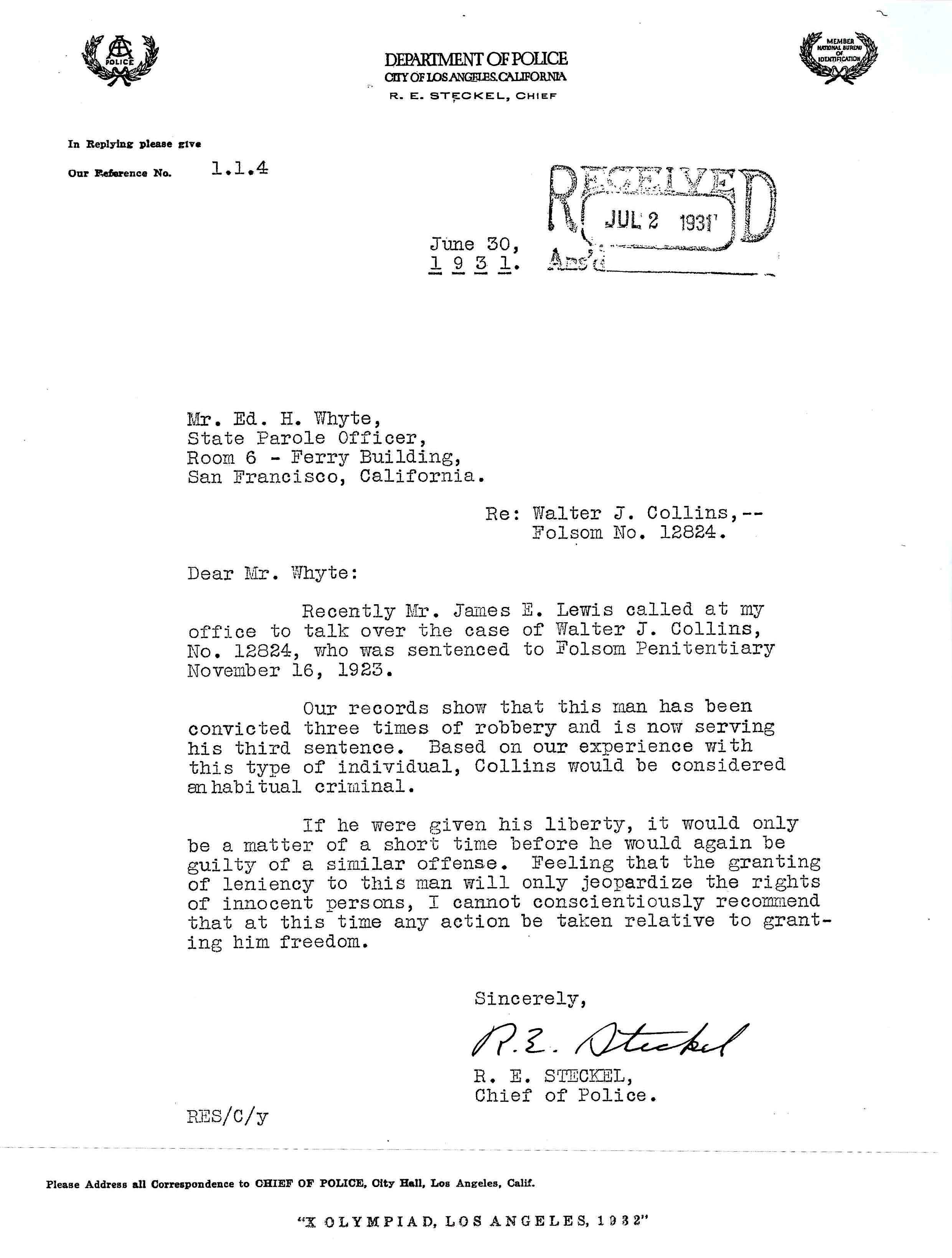
June 3, 1931: Police Chief R.E. Steckel tells the parole board that Walter Collins should be considered a habitual criminal.

Posted in #courts, Changeling, Christine Collins, Film, Hollywood, LAPD | 1 Comment

Dodgers move outfield fence, January 10, 1959

1959_0110_coliseum

1959_0110_sports_2

1959_0110_sports_ro

The Dodgers announced they were moving the Coliseum fences in and The Times saw it as a victory for Duke Snider.

The dimensions were reduced in center (425 feet to 410) and
right-center fields (440 to 385). The short porch and tall screen in
left field weren’t changed. The Times’ Frank Finch noted that Snider
hit 40 or more home runs in five consecutive seasons but hit only six
home runs in the Coliseum in 1957.

"Time after time enemy outfielders camped under drives by Duke which
would have been home runs in other National League parks," Finch wrote.

But Snider, in a story last year by The Times’ Ross Newhan, blamed a
1957 knee surgery more than the Coliseum for his power decline. "That
was before arthroscopic surgery and the knee was never the same,"
Snider said. "I was never the same hitter, I had to change my whole
style. I
had to try to be more of a contact hitter, a tough adjustment
when you’ve been a free swinger your entire career."

Snider was no fan of the ballpark, however. "Baseball deserves its
own identity," he said. "It shouldn’t ever be piecemealed into a
football and track stadium, which is what the Coliseum is."

One strange thing about the original story: General manager Buzzie
Bavasi said the Dodgers wanted to get Manager Walt Alston’s approval
before making the changes official.

–Keith Thursby

Posted in Dodgers, Downtown, Front Pages, Sports | 1 Comment

Another Nixon story challenged, January 10, 1959

1959_0110_strike_2

A strike at a Hollywood supermarket turns into a management lockout involving 1,000 grocery stores across Southern California that lasts for 28 days. The union negotiator charged that the lockout was aimed at crushing the clerks’ union and forcing smaller markets out of business in favor of the "Big Dozen."

1959_0110_metro_2

Richard Nixon’s memoirs famously begin "I was born in the house my father built." But his mother told The Times he was born in a hospital!

1959_0110_crikelair_3

1959_0110_lapd_3
Above, a father commits suicide on the grave of his young son and a driver gets six months for killing an LAPD officer.

Robert Mangrum admitted running a red light and broadsiding the patrol car of Officers Joseph Bennett and George Burgoon. The impact threw both officers out of their vehicle. Bennett was killed when hit a utility pole 35 feet away and Burgoon was injured when he was thrown under a parked car. Mangrum told police he was doing 35 mph in a 25-mph zone.

1959_0110_deseg_2
Federal courts rule Atlanta’s bus segregation laws are illegal.
1959_0110_rifle
Back when you could order a World War I 03 Springfield or Colt Government Model ($281.24 USD 2007) by phone–like a pizza!

Update: I stand corrected. The ad says handguns had to be purchased in the store. Evidently only rifles and shotguns were available C.O.D. by phone–like a pizza. So much for my fantasy: "I’d like a Union Switch & Signal .45 in original finish, no anchovies, please."

Posted in Countdown to Watts, Front Pages, LAPD, Politics, Suicide | 1 Comment

Found on EBay — Oviatt’s

Oviatt_jackett_eisenhower

Oviatt_jackett_eisenhower_label

Oviatt_label_lbj_02

Here’s what appears to be an Eisenhower-style herringbone jacket from Oviatt’s, listed on EBay. Bidding starts at $99.99. The Vintage Fashion Guild’s label guide has nothing for Oviatt’s, but the label, below left, contrasts with a known label from 1955, above. I would suspect it’s more recent.

Posted in Fashion | 1 Comment

Matt Weinstock — January 9, 1959


Rugged Fisherman

Matt_weinstockd_2
The telephone
rang at 3 a.m. Wednesday in the Venice home of Bill O’Connor. It was
Pat Lister, Santa Monica harbor master, informing him that gale winds
were whipping the bay and his boat was dragging its mooring.

O’Connor, 47, a former champion swimmer and lifeguard, is now a fisherman. He owns the 30-foot El Salvador.

He
dressed and rushed out in the rain to his car only to find his
headlights wouldn’t work. He grabbed his little girl’s bicycle and was
off, aided by a strong tailwind. Within minutes he was at the end of
the groaning pier.

Still clothed, without hesitation, he
jumped into Santa Monica Bay and headed for his boat, pitching in heavy
seas 200 yards away. The next time Lister saw him was in the eerie glow
of a flashlight on deck.

1959_0109_hostage
O’CONNOR SET
a stern anchor, reinforcing his mooring lines, put stronger lashings on the deck gear, then too another header into the bay.

As
he climbed up the ladder to the dock, a $10,000 catamaran broke loose
from its mooring and swept toward the beach. O’Connor and Chad Merrill,
assistant harbor master, jumped onto its deck, threw lines to the dock,
and swam back to the pier.

After a look around to see that
everything else was secure, O’Connor got back on the bike and headed
home. Wonder how things are these days with Ernest Hemingway?

* *

THE STRONG WINDS also awakened an advertising executive who suddenly remembered a newly planted 8-foot tree and rushed outside to the rescue.

On
reaching up to brace the tree against the wind his pajama pants dropped
around his ankles. When he reached down to retrieve them the tree
swayed dangerously in the gale. This happened over and over, like in an
old Laurel and Hardy movie, and his wife, who watched through the
living room window, is still laughing.

* *

UNANIMOUS
Never a letter from a friend or foe,
They’re either ads or bills I owe.
– RALPH FREEMAN

* *

REMEMBERED quotes from the lavish Sports Illustrated dinner acclaiming UCLA’s Rafer Johnson:

Art Linkletter introduced a celebrity as having "a greater rating than if Brigitte Bardot played ‘Lolita’ on TV." He also referred to Henry Luce as "the Vic Tanny of the publishing world."

An apt line by Luce: "The test of a high civilization is the pursuit of excellence — that’s why we honor Rafer."

Romain
Gary: "I saw Mr. Luce play golf a few days ago in Phoenix. If I were
the owner of Time, Life, Fortune and Sports Illustrated I’d hire
someone to play for me."

* *

1959_0109_hostage_runover
NEW YEARS
33 years ago — Jan. 1, 1929 — a young ensign named Edward V. Dockweiler drew the midwatch
(midnight to 4 a.m.) aboard the USS Idaho, anchored off San Pedro. This
was before the present nine-mile breakwater was completed.

An unwritten rule required that midwatch entries in the log be in rhyme and Dockweiler
wrote, "We are anchored in Pedro Harbor, though there isn’t much of a
fee, and why they call it a harbor, is something I never could see."

Imagine the surprise of Bernard J. Caughlin,
general manager of L.A. Harbor, to read this in the January 1959 issue
of U.S. Naval Institute Proceedings, which reprinted it. Dockweiler, a retired admiral, is the Harbor’s chief engineer. Caughlin is his boss. 

* *

MISCELLANY — Conductor Fritz Reiner’s appearance with the Philharmonic orchestra reminded Orlando Northcutt of the time Reiner
conducted at Hollywood Bowl. During rehearsal, the orchestra had
difficulty mastering tricky passages of a new symphony and after a
hectic session Reiner invited them to a beer bust, and unheard of gesture. But it relaxed everyone . . . A group of La Mirada residents have hastily joined forces to oppose incorporation of their community to be voted on Tuesday. They claim Gardena gambling interests are behind the proposal . . . Sign on a market in the 8300 block of Wes 3rd Street: "Tomorrow’s fish today."  

Posted in Columnists, Matt Weinstock | Comments Off on Matt Weinstock — January 9, 1959

Paul Coates — Confidential File, January 9, 1959


CONFIDENTIAL FILE

‘Madame Guillotine,’ Alias Pierre Coates

Paul_coates_2
As a combined result of personal preference and the common sense
economics of knowing what side my bread is buttered on, I have a
paid-up subscription to this newspaper.

And I recall reading in its pages, many months ago, a series of articles titled "Why Johnny Can’t Read."

At the time I thought this scathing indictment of laxity in our educational system would produce favorable results.

But it hasn’t. At least, not where I live.

There’s a teenage daughter in our household. And don’t ask me what I’ve
gone through to see that this kid got the best of everything. I wanted
her to have the chance in life that I never had — to go to Sarah
Lawrence and come out engaged to a Yale boy.

The way she’s going, however, she’ll be lucky to nail a subsidized SC football player.

1959_0109_cover
When I came home last night she was sitting at the kitchen table and
staring mournfully at the blank pages of a loose-leaf notebook.
"Whatsa’matter with her?" I demanded of my wife.

"She’s got to do an essay on the French Revolution for her homework. And she needs your help. She doesn’t know enough about it."

I spun around angrily and faced the child. "Why do you wait until you get home to do your homework?" I shouted.

"Daddy," she replied, "I wanted to wait until you were here. There are some things I don’t know about the French Revolution."

"There are some things a lot of people don’t know about the French
Revolution," I said mysteriously. Then, pacing up and down irritably, I
challenged: "Go ahead. Ask me."

"Well," she asked, "like what caused the French Revolution?"

"Politics," I said.

"And who was Robespierre?"

"Yes," I nodded sagely, "He was one of them."

1959_0109_runoverI rubbed my chin thoughtfully and continued: "The major engagement of the French Revolution was known as the Battle of Concord."

"Concord? That’s in America," she said.

"France," I snapped.

"But, Daddy," she pleaded, "wasn’t the Battle of Concord in the American Revolution?"

I shot her a glance that would wither a lesser child. "My dear," I said
coldly, "let me answer a question with a question. What is France’s
leading product?"

"Wine," she said.

"Very good," I commended in a tone that oozed sarcasm. "Now then, if you please, from what is wine made?"

"Grapes," she replied.

"Excellent. And," I hooted triumphantly, "I suppose you never heard of Concord grapes!"

That victory won, I warmed up to the subject. "Make notes while I talk," I commanded. And, pacing furiously, I went on:

"The mother of the French Revolution was an old lady named Madame Chere
who was known affectionately to the unwashed hordes as ‘Ma Chere.’ She
used to sit in the bleachers at the guillotine and knit while they were
knocking off the Royalists.

That Same Old Revolution

"It was in this same revolution that Marie Antoinette, upon being
advised that the peasants were storming the palace courtyard made the
now historic remark: ‘If they don’t like it here, let them go back
where they came from.’"

1959_0109_simcaAfter giving her a few basic facts, I dismissed her with a gentle
reminder that while I was glad to help her, I wouldn’t be here forever,
and she must learn to think for herself.

Obviously, she’ll get a good grade on her essay. And she’s informed now
about the French Revolution. But you can’t thank our school system for
that. If you want to thank anybody, thank me. 

Posted in @news, Columnists, Paul Coates | Comments Off on Paul Coates — Confidential File, January 9, 1959

Voices — Christine Collins, June 19, 1931


1931_0619_christine_collins_01

Posted in #courts, Changeling, Film, Hollywood, LAPD | Comments Off on Voices — Christine Collins, June 19, 1931

Movie star mystery photo

2009_0105_mystery_photo
Los Angeles Times file photo

Our mystery woman has more than 150 credits on IMDb. Update: She is Blanche Sweet, whose career spanned 1909 to 1960. In this undated photo, she is returning to the U.S. on the ship Pennsylvania.

2009_0106_mystery_photo
Los Angeles Times file photo
Lots of guesses about our mystery woman, but none of them right. Here’s another photo.

Update: Two correct guesses so far. Dewey Webb and Nick Santa Maria have identified the mystery woman, but I’m not going to publish the answer yet to give other people a chance. Keep checking back throughout the week for more photos and the answer on Friday!

Update: Blanche Sweet in 1927

2009_0107_mystery_photo
Los Angeles Times file photo
Update: We have correct guesses from Mary Mallory and mmullen98. Congratulations!

Update II: Blanche Sweet in 1926.

2009_0108_mystery_woman

Los Angeles Times file photo

One thing we can never get enough of at the Daily Mirror is photos of movie stars posing with a Studebaker. Here’s our mystery woman on the running board of roadster. (Did you know Frances Bavier–Aunt Bee from "The Andy Griffith Show"–drove a Lark Daytona? It’s true!)


2008_0109_mystery_photo

Los Angeles Times file photo

Blanche Sweet in a photo for the 1926 film "Diplomacy," when movie publicity consisted of having someone drive across the country carrying the film cans. One of the men in the photo is director Marshall Neilan, Sweet’s husband at the time (I believe he’s the gent on the right). The other fellow is, alas, unidentified. Clifford Street, as seen in the photo, intersects with Glendale Boulevard north of downtown.

Posted in Film, Hollywood, Mystery Photo | 46 Comments