Teens Rescued From Ledge, Dodgers Beat Cubs, April 13, 1959

April 13, 1959, Dodgers at the Coliseum

The Coliseum's improvised arrangement for the Dodgers is changed for the opening of the 1959 season. The right field fence is brought in to 333 feet from 390 feet and right center is cut to 375 feet from 440 feet.

April 13, 1959, Los Angeles Times cover Assemblyman Thomas M. Rees, a Beverly Hills Democrat, plans to introduce a measure creating the State Air Pollution Board.

A TWA Boeing 707 sets a record time of three hours, 20 minutes from Chicago to Los Angeles, breaking the previous record of three hours, 54 minutes. A Sheriff's Department helicopter balances one skid on a narrow ridge as rescuers retrieve two teenage boys stranded on a ledge in Angeles National Forest.  

And former Chief Deputy Atty. Gen. William V. O'Connor reports the theft of $12,500 he hid in a Bible. O'Connor says he wasn't able to deposit the money in a bank before checking into a hospital for a checkup. 

April 13, 1959, Letters to the Los Angeles Times
What's on readers' minds? The quality of schools, raises for state workers, taxes, more police officers, unions — and newspaper bias. Notice the Bible passage, from Psalms.
April 13, 1959, Art Buchwald Interviews Debbie Reynolds
Debbie Reynolds, in Paris en route to Madrid to film scenes for "It Started With a Kiss,"  says "I've never believed in divorce but I had no control over the circumstances." In one of the 1950s' biggest scandals, her husband, Eddie Fisher, left her for Elizabeth Taylor.

April 13, 1959, Comics Dec. 25, 1946, Milton Caniff,

Above, "Terry and the Pirates" by Milton Caniff, Dec. 25, 1946.

George Wunder's highly detailed panels in "Terry and the Pirates" always struck me as being a little too crowded and I prefer Milton Caniff's earlier artwork in the strip. I didn't always care for message in Caniff's later strip, "Steve Canyon," (which didn't appear in The Times,) but the man was a fabulous artist.

April 13, 1959, Movies and Theater
A clever ad campaign for "The Naked Maja" uses the back of a postcard from the Prado and a hint at what moviegoers can expect: "the other side."
April 13, 1959, Los Angeles Times Sports
Sports writing of the era: "Don Demeter, the 23-year-old Oklahoma City church worker, delivered a powerful sermon to the Cubs on this cold but sunny Sabbath afternoon."

Posted in @news, Film, Front Pages, Hollywood, Sports, Stage | 1 Comment

Architecture — Greene & Greene

Spinks Craftsman House, Pasadena, 2006
Photographs by Chris Considine

The Spinks Craftsman House, 2006

 
Note: The Greene & Greene home at 1344 Hillcrest Ave., Pasadena, has been listed at $4.625,000. It was on the market two years ago at $5.35 million.

A pair of repolished Greene & Greene gems

* Pasadena house sits on nearly 1.5 acres. Its meadow-like setting affords privacy.

April 02, 2006

By Gayle Pollard-Terry, Times Staff Writer

Stairway, Spinks Craftsman House Charles
Greene, the chief designer of the Greene & Greene firm, needed a
break. So in 1909 he took his family back to London, where he and his
wife had honeymooned, according to "Greene & Greene Masterworks,"
by Bruce Smith and Alexander Vertikoff. During his respite, his
brother, Henry, stepped in to fill the void.

While Charles
visited England, Henry completed the Spinks Craftsman house for retired
Judge William Ward Spinks and his wife, Margaret B.S. Clapham Spinks.
They had recently moved from Victoria, Canada, because the judge had
accepted the presidency of the Pasadena Hotel Co.

The Spinks House cost a princely $11,000 at a time when few homes cost more than $2,000 to build.

As
in their other homes, Henry Greene continued to use a variety of woods,
such as Port Orford cedar and redwood, to make the Spinks home
compatible with nature. Henry — known for his linear designs — gave
the home a rectangular shape.

The Spinks House sits atop a slope
on a nearly 1.5-acre property in the Oak Knoll neighborhood. Its
meadow-like setting provides privacy. Isabelle Greene, granddaughter of
Henry Greene, restored and redesigned some of the gardens in 1989. It
has extensive terraces and porches, as well as a balcony.

About this house: Despite the wear and tear of nearly a century, the house has been maintained over many years.

Asking price: $5.35 million

Size: The house has seven bedrooms and 4 1/2 bathrooms in 5,046 square feet.

Features: Built-ins, hinged skylights and three fireplaces. There is a view of the mountains from the rear of the property.

Where: Pasadena

Posted in Architecture | Comments Off on Architecture — Greene & Greene

Found on EBay — Black Mask Magazine

Black Mask Magazine, 1925

A February 1925 issue of Black Mask magazine has been listed on EBay. The magazine is priced at $300, Buy It Now. Copies of Black Mask in this era are difficult to find and tend to sell in the $200 range and above, but $300 seems slightly high to me. As with all EBay listings, check the item and the vendor thoroughly before bidding.
Posted in books | Comments Off on Found on EBay — Black Mask Magazine

Soviets Face Up to the Gulag, 1990

    Note: The Daily Mirror is pleased to present a nondupe by the late Charles Hillinger, written in 1990.
 

COLUMN ONE

Soviets Face Up to the Gulag

Millions
died in prison camps in harshest Siberia. The once-taboo topic is now
in the open, the anguish even shared with visiting Americans.

September 15, 1990

By CHARLES HILLINGER, TIMES STAFF WRITER

VOSTOCHNY
CAMP, Soviet Union — Thousands died in this Stalin-era death camp,
bleak and desolate on a wind-swept mountain top in Siberia. They were
beaten to death, or shot or died from the extreme cold, from disease
and from hunger. Human bones still litter the ground.

For Dennis
Robbins, 45, a medical ethics specialist from Farmington Hills, Mich.,
who recently visited Vostochny (pronounced Vos-TOACH-knee ), the sight
of the camp's ruins and rusted barbed wire renewed his grief over the
loss of most of his Russian-Jewish grandfather's family.

His
grandfather's seven brothers and sisters were murdered, apparently
because they were Jews, Robbins said. His grandfather survived only
because his train broke down and he arrived home a day later than
planned.

"I cry for the Soviet Union," Robbins said, wiping away
tears. "I feel the pain of sorrow and despair for those who suffered so
much in this place, for my grandfather's brothers and sisters, for all
the useless brutality and lack of humanity on Earth."

Tatiana
Khokhorina, 34, a Soviet interpreter visiting from the port of Magadan,
about 1,000 miles to the southwest, also was moved to tears.

"I
cannot express my innermost feelings seeing these human bones, knowing
what happened here. I was a real Soviet patriot growing up in school. I
loved my country. I considered it the best country on Earth. I never
heard about these camps until five years ago. I am so sad for my
country . . . ."

Vostochny lies beyond the Arctic Circle, near
the edge of the Magadan Oblast, a region almost three times the size of
California in the remote, easternmost reaches of Siberia. For years
travel was strictly controlled, both for Soviet citizens and
foreigners. This was because of the area's dark history as a center of
the Gulag, as the labor-camp system is called, because of its
militarily strategic location close to Alaska, China and Japan and
because of fears that gold might be smuggled from the mineral-rich area.

Now,
although glasnost and perestroika have not brought complete freedom of
movement in this vast region of tundra and permafrost, more and more
people have been given access to it. Recently, 31 American medical
personnel visited the region for 17 days. Among them was Robbins, who,
along with several other members of the group, visited the Vostochny
site in the company of some Soviet doctors.

The Americans
visited different parts of the region under the auspices of the
University of Alaska's Institute for Circumpolar Health Studies, an
organization founded on the premise that medical personnel in countries
at the top of the world can learn from one another about such shared
problems as the remoteness and poor communications of the areas they
serve, the long periods of darkness in winter and of perpetual daylight
in summer and the common incidence of alcoholism.

The Soviet
Union's reform policies have also opened the subject of the dreaded
Gulag system to discussion. In Magadan City, Dr. Alexander (Sasha)
Nochevnoy, 42, told how only in recent years have people living in the
Magadan Region been allowed to "talk about the camps with one another.
Before, if the authorities heard us discussing the camps, we would be
sent to prison."

Scattered throughout the mountains and
glacier-sculptured river valleys in the Soviet Union's northeastern
corner, from the Sea of Okhotsk to the Arctic Ocean, are the ruins of
more than 100 Gulag camps in which an estimated 3 million men, women
and children were executed or died.

At Vostochny, one of the
Soviet doctors traveling with the American visitors recalled that the
camp was "one of the deadliest of the infamous Gulag camps of the
Kolyma River area described by Solzhenitsyn."

To some Soviet citizens, the names Magadan and Kolyma have the same ring as the names Buchenwald or Dachau to a Jew.

"Kolyma
in eastern Siberia was the largest camp area in the U.S.S.R., had the
highest death rate. Whole camps perished to a man," wrote Alexander
Solzhenitsyn in his novel, "The Gulag Archipelago." "Prisoners worked
at 75 degrees below zero, in six-foot snow, beneath it only permafrost.
One bowl of gruel a day. Kolyma camps were known for executions and
mass graves."

At one Kolyma camp, Solzhenitsyn wrote, "the
prisoners were so famished they ate the corpse of a horse lying dead
for more than a week in summer, which not only stank, but was covered
with flies and maggots. They ate a half-barrel of lubrication grease
brought there to grease the wheelbarrows . . . ."

At Vostochny
camp, the bone fragments, bleached white by time and the elements, lie
everywhere on the rock-strewn ground. The doctors, American and Soviet,
agreed they were human, but, beyond the assumption that they were the
remains of the camp's victims, no one could explain how they had come
to be exposed.

Beyond the barbed wire, on the summit of the
treeless mountaintop, rests what once was called "the living zone." It
is a row of single-story stone barracks with rusted iron bars in window
openings.

The roofs and walls of many of the buildings have
collapsed from heavy snow and howling winds. Shreds of clothing, shoes,
rusted bedposts, tin dishes, shovels and other debris are mute
reminders of life before the camp was abandoned. Barracks with roofs
still intact were filled with snow and ice unmelted despite the 24-hour
summer sun.

At any given time, 800 to 1,000 prisoners were
incarcerated at Vostochny, working long hours with primitive tools to
mine gold under the harshest conditions.

Before they left the
mountain, the Soviet and American doctors placed a bouquet of flowers
on the barbed wire to the memory of the victims of Vostochny.

The POWs

Criminals
are still sent to Siberia and, until 1987, political prisoners were
sent there, too. Poles, Germans, Lithuanians, Latvians, Estonians and
others also were imprisoned in the camps. Solzhenitsyn has written that
as many as 20 million people may have perished in the entire Gulag
system.

"Thousands were sent here for petty theft, for making
jokes about Stalin, for unbelievable inconsequential reasons as
'enemies of the people,' " said Yuri Pavlov, 57, a columnist for the
newspaper Magadanskay Pravda. "All Soviet citizens who had been
captured by the Germans during World War II and later freed were
believed to have been tainted by their Fascist captors, and were
re-arrested on arrival home and sent here and to other parts of Siberia.

"Americans
liberated many Soviets from German prison camps," Pavlov said. "When
they (the ex-POWS) returned home at war's end, they were sent to the
Gulag in Siberia because Stalin thought they were all spies because the
Americas saved them. It was crazy."

Now, in a new, more open
time, residents of the region are willing to speculate about
suggestions by some in the West that American POWs from the Korean War,
who had been presumed dead, may have been imprisoned in the Gulag.

(A
Times report in July, for example, quoted an American Red Cross
spokeswoman in Seattle as saying that the agency knows of 12 reported
sightings of American POWs in Siberia, some as recently as the 1970s.
The report noted also that the Pentagon and State Department had
dismissed the sightings.)

Pyotr Chagin, 63, for 38 years a
member of the Communist Party and assistant director of the Magadan
television station, insisted that there is no way there could have been
American Korean War POWs in Magadan.

"I would have known about that if it were true," he said. "Somebody would have talked about it."

But Alexander Shornikov, 36, a writer for the Magadanskay Komsomoles, the other daily newspaper in Magadan, was less certain.

"I
believe there is a remote possibility American POWs could have been
shipped here during the Korean War. There were many foreign prisoners
in the camps.

"There were German prisoners from World War II
held in the camps as late as 1956, when (Nikita S.) Khrushchev began
phasing out the camps," he said. "There were Japanese prisoners taken
from the Kurile Islands in the closing days of World War II, who worked
as forced laborers constructing several large buildings along Lenin
Street, the main thoroughfare in Magadan City (constructed) from 1945
to 1949."

Shornikov said that for the North Koreans to make a
deal with the Soviet Union to send American prisoners to the Magadan
region "is believable."

"If they did indeed exist, it's possible
that we would never have heard about special, very secretive labor
camps for the Americans. In the Gulag, anything was possible."

The Singer

From
1930 until dictator Josef Stalin's death in 1953, and even a few years
afterward, the Magadan region evolved around the prison camps. Prison
labor built the city of Magadan and other settlements in the far north
that supported the camps. Today, 80% of the structures in the port,
primarily four- and five-story concrete housing and office complexes,
are prisoner-built.

Where in the past prisoners toiled in huge
coal and gold mines, today civilians from throughout the Soviet Union
do the work, attracted to the remote area by wages three times those in
Moscow.

But many volunteers leave as soon as their first
contract is up. Others stay on long enough–and that can be some
time–to save the rubles for a better life elsewhere in the Soviet
Union.

And there are many survivors of the Gulag, like Vadim
Kozin, who have opted to stay because they cannot afford to move.
Kozin, 87, lives in one of the typical tiny apartments, as does
everyone except senior officials of the Communist Party.

Locals
in Magadan describe Kozin as the "Bing Crosby" of the Soviet Union in
the 1930s and 1940s. He was shipped to Magadan in 1942 because he
refused to write or sing a song about Stalin.

"I admired Stalin,
as did most Soviet citizens," recalled Kozin in his apartment, where he
played his piano and, still in good voice, sang some of his best-known
songs. But "in my heart, I did not think I was good enough to write or
sing a song about our great leader. So, I spent three years in a
Magadan camp still making records that were sold all over the Soviet
Union, with all proceeds going to the government. I wrote and recorded
many popular songs sung in the U.S.S.R. during the Great Patriotic War
(World War II) from my cell."

Kozin said he was not starved or
mistreated as his fellow prisoners were. But "I heard the screams, the
gunshots, the beatings, everything . . . ."

Solzhenitsyn wrote
about the singer's performing in a camp theater in "The Gulag
Archipelago": "The local Gulag big shots sat haughtily with their wives
in the first rows and watched their slaves with curiosity and contempt.
And the convoy guards sat behind the scenes and in the boxes with their
automatic pistols. After the performances, those players who won
applause were taken back to camp and those who had fallen on their
faces . . . to punishment blocks.

"Sometimes they were not even
allowed to enjoy the applause. In the Magadan Theater, Nikishov, the
chief of Dalstroi (camp), interrupted Vadim Kozin, a widely known
singer at that time: 'All right, Kozin, stop the bowing and get out!'
(Kozin tried to hang himself but was taken down out of the noose.)"

The Sculptor

Ernst
Neizvestny, 65, is considered one of the greatest living Soviet-born
sculptors. He created one of the world's largest sculptures, the
325-foot-high "Lotus Blossom Monument" atop Egypt's Aswan Dam. He did
the headstone for Khrushchev's grave in Moscow. His monumental pieces
stand in many sites in the Soviet Union, Washington, New York, Paris,
the Vatican and Taipei.

He was in Magadan recently to begin his
latest project: three 60-foot memorials to victims of Stalin's death
camps, one in Magadan, to be put up over a mass grave. The others will
be in Sverdlovsk, his hometown, and Vorkuta. The three areas contained
the most notorious concentrations of Gulag camps.

"The Soviet
Union never built a monument to what they did wrong. So, it is my
historic duty to do it. These will be spiritual places. I personally
was never a Gulag prisoner, but members of my family and many friends
were. While the tragedy of the Holocaust was going on in Germany, this
was taking place in the U.S.S.R.," said Neizvestny, interviewed at
Magadan Mayor Gennady Dozofeew's home.

The Magadan work,
expected to be completed in two years, will be a gigantic mask adorned
with smaller masks, representing the souls of the thousands of Gulag
victims. A huge tear will flow down the cheek of the 60-foot-high mask
sculpture. Inside the monument will be a giant crucifix.
Author-in-exile Solzhenitsyn, his Soviet citizenship recently restored,
has been invited to attend the dedication.

At the mayor's home
with Neizvestny was Atlis Merum Marcovitch, 62, president of the
Magadan chapter of the Memorial Society, formed two years ago in Moscow
by human rights advocates and former prisoners of the Gulag. Marcovitch
himself spent eight years in the Stalin Gulag.

"To this day, I
vividly recall when Stalin died in 1953. I was alone in a cage (cell)
when word came about Stalin's death. It was the best news ever in the
history of the Gulag," he recalled.

"The Memorial Society has
7,000 members throughout the Soviet Union," he added. "Our purpose is
to bring respect to the victims, to honor their memory by finding the
records and learning who they were. Until now, the records have been
hidden by the KGB and others. We want their names. We are searching the
truth of history. Ours is not a society for vendetta.

"After all
these years," he added, "we are just beginning to put the pieces
together of this horrendous puzzle. We want to preserve the ruins so
people will know and remember what happened, so it will never happen
again. The ruins are as they were when abandoned. In some camps, skulls
and bones still lie exposed above the ground. We want proper burials.
We want to know where the secret graves are."

In the city of
Magadan, population 150,000, for the first time there is an exhibit at
a local museum about the Magadan and Kolyma camps.

"We think it
is vitally important that everybody realizes the entire Magadan region
was built on the foundation of Stalin prison camps," said Svetlana
Vladimirova, the museum director.

The Prisons

Prisons
in Siberia still retain their notoriety. The most hardened criminals
are sent from throughout the Soviet Union to these remote sites in this
land of incredible cold.

Steve Carr, 42, a physician's assistant
with the Alaska State Department of Corrections, was among the
Americans on the recent trip. His goal in coming was to meet with
Magadan penal authorities, to visit their prisons and to get to know
his professional counterpart, the Magadan prison medical officer.

Although
Carr had asked that a journalist be allowed to accompany him on his
tour, in a meeting at the Magadan police headquarters, Police Chief
Vladimir Povazhny gave a firm " Nyet " to the request, saying: "We are
not interested in a journalistic perspective on our prisons. We know
how bad they are. . . . .' "

Carr visited three Magadan prisons,
including one known simply as Colony III, a maximum security prison 217
miles north of Magadan City. It is on the Kolyma High Road, which,
local residents said, was built over 20 years on a foundation of human
bones–those of the thousands of prison camp inmates who died while
constructing it.

Colony III was built by Stalin in 1930. It sits
behind 18-foot-high walls guarded by Interior Ministry troops, backed
up by guards, lights and dogs. And there are also 220-volt trip wires.

Carr
said Colony III is the worst prison that he has ever seen: "Pipes are
rusting, concrete is falling off exterior and interior walls, the
toilets and general condition of the dormitories and cells are
primitive and unsanitary. Yet, that's true about most buildings in
Magadan.

"Many prisoners," Carr added, "are employed in a
furniture factory. Others work outside in a courtyard crushing rock for
roadbeds with jackhammers."

He said the food left much to be desired:

"Breakfast
was bread and tea; lunch was bread, tea and salted fish; dinner was
broth with potatoes, bread, salted fish and tea. Prisoners are not
allowed to have visitors. Solitary confinement is in a small cell with
a hole in the ground for a toilet, no windows and a bare bulb hanging
from a wire out of the ceiling."

Although it was summer when he
visited, the prison was cold. Carr said he could only imagine what it
would be like in winter when the sun never comes out and temperatures
outside are often 50 to 80 degrees Fahrenheit below zero.

"I
would say the guards and officers are doing the best they can with what
little they have," Carr said, but he added: "Even (their own) quarters
would fail to pass a housing inspection anywhere in America."

Posted in @news, Charles Hillinger | Comments Off on Soviets Face Up to the Gulag, 1990

January 10, 1909: Addicted to Gambling

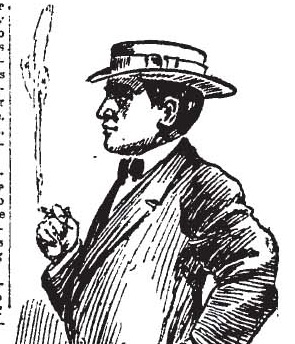
January 10, 1909: A gambling dandyJanuary 10, 1909: If you strip away the moralistic tone used by the anonymous Times
reporter, the problems of the young men caught up in gambling (in this case horse racing) a century ago are quite modern.

Wrecked on the rocks of the betting game! Of how many young men of Los Angeles, who but a few months ago held positions of honor or trust, and are now serving time on the chain gang, is this true?

At right, Frank Reynolds, vagrant.

Continue reading →

Posted in #courts, 1909, Downtown, Fashion, LAPD | Comments Off on January 10, 1909: Addicted to Gambling

In the Theaters, April 12, 1938

1938_0412_theater
Posted in Film, Hollywood | Comments Off on In the Theaters, April 12, 1938

Second Takes — Billy Wilder

Nov. 28, 1945, Lost Weekend

April 13, 1944, Hedda Hopper, Lost Weekend

June 9, 1944, Hedda Hopper, Lost Weekend

"Andrea Leeds is cast for the lead of "Lost Weekend" …

July 7, 1944_0707, Hedda Hoppe, Lost Weekend
… or maybe Katharine Hepburn.


http://video.google.com/googleplayer.swf?docid=-1976207906583051047&hl=en&fs=true Note the use of the theremin in Miklos Rozsa's score. 

Aug. 24, 1944, Hedda hopper, Lost Weekend

Nov. 24, 1944, Hedda Hopper, Lost Weekend Dec. 14, 1944, Hedda Hopper, Lost Weekend

Nov. 30, 1945, Lost Weekend Review

Edwin Schallert reviews "Lost Weekend," Nov. 30, 1945

March 8, 1946, Ray Milland wins an Academy Award for 'Lost Weekend'

Billy Wilder wins an Academy Award for best direction and shares an Academy Award with Charles Brackett for screenplay for "Lost Weekend." Ray Milland wins an Academy Award for best performance.

CRITIC AT LARGE

'Lights' Director Focuses on 'Lost Weekend'

April 28, 1988

By CHARLES CHAMPLIN, Times Arts Editor

March 11, 1986, Ray Milland Dies Watching "Bright Lights, Big City" a few weeks ago, it occurred to me that it was "The Lost Weekend" of the cocaine age.

For the protagonist, very well played by Michael J. Fox in a wild change of venue from "Family Ties," the social sniffing of the drug had corrupted every aspect of his life, as booze had undone Ray Milland as a writer of promise.

The moments of exultation — Milland was unforgettable saying that the first drinks made him feel "like Michelangelo, sculpting the beard of Moses" — had died all too quickly for the Fox character.

It was clear in the Jay McInerney novel that the boy had been using hard for only two months. But he was on the verge of losing his job as a fact-checker at a magazine like the New Yorker (where McInerney himself had worked as a fact-checker). His days and nights were a desperate scramble to maintain even the appearance that nothing was different. He had cut himself off from his family and had no sustaining relationship simply because he couldn't sustain one.

"Yeah. We thought about 'The Lost Weekend.' We talked about it," the film's director, Jim Bridges, said at lunch earlier this week.

The psychological parallels extended to the ending. "There had to be hope in it," Bridges said. "But it's very guarded, as it was in 'The Lost Weekend.' " Milland drops a cigarette into his highball, the most mixed of mixed emotions playing over his face. Fox sits on a wall, watching the dawn come up over the East River.

You hoped hard lessons had been learned, but you could only hope.

"(Cocaine's) so deceptive," Bridges said. "It makes you feel good and even look good — you sparkle — until you've gone too far." He thinks the social usage has dropped off sharply in Hollywood since the early '80s, but not before some careers were severely damaged.

Bridges, whose earlier films included "The Paper Chase," "Urban Cowboy" and "The China Syndrome," became involved with "Bright Lights, Big City" in the least comfortable circumstances for any director.

He replaced a director (Joyce Chopra) who had already been shooting for 20 days on a script that, all too significantly, had gone through five writers, including McInerney himself, and as many as 15 drafts.

After Chopra left the project, Bridges read the shooting script and concluded it was undoable. "It would have run 10 hours," he said.

"I went back to the novel, which had been left rather far behind." In six days, McInerney and Bridges, who had begun his Hollywood career as a writer in television and learned to move fast, produced a new script, following a bare-bones outline of the book.

March 11, 1986, Ray Milland Dies Bridges also had some sets revised and recast several supporting roles, bringing in Frances Sternhagen as the magazine's head of research, Swoosie Kurtz as a fellow worker and Jason Robards as the alcoholic editor who used to run with the Algonquin crowd.

He also brought in his own cinematographer, Gordon Willis, famous for his films with Woody Allen. Willis is known to work swiftly, and contractual commitments left Bridges only 36 days to do the film. "My deal was that we wouldn't use a foot of what had been shot before, and we didn't."

Necessity occasionally mothers some nice inventions. In this case the necessities of time forced a useful simplicity. The jangling discos where the Fox character spends most of his nights have by now become a cinematic cliche of jump cuts, a hyperactive camera and a blizzard of lights and blurs.

But in the discos here and at a climactic cocktail party, the Bridges/Willis camera stays remarkably calm, maintaining a steady, almost clinical watch on Fox.

"It's the most simply and directly shot film I've ever done," Bridges said. "We focus only on the people. It was the pressure of time." It works better than a multitude of cutaways might.

The camera never moves in for an extreme close-up until the critical moment Fox confronts his face in the mirror and comprehends, as if for the first time, all that he has done to himself and his life.

Particularly in its late stages, "Bright Lights, Big City" has a power of implication, when what is going with Fox's emotions is readable but unsaid and not overtly shown. "I try to make the audience work," Bridges said. "I don't believe in making everything cut and dried and then dumping it in the audience's lap. I don't think of a film as being finished until the audience is there."

After 30 years in Hollywood, Bridges is philosophical about success and failure and has tasted both. "I think they run in 10-year cycles of favor and disfavor, hurt and happiness," he said.

He had two big commercial successes in a row, "Urban Cowboy" and "The China Syndrome." But when a very personal film of his called "Mike's Murder" was sneak-previewed in its original form, the audience screamed at the screen and there were cries of "Lynch the director!"

"There is real violence and make-believe violence, and I had obviously gone over the line," Bridges said. But he had brought the film in $1 million under budget, and the company allowed him to spend the savings on a partial remake. The later version was enthusiastically reviewed and has become something of a cult classic.

"A writer friend says there are three career stages," Bridges said: "New Kid in Town, Fall of New Kid and The Comeback. I'm not the new kid. But once you begin to understand the cycles, it's not so bad."

Posted in books, Film, Hollywood, Second Takes | Comments Off on Second Takes — Billy Wilder

Hollywood Star Couple Gets Divorce, April 12, 1939

1939_0412_nuestro

Los Angeles Times Cover, April 12, 1939 Joan Crawford appears in court to get an interlocutory decree in her divorce from actor Franchot Tone. Judge Benjamin J. Scheinman had refused to proceed in the divorce until Crawford appeared in court.

Romania appears likely to capitulate to the Nazis unless it receives a guarantee of support from Britain … President Roosevelt, bidding farewell to people in Warm Springs, Ga., en route to Washington, says: "I'll be back in the fall if we don't have a war."

And a D.A.R. official says the organization was merely following the law in barring singer Marian Anderson from a performance at Continental Hall.

Arabs, Jews Discuss Palestine Peace Plan
Hitler Escapes Czech Death Plot, April 12, 1939

At left, the Egyptian ambassador to London arrives in Cairo with proposed changes in the British plan for Palestine. The present plan calls for an Arab-dominated state with a Jewish minority.

Comics, April 12, 1939 The draftsmanship in the 1939 comics is quite remarkable. Today, we're accustomed to having characters reduced to simplified figures in contrast to the finely detailed work in the old panels. The shading in Al Capp's "Li'l Abner," for example, shows the amount of care artists used to pour into their comics. Even "Gasoline Alley," which was not particularly known for its artwork, makes interesting use of silhouettes.

Theater and Movies, April 12, 1939

Carole Lombard appears in a revival of "The Eagle and the Hawk," with Fredric March and Cary Grant.

Sports, April 12, 1939

Boxing officials discuss rules for the upcoming Joe Louis-Jack Roper match. Most questions are answered: "That's strictly up to the referee."

Posted in Uncategorized | Comments Off on Hollywood Star Couple Gets Divorce, April 12, 1939

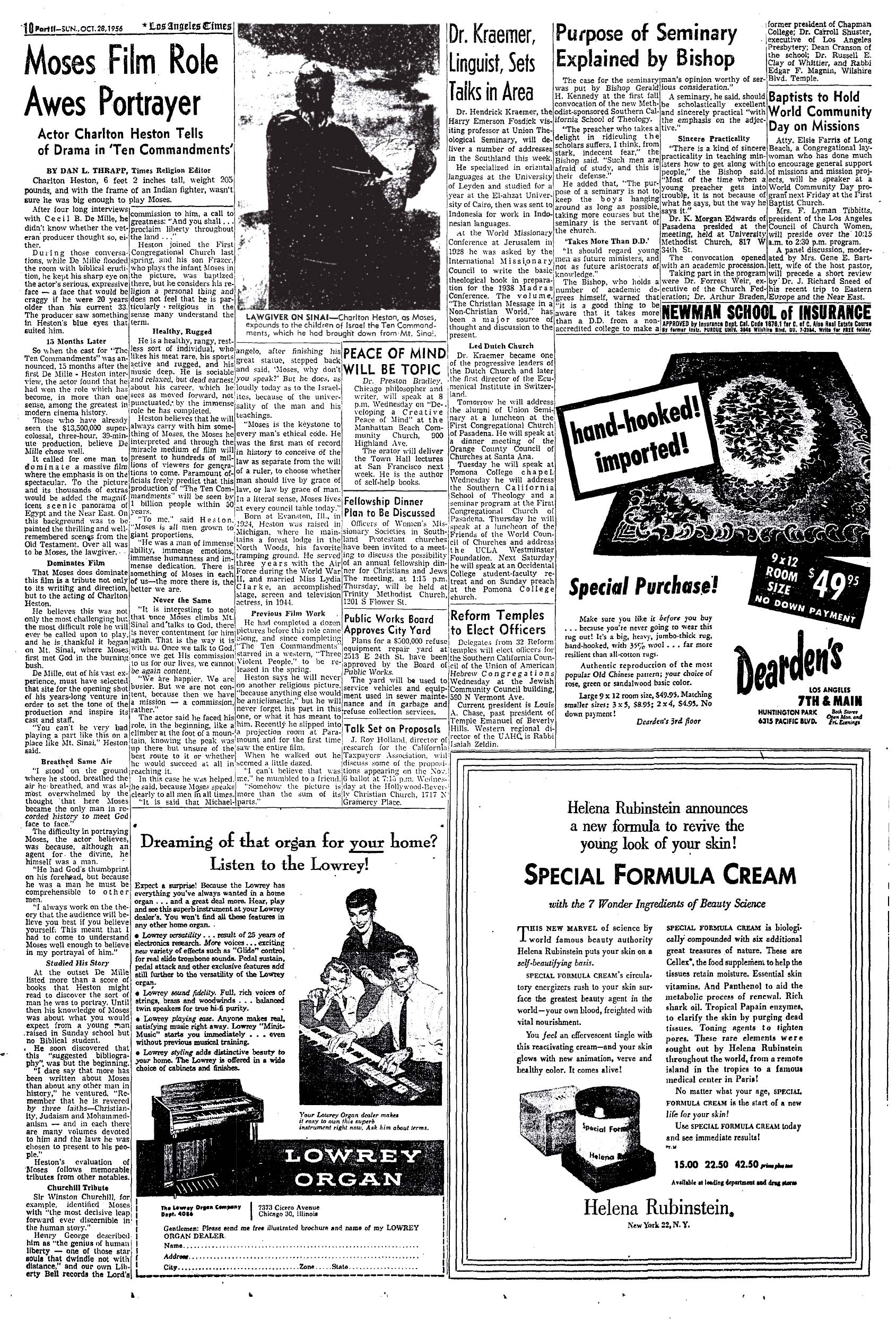
October 28, 1956: Charlton Heston on the ‘Ten Commandments’

October 28, 1956: Ten Commandments

We had our religion writer Dan Thrapp interview Charlton Heston about his role as Moses in “The Ten Commandments.” Fortunately, Thrapp was not from the “over a salad and mineral water at the Polo Lounge” or “speaking by phone from Paris, where he is at work on his next picture” schools of celebrity interviewers, but he got something of substance.

Quote of the Day: It is interesting to note that once Moses climbs Mt. Sinai and talks to God there is never contentment for him again. That is the way it is with us. Once we talk to God, once we get his commission to us for our lives we cannot be again content. We are happier. We are busier. But we are not content because then we have a mission — a commission, rather.”

— Charlton Heston

This is adapted from an earlier post on Heston’s death >>>

Posted in Film, Hollywood, Religion | Comments Off on October 28, 1956: Charlton Heston on the ‘Ten Commandments’

Found on EBay — Great White Fleet, 1908

1908_louisiana_ebay_crop

A souvenir postcard of the Great White Fleet's 1908 visit to Los Angeles, showing the battleship Louisiana, has been listed on EBay.  Bidding starts at $9.99.
Posted in Transportation | Comments Off on Found on EBay — Great White Fleet, 1908

Matt Weinstock, April 11, 1959


Glendale 'Witch'

Matt_weinstockdWhile recovering from the flu in 1942 Charlotte Armstrong amused herself by writing a mystery novel, "Lay On, MacDuff!"
To her surprise, she sold it and it was published the way she wrote it.
Until then she had been writing unsuccessful plays. Previous to that
she took classified ads on the phone for the New York Times.

It
seemed like a nice life compared to the arduous toil of writing and
rewriting plays and since that time she had written 13 more, almost one
a year, most of which have appeared in magazines. "A Dram of Poison,"
won the Mystery Writers "Edgar" as the best suspense novel of 1956 and
critic Anthony Boucher called her "one of the few authentic spell-casting witches of modern times."

HER NEWEST
is "Duo," two short novels with an L.A. setting. Scheduled for publication later this year is "The Seventeen Widows of Sans Souci."

1959_0411_brawl "There's
no such thing as coasting for Miss Armstrong, wife of ad man Jack
Lewis. She's at her typewriter every day at her home at 1700 Grandview Ave., Glendale. (What's that you say? People in Glendale don't write suspense novels? Huh!)

Miss Armstrong makes a fine distinction in this day of shoot-'em-up and beat-'em-up TV.

"I
find I kill off fewer and fewer characters all the time," she said. "My
'Dram of Poison' had no crime, no violence and no villain."

::


SOMETHING

has gone wrong with a Rolling Hills resident's TV set and all he gets
is a diagonal picture across the middle with the other two-thirds of
the screen, top and bottom, blacked out. Says he never had so much fun.
The horses in westerns look like dachshunds. As for the ladies at the
Academy Awards, my, my, such distortion.

::

COULD BE

It must have been fun
When people had some
Of the thing they call togetherness.
And the reason why
They still got by–
Perhaps they were just togetherless.

–CALL CROTSENBERG

::


THE PHONE RANG
at
the home of Bart Bradley, 12, TV actor and the caller asked, "Is Melvin
there?" Bart said he must have the wrong number. A moment later the
routine was repeated. The third time Bart said, "Melvin is being
punished–he can't come to the phone." That stopped it.

::


EVERYONE TALKS
,
some in horrified tones, about juvenile delinquency but the County
Federation of Community Coordinating Councils tries to do something
about it by tracing its causes and understanding it.

The problem was pinpointed recently when a Pico
Rivera housewife reported two little strangers appeared at her home
with this note from their mother. "To whom it may concern: Please send
my children home by five." In other words, she didn't care where they
were just so they didn't bother her.

::


1959_0411_abby   NOTE FROM

a voter: "Do you suppose the people in politics and government got the
message last Tuesday that the 2-1 defeat of Prop. A meant we won't
stand for further tax increases? Or will we have to go through all that
again?" Don't hold your breath.

::


FOOTNOTES —
Among
the interplanetary problems raised at the Space Conference in New York
was "Suppose a man sent to another planet liked it so much he didn't
want to return to earth" … The Animal Regulation Department has done
it again. In addition to 1,234 dog and 99 cat bites, the monthly report
lists the year's firstcoatimundi bite. Of course, we've also had chomps
by an eagle, an eland, a mole and an ocelot … Oops, a learned
professor on Channel 4's early morning show, "Continental Classroom,"
committed this redundancy: "The beam of light goes vertically straight
up" … "No truth to the rumor, Bob Holcomb says, that if and when the
cut version of "Gigi" is shown on the late, late show it will be called
"Gi."

Posted in Columnists, Matt Weinstock | Comments Off on Matt Weinstock, April 11, 1959

Paul Coates — Confidential File, April 11, 1959

Confidential File

Paul_coates(Press
release) "Those who are skeptical of the adage 'love at first sight'
would do well to know Steve Allen's account of his first meeting with
Jayne Meadows.

"Steve leaves no doubt about his feelings on the
subject in an eloquent tribute he pays his wife in a current Look
magazine article.

" 'Coming into contact with Jayne Meadows for
the first time,' writes Steve 'is in some particulars like being
exposed to the Statue of Liberty or Grand Canyon for the first time;
one is just apt to stand and look. She is, like these other national
wonders, big and beautiful and a bit overwhelming.

" 'You are
confronted suddenly with a barrage of red hair and earrings and perfume
and eyelashes and a generous red and white and pink mouth that keeps
talking and smiling and gasping. " (signed) Public Relations
Department, Look magazine.

–Beautiful! But, Steve, she sounds ill.

::

1960 GOP Convention Set for Chicago, April 11, 1959  "Dear Paul,

"Last week you wrote about a soap opera and a syrupy voice (Mr. Don Ameche) and there was Melinda and Carri. You admitted being confused. Perhaps I can set you straight, as I heard the whole story.

"You
see, Helen was actually Don's (Jeff's) wife. Pop was Carri's stepfather
and Jeff's manager, before he quit to be a horse trainer and became a
fight promoter instead.

"Not that Pop was really anyone's Pop. But he helped Joe, Don's (Jef's) brother to meet Carri who fed sugar to the horses.

"But
Carri decided she really loved Jeff's (Don's) brother. Now Jeff's wife,
Helen, is dead so Melinda is fixing dinner. Jane, the daughter of
Edward (a recluse at CampPendleton and first husband of Carri), runs away from home.

"Pop, Edward, Carri, Jeff (Don) and Melinda and Joe let Jane make her own way.

Garden of Allah to Be Torn Down, April 11, 1959"Wouldn't you?" signed Mickee.

–Frankly, I don't care what she does. I'm sick of the whole ugly mess.

::

 (Press release) "A national movement is afoot to replace the salutation 'Mister' with 'Esquire.'

"The
originators of this plan suggest that the appellation 'Esquire' carries
more dignity and gives a man more stature than the commonplace 'Mister.'

"Derivation
of 'Esquire' is English. Originally meaning shield bearer and candidate
for knighthood because of chivalry, the term came to refer to English
landed gentry, men of property or squires.

"There is no doubt that Esq. after a name looks more impressive than Mr. before it.

"Today, man's reputation as the stranger sex has sunk low,' says Irving J. Bottner of Great Neck, N.Y., who's spearheading the Esquire campaign.

"He's head of a shoe polish firm coincidentally named Esquire." (signed) Carl Erbe Associates, New York, N.Y.

–Coincidentally? It's downright eerie.

Posted in Columnists, Paul Coates | Comments Off on Paul Coates — Confidential File, April 11, 1959

In the Theaters, April 11, 1935

1935_0411_theater

Posted in Film, Hollywood | Comments Off on In the Theaters, April 11, 1935

Second Takes — Billy Wilder

1944_0806_double_indemnity_ad

Coming Attraction: "Double Indemnity," Aug. 6, 1944

Double_indemnity_script[1]
A page from the script of "Double Indemnity."

1943_0912_chandler[1]

Sept. 12, 1943: James M. Cain and Raymond Chandler discuss making "Double Indemnity." Here's the script from "Double Indemnity" from "The Daily Script."

Philip K. Scheuer's Aug. 6, 1944, review calls "Double Indemnity" a turning point in American film, like "The Human Comedy," "Citizen Kane" and "The Maltese Falcon."

1944_0806_double_indemnity01

1944_0806_double_indemnity02

Posted in Uncategorized | Comments Off on Second Takes — Billy Wilder

Movie Mystery Photo


2009_0406_mystery_photo

Los Angeles Times file photo

Diana Sands plays Diahann Carroll's cousin in an episode of "Julia," 1970.

Update: Yes, as nearly everyone realized, this is Diana Sands, who died in 1973 at the age of 39.

Just a reminder on how this works: I post the mystery photo on Monday and reveal the answer on Friday. To keep the mystery photo from getting lost in the other entries, I move it from Monday to Tuesday to Wednesday, etc., adding a photo every day.

I have to approve all comments, so if your guess is posted immediately, that means you're wrong. (And if a wrong guess has already been submitted by someone else, there's no point in submitting it again.) If you're right, you will have to wait until Friday. There's no need to submit your guess five times. Once is enough. The only prize is bragging rights. 

The answer to last week's photo: Sheila Ryan.

2009_0410_mystery_photo

Here's a final photo of Diana Sands. Notice anything unusual about it?

1973_0923_diana_sands  

 
Diana_sands_1970_0804_combo_crop

Los Angeles Times file photo

As a few people noticed, the photo of Sugar Ray Robinson, Diana Sands and Diahann Carroll has been altered. Here's a detail shot:

Diana_sands_1970_0804_combo_detail_crop

There was a time when cutting and pasting a photo was considered an art, believe it or not.

2009_0407_mystery_photo

Los Angeles Times file photo

Update: Diana Sands in "Doctors' Wives."

Here's another picture of our mystery woman. Please congratulate Dewey Webb, Eve Golden, Carmen, Sonny King, Atriana, Bernard in NYC, Jeff Comstock, Barbara Klein, Elsie, Pamela Porter, R. Ahuna, Mary Mallory, Vanessa Carey, Edward Cradduck and Sam O'Neal for correctly identifying her!

2009_0408_mystery_photo

Los Angeles Times file photo

Update: Diana Sands and Diahann Carroll in "Julia."

Here's another photo of our mystery woman with a mystery companion. So many people have identified her that I can't list them all. Congratulations!

2009_0409_mystery_photo

Los Angeles Times file photo

Update: Diana Sands in "Georgia, Georgia, 1972.

And here's another picture of our mystery woman!

Posted in broadcasting, Film, Hollywood, Mystery Photo, Stage, Television | 150 Comments

City Workers May Get 5% Raises; Snow Cancels Dodgers Opener, April 11, 1959

1959_0411_cover

1959_0411_hermit 1959_0411_defiant

On the cover, President Eisenhower and Vice President Nixon predict a Republican victory in the 1960 presidential election. The country is "squarely behind our efforts to block excess spending and to keep the federal budget in balance," Nixon says.

At left, relatives are looking for Dennis Farrell, a hermit who lives in Griffith Park. Farrell, who has been sleeping in a cave near the Observatory, is being sought by his brother and father, who want him to come home to Nebraska.

And a curious story about Officer Marion D. Hoover, who shot Ramon Adolfo Vega Jr. in the head after Vega stabbed him during a chase through Hollenbeck Heights. Stay tuned on that one.

1959_0411_theater

 Hey! It's "zany insult artist" Don Rickles!

1959_0411_comics

1959_0411_sports The Dodgers and Cubs had a snow day instead of an opening day.

Game-time temperature in Chicago was a balmy 32 degrees, more
suitable to the Bears and Rams playing, The Times' Frank Finch pointed
out.

Finch apparently didn't expect bad weather: "Our hastily gathered
wardrobe today included topcoat by Klippstein, gloves by Becker and
insulation by Daniels [Jack, that is]."

Amazing that would make it into a story.

The Dodgers lost the season opener the following day to the Cubs,
6-1, the only Los Angeles run coming on a home run by losing pitcher
Don Drysdale. Bob Anderson, who had been a relief pitcher for the
Pacific Coast League Angels, was the winning pitcher for the Cubs.

–Keith Thursby

Posted in Charles Hillinger, Film, Front Pages, Hollywood, Nightclubs, Politics, Richard Nixon | Comments Off on City Workers May Get 5% Raises; Snow Cancels Dodgers Opener, April 11, 1959

Little Girl’s Body Taken From Well, April 11, 1949

Posted in Front Pages | Comments Off on Little Girl’s Body Taken From Well, April 11, 1949

Found on EBay — UFO Society

Ufos_ebay

This label, for the Amalgamated Flying Saucer Clubs of America has been listed on EBay. Bidding starts at $9.99.
Posted in UFOs | Comments Off on Found on EBay — UFO Society

Matt Weinstock — April 10, 1959

Dilemma Continues

Matt_weinstockdA year and a half ago the frustrating dilemma of Roy Huerta, 38, a cook, and his wife, Manuela, 32, was told here.

Ten
years before, in 1947, they were married in Los Angeles. One day in
1949 they took a trip to Tijuana. At the border on the way back they
were asked the usual questions.

Roy had no trouble. He was born in Johnstown, Pa., and served three years in the Army in World War II, 18 months in the South Pacific.

Manuela panicked. Born in Zacatecas,
Mexico, she speaks little English. She said she had never been in the
United States, then said she had. She was detained and accused of
entering this country illegally.

A hearing was set and she was
notified but, out of fear, she ignored the summons. She was convicted
of perjury and forbidden under theMcCarran Act to reenter the country.

"And
so for the last eight years," it was stated here, "Roy has made a
weekly pilgrimage to Tijuana. He takes along groceries, clothes and
gifts for the five children."

1959_0410_fashions THE OTHER DAY a letter came in from Mrs. William Hr. Rosenblatt,
2424 Wilshire Blvd., stating, "The story in your column Sept. 13, 1957,
about Roy Huerta and his separation from his wife and children living
in Mexico has pricked my conscience daily. Can you let us known if this
situation still exists? An injustice of this kind disturbs me. Perhaps
enough attention can be focused on this case to try to heal one of the
many heartaches caused by theMcCarran Act."

THIS IS TO REPORT
that the situation is unchanged. Roy now works as a cook in a
restaurant on Sunset Boulevard and lives with a brother on North
Broadway.

He still travels to Tijuana each weekend to be with
his family. There are now six children, three girls and three boys. The
oldest, Gloria Jean, 9, and two others attend school.

Manuela's
case is at a stalemate. Roy has been told by attorneys and the
immigration people that the only hope is the repeal of theMcCarran Act.

Meanwhile,
this patient, conscientious man continues to look forward after nearly
10 years to the day that his family may join him in Los Angeles

::


1959_0410_comicsDID YOU HEAR
about the tabulating machine that can translate into Russian and then
back into English? Someone inserted the line, "The spirit is willing
but the flesh is weak." It came out, "Vodka is ready but the meat's
gone bad."

::

RUMMAGE

Though I often buy a new car
Don't call me an easy touch,
It's because my new car dealer
Claims he needs used cars so much.

–PEARL ROWE

::


TWO YEARS AGO

Malvin Ward wrote a film based on the Mad Bomber of New York. One scene
showed airplane passengers' luggage being examined because of the bomb
threat.

Last week as he was about to take off for L.A. from Idlewild
Airport in N.Y. policemen surrounded the waiting room and asked
passengers to open their luggage for inspection. There was a rumor a
bomb would be planted in the plane.

The real-life incident had an odd twist. A heavy fog prevented the plane from taking off.

::


1959_0410_abby ONE OF THE

most imperishable lines I ever heard was the cry of a downtown newsboy,
now dead. No matter what the headlines stated he shouted, "It won't be
long now!"

Walking past sunset and Gower the other day I heard
another enduring remark, one unemployed actor sadly to another: "I've
never seen it like this before." And never will again.

::


AROUND TOWN —
Language enrichment note: Mike Molony heard a customer tell Eddie, a Hill Street bartender, how he "got stooken" with a bum check. Superpluperfect
of stuck, Mike figured … The L.A. Press Club has 2,543 members, 1,398
actives — largest in the world … As one who only recently was
dragged kicking and screaming into his 30s, JackSearles shuddered to hear the announcer dedicate a TV kiddies' program "To you — the leaders of the 21st century!"

Posted in Columnists, Matt Weinstock | Comments Off on Matt Weinstock — April 10, 1959

Paul Coates — Confidential File, April 10, 1959

Confidential File

Con Men Live High When Going's Tough

Paul_coatesPaul Coates is back on the local scene. He'll take another look at the explosive Caribbean situation beginning Monday.

It's a simple economic fact. When times get tough, the con men live good.

Paradoxical, but that's the way it works.

A household blighted by recession becomes a fertile field for those who make their living fleecing the little guy.

And maybe it makes sense.

Those who need, want.

And the con artist holds out a glowing dream of plenty.

Too often, the dream becomes a nightmare.

A nightmare which drains American pocketbooks of an estimated $500,000,000 annually.

 Mr. and Mrs. Edwin Lamb, an English-born couple now living in Sherman Oaks, hold the purse strings on one of those pocketbooks.

The racket they succumbed to has a generic name — "homework."

1959_0410_cover"Make big money at home in your spare time," the pitchmen promise.

Specifically, Mr. and Mrs. Lamb fell victim to the knitting machine con.

And
they signed a contract which obligated them to pay $364 for a knitting
machine which can be purchased "wholesale" for far less than half that
figure.

In return for their investment, secured for the company
by a chattel mortgage on their furniture, the Lambs were promised that
any acceptable item manufactured on their machine would be purchased by
the firm which sold it to them.

I talked to the couple yesterday.

"I
know we're hooked," Mr. Lamb told me in a voice colored by both British
accent and resignation. "But maybe if someone exposes this racket,
other people won't be taken."

"Being English, we didn't know about things like this," his wife interjected. "We believed them. We trusted them."

 "Maybe we're kind of foolish," she added.

"How did you get mixed up in a deal like this?" I asked.

"We
wanted to make a bit of extra cash, you know. So my wife and I answered
an ad regarding work at home. It was knitting garments at our house and
selling them to this company," Mr. Lamb explained.

1959_0410_dodgers"And did you ever sell anything?" I wanted to know.

"No,"
Mr. Lamb said bitterly. "My wife kept making garments and taking them
down to the company's office. But the people down there always said
they weren't good enough.

"I don't think they ever really planned to buy anything from us," he concluded hopelessly.

And I don't think so either.

Now
the Lambs are stuck with their $364 knitting machine. That is, unless
they want to pay it off, then sell it back to the company for $75.

"We couldn't possibly sell it that cheap," Mr. Lamb said.

"And besides," his wife added, "they'd probably turn right around and sell it to some other poor sucker."

She's undoubtedly right. That's the usual MO.

But
in a way, the Lambs are luckier than some. Other knit-at-home pitchmen
operating in and around Los Angeles are getting as much as $418 for
their machines.

A Cruel, Vicious Racket

And always, they demand a chattel mortgage on the family furniture.

You can see it's a vicious racket. One that law enforcement agencies are working overtime to stamp out.

But the going is tough. Some of the firms involved do buy finished garments. Just enough to prove some sort of proper intent.

Many
others don't bother. They place their ads, open their doors, fleece the
sheep, then fold up and disappear to start again in another community
where the pickings are good.

Where some economic disaster has worked a hardship on residents.

Where opportunity, when it knocks, is always answered.

Even when it's only a thinly disguised con man's pitch.

Posted in Columnists, Paul Coates | Comments Off on Paul Coates — Confidential File, April 10, 1959