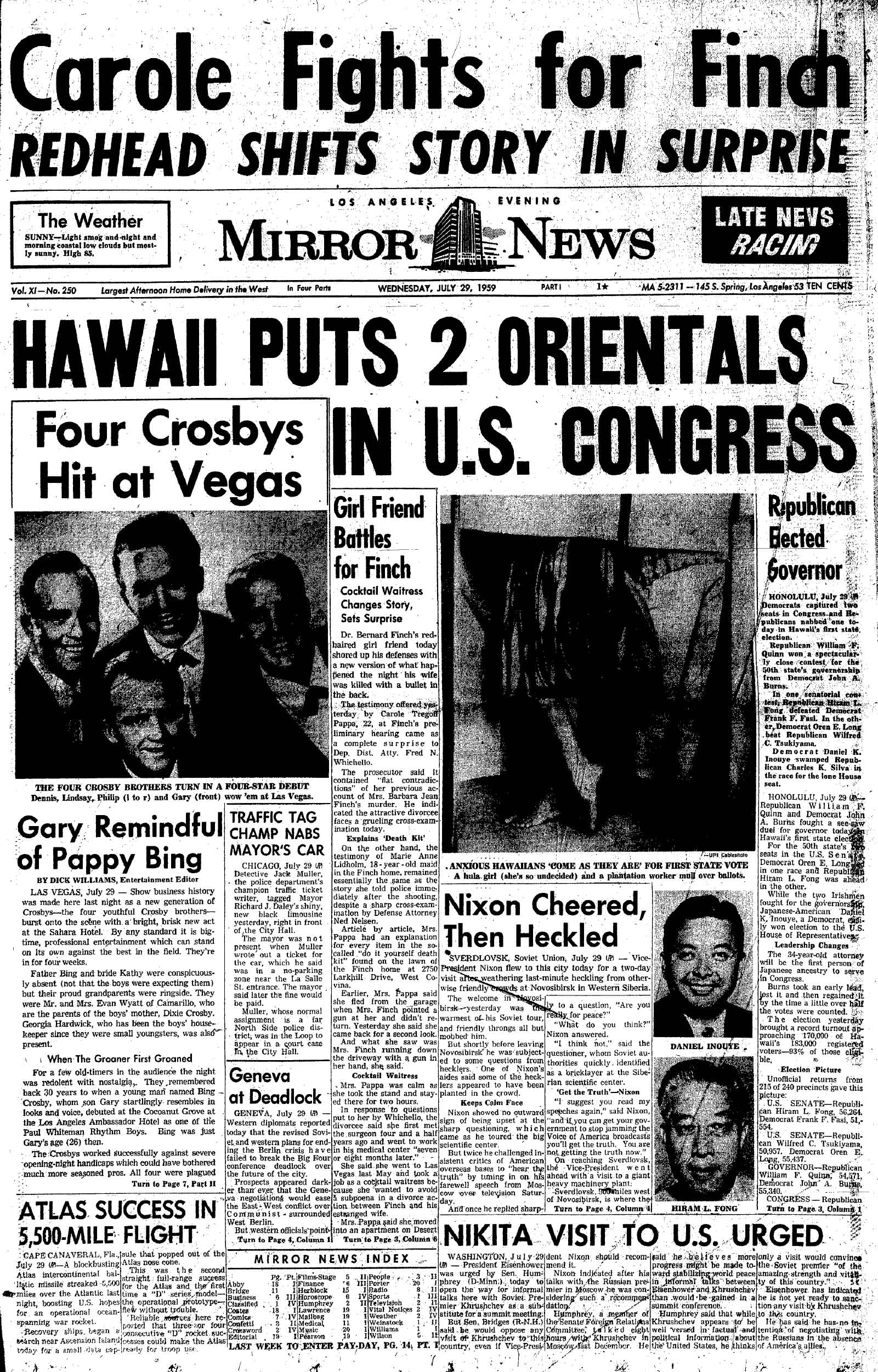
Matt Weinstock, July 10, 1959

Unfriendly Frisco

Matt Weinstock My San Francisco
spy has smuggled through the mail a clipping of a sports column by
Prescott Sullivan in the S.F. Examiner as follows:

"Ingemar Johansson demonstrated that he is the possessor of a devastating right-hand punch when he upended Floyd Patterson for the heavyweight championship of the world. Last week the handsome, affable Swede demonstrated that he is also the possessor of an orderly, analytical mind.

"In Goteborg, his home town, Johansson
said it looked like Los Angeles would be the scene of his first defense
of the title and that would be fine and dandy with him. 'I like Los
Angeles because I've never been there,' he declared.

"THINK IT over
and you'll agree that never having been there is the best possible
reason for anyone liking Los Angeles. What other reason is there for
liking it? Can L.A. be liked for its smog, its monstrous freeway
traffic jams or Charlie Park, the scorekeeper who did Sad Sam Jones out
of a no-hit game? Is it to be venerated for its oppressive heat, its
crackpots, the Dodgers or Braven Dyer?

July 10, 1959, Hats "For years we have been
trying to puzzle things out. Now a young Swede, to whom the English
language is strange and difficult, shames us by making it all look so
easy. Ingemar Johansson likes Los Angeles because he has never been there and no one could sum it up more succinctly than that."

My,
my, such bitterness. They must really hate us up there. And we always
say such nice things about S.F. Only thing to do is smile and whip out
the population figures.

::

"OH MEMORY, thou fond deceiver!" wrote Oliver Goldsmith. It certainly is.

The
boys on the copy desk were discussing the new sales tax on cigarettes,
which make them 30 cents a pack in the office vending machine, and a 2nd World War veteran reminisced, "Gosh, remember how cheap they were in the Army PBX?" That's what he said — PBX.

::

JULY 4 has disappeared into limbo for most people but not quite for writer Alvin Sapinsley.
He and his wife, Elizabeth, were having supper in the patio of their
Sherman Oaks home around 8:30 p.m. when something hit with a sharp,
cracking sound on the roof not too many inches away from his head and
bounced onto the driveway. It was the nose cone of a .45-caliber bullet
— copper-colored and warm.


July 10, 1959, Peanuts

Another panel you will never see in the sitcom legacy version of "Peanuts."

July 10, 2009, Peanuts

The current legacy strip: "It's a Laugh Track, Charlie Brown."


He went up on the roof and found a
deep dent it had made. By fitting the slug into the hole he determined
it apparently had been fired from somewhere around Mulholland Dr. and Beverly Glen Blvd.

He
called the police and an officer was sympathetic and made a report but
said there wasn't much he could and actually there wasn't.

The
disturbing thing is that five minutes before the bullet struck, his
wife had wondered if they could see the fireworks from the back yard.
He'd said he didn't think so and suggested, he recalls with a shudder,
they go up on the roof for a better view.

::

BATHERS BEWARE
Hark, hark, the shark —
All bite, no bark.
    –LEN DRESSER

::

July 10, 1959, Abby A LADY NAMED
Julia made the final payment on her car and remarked that she should
soon be receiving the pink slip in the mail. At a question by Donna, 5
1/2, she explained the pink slip meant ownership of the car. Donna said
she wanted to be there when the box came. "What box?" Julia asked.
Turned out Donna somehow had gotten the idea that the pink slip was a
ruffled pink seat cover. Breaking the news was like telling her there
was no Santa Claus.

Ah, those wonderful childhood misconceptions.

::

PUBLIC AT LARGE — Picture postcard from Terracina, Italy, from publicist Al Hix has the message, "This is just like Zuma Beach — with pizzas." . . . Tom Cracraft
can't understand why the missile people don't send gophers and moles up
in rockets. "Out in Studio City," he says, "we're hardly ever bothered
by monkeys."

Posted in Columnists, Matt Weinstock | Comments Off on Matt Weinstock, July 10, 1959

Paul V. Coates — Confidential File, July 10, 1959

July 10, 1959, Gordo

Confidential File

Mash Notes and Comments

Paul Coates"Dear Paul,

"Have you taken a close look in the mirror recently?

"Well, we here at the Encino Summer Playhouse have. And do you know what we saw?

"YOU — as an actor!

"Now we are prepared to offer you a deal. We'd like you to take part in our play, 'Laura,' which opens July 24 for two weeks.

"How
would you like to have your name up in lights in front of our theater?
That's a pretty exciting thought, isn't it? Just think of the comment
it would cause among your close circle of friends.

"Your first reaction is probably something like this:

" 'Aw, go on. I'm too busy writing a column and doing a TV program every day.'

"Sure, you're busy! We're all busy!

July 10, 1959, Drugs "But a true artist never thinks of that. All he can think of is the excitement of opening night —

"The
blaring overture…A quick once-over of the script to make sure you
know your lines…The butterflies in your stomach doing the
minute-waltz incha-cha-cha time…The last minute touches to your
makeup…Then, the creak of the curtain going up in all its faded
glory…And there you are — in the flesh — for all the world to see!"
(signed) Bill Dodge,Encino Summer Playhouse, 4935 Balboa Ave., Encino.
    — I'm not going on like that unless the rest of the cast does.

::

"Dear Sir:

"A
compulsion drives many imperfectly educated men, like the writer, to
put words on paper expounding theories and opinions that spring from
the bottomless well of their imagination; an imagination that is
renewed by contact with the works of literary giants and is similar to
the method used by Antaeus to renew his strength.

"A representative example of this compulsion follows:

"Parkey Sharkey
exists as the California counterpart of the British 'man who never
was,' although neither run much danger of being tagged with a Social
Security number.

"There is one significant difference between
these two illusions: the 'man who never was' played a vital role in a
desperate war, while Parkey Sharkey is the embodiment of his creator's
frustration, tinged with revulsion, which is the natural result when an
imaginative writer like you is forced into contact with the helpless,
the downtrodden and the foolish.

"In short, a sensitive person
must resort to such allegorical devices if he is to remain at all
objective on the job in the face of the ceaseless waves of human misery
beating against his desk…

"That's it. Or rather, it's only it until the next time the trigger is pulled by a remembrance, an article, a word. What do you think?" (signed) Harold Parrow, P.O. Box 42507, L.A. 42.
    — What should I think? You've just told me that my best friend in the whole world is only a hallucination.

::

"to Paul,

"I have two jobs now, when I get through cleaning up the Oasis bar, I deliver Chinese dinners for a Chinese resterant.

"The other night I asked the Chinese cook, what you got for supper???

"He
ran off a list of Chinese dinners which I had never heard of before. I
had never had a Chinese dinner before, Paul, so I said Chow Mein, without the chopsticks. I can't eat with them.

"Paul, my wife is driving me nuts.

"The
other day she walked a 82-year-old man home from a bar. He was drunk.
They were crossing the street at a signal when his pants fell off him,
and my wife had to pull his pants up for him in the middle of the
street." (signed) Parkey Sharkey, c/o Oasis Bar, Menlo Park.
    — Lies! Lies! Lies!


Posted in Columnists, Paul Coates | Comments Off on Paul V. Coates — Confidential File, July 10, 1959

A Kinder, Simpler Time Dept: Your Movies

July 10, 1933, Ginger Rogers at The Gold Diggers of 1933

July 10, 1933: Ginger Rogers appears at Grauman's Chinese Theater for a showing of "The Gold Diggers of 1933."

Posted in Film, Hollywood | 1 Comment

Movie Star Mystery Photo


 July 6, 2009, Mystery Photo

 Los Angeles Times file photo

Noreen Nash in "The Red Stallion," 1947. 

July 10, 2009, Mystery Star
Los Angeles Times file photo

Noreen Nash, Dec. 27, 1957

Update: This is actress and author Noreen Nash. Please congratulate Sue
Willahan for identifying her. (Sue explains that her mother went to
school with Nash).

Just
a
reminder on how this works: I post the mystery photo on Monday and
reveal the answer on Friday … or on Saturday if I have a hard time
picking only five pictures — sometimes it's difficult to choose. To
keep the mystery photo from getting
lost in the other entries, I move it from Monday to Tuesday to
Wednesday, etc., adding a photo every day.

I have to approve
all comments, so if your guess is posted immediately, that means you're
wrong. (And if a wrong guess has already been submitted by someone
else, there's no point in submitting it again.) If you're right, you
will have to wait until Friday. There's no need to submit your guess
five times. Once is enough. The only prize is bragging rights. 

The answer to last week's mystery star: John Loder!

March 4, 1957, Noreen Nash


July 7, 2009, Mystery Photo

Los Angeles Times file photo

Update: Noreen Nash, June 22, 1955. 

Here's another picture of our mystery gal!

July 8, 2009, Mystery Photo

Los Angeles Times file photo

Update: Noreen Nash and William Bendix in "The Life of Riley," Aug. 8, 1959. "Riley is surprised when 'Pat Davidson' turns out to be a beautiful girl and worries about how to break the news to his wife that 'Pat" will ride in his carpool."

So far I seem to have stumped everybody. I never know how hard the mystery guests are going to be until I post them. Today, she has a mystery companion!

July 9, 2009, Mystery Photo

Los Angeles Times file photo

Update: Robert Evans, Lynne Frederick Sellers, left, novelist Noreen Nash Siegel and her husband, Dr. Lee Siegel, staff physician at 20th Century Fox, Nov. 9, 1980.

Here's our mystery woman with a couple of mystery guests. I can't believe I have stumped everybody but evidently I have. I never know how difficult the mystery photos are going to be until I post them.

July 10, 2009, Mystery Star

Los Angeles Times file photo

Noreen Nash in "Lineup," Nov. 23, 1956.

Posted in Film, Hollywood, Mystery Photo | 59 Comments

Body of Missing Woman Found in Car Trunk; Dodgers Win in 13th Inning

July 10, 1959, Times Cover

July 10, 1959: A heatwave sears Southern California as a fire threatens homes in the Linda Vista neighborhood of Pasadena.

July 10, 1959, Killing

More attacks are feared in Vietnam after a bombing kills two American advisors.

An Inglewood police officer putting a ticket on a car that hadn't been moved for two days discovers the partially clothed body of a missing Fresno woman in the trunk. On the front seat is a sweater and a pair of Capri pants, a front tooth and blood.

The victim is identified as Mary Jean Prestridge, 26, the wife of a truck driver and the mother of two children.

Police are looking for a young man seen with Prestridge in Fresno shortly before she vanished. 

Caryl Chessman plans a new legal battle against his death sentence. The court reporter in Chessman's original trial died during the proceedings and court reporters said his notes were illegible. When a reporter was finally found who could transcribe the notes, Chessman discovered that he was an uncle of the prosecutor's wife. Chessman has been in prison since 1948.

July 10, 1959, Sports The Dodgers' games against the Milwaukee Braves are fascinating to
study since the teams finished the regular season tied and faced each
other in a playoff to decide the 1959 National League champion.

In a typically close game, the Dodgers edged the Braves, 4-3, in 13
innings. The Dodgers moved into second place with the victory, wedged
between the first-place Giants and the third-place Braves.

What stood out was how pitching has changed. Milwaukee's Warren
Spahn took the loss after pitching 5 2/3 innings in relief of starter
Joey Jay.

Spahn was still a top pitcher. He would win 21 games in 1959, the
fourth of six consecutive seasons with at least 20 wins. What was he
doing coming out of the bullpen?

The Dodgers' relief staff was similarly quiet. Roger Craig was the
winning pitcher and he really earned it, pitching the final 11 innings.
There's a reference in the story to how few pitches Craig threw, but 11
innings is a lot under any circumstance. Wonder how many pitchers the
Dodgers and Braves would use in a similar game today.

And this wasn't a rare case. The next afternoon, Don Drysdale came
out of the bullpen to pitch the Dodgers past the Braves in the final
game of the series. Drysdale had pitched two scoreless innings the
night before, but the game was rained out in the third inning. He was
scheduled to pitch the first game of the next series in Cincinnati but
was called in when Sandy Koufax struggled. There was no one else?
Drysdale pitched six innings.

It's impossible to imagine a current manager juggling such a star pitcher.

— Keith Thursby

Posted in Dodgers, Front Pages, Homicide, Sports | Comments Off on Body of Missing Woman Found in Car Trunk; Dodgers Win in 13th Inning

Nuestro Pueblo: Long Beach

  July 10, 1939, Nuestro Pueblo

July 10, 1939: Joe Seewerker and Charles Owens go down to Long Beach and visit Shorty Orr.

Posted in Architecture, art and artists, books, Nuestro Pueblo | Comments Off on Nuestro Pueblo: Long Beach

Black Man Survives Lynching

 July 10, 1899, Trilby

July 10, 1899: Dick "Trilby" Williams, an African American charged with killing two white men, survives being lynched because the marshal of Alma, Kan., cut him down after six minutes. Although this story says Williams wasn't expected to live, a story three days later reported that Williams' neck had not been broken and he was likely to survive. The Times never reported anything further on whether he was tried.

Posted in #courts, Countdown to Watts, Homicide | 2 Comments

Bullets Fly When Men Try to Kill Mule

  July 10, 1889, Mule Incident

July 10, 1889: Two men trying to shoot a sick mule nearly kill a neighbor. The mule had glanders, an incurable disease passed in public watering troughs, so they shot it five times. One of the bullets almost hit Mrs. Maria Ybarra.

Posted in Animals, health | Comments Off on Bullets Fly When Men Try to Kill Mule

Cooking With the Junior League, 1979

Mary McCoy on Canning
Bread and Butter pickles
In the latest post on Cooking With the Junior League, Mary McCoy visits 1979 cuisine with the Junior League of Tuscaloosa’s "Winning Seasons."

Mary says: "Canning is really, really fun, and makes you feel like some kind of 21st-century Rosie the Riveter."

Read more >>>

Posted in Food and Drink | Comments Off on Cooking With the Junior League, 1979

Found on EBay — Bullock’s Wilshire

Bullocks Menu Ebay

This children's menu from Bullock's Wilshire has been listed on EBay. Bidding starts at $7.99.

Posted in Fashion, Food and Drink | Comments Off on Found on EBay — Bullock’s Wilshire

Matt Weinstock, July 9, 1959

1959_0709_peanuts

Way, Way Out

Matt Weinstock The
Amalgamated Flying Saucer Clubs of America have been sending me daily
notices concerning their convention here this weekend and, although I
am open-minded on flying saucers, I simply don't know how to handle
thisoverwhelming situation. As the boys say, it bugs me.

One featured speaker, a press release states, will be Kelvin Rowe of San Jacinto,
"who reportedly has flown into outer space more than 350 times." The
release blandly adds, "Rowe's contacts have been primarily with people
from Jupiter and Pluto." Just like that.

Another will be Daniel W. Fry of West Covina,
"who in 1950 rode in a spaceship from another world from White Sands
Proving Grounds, N.M. to New York City and back in half an hour."

July 9, 1959, Watts Towers Another will be Hope Troxel, Altadena interior decorator, "who has enjoyed many remarkable incidents involving extraterrestrial life."

ANOTHER WILL BE
Reinhold Schmidt, Bakersfield grain buyer, "who on Aug. 14, 1958, flew
from the Mojave Desert to the Arctic Circle and under the ice pack in a
spaceship from the planet Saturn." Schmidt's experiences, which
required a whole page for the telling, continue: "On Nov. 5, 1957, he
was contacted by aSaturnian spaceship and invited aboard by its crew of
four men and two women outside Kearney, Neb. Schmidt has since had many
contacts with his friends from outer space."

 Many aviation and
military authorities are quoted as expressing belief that there's
something up there all right, doubtless from outer space. Of a sighting
in Rome, Clare Boothe Luce said, "I did see an object. I don't know
what it was."

The AFSCA also raises some interesting questions,
including the following: Was the star of Bethlehem a spaceship? Did
Moses receive the Ten Commandments from outer space? Was the Red Sea parted by extraterrestrial technology? Are there more than nine planets in our solar system?

July 9, 1959, Freeways Honest, fellows, I don't know. Somewhere along the line I seem to have lost my childlike credulity.

::

LET US LOOK IN on an exciting drama of conflict and emotion in a suburb and hope we don't disturb it.

There's
a campaign in this town to cut down trees for one reason or another,
mostly beauty of what is called progress. A certain woman announced she
was going to take out a crooked fig tree at the side of her house. She
feared it would crack the sidewalk. Not only that, it looked dead.

Suddenly,
the tree has busted loose with leaves and small figs. She can't
understand it. A neighbor can. A tree lover, she has been secretly
watering it at night.

::

 AFTER MANY years
of drinking as he pleased, a movie studio worker recently saw the
light. His doctor held the lamp for him. Stop or drop, he warned. Dead,
he meant.

Four days after he quit the liquor store he'd patronized for 14 years had a sign in the window, "Going Out of Business."

The
poor guy now has a guilt complex. He is brooding about the possibility
that he may have undermined the economic foundation of an Inglewood
shopping center.

::

 July 9, 1959, Abby HARDEST KIND
The most difficult work that
    I have to go through,
Is trying to look busy when
    I've nothing to do.
    –RALPH FREEMAN

::

A CABDRIVER named
Dick Vasquez tells of the time he picked up a passenger who had
misplaced his car while busy relaxing and suggested they cruise around
looking for it.

They went up one street and down the next but it was nowhere in sight. As the cabby turned a corner the passenger said irritably, "We've been on this street before. Gosh, you're dumb!"

"Yes, sir," Dick said, "but my cab's not lost, is it?"

Posted in Columnists, Matt Weinstock | Comments Off on Matt Weinstock, July 9, 1959

Paul V. Coates — Confidential File, July 9, 1959

 1959_0705_cockrum

July 5, 1959: Ira Cockrum is arrested in the death of his grandson.

Confidential File

About a Grandpa Who Killed

Paul CoatesMichael Gary Cockrum, a stocky little kid with blond hair and desert-brown skin, was buried yesterday.

After
14 years of being alive, he was laid to rest in Lancaster Community
Cemetery. And all the family was there to pay final respects.

All except his Grandpa Ira, who blasted Michael to eternity with his shotgun last Friday.

Grandpa Ira's in jail.

You
probably read in the papers over the week end how deputies picked him
up and booked him for murder of Mike and for injuring Mike's brother,
George Jr., 10, in a family feud over a $12 electric iron.

I read it, too, but somehow, I forgot about it until I got a call yesterday from the dead boy's father. George Cockrum
Sr. phoned me shortly after he, his wife and his three other sons,
Georgie Jr., Charles, 9, and Dennis, 4, had left the cemetery.

"About
my father killing my son that way," the 44-year-old hod carrier told
me, "I'd kind of like to straighten out some of the things that was
said."

July 9, 1959, Cover The reports in the papers said that Cockrum, who arrived at the scene minutes after the tragedy, was restrained from attacking his father with a baseball bat.

"What
happened," he explained, "was that I did pick up that baseball bat. And
I was walking at my papa. But nobody got in my way.

"By myself, I dropped it.

"I knew, before I reached him, that if I hit him, God would punish me."

Cockrum told me that his father was a big, strong man for his 64 years.

'Pa Had a Bad Temper'

"He
drank and he had a bad temper," he said. "Pa always had a bad temper.
When I was a kid, he used to beat on my mother something awful.

"But he was an awful hard worker, and he paid the bills. My father would be good sometimes. He could be real good, too."

Then George Cockrum talked about his dead son.

July 9, 1959, Vietnam "Michael was a good boy. He wasn't a tall boy. He was stocky, but there was no fat on him.

"Strange," Cockrum
recalled, "but my father always did kindly favor Michael. In fact,
Michael had been helping him work on his house until just lately, when
Michael told me he'd rather not go over there no more. Grandpa was
cussing at him too much, he said.

"I told the boy that if he didn't want to, he didn't have to.

"My
papa's been worse lately," the dead boy's father continued. "His father
— my grandpa — died two or three years ago. He grieved over that.
Then, two months ago, my mother died. That hit him. Extra hard, I
guess, 'cause of the way he treated her.

"It got so he wouldn't listen to any of us. He told me just last month, 'Georgie, if you don't watch out, something's going to happen. It's going to happen to one of your loved ones.'

'I Hope He Finds God'

"I said, 'Papa, you're sick. I'm going to take you to a doctor.' Last week I got an appointment for him. For the 10th of this month. I just got it too late."

July 9, 1959, Accordion Cockrom cleared his throat.

"If
anybody was to ask me how I feel about my father, I'd have to say that
I feel sorry for him. I hope and pray that he gets down on his knees
and finds God. I hope God helps him, because I know he's a sick man.

"I love my father. I loved my boy. He thought a lot of that boy, too.

"Tomorrow," George Cockrum
told me, "they'll be bringing him back here to Lancaster for his trial.
I haven't seen him, but I hear he's been asking for cigarettes. I'm
taking him a few, I guess.

"But what I don't know," he added, "I just don't know why he done me this way."

Posted in Columnists, Paul Coates | Comments Off on Paul V. Coates — Confidential File, July 9, 1959

A Kinder, Simpler Time Dept.: Your Movies

July 9, 1932, Movies  

July 9, 1932: Constance Bennett stars in "What Price Hollywood."  Don't you just love this lettering?

Posted in Film, Hollywood | Comments Off on A Kinder, Simpler Time Dept.: Your Movies

Dodgers Back in First Place

July 9, 1969, Sports A memorable night for the Dodgers and Manny Mota.

The Dodgers climbed back into first place in the National League West by sweeping the Atlanta Braves in a Dodger Stadium doubleheader, 5-3 and 4-3. Mota led the way with four hits in each game.

He won the nightcap for the Dodgers with a bases-loaded single that went over the head of Atlanta's right fielder, none other than Henry Aaron.

"It is the greatest thrill of my life," Mota told The Times' John Wiebusch. "A Dodger I always want to be and now I am one and we are in first place. I want to play on a champion."

–Keith Thursby

Posted in Front Pages, Sports | Comments Off on Dodgers Back in First Place

Executive’s Killing Reveals Double Life


View Larger Map

Seco Street, Pasadena, in the vicinity of the killing, via Google maps' street view.

Jan 30, 1948, George T. Judd George T. Judd lived a model life as far as anyone could tell. He was a
respected financial executive, and he and his wife, Margaret, were
often listed in The Times' society columns. Judd belonged to the
Kiwanis, was active in the Republican Party, supported the Pasadena
Playhouse and attended All Saints Episcopal Church. He and his wife
raised a son and a daughter in a home on Lagunita Road in an upscale Pasadena neighborhood. 

When
he was killed in 1948 at the age of 55, Judd was vice president of West
Coast Bond and Mortgage Co. and living alone at 840 Seco Street, a new,
2,200-square-foot home near the Rose Bowl. His wife, Margaret, had died
in 1945 and another life, one he had been leading all along in great
secrecy, took over.

We don't know for sure that Judd was gay,
although it would explain what happened to him. The Times never
addressed the question directly, but left the strong implication that
he was. One story said he "had no particular women friends" since his
wife's death and quoted Pasadena homicide Detective Lt. Cecil H. Burlingame as saying: "We are not looking for a woman in the case."

What we do know is that Judd had a history of being beaten and robbed
by men he picked up hitchhiking or in bars, and eventually one of them
killed him.

The first incident reported in The Times occurred
in San Francisco 20 years earlier. As he recovered at University of
California Hospital, Judd told police he picked up a stranger who
offered him a "headache tablet." The pill made him sick and the
stranger beat him and took his car, which police recovered outside the
city. In reporting the attack, The Times noted that Judd had gone to a
Mill Valley ranch the previous summer after resigning from his job at a
Pasadena bank due to health problems.

Feb. 1, 1948, Judd

Nothing appeared in the
paper for two decades, but homicide detectives learned that he had been
beaten by two hitchhikers about 1936 during a trip to San Francisco.

The
beatings and robberies became more frequent in the year before his
death. On Aug. 30, 1947, Judd met two men in a bar and had them drive
him home. He told police that one of the men, named Tex, threatened him
with a knife and when he ran for help, the men stole his car, which
police found wrecked. He also told police he suspected the men of burglarizing his house.

Although he never reported anything to authorities, friends told homicide investigators
that in the six months before he was killed, Judd had been beaten and
robbed several times, with his attackers usually taking his wristwatch.
 

Two days before his death, Judd contacted a neighbor who was
a building contractor to see about getting a shower head replaced. He
explained that he let three men spend the night at his house and one of
them had broken the fixture.

His daughter found him Jan. 29,
1948. She came over in the morning, looked through a window, saw him
in bed and assumed he was sleeping. She returned in the afternoon, went
in and found him dead. She contacted one of her father's business
associates, who called the police.  

Nov. 19, 1948, Bentley 1948_1119_bentley Although Judd was
strangled and stabbed in the neck, and a bloody fork and a carving
knife had been left in the kitchen sink, the daughter assumed Judd died
of natural causes, "pulled a sheet over her father's body and 'tidied
up a bit' while waiting for the doctor," The Times said.   
Homicide investigators
soon focused on the gritty bars around Hill and 3rd streets in downtown
Los Angeles because Judd "often visited resorts below his social
status," The Times said.

Judd's home was thoroughly checked for fingerprints that might have survived his daughter's cleaning and his friends were fingerprinted to eliminate their prints from the killer's.

In October 1948, police arrested a suspect at 6th
and Hill streets: a 19-year-old drifter from Yakima, Wash., named Edgar
Eugene Bentley. An off-duty detective recognized Bentley from a photo
released by Pasadena police based on leads from the downtown bars Judd
patronized. A crime scene investigator matched Bentley to fingerprints found on the refrigerator in Judd's home and on a bottle of soda water.

According to police, Bentley said: "I met Mr. Judd at the tavern and we went to his home at 840 Seco
Drive, Pasadena. We had several drinks. Mr. Judd made a sudden lunge at
my throat — and from then on I can't remember…. I sort of blacked
out."

Bentley also told police: "I must have done it — there was nobody else there but me …"

Under
questioning, Bentley said he hitchhiked out of Los Angeles the next
day. He pawned Judd's wristwatch in New Orleans, then sold the ticket
for $5. Within a few days, police traced the watch to a shop whose
owner "forgot" to report it.

On Jan. 14, 1949, Bentley pleaded
guilty to second-degree murder and was sentenced to five years to life
at San Quentin. In 1958, he and two companions escaped from a remote
prison honor camp at High Rock in Humboldt County. The men held up a
bar in Redding, Calif., took $250 and forced 11 people into a washroom.
Bentley was captured during a police chase after the men ran a Highway
Patrol roadblock in a stolen 1956 Mercury.

In 1969, Bentley escaped from the Miramonte Conservation
Camp, a minimum security facility east of Fresno, and was captured
several hours later. Washington death records list an Edgar E. Bentley
who died July 11, 1995, at the age of 65.

Judd was survived by his children, mother, sister and half brother. He was cremated at Mountain View Mausoleum in Altadena after funeral services at All Saints.

Note: Thanks to Dick Morris for help in research with this post.


Posted in #courts, #gays and lesbians, Homicide | Comments Off on Executive’s Killing Reveals Double Life

Funeral Home Refuses to Give Up Body of Murder Victim

July 9, 1899, Coroner

July
9, 1899: The coroner gets enmeshed in a grim dispute over the body of a murder victim. Before C.D. Howry, the coroner's preferred funeral home, could claim the remains of Mrs. Earl Hanchette, Bresee and Shafer, a rival company, took the body after being hired by the victim's closest relative. The coroner demanded that Bresee return the body but the company refused.

And Michael McGrath, an East Los Angeles scissors grinder, is killed when his horse runs away and he is thrown from his wagon.

Posted in #courts, Homicide | Comments Off on Funeral Home Refuses to Give Up Body of Murder Victim

Drunk Woman Rescued From Surf

  July 9, 1889, Drunk

July 9, 1889: A drunk woman is rescued after she wanders into the surf at Santa Monica. She had just lost her job as a servant because she was an alcoholic.

Posted in Food and Drink, Suicide | Comments Off on Drunk Woman Rescued From Surf

Found on EBay — Marilyn Monroe Pictures

Jasgur Photos of Marilyn Monroe

If you have $10,000* that isn't doing anything, you might want to pick up some Marilyn Monroe photos by Joe Jasgur that have been listed on EBay. And yes, you may recall him as the guy who said Monroe had six toes. He also made some claims about the Black Dahlia case, but given his nonsense about Monroe's six toes I wouldn't believe anything he said about anything. 

The listing is here.

*Update: The price has been cut to $2,500.
 

Posted in Film, Hollywood, Obituaries | Comments Off on Found on EBay — Marilyn Monroe Pictures

Matt Weinstock, July 8, 1959

Mother's a Smuggler

Matt Weinstock There
is a nice old doll, maybe 60, who drinks along with the boys in a Hill
St. bat cave. Every now and then some longtime friend calls her Mother,
which leads to mutual merriment.

The Mother story goes back perhaps 15 years, when she was a popular waitress in an all-night restaurant in Long Beach.

One
night a young lieutenant with a full head of steam was chatting with
her when he noticed in horror that the booze-buying deadline had
slipped by. She tried to hustle him a pint but had no luck. Here indeed
was a crisis. He had to make ship, be awake and alert at a certain
hour, without a drop to soothe his nerves which, he knew from
experience, would be jumping. So they plotted.

July 8, 1959, Cover NEXT DAY the old doll got dressed in her best and met the ship's launch at the scheduled time and was taken aboard the battlewagon.
She was greeted lovingly by the lieutenant, who introduced her to the
captain and other officers as his mother. The captain invited her to
lunch. All this took place under the eyes of scores of sailors who knew
darn well she wasn't his mother but that nice hasher in Long Beach.

 Meanwhile,
she was nervously trying to deliver a fifth of whisky concealed in her
handbag to her "son." She couldn't because of all the beaming brass
eager to welcome the lieutenant's dear mother.

Finally he
managed to take her on a tour of the ship and somewhere in the tangle
of the engine room she managed to slip him the bottle, which he stashed.

Topside
again, the lieutenant arranged to get his mother ashore, explaining
that she was only in town for the day and had to catch a plane back to
her home in Boston.

July 8, 1959, Recipe Although seamen do not always revere officers, this has been a well-kept secret and to this day she is known to them as Mother.

::

A BUNCH OF downtown
office workers got into a discussion about ferocious denizens of the
deep, and a girl named Helen came to the rescue of sharks and whales.
Men had no ethical right to kill them, she said, because the sharks and
whales were in their own habitat, minding their business and the
hunters were not. This blew up a storm, led by a girl who disagreed
vehemently, and later sent Helen this verse:

These giant mammals
    would agree
That you excel in
    sympathy.
My daily prayer is

    most devout —
You're never inside
    looking out. 

::

 THE REHEARSAL at
a Huntington Park church for a CBS Church of the Air program went off
fine a few days ago but when director Gene Webster began taping the
show the choir upped the tempo, throwing off the timing. As a result,
the program came out a few seconds short. When Gene pointed this out,
the choir director shrugged, "Oh well, that's show business."

::

ONLY IN L.A. — The
grim drivers, four abreast in the fearful 5 p.m. westbound traffic on
Olympic Blvd., were on the pace to make all the signals when, near
Catalina, an unmistakable whistling decrescendo rent the air. Someone
had a tire puncture. The drivers looked about in alarm, each hoping it
was someone else. A flat tire in rush hour traffic is almost a fate
worse than death. The agonizing whistling finally stopped and was
followed by the familiar thumping. One man, in despair, was seen
wrestling with his steering wheel, the others happily darted off.

::

July 8, 1959, Abby FRAGMENT OF flighty conversation
between two teenage girls overheard in a seaside restaurant by a gal
named Muriel: "I don't know why I get so upset about it because I
really don't care — do you know what I mean?"

::

AT RANDOM — Tex Elgin of Oxnard says that when the folks around Lompoc,
near the Pacific Missile Range, hear a roar they don't know if it's the
Navy sending up a rocket or the Air Force exploding a publicity blast.
. . . A station wagon with Ohio license plates on Harbor Freeway had a
Volkswagen in tow instead of the usual trailer. Only thing Seymour
Mandel could figure was that the couple and their children used it as a
scout car en route in patrolling the prairie.

Posted in Columnists, Matt Weinstock | Comments Off on Matt Weinstock, July 8, 1959

Paul V. Coates — Confidential File, July 8, 1959


Confidential File

How Secrets Filter From Me to Kozlov

Paul CoatesWASHINGTON, July 8 — Allowing Soviet Deputy Premier Kozlov
to visit the University of California's radiation laboratory at
Berkeley has been called "soft-headed nonsense" by Rep. Lipscomb (R-Los
Angeles).

Lipscomb angrily demanded official explanations for the Russian's visit to the top security installation while American newsmen were excluded for security reasons.

Rep.
Lipscomb makes a good propaganda point in this Washington report, but
as sometimes happens, the story is wrong. Newsmen DID tag along with Koslov.

He raises a point, though, that shouldn't go unanswered.

Should U.S. reporters be trusted with a lot of top-secret information? Or is a little knowledge a dangerous thing?

July 8, 1959, Kozlov I'm
not speaking for all of us American newsmen. Just for me. But the way I
look at it, Rep. Lipscomb should keep his nose out of our private
battles with the State Department.

If [Secretary of State Christian A.] Herter's
hired hands want to show our nuclear secrets to the Russians and bar
the door to us reporters, I say they've got their reasons. They
probably figure that if they let us in and deny admission to Kozlov, the Kremlin would find out soon enough, anyway.

Take me, for instance. Suppose I were admitted into the radiation lab at Berkeley as a newsman.

I'd come home that evening and my wife would say, "What happened at the office today?"

"I'm beat," I'd tell her.

"What'd you do?" she would press.

"Nothing."

"Nothing," she'd snort.

She would keep it up a while longer, and finally I'd blurt out: "If you must know, I was at Berkeley inspecting a double meglacyclotron atom smasher with powerglide. But it's top secret."

Early the next morning the dry cleaning man would come by for his weekly pickup. She would hand him my suit.

"He looks a little baggy in the knees this week," the cleaning man would say.

Had to Get on Knees

My wife would nod. "He was out at Berkeley inspecting a top-secret double meglacyclotron atom smasher with powerglide. And I guess he had to get on his knees to get a good look."

The cleaning man would tell it to his cousin Sandra, who plays bass viol with Phil Spitainy's All-Girl Orchestra. And, on a one-nighter
in Sioux City, Sandra would tell a stage-door Johnny who dates her
because he digs bass viol, that her cousin, the cleaning man in L.A.,
has a customer who saw a top-secret double meglacyclotron atom smasher with powerglide.

July 8, 1959, Stowaways The
stage-door Johnny, a salesman who travels in ladies cut-rate lingerie,
would casually let it drop to the buyer at John Wanamaker in Philadelphia
, who would put it in an air-mail letter to his aging mother in the
Bronx, whose sister Jennie has an unmarried daughter, Sophie, who rooms
with a girl named Tanya who is a waitress at the Russian Tea Room
opposite Carnegie Hall on 57th Street in New York.

During the
post-lunchtime lull, Tanya would confide to another waitress that her
roommate's mother's sister's son at John Wanamaker knows a salesman who
dates a bass viol player with Phil Spitainy whose cousin, a cleaning man, has a customer who saw a top-secret double meglacyclotron atom smasher with powerglide.

Cloak, Complete With Dagger

She would be overheard by a girl with muscular calves and an almost imperceptible mustache who has a 10-minute glass-of-tea break from rehearsals of the Bolshot ballet next door.

Now, this girl is not really a ballerina. She's a fink for Anastas Mikoyan. And she would promptly send him a coded letter.

A few days later, at the regular 9 a.m. sales conference of the deputy premier in the Kremlin, Anastas would take Kozlev aside and smugly ask: "You just got back. Do you know about their double meglacyclotron atom smasher with powerglide?"

Posted in Columnists, Paul Coates | Comments Off on Paul V. Coates — Confidential File, July 8, 1959