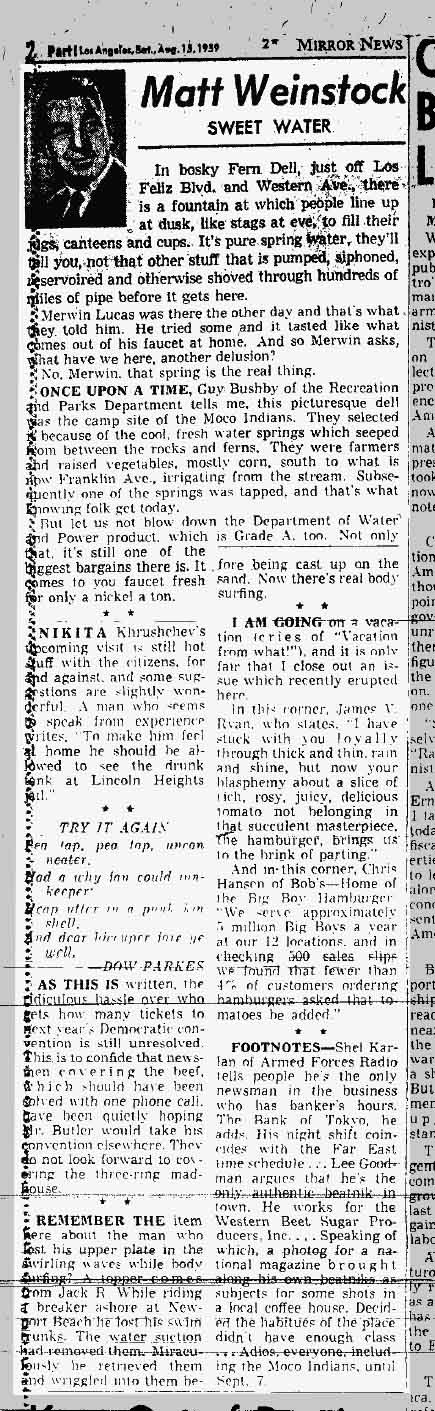
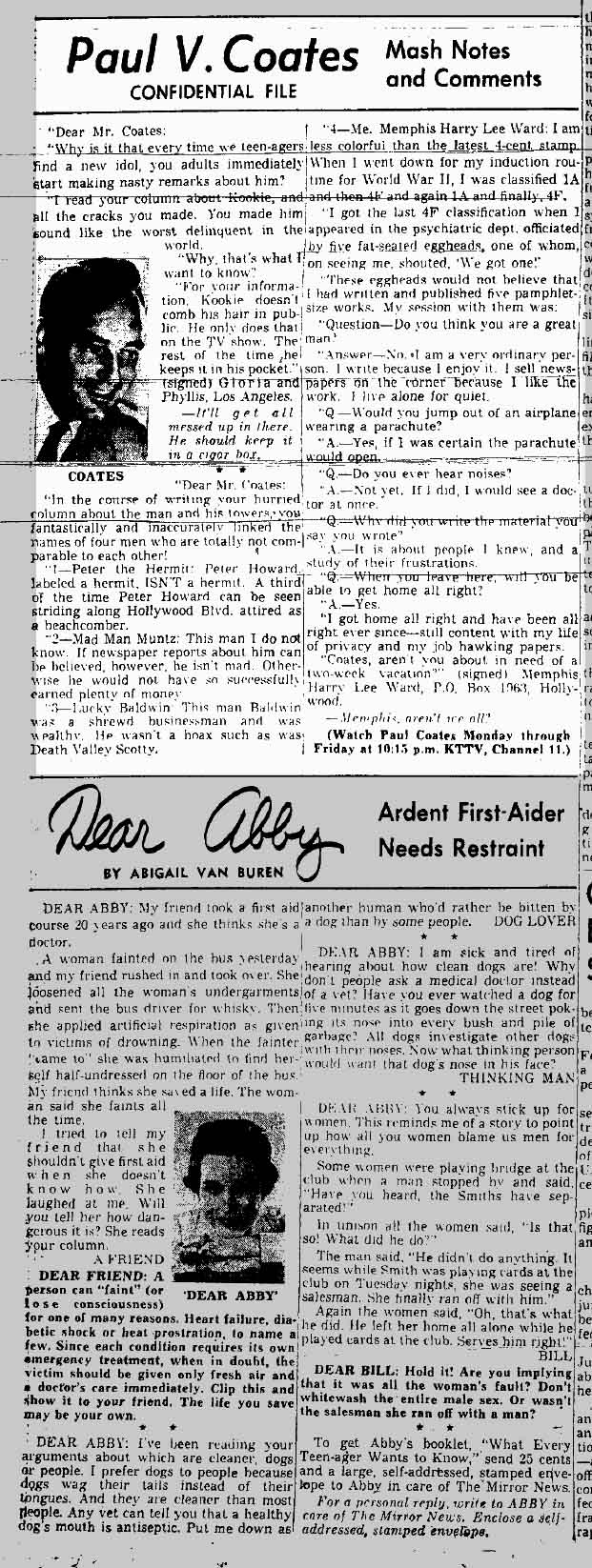
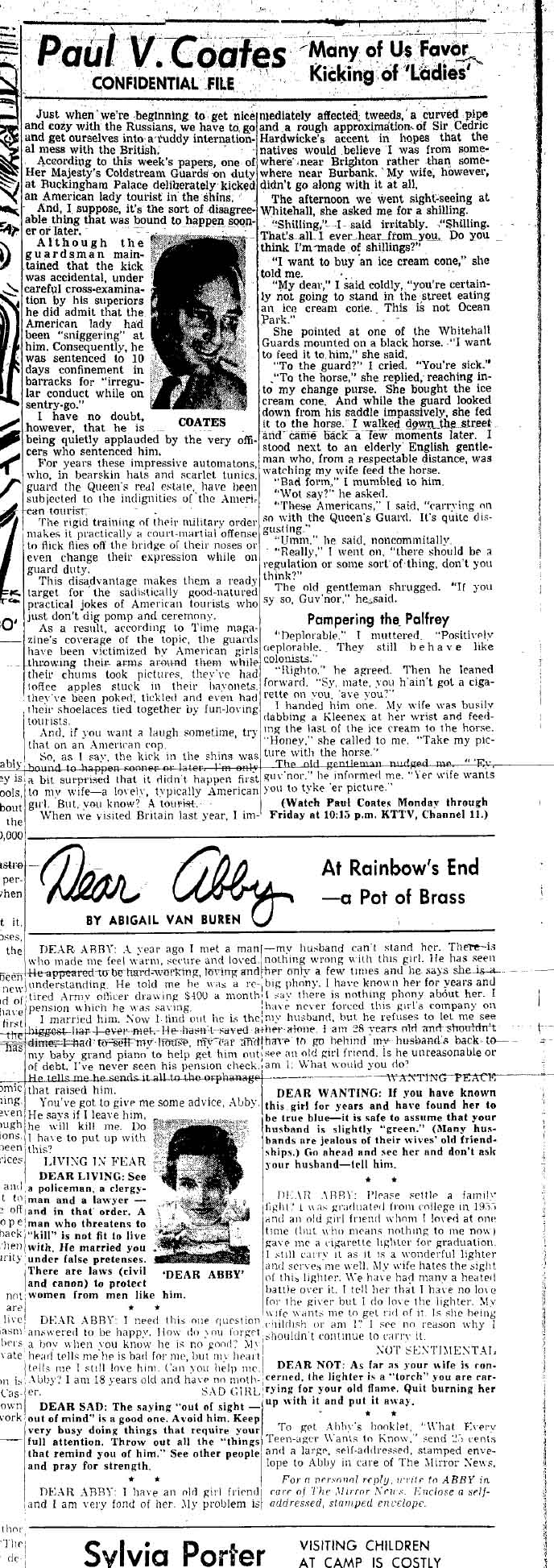
Mother Looking for Runaway Boy, 11

July 20, 1899, Missing Boy  

July 20, 1899: A mother is trying to find her 11-year-old son, who ran away from the orphans' home five days ago. He was wearing blue overalls, a blue shirt, straw hat and was barefoot.

Posted in Adoptions | 1 Comment

Man Says He’s Jack the Ripper!

July 20, 1889, Ripper


July 20, 1889: A man confesses to being Jack the Ripper — no wait, he's only a drunken lunatic.

Posted in @news, Homicide | Comments Off on Man Says He’s Jack the Ripper!

Found on EBay — Hotel Green

Hotel Green, EBay

A postcard of Pasadena's Hotel Green has been listed on EBay. Notice that it shows the archway over Raymond Avenue. Bidding starts at $1.99.
Posted in Architecture, art and artists | Comments Off on Found on EBay — Hotel Green

Frank McCourt, 1930 – 2009

MEMOIR

The Life Force Triumphs


ANGELA'S ASHES: A Memoir. By Frank McCourt (Scribner: $23, 364 pp.)

September 29, 1996

Book Review

By Mary Morrissey, Mary Morrissy is the author of "A Lazy Eye" and "Mother of Pearl." She reviews fiction for the Irish Times

The
Irish American view of the home country–especially among emigrants of
Frank McCourt's generation–can often be irritatingly sentimental
(usually induced retrospectively) or ingratiatingly stage-Oirishy. No
fear of that in "Angela's Ashes"–here is a memoir of blood, snot and
tears. In the opening paragraphs, a bemused McCourt ruminates on how he
managed to come through his early years: "Worse than the ordinary
miserable childhood is the miserable Irish childhood, and worse yet is
the miserable Irish Catholic childhood."

The reader shudders.
Are we in for a parochial, church-bashing memoir full of that
particularly Irish brand of aggrandizing self-pity? (McCourt has
described the book as "an epic of woe.") No again. By the end of this
tender, harrowing and bleakly funny volume, the reader, too, is left
marveling at how McCourt survived.

Born in New York to Irish
emigrant parents, McCourt, aged 4, returns to Limerick with his three
brothers to settle in his mother's native city. It is the 1930s and the
family is destitute, driven home by the Depression and the death of an
idolized infant daughter. McCourt's father, Malachy–"shiftless,
loquacious, alcoholic"–cannot hold a job for longer than it takes him
to down the first pay packet in a pub.

He is also from the north
of Ireland, perhaps his biggest crime in the narrow, bigoted world of
then-President Eamon de Valera's Free State. While "Dev" was busily
penning his constitution and conjuring up an image of his fledgling
state where "comely maidens" would dance at the crossroads, Malachy
McCourt was being refused work in Limerick because of his accent.

The
McCourts are reduced to a Dickensian round of "relief"–charity from
the St. Vincent de Paul society, public assistance from the state,
handouts from the priest, medicine from the public dispensary. The
family lives in abject poverty in Limerick's notorious slums, sharing
the same flea-ridden bed, a bucket with the communal sip of a whole
street standing by their front door, damp seeping through the walls.
Often hungry, always cold, the children are sent out scavenging for
fuel and scraps. McCourt's baby brother dies of pneumonia; a twin
follows six months later.

The author's mother, the Angela of the
book's title, succumbs to a low-lying grief from which she never really
recovers. McCourt describes her as pious and defeated, but this reader
found her proud, fickle, feisty and fragile by turns and blessed (or
perhaps cursed) with a tender but absurd optimism, epitomized by the
flapper dress she keeps in a trunk in case one day she might be asked
out dancing.

It is she who bears the brunt of the cycle of
anticipation and disappointment that an alcoholic imposes on those he
loves. Malachy gets a job; Angela makes feverish plans to pay off their
debts, to buy the children shoes; the boys nourish their imaginations
on the food they will have–ham, eggs, fish and chips. A doomed kind of
hope sustains them and then their father comes home drunk and penniless
and the round of begging starts all over again.

Feckless though
McCourt's father is, he is never demonized, never reduced to easy
stereotype. Here is a man who genuinely loves his children, who
comforts and cherishes them. He just can't support them. The young
Frank loves, admires and pities his father until Malachy disappears to
England to work in a munitions factory during World War II and simply
drifts out of their lives.

But "Angela's Ashes" is much more
than a personal memoir. It is a pen picture of a lost generation–lost
to early death and emigration. McCourt gives us cultural snapshots of
these embattled, impoverished lives. Here he is describing a school
pal: "Paddy Clohessy has no shoe to his foot, his mother shaves his
head to keep the lice away, his eyes are red, his nose always snotty.
The sores on his kneecaps never heal because he picks at the scabs and
puts them in his mouth. His clothes are rags he has to share with his
six brothers and a sister and when he comes to school with a bloody
nose or a black eye you know he had a fight over the clothes that
morning. He hates school. He's seven going on eight, the biggest and
oldest boy in the class and he can't wait to grow up and join the
English army and go to India where it's nice and warm and he'll live in
a tent with a dark girl with the red dot on her forehead and he'll be
lying there eating figs, that's what they eat in India, figs, and
she'll cook the curry day and night and plonk on a ukulele and when he
has enough money he'll send for the whole family and they'll all live
in the tent especially his poor father who's at home coughing up great
gobs of blood because of the consumption."

Much of McCourt's
memoir is written in this urgent present tense. With it he conveys the
contingency of a child's-eye view and the marvelous literalness of the
very young. Frank confides in the Angel of the Seventh Step, who, his
father has told him, brings new babies to his mother. It is an
illusion, of course, but the ghostly mentor brings comfort. So meager
is the joy in these lives that the reader cheers when McCourt as a
13-year-old engages in a bleak but defiant act of masturbation on a
hilltop. It seems like a triumphant life-giving yes to the possibility
of happiness.

But if there is not much joy, there is plenty of
humor. McCourt captures the rhythms of speech and the dark,
self-deprecating wit of the Irish to perfection. He writes as if he is
speaking; it is no surprise to learn that he has been a raconteur all
his life.

But what is most remarkable is that he has managed to
reenter his boyhood self so completely, while maintaining a quiet,
sardonic, authorial distance from his early life, which gives "Angela's
Ashes" its rigor and power. Whatever scars McCourt bears from his
childhood, they are not exorcised here. Only someone who has
successfully battled with his demons could have crafted such a
compelling work of art out of his own pain.


::

Excerpts From the 17th Annual Los Angeles Times Book Prize Winners

April 20, 1997

By
FRANK McCOURT, Frank McCourt is the winner of this year's Pulitzer
Prize for biography. He was for many years a writing teacher at
Stuyvesant High School. He lives in New York City

My father
and mother should have stayed in New York where they met and married
and where I was born. Instead, they returned to Ireland when I was
four, my brother, Malachy, three, the twins, Oliver and Eugene, barely
one, and my sister, Margaret, dead and gone.

When I look back on
my childhood I wondered how I survived at all. It was, of course, a
miserable childhood: the happy childhood is hardly worth your while.
Worse than the ordinary miserable childhood is the miserable Irish
childhood, and worse yet is the miserable Irish Catholic childhood.

::

Smoldering 'Ashes'

*
Frank McCourt's Bestselling Memoir About His Painful and Impoverished
Childhood in Ireland Has Ignited an Emotional Debate in His Hometown of
Limerick

September 11, 1998

By AMBROSE CLANCY, SPECIAL TO THE TIMES

LIMERICK
— On a quiet Sunday afternoon at W.J. South's pub–all mahogany,
frosted glass, marble and mirrors–an old fellow at the bar was
contentedly sinking a pint of Guinness when a photographer's flash
whitened the room.

"I don't like my picture taken," the man
snapped, glaring. Assured that he hadn't been included in the shot, he
turned away, still angry.

Asked his name, he said "Martin, and
that's all I'm givin'. The worst thing to happen to Limerick was that
book. And the next worse was the likes of you fellas. This isn't a pub
anymore, it's a bloody disco. Try and drink a pint in peace and here's
another Yank or Englishman or God-knows-who after your opinion. Opinion
about a book!"

"That book" being "Angela's Ashes," a
coming-of-age memoir by Frank McCourt set amid the horrific poverty of
Limerick in the 1930s and '40s. It is one of the publishing phenomena
of the century. Winner of the Pulitzer Prize, it has been on the
hard-cover bestseller lists for nearly two years. Sales are so strong
there is still no American paperback edition. The numbers of copies
sold worldwide, in English and in translation, are "like the national
debt: I can't begin to understand it," McCourt said recently from his
home in Manhattan.

A film version, produced by Scott Rudin and
David Brown and directed by Alan Parker, will include Emily Watson and
Robert Carlyle, star of the "The Full Monty," as McCourt's parents.

"The whole thing," the author said with comic gravity, "has gotten out of hand entirely."

*

Beyond
the numbers of editions and copies sold, there is another sure sign of
McCourt's success: the appearance of searbhas, the Irish word for
begrudgery.

"A defining national trait," McCourt said. "They
should put the word on the Irish flag. Oh, the snipers are out in
Limerick, you can be sure of that."

South's pub features
prominently in the book as the neighborhood "local," the place where
the family's meager finances go, mostly for drink for McCourt's
ne'er-do-well father. The current owner of South's, David Hickey, says
there have been many visitors lately, from the world over. Proudly, he
shows a picture of a Chinese journalist who dropped in a month ago.

The
people of Limerick, Hickey continues, have three opinions of the
memoir: "Pro, anti and against the whole debate itself. Deep down, I
feel, it's a true book, or 75% to 80% true, and that's a good
percentage for memory. The anti crowd says it never happened, the
poverty that McCourt describes. Or they say he never should have
written about his family that way, you know, his mother being sort of a
prostitute. That did not go down well.

"The pro people say it's
a great book, and something that should be said. There were poor people
everywhere in Ireland in those days. Everywhere. Don't I remember it,"
says the 60-something-year-old. "The women in the old shawls and ragged
clothes. Toilets in the yards, the smell, Jesus. And cold. And hunger."

And
are the people against the book motivated by searbhas? "Some, I
suppose." Hickey reflects. "But some who went through those times have
a sense of shame about it. Limerick people take everything so
personally, you know."

*

Thin-skin isn't all that the
people in this city of 150,000 are accused of. Many Irish look at
Limerick as forbidding, insular, clannish, hopelessly provincial. It
was a grim British Army garrison town for more than two centuries;
unlike other Irish cities of its size, it was without a university
until 25 years ago. If young people wanted higher education, they had
to leave. Meanwhile, culture was defined exclusively by the Church.

"Angela's
Ashes" seems to some people just one more black mark against their
city, a reaction that hasn't been confined to barroom arguments. Last
year, after the University of Limerick awarded McCourt an honorary
doctor of letters, comments by phone and letter began to flood in,
including anonymous threats.

"The response was overwhelmingly
favorable," recalls Colin Townsend, dean of Humanities. "But then there
were some saying McCourt had fouled his own nest, that sort of thing.
We even got a letter from a convent of nuns in Florida, letting us know
what a scurrilous book it was and that giving the author a degree was
absolutely disgraceful."

Were the threats taken seriously?

"Enough to get in touch with the police," Townsend replies. "At every event there was security. But it all went smoothly."

*

These
days, with its world-class university, and benefiting from Ireland's
powerhouse economy, Limerick in many ways has been reborn. The filthy,
crowded "lanes" where the McCourts lived are long gone, having been
replaced with new housing or gentrified into pleasant rows of brick
houses and flower boxes. The poor don't live there anymore.

Indeed,
there is a social safety net now, and life for the poor has been eased
somewhat since McCourt's boyhood days. But poverty still exists: The
poor are still ghettoized, and it is still a struggle to escape. In
what ironically are called "estates" such as Southill and Weston on the
edges of the city–bleak, graffiti-scarred neighborhoods that are
drug-plagued and violent–the dole still passes from one generation to
the next like patrimony. And now there are the added scourges of
addiction and crime.

In Weston–where the graffiti is about
soccer ("Leeds United"), nationalist politics ("Brits Out") and rock
'n' roll ("Metal Rules")–Josephine O'Reilly, 68, invites a visitor
into her immaculate home to talk about "that book."

She grew up in the lanes before moving to Weston in the early '50s.

"It
was nice then," she says in a clear, musical voice. "We had some
beautiful neighbors." Seated at a table in her small, tidy garden, she
waves a hand in the direction of the street, shaking her head. "But now
these drug people. It's very frightening. I had a car, but it was
burned out, right outside there. If they can't steal it, they burn it.
If they can't have it, you can't have it."

Still, O'Reilly–who "knew the McCourts, I lived on Windmill Lane with them"–was horrified by "Angela's Ashes."

"The
way he wrote about Angela, his own mother! I think it's a pity. She was
a very good woman. I can't see her doing anything bad. And Pa Keating
taking a child into a pub, young Frank for a pint, it was a crime to do
that sort of thing. I don't believe it a'tall."

She speaks of Malachy McCourt, Frank's brother and author of his own bestselling memoir, "A Monk Swimming."

"He
was on the radio here in Limerick, a call-in show, Malachy was. I
phoned in and said, 'Your brother has wronged your aunt, Aggie
Keating.' Malachy said she'd once hit him in the head with a bottle. I
said, 'Well, I'm sure you deserved it."'

When Josephine was 9
years old, her mother died at age 36, leaving a husband and five
children. The family lived in one room "and a very small room at that.
Right after my mother died, my grandmother stood me on a stool and
taught me to wash on an old washboard. At 9 years old I had work."
Asked if her reaction to the book might have anything to do with
memories of her own hard times, she answers indirectly:

"I can't
really be bitter or cross. He's telling the truth in a lot of ways. But
why write a book about Limerick showing it in that light?"

*

The
call-in radio show of which Josephine spoke is "Limerick 95," a
late-night program hosted five nights a week by Gerry Hannan, easily
the most dedicated and vocal critic in town of Frank McCourt's memoir.

Hannan
is the author of "Ashes," a self-published book ("I paid for the entire
excursion myself") dedicated to "all the people who grew up on the
lanes of Limerick and were perfectly happy during their childhood."

Hannan
was born in 1959, well after the lanes were gone; nevertheless, he
claims on the book cover that these are "real memoirs." The 383 pages,
he says proudly, took him "only six weeks to write." Some say it shows.
But sales have been brisk in Limerick–nearly 8,000 copies and climbing.

"I
have no ax to grind with Frank McCourt," Hannan says. "And I don't
begrudge him the success he's had with his book. But I genuinely feel
he was unfair to his contemporaries. I wrote my book to defend the
people of the city I love."

At midnight on a Monday, from his
studio on the third floor of a downtown building, Hannan broadcasts yet
another program on "the controversy." Caller Jim, who describes himself
as "a country man down to the ground," says he has not read the book
but heard it is "indecent." Terence, "67 today, and lived every day of
my life in Limerick," says that McCourt "hasn't a bloody clue. He makes
Limerick sound like a third-world country, for the love of God." Hannan
asks Terence if he had a happy childhood.

"Happy? If you wanted
some help from the church, from the St. Vincent de Paul Society, they'd
come, wouldn't they, to your place and say, 'You're not poor. Sell that
chair. Sell that table.' "

Hannan moves quickly to a new caller.

::


The Outsider

* Peter Collier and Warren Hinckle on Frank McCourt's American Story

* 'Tis A Memoir by Frank McCourt; Scribner: 368 pp., $26

September 19, 1999

Book Review

By
PETER COLLIER, Peter Collier is the author, with David Horowitz, of
"The Roosevelts: An American Saga." He is writing a memoir about
growing up in the San Fernando Valley in the '50s

"Angela's
Ashes" ends with 19-year-old Frank McCourt, born in the United States
but raised in Ireland, coming back to his future on a ship from Cork.
As he stands on the deck looking at the lights of America twinkling in
the darkness, the ship's wireless officer comes up to him and says,
"Isn't this a great country altogether?" And McCourt concludes that
wondrous book with a chapter containing one word: " 'Tis."

Like
a literary trick out of James Joyce, the end was a beginning in
disguise. In " 'Tis," that one-word chapter becomes a book about what
happens to McCourt in that great country he sees shimmering like a
mirage in the distance. But while "Angela's Ashes" is a book in which
things fall apart, a child's eye view of the social boneyard of
Limerick and of a fractured family's struggle for survival, it is told
with grim comic brio that makes it paradoxically uplifting. The story
in " 'Tis," though not so dark, is also not so grand. If its
predecessor was a song of innocence, this book–in some ways more an
extended epilogue than a sequel–is a song of experience, a story
filled with the compromise and puzzlement of adulthood made all the
more ambiguous because it takes place in what always remains for
McCourt a foreign land.

He arrives in New York in 1949 as a
virtual immigrant but without the immigrant's clarity about the task at
hand because he seems to have a claim from being born here before his
parents uprooted him at the age of 4 to return the family to the Old
Country. He feels like an alien, impeded in his clumsy pursuit of the
American Dream by infected eyes, rotten teeth, scant formal education.
Can he make his way and his mark? Will these Protestant straight-ahead
citizens allow him to succeed without renouncing the dual citizenship
that is his glory and his tragic predicament? Will the price of
admission in America be the renunciation of all that Irish doom and
laughter, the genius for friendship and the skylarking conversation?
These are the issues in " 'Tis." As McCourt says at one point in the
narrative, "I'd like to be Irish American or American Irish though I
know I can't be two things at once. . . ."

Thanks to a drunken
priest and a boss in the local Democratic Party (the Irish American
employment agency in New York), he gets a job, soon after debarking, at
the Biltmore, cleaning ashtrays and mopping floors and enviously
watching the young Americans his age with their fresh good looks,
arcane flirtation rituals, white teeth and college textbooks. He rents
a room and subsists on bananas, the cheapest food he can find. The
disillusion that sets in at the very onset of his new life will give
way to wry knowledge but never really leave him: "New York was the city
of my dreams but now I'm here the dreams are gone and it's not what I
expected at all." He wants it all, this prodigal life he sees all
around him, but from the beginning he so devalues it by his mordant and
cutting irony that when it finally comes to him, its worth has been
depleted.

After being drafted, he is stationed in Germany, still
digging out of the rubble, where his experiences combine "Sgt. Bilko"
and "Catch-22." He is trained to handle a truculent German shepherd in
the K-9 corps but then is made company clerk. Like other GIs, he trades
coffee and cigarettes for sex in squalid encampments of refugees, but
unlike the rest of them he is a despairing observer during his own
copulation. At one point, he is sent with others on an errand to
Dachau, and in the cognitive dissonance he accepts and finds himself
saying an Our Father at the door of an oven, knowing that his tenuous
Christianity was implicated in the horror.

Back in New York
after his discharge, McCourt still continues his picaresque life. He
feels fortunate to find a job unloading trucks for $75 a week. Yet he
has trouble with women and can't bring his future into view. He becomes
a sleepwalker in the city, with the rich life around him exceeding his
grasp in a way that causes him to wonder, "What am I doing in the world
at all?" This question haunts " 'Tis." It is never really answered,
only tabled.

He wangles his way into NYU's education school
despite his lack of a high school diploma. He strives upwardly there
but as always is undone by his Irishness, which ineradicably asserts
itself in his brogue and in his face, which he feels looks like a map
of the old country. He is ever the naif, always being slapped down by a
world more sophisticated than he. In an English class, for instance, he
timorously speaks up when the professor refers to Jonathan Swift as a
great English satirist, pointing out that Swift was actually Irish.

"Does
that mean," the professor replies in one of those put-downs that
continues to echo through a life, "that if I'm from the Virgin Islands
I'm a virgin?"

McCourt goes on to a teaching career, eventually
rising from a zoo-like vocational school on Staten Island, where he is
initially warehoused because of his Barry Fitzgerald voice, to
celebrated Stuyvesant High. By all outward measure, his life is a
success, but it doesn't feel that way. McCourt remains stuck in the
in-betweenness that is his birthright, unable to claim and occupy a
piece of ground of his own and victimized by obscure wants he cannot
satisfy. When he is poor, he wants to be comfortable. When he is
comfortable, he wants to be footloose like his bohemian brother
Malachy, a singer and wit about town. When he's doing manual labor, he
wants to teach. When he's teaching, he wants to write books. When he's
single, he wants to be married. When he finally marries a blond goddess
who represents all the illusory Protestant promise of America, he stays
out late at bars until he loses her. For McCourt, as for Oscar Wilde,
there are two types of tragedy–not getting what you want and getting
it.

McCourt seems less in control in this book and at times is
powerless to keep himself from becoming the stage Irishman, crying in
his beer, milking sentiment until it becomes false, mistaking talk for
thought. He uses his outsider's status to make some palpable hits on
aspects of American social life, particularly the class distinctions
that divide people in and out of the workplace. But at times his sharp
observations stumble into banality: "No one dies in America, they pass
away or they're deceased and when they die the body, which is called
the remains, is taken to a funeral home where people just stand around
and look at it and no one sings or tells a story or takes a drink and
then it's taken away in a casket to be interred. They don't like saying
coffin and they don't like saying buried. They never say graveyard."

If
" 'Tis" sometimes becomes tedious when telling how McCourt became a
stranger in a strange land, it is profound when dealing with his
unappeasable past. The authors of that past, his father and mother,
play a role in this book. But they are no longer those larger-than-life
figures from "Angela's Ashes"–the one shaping his sons' imaginations
with stories of Ireland's greatness and its foul betrayal, the other a
pillar of long-suffering love, endurance and survival. Here they are
diminished, cut down by life, condemned to live out the aftermath of
their primal drama.

McCourt's mother arrives for a visit in
America and stays, becoming more isolated and dispossessed although she
is in the midst of her reunited children. The father arrives for a
visit from Northern Ireland, still spreading moral chaos and deceit
among his children. Claiming to have succeeded at Alcoholics Anonymous,
he euchres Frank into a drunken spree that reopens old family wounds
and then leaves on the next boat home.

There is no resolution
for the McCourts, but there is at least a truce with life. When their
mother finally dies, he and his brothers have her cremated and wait for
a time to repatriate her in accordance with her final wishes. Not long
afterward, word comes that their father has died. Frank alone of all
the children travels to war-torn Belfast for the last rites. On the day
of the funeral, three IRA gunmen are killed running a British
barricade, and McCourt imagines them as providing his father the
"escort of his dreams . . . and he'd envy them their manner of going."

In
1985, three and a half decades after his arrival in America, Frank
joins with his brothers, Malachy, Michael and Alphie to take their
mother home to Limerick. They stand in the graveyard there, dip their
fingers in the urn brought from the New Jersey crematorium and scatter
what is left of her to the wind. Thus " 'Tis" ends where this unique
memoir first began–with Angela's ashes. And Frank McCourt completes
the book he lived all those years and only just recently got around to
writing.

" 'Tis" has those elements that made "Angela's Ashes"
such a success–the narrative brio, the fierce sympathy for human tic
and torment, the intuitive feel for character and above all the love of
language and that very Irish understanding that words are our only
weapon in our long quarrel with God.

::

COVER REVIEW

Homeward Bound

* IRISH ON THE INSIDE: In Search of the Soul of Irish America, By Tom Hayden, Verso: 312 pp., $25

January 06, 2002

By FRANK McCOURT

Toward
the end of his latest book, "Irish on the Inside," Tom Hayden throws
down the gauntlet: history or amnesia. Take your choice. It reminded me
of a moment when I was teaching high school English. (No, don't go
away. This won't be a "personal" review.) We were discussing the
hyphenated American, so reviled by Woodrow Wilson.

Except for
one, my students were happy with their hyphens. I asked that one:
"Joey, if I were to wake you in the middle of the night and ask you
what you are, what would you say?"

His reply was, "Tired."

If
Joey were to respond to the Hayden challenge, he might choose amnesia,
but if Hayden were his teacher, he wouldn't let him get away with it,
not in this book. Hayden would urge on Joey the glories of an Italian
heritage just as he dwells on the richness of his own Irish heritage.

And
no, he won't let it go at that. "Irish on the Inside" is an urgent
book, fueled by a great, somber energy. As the title indicates, it's
about Irishness, the search for Irishness, the definition of Irishness,
the achievement of Irishness, the perpetuation of Irishness. It is,
first of all, the story of Hayden, who angrily erases his racial
designation from a census form, "White, non-Hispanic" and pencils in
"Irish, born in the United States, American citizen." (Joey might have
said, "Yo, man, that's too much.") That response to a census form was,
perhaps, the first stroke in Hayden's long swim toward the Shamrock
Shore.

You wonder: "Why bother? Isn't it enough to be American?
Heavens, man, isn't it hard enough being human without taking on the
Celtic burden?" Especially when you're Tom Hayden. Tough, thoughtful,
radical, you've straddled history. You've faced the dogs and cops of
Chicago; you've bothered J. Edgar Hoover and you know what that can
lead to; you've sat (although sitting is not your favorite activity) in
the California Legislature for nearly two decades; you've fought for
migrants and immigrants and for the environment; you've denounced
globalization and assimilation and all things that lead to blandness.

A
little diversion here; comedian Fred Allen once defined the Lace
Curtain Irish, the more well-to-do of the clan, as "people who keep
fruit in the house even when no one is sick." He, of course, was Irish.
(Where else would you find a melancholy so hilarious?)

Allen was
looking at what happens to us when we become respectable, a fate
abhorrent to Hayden, sprung (if that's the word) from the middle class,
Midwest. If Hayden were Garrison Keillor, he'd sweep aside all those
sweet stories about a Scandinavian Lake Wobegon. He'd swarm in there
urging the natives to hold fast to their Norwegian-ness, lest they be
lost in the blandness of a consumer culture.

The United States
is a big country, but not big enough for Hayden. He would have made a
hell of an Irish monk in ancient times, a great missionary. You can see
him setting out for distant shores, bringing light to the barbarians of
Britain and lands beyond. That's what he's trying to do now–and
there's an air of desperation in his life and message. The world
already knows much of that life, which is laid out in Part I of his
book. The titles of certain sections speak for themselves: "What Is an
Irish Soul?" and "The Sixties Made Me Irish."

So far, so good.
Along the way we meet Che Guevara, C. Wright Mills, the Molly Maguires,
the San Patricios. Here, Hayden is filling in his Irish American past.
When he says the '60s made him Irish, he refers mainly to the Kennedys,
particularly Bobby–the more Irish of the two dead Kennedys. He glances
briefly at Bobby's transformation from close aide to Joe McCarthy to
his role as champion of civil liberties. He reflects on the growing
conservatism of Irish Americans, how they rushed to the flag of Ronald
Reagan. Even as he understands, he despairs. He understands that the
late Richard J. Daley, mayor of Chicago and arch tormentor of the
Chicago Seven, carries a "psychic burden" of the Famine generation.

That
is the value of Hayden's book, the search for understanding, and Hayden
expects us to engage in the same quest. A tall order. (Joey would have
been too tired.) New Age philosophy tells us, "Wherever you are, there
you are." Not for Hayden or thousands of Americans who travel the globe
in search of roots or identity or a cure for whatever ails them. There
are Americans and American Irish who write of going back, buying ruined
houses and castles, dealing with the charming eccentricities of the
locals as if County Cork were an Irish Tuscany.

Again, not for
Hayden: When he returns to the Ould Sod, it's not to pub and thatched
cottage. It's directly to the North. Nobody goes to the North; it's not
a tourist destination and you go there only if you're a spy, a
diplomat, a gunrunner, a Sinn Fein sympathizer.

Now why didn't
Hayden go to a nice place like Dublin–or even Limerick? Why the North?
Because "A central theme of this book is that the most independent
Irish consciousness is rooted in the North of Ireland … where the
ancient and enduring conflict between Irish nationalism and British
colonialism is most stark." To find himself, to define his Irishness,
Hayden has to dive right into the conflict. Not for him the ramble
through the groves of Blarney or Killarney. Up the Falls Road he goes,
or Sandy Row. The general reader will wonder, "So?" And this, if you
are a general reader, is where we lose you. Before you can understand
Part II, "Going North," you might want to take courses in Irish
history, economics, the geography of Belfast, the byzantine world of
politics in the North. If the following names mean nothing to you, then
you're wandering in the woods: De Chastelain, "Mo" Mowbray, Trimble,
Hume.

"Irish on the Inside" is not a big book, but it is packed
and demanding. You'll be charmed, perhaps, by Part I but, again
perhaps, puzzled, mystified and at-swim in Part II. Read Part II slowly
and, whether you agree or disagree with Hayden's uncompromising
views–pro-Sinn Fein, anti-colonialist–you'll find it a valuable guide
to the craziness of a troubled area.

When you finish Part II,
put the book down. You'll need rest and reflection before Part III,
"Recovering the Irish Soul." This is a call to action. Get off your
assimilated rump and be Irish. And how can you be Irish? The ways are
beyond counting. Learn the language, the geography, the history, the
songs, the literature. Eschew the "Paddy" stereotype, the St. Patrick's
Day boozing, the rest of that green nonsense. Psychologically and
spiritually you must become an archeologist. You must go digging to
find your roots, yourself.

Hayden is calling for a tremendous
expenditure of intellectual energy, defiant and defining. Tear down the
Lace Curtain, dump the fruit and wake up, Joey. It's time to be
something besides tired. It's history over amnesia.

*

Frank McCourt is the author of "Angela's Ashes" and "'Tis."


 ::

The Oscars: 76th Annual Academy Awards

THE DIRECTOR'S LIFE

Their lives writ large

* The Sheridans summon their immigrant experience and the unruly nature of memory that shaped 'In America.'

 February 29, 2004

By Frank McCourt, Special to The Times

NEW YORK — Yes, I knew him when.

So did hundreds of people — all kinds — in the Hell's Kitchen area of New York City's West Side.

We
knew Jim Sheridan as artistic director of the Irish Arts Center, where
he worked with Nye Heron to present plays traditional and experimental.

I
must have met Jim at some Irish Arts function. There was always
something going on. You could take classes in various aspects of Irish
culture: dancing, tin whistle, acting, history. All this took place in
an old building that had once been condemned but was now leased to Nye
Heron and his group for, I think, a dollar a year.

There was Jim
— fresh from Ireland by way of Toronto. There was his exquisite wife,
Fran, and there were his two daughters, Naomi and Kirsten.

And
here is the story about the whole adventure I like best. When they
drove from Toronto it was in a rented car. They had no use for it in
New York and wondered what to do with it. Dump it? Yeah. That's what
friends suggested.

"No," said Fran. She would not take the easy
way out. She drove the car all the way back to Toronto — 12-hour drive
— and took a cheap flight back.

That's Fran, and you can see
with a woman like that running the family there would be no nonsense.
She insists on that strange thing called honor.

I was sorry she
wasn't there the morning I interviewed Jim, Naomi and Kirsten. I hadn't
seen her in years and, of course, wondered if she'd changed. I
wondered, also, if the daughters had changed. They were little ones the
last time I saw them before they returned to Ireland.

But there
they were in Naomi's hotel room overlooking Central Park, natural,
good-humored, unaffected. I expected at least a little … well, you
know, world weariness.

No, that's not going to happen in the
Sheridan family. No airs here. The sisters sat on the couch while Jim
reclined in a deep armchair reaching, between remarks, for fresh fruit
and a bowl of cereal. His accent is pure Dublin. Pure.

I
reminded him that a long time ago at one of our late-night beer
sessions he talked of making a film about a family coming here from
Canada, a Polish family. Did he want to make it Polish to give himself
distance? Well, maybe, but the more they talked about it the more it
seemed necessary to make it autobiographical. Make it a Polish family
and you have trouble with language, and isn't life hard enough. Jim
created Frankie, a new character based on his brother who died as a
child, but for the rest of it the family story was rich enough.

They
weren't easy days for the Sheridans. They lived in a Hell's Kitchen
apartment, sent the children to school and survived 'til they decided
to return to Ireland.

It's a long way from Hell's Kitchen (now known to the gentry as Clinton Hill) to Dublin to Oscar night.

When
you see "In America," written by Jim, Naomi and Kirsten, you'll know
it's a love letter to New York. Jim and Kirsten still live in Dublin,
but Naomi is here writing and planning various projects. It's
commonplace now to say that Woody Allen is the great lover of New York,
but step right up Sheridans One Two Three.

At the end of the
interview we walked along Central Park South, and I said goodbye to the
Sheridans making their way into the park for a picture session. I
headed west to the streets of their memories, Hell's Kitchen. For
decades this was an Irish neighborhood, where dockers raised their
families, where they built Catholic schools and churches. And bars, of
course. It was a tough neighborhood.

Old timers say it was a great place to raise kids. Neighbors looked out for you.

What we see in "In America" is love.

Frank McCourt: When you were growing up, you were like midwives, weren't you, to a script that was developing?

Naomi Sheridan: I don't think we knew it at the time.

Frank: But you were talking about it, weren't you? About the adventures in New York?

Naomi:
I think as soon as my dad let us. We moved up to Inwood because it was
a better neighborhood and we had a bigger apartment and he was like …

Kirsten Sheridan: "… all the Irish are here."

Naomi: So as soon as we left I think he started talking about it.

Frank: I remember you saying one time you'd make it a Polish family …

Kirsten: Then the American Indian family. Is that when Johnny was a musician?

Jim Sheridan: He was going to do everything. He was a Polish musician then …

Kirsten:
He went through the entire orchestra. Then he was an American Indian.
The kids were half-American Indian, half-Irish and they came from the
West, or from Canada.

Jim: I wrote the first draft about
1990. I was [going to] the Oscars [for "In the Name of the Father"]. I
went to get a tuxedo and I was walking along Santa Monica Boulevard and
the painter who had lived downstairs who was black [but] who didn't die
of AIDS came running our way and said, "Oh, my God, oh, my God. That
house was blessed. You made, and I made it. Joey jumped off the roof
but Laura's an opera singer in Vermont." So everybody [from that
building] is either dead or famous in the end.

Frank: Extremes.

Jim (laughing):
Yeah. He said, "You should write a film about that." So I started to
and it always ended up with this stupid scene about going to the Oscars
and that didn't really work…. Then I asked the girls to write it, and
Naomi put in the voice-over. They wrote two completely independent
scripts, which had nothing to do with me. It was all about going to
school and having to shop at the …

Kirsten: … the Salvation Army. And being [ticked off]. I hated that Salvation Army.

Naomi: All these kind of odd people would lunge out from between the racks.

Kirsten: Mam would get a Hoover for like a dollar. She loved it. She still does.

Frank: When you were writing, did you have any models from any other films?

Kirsten: No, because my dad just wanted a kid's point of view. So it was the easiest job ever in the world. It was like writing a diary.

Naomi: Just stories, memories, that stood out.

Kirsten (laughing): I think [Dad] expected to see a hero emerge out of the mist called Jim.

Frank (laughing): You took care of that.

Kirsten: We did. My hero was called Kirsten.

Naomi:
I think it's weird like that everybody remembers something different or
remembers the same scene differently. Kirsten wrote stuff that I was
like, "When did that happen?" and vice versa. You wonder why you
remember a particular thing where somebody else doesn't.

Frank:
Do you think memory is an Irish thing? You know the definition of Irish
Alzheimer's — they forget everything but the grudge. [But] you go to
an Irish party, everybody knows songs going way back to 1798.

Jim: I mean it's, that's the point of "Ulysses," isn't it? I mean remembering everything like the streets in Dublin.

Frank: It's all we had.

Kirsten: The nostalgia.

Frank:
Compare Italian Catholicism, Irish Catholicism…. You go to Italy,
they have monuments, buildings, they have art, they have the materials
for art, paintings, sculpture, music, symphony orchestra. We didn't
have anything but the tin whistle and the fiddle.

Naomi: And it rained all the time, so we were always indoors.

Frank:
When you have nothing, you remember everything. The tin whistle, the
fiddle and the mouth. These are the symphonic instruments of the
Irish…. And now with this new medium in America. People like the
Sheridans came, Neil Jordan. Who was there before them? There's "The
Quiet Man" — green fields, Maureen O'Hara and "Here's a stick to bait
the lovely lady." That was Ireland. And now you have a few months ago
"Veronica Guerin" came along. People were horrified. The Irish tourism
bureau was horrified. "This is not Ireland."

Naomi: I
think Americans like to kind of hang on to these images. And the Irish
here. They want somewhere they can go back to where things are green …

Frank: Yes, the green …

Jim:
Blacks from the South, Irish from the west of Ireland, Italians from
below Naples, Poles and Jews — that's basically the population of
American cities. In the Irish case, they were people who lost their
language and their identity in the first generation. So there's an
anger here. When I go around, everybody is saying, "When are you going
to do something about the famine?"

Kirsten: For us,
Ireland was this idyllic place that didn't have any conflict. It had so
much conflict in reality, but for us it didn't have any conflict. Then
coming over here, I suddenly became completely aware of money, and I
was 5. It was a total double-edged sword because on the one hand, it
was very exciting and you're in this Spanish neighborhood and it's mad
and there's junkies and transvestites. On the flip side of it, it's
unsafe and vulnerable and shaky. So you kind of grow up quickly.

Naomi:
As hard as it was, [Mother] still loved it and she said she used to get
a lump in her throat when she was coming back from Ireland. You can get
to the point where the city drives you mad and then as soon as you
leave, you're like, "Oh, I miss New York."

Jim: When I
first went back [to Ireland] I noticed that the guys at the pub were
saying, "What do you want to drink? Get this bastard a drink here." I
said, "Why are you calling me names?" And he said, "You were in America
too long." [His daughters laugh.] The toxic nature of the language in
Dublin is about the political realities — look, I'm buying this guy a
drink, but he's not necessarily on my side. [Frank laughs.]

Frank:
When I first came here, I couldn't understand the directness. The Irish
are like the blacks off the plantation, they use what you call
circumlocution. You had to talk in a roundabout way, you had to pluck
the forelock, tweak your cap and so on. You had a way of dealing with
the language which was roundabout and the outsiders would call it
lyrical and poetic. But it had its practical use.

Jim: I
even think it's lying. I try to figure a little thing where the
landlord came to the farm and the guy says, "You know, you're only
allowed five pigs," and he'd pick up a pig and say, "This is a sheep,
sir." And the landlord would laugh, but they'd let the guy way with a
lie, with the means of control.

Kirsten: When I came over
here I had a huge mistrust of language. A huge mistrust. I don't
believe it for a second, and I've been much more visual person.

Frank: But you have to use it anyway. That's your living.

Kirsten:
Yeah, but dialogue wouldn't be my strong point. I just don't believe
it…. [In life,] the plot points are tiny. They're like a whisper.

Jim:
But drama has a structural organization that's very limited, and real
life has one that's unlimited. So when we did the film and we were
trying to put into a box the experience, we didn't have any plot
points, so we had to go back and invent a voice-over, which we took
from Naomi's script.

Kirsten: When Dad started writing
about Frankie, I wondered how did I not see this all along? It's like
just when you feel things are perfectly focused.

Frank: Did you think it was too weak without Frankie?

Kirsten:
Yeah. Too episodic. My dad kept going, "We should do the story, we
should do our story, we should do our story," and we'd write it and
people would laugh, but it never came together.

Jim: It must be something in the Irish, where a child dying is as worse as you can get.

Frank:
It wasn't until after [my mother] died that I began to think about what
she'd gone through having six children in 5 1/2 years and then three of
them dying within a year and a half. When I became a father, if I heard
[my daughter] sniffling in the middle of the night, I was rushing to
the crib. And then I began to realize what she'd gone through. It's
unbearable.

Jim: Think of it on a national level then.
When the famine happened, that happened on a psychic level for the
whole race. And that's the foundation stone.

Frank: That
hasn't been dealt with in Irish literature…. The pain is there and
now there are historians, what they call revisionist, who say, ah well,
you're paying too much attention to the famine. You can't pay too much
attention to the famine. I met Iman and she's Somalian. She says when
she gets off the plane in Somalia, the first people she meets are Irish
aid workers and what is it about the Irish that makes them flock to
wherever there's hunger. Even though a lot of them are young and they
don't understand, they do it anyway. The pain is still there.

Kirsten: It seems only when you leave Ireland that you can express it. I don't know of anyone in Ireland who articulates it.

Jim:
I'm thinking about what you said about language, Frank. If you go back
in history, there was a tax on windows and a tax on chimneys. So the
Irish used to put the slate on the chimney, board the windows, and sit
with the door open in the hovel looking out. And that's Irish vision.
Smoke-filled interior, nothing outside except white light…. Any means
of expression is like defusing a bomb. Because when you can express it
verbally it means you're not illiterate and mute and a rage-aholic. The
rage comes from not being able to express yourself.

McCourt:
When I came here, I didn't know you could think for yourself. It took
me a long, long time to get over the catechism and the ritual, which is
gorgeous and powerful. [But] you're dealing with a new Ireland where
the young are thinking for themselves, they can travel.

Naomi:
When I was growing up it was kind of like the end of the church's power
anyway. When we were there when I was a kid it was still very
prevalent. But by the time I'd gone back after having been in America,
you could feel it starting to lose its power.

Frank: From what you know from the young Irish filmmakers, what are the subjects?

Naomi: Maybe they're concentrating more on relationships than on Ireland as a theme — about relationships within their lives there.

Frank: When you were making [the film], were there moments when you felt you were being edited out?

Naomi:
I wrote about us all going to Central Park and we got into one of those
boats and we went out on the lake. It was so ridiculous. Everyone else
is floating by in these boat rides, and we were going around in
circles. And me dad was screaming, "You take oar and go the opposite
way." And Kirsten was standing up and me mom was going, "Jesus, sit
down!" We ended up like that, turning around and around and everybody
else just drifting passed us …

Frank: You couldn't do anything simple in a relaxed way.

Kirsten: No.

Frank: You had to be dramatic.

Kirsten: Yeah.

Frank
McCourt wrote "Angela's Ashes," which received a Pulitzer, and " 'Tis."
He is working on a book about his years as a teacher.

::


BOOK REVIEW

Many lessons to teach, more to learn

* Teacher Man, A Memoir; Frank McCourt; Scribner: 258 pp., $26

November 11, 2005

By Phillip Lopate, Special to The Times

*

FRANK
McCOURT'S first book, "Angela's Ashes," won the Pulitzer Prize and the
National Book Critics Circle Award and sold millions of copies. "
'Tis," its thin, disappointing sequel, managed to sell millions more.
Now comes "Teacher Man," the third of McCourt's memoirs. One might be
forgiven for wondering if this very winning Irish American author's
recollecting act is getting a bit old, his blarney running stale. Yet
"Teacher Man" is, in fact, the best book in the trilogy, an enthralling
work of autobiographical storytelling.

Perhaps this enthusiasm
will make better sense if I confess that I was in the tiny minority who
thought "Angela's Ashes" overrated. Yes, young McCourt's childhood
travails in Limerick, Ireland, were engaging, but they had the
over-rehearsed quality of anecdotes too often told. What's more, their
author had taken such pains to re-create the myopia of youthful
confusion that the book read more like fiction than autobiography; I
missed the double perspective of reflection on prior experience that
classic memoirs supply. There was one final problem: Because children
are presumed innocent, the boy protagonist of "Angela's Ashes" tended
to be bathed in a victimized, self-approving aura.

These defects
have been corrected in "Teacher Man," which shows the adult McCourt
committing follies aplenty and describing them with wry retrospective
insight. He is more than willing to look back on his own embarrassing
past and portray himself in comic terms as an insecure Irish schlemiel.
McCourt is not only self-deprecating, but he's also savvy about it: "If
self-denigration is the race," he writes, "I am the winner, even before
the starting gun."

As the book begins, McCourt is 27 and about
to embark on a career as a New York City high school teacher. His
education courses have ill-prepared him for the realities of the
classroom. Worried that he is rising above his station, he soon
discovers the low esteem in which secondary school teachers are held in
this society and tries to advance himself by getting a doctorate (never
managing to write his dissertation ) and teaching in community
colleges. Yet he always returns to the high school classroom, partly
because he is a screw-up and partly because he has a genuine gift for
working with adolescents.

What he discovers, at first haltingly
and then with confidence, is the age-old secret of how to teach: "You
have to develop your own style, your own techniques. You have to tell
the truth or you'll be found out." Most important, "Find out what you
love and do it." As an example, he allows students to head him off from
a grammar lesson by asking about his childhood, encouraging them to
think of him as a human being. He teaches the art of the excuse note,
drawing from his students' samples: "Here was American high school
writing at its best — raw, real, urgent, lucid, brief, lying."
Deciding that what really matters to teenagers is sex and food, he
focuses on food, getting his class to read favorite family recipes
aloud to musical accompaniment, holding gourmet picnics in the park and
comparing restaurant critics' prose. These assignments might fall flat
if copied by another teacher; the point is for each teacher to work
with his or her enthusiasms and translate them into educational
practice.

Anyone who has ever faced a classroom of yawning,
slouching adolescents will recognize the accuracy of McCourt's
descriptions and applaud his honesty. About one teenage boy, he writes,
"I look back at his cold stare and wonder if I should try to win him
over or destroy him completely." At another point, he confesses: "My
head feels hot and I want to shout, Why are you so damn stupid? … Why
can't you just look at this sentence and, for once in your miserable
teenage existence, make an attempt to learn." Out of frustration, he
submits to dubious impulses; he slaps a rude kid with a magazine and
asks students to write 150-word suicide notes. But always, he
sympathizes with the kids as individuals embedded in difficult,
complicated lives. And always, he bonds with them against the
higher-ups, the department heads and principals. Having immigrated and
started at the bottom, he is a fellow underdog. "I disliked anyone with
power over me," he explains, "bosses, bishops, college professors, tax
examiners, foremen in general."

After decades of subverting the
rigid curriculum with personal inventions that often land him in
trouble, McCourt finally gets a job at the elite Stuyvesant High
School, where a benign department chair tells him: "Teach whatever you
like." He is in heaven, or should be, but he continues to be ingenious,
as he puts it, at making himself miserable. Even when his creative
writing classes become wildly popular, he has "the nagging doubt I was
teaching under false pretenses." Maybe the students are there because
he's an easy mark?

What gives "Teacher Man" its spine is the
tight focus on day-to-day teaching. For an activity that consumes so
much labor and funding, education is consistently under-reported. To
publishers, its glamour is nil, unless it can be used to reflect a
topical crisis. Here, McCourt mocks his lover June's ambition to work
for a year in the schools and write a scathing indictment that will
become a bestseller. He stays in the trenches for more than three
decades, teaching, by his count, 33,000 classes; when he details the
day-to-day grind and satisfactions he knows the score. With "Teacher
Man," McCourt deserves to join that small coterie of classic pedagogic
memoirists, including Sylvia Ashton-Warner, John Holt, Herbert Kohl,
James Herndon and Jonathan Kozol.

While aware that students
think that "[b]elow the belly button the teacher is dead," McCourt
knows it takes a whole human being, sensually as well as intellectually
awake, to make a good teacher. Lest one think this book is only about
teaching, he interjects juicy, bittersweet vignettes about his
relations with women, his experiences working on the docks, his divorce
and reentry to bachelorhood, and his misadventures at the fringes of
the New York and Dublin literary scenes, including a priceless portrait
of Edward Dahlberg as a pompous windbag. In the end, McCourt became a
literary lion — just reward for a man who has certainly paid his dues.

One
of the curious dynamics in "Teacher Man" is McCourt's lingering
ambivalence toward self-analysis. Willing to call on his Catholic
school training to confess his sins, he admits, "I had no talent for
introspection." At one point, his first wife, Alberta, insists that he
go into therapy to save their marriage; McCourt gives a hilarious
account of himself as a shy Irishman, desperate to show "how reasonable
and balanced" he is, failing to compete with garrulously neurotic New
York analysands. There is a more self-scrutiny in this book than in
McCourt's previous ones, but his literary technique is still prone to
comic schtick and manic stream-of-consciousness reveries, developing
insights through controlled irony.

"Teacher Man," a slender
book, may strike some readers as more casual, less burnished than
"Angela's Ashes"; that work will doubtless continue to occupy a
respected place in the literature of the memoir. But it seems that
McCourt is still learning on the job, as he did in the classroom, and
his latest effort marks a considerable advance in honesty, complexity
and humanity.

*

Phillip Lopate is the author of "Being With Children" and "Waterfront."


Posted in books, Film, Hollywood | Comments Off on Frank McCourt, 1930 – 2009

Update on ‘Long Sam’

Dorothy Brown, 1957

Since I wrote about Dorothy "Long Sam" Brown in 2007 I have received repeated inquiries about the beautiful young North Carolina woman who became famous in 1957 after being found living in a shack with no running water.

Here's an update from Lake Norman magazine >>>

Posted in broadcasting, Comics, Education, Hollywood, Music, Stage | Comments Off on Update on ‘Long Sam’

A Kinder, Simpler Time Dept: Your Movies

July 19, 1942, Movies

July 19, 1941: Greer Garson and Walter Pidgeon in "Mrs. Miniver."

Posted in Film, Hollywood | Comments Off on A Kinder, Simpler Time Dept: Your Movies

A Brutal Sport Hounded to Extinction

Dec. 12, 1897, Coursing

Coursing as depicted in The Times on Dec. 12, 1897.

"The rabbit dodged this way and that, squatted suddenly to the ground while the hound rushed past. Once, the dog's teeth sank in the hindquarters of the rabbit, jerked the little creature in full flight from the ground. But with a dying spasm, the rabbit freed himself and ran on.

"Again, the hound's teeth snapped and the fur could be seen tearing off in a fluff. With the awful terror and pain tearing at its heart, the rabbit went on. At last, he made the wrong turn and the hound closed in on it with a sickening crunch.

The rabbit was ground to death amid shrieks of agony. These cries of a rabbit sound appallingly like those of a tortured little child."

–The Times, April 24, 1905

Agricultural Park

Los Angeles Times file photo

One of the entrances to Agricultural Park in an undated photo.

"Dog coursing" was a sensationally popular pastime in Los Angeles that flourished in the 1890s despite repeated court rulings of animal cruelty and a personal campaign by the mayor after the police chief failed to close it down. The fight over coursing was so fierce that its supporters nearly derailed the city's annexation of USC and nearby Agricultural Park, where the races were held.
 
A variation of greyhound racing in which dogs chased a live jackrabbit over a fenced field of about 40 acres, coursing was finally stopped through the efforts of the Society for the Prevention of Cruelty to Animals and resulted in the arrest of several promoters, including an unrepentant E.J. "Lucky" Baldwin.

The races, which date to ancient times and were given a set of rules in Elizabethan England, were already underway elsewhere in California before being introduced to Los Angeles in the summer of 1897 by Francis D. Black, the manager of what is now Exposition Park. Coursing caught on quickly, The Times said, adding: "The people take to it with a vim that surpassed their enthusiasm for horse racing."

::

Jan. 1, 1898, Slipper

Jan. 1, 1898, the "slipper."

In a typical coursing match, a rabbit was released into a large open field that was tightly fenced. To give the rabbit what was considered a sporting chance, there was an inner enclosure with 20 to 40 "escapes" in which it could flee to safety from the dogs. At one end of the grounds was a grandstand and many stories noted that the finely dressed women spectators, rather than being reserved and delicate, were far more bloodthirsty than the men.

A man called a "slipper" held two competing greyhounds — sometimes four — on a leash, while the rabbit was given a head start of 60 yards to 80 yards. The dogs were released to chase the rabbit and trailed by a man on horseback who judged the race by assigning points based on when the dogs turned to follow the rabbit, when one dog passed the other and when a dog caught the prey. If the rabbit wasn't dead when the dogs were through, someone killed it by stepping on its skull.

Although The Times eventually opposed the races, the paper endorsed them at first: "Coursing as a sport is almost as old as the sport of falconry and there is no country on the civilized globe where it is not indulged in," it said in 1898.

In explaining the races to a novice audience in 1897, The Times said: "The two species are natural enemies, and, while the dogs kill the rabbits as a general conclusion to a race, there is nothing cruel in the sport. The hares are given 'way the best of the start,' and more than 40 escapes are provided for them into which they can run and find safety.

"As a matter of fact, the hares are jackrabbits, the pest of Southern California. Thousands and tens of thousands of the rabbits are killed every year by farmers, whose orchards and vineyards they are ruining, by driving the rabbits into a pen and beating them to death with clubs. Such work is slaughter, necessary slaughter, it is true, but slaughter none the less. Coursing is not.

"The rabbit is turned loose in the field and the dogs are turned loose after it. If the dogs are swifter than the rabbit, they catch and kill it, just as nature intended they should do, but the rabbit has a chance for its life never given it in a rabbit drive by the farmers club. There is nothing brutal in coursing."

Not only did The Times imply that the races were merely following natural law, a Thanksgiving story from 1897 said — perhaps sarcastically — that the rabbits relished their role.

 "At Agricultural Park the winners in the coursing matches thanked an ever-watchful providence for bestowing upon mankind the gift of good dogs, sound in wind and speedy in the legs; the dogs were duly grateful for the chance to use those legs, and the unfortunate jackrabbits doubtless rejoiced over such an excellent opportunity to cultivate the true martyr spirit in yielding up their wretched little lives for the delectation of civilized humanity."

::

Jan. 1, 1898, Rabbits

Jan. 1, 1898, the rabbit enclosure at Agricultural Park.

If the races were intended to be thrilling spectacles of majestic sport, they often fell short. Although promoters insisted that the rabbits were crop-destroying vermin preying on local farmers, the animals were actually imported from Kern County. And after being kept in dark cages for days before the race, the suddenly freed rabbits frequently sat trembling and frozen in fear, unresponsive to race course employees' efforts to frighten them into running. Sometimes an injured rabbit was mistaken for dead and had more dogs set on it when it sprang to life and started running again.  

As for what became of the dead rabbits, The Times explained that some were sold to a downtown meat market for 75 cents a dozen, others were cooked for the dogs and "one or two persons about the park have enjoyed a rabbit stew for breakfast every Monday morning for the last year."

The dogs did not fare much better. Races sometimes had to be rerun because the greyhounds didn't see their prey. A winning dog might run three races in an hour, get a 30-minute rest, and then race again. One Times story mentions a dog that was lame and ran on three legs. Another story tells of an 11-year-old greyhound that won after being dosed with cocaine.

Coursing at Agricultural Park was an immediate sensation and within four months, promoters were reporting crowds of 2,500. Trolley service on the two lines to the park was increased to a capacity of 2,000 people an hour with streetcars leaving for the park every five minutes.

For two years, the enterprise flourished — helped by "nickel in the slot machines" –  and then Black ran into the first hint of the problems that lay ahead.

Along with the races at Agricultural Park, Black ran a gambling operation at 143 S. Broadway that accepted bets on races in New Orleans, Oakland and elsewhere. When authorities closed him down in 1899, Black moved his operation beyond the city limits to the park, but he got in trouble with the American Turf Congress which prohibited off-track betting and said the races were illegal.  

Jan. 1, 1898, Greyound

Jan. 1, 1898: Trip, owned by Oscar H. Hinters, one of the fleetest hounds on the course.

Then came a more serious complication: Annexation.

Los Angeles was continually expanding in this era and an election campaign was underway to add USC to the city. Annexation would also include Agricultural Park, which would mean an end to the dog races and gambling.

In an attempt to tilt the election with a tactic called "colonizing," Black hired about 100 men on the pretense of resurfacing the grounds and housed them in tents at the park, making them eligible to vote on annexation. On May 24, 1899, annexation of USC passed by less than 10%, with a close vote in the university district, 139 to 116.

The next month, Black's wife went to the park and tried to shoot his personal secretary, William Taylor, who was evidently keeping Black away from home. Mrs. Black missed her target and someone grabbed her arm before she could fire again as Taylor fled. "To those who led her away she expressed her regret at the failure of her effort," The Times said. She was never charged.

The next day, Black and the park's "slipper" were arrested on charges of animal cruelty by a newly appointed humane officer, and the trial was held in Gardena.  

Jan. 1, 1898, F.D. Black The previous officer had seen nothing cruel about coursing, but his successor had made a study of the operation by interviewing Black two weeks earlier while posing as a gambling entrepreneur from Santa Barbara who wanted to set up similar races.

Black's trial ended in a hung jury, so new animal cruelty charges were filed over another race in an attempt to put the case under the jurisdiction of a court in Los Angeles. 

On June 20, 1899, Justice James of the Township Court ruled that the races were illegal under state law, saying: "The coursing club is not conducted for the purpose of destroying hares because they are dangerous to crops when at large. The chase is had for the purpose of furnishing an object of pursuit to the hounds, whereby the spectators find amusement and recreation and the managers reap financial gain."

Black was fined $10 and resumed the races pending an appeal.

In July, The Times noted that gambling and coursing had continued at Agricultural Park even though it was now part of the city. A furious Mayor Fred Eaton had ordered Police Chief J.M. Glass to end the races at once and when those efforts failed, despite Black's arrest, Eaton vowed to lead a squadron of police officers to the park on the Fourth of July and personally stop the races by arresting everyone and seizing all the rabbits.

"If coursing can be run there without rabbits, he wants to see how it is done," The Times said.  
 
But Black was tired of the legal battles, complaining to reporters: "The town has been given over to the longhairs, so what's the use of trying to do business?" His conviction was upheld on appeal and the case was held as a precedent in state law.

::

Lucky Baldwin

Los Angeles Times file photo

E.J. "Lucky" Baldwin in an undated photograph.

With racing shut down at Agricultural Park, enthusiasts looked for another city that might be more friendly to coursing. Santa Monica rebuffed attempts to begin races there, and in 1900, coursing began on what The Times described as open land 10 or 12 miles east of Long Beach near the beet fields of the Los Alamitos sugar factory.

By now, popular opinion was turning against coursing, with opposition by The Times not only in news stories, but in letters to the editor:

"It is a peculiar cry that the dying rabbit utters. It is the nearest to the wail of a young child of any known sound. And how men that are fathers and women that are mothers can hear these and at the same time rise to applaud the fierce dogs that are pulling and crunching the quivering bodies from which these wails and moans come is a question that staggers a man that has not had all the pity and compassion frozen out of his soul.

"The women who habitually attend these scenes can sit and witness these performances without a breath of protest. They grin and jest about 'the long-haired and old women,' referring to those who believe coursing is cruel, and cruelty under the state's laws in punishable. And when a hound is more fierce than others they rise with shrieks and clap their hands in applause."

The races continued infrequently without legal interference until March 1905, when E.J. "Lucky" Baldwin, whom The Times called "the despot of Arcadia," announced plans to stage them.

A month later, a brawl broke out at Baldwin's coursing grounds over an attempt to stop the races. Three agents of the SPCA, one of them a deputy sheriff, planned to halt coursing while Jack Birdie, a Baldwin enforcer who was also a deputy, tried to handcuff one of them. Overpowered, Birdie gave up and soon had his deputy's badge confiscated by the sheriff.

Known throughout his life as a man who loved a fight, Baldwin was angry over being arrested and outraged that he was taken to court in Pasadena rather than Arcadia, where he had more influence. The Times said: "Upon entering the courtroom 'Lucky' bragged aloud of his arrest, declaring that it was just what he had been looking for and wanting for a long time past. He declares that he will fight the case to the bitter end and will not stop short of the Supreme Court, if it takes the biggest part of his millions."

"I want every sign of a rabbit on my ranch killed off," Baldwin said. "They are the worst pest I have to contend with and I have a number. My dogs are out chasing them every night and I intend to keep it up till I get every rabbit off my fields. They have caused me to lose thousands of dollars in grain and grass each year."

April 24, 1905, Illustration

Stylishly arrayed woman applauds bloody killing of rabbit at Arcadia coursing event, April 24, 1905.

Baldwin and his seven co-defendants were released on bail and the case lay dormant. After repeated inquiries, The Times learned that all charges were dropped because the SPCA didn't want to pursue the case, citing the expense to the county of fighting Baldwin and the defendants' promise that coursing would not resume.

In July, Baldwin's coursing grounds were turned into a baseball field, perhaps as a ruse because two months later, word leaked out that rabbit cages had been seen at the park and the dog kennels had been prepared for the greyhounds.

Races were held once or twice more in Arcadia before the district attorney's office took up the fight at the SPCA's request in November 1905.

Dist. Atty. John D. Fredericks rejected promoters' pleas that he permit them run a few final races as "test cases." The Times said: "The only answer he has made to them is that coursing has stopped in this county; the first man who turns loose a dog in the trail of a rabbit will be put in jail."

Postscripts: Black died in Hong Kong in 1905 and Baldwin died at his ranch in 1909. The Arcadia coursing park was sold in 1907. In 1910, nearly all the buildings at Agricultural Park were torn down as 104 acres, including the coursing field, were cleared for a state exposition building and a county historical museum and art gallery.
 

Posted in #courts, #games, 1897, 1898, Animals, City Hall, LAPD, Long Beach, Parks and Recreation, Politics | Comments Off on A Brutal Sport Hounded to Extinction

Police Botch Raid on Club

July 19, 1899, Raid

July 19, 1899: Police testified about a raid on the Republican Club, run by African Americans, but although they described debauchery, they couldn't cite specific instances. They just said it was a bad place: "Officers who testified were woefully lacking in specific information as to the nature of the orgies that made the place notorious …  Men and women, white and black, had been drinking and dancing there and having a good time generally prior to the police raid."

"Mrs.Sibyl Slone of Pasadena is in deep distress over the wayward actions of her sister, Inola Reed, 17 years…. Last week Mrs. Slone called on Chief of Police Glass and stated that Inola had been sustaining improper relations with a tailor named Cohen."

Posted in #courts, Blues, Food and Drink, LAPD, Music, Nightclubs, Politics | 1 Comment

Train Derails After Hitting Cow

July 19, 1889, Cow Vs. Train

July 19, 1889: What happens when a train hits a cow … and a faithless husband was once a dancing master in Pasadena. 

Posted in Animals, Transportation | Comments Off on Train Derails After Hitting Cow

Matt Weinstock, July 18, 1959

July 18, 1959, Peanuts

Those Towers

Matt Weinstock By the nature of their work, artists are individualists. But they have become united as never before by the condemnation of Simon Rodia's Watts Towers. It has become a cause celebre to them, and every day those who can spare the time appear at the hearings in Room 216 of City Hall to back up their speakers.

The Building and Safety Department says the towers are unsafe and should be torn down.

Artists,
art lovers and plain interested citizens say no. Their arguments go
beyond the possibility that the 104-foot towers, built by immigrant
stonemasonRodia of concrete, scrap metal, ceramics and seashells, may be toppled. To them the debate is one of culture vs. ignorance.

LET DENNIS M'CALIB, L.A. artist, have his say:

July 18, 1959, Dennis "Simon Rodia's
towers are an expression of 33 years of a vision embodying the most
instinctive verities of great art. Since 1921, through rain, sun, and
the depredations of small boys, his monumental masterpiece, with its intricate embellishment representing grueling toil, has risen. Now a deadly shadow has fallen across his work, the shadow of persecution and official presumption.

"Simon Rodia's
lifetime work of love and mystic devotion to the ideal of beauty is in
danger of being cruelly destroyed. Why? Because he did not obtain a
permit and because the Building and Safety Department maintains his
towers constitute a danger to habitations and persons in the area. Mr.Rodia did not use his materials as building materials per se
. He is an artist, not an engineer. If a danger exists, as is claimed,
why not simply prohibit children getting near the towers without adult
supervision?"

Meanwhile Simon, 81, sits in retirement in Martinez, Cal., aloof from the battle.

::

July 18, 1959, Arabs Beauty Contest AT LAST REPORT
rattlesnake hunters were closing in on the deadly reptiles, forced into
the open by the heat and drought. If the hunters run out of
inspiration, they might call for Marsha Hunt, the beautiful actress.
She's an expert.

Not long ago she knocked off one with 10 rattles in her Sherman Oaks yard — with a shovel. When disbelievers — I was one — sound off, she disappears for a moment and comes back wearing the handsome belt she had made of the skin.

::

A LATE
afternoon plane was in position on the runway to take off from S.F. to
L.A. the other day when it became apparent something was amiss. The
pilot taxied back to the apron and after a systematic search the crew
found what it was looking for — a box marked "Dead case" containing a
load of ice cubes.

The plane was a little late arriving here, reports a passenger, Sydney Rosenbert, American Building Maintenance president, but nobody cared.

::

FOR THE LAST couple of years, Natividad Vacio
has played a Mexican gardener in the TV series "Father Knows Best."
Jerry Hoffman, publicity man at Columbia Pictures, where the episodes
are made, has become acquainted with him and unconsciously addresses him as Feliz. Natividad, who by the way teaches the third grade at Solano Ave. School, has never corrected him.

July 18, 1959, Abby The other day Jerry saw him on the set and said, "How are you, Feliz?" Herb Wallerstein, assistant director, heard him and asked, "What's this Feliz business? You're mixed up. Are you trying to wish him a merry Christmas?" Feliz Navidad is Merry Christmas.

Made Jerry realized he'd built up a memory association blur. So he has compromised. He now calls Natividad Vacio Chris.

::

AT HOLLYWOOD
Park one recent Saturday Mrs. Hazel Roberts of Highland Park met some
friends who suggested she and her husband occupy their grandstand
seats, which could be located by the white scarf over them. When they
got to them Mrs. Roberts found her sister and family in the next row.
They'd come down from Sacramento on a surprise visit and hadn't yet
announced their presence. Suddenly it was reunion time. Quite a
long-shot with 50,000 people at the track.

Posted in Columnists, Matt Weinstock | Comments Off on Matt Weinstock, July 18, 1959

Paul V. Coates — Confidential File, July 18, 1959

July 18, 1959, Cover

Stop the presses–Big Tiny Little quits the Lawrence Welk show. Below, Scott Joplin's "Maple Leaf Rag" reduced to "rinky tink piano" crapola.

Confidential File

Mash Notes and Comments

Paul Coates(Press
Release) "The Adventures of Learning in College," a guide for the young
persons who seeks profit from his college years, will be published by
Harper & Brothers on Aug. 5 . . ." (signed) Stuart Harris,
Publicity Director, Harper & Brothers, New York City.
    — It were an adventure, weren't it, Stu.

::

"To Paul,

"Paul, I got a letter from Memphis Ward. I want to get something straight. Memphis says one of your readers said I had hallatusions.

"Paul, I don't dream these things I write you about up. They happen to me.

"Every
morning in this bar where I work a bird flies in the back door. He
flies around the bar and chirps away at me. I feed him peanuts.

"Then he flies away but the next morning at 9 a.m. he is right back to see me.

"We are pals.

July 18, 1959, Kemp "Paul, people that think I have hallitousions have never been out in this world and seen things like me.

"I have been to the Grand Canyon. I went to Mexico to look for a gold mine. I have been to Colma Calif. where Sutter discovered gold.

"I have been a bouncer on the San Francisco water front. I started the first taxi on Bayshore highway south of San Francisoco. I started the first boys boxing club of Palo Alto my old home town I moved out of forever.

"I crashed Hollywood and worked in a movie with Greer Garson. In 1935 I was a beach comber at Santa Monica and boxing at Ocean Park and Redondo Beach. I was in the reform school Preston Calif.

"I could go on and on with the true story of my life, but anyway Paul tell your readers that I don't have hallitoutions." (signed) Parkey Sharkey, The Oasis Beer Garden, 241 El Camino Real, Menlo Park.
    — I would, Parkey, but I don't know how to spell it.

::

 (Press Release) "Of the 36 million pounds of snuff consumed by Americans last year, less than 1% was sniffed.

"That's
right! Twentieth century snuffers, following the lead of their pioneer
forefathers who established the product's trend fromblueblood to redblood use, prefer to taste rather than smell the flavored tobacco.

"Seeing as they modernized the ancient snuff-taking ritual — eliminating the cumbersome snuffbox, the lace hanky
and other distracting frills — it's little wonder that present-day
snuff users call to mind the spirit of the rugged, independent
Colonists whenever this one's heard: 'I've Had It!'" (signed) Snuff
Information Center, 250 Park Ave., New York City.
    — So have I. Let's get the hell out of here.

::

"Dear Mr. Coates,

"I've never written a fan letter before in my life, but I enjoy your column so much I felt an urge to write and let you know.

"I
appreciate your frankness and your worthwhile items about things that
concern all of us, or should. You bring things to light that most
writers would not dare. It's very seldom that you run across a man as
good-looking as you are who also has brains.

"I wish they would
write about you in the movie magazines so we could find out if you're
married and where you are from and all. By the way, do you have a
wife?" (signed) Kathleen M., Los Angeles
    — Yes, but she doesn't understand me like you do.

Posted in Columnists, Paul Coates | 1 Comment

All-Star Game in Seattle

July 17, 1979, All Star Game Ticket

The 1979 All-Star Game in Seattle.

July 18, 1979, Sports I'm not quite sure why I still have my ticket to the 1979 All-Star
game in Seattle. I'm not much of a saver and the game doesn't rank
among the most memorable. But I'm glad it managed to survive in a
little plastic bag with a few other old items, none very valuable but
all with memories attached.

The first thing I noticed is the price–all of $7. That is
ridiculous and impossible now, but back then a college student with a
free week could drive to Seattle, see the game and not have to rob a
bank somewhere in between.

The mere fact that my brother and I could buy tickets at any price
is also impossible now. We heard one day while watching an Angels game
that tickets were available. We checked the calendar, figured why not
try and sent off a check.

All-star games are now appointment viewing. My sons are making plans
for next year's game in Anaheim, hoping they'll be able to get into one
of the various events that surround the real game. They don't even
consider watching the actual game because those tickets are out of
reach for anyone with a budget or a sense of priorities.

But things were much, much simpler in 1979. The tickets arrived and
we drove to our eldest brother's house in Portland. After staying a few
days, we drove to Seattle straight for the Kingdome, the Mariners'
stadium that's long gone now.

We missed most of the game's top play when Dave Parker's throw from
right field got the Angels' Brian Downing at home. Parker was in right
field and our seats seemed about 1,000 feet above him. He went after a
ball in the corner, disappeared from our view and then a throw came out
of nowhere headed to the plate. We were probably more surprised than
Downing.

My younger son still has a shirt I bought at the game with my last
$5.  The players are retired now and I couldn't fit half my frame into
that shirt.

The memories of the trip linger, of course. Being at an event in a
strange city. Fun times with one of my brothers before we both went off
to more adult pursuits. The stupidity of driving home from Seattle
stopping only for food and gas.

I wish my kids could find adventures that cost so little but are worth so much.

—Keith Thursby

Posted in Sports | Comments Off on All-Star Game in Seattle

GM May Recall 60,000 Cars; Angels Miss Their Scoreboard

July 18, 1979, Cover

July 18, 1979: The meltdown of the U.S. auto industry foretold — GM may recall 60,000 X-Cars (that was the Chevy Citation, Buick Skylark, Oldsmobile Omega and Pontiac Phoenix). And what's in the news? Illegal immigrants on Page 1 and the Metro cover (below).

July 18, 1979, Metro The Angels had a rotten sense of timing, finally having a good
season just as their ballpark was being redeveloped to make the new
kids from Los Angeles happy.

Anaheim Stadium was a mess in 1979 as the stadium was transformed
during the season into one of those classically bad combination
stadiums. While the Angels played, the ballpark became something almost
unrecognizable so the Rams could begin playing there the next football
season.

How big was the change? They sent the stadium's landmark scoreboard packing.

Back in the stadium's quaint early days, the scoreboard looming over
the center field fence was the perfect centerpiece. But when the
renovations started, they unplugged the Big A and eventually moved it
out to the parking lot. Progress.

That was no easy feat in 1979. The first moving day ended early when once of the dollies under its base started to tilt.

The scoreboard wasn't much by today's standards, of course. But it seemed like a lot then.

"That big board was nice because when you're not pitching and just
sitting there for nine innings you get the trivia question of the day
and a few stats to keep your mind occupied," pitcher Dave Frost told
The Times in 1979.

Without the big board, the stadium's announcers had to talk more,
bringing back memories of the Dodgers' early days in the Coliseum.
Which wasn't exactly a good thing.

"They had a small board in the peristyle and it got to the point
where there were so many announcements that they were distracting
people from the game," Dennis Packer said.

–Keith Thursby

Posted in Architecture, Environment, Front Pages, Politics, Sports, Transportation | Comments Off on GM May Recall 60,000 Cars; Angels Miss Their Scoreboard

Officer Cracks Mysterious Case

 July 18, 1899, Butcher Boy

July 18, 1899: Officer C.L. Foster unravels a series of mysterious thefts. A deliveryman from the butcher shop is helping himself to whatever he can take.
Posted in #courts, LAPD | 1 Comment

Police Commission Ignores Mayor, Fires Police Chief

July 18, 1889, Police Chief

July 18, 1889: Don't be put off because this is an extremely gray page. It's loaded with wild stories. The Police Commission decides in executive session to replace the police chief against the mayor's wishes. The chief refuses to surrender his job unless his successor is qualified.

Posted in City Hall, LAPD, Politics | Comments Off on Police Commission Ignores Mayor, Fires Police Chief

Walter Cronkite Retires — And That’s the Way It Was

March 7, 1981: Walter Cronkite Retires

March 7, 1981: "And that's the way it is. Friday, March 6, 1981. I'll be away on assignment and Dan Rather will be sitting in here for the next few years. Good night."

March 7, 1981: Walter Cronkite Retires

Posted in @news, broadcasting, Obituaries, Television, Walter Cronkite | Comments Off on Walter Cronkite Retires — And That’s the Way It Was

Walter Cronkite: Nixon Out to Destroy Press Credibility

May 19, 1971, Walter Cronkite  

Walter
Cronkite, May 19, 1971: "Many of us see a clear indication on the part of this administration of a grand conspiracy to destroy the credibility of the press. No one doubts the right of anyone to seek to correct distortion, to right untruths … but the present campaign, spearheaded by Vice President Agnew and Republican National Chairman Sen. Robert Dole goes beyond that."

Posted in @news, broadcasting, Obituaries, Richard Nixon, Television, Walter Cronkite | Comments Off on Walter Cronkite: Nixon Out to Destroy Press Credibility

Walter Cronkite — TV’s Father Figure

May 12, 1970, Walter Cronkite

Walter Cronkite, May 12, 1970: "As news disseminators, nobody can touch us. And we have the best informed society in the world's history." He smiled wryly: "That's what worries the Establishment. No Establishment likes the people to be too well informed."

Then with a sigh, he said: "Our glaring weakness is as news gatherers. We are distinctly third-rate. without the newspaper news services, we'd die."

Posted in @news, broadcasting, Obituaries, Television, Walter Cronkite | Comments Off on Walter Cronkite — TV’s Father Figure

Walter Cronkite Interviews LBJ on Kennedy Assassination

May 3, 1970, Walter Cronkite, LBJ

May 3, 1970: Walter Cronkite interviews former President Johnson about the assassination of President Kennedy. Johnson said he was undermined by holdovers from the Kennedy administration.
May 3, 1970, Walter Cronkite, LBJ

Posted in @news, broadcasting, Obituaries, Politics, Television, Walter Cronkite | Comments Off on Walter Cronkite Interviews LBJ on Kennedy Assassination

Walter Cronkite on Nixon Era Attempt to Intimidate TV News

Nov. 26, 1969, Walter Cronkite, Spiro Agnew

Nov. 26, 1969: "It's not reaction to a charge made against us that is the question that is at stake here. It's the reaction to an implied threat to freedom of speech in this country."

–Walter Cronkite, on Vice President Spiro Agnew's criticism of TV news. During his speech, Agnew noted that radio and TV stations are federally licensed.

Posted in @news, broadcasting, Obituaries, Richard Nixon, Television, Walter Cronkite | 1 Comment