County Asks U.S. to Help Fight Border Drug Traffic; Hearing on Chavez Ravine

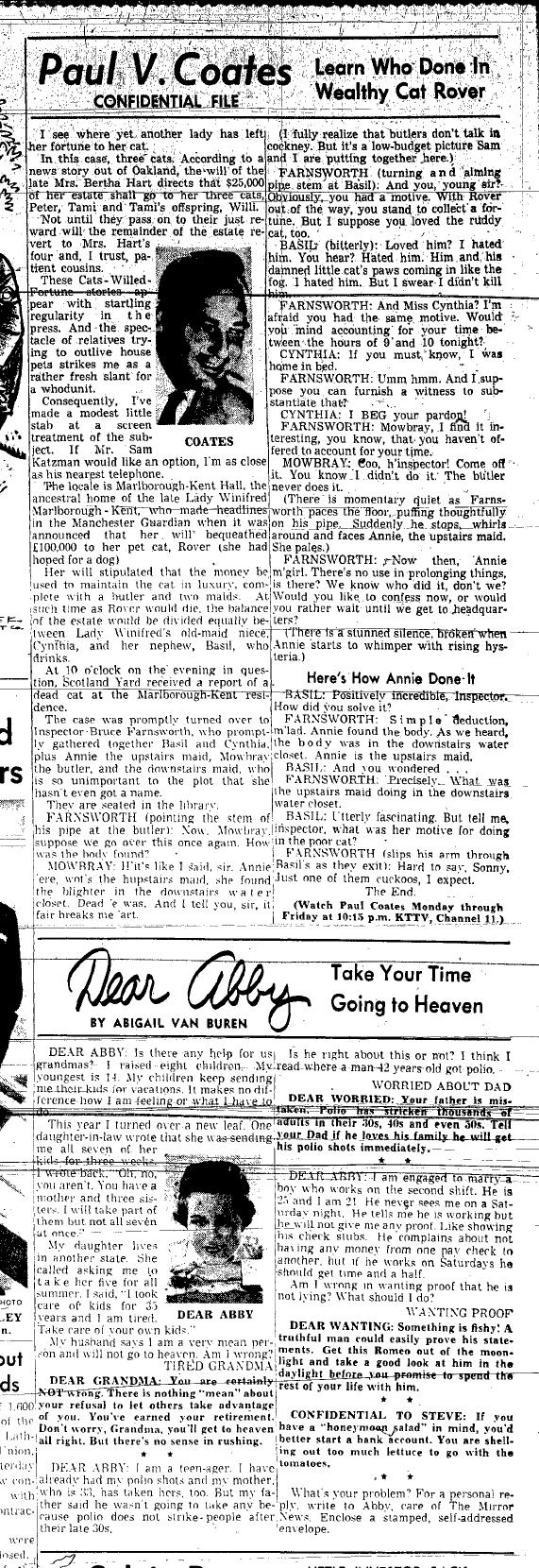
July 28, 1959, Times Cover

July 28, 1959: Vice President Richard Nixon's "kitchen debate" with Nikita Khrushchev bolsters his political stature, but Republican leaders are being careful not to overemphasize his new prestige.  And questions arise about the fire at the home of boxing promoter Jackie Leonard.

July 28, 1959, Border

July 28, 1959, Movies

"The Beat Generation" with hipsters Jackie Coogan, "Slapsie Maxie" Rosenbloom and Vampira.

July 28, 1959, Tick Tock

The Tick Tock loves children.

July 28, 1959, Border

Supervisor Kenneth Hahn wants President Eisenhower to help fight drug traffic from Mexico. 


July 28, 1959, Chavez Ravine The battle over Chavez Ravine wouldn't end.

The Times ran a short story about whether the city should do some
construction work in Chavez Ravine before the Supreme Court ruled on an
effort to stop the Dodgers' stadium from being built.

The story was memorable because of a quote from Councilman Karl L.
Rundberg, apparently from a "directive," which I hope meant it was
written and not spoken:

"What I am saying is this communication is for you to analyze the
whole plan and tell the City Council and other agencies what lies ahead
to be done by the city and the cost to the city of the fulfilling of
its obligations and the commitment of the other government agencies to
contribute toward the overall plan and what it is estimated to cost and
who is to pay for it."

Well, when you put it that way…..

–Keith Thursby

Posted in #courts, City Hall, Dodgers, Downtown, Film, Hollywood, Richard Nixon | 1 Comment

Health Inspectors Check Land Irrigated With Sewage

 July 28, 1899, Sewage


July 28, 1899: What happens when a city uses sewage for irrigation? People get sick.

Posted in Environment, health | 2 Comments

Los Angeles Debates a Sewer System to the Ocean

July 28, 1889, Sewage

July 28, 1889: Civic leaders argue over what to do with Los Angeles' sewage. Many oppose letting it flow into Santa Monica Bay at Ballona because it would pollute the beaches and because building a system would be expensive. Some favor using the sewage for irrigation (yes, really).

Posted in City Hall, Environment, Politics | 1 Comment

Artist’s Notebook — MacArthur Park

2008_0624_macarthur_park_thumb

MacArthur Park by Marion Eisenmann, 2008

This is a piece Marion did last year of MacArthur Park, which is only one Red Line stop from downtown, but a world away. On one corner, a 24-hour check-cashing business does a brisk trade in wiring money to Latin America. Vendors on the crowded sidewalk between the Metro station and 7th Street offer shoeshines, wallets, belts, votive candles and all sorts of other merchandise. Sometimes there's a street corner evangelist with a megaphone shouting "Jesucristo es el Señor!" I'll always remember the first time someone tried to sell me "papeles" (immigration papers) on my way to Langer's Deli at 7th and Alvarado, as if I look like I need them. (Note for vegetarians: Mama's Hot Tamales Cafe is half a block away).

Marion says:  I mainly feel attracted to this place because of its variety in colors shapes and other atmospherical reasons. Also, it feels a bit like the pulse of the area, people are gathering around the lake, a green and filthy "paradise," and the surrounding streets connect it with Koreatown, Downtown, Echo Park, and Hollywood.

Note: If you just tuned in, Marion and I are roaming Los Angeles to produce something similar to what Charles Owens and Joe Seewerker did with Nuestro Pueblo in 1938-39. I'll have another sketch by Marion next week. In the meantime, you can contact her here.

Posted in art and artists, Marion Eisenmann, Nuestro Pueblo | Comments Off on Artist’s Notebook — MacArthur Park

Found on EBay — Lucky Baldwin

C.B. Glasscock, Lucky Baldwin, EBay

A copy of C.B. Glasscock's biography of Lucky Baldwin has been listed
on EBay. Glasscock wrote several books about California
history, including "Bandits and the Southern Pacific." Bidding starts at $9.99

When Baldwin's daughter Anita learned in 1935 that Universal planned to make a movie based on Glasscock's book, she said it was "a monument of misinformation. It belittles my father and puts words into his mouth that he never uttered. Even the description of his appearance is ridiculous and untrue. It is wrong as to dates and events."

She added: "But if it were true and accurate in every particular we would still resent the production of any such picture. I see no reason why the family should have to submit to any such publicity.

"Only one true account of my father was ever published, that by Hubert C. Bancroft in 'Chronicles of the Builders,' for which my father gave a personal interview."


Posted in books, Film, Hollywood | Comments Off on Found on EBay — Lucky Baldwin

Matt Weinstock, July 27, 1959

July 27, 1959, Peanuts

July 27, 1959: Another downbeat "Peanuts" strip from the Cold War era that you won't see in the sitcom legacy version.

Back to Aimee

Matt Weinstock Ever since the book "The Vanishing Evangelist," the story of the Aimee Semple
McPherson kidnapping
affair, was published about two months ago a
controversy has existed concerning the identity of the author, Lately
Thomas.

Critics and reviewers disagreed as to whether the name was real or a pseudonym. The publisher, naturally, let them argue.

I
wrote here that it seemed an unlikely name and promptly received a
friendly letter from San Francisco signed Lately Thomas, stating it was
his true name, the only one he has.

Juy 27, 1959, Classroom Sex Study I don't know who wrote the letter but I know now it was a phony because I have just talked with the man who wrote the book.

HE IS A NEWSPAPERMAN who
prefers to remain anonymous. His first name is Bob. "I've been around a
long time," he said, "and publicity means nothing to me."

 He has
worked on papers in the East and San Francisco. He came to Los Angeles
four years ago, became interested in the Aimee story from newspaper
files and decided to have a go at it.

"Newspapermen always talk about writing a book but very few of them ever do," he said. "I'm still surprised at myself."

Not
too surprised, though. A contract is being drawn up for a New York
stage play based on the book. Meanwhile, Bob has just finished and is
copying a second book, "Aimee and Ma," dealing with the life and times
and hassles of the evangelist and her vigorous mother, Ma Kennedy.

How did he decide on the name Lately Thomas? Both were family names, he replied. One ancestor, of English origin, was named Leightly, but when he came to this country he got tired of spelling it for people and changed it.

While
checking some facts in the religion room of the public library a few
days ago Bob was assailed with the curiosity common to new authors.

He
went to the card file to see if the library had his book. There it was,
in great company — Thomas  Kempis, Thomas Aquinas, Thomas Lately.

Doggone it, I forgot to ask him, "Have you read any good books lately, Lately?"

::

LAST DEC. 31 Gabor Rona, CBS photog,
attended a New Year's Eve party that was a big nothing. The people
there were so worried about roadblocks and drunk tests and other
drivers and baby sitters they didn't have any fun.

To make up for it Gabor's staging his own New Year's Eve party next week at his home in Pacoima,
inviting only neighbors who can walk there and back without driving and
possibly being requested to blow up balloons for the boys in blue. He
has provided paper hats, recordings of "Auld Lang Syne" and "Down by the Old Mill Stream" — everything.

It could start a trend.

::

KID STUFF — During an oral exam at Sunday school the teacher asked Kathy Mellen, 8, "What did God say to Adam and Eve?" Kathy replied confidently, "Don't eat them apples" . . . Bill Larkin,
who writes for Bob Hope, took his son Barry, 3, to the ocean for the
first time and after a few minutes of trying to stand upright in the
boiling surf the boy called to his father, "Tell whoever's doing that to stop it!"

::

PESSIMIST
He sits all alone, pasty and pale,
Thinking only of people who fail,
Letting their fears fill his self-made cell,
And wondering why he doesn't feel so well.
    — MATTIE RAE

::

AT RANDOM —
The best examples of the graphic arts produced in this country in the
last 10 years — on display at the Moscow exhibit — include one book
from L.A., Robert L. Balzer's "California's Best Wines," printed by the Ward Ritchie Press . . . Someone stole Mike Molony's
ebony cane while his gout was at its worst and he is calling it the
crime of the century and the culprit the meanest man since someone took
candy from a baby . . . Martin Ragaway , after waiting interminably for
an opening in the line of cars on Highway 101 so he could make a left
turn, remarked, "The only way to get across this street is to be a
landslide."

Posted in Columnists, Matt Weinstock | Comments Off on Matt Weinstock, July 27, 1959

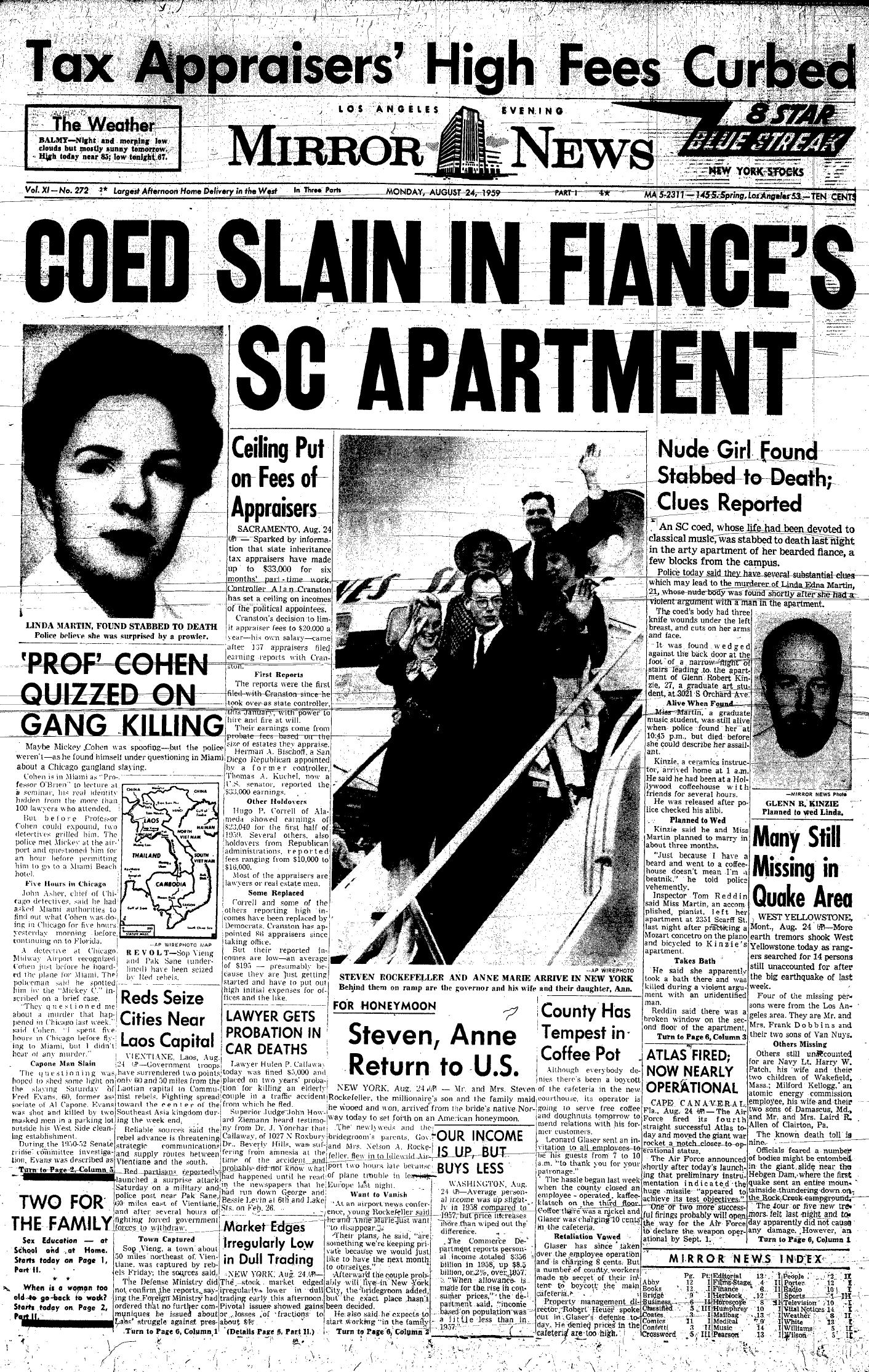
Paul V. Coates — Confidential File, July 27, 1959

July 27, 1959, Mirror Cover


Confidential File

Why My Mom Said Farewell to Macy's

Paul CoatesLet's talk about me for a moment. Did I ever tell you that my nightly KTTV program is viewed a week later in New York at 3 in the afternoon?

"Viewed"
may be somewhat of an exaggeration. I get the uncomfortable feeling
that in all the vast, sprawling metropolis of New York the only one who
bothers to "view" me is my mother.

But her dedication is not
without frustration. The other day she called and announced tersely:
"As far as I'm concerned, R.H. Macy & Co. can go you-know-where."

"What happened, mom?" I asked.

And this, in effect, is what she replied:

Last
week she was in Macy's to pick up a special on dish towels, 40 cents
apiece, three for $1. She glanced at her watch and noticed that it was
almost time for my program.

July 27, 1959, Sunset Strip Taking the Up escalator two steps at a time, she hurried to the fourth floor — pre-teen ready-to-wear, washing machines, house and garden utensils, stoves, radio and television sets.

In
the TV department a buxom lady shopper had turned on one of the floor
samples and was staring fixedly at "The Price Is Right." My mother
tapped her gently on the shoulder. "Beg your pardon," she murmured,
"but would you mind if I turned to Channel 5?"

Cold Glance

The woman turned her head slowly, glanced coldly at my mother and snarled: "I certainly would mind."

Ordinarily,
mom would have withered her with a word. But there wasn't time. She
rushed over to another set, flipped it on and tried, unsuccessfully, to
tune in Channel 5. Finally she called over one of the salesmen. "Beg
your pardon," she said politely, "but would you show me how to get
Channel 5? My son is on, and I want to . . ."

"Lady," he interrupted impatiently, "can't you see I'm busy with a customer?"

He
walked away. "Nasty thing," she muttered, continuing to work the dials
until I came in loud and clear. That day I was interviewing a guest in
a mask. A small crowd gathered, listened curiously a moment or two and
began drifting away until only my mother and one enormously fat man
were left. He wasn't exactly looking at the program. He was just
leaning against a wall and tidying his nails with the sharp corner of a
paper matchbox. My mother pointed to the set. "That's my son," she told
him.

"Which one?" the fat man asked.

"Which one?" my mother snorted. "You think the one in the mask? The one asking the questions, Paul Coates."

"Paul Coates?" The man thought a moment, then shook his head. "Never heard of him."

An
elderly gentleman walked unsuspectingly into the TV department and my
mother cornered him immediately. "You see that man on the screen over
there?" she demanded. "That's my son."

"Boy oh boy oh boy," the old man said, rocking his head appreciatively. "Imagine such a thing. Your son! How you must be proud."

July 27, 1959, Abby My
mother sighed contentedly. "Well I am, of course," she confided. "But
I'll tell you something. I always knew it would happen. He was never
like other children. He was different. You know what I mean?"

The man nodded. "And money?" he said. "Boy oh boy oh boy, I bet he makes a small fortune."

She Explains

My
mother shot him a quick, suspicious look. "Well," she said cautiously,"
he's got a lot of expenses. A man like that can't go around looking
like a bum."

"Listen," the old man agreed, "you're telling me? Naturally not, he can't."

"But," she couldn't resist adding, "he makes a living."

The salesman came over. "Lady," he said, "you inner'ested in buying this TV set?"

"Buying it?" my mother cried. "Why should I buy it? I already have a TV set."

"Then you don't object if I try and sell it to somebody else," he said, turning it off.

"Not at all," she said archly. "My son was almost through, anyway."

And with a triumphant flourish, she stalked out of R.H. Macy and Co., never again to return.

Posted in Columnists, Paul Coates | 1 Comment

From the Daily Mirror Files: Merce Cunningham, 1980

April 7, 1980, Merce Cunningham     
April 4, 1980: The late Daniel Cariaga interviews Merce Cunningham for a Times feature story. One line reads: "When career over, how do you want to be remembered?"

Note: Several months ago I rescued several boxes of old ephemeral files, discarded by The Times, that were used for reference in the pre-Internet era in covering classical music and dance. These notes are a sample of the contents. Alas, finding a good home has been problematic. The Huntington Library, which has a large collection of Times items, offered a cordial "no thanks." Surely there must be a Southern California library that would be interested in these files. Let me know.

April 7, 1980, Merce Cunningham
"Lady on street hit me with umbrella because she couldn't get in studio for perfr."
April 7, 1980, Merce Cunningham
"Dancing is not terribly important. It's important to me. Fascinating if you like it."
Posted in art and artists, Music, Obituaries, Stage | 1 Comment

A Kinder, Simpler Time Dept: Your Impure Movie

July 27, 1949, Movies


July 27, 1949: Sally Forrest, Leo Penn and Keefe Brasselle in "Not Wanted," co-written and co-produced by Ida Lupino.

Posted in Film, Hollywood, Religion | 1 Comment

Merce Cunningham, 1919 – 2009

Merce Cunningham / Stanford News Service

Linda A. Cicero/Stanford News Service

Merce Cunningham in 2007.

Grand Master of Movement

* Merce Cunningham has been dancing and choreographing since the
1940s. 'Dancing is looking,' he says, and he still has a keen eye for
the endless subtleties of the art.

January 12, 1997

By Jordan Levin, Jordan Levin is a freelance arts and entertainment writer

NEW
YORK — Merce Cunningham enters the studio slowly, a legend with
scruffy gray hair, a muffler and two canvas tote bags. Inside the large
practice space on the top floor of the Westbeth arts complex in New
York's West Village, the current generation of dancers in his company
are moving through the self-absorbed ritual of a class in the technique
he created. They are wearing the familiar dancer's motley of practice
clothes, with a '90s complement of pierced lips and noses, goatees,
braids and buzz cuts. Their legs carve the air around them in long
sweeping arcs, while their arms and torsos twist and curve in
asymmetrical, oddly elegant shapes, sweat dripping, faces blank with
concentration. Most of them–graceful, straight-limbed, perfectly
conditioned–are in their 20s.

Cunningham, however, is 77.

He
has seen five decades of young dancers come and go. Severe arthritis in
his feet makes his progress across the studio a slow, painful shuffle
and a startling contrast to the company's easy, virtuosic athleticism.
But it is still his dances that set those superb bodies flashing and
whirling through space; it is his eye, mind and hand that forms the
movement in front of him.

At first, on this misty gray December
day, he takes a place at the back of the studio, at a desk half hidden
by some droopy potted palms. He is seemingly oblivious to the class
that fills the space, absorbed in papers and other business, and he
looks up only once, when one of the dancers turns an accidental and
loud somersault.

But when it comes time to lead rehearsal, he is
sharply present. In just a few weeks, the Merce Cunningham Dance
Company will embark on its latest national mini-tour, five cities in
one month, including stops at the Orange County Performing Arts Center
in Costa Mesa on Tuesday and the Alex Theatre in Glendale on Saturday.

As
he sits in front of the dancers, Cunningham remains quiet and reserved.
He watches intently, chin in hand, taking notes on a little pad, but
says nothing until the dancers have finished with a particular section.
His comments are minimal, his diction is formal and quiet, while he
makes small, polite requests to adjust some detail of timing, an
entrance cue or the relationship of one group to another.

"Something's
just slightly off there," he offers, or "Can you just check that?" The
dancers respond immediately, rapidly repeating the sequence as they
analyze the problem, until Cunningham offers an impassive "Yes, that's
all right now."

He has an extraordinary eye. As the dancers all
do a rapid duet from a 1975 piece called "Changing Steps," he sits
grinning, even laughing, delighted at the near chaos of whirling,
falling, leaping, almost-colliding pairs of bodies. But then he picks
out a precise lag in a jump by one man that lessens, by a tick, the
impact of the next move, which is a catch of his falling partner.

"Dancing
is looking," Cunningham likes to say. After some 50 years of making and
looking at dance, he remains perpetually curious about what he may see
next, like that sudden flip amid the orderly patterns of a technique
class. What motivates him now is exactly what has motivated him all
along: the seemingly infinite possibilities of the human body in motion.

"Movement,"
Cunningham says, "remains endlessly fascinating to me. Within the scale
of the human being there are endless possibilities. And that's really
what interests me, to find something that I don't know about and find a
way to use it."

*

Since he presented his first solo
concert in a New York loft in 1944, Cunningham's tireless quest to find
and use what he doesn't know about has revolutionized people's thinking
about what is possible in making and looking at dance.

In
breaking with the modern dance's doyenne of drama, Martha Graham, with
whom he performed from 1939 to 1944, Cunningham linked dance with
cutting-edge ideas of randomness and abstraction and simultaneity. He
declared dance independent of story or meaning, independent of music,
to be looked at purely for itself.

"For me, it seems enough that
dancing is a spiritual exercise in physical form, and that what is seen
is what it is," he wrote in a 1952 essay. For him to attach meaning to
a moving body would be like trying to explain the sun coming up and the
rain coming down, a notion that both diminished and distorted their
wonder. "Dancing," he wrote, "is a visible action of life."

Cunningham
formed his first company in 1953, and together with experimental
composer John Cage, his domestic partner and collaborator, began making
works in which dance, music and decor are conceived and presented as
separate elements, sharing time and space during a performance but not
integrated in the usual manner. He used chance formulas, often from the
ancient Chinese spiritual text the I Ching, to construct pieces,
searching for connections beyond what his own mind might invent, and
worked with some of the foremost contemporary composers and visual
artists of the times: Robert Rauschenberg, Jasper Johns, Andy Warhol,
Frank Stella, Morton Feldman, David Tudor and Robert Ashley, as well as
Cage.

Works like "Suite for Five in Time and Space" (1956), with
its composition by chance and complete reorientation of the stage
space; "Winterbranch" (1964), with its screaming La Monte Young score
and flashing lights; or 1968's "Rainforest," with the dancers squirming
like strange fish among Warhol's silver helium pillows, shocked and
challenged audiences and critics. People hated or supported his work
passionately. What you thought of Cunningham, wrote critic and essayist
Richard Kostelanetz of his early days, showed not only what you thought
of dance but of contemporary art in general.

In the '50s,
Cunningham was performing for tiny audiences and mostly being reviled
by critics. But by the mid-'60s, though still considered very much in
the vanguard, both critics and audiences were beginning to catch up. In
1974, Calvin Tomkins of the New Yorker wrote: "Far more than any other
choreographer in our time, Cunningham has pursued the difficult goal of
a true synthesis of the arts, and the manner of his doing so, I
believe, has a bearing not only on his own remarkable career but on the
development of 20th century art."

Since the early '80s,
Cunningham has become a veritable dance world icon, heaped with
accolades, honors and bookings. Successive generations of post- and
post-post-modern choreographers and performers have built on, imitated,
abandoned and taken for granted Cunningham's ideas. But even now, his
dances can still challenge and confound.

When the company goes
on tour, a common query in post-performance question and answer
sessions remains "Why don't you dance to the music?" And journalists
still ask the same questions they've been asking since the beginning of
his career.

"You're not going to ask him all those questions
people ask him all the time, are you?" Robert Swinston, at 17 years
with the company its senior member, asks a press visitor to the studio
indignantly. "The ones about space and time and why doesn't he work
with music?"

These days, Cunningham keeps a monk-like schedule.
He comes in to the company's Westbeth headquarters six mornings a week
to do yoga and exercises by himself. Two mornings are devoted to
choreography, largely computer assisted. He has lunch (pita bread,
peanut butter, raisins, hummus), and rehearses with the company five
afternoons a week. He often teaches the company class, and even the
occasional class at his dance school, the Merce Cunningham Studio.
Efforts to get him to take two days off on the weekends have been
unsuccessful, and he shakes his head at the idea. "Oh, no," he says.
"Always here."

Even his interaction with his dancers carries a
bit of monk-like reserve. When not giving them practical directives,
for instance, he often offers them Zen-like parables, anecdotes from
which his listeners must extract their own meaning, much as with his
dances. Like the one he tells about a mahogany tree in his loft that
hadn't grown a new shoot or lost a leaf in over a year. One day, as he
was doing yoga, he noticed a new sprig on the tree, and suddenly leaves
were falling off. Change is always imminent–the message seems to
be–anything can happen at any time.

His dancers relate to him
less as friends and colleagues than as students–across a respectful
distance. Bill Cook, the director of the Cunningham Dance Foundation,
the umbrella organization for the company, school and the Cunningham
historical archives, remembers that after he came to work there,
Cunningham told him, "I'm so glad you're here, because now the dancers
will have someone to talk to."

The distance is due, certainly,
to the difference in age and to the fact that the majority of the
dancers are relatively new to the Merce Cunningham Dance Company. But
it may also be in part because, since 1989, he has been choreographing
primarily with a computer program called Life Forms, rather than on his
own or his dancers' bodies in the studio. The idea, once again, is to
exploit potential. "It's added possibilities," Cunningham says of Life
Forms. "Complexity. I see possibilities that I realize have always been
in dance, but I never found a way or never saw them before."

The
program consists of flexible three-dimensional humanoid figures that
Cunningham can manipulate in any way and view from any angle using a
mouse or keyboard, allowing him to create complex sequences and
combinations of movements entirely on screen. On a practical level, it
has allowed him to keep working when his body cannot.

Again, he
emphasizes the process of discovery Life Forms has made possible. "In
the beginning, I made an enormous number of errors and would lose
things constantly, but it didn't matter to me," he says. "I didn't feel
I was out to accomplish something. I was rather out, as I still am, to
discover something."

Occasionally, his mistakes allowed
Cunningham to do things that Life Form's creators, at Simon Fraser
University in Vancouver, didn't know the program could do; prompting an
advisor whom they sent periodically to work with him to ask, "How did
you do that?"

Working with the computer has, by most accounts,
intensified aspects of Cunningham's abstract style, adding newly
complex movement patterns and shapes. He says it has allowed him to
experiment more freely with visual points of view, and to add
complexity in the upper body and the arms. "It was all possibilities
that were always there," he says. "But I was involved with other kinds
of thinking in the earlier dances, space and time and movement."

Recent
computer-developed dances like "Rondo," "Ground Level Overlay" (both of
which the company will perform in Orange County, along with the 1975
"Soundance"), and the monumental "Ocean" (which had its U.S. premiere
at UC Berkeley in April 1996) are remarkable for their lush sense of
endlessly mutating form. Reviews of these pieces tend to use words like
"beautiful," "sculptural" and "lavish."

Cunningham still
demonstrates his computer-composed phrases to the company himself, and
then comes a process of putting the dance together in real time and
space. Here he depends on his eye, those specific and courtly comments
and the company's ability to make what he's created on screen work on
their bodies, however they can.

"He really just lets you do it,"
says dancer Jeannie Steele. "He mostly gives us the rhythm, the legs,
then the arms and the back. With quality, it's mostly simple
[instructions]–harder, faster, slower, retard there, speed up."

"He gives you a lot of freedom," says another dancer Banu Ogan. "We're famous for that."

A
great change for Cunningham came in 1992, with the death of John Cage.
The two not only lived together for more than 40 years, they were so
closely linked creatively that as artists their names were often spoken
as a unit–Cage-Cunningham. Together, they developed such concepts as
the use of chance and the equality of music and dance. Indeed, those
ideas were expressed as much in Cage's music as in Cunningham's dances.
Cage was musical director and an integral part of Cunningham's company
until his death, and people who were close to them say the more
outgoing and charismatic Cage tended to dominate their private and
social life.

Still, as difficult as Cage's death has been for
Cunningham, he has remained as productive as ever, making two pieces
each year, while the company has continued to tour frequently. He seems
to have taken comfort in his work; he came into the studio the day
after Cage's death. In fact, the end of the close relationship with
that powerful personality may have opened doors for him. "John's death
freed my work," Cunningham told the San Francisco Examiner in a 1995
interview. "We used to discuss everything. Now I make all the
decisions."

"It's sort of as though you had this father of
abstract philosophy sitting at the dinner table all the time," says
Cook. "I think Merce's work now comes from loneliness, but also from
the freedom to be his own person."

Cunningham reacts
uncomfortably, stiffening and pausing, to the question of whether his
work has changed since Cage's passing, as if such an admission might
imply some rejection of their work together.

"Change–I always
think change is like additions," he says finally. "I don't think we
lose anything else. We may not use it all the time, but it's there."

Change,
of course, is a necessary byproduct of Cunningham's desire to keep
exploring. It makes him a good fit with the Information Age, as his
affinity for the computer indicates. Indeed, he says technology and its
attendant culture may be helping the rest of us to catch up with his
vision, may even cut down on all those questions about meaning and
chance.

"Dancing is about seeing," he explains for the umpteenth
time. "And I think so much of life now is about looking. I keep
bringing this up to people and they all agree with me so far. Children
have grown up looking at the television, and what's that word? Scroll?
Surfing, yes. The children don't listen, they simply look. That is,
their eye is taking in something but not their ear. And it's a wholly
different way of being."

In fact, he thinks this image and
information laden world, where we have grown accustomed to absorbing a
multiplicity of unrelated facts, might even help people to absorb
something like one of his Events, which he started doing in the early
'60s. An Event links varying chunks from any of nine or 10 dances, put
together according to the shape of the space and chance procedures on
the day of the performance (the company will do an Event in Glendale,
in which Cunningham will likely perform).

Bewildering as this
might sound to some, Cunningham thinks it should be no more complex or
confusing for his audiences than such everyday miracles as a television
simulcast of something happening on the other side of the world, or the
flood of text and images on the Internet.

"What people don't
catch–some do, I don't doubt–is that everything is fragmented in a
way," Cunningham says. "Maybe that's why they can't see it in another
form, I don't know, but the society is so fragmented, everything about
how we have to work is so fragmented." Such drastic fragmentation must,
he believes "affect the way we think. And I see no reason why it
shouldn't affect the way one makes a dance."

And, as the
generations and the changes keep coming, Cunningham keeps finding
reasons and new ways to make dances. "There's so much repetition,
certainly in dancing, if you get bogged down in that it's really very
boring. But so much of life is like that. So that's why, like in
cooking, it's wonderful if you can see another way, some other kind of
feeling, different tastes.

"I really feel this very strongly,
though it's not easy, that you may find something that you don't know
about. Even though you're doing the same thing, you may find out
something about it which is not quite the same."

Cunningham, who has been talking during a rehearsal break, looks up and smiles as his dancers reassemble.

"Begin again," he says, "that's what we're always doing, is beginning again."

And does he never get tired of beginning again?

"Well, it's what you have to do every day," he laughs. "So why not do it in dancing if you can?"

Posted in Uncategorized | Comments Off on Merce Cunningham, 1919 – 2009

Charges Dismissed in Attack

   July 27, 1899, Court


July 27, 1899: Charges are dismissed against Frank McVey, an African American accused of attacking a white man who was allegedly living with his sister.

Posted in #courts | Comments Off on Charges Dismissed in Attack

Indian Jim Dies

July 27, 1889, Indian Jim  

July
27, 1889: The Times receives word on the passing of "Indian Jim" of Yuma, Ariz. … a follow-up on the abandoned baby story … the "White Caps" trial … and home-wrecker Robert Sykes must stay in jail.

Posted in #courts, Obituaries | Comments Off on Indian Jim Dies

Found on EBay — Bullock’s Wilshire

Ivan Nagy's Credit Cards

.

Ivan Nagy EBay
Several old credit cards have been listed on EBay, including one from Bullock's Wilshire. And not just anyone's credit cards, either. They belonged to former Heidi Fleiss beau Ivan Nagy. Bidding starts at $4.99.
Posted in Fashion | Comments Off on Found on EBay — Bullock’s Wilshire

A Kinder, Simpler Time Dept: Sus Peliculas

July 26, 1948, Movies  

July 26, 1948: Pedro Infante and Sara Garcia in "¡Vuelven los Garcia!"

Posted in Film, Hollywood, Music | Comments Off on A Kinder, Simpler Time Dept: Sus Peliculas

Jealous Neighbor Kills Woman, Attempts Suicide

 July 26, 1899, Shooting


July 26, 1899: E.V. Methever, 52, a Long Beach shoemaker who was infatuated with Dorothy McKee, a neighboring shopkeeper, rammed her bicycle with his bike and shot her to death, then tried to commit suicide.

Posted in #courts, Suicide | Comments Off on Jealous Neighbor Kills Woman, Attempts Suicide

Mother Charged With Abandoning Baby

July 26, 1889, Abandoned Baby

July 26, 1889: A broken promise of marriage … a wronged woman … an abandoned baby … Police Chief Glass has his hands full! … Cantankerous people plague the district attorney's office.

Posted in #courts, LAPD | Comments Off on Mother Charged With Abandoning Baby

Matt Weinstock — July 25, 1959

New-Type Hero

Matt Weinstock If the situation
in Cuba seems chaotic, let writer Malvin Wald fill you in on some
details. He has just returned from five weeks in Havana getting
material for a film about Fidel Castro.

One time he and director
Dick Wilson had a dinner date with the director of prisons. He didn't
show and next day he phoned to apologize. There had been a riot in the
prison requiring his prior attention.

Another time they had an
appointment with Castro. After waiting several hours they were told he
couldn't make it because of a sudden crisis. His air force chief had
resigned and was believed to have fled the country.

Then there
was the case of the traffic officer who gave the prime minister a
ticket. Instead of being angry, Fidel praised him for his dedication to
duty and the conscientious cop became a front-page hero for a day.

As
a result all Havana policemen are on the alert for Castro's blue
Mercedes, hoping his driver will run a red light or park in a
prohibited zone so they can give him a ticket and become heroes, too.

::

CLOSER TO HOME,
an L.A. resident is unhappy about zealous Newport Beach authorities.
Policemen patrolling Balboa Island in an outboard last Sunday came
ashore and cited everyone they saw with a beer can in his hand.
Unannounced, they'd begun enforcing an ordinance prohibiting drinking
of alcoholic beverages in public — bail $25, which he forfeited.

Understand it's okay to eat a hamburger if you show your driver's license and take a loyalty oath.

::

SPEAKING OF hamburgers, Bobby Hammack,
ABC band leader and pianist, was eating one in a Vine St. restaurant
when he heard a waitress relay the order to a cook, "Cheeseburger, hold
the relish, onionsville!"

Bobby says, "I will stipulate that we are hung up with the suffix 'ville' as in

hotsville, coldsville, smogsville and so on during working hours, but when they invade my lunch hour, I'm hacked."

Like crazyville, man.

::

YOU CAN'T WIN
They've purified our cigarettes
We almost could relax,
If when they lowered coals and tars
They hadn't upped the tax.
    — PEARL ROWE

::

MOST VIVID
memory Gloria Saunders, actress and writer, brought back from Tijuana
was that of a battered 1954 Henry J on a used car lot not too far from
the bull ring. Across its windshield was written in bold yellow
letters, "Muy Bravo!"

::

ONLY IN HOLLYWOOD —
It isn't that people don't trust each other, it's just that they want
to make sure about things. Which doubtless explains the action of a
woman in a market who selected a hunk of cut, wrapped and labeled meat,
carried it to the hanging scale in the produce section and weighed it .
. . And there's a story going around about a colleague asking an
actor's agent if he'd seen the Laurel Canyon fire — to which the agent
responded eagerly, "Who do we have in it?"

::

PROF. Ulfert Wilke's final assignment to painting students at Claremont summer session was, "Go to the Watts Towers, 1765 E. 107th
St., and give impression of its miracle in paintings which may reflect
a little of its colorful glory, its feast of fantasy and human
dedication, its manifestation of idealism and hope. Pay homage to Sam Rodilla
, whose work should be preserved to give joy to others, yet who was
1,000 times rewarded by the bliss of his own labors in bringing forth
his vision."

::

FOOTNOTES —
Biggest horse show in the west, with 90 L.A. and Ventura County 4-H
clubs participating, will be held tomorrow in Malibu. Starts at 9 a.m.
with judging of halter classes which, some anonymous press agent wants
people to know, has to do with horses, not bras. . . During a Dodger
broadcast, Jerry Doggett said "pitchingwise."

Posted in Columnists, Matt Weinstock | 1 Comment

Paul V. Coates — Confidential File, July 25, 1959

Confidential File

Fear, Ignorance Hard to Defeat

Paul CoatesThis is a very unlikely story about a minister whom everybody feared.

He
was a kind, friendly man — a dedicated worker for his church. In fact,
his dedication was so great that he spent 31 years as a missionary in
Burma.

But that's not where his story begins. The people in Burma trusted and loved him.

It
wasn't until after he came back to the United States, to the community
of Glendale, in 1946, that he became a victim of man's ignorance and
superstition and fear.

In one terrifying day, about a year after
his return here, he was forced to get out of his home, resign his job
as director of missions for his church, and head for the state line as
fast as he could.

His alternative was to wait for the authorities to come knocking on his front door to lead him off and lock him up.

The reason for his flight was a small red spot which appeared days earlier on his ankle.

On the day he fled, the spot was diagnosed by a doctor as Hansen's disease — leprosy.

And it branded him as a dangerous public menace — a man who must immediately be isolated, removed from society.

Today,
I met the minister whom everybody feared. He's 71 years old now,
retired, and back in the city of Glendale. His name is Clarence Olmstead.

He filled me in on what has happened since the day he ran scared for the Arizona border.

Drove to U.S. Leprosarium

"My wife was with me," he said, "and we drove straight to the U.S. Public Health Service Leprosarium in Louisiana. It's in Carville."

There,
he related, the doctors didn't share the fear which gripped the
"enlightened" state of California. They immediately granted him
permission to drive his car to a brother's home in Illinois, suggesting
that he return in about a week.

He did return. And he spent most
of the next two years undergoing treatment — until doctors established
that his case was arrested.

Then he was released into society again.

With a touch of bitterness in his voice, the Rev. Mr. Olmstead told me, "When I arrived at Carville, the doctors agreed with me that if it weren't for the public's
fear and the social stigma attached to Hansen's disease, I could just
as easily have been treated in my own home and continued a normal
existence. I could have been a breadwinner for my family.

Just Few, Simple Precautions

"The
disease," he continued, "is the least communicable of all communicable
diseases. With a few simple precautions, even when the disease is
active, you can protect others."

But even when his case was proven arrested, Mr. Olmstead
found out that society wasn't ready to accept a leper. (The term leper
still makes the minister cringe. "The connotation is bad," he says.
"It's a very nasty, vile word.")

"However, he told me, "since I was at Carville,
there has been much improvement in public attitudes. California is just
one of several states which have liberalized their isolation laws
regarding Hansen's disease victims.

"If people could only be
made aware of the pointlessness of herding leprosy victims out of
society, if they only understood the hardship andheartbreak these separations are causing…"

His voice faded.

At 71, he's been around long enough to understand that progress is a slow process.

Posted in Columnists, Paul Coates | Comments Off on Paul V. Coates — Confidential File, July 25, 1959

A Kinder, Simpler Time Dept.: Your Motorcar

July 25, 1947, Tucker

July 25, 1947: The Tucker.

Posted in Film, Freeways, Hollywood, Transportation | Comments Off on A Kinder, Simpler Time Dept.: Your Motorcar

Remembering Armida Wiltsey

Karen Davis writes of Armida Wiltsey, whose 1978 killing was solved through DNA analysis:

Armida Wiltsey
My family has been following the news stories since the real killer was
found and each time I read another update, the angrier I became as more
and more time and attention has been given to him with only a few lines
dedicated to his victims.  And unfortunately, this is typically how
these sad stories are told. Wouldn't our world be a different place if
the opposite were true.

I was a child when we lived next door to the Wiltseys. And my detailed
memories of Armida are those of a child. We lived in a small town out
past Indio and often my mother, Armida, her son, my sister and I would
go into town to by groceries.  Often we would stop for lunch at the
local Mexican restaurants. Armida ordered chicken taquitos for me and
she showed me how to eat them with guacamole. It was a new and
delicious treat! She also showed us where to buy the most wonderful
homemade tamales from the street vendors. She was always concerned for
us and I was always happy to be with her.

My broader memories of her were that as a close friend to my  mother.
Mr. Wiltsey and my father worked together and they often worked many
long hours. My mother was very lonely living in small town out in the
middle of the desert. Armida became a close friend to my mother. I
remember them laughing and the warmth of their friendship. When Mr.
Wiltsey was transferred to Oakland, I remember how sad my mother was
when Armida moved away.

The sad legacy of her murder stays with me as well.  The late night
phone call, trying to get details of what happened, the shock and
disbelief…and the helplessness we felt for her son and husband. We
could not begin to comprehend what her loss and the horrible way she
died, meant to them.

Karen Davis

Posted in #courts, Homicide, LAPD, Obituaries | 1 Comment