Solid-Body Legend
Plagued by arthritis, Les Paul acknowledges that his playing days are probably numbered, but new releases will preserve his work
November 24, 1991
By MICHAEL WALKER, Michael Walker is a free-lance writer based in New York.
NEW
YORK — Les Paul is plowing through the last of his chicken supper at
Fat Tuesday's, the tiny basement jazz club in Manhattan where he has
performed two shows on Monday nights for the last eight years. It's 15
minutes or so before the start of the first set, and the tables ringing
the stage are already filled. As usual, the 76-year-old guitarist and
inventor, whose pioneering designs for the solid-body electric guitar
and multi-track recording continue to reverberate throughout the music
industry, has forsaken the privacy of a dressing room, preferring to
devour his pre-show dinner in full view of the fans.
Les Paul
wouldn't have it any other way. Fat Tuesday's is his woodshed, the
jamming haven he adopted after he resumed regular performing in 1984 as
therapy for his arthritic hands. Since the club's management
reluctantly agreed to let him take over the Monday night spot, the
shows have apotheosized into the downtown equivalent of Bobby Short's
eternal gig at the Hotel Carlyle. But where Short wears black tie, Paul
performs in what looks like whatever he happened to throw on before
driving in from his 29-room mansion/recording compound in Mahwah, N.J.
Paul's
unassuming bearing belies his considerable stature among musicians of
virtually every persuasion. Over the years he has, it seems, played
with just about everyone: Art Tatum, Charlie Christian, Nat King Cole,
Louis Armstrong, Bing Crosby (with whom he recorded "It's Been a Long,
Long Time"), the Andrews Sisters, Andy Williams–even W.C. Fields. Rock
guitarists from Jeff Beck to Edward Van Halen have acknowledged their
debt to his studio techniques and guitar design, and the walls of Fat
Tuesday's are papered with photos of Paul draping his arm around the
players who drop by to pay their respects: George Benson, Mark
Knopfler, Eric Clapton and perhaps Paul's biggest fan, Jimmy Page, who
is said to travel with a framed portrait of his idol.
These are
good times for Les Paul. He was inducted into the Rock and Roll Hall of
Fame in 1988 and received the National Academy of Recording Arts &
Sciences Trustee Award in 1982. Now, 14 years after he shared a Grammy
with country guitarist Chet Atkins for their "Chester and Lester"
album, a slew of Les Paul recordings is being unleashed. Capitol
Records has released "Les Paul: The Legend and the Legacy," a four-CD
box set culled from Paul's and his vocalist wife Mary Ford's years on
the label in the '40s and '50s. (See review on Page 74.) The set will
include the couple's hits, plus their radio shows, "Les Paul and Mary
Ford at Home," which were broadcast on NBC (they also did 170
television shows, sponsored by Listerine, from 1953 and 1960), as well
as unreleased material from Paul's personal collection.
Early
next year, Columbia Records' Legacy label will release two albums of
material that Paul and Ford made after leaving Capitol in the late
'50s. Paul is also working on four albums of newly recorded
material–one album each of rock, jazz, blues and country–featuring
the guitarist soloing over songs performed by an all-star ensemble of
players. "They're gonna be smokin'," Paul enthuses.
Despite his
arthritis, Paul still plays with surprising deftness the fluid,
echo-drenched jazz-inspired lines he made famous on hits like "How High
the Moon." His guitar, as always, is a custom version of the famous
Gibson solid-body electric, introduced in 1952, that bears his name.
(He still receives a royalty on each one sold.) When Paul and his
sideman, Lou Pallo on rhythm guitar and Gary Mazzaroppi on bass, kick
into one of the old hits, the club is immersed in the thick,
reverb-heavy hi-fi sound that is the guitarist's legacy and signature.
The
relaxed atmosphere at the shows and Paul's genuinely easygoing
demeanor–he graciously signs dozens of autographs and gamely honors
requests shouted out from the audience–have attracted a group of
hard-core regulars almost fanatical in their devotion. (One had the
show piped into his hospital room over the telephone.)
"Nobody
wanders down here on Monday just because it's Fat Tuesday's–they come
to see Les Paul," says Cate Ludlam, a computer consultant who has
attended the shows for the last three years. As one Japanese fan
exclaimed, marveling at the Les Paul guitar that Paul autographed for
him at the club one night: "This is like having the Bible signed by
Jesus Christ!"
Yet Paul's Monday night gigs are somewhat
bittersweet: Both he and the regulars know that his playing days are
probably numbered.
"These fingers are all shot," says Paul
through a mouthful of chicken, holding up his gnarled right hand. "They
just don't move. This hand's the same way. He moves there," he adds,
wiggling a finger, "but he don't move there."
Paul's pluck in
the face of his disability seems to inspire the Fat Tuesday's regulars
as much as his playing. "I've seen him here in the winter when his
fingers looked like sausages," winces Ludlam.
Working around his
maladies is nothing new: A 1948 automobile accident in Oklahoma so
mangled Paul's right arm that he instructed the doctors to set it at a
right angle so he could continue playing. Since 1980, he has undergone
quintuple bypass surgery and several operations for Meniere's syndrome,
a vertigo-inducing ear disorder. "There's a way out of everything,"
Paul says in his soft, gravelly voice. "You just have to have the
determination and will to go in there and fight."
His frail
health aside, Paul's career is at its most robust in years–or, as he
puts, "I'm just gettin' started." Like the roots-mania that has
pervaded jazz under the aegis of Wynton Marsalis, Paul's legacy to rock
'n' roll has benefited from his rediscovery by the likes of Van Halen
and other rockers who had known him, if at all, through the Les Paul
guitar. And his nascent renaissance is a far cry from 1965 when, the
hits behind him and Ford and unable to make the transition from pop to
rock, Paul hung up his guitar and retired from performing. (He and
Ford, who died in 1977, divorced the year before.)
"The late
'50s and early '60s was a critical time for Sinatra, (Benny) Goodman,
Les Paul and Mary Ford–whomever," explains Paul. "Everybody was in
trouble, because they've got the devils on their back, and the Beatles
and so forth. The record companies approached us and said, 'We want you
to change your style.' Mary, who disliked rock, didn't feel as though
she should change. We tried one or two things, but it didn't fit. We
felt very uncomfortable trying to be somebody other than we were."
Yet
even if Paul had never played another note, his place in the musical
pantheon would have been assured from his inventions, many of which he
never patented. ("I was too busy playing," he shrugs.)
Perhaps
most crucial was his work with so-called sound-on-sound recording, or
overdubbing, which he used to layer Ford's vocals into shimmering
harmonic choruses and his guitar into dense, multiple voicings. "Nobody
had done that before," says Brad Tolinski, editor of Guitar World
magazine. "In that sense, Les Paul is the father of modern recordings."
Paul's
relentless tinkering throughout the postwar years brought forth several
seminal innovations. He designed the first eight-track recording
machine (the original, which stretches to the ceiling of his home
studio, was used to remix some songs on the Capitol box set); perfected
slap-back echo; recorded his guitar on a machine running slowly, then
speeded up the tape to raise its tone several octaves. Bucking the then
conventional wisdom that singers should stand no closer than 2 feet
from the microphone, he introduced the now-standard technique of
positioning the vocalist inches from the mike, which captured every
rasp and sigh of Mary Ford's smoky voice. While encased in a body cast
after his 1948 car accident, he designed what would have been the first
musical synthesizer. "I had the schematics drawn up–it would have been
as big as your refrigerator," laughs Paul, who let the project go after
his recovery.
Then there was the Log, the solid-body electric
guitar he cobbled together in 1941. Unhappy with the tone and feedback
problems of hollow-body electrics, Paul mounted two pickups on a 4×4
block of maple and attached to it the wings from an Epiphone guitar he
had sawed in half. When he pitched it to M.H. Berlin, president of
Chicago Musical Instruments, the parent company of Gibson guitars,
Berlin dismissed it as "a broomstick with pickups." In the early '50s,
after Leo Fender had scored with his solid-body Telecaster guitar,
Berlin reconsidered. "He said, find that guy with the broomstick with
pickups and sign him up,' " Paul says.
The Log led indirectly to
the elegant Les Paul model, which, in various guises, has been Gibson's
crown jewel for most of the guitar's 30-some years of production. (Some
vintage 1958-60 models, with two humbucking pickups and gorgeous
flame-maple tops, command more than $30,000 on the rare-guitar market.)
Renowned for its fat, round tone and ability to sustain notes, the Les
Paul became the natural choice for rock players when the genre shifted
into heavier playing in the late '60s. Jimmy Page used a Les Paul
extensively on the second Led Zeppelin album, and Peter Frampton
flashed one from the cover of his zillion-selling 1976 live album.
Though the Les Paul was overtaken during the '80s by the rival Fender
Stratocaster and its clones, its use by Guns N' Roses lead guitarist
Slash and other third-generation rockers has returned it to prominence.
"Culturally,
my God, what a contribution," says Guitar World's Tolinski. "Almost any
hard-rock record features it in some way. People say, 'Get me that Les
Paul sound,' and you know exactly what they're talking about."
Paul
has been dreaming up music-related contraptions since his childhood in
Waukesha, Wis., where he was born Lester William Polsfuss on June 9,
1915. By the time he was 7, he was punching extra holes in his mother's
player piano rolls to alter the sound. After a ditchdigger gave him a
harmonica that Paul had been ogling ("My mother boiled and boiled it"),
he began performing around town, later adding the banjo and then the
guitar to his act. He fashioned a harmonica rack from a clothes hanger,
his first invention, so that he could play two instruments at once.
Soon he was amplifying the sound of his mail-order acoustic guitar with
a phonograph needle connected to a radio speaker and had assembled a
crude recording device using a Cadillac flywheel.
"I was just
curious," Paul explains. "My brother would just throw the light switch
and was never curious to find out what made the light light. Well, as
soon as my mother left the house, I had a screwdriver and the plates
off and I'm gonna find out, if I get knocked on my ass, I'm gonna know
that there's 110 volts there, whether it's alternating or direct
current. I'm gonna know what's happening."
Paul dropped out of
high school and ended up in Chicago, performing with a cowboy outfit
under the name Rhubarb Red (he still tosses a few country groaners,
like "Haul Off and Love Me Like You Should," into his Fat Tuesday's
sets). At the age of 19 he was performing nationally on NBC radio.
Tiring of country music, he immersed himself in Chicago's burgeoning
jazz scene, and left for New York with his first Les Paul Trio in 1937,
which performed on orchestra leader Fred Waring's national radio show.
In
1943 he moved to Los Angeles, where Bing Crosby, impressed with his
playing, got him a contract with Decca Records and later tapped him to
play on "It's Been a Long, Long Time." With Crosby's encouragement,
Paul soundproofed the garage of his Hollywood bungalow in 1945 and
turned it into a studio, where he recorded the Andrews Sisters, Kay
Starr and other luminaries while developing his recording inventions in
earnest.
It was there that Paul perfected the multi-tracked "New
Sound" heard on his instrumental hits "Lover" and "Brazil," released by
Capitol in 1948, and also where he met a country vocalist named Iris
Colleen Summers, who later changed her name to Mary Ford and joined
Paul as the partner on his biggest hits. (They married in Milwaukee in
1949.)
Les Paul and Mary Ford were all over radio and television
throughout the '50s, with hits like "How High the Moon," "Via Con Dios"
and "Hummingbird." Though much of their work now sounds dated, Paul's
recording techniques were nevertheless far ahead of the industry's
standard. "If it weren't for him, the whole electric guitar and
recording industry wouldn't be happening, y'know, wouldn't have moved
out of that earlier era," Jimmy Page has said. "Those experiments of
his with recording techniques paved the way for people like the Beatles
with their innovations."
These days, Paul is happily immersed in
his new projects–including the refurbishment of his home studios with
the latest equipment. Curators at the Smithsonian have let it be known
they want his inventions and prototype guitars when he's ready to let
them go (not yet, was his answer), there's his long-promised
autobiography to be written, and he's been sorting through his and
Mary's TV shows for a home-video release. But his first love remains
performing the Monday night shows.
"I wouldn't dare miss a night
at Fat Tuesday's," he says at the club after a blazing first set. "I
like it too much. I never enjoyed playing as much as I do down here."
As
well-wishers swarm around Paul at the bar, a visitor reflects on a
story Paul had related earlier. Back in Waukesha, before he went to
bed, the young Paul would tie a string around his big toe and dangle
the rest out his second-story bedroom window. His neighborhood cronies
had instructions to give the string a yank in the event an "emergency"
required his attendance. One Sunday morning, when he was 9, Paul was
wakened by a furious tugging on the string–one of his friends, it
turned out, had seen a guitar player 90 miles away in Chicago. It was
the beginning of a lifelong love affair, with the road, the romance of
music and especially the guitar.
"When he pulled that string," says Les Paul, "the whole world changed for me."
|

 Splash!
 When visitors wonder why Jim Wallin, Arcadia planning commissioner, has no diving board for his swimming pool, he tells them about his big impulsive moment. Not long ago a nephew from out of state, a husky lad of 21, visited him and kept practicing triple flips, striking the water with a tremendous splash.
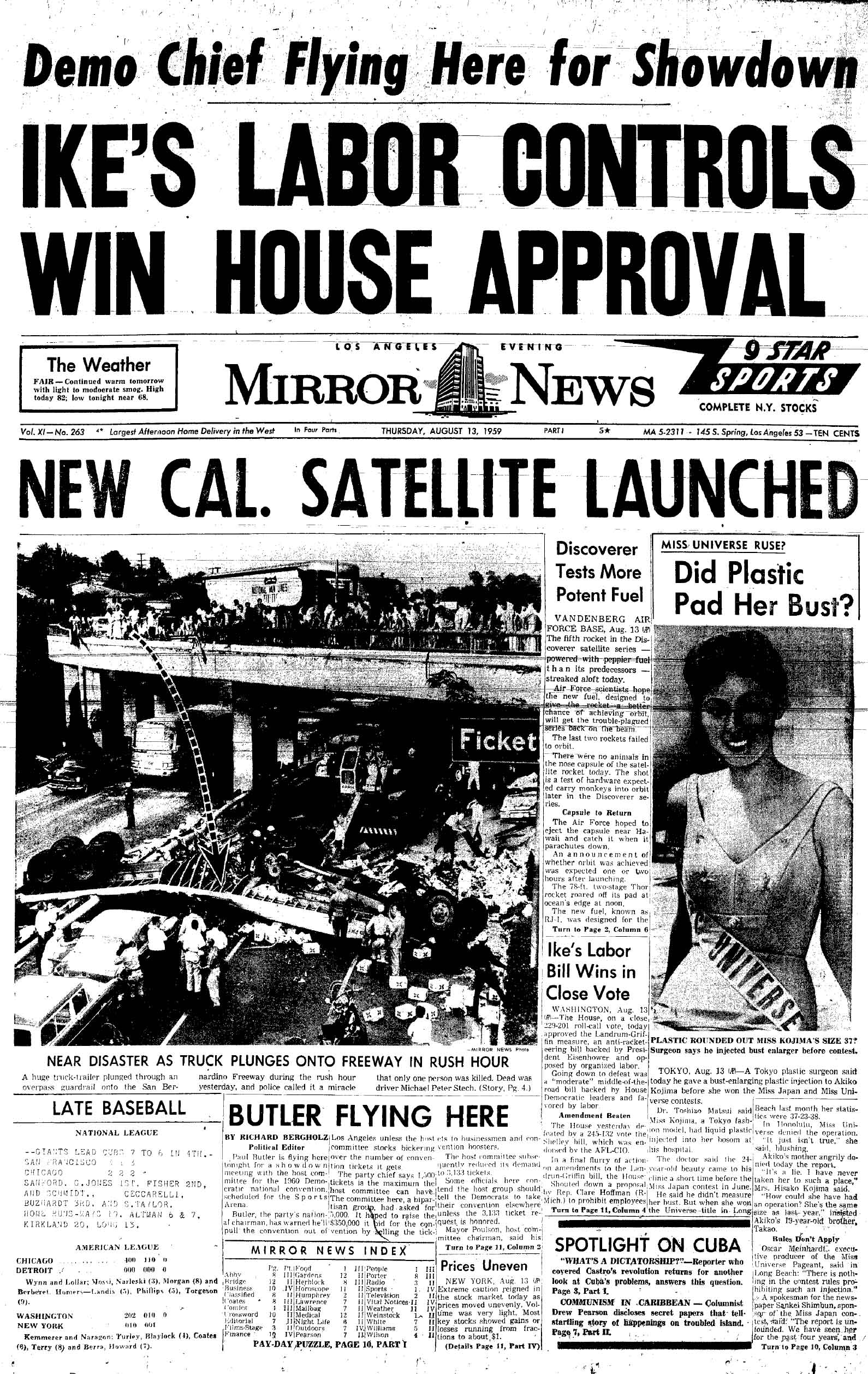 August 13, 1959: Did Miss Japan have plastic surgery?
  She was a pretty little girl with natural blond hair and baby-blue eyes with stars in them.

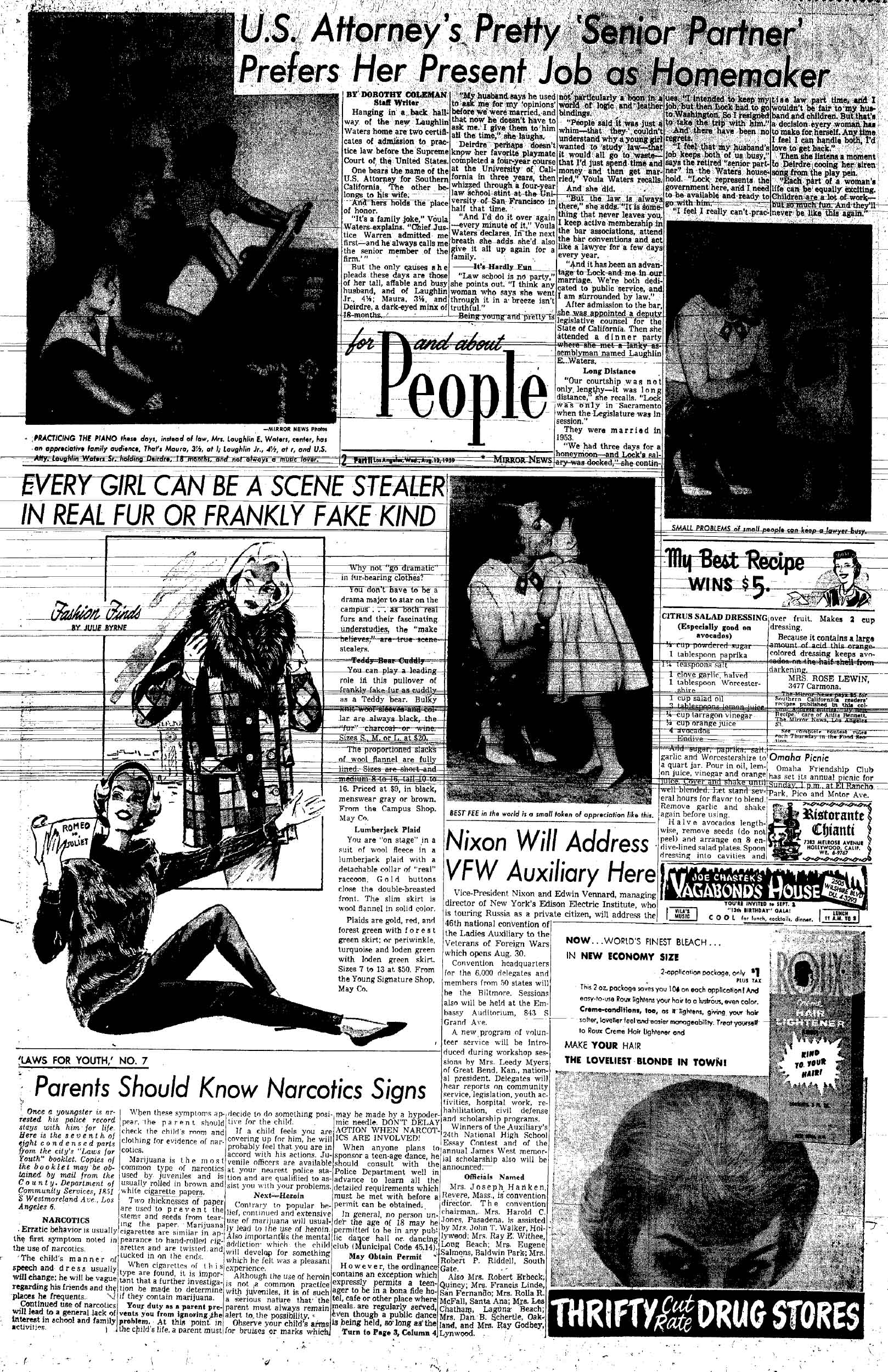 August 12, 1959: “People said it was just a whim — that they couldn’t understand why a young girl wanted to study law — that it would all go to waste — that I’d just spend time and money and then get married.”
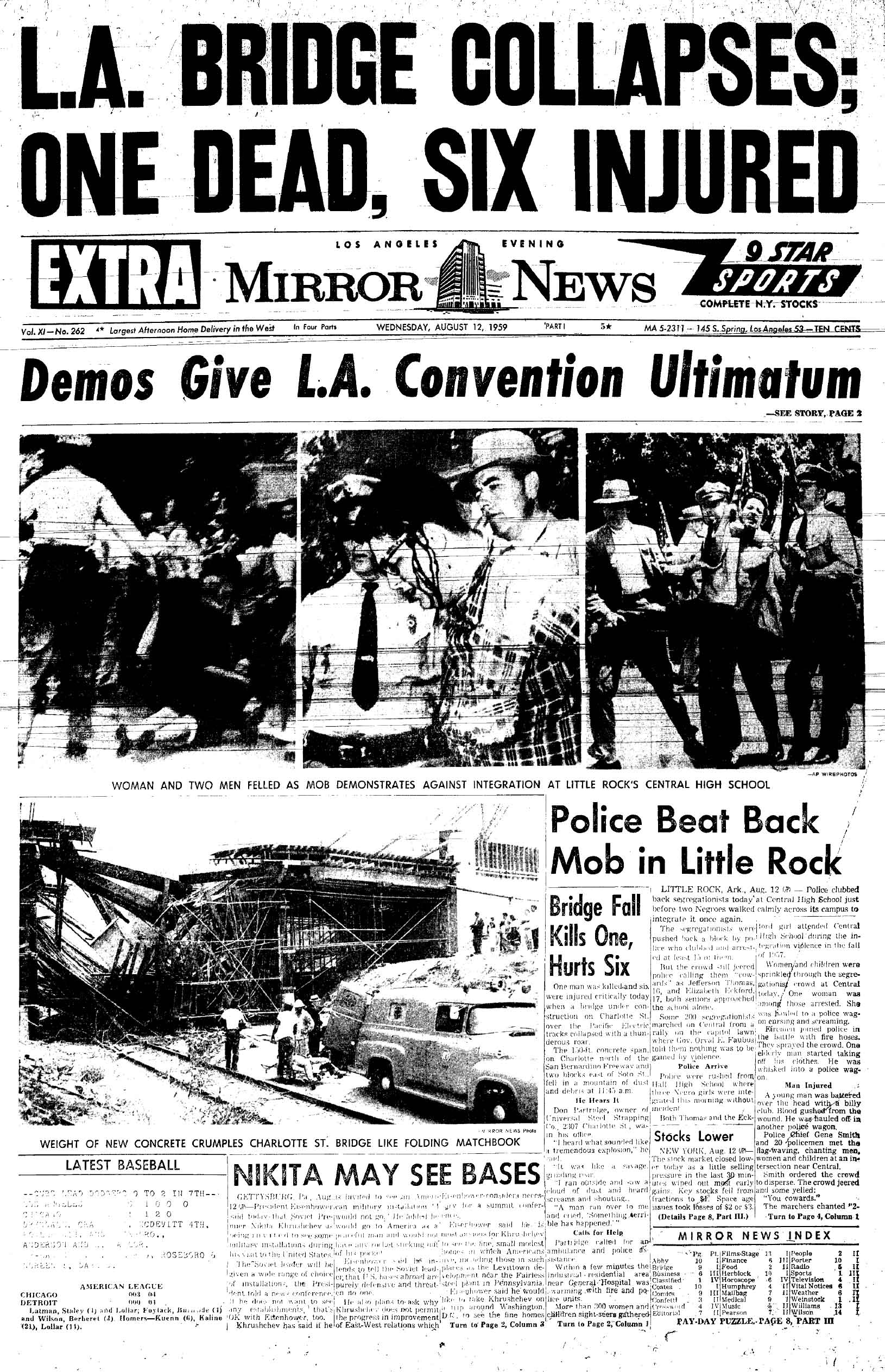 August 12, 1959: One man is killed and six are injured in the collapse of a bridge being built over the Pacific Electric tracks on

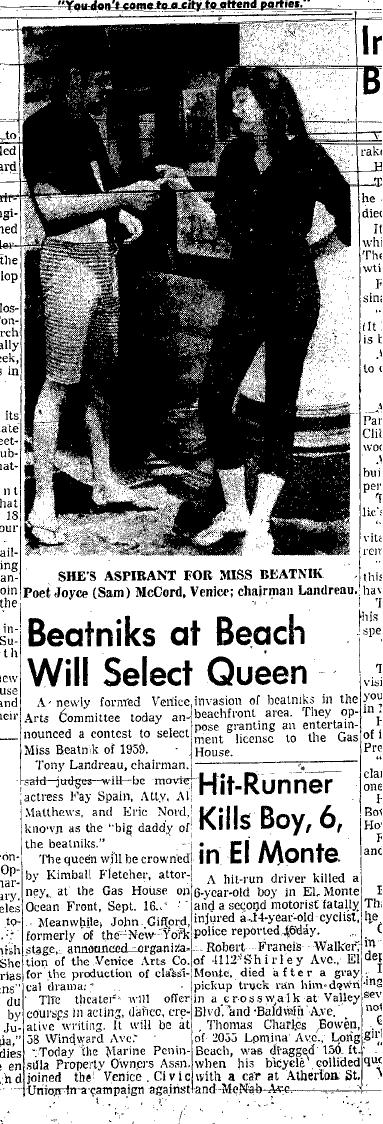 Wait a minute, the Beats reject things like beauty contests. What’s with this?
 ladailymirror.com


