Voices: Larry Gelbart, 1928 – 2009

June 17, 1951, Larry Gelbart

June 17, 1951: How Larry Gelbart got started in show business while he was a student at Fairfax High.  


Nov. 25, 1951, My L.A.

Nov. 25, 1951: Rehearsals of "My L.A.," sketches inspired by Matt Weinstock's book, with a script by Larry Gelbart, Laurence Marks and Bill Manhoff.


Nov. 25, 1951. My L.A.

Nov. 25, 1951, My L.A.

Nov. 3, 1972, Mash


Nov. 3, 1972: Larry Gelbart on writing "MASH" for TV.    

 
BOB HOPE 1903-2003

Comic wit of a century

* What a show. Animated as a cartoon, he amused presidents and delighted a loyal, loving public.

Tuesday July 29, 2003

By Larry Gelbart, Special to The Times

Paying tribute to Bob Hope in just a few short words is like trying to give Mt. Rushmore a close shave.

In
an industry that demands not only ever-newer faces, but also that the
older faces be made to look as if they were new all over again, Hope
boasted a career that had a shelf life of darn near an entire century.

The
year that he was born (following a nine-month tryout in the womb),
Roosevelt was in the White House. Theodore Roosevelt, that is; the 26th
of our presidents. Hope went on to entertain and become the confidant
and golf partner of succeeding U.S. presidents clear through to our
43rd. In a life that spanned the better and all of the worst parts of
the last hundred years — from TR to FDR, from Henry to Gerald Ford,
from Bush to Bush, Louis to Neil Armstrong, Bojangles to Jackie
Robinson, Karl Marx to Groucho, from vaudeville to video — America's
comic laureate never met a medium he couldn't, and didn't eventually,
master.

With his first radio show in May of 1937, Hope entered
the national consciousness he was not to leave for the next 60 years.
Either radio was invented for him or he was invented for radio, for it
was through that medium that, by generating incredible bursts of brio,
Hope made the family Philco crackle with his machine-gun delivery, his
style very much like another ex-hoofer, Jimmy Cagney. Only without the
snarl.

(Philco, for those of you who might quite possibly have
been born yesterday, was the name of a make of radio in the days when,
more than a mere appliance, radios could be surfed for their Web-like
usefulness; a wooden member of every household, they were, for the
family that owned one [one was enough in those days — one of
anything], its theater, its newsroom, encyclopedia, vaudeville house,
jukebox. Radio was a warm, friendly, benevolent friend — despite the
commercials it offered, wherein doctors instructed a simpler, sweeter,
goofier American on how much our digestive process could be aided by
the smoking of cigarettes.)

Although his radio shows are
somewhat inaccessible these days, it's altogether possible that
somewhere, way, way out there, high up in the ether, perhaps a member
of the Martian Marine Corps is laughing his heads off at Hope's cracks
about Bing's protruding ears or Jane Russell's equally outstanding
protrusions.

But see Bob on the big screen. See him on the
little one. See Bob run. See him clown and quip, see him lech and leer.
See how Bob always gave his all — which for anyone else would have
been all-and-a-half.

Walt Disney had to draw animation. Bob Hope embodied it.

In
1950, when he agreed to stick his head inside the then-new medium of
television, he did so with his characteristic confidence and sense of
adventure, knowing all that he had done before was prologue and that
the tube would prove to be his ideal, ultimate destination; knowing
that when vaudeville died, television was the box they put it in.

And
so, from his debut in 1950 until his final special in 1996, this Peck's
Bad Boy in a Windsor knot reigned supreme in a medium at once whimsical
and harsh, where some less-fortunate performers' shows have been known
to be canceled before the very first commercial.

God only knows
how much comedy material Hope consumed, this man for so many seasons —
how many ad-libs and trigger-fast comebacks he read off an endless sea
of cue cards that he was the first to call "idiot boards."

Faceless
we might have been, we who toiled endlessly to mine Hope's one-liners,
but we were always publicly appreciated by him — as we were privately
delighted by him.

Those who knew him knew that he never needed a
script in his hands to be humorous. His mind was as swift as his
delivery; his offstage, off-the-cuff remarks often far more spontaneous
and wittier than the sometimes too easy, by-the-numbers jokes we came
up with for him.

Here's a sample, though, of some of the best of
our work, one of the better jokes from a Bob Hope monologue. The
context will reveal its vintage.

"I see where Gen. Eisenhower has decided to run for president," Hope informs us.

Then adds:

"Just shows you what some guys won't do to get out of the Army."

Two
simple sentences, the joke is an example of democracy in action, Hope
demonstrating that in America even an immigrant boy can grow up to kid
the president. And use a bank shot off a five-star supreme commander in
the process.

For several decades and for far more wars than anyone ever wanted, one of Bob's sure-fire one-liners used to be:

"I just got back from Washington. I like to go there every once in a while just to visit my money."

In
these times, when numbers seem to have replaced words in the matter of
which is more important to us, there has been a good deal of
speculation as to just how many millions Bob Hope managed to stash away
throughout his mortal gig. The exact number is strictly between his
estate and the IRS. (His gift for business — not stage business but
rather business business — was not in any way less brilliant. His
long-ago agent, Jimmy Saphier, once told me that Bob had the smarts to
be able to run General Motors.)

Let us rather speculate, and
appreciate, how many millions — those millions we are sure of — whose
lives were enriched watching him as he displayed his gift for acting
the fool, the fool we were always certain was the person sitting right
next to us.

And for being cheeky, for trying to turn on an
achingly pretty woman and always getting turned down for his efforts,
instead of suffering that fate ourselves.

And, lastly, for
visiting the countless sons and daughters in faraway places — all the
husbands and fathers and sisters that we could not — to say how
grateful we at home were for the sacrifices they were making on our
behalf.

Asked to recall a favorite anecdote of the days I spent
working with Hope, my standard reply is that it was, in fact, one, long
anecdote that lasted four years.

Pressed for something that
won't take quite that long to retell, I repeat a telegram that he sent
ages ago to a former secretary of his — a young woman who had just
married. The message, which Bob had delivered to the bride on her first
night in her honeymoon suite, consisted of two words.

The two words were: "Act surprised."

Brevity, indeed, is the soul of wit.

And so, indeed, was Bob Hope.

*

Larry Gelbart wrote for Bob Hope from 1948 to 1952. He went on to write for Broadway and films.

Posted in broadcasting, Film, Hollywood, Obituaries, Television | 2 Comments

Paul V. Coates — Confidential File, Sept. 11, 1959

Sept. 11, 1959, Mirror Cover

Actor Paul Douglas dies at the age of 52.

Sept. 11, 1959, Victims

"The reading public is seldom aware of the enterprise, imagination, teamwork and tireless digging that goes into the achievement of an exclusive newspaper story.

The Mirror News published such a scoop yesterday when it identified the victims of a double murder in the desert near Victorville; a mystery that had defied solution by law enforcement agencies."

Although reporters in 2009 have Google and online databases in their arsenal, in many ways reporting hasn't changed much.

Sept. 11, 1959, Paul Coates

Confidential to Dorothy: Sorry. You came to your senses 10 years and three children too late. when a woman gives herself to a man for nothing (not even a marriage certificate) he usually figures she is worth exactly what she cost him.

Posted in Columnists, Film, Hollywood, Homicide, Obituaries, Paul Coates | Comments Off on Paul V. Coates — Confidential File, Sept. 11, 1959

A Kinder, Simpler Time Dept.: Your Movies

Sept. 11, 1929, Movies

Sept. 11, 1929: All talking … singing … dancing! "Broadway Melody." Note Lon Chaney in "Thunder," a film that is now lost.

Posted in Film, Hollywood | Comments Off on A Kinder, Simpler Time Dept.: Your Movies

Movie Star Mystery Photo

Sept. 7, 2009, Mystery Photo
 Los Angeles Times file photo

Oct. 23, 1954: Lance Fuller (1928 – 2001) in a publicity shot from Universal.

April 27, 1958, God's Little Acre Update: The cool cat is Lance Fuller. Please congratulate Dewey Webb, Michael Christian, Richard Heft and Stacia for identifying him! 

At right, a review of "God's Little Acre," which featured him.

Don't you Fedora Lounge folks love this guy?

Just
a reminder on how this works: I post the mystery photo on Monday and
reveal the answer on Friday … or on Saturday if I have a hard time
picking only five pictures; sometimes it's difficult to choose. To keep
the mystery photo from getting lost in the other entries, I move it
from Monday to Tuesday to Wednesday, etc., adding a photo every day.

I
have to approve all comments, so if your guess is posted immediately,
that means you're wrong. (And if a wrong guess has already been
submitted by someone else, there's no point in submitting it again.)

If
you're right, you will have to wait until Friday. There's no need to
submit your guess five times. Once is enough. The only prize is
bragging rights. 

The answer to last week's mystery star: Renzo Cesana!

Sept. 8, 2009, Mystery Photo

Los Angeles Times file photo

Update: Lance Fuller in a photo published June 9, 1955.

Here's another picture of our mystery guest!

Sept. 9, 2009, Mystery Photo

Los Angeles Times file photo

Feb. 4, 1955: According to the caption information, film exhibitor Joy Houck, left, of New Orleans, on behalf of Louisiana-Mississippi theater owners, presents plaques to Dorothy Malone and Lance Fuller as "the most promising star personalities of 1955." Malone's latest picture is Roger Corman's production "Five Guns West." Fuller recently completed "Kentucky Rifle."

Here's our mystery guest with some mystery companions. Please congratulate Mike Hawks for identifying him!

Sept. 10, 2009, Mystery Photo

Los Angeles Times file photo

June 6, 1958:  Robert Ryan as Ty Ty and Lance Fuller as his son in "God's Little Acre. Tina Louise was cropped out of the published version.

Here's our mystery guest with some mystery companions. Please congratulate Rinky Dink for identifying one of yesterday's mystery companions!


Posted in Film, Hollywood, Mystery Photo | 36 Comments

Dangers of Police, Firefighters Unions

Sept. 11, 1919, Comics  
"Wonder What Venus de Milo Thinks About" by Clare Briggs.

Sept. 11, 1919, Unions


The Times editorializes against unions for police officers and firefighters, asking: "Shall we expect union firemen to put out union-set fires?"

"Only a few days ago The Times called attention editorially to the secret organization of a policemen's union inside the Los Angeles police force, asked what steps had been taken by the mayor or the Police Commission to check the movement. It is within the jurisdiction of the Police Commission to require that each member of the force shall resign either from the union or the department. The spirit of Los Angeles is such that it will not tolerate a police force that has sworn allegiance to an organization that incites and fosters arson, incendiarism, strikes, sabotage and willful disregard for the law."

Posted in City Hall, Comics, LAPD | Comments Off on Dangers of Police, Firefighters Unions

Colored YMCA to Dedicate Headquarters

Sept. 11, 1909, Horoscope

Sept. 11, 1909: The daily horoscope, which The Times published on the editorial page. "Women will hear good news from afar."

Sept. 11, 1909, YMCA

The Colored Young Men's Christian Assn. will open at 829 S. San Pedro St. The building has a gymnasium, a dining room and 12 bedrooms. 

Posted in Downtown, Religion | Comments Off on Colored YMCA to Dedicate Headquarters

Found on EBay — Batchelder Fireplace

Batchelder Fireplace

An entire Batchelder tile fireplace has been listed on EBay. Not to be confused with the other Batchelder fireplace in a Fullerton house that was listed in April, with a starting price of $20,000. Bidding on this fireplace starts at $2,300.
Posted in Architecture | Comments Off on Found on EBay — Batchelder Fireplace

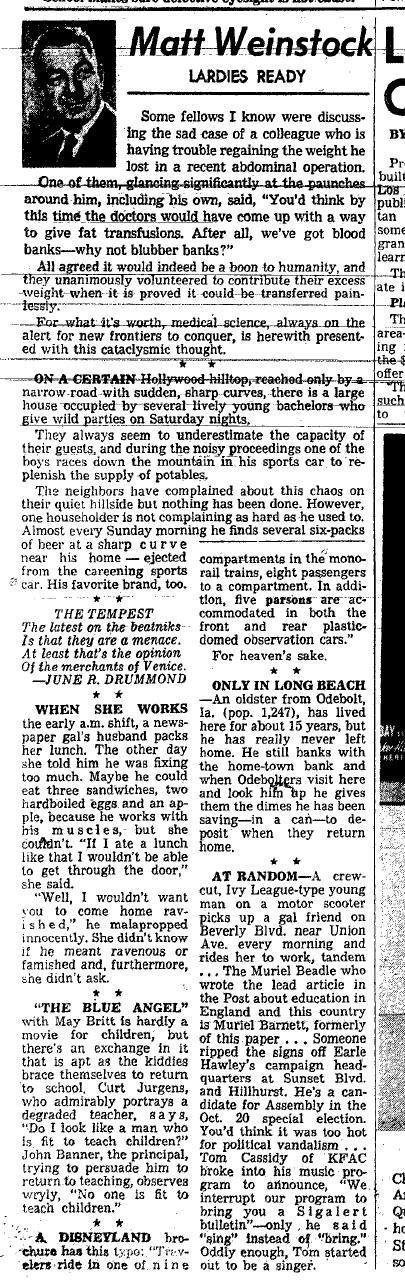
September 10, 1959: Matt Weinstock

September 10, 1959: Should doctors do fat transfusions? Matt Weinstock takes a look.

Posted in Columnists, Matt Weinstock | Comments Off on September 10, 1959: Matt Weinstock

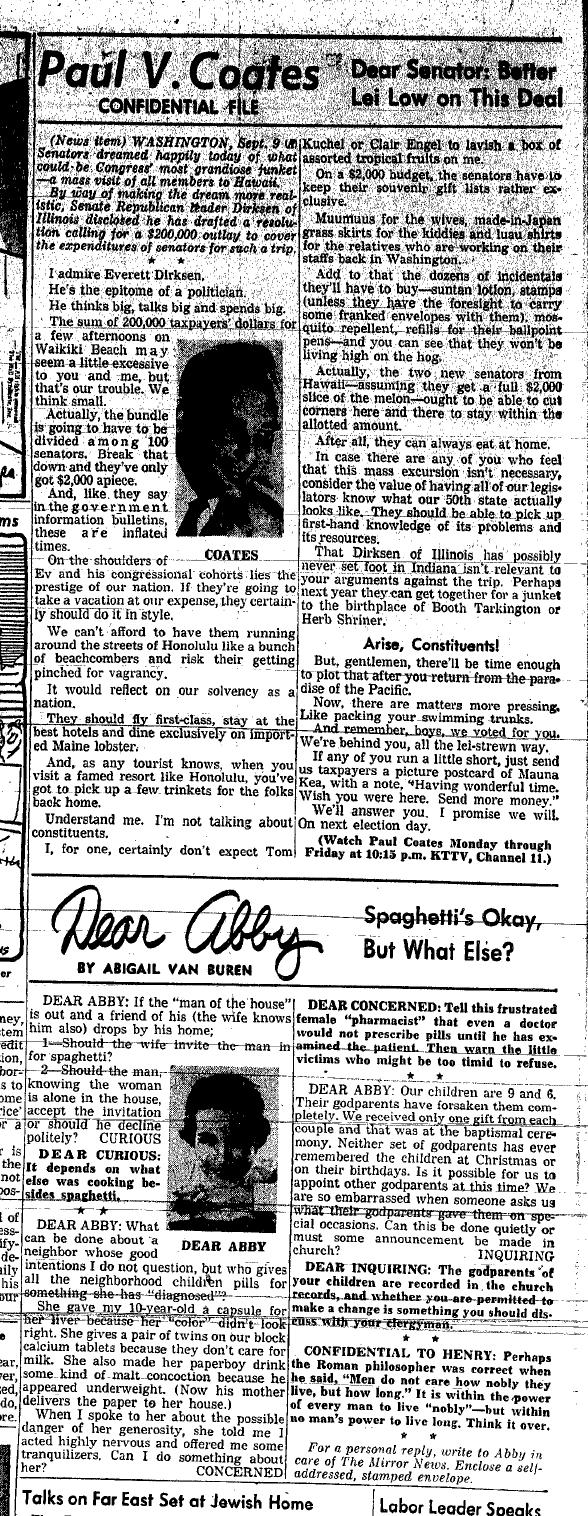
September 10, 1959: Paul V. Coates — Confidential File

September 10, 1959: Sen. Everett Dirksen (R-Ill) wants a Senate junket to Hawaii, and Paul Coates has thoughts.

Posted in Columnists, Paul Coates | Comments Off on September 10, 1959: Paul V. Coates — Confidential File

A Kinder, Simpler Time Dept.: Jazz Mad Morals

Sept. 10, 1928, Comics

Sept. 10, 1928: "Once Overs" by Clarence Daniel Batchelor, who won a Pulitzer Prize in 1937 for this cartoon:

Batchelor_daddy

"Come on in, I'll treat you right. I used to know your daddy."

Sept. 10, 1928, Movies

Ronald Colman and Vilma Banky in "Two Lovers," Samuel Goldwyn's first sound picture! "White Shadows in the South Seas" at Grauman's Chinese Theatre … and a very busy Edward Everett Horton.

Posted in art and artists, Film, Hollywood, Stage | Comments Off on A Kinder, Simpler Time Dept.: Jazz Mad Morals

Don’t Underestimate Khrushchev

Sept. 10, 1959, Khrushchev

Sept. 10, 1959: A tidy little piece showing just how much Americans feared Nikita Khrushchev.

Sept. 10, 1959, Tom Lehrer


"So Long, Mom. I'm Off to Drop the Bomb."

"We'll All Go Together When We Go"

At left, Tom Lehrer performs at UCLA. His satirical songs perfectly captured the nation's anxieties and were a breath of fresh air in the depths of the Cold War. Lehrer retired from performing and composing, with a few exceptions.  Fortunately (or perhaps not since he was singing about things like intolerance and mass destruction) his humor remains relevant.  

Sept. 10, 1959, Sports

Don Drysdale throws his fourth shutout of the season, 1-0, against the Phillies. Because of the results in other games, the Dodgers remained tied with Milwaukee for second, three games behind the Giants… We  could say that the space between goal posts in college football has been widened by 58 inches. But that would be too easy. So we say they are 2 inches less than five feet farther apart.

Posted in Dodgers, Music, Politics, Sports, Stage | Comments Off on Don’t Underestimate Khrushchev

Santa Monica Dedicates Pier

Sept. 10, 1909, Cover

Sept. 10, 1909: Edward Henry Harriman, "the master builder of railways," dies after a long illness, but the news is withheld from reporters until the stock market closes. Cmdr. Robert Peary files Part 2 of his description of discovering the North Pole.
Sept. 10, 1909, Evan Williams
Evan Williams sings "Auld Lang Syne." RCA Victor records cost $23.67 to $35.51 USD 2008.

Sept. 10, 1909, Harriman
A map shows the extent of Harriman's railroad holdings.

Sept. 10, 1909, Harriman

"Los Angeles people were accustomed to think of E.H. Harriman as a distant magnate who owned some railroads away off somewhere. When the commercial associations of this city appointed committees to ask him for new depots, they always spoke of 'you' and of 'our city.' But in reality, it was more Harriman's city than theirs…. He controlled two, and probably all three, of the transcontinental railroads which connect Los Angeles with the East. He owned an even half-interest in the great Pacific Electric system, the greatest interurban trolley road in the world."

Sept. 10, 1909, Harriman
Harriman was "bold, astute and energetic."

Sept. 10, 1909, Peary
Smashed sledges and frostbite on Peary's trip north.

Sept. 10, 1909, Pier

"Admission Day's principal celebration in Los Angeles County yesterday centered at Santa Monica, where representative citizens gathered in thousands to join with the old city by the sea in the dedication of its municipal pier, which is declared to be the best of its kind ever committed to public use, and unique in many respects."

Sept. 10, 1909, Motorcycles

The Los Angeles Motorcycle Club holds its annual meet at Ascot Park. The winner of the five-mile race rode an Indian motorcycle.
Sept. 10, 1909, Hats
"While sleeping?"
Sept. 10, 1909, Santa Monica Pier

    "…gathered as it has been from every part of the world, there cannot fail to come out from California in the years and centuries to come, men that shall do honor to their progenitors, and do honor to the nation, of which this state shall be one of the most proud."

[Applause.]"

Posted in Fashion, Front Pages, health, Obituaries, Transportation, travel | Comments Off on Santa Monica Dedicates Pier

Found on EBay — Hollywood Spin

Hollywood Spin EBay

An unusual novelty — a board game based on Hollywood streets — has been listed on EBay. Hollywood Spin is similar to Monopoly, according to the vendor, with familiar landmarks from the 1940s like Earl Carroll's and the Brown Derby. Evidently The Times never wrote about this item, marketed by World Games of Hollywood. Bidding starts at $24.99.
Posted in #games, Hollywood, Transportation | Comments Off on Found on EBay — Hollywood Spin

Matt Weinstock, Sept. 9, 1959

Sept. 9, 1959, Matt Weinstock

A lady named Harriett who frequents the Rainbow bar favors a slice of dill pickle in her beer, which she inhales with the last swallow….

Posted in Columnists, Matt Weinstock | Comments Off on Matt Weinstock, Sept. 9, 1959

Paul Coates — Confidential File, Sept. 9, 1959


Sept. 9, 1959, Cover

Sept. 9, 1959: A man and a woman are found shot in the head 400 feet off California 395, seven miles north of Adelanto. In the man's pocket is a letter so covered with blood that only one word is legible: "Love."

The couple were eventually identified as Richard L. Nowlen, an escaped convict, and Patricia Skene. Investigation determined that Nowlen and Skene planned to get married and had taken a trip with Sandra (Sondra) Ground Garner and Lawrence Garner as a combination wedding trip and expedition to plan forgeries. When asked why he killed Nowlen, Lawrence Garner said: "I did not like him. He was an arrogant character." He shot Skene in the back of the head as she embraced the dying man.

In May 1960, Sandra Garner was sentenced to life in prison for the killings. Lawrence Garner was executed in the gas chamber Sept. 4, 1962.

Sept. 9, 1959, Paul Coates  

Dear Abby: You are my last hope. I will be frank with you. I am a 15-year-old girl who has been going steady with a 17-year-old boy. I know it was wrong but before we could control ourselves we went too far. I think I am pregnant but I'm not sure. If I go to a doctor, he will tell my mother. Neither my boyfriend nor I have the kind of parents you can talk to. I heard if I am pregnant they can send my boyfriend to prison because I am underage. We don't know which way to turn, Abby. Please put this in the paper and tell me what to do. I can't sign my real name.

Posted in Columnists, Paul Coates | Comments Off on Paul Coates — Confidential File, Sept. 9, 1959

A Kinder, Simpler Time Dept. : Your Films

Sept. 9, 1927, Movies

Sept. 9, 1927: Harry Langdon in "Three's a Crowd" and King Vidor's "The Big Parade." And Al Jolson in a live show at the Metropolitan. With Rube Wolf!

Sept. 11, 1927, Al Jolson  

Posted in Film, Hollywood | 1 Comment

A Shotgun Divorce

Sept. 9, 1919, Schools

Sept. 9, 1919: Military schools are flourishing in Los Angeles.

Sept. 9, 1919, Shotgun

Someone came up behind Frank Gentile while he was sleeping on the couch and blew off the back of his head with a 16-gauge shotgun. Because he was Italian, police naturally assumed it was the work of mobsters. But no, further investigation discovers a double-barreled 16-gauge shotgun, recently fired, in a closet and Gentile's wife, Maggie, is charged.

Posted in #courts, Education, Homicide, LAPD | Comments Off on A Shotgun Divorce

A Fatal Can of Chili?

Sept. 9, 1909, Venice
Sept. 9, 1909: Follow the crowds to Venice!

Sept. 9, 1909, Poison

The
city chemist's failure to analyze a half-empty can of chili con carne
before it spoiled — preventing a test for food poisoning — figures in
the murder trial of Harper E. Bennett. Prosecutors accused Bennett of
killing his wife, Eugenia, because he was having an affair with Midge
Molster, the wife of E.P. Molster. A chemical analysis found strychnine
in the dead woman's exhumed body, but a doctor testified that he gave
her a mild shot of the poison to steady her heart.

A mistrial was declared when the jury deadlocked and Bennett evidently
left for Mexico before he could be retried. In September 1910, E.P.
Molster won a divorce from his wife, charging that she "had been guilty
of adultery with Harper E. Bennett at the Hotel Dakota at divers and
sundry times within the past two years."

P.J. Durbin, Vernon's city trustee, says his political enemies are trying to poison him with strychnine.

Posted in #courts, Food and Drink, Politics | Comments Off on A Fatal Can of Chili?

Voices — Army Archerd, 1922 – 2009

Perfect Casting

* The Role Called for a Dapper Guy Who Could Schmooze With
Hollywood's Rich and Famous as They Arrived at the Academy Awards.
Enter Army Archerd. The Rest Is History.


Sunday March 21, 1999

By ROBIN ABCARIAN, Robin Abcarian is a former Times columnist. Her last feature for the magazine was on Steve Soboroff

So
far, the columnist has written only two words on his computer screen.
They are the same words he always begins with: "Good Morning." He is
not visibly nervous, but he is not relaxed. Despite his gracious
welcome and genteel air, a visitor feels like an intruder. Deadline is
a mere six hours away.

From his mid-Wilshire corner office, the
clarity of winter has produced a postcard view of palm trees, mountains
and sky: what people in Peoria might imagine when they dream of
Hollywood. The columnist hasn't noticed. His back is to the window.
"Mind if I roll up my sleeves?" he asks. The phone rings. He picks it
up, takes a sheet from a tall stack of yellow paper at his right elbow
and positions it just so. He grabs his pen. His tone is convivial and
clipped. In an industry that invented the dilatory art of schmooze,
Daily Variety's Army Archerd is a model of verbal economy.

Hello?
Hi, Paul, how are you? OK, thanks. Not too shabby! Whose company is it?
Uh-huh. So it's to be released as a feature, or on tape? I see. This is
directly from the play? Who did the script? Oh, that's great! So he
doesn't have to complain about the changeover from the play to the
movie. Is he on the set or anything? I see. Sorry you didn't get to put
Mira in the picture, though. She's terrific.

A second line
rings. Hold on a sec, please. Hello? Yeah, are you still with the actor
Benigni? I have a terrific story on him that I just found out early
this morning and I HAVE to talk to him, so could you reach him for me?
You know, of course, he knows me from Europe and so on. So could you
please have him call me? It's about the lady whom he and his wife had
dinner with last night, and I was wondering how that all came about.
Thanks. Goodbye.

Sorry, Paul. So, where are you shooting?

If
you're a civilian, as those in The Industry call those who are not, you
may know Army Archerd as the dapper gentleman who interviews the stars
as they arrive at the Academy Awards, a task he has performed each year
since 1958, or perhaps as a co-host and associate producer of the
annual People's Choice Awards since its inception in 1974, or, more
recently, as a contributor to the E! channel's "Gossip Show."

If
you're an insider, the 77-year-old Archerd is a household name, maybe a
daily presence. Since 1953, he has churned out his "Just for Variety"
columns at the rate of five a week, cutting back to four a week only in
the last year. With a circulation of 35,500, Daily Variety, which
chronicles the wheelings and dealings of Hollywood, is a minnow in a
media ocean. But look who's reading: According to a survey commissioned
by Variety last year, the average reader has a household income of
$404,000.

Archerd's readers don't look to his Page 2 column for
attitude or poetry. They want information, and his "just the facts,
ma'am" tone fits the bill. The column–replete with the slangy jargon
peculiar to Variety (where films are lensed, not shot, and helmed, not
directed) and a soupon of French–is a three-dot stew of celebrity
items (restaurant sightings, couplings and uncouplings, births, deaths
and illness) and industry information (deals, shoots, fund-raisers,
lawsuits, parties). Archerd says his only criterion is newsworthiness.
And, preferably, exclusivity. Some of his items may read like press
releases, but you can be sure he had them first. And, perhaps
understandably, given his age and experience, the folks who populate
his column are more Chasen's than Sky Bar. "He's not writing a lot
about Cameron Diaz," says one industry observer.

Daily Variety
editor in chief Peter Bart calls him "one part community bulletin
board, one part community conscience, one part cheering section."
Archerd's energy and dedication amaze (and gratify) his boss: "He never
comes close to burnout," says Bart. "I wish some of our younger
reporters got as excited as he does when he lands a big story. He is
genuinely an example of someone who loves what he does. It is perfect
casting."

"He clearly likes most of the people he writes about,
but he doesn't fawn over them," says Damien Bona, co-author of "Inside
Oscar: The Unofficial History of the Academy Awards." "For anyone
interested in the film industry, he's invaluable."

Archerd is so
reliable that when a severe bout of flu in 1983 forced him to miss work
for the first time in 30 years, the Associated Press reported that
"confusion and consternation reigned [in Hollywood] when the column
failed to appear for three days."

"What shakes me up about his
columns is that in most of them he must have 18 different things," says
producer Aaron Spelling, a longtime friend who briefly shared his house
with Archerd in the late '60s after Archerd's first marriage broke up.
"How in the hell does he find out all these things?"

Don't
forget, says Archerd, "I've been doing this for a while. So I have a
lot of friends and people I know in the business. And publicists, of
course, always want to see their clients in the column."

Although
Archerd receives tips in a constant stream of phone calls and faxes, he
says he always tries to speak directly to the players. His friendships
lead to items as well. (So, for instance, in August 1989, amid a swirl
of rumors that their marriage was on the rocks because of wifely
wandering, he sat down with the Spellings. "These stories make me out
to be a slut," a tearful Candy Spelling told Archerd. The wire services
loved it.)

Should you catch him on television this evening, it
is unlikely you will notice that Archerd had trouble sleeping last
night. And though it is possible that he passed the night in blissful
slumber, it is also extremely unlikely. For just as it is an annual
tradition that Archerd greets and interviews Hollywood's bejeweled and
bespoke as they arrive at the Oscars "kudocast," so it is a tradition
that Archerd is too nervous to sleep well the night before.

At least that is what he would have you believe.

And
there is no reason to doubt him. A hallmark of Archerd's longevity is
his reputation for keeping his word. It is a quality rivaled only by
that extraordinary work ethic, a thing so ferocious one suspects it is
partly fueled by fear: Fear of getting scooped. Fear of missing a
deadline. Fear of blundering in front of an audience, or, worse, in
print.

Bart says it took a long time to get Archerd to agree to
drop one column a week. "The first thing he said was, 'But someone may
scoop me!' "

*

Archerd was given his first break by Bob
Thomas of Associated Press, the only reporter Archerd can think of
whose Oscar attendance record exceeds his own. (Thomas, 13 days younger
than Archerd, will be attending his 55th show tonight.) The pair had
attended UCLA together, but did not meet until after Archerd was
discharged from the Navy in 1945. Thomas hired him as a "leg man" to
help compile Hollywood items for his AP wire column.

"I wouldn't be here if it wasn't for Bob," says Archerd.

In 1947, Archerd left AP and hired on as leg man for another Hollywood columnist, Harrison Carroll of Hearst's Herald-Express.

Six
years later, in 1953, Daily Variety hired him when columnist Sheilah
Graham left. His column debuted on April 27: "Good Morning: Here's the
public's answer to the future of 3-D: nine out of 10 want to see more."
He ended the year on a poignant note: "An over-dressed gal, waiting for
a table at a Las Vegas supper club: 'Isn't this disgusting, isn't this
awful–waiting.' A soft voice behind her: 'I don't mind–I can remember
waiting in line for bread.' Happy New Year!"

Over time, Archerd
has been criticized for accepting fees from studios to emcee premieres
and for taking first-class studio-paid junkets to movie sets. A
double-standard in the Daily Variety newsroom?

Archerd, says
Peter Bart, "has done this work over decades. I think one has to allow
for the fact that someone doing something over generations does present
a circumstance that is different from someone who's more recently
hired."

Asked if he accepts gifts, Archerd replies, "I don't ask
for anything, but I don't insult people." And though the tone of his
column is generally sunny and informational–one mid-level studio
publicist says "people use him because he's kind"–he is capable of
stinging criticism.

He's knocked Jerry Lewis for "mimicking
people by being grotesque and making fun of their deficiencies . . .
and he's involved in that charity."

He has taken on Charlton
Heston over gun control. In 1995 and 1996 in at least five columns,
Archerd, who is Jewish, slammed Michael Jackson hard for using
anti-Semitic slurs in his song "They Don't Care About Us."

Jackson called Archerd to apologize and to announce that he would be changing the lyrics.

Recently,
Archerd waded into the controversy surrounding the honorary Oscar that
is to be presented tonight to Elia Kazan. In one piece, he recounted
the professional wreckage that followed the director's 1952 appearance
before the House Un-American Activities Committee and concluded: "I,
for one, will not be giving him a standing ovation."

Writer
Larry Gelbart, who has known Archerd for nearly 30 years, says the
columnist's opinions get respect "because most people know that Army
does not use his position as a vehicle of revenge or for
self-promotion. He knows his place is secure and recognized and he
doesn't have to wear all his medals to impress us."

Those
"medals" include a star in front of Mann's Chinese Theatre on the
Hollywood Walk of Fame ("My mother was very pleased," says Archerd.)
and a special plaque from the Academy of Motion Picture Arts &
Sciences for his Oscar arrival emceeing. He has also played himself in
countless movies and TV shows.

When asked to name his friends,
the short list is composed of names from Hollywood's old guard: Paul
Newman, Gregory Peck, Sidney Poitier, Kirk Douglas.

"He really
is the straight arrow by which all other columnists should measure
themselves," says Paul Newman. "He's painfully honest and he does his
homework, and he never publishes anything without getting double
verification on it."

"We all know he is absolutely trustworthy,"
says Gregory Peck, who calls his longtime friend Armand. "If you tell
him something off the record, he will never betray you. He keeps a
confidence, and I think that's why he has been able to write this
column for so long. He doesn't grind axes."

"Here is a guy whose word is his bond," says Sidney Poitier.

Archerd
is gracious and courtly with stars and big names, but not every
industry insider loves him. Some publicists who refuse to be named say
his terse telephone manner is rude and intimidating. "I don't think
anyone looks forward to calling him," says one.

"He should be
respected when he's been doing something as long as he has," says a
former studio executive with decades of experience. "But he isn't
breaking news the way he used to." Although Archerd prides himself on
never having printed a retraction, some of his industry sources say
this is because he refuses to acknowledge his mistakes.

Don't
tell that to Selma Archerd, who fell in love with her husband at 16 (he
was 19 and they met at a party) and married him 28 years later after
both of their first marriages ended in divorce. Between them, they have
four children and five grandchildren–one of whom, to his delight, has
nicknamed Archerd "Honey." Selma is as outspoken about her husband's
career as he is modest.

"I am very proud of him and I am very
fierce about protecting the status of what he is," says Selma, an
actress with a recurring role of Nurse Amy on "Melrose Place," which is
produced by Aaron Spelling. "He isn't the richest man in the world, or
the most powerful . . . but what he has, I want respected. And I'll
take the title of pain in the ass so that he will be respected."

And he does get respect.

Occasionally,
Archerd's juicy celebrity items are worldwide scoops. He was the first
to report in 1991 that Julia Roberts had flaked out on Kiefer
Sutherland three days before the wedding, first to announce in 1992
that Annette Bening had secretly removed Warren Beatty, the father of
her infant daughter, from the active list.

"He was first to report that my salad dressing was outgrossing my movies," says Paul Newman.

He
broke the biggest story of his career on July 23, 1985: "The whispering
campaign on Rock Hudson can and should stop. He has flown to Paris for
further help. His illness was no secret to close Hollywood friends, but
its true nature was divulged to very, very few. Doctors warn that the
dread disease is going to reach catastrophic proportions in all
communities if a cure is not soon found."

The story rocked the world.

"It was a thunder strike," says Bob Thomas.

For
two days, Hudson's spokespeople maintained that the actor had flown to
Paris to be treated for liver cancer or unexplainable fatigue.

"Someone
had anonymously mailed him a photocopy of the doctor's records," says
Selma Archerd. "And he'd had them for months, but it was so devastating
to print it. It was so shocking–someone that you actually knew! But he
waited until Rock was really out of it. The press agents tried to
discredit Army. His [previous] editor said he might have to retract it.
And Army said, 'Please don't do that to me. The story is right.' And,
of course, it proved to be right."

Archerd is so well-connected
that, if a star takes ill, chances are he will reach a family member
for a bedside quote. "He knows all the numbers of all the nurses on
every floor of every hospital," says Bart.

Each day at the
office, an intern delivers to his desk a stack of gossip and Hollywood
columns from New York newspapers, which he reads, he says, "to see what
they've stolen from me or if someone has double planted an item."

*

If
all goes as planned, Archerd will have spent Saturday observing Oscar
rehearsals at the Dorothy Chandler Pavilion. This morning, he will
write the bottom half of his Monday column and arrive downtown at about
2 p.m. He'll chat with the director of the show, check outside to size
up the crowd. Around 4 p.m., he'll mount the platform that puts him
close to the star-struck civilians who have camped out in temporary
bleachers.

"Good evening, movie fans!" he will say, paraphrasing
his famous column opening. And the movie fans, he says, chant his name
and "go berserk." ("It always amazes me that anyone knows who the hell
I am," he says.) For the next 90 minutes, assisted by two Oscar
staffers, he will greet and interview the stars. Around him, controlled
chaos will reign: paparazzi, mainstream photographers and reporters
will jostle for space along the roped-off red carpet as boisterous fans
scream the names of arriving stars. As news helicopters hover, the
fringes will teem with police officers, security guards, scantily clad
has-beens or never-weres vying for attention, anonymous, unglamorous
academy members, perhaps a few protesters with placards.

Archerd,
his head crammed full of names and facts, will be above the fray. In
his Armani tuxedo, silk tie from Harrod's and black velvet smoking
slippers gilded with his initials embroidered on the toes, he will be,
promises his wife Selma, "sartorially perfect."

He will be a
picture of cool as he interviews the Gwyneths, the Toms, the Billy
Bobs. But he will not be relaxed. Because as he's asking, say, "Saving
Private Ryan's" Steven Spielberg how he's feeling tonight compared to
how he felt when he was nominated for "Schindler's List," he will be
keeping an eye on who is arriving and needs to be interviewed and the
dwindling time. "That clock," he says, "waits for no one."

Moments
before the show begins, he will take his seat. Now his job will be to
report for his readers what happens in the auditorium, the tidbits they
won't see on TV. As the Best Picture Oscar is being announced, the
columnist will slide out of his seat and make his way to the aisle.
He'll wait to see how the audience reacts, then will dash to an
elevator and compose a lead on his way up to the pressroom. He'll file
the top of his column by phone, grab a sandwich, then a notebook, and
head to the Governors Ball, then into the party-filled night. He is,
needless to say, invited to everything.

Monday morning, he'll be
at his desk. He will sit with his back to the window, his yellow paper
neatly stacked, his pen at the ready. He will type the words "Good
Morning." The phone lines will ring. And the conversation will go
something like this:

Hello? You're where? Paris? Coming back to L.A. tomorrow? My God. Who? Oh, great. I beg your pardon. Hold on a sec.

Hello?
So are you on budget and on schedule? How many days now? Oh, that's
great! Wonderful . . . I gotta put that down exactly. So have you got
any other things you're trying to direct? OK, well, let me know about
it when they do happen. Don't let me read about it, OK?

Hello?

Posted in Film, Hollywood, Obituaries | Comments Off on Voices — Army Archerd, 1922 – 2009

Matt Weinstock, Sept. 8, 1959

Sept. 8, 1959, Matt Weinstock

Matt Weinstock goes to the Hollywood Bowl to hear Van Cliburn….

Posted in Columnists, Matt Weinstock | Comments Off on Matt Weinstock, Sept. 8, 1959