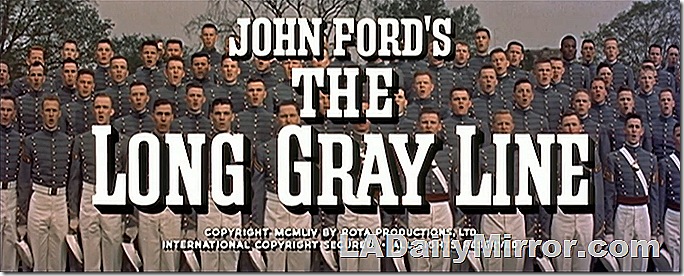
This week’s mystery movie was the 1955 Columbia film The Long Gray Line, with Tyrone Power, Maureen O’Hara, Robert Francis, Donald Crisp, Ward Bond, Betsy Palmer, Phil Carey, William Leslie, Harry Carey Jr., Patrick Wayne, Sean McClory, Peter Graves, Milburn Stone, Erin O’Brien Moore, Walter D. Ehlers and Willis Bouchey.
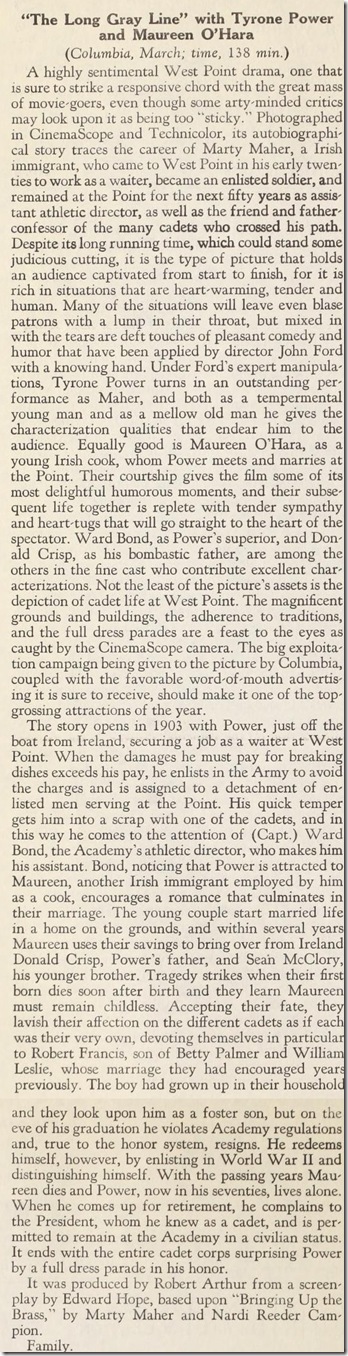 Screenplay by Edward Hope.
Based upon Bringing Up the Brass by Marty Maher and Nardi Reeder Campion.
Color by Technicolor.
Photography by Charles Lawton Jr.
Technicolor color consultant Francis Cugat.
Gowns by Jean Louis.
Music supervised by Morris Stoloff.
Musical adaptation by George Duning.
Art direction by Robert Peterson.
Edited by William A. Lyon.
Assistant directors Wingate Smith and Jack Corrick.
Technical advisers Lt. Col. George McIntyre and Maj. George Pappas.
Makeup by Clay Campbell.
Hairstyles by Helen Hunt.
Sound by John Livadary and George Cooper.
Re-recording by Richard Olson.
Photographed in CinemaScope.
Produced by Robert Arthur.
Directed by John Ford.
Further information on The Long Gray Line is available from the AFI Catalog.
The Long Gray Line is available on DVD from Amazon.
::
I picked The Long Gray Line by going through the trades and it looked interesting: A lesser-known John Ford film with some strong reviews and very few screen captures on IMDB. The story is a bit predictable but well-handled and the leads are good. There are lots of familiar faces in the cast who went on to long careers in television.
I’m not sure how Bosley called this one. Maybe he said it was obvious (in some ways it is), maybe he was entranced by the CinemaScope and Technicolor. I’m guessing at least a middling review.
He liked it quite a bit! (The New York Times, February 11, 1955):
If the green of the shamrock seems to color Columbia’s The Long Gray Line, which trooped with pennants snapping into the Capitol yesterday, it is not in the least surprising. This film tells the story of Marty Maher, a much-beloved athletic trainer and instructor at West Point for fifty years. The role of the Irish hero is played by Tyrone Power. And the picture is lustily directed by that most positive Hibernian, John Ford.
As a consequence, this rich and rousing tribute to West Point and Sgt. Maher, to the academy’s deep traditions and to its long line of loyal cadets, tends somehow to leave the impression that the Irish captured the Point when Marty Maher took up residence and that it continued that way for fifty years.
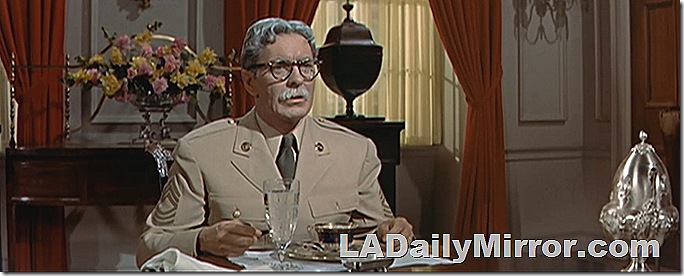
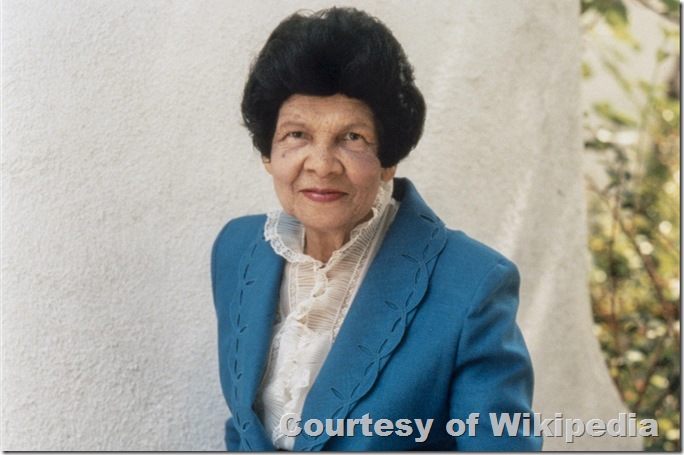
For Monday, we have a mysterious fellow.
Update: This is Tyrone Power in heavy age makeup.
Continue reading →

 ladailymirror.com