Photo: City Hall, Sunday, Sept. 11, 2011. Credit: Larry Harnisch/LADailyMirror.com
Photo: City Hall, Sunday, Sept. 11, 2011. Credit: Larry Harnisch/LADailyMirror.com
 Note: This is an encore post from 2006.
Sept. 11, 1907
Direct Wire From New York
Wow! Now this is the kind of quote one simply doesn’t see every day, at least in the 21st century. The Victorians certainly had a different attitude toward women’s physiques:
“The woman who gets the proper sort of corset will have the fashionable figure, even if she weighs a ton.”
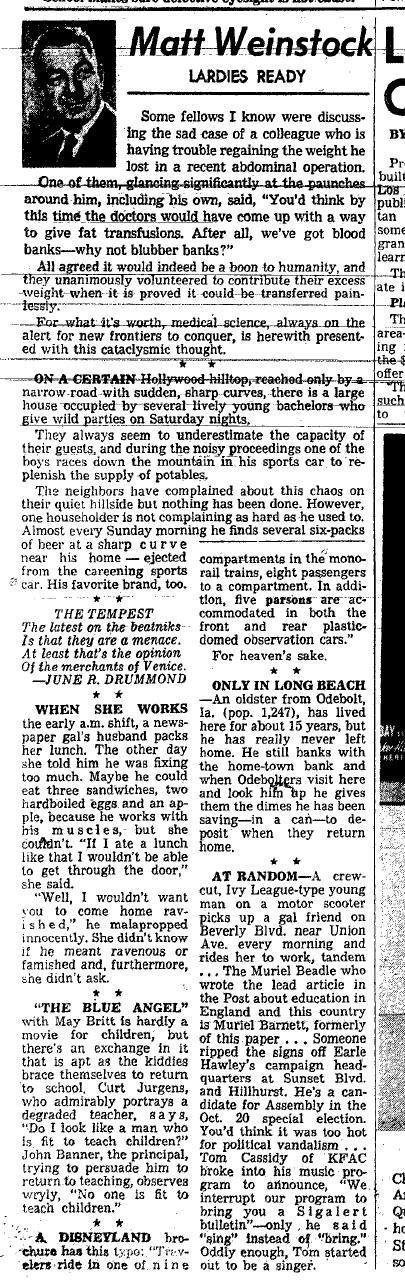
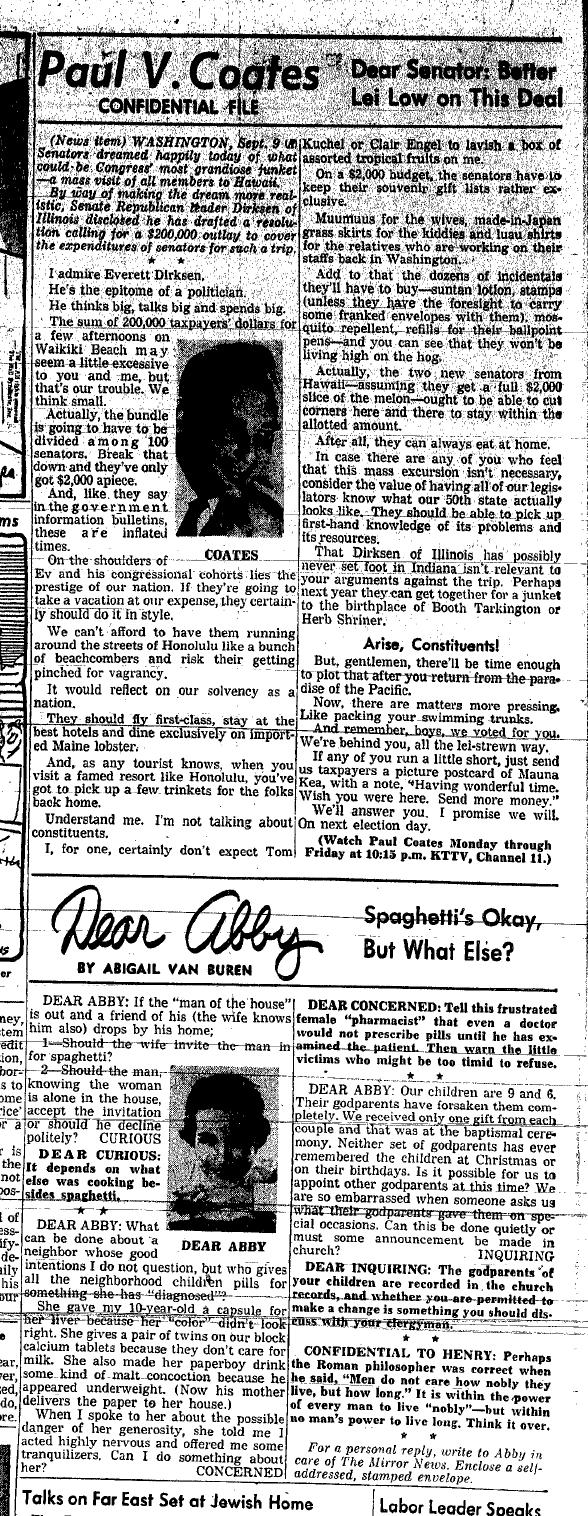
Note: This is an encore post from 2005 and originally appeared on the 1947project.
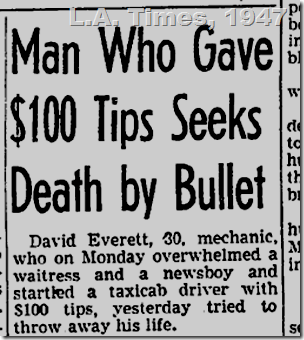 There are some obstacles that even love cannot overcome, or so David Everett has discovered. The 30-year-old mechanic is in critical condition at Torrance General Hospital after shooting himself in the head and neck in despondency over his frustrated love for his 17-year-old first cousin Janet. And yes, she lives in a trailer park.
Everett is the man who was handing out $100 tips the other day after withdrawing all his money from the bank. Not just to Flora Killingsworth for bringing him ham and eggs, but to 15-year-old newsboy Edward Grant for a nickel paper, and to a cabdriver who took him to Glendale. To top it off, Everett ripped up some $100 bills and threw them in the street.
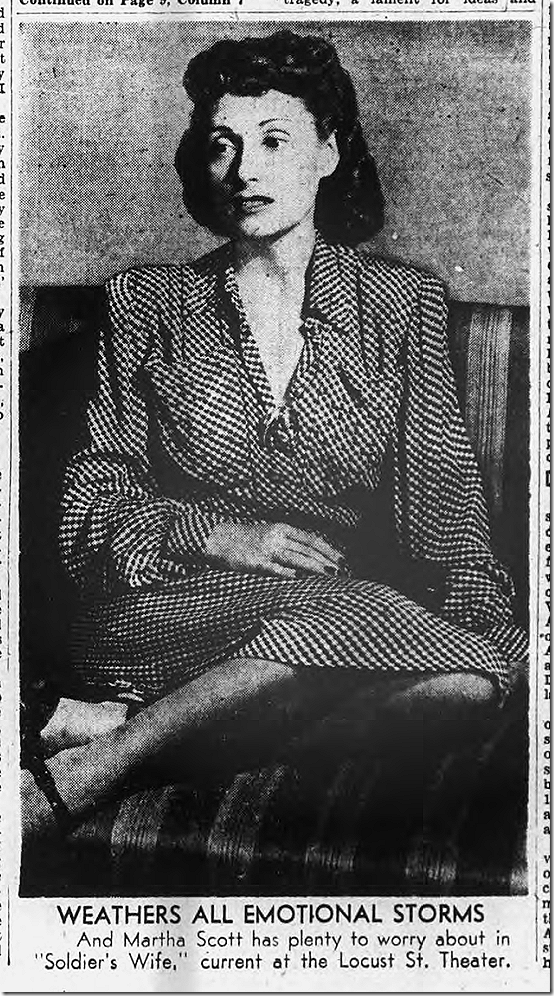
Sept. 10, 1944
The influence of Andre de Toth, the director, has been very important in the life of Veronica Lake. She is no longer the girl who doesn’t care. She cares very much now what people think of her, and she is eager to win the respect of fellow workers and to explain why she has done some of the things in the past that have brought criticism on her — not really serious things, but impulsive, foolish little exhibitions of her temperament.
From the Philadelphia Inquirer via Fultonhistory.com.

Note: This is an encore post from 2006.
September 10, 1907
Los Angeles
A very uncertain day. No evil omens glare anywhere but in all aspects there lies a heavy veil, defying those who would peer into this day. Beware, therefore, of all and any unconsidered act. Promise nothing unless you comprehend clearly the full scope and limit of the pledge. Sign neither note nor contract this day without full security in your hand. Avoid speculative enterprises like the plague.
“A red flag flows wildly” this day. Take heed that neither spark nor flame be left carelessly in dangerous places. Do not retire tonight without guarding against fire with much more care than usual. A great fire is threatened for a large city on the Atlantic Coast this night.
Reminder: Boxie and I will be doing a live “Ask Me Anything” on George Hodel and Steve Hodel on Tuesday, September 16, at 10 a.m. Pacific time on YouTube.
Can’t make the live session? Email me your questions and I’ll answer them! The video will be posted once the session ends so you can watch it later. Remember, this is ask me anything, so please remember to ask questions rather than make comments. Thanks!

Black Dahlia: Murder, Monsters, and Madness in Midcentury Hollywood, by William J. Mann, Simon & Schuster, 464 pages, January 27, 2026, $31.
Like a game of Clue with an actual cold case to solve, a well-worn list of suspects in the 1947 Black Dahlia killing released 22 years ago continues to provide the “true” crime community and the multimillion-dollar industry that feeds it with endless possibilities for speculation and, occasionally, another book.
Was it the murderous Dr. George Hodel at the Sowden House in a gruesome attempt at surrealist art? Mob nightclub owner Mark Hansen at the Florentine Gardens hiring morgue-trained assassin Leslie Dillon to take care of a troublesome dame? Army butcher Carl Balsiger in a fit of violence?
All of them are fakery and fraud by writers Steve Hodel (the ongoing Black Dahlia Avenger franchise launched in 2003), Piu Eatwell (Black Dahlia, Red Rose, 2017) and Eli Frankel (Sisters in Death, forthcoming in October 2025) who, if they read all of their source material, knew their suspect wasn’t the killer and proceeded anyway. Truth is the first victim for a “true” crime author with hopes of making The New York Times bestseller list and everything that goes with it. Continue reading

This week’s mystery movie was the 1934 Warner Bros. film Fashions, with William Powell, Bette Davis, Frank McHugh, Hugh Herbert, Verree Teasdale, Reginald Owen, Henry O’Neill, Phillip Reed, Gordon Westcott, Dorothy Burgess, Etienne Giradot, William Burress, Nella Walker, Spencer Charters, George Humbert, Frank Darien and Harry Beresford. Continue reading
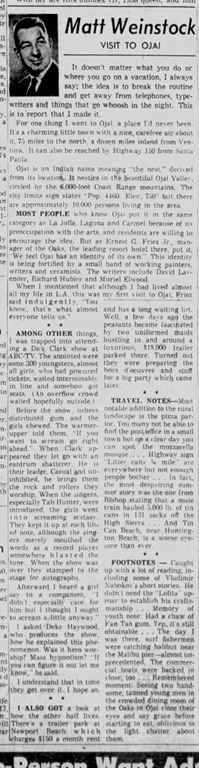
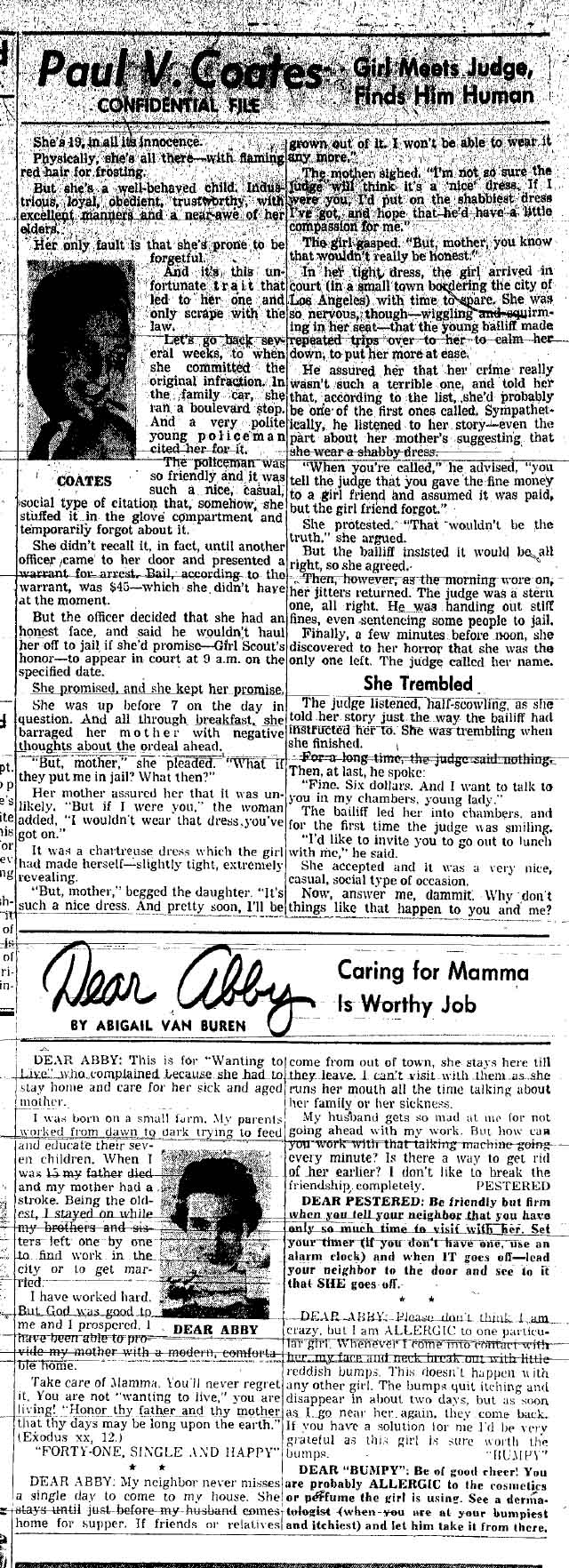

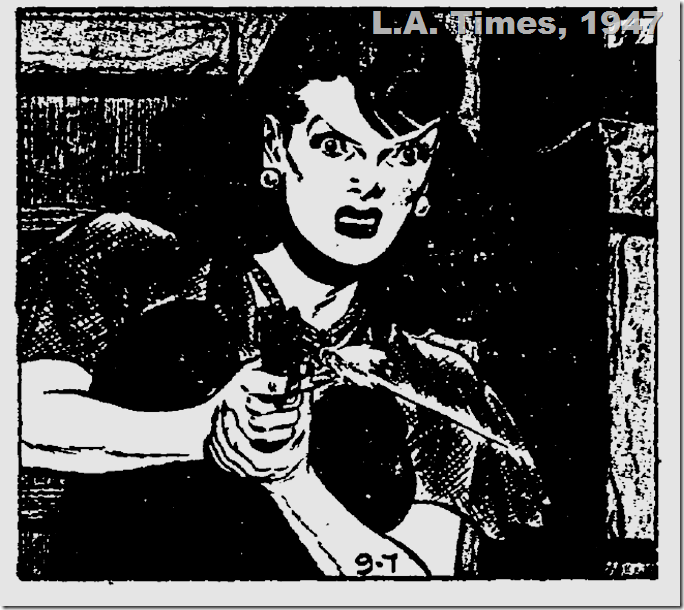
Sept. 7, 1947: Oh, the innocence here.
Note: This is an encore post from 2005 and originally appeared on the 1947project.
Say kids, it’s Sunday morning, let’s look at the comics. Why it’s a 10-page section, imagine that. Los Angeles Times, World’s Greatest Comics—15 cents. That would be $1.42 today.
Who have we got here? Looks like Dick Tracy has finally captured Coffyhead with the help of the Junior Crimestoppers. Red Ryder and his pals are expanding the Rimrock School. Who’s that kid? His name is Little Beaver and he’s supposed to be a Native American. He’s saying: “Him make-um eyes like wolf at teacher. Me gusdusted.”

Note: This is an encore post from 2006.
Sept. 7, 1907
Los Angeles
Henry Sief of the health office has released the latest figures on infectious diseases in Los Angeles and the news is wonderful.
There were only 20 cases of diphtheria in August, a 31% decrease from the 29 cases in July. Scarlet fever was down to 9 cases in August, a 55% drop from July, when there were 20. Tuberculosis is down to 10 cases from 24.
Note: This is an encore post from 2011.
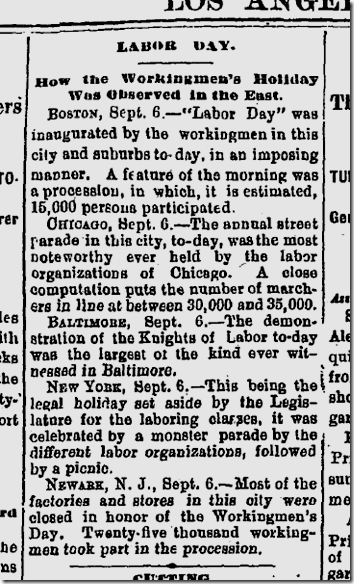
September 7, 1886: The Times publishes a roundup of events marking Labor Day, but there are no reports of any celebrations in Los Angeles. On the jump, Labor Day, 1891, is celebrated on the West Coast, but there’s nothing about Los Angeles.
For Labor Day, 1895, The Times reported on a parade that began at the old junction of Temple, Main and Spring, which was changed when Spring Street was straightened to make room for City Hall.
The parade went down Spring to 5th Street, east on 5th to Main, north on Main to 1st and from there to La Grande Station [the Santa Fe depot at 1st and Santa Fe Avenue (d. 1946)], where many participants took the cars to Redondo Beach.
The parade consisted of four police officers on bicycles, a marching band, the council of labor and 14 members of the Turnverein Germania. There were 48 members of the Plumbers Union, No. 78; 36 members of the Brotherhood of Carpenters and Joiners; 34 members of the Typographical Union, No. 174; 25 members of the Retail Clerks Protective Assn.
After another marching band, there were 50 members of the Pastry Cooks Union; 30 members of the Tin, Sheet and Cornice Workers Union; and 45 members of the Painters and Decorators Union.
The parade ended with 31 men in black shirts and red neckties with “a blood-red flag bearing the words “Socialistic Labor Union,” The Times said.
“The Socialistic Labor Union refused to go to Redondo, claiming that the principles of the organization forbade the needless enriching of a railway corporation’s coffers, and there was small opportunity to capture a train,” The Times said.


September 6, 1953: Barbara Graham, on trial in the Mabel Monahan killing, sobs “almost hysterically” as she holds her 18-month-old son, Tommy, during a visit at the Hall of Justice, The Times says. He was in the custody of his grandmother Anne Webb.
Bessie Lill, veteran court reporter, retires after 34 years at the age of 70. Lill worked mostly in civil court and said one of her most interesting cases was “the old water litigation in the 1920s when much of California’s water law was written.” Lill used the Pitman method of shorthand, she says. No stenographic machine for her!
Note: This is an encore post from 2005 and originally appeared on the 1947project.
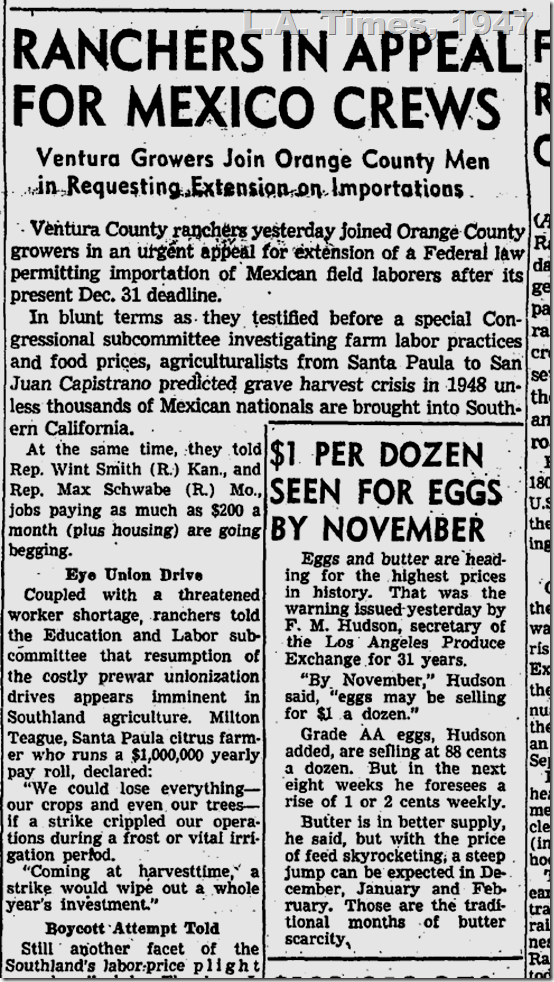
“Up from his 160-acre vegetable farm at San Juan Capistrano, veteran rancher H.L. Remmers informed the committee that he must “get Mexican workers” or “think about going out of business.” Americans, Remmers said, “don’t like ‘stoop labor.’ ”
Farmers, he said, will be “glad to go down to the border and bring the Mexicans north at our own expense and responsibility.” Pay ranges from 70 cents an hour for harvesters ($6.62 USD 2005) to $1.10 ($10.41 USD 2005) for tractor men, Remmers said….

Note: Last year I was given a box of news releases, photographs and random pieces of paper from the old press room at Parker Center. I’m gradually posting the material.
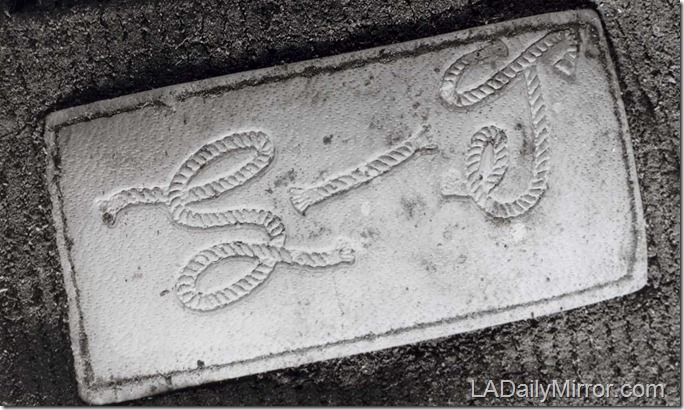
These are the earrings and the label from a pair of pants worn by a teenage girl whose body was found Sept. 5, 1973, in an open grave in Hacienda Heights. She had been dead about 30 to 90 days, authorities said. She had been shot in the head.
From the original press release:
Sheriff Peter J. Pitchess is requesting the cooperation of the public in identifying a young girl who’s body was found in an open grave on September 5, 1973, in Hacienda Heights.