Man’s Skull Fractured in Assault

Dec. 31, 1909, Assault 


Dec. 31, 1909: Former stockbroker Henry SO. Clark  is hospitalized after hitting his head on the pavement at Spring and 9th streets when a man struck him for talking to his wife. 

Posted in Downtown, LAPD | Comments Off on Man’s Skull Fractured in Assault

December 30, 1959: Matt Weinstock

Year-End Recess

Matt WeinstockAgain this year there’s an unmistakable though unorganized trend toward calling everything off between Christmas and New Year’s Day and letting the week drift itself out, which it does anyway.

Nobody feels up to anything, especially answering the phone or paying attention to the stern, year’s end admonitions by savants and politicians.

They’re recovering from the Dec. 25 overindulgence and bracing themselves for the Jan. 1 bacchanalian revel.

Actually all they’re interested in, besides having a little fun, is getting through the week alive or at least not spending a night in the drunk tank.  Everyone is frightened by the traffic statistics. Continue reading

Posted in Columnists, Matt Weinstock | Comments Off on December 30, 1959: Matt Weinstock

December 30, 1959: Paul V. Coates – Confidential File

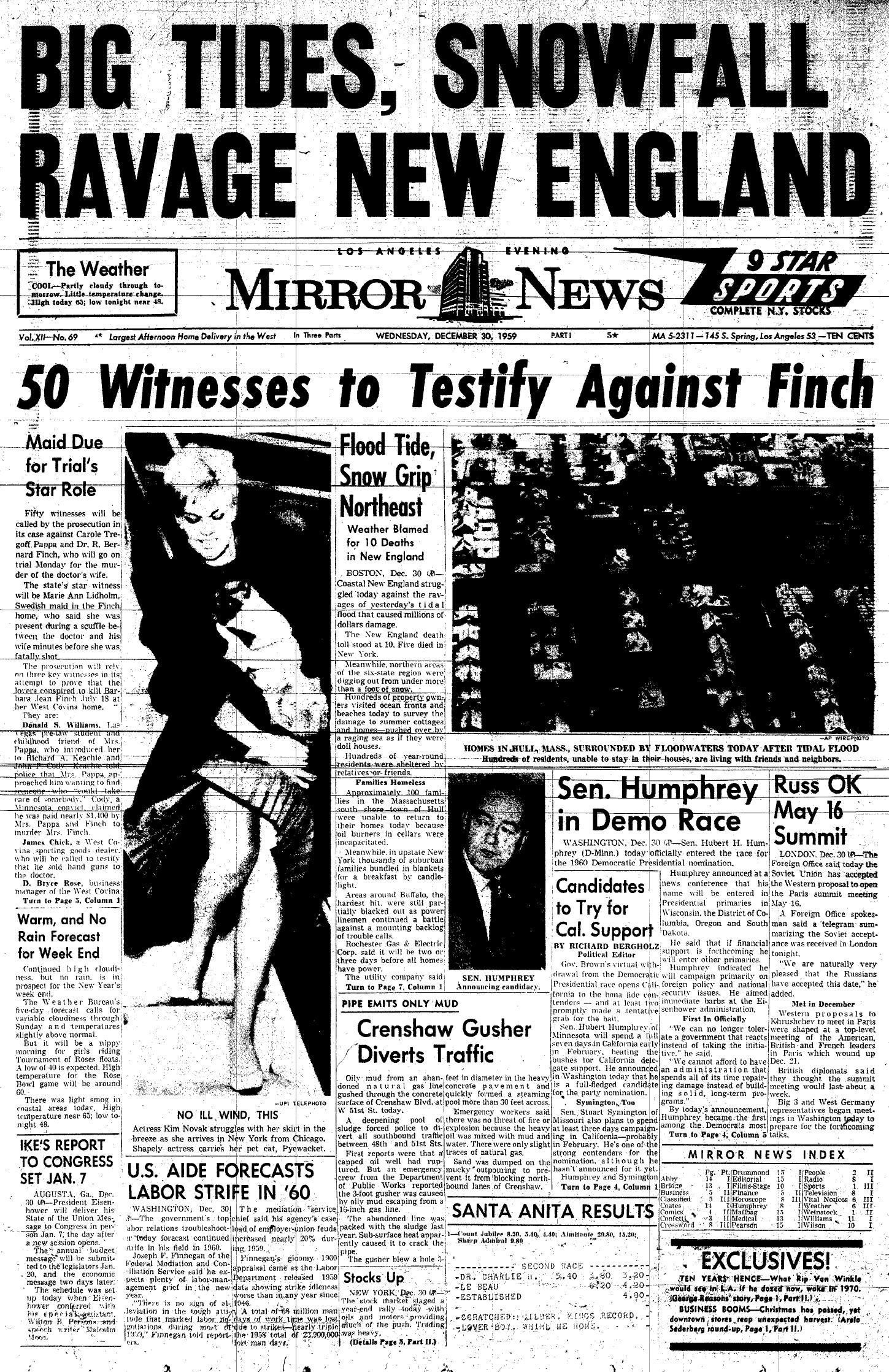
December 30, 1959: Mirror cover

Pappy Coates Cases Learning With Kids

Paul Coates, in coat and tieFeeling good all over, today.  In this age of neurotic juveniles and delinquent parents, I, at least, have met my responsibility as a father.

Maybe you don’t know “Where Are Your Children, Tonight,” but I know where mine were, last night.

They were with me, getting a firm foundation in their religious training.

While other youngsters were out carousing in poolrooms, dancing in dance halls and lounging in front of pizza parlors whistling at girls, mine were in the balcony of Fox Wilshire Theater.

I took them there to see “Solomon and Sheba,” a wall-to-wall, silver-screen, religious epic about two nice kids in love.  In living color. Continue reading

Posted in Columnists, Film, Hollywood, Paul Coates | Comments Off on December 30, 1959: Paul V. Coates – Confidential File

Three Tristans Update

image7 

 
No credit in Season Book
"courtesy of Metropolitan Opera Press Department"
??  Three Tristans update: I sent this item to bass-baritone  Alan Held, who’s appearing in the current Metropolitan Opera production of “Tales of Hoffmann.”

Held says, “ I have been in several performances where a singer had to be replaced midway through the night–most memorably was a Tannhauser at The Met where we went through 2-3 tenors in one night (can't remember). It seemed we went through the entire list of Met tenors during that show. I also did a lot of Tristans in Barcelona that seemed to have a revolving door of tenors. My own professional debut was made while jumping in as Colline in Boheme.  These things happen all the time in opera–sometimes a singer really isn't sure if he can make it through the night but wants to give it a try and then once confronted with the dryness of the stage, things change. And I've been in countless performances where the singer isn't sure they can even start the night but ends up singing the best performance of the run. These are special nights and can bring a lot of excitement to the show.”

Photo courtesy of the Metropolitan Opera

Posted in #opera, classical music | Comments Off on Three Tristans Update

A Kinder, Simpler Time Dept.: Your Movie Columnist

Dec. 30, 1941, Hedda Hopper 

Dec. 30, 1941: “Jackie Cooper is studying the finer points of drumming with Buddy Rich of Tommy Dorsey's band these days and doing so well that he sits in with the band at the Mocambo now and then just to get used to playing before an audience.”

Posted in #Jazz, Columnists, Film, Hollywood, Nightclubs | Comments Off on A Kinder, Simpler Time Dept.: Your Movie Columnist

On the Brink of the 1960s

Dec. 30, 1959, Hedda Hopper

Hedda Hopper tapes a “Ben-Hur” segment with Stephen Boyd, Francis X. Bushman and Ramon Novarro, but not Charlton Heston.

Dec. 30, 1959, Heston

Dec. 30, 1959, Traffic

Los Angeles officials struggle once more to deal with congested streets. I have said this before, but it bears repeating: Traffic in Los Angeles is 100-year-old problem.

image

Dec. 30, 1959, The 1950s

Dec. 30, 1959, The 1950s

Dec. 30, 1959:  “Americans came to the end of the 1950s with more of everything, more wealth, more cars, more schools and churches, more gadgets, more babies–and more self-doubt–than ever before.

“A vague shadow of uneasiness spread across the land.

“ ‘There is an overwhelming feeling here that somehow we have lost our way,’ wrote James Reston, Washington correspondent of the New York Times. ‘Nobody seems to know just how or why. But everybody feels that something's wrong.’ ”

Posted in broadcasting, Columnists, Film, Hollywood, Television, Transportation | Comments Off on On the Brink of the 1960s

A Poem for the New Year

Dec. 30, 1919, Railways  

Isn’t this a great drawing? I suppose in 1919 smokestacks meant progress and not pollution.

image 

Enumerators prepare to take the 1920 census and have a few questions. Is a lone man or woman without any known relatives a family? Yes. When is a chicken ranch not a chicken ranch? When it earns more than $250 a year. Then it’s a chicken farm.  

Dec. 30, 1919, Poem

Dec. 30, 1919:  George Steunenberg writes:

"Our streets will be real thoroughfares instead of auto parks;
And not a feature will remain to merit the remarks
Of those gol-darned New Yorkers who say our town is slow–
L.A. will be a city in the year One-nine-two-O."

Posted in Environment, health, Politics, Transportation | Comments Off on A Poem for the New Year

No Gunfire for New Year’s Eve

Dec. 30, 1909, Furniture Sale

Joseph’s has a sale on Stickley furniture!

Dec. 30, 1909, New Year's

Dec. 30, 1909: Rules for New Year’s Eve – No slapping of people on the back, no rude jostling, no disrespectful address of persons one does not know. Most important, “no discharging of firearms in the city limits.”

Posted in Architecture, Downtown, Fashion, LAPD | Comments Off on No Gunfire for New Year’s Eve

Matt Weinstock, Dec. 29, 1959

dEC. 29, 1959, Peanuts  
Dec. 29, 1959, Peanuts

Blacklist Blunder

Matt Weinstock           The case of writer Louis Pollock, who was unaware for five years that he was on a film and TV blacklist through mistaken identity, has recalled an even weirder case.

          About a year ago a studio executive told his story editor that the work of a writer on his staff could not be used.  The story editor wanted to know why.  He was told evasively that there was something subversive in the writer’s background.

          The story editor persisted over a period of time and finally broke down the executive, who told him, “He was a member of the Office Workers International.  It’s on his record.”

          The story editor had never heard of any such organization and asked to see the writer’s biographical file.  Sure enough, there it was, the writer’s own statement that he’d served with the OWI, the Office of War Information — which some moron had interpreted to mean the Office Workers International.

          As a result of this ridiculous charge the writer didn’t work for seven months.

::

Dec. 29, 1959, Bloody Christmas             ONLY IN L.A.  — A footnote on the disappearance of another landmark, the Rainbow bar on Hill St., comes from Fred Winckel.  Workmen stripping the interior of the once famous bat cave were observed by him carrying out, among other objects d’art, a pot.  Let us hope this disclosure will restore the faith of the true believers that there is indeed a pot at the end of the Rainbow.

::

          SOCIAL POSITION

Even though I possess

        savoir-faire

There’s a steady undertow

That has me constantly

         falling

Right flat on my apropos.

         –JUNE R. DRUMMOND

::

          AWESOME TALES of the Christmas shopping frenzy are still trickling in.  One concerns an arrogant matron who stormed into a small notions store in Alhambra.  She went through the greeting cards like a whirlwind, leaving them scattered all over the counter.  Then she barged over the toilet goods counter and upset everything there.  She was burrowing furiously through the lipstick when the manager came over and said plaintively, “Lady, would you please do your future shopping at Woolworth’s? They have more things to mess up than we do.”

::

          THEN THERE WAS the group of children in Rolling Hills strolling through their neighborhood singing Christmas carols.  As they broke into song in front of one house, Mark Bailey, 2, looked at them as if he thought they’d lost their minds, then, broke away from his mother and dashed up to the front door.  He rang the bell and, when a woman appeared, shouted jubilantly, “Trick or treat!”

::

            SINCE THE quiz show and payola scandals, the networks have been extremely sensitive about truth and honesty.  All in all, it has been a soul-searing experience — well, searing, anyway.  Now they’ve swung in the other direction.  For instance, announcers sign off some shows with the comment, “Portions of the proceeding program were prerecorded,” which is a little silly.

          Things have been particularly furtive at CBS, where everyone cringes under the scowls of Dr. Frank Stanton, the boss, who has come out strong for purity.  Imagine the consternation then of a CBS executive Christmas week when his daughter, 8, confided that she wasn’t sure she believed in Santa Claus anymore.   It was a terrible moment.  What should he tell her?  Fortunately she saved the situation for him.  She said she wanted him to know that regardless of her feelings she wouldn’t spill the beans to her 6-year-old sister.

::

          WHAT IS THE state of the world, with 1960 around the corner?  Several psychiatrists at the Reiss Davis Clinic for Child Guidance were chatting about the anxieties they encountered and one said, “The standard of living is way up, people are eating better than ever, but underneath there is greater insecurity, tied up with the fast pace, the pressures and tensions, and the bomb!”

          “It’s like the old joke,” another said.  “People used to insist two and two were five, now they tell us they know two and two are four but it bothers them.”

Dec. 29, 1959, Abby


Posted in Columnists, Matt Weinstock | Comments Off on Matt Weinstock, Dec. 29, 1959

Paul V. Coates – Confidential File, Dec. 29, 1959

Dec. 29, 1959, Mirror

Incredibly, Old Con Game Still Works

         
Paul CoatesThe name of the game is “pigeon drop.”

          And, like pinochle, it generally requires three players.

          Unlike pinochle, however, two of them must be equipped with glib tongues.  The third player — in the parlance of those dedicated to its perpetuity — is the pigeon.

          He loses.

          The game itself is so broad, so base, so obvious, that it should never work.  But records of its success date back hundreds of years.

          It has become a classic among con artists.  They like it because it requires no elaborate plans or equipment, no special locale.

          It can be played on a street corner.  Any street corner.

Dec. 29, 1959, Whalen          Basically, its rules are these:

          First, find a pigeon.  Somebody with money (at least a few hundred bucks) and a desire for more.

           The pigeon can’t be 100% morally honest or the game won’t work.  But you’d be amazed at the number of people who considered themselves pillars of their communities until they joined the growing list of victims.

          The initial step is for one of the con artists to “find” a wallet or a purse loaded with money.  (This can be achieved by flashing a “Chicago bank roll” — a $20 or $50 bill wrapped around a wad of ones.)

          Frequently, the purse is “found” in the presence of the pigeon.  But whatever the circumstances, the con man always insists that the sucker is, by virtue of his presence, entitled to a share.

          Here’s where the “good faith” clause comes in.  The pigeon is asked to prove that he’s a respectable citizen.  He must show that he has assets.  Cash assets.

          If the victim has no large amount of money on his person, he’s asked to draw a few hundred or a few thousand dollars out of the bank, with assurance that his own money will never leave his sight.

          Variations in the plot are limitless, but generally, along about this time, the second con man joins the game.  He’s a “respectable businessman.”  He’s approached by the first con man and the victim to “hold” the purse while the victim gets his “good faith” money.

          Then, through an envelope switch, a quick “phone call to make” pitch, or any of a dozen other ruses, the pigeon and his money parted.

          The “pigeon drop” is vicious, not so much in its execution, but in its selection of victims. Invariably, the victims are the elderly — people whose moral standards can become easily confused.  The con artists will tell the victim, for example, that the money was found with a pair of race track tickets — and obviously was won gambling — and therefore it’s all right not to return it.

          A few weeks ago, at 54th and Broadway,  a pair of women, one about 30, another about 55, used a similar approach on a 69-year-old housewife who had stepped out to do some shopping.

          The housewife had suffered a stroke not too long ago and was, according to her husband, still easily confused.

          The pair offered to let her share in $9,000 they claimed to have found, and by the time they were through with her a couple of hours later, she had drawn out her entire life savings of $7,700 and was left standing on the fourth floor of an office building at 9th and Hill Sts. Waiting for a fictitious “Mr. Adkins.”

          They, of course, were long gone with her $7,700 by the time she realized what had happened.


Hard-Earned Savings Gone


          “Since before World War I, we’ve been in the small restaurant business,” the victim’s husband told me yesterday.  “We worked hard all our lives — 20 hours a day.  Now we’ve lost everything.”

          Christmas, 1959, passed by their house unnoticed, he said.

          “Our nerves are gone,” he told me.  “We’ve just gone haywire.  Christmas Eve we stayed up, but honestly, we were so confused we thought it was New Year’s Eve.”

          The man asked me not to mention his name.

          I won’t.  But I am mentioning the case, because maybe somebody else who’s a little confused might benefit from the reminder that the pigeon drop, old and unbelievable as it is, still works. 
   

Posted in Columnists, Front Pages, LAPD, Mickey Cohen | Comments Off on Paul V. Coates – Confidential File, Dec. 29, 1959

A Kinder, Simpler Time Dept.: Your Movie Columnist

Dec. 29, 1940, Hedda Hopper

Behind the news of Hollywood divorces (which, statistics prove, are no more numerous than those of any other town in America) behind the lurid news that our people sometimes make while blowing off steam, is the story of a job being done – a job that has great influence on the public that seeks its diversion seven nights a week in movie theaters.

Dec. 29, 1940, Hedda Hopper

Dec. 29, 1940: Hedda Hopper still has good things to say about Charlie Chaplin. “ ‘The Great Dictator’ had faults, but deserved more than faint praise from some critics. It was the greatest work of slapstick Chaplin ever made, and was a cry from the depths of the soul of humankind, through the little man, for a world at peace and a people united for one cause  — goodwill among men.” Eventually, Hopper will support “good Americans” in boycotting Chaplin’s films.

Posted in Columnists, Film, Hollywood | 1 Comment

Three Tristans!

image 

Ramon Vinay, the tenor cast with Birgit Nilsson in "Tristan," said he was too ill to do the entire opera, so Rudolph Bing had Vinay sing Act I, Karl Liebel (likewise under the weather) sing Act II and Albert da Costa (also ill) sing Act III.

Dec. 29, 1959, Ernie Kovacs

Hedda Hopper interviews Ernie Kovacs.

Dec. 29, 1959, Dick Norman

Jeane Hoffman profiles Stanford’s Dick Norman.

Dec. 29, 1959: A fascinating bit of insight from Ernie Kovacs: “The part of the public I lose completely is the 8-to-5 clerk who bowls every Thursday night and has Sunday dinner with his mother one week and his wife's mother the next.” I wonder what Kovacs would say about TV audiences today.

Posted in #opera, broadcasting, Columnists, Sports, Television | 1 Comment

Husband Shoots Wife, Two Others, on Streetcar

Dec. 29, 1919, Briggs 
“That Guiltiest Feeling,” by Clare Briggs.

Dec. 29, 1919, Shooting

July 9, 1920, Acquittal

Dec. 29, 1919: Former Army Capt. Raymond C. Potter gets on a streetcar and shoots his wife because she’s riding with another man. One of his shots goes wild and hits her companion, then strikes the woman sitting in the seat behind them. Not only did his wife survive, the Potters reconciled and said they would profit by their experience. The Times never reported on whether charges were filed against Potter for shooting the other people.

Posted in #courts, Transportation | Comments Off on Husband Shoots Wife, Two Others, on Streetcar

Airplanes Arrive for Aviation Meet

image 

Dec. 29, 1909: Preparations continue for Aviation Week and the railroads are reporting unusually heavy ticket sales to people coming to Los Angeles for the event.  In addition to the airplanes and balloons, the meet will feature a carnival midway with a Ferris wheel, a merry-go-round and an “educated horse.”

Posted in Transportation | Comments Off on Airplanes Arrive for Aviation Meet

Matt Weinstock, Dec. 28, 1959

Dec. 28, 1959, Films

The Pigeon Problem

Matt Weinstock           A woman on the telephone a few days ago asked excitedly, “What should I do about these crazy pigeons?  They’ve moved into our neighborhood (3rd and La Cienega) and they’re all over the place.  One of them flew down and bumped into my boy.  It could have blinded him.  They’re a menace.  And when I call the City Hall all I get is the run-around.”

          I could give the lady no solace then and I can give her no hope of relief now, after talking to Dick Bonner of the animal regulation department.  The blunt truth is that there’s nothing anyone can do about pigeons.

          THERE’S A CITY ordinance against feeding them in certain downtown areas but it’s not enforced.  In fact, it’s considered unenforceable.  Besides, feeding friendly pigeons is one of the few pleasures left to many apartment-dwelling oldsters in the midtown section, particularly in the parks.

          Meanwhile, roving bands of pigeons, some beautifully colored, have taken over some areas.  They go where the food is likely to be.  Some are so bold they dare you to step on them as you walk. 

          Some cities have tried exterminating them by electrocution — juicing up a wire they stand on — and putting a sleeping potion in grain they eat and trapping them in sticky stuff, but none of these has proved satisfactory.

          As Dick Bonner puts it, “We’re groping for solutions.”

::

VAGRANT THOUGHT on seeing a house on Beverly Blvd. at Westlake Ave. being dismantled:  There’s nothing so naked looking as a bathtub out of context, that is, left in the open amidst rubble.

::

TRY IT AGAIN

Riddle check horn ersatz

Unicorn err

Eton ace wrist muss pi;

Hypotenuse sum ampule

                doubt aplomb

Unsaid water good buoy

                am eye.

          –MUTTER GUSE

::

THE JAPANESE gardener who has taken care of Jack Waxman’s home on Beverly Glen Blvd. for several years is a cheerful, polite, hard-working little man of about 55.  He has only one fault.  He never cashes his monthly paychecks.

Dec. 28, 1959, Road Rage

When Jack discovered this he asked about it.  “Got no time to go to bank,” the gardener replied.  However, he promised he would.

But he didn’t and months later Jack appealed to him again.  “You’re messing up my account,” he said.  “Besides, what if I went broke — you’d be out all that money.”

“Oh no, you got plenty money,” was the reply, “no afraid.”  Again he promised to cash his back checks and again he didn’t.

So Jack, unknown to the gardener, has opened an account in his name with a savings and loan firm and deposits an equivalent amount to the check he gives him each month.  The inscrutable one, who still hasn’t cashed check, now has more than $2,000 on deposit drawing 4½% interest.

::

IN ONE OF those unpredictable quirks of fate which occasionally upset the averages, George, a pool hall racker, and Ed, a lunchroom chef, parlayed an initial ante of $200 into around $15,000, playing the market.

They began living high on the hog — new cars, new clothes, Las Vegas.

One day their paper wealth disappeared as fast as it had come, due to a drop in the market, and the cars were repossessed, their new-found friends slunk away and life became grim
and normal.

One day newsman Mike Molony found George back at his old job, brushing the green felt on a pool table, and asked him how things were with him.

“Fine,” George said.  “It was nice while it lasted but I don’t mind much.  After all, people will always be playing pool.”

It’s a comforting thought in a world of change.

::

WOULDN’T YOU KNOW — W. Wilson’s wife bought him a used radio for the store he manages in Burbank.  After plugging it in he turned it on and got a rebroadcast of a 1954 football game.  The refrain from the customers: “Man, you really got an old radio there!”

 
Posted in Columnists, Film, Freeways, Hollywood, Matt Weinstock, Transportation | Comments Off on Matt Weinstock, Dec. 28, 1959

Paul V. Coates – Confidential File, Dec. 28, 1959


Dec. 28, 1959, Mirror Cover

Bus Crash felt in Redondo Beach


Paul Coates          (News item) TUCSON, Ariz., Dec. 20.  A double-decker bus and a cattle truck collided head on today, killing nine persons and injuring 32.

          The bus was a Greyhound special added for holiday travelers.  On the Los Angeles-to-New Orleans run, it was only minutes out of Tucson when the crash occurred . . .

::

          “I’m the commission agent for Greyhound in Redondo Beach,” Helen Stierli told me.  “I know that I’m not supposed to become personally involved in these matters.  It shouldn’t be any of my business, really.

          “But in a small town — well, things are a little more personal than in a big town.”

          Mrs. Stierli explained that she first heard about the crash on Sunday night. 

          “Immediately, I had the terrible feeling that I’d sold somebody a ticket on that bus,” she said.  “I was restless and worried all night.  Then, Monday morning, I rushed to the office and checked the list.

image           “And sure enough,” she added, “there was Mrs. Rodden and her two sons.  I saw those names and I just broke down.”

          (The news reports read:  Dead:  Johnny Lee Rodden, 7, son of Mr. and Mrs. Charles Rodden, Redondo Beach.  Injured: Mrs. Margaret Rodden, 38; Charles Rodden Jr., 15.) 

          Mrs. Stierli continued: “I’ve been in Redondo 11 years, but I didn’t know the family.  Not until the week of their trip.  They were going to spend Christmas with Mrs. Rodden’s mother in Lubbock, Texas.

          “Just the mother and the boys were going.  Mr. Rodden was going to stay in Redondo and work.  I don’t know.  Maybe he was going to join them later.

          “She called me three times about the trip.  The first time was just for information.  The second time was on how much baggage they could take.  And the last time was to ask if she could wait until Friday to pay for the tickets.  That’s when her husband would get his paycheck.

          “I remember the last call.  She said she was turning it over on her mind whether she should drive, instead.

          “I told her . . .” Mrs. Stierli hesitated.  “I told her that it was safer to go by bus.  You see, I was in a head-on auto crash once.  And five years ago, my husband lost a leg in a traffic accident. 

          “Maybe that’s why I can’t keep out of this case.  I know the sorrow and the hardship.  At times like these the financial strain can make it so much worse, and the Roddens were just average people.  They weren’t rich.”

          Mrs. Stierli sighed.  “The day she came in for the tickets, they were $10 more than she’d figured.  She’d misadded.  Two round-trips from here to Lubbock were $60.45 apiece, plus the half-fare ticket for Johnny Lee.  The $10 difference seemed to mean a lot to her.
 
Asks About Refund
 

          “That’s why, after the accident, I checked with Greyhound downtown right away to find out about getting their fare money back for them.  That way, before they came in, I would know how to handle it.

          “I’ve never had a situation like this before.”

          “And what happened?” I asked Mrs. Stierli.

          “Well,” she replied, “the man in the traffic office checked company policy for me.  He told me that when they brought the tickets in, I could refund for the distance from Tucson to Lubbock and the return trip.

          “But,” she added, “they’d have to pay for the trip from Los Angeles to the time of the accident.  That’s the policy.

          “I can’t say as I understand it,” she told me, “bu
t there’s a lot of things nowadays that I don’t understand.”
  

Dec. 28, 1959, Abby

Posted in Columnists, Paul Coates | Comments Off on Paul V. Coates – Confidential File, Dec. 28, 1959

A Kinder, Simpler Time Dept.: Your Movie Columnist

Dec. 28, 1939 Hedda Hopper 

Dec. 28, 1939: Hedda Hopper calls “Of Mice and Men” one of the best pictures of the year.

Posted in Columnists, Film, Hollywood | Comments Off on A Kinder, Simpler Time Dept.: Your Movie Columnist

The Age of Anxiety and the Age of Maturity

Dec. 28, 1959, The 1950s  

Dec. 28, 1959, The 1950s

Dec. 28, 1959: “Should the president have consulted Congress before ordering Americans into action?

“Would there be time, in the next war, to consult Congress?

“In this new age, what was the role of infantry, battleships and conventional weapons?

“Should American troops be dispersed overseas or kept home to man the walls of a ‘Fortress America?’ 

“How much reliance could be placed on the allies of the United States?

“In short — Where do we stand? How do we survive?

“Americans searched for a single, all-embracing answer and found none.

“So the 1950s began as the age of anxiety.”

Posted in Politics | Comments Off on The Age of Anxiety and the Age of Maturity

The Empty Prophecy of Prohibition

Dec. 28, 1919, Raid  
Detectives Brown, Barnett and Harry Raymond in a raid on a club in Little Tokyo.

image

Dec. 28, 1919, Prohibition

Dec. 28, 1919:  The Times analyzes the first six months of Prohibition and finds that many predictions have not come true. Some minor offenses have decreased, but violent crimes have risen sharply, police say. Instead of needing fewer officers, the LAPD says it needs to double the force and build bigger jails for all the prisoners charged under the new laws.

"The best prophets all seem to have died in time to get written up in the Bible. Many things that were expected to happen after last July 1 have not happened; some unexpected things have. No prognosticator who held forth last June seems to have been altogether right, unless he confined his remarks to the obvious and then qualified that," The Times says.

Posted in #courts, Food and Drink, Front Pages, LAPD, Nightclubs | Comments Off on The Empty Prophecy of Prohibition

An Actress and Her Dog

Dec. 28, 1909, Cover 

"Five iron manhole caps, each weighing more than 100 pounds, shot into the air last night when "burn-out gas" in the sewer between Spring Street and the northeast corner of 1st and Main streets blew them higher than the trolley wires."

olga_nethersole_crop

It’s our old friend, Olga Nethersole!

Dec. 28, 1909, Nethersole

Dec. 28, 1909: I couldn’t decide on a single story in today’s paper because the whole page is interesting. There’s the unfortunate deaf and dumb man who is arrested for being drunk and is booked as John Doe No. 2 … A couple of con artists passing themselves off as the American Salvation Army … Preparations for a huge project to tunnel through the Newhall grade … And an interview with Olga Nethersole that’s quite unlike the celebrity interviews published today.

A sample: "Nethersole has become famous through doing plays that concern questionable damsels who kiss like a house on fire and in the last act tear up the rugs and generally rough-house the furniture of the flat and cry: 'You shall not leave meh; you shall not leave meh; yow, yow, yow.' "

Posted in Animals, LAPD, Stage, Transportation | Comments Off on An Actress and Her Dog