Paul V. Coates – Confidential File, Feb. 3, 1960

Feb. 3, 1960, Mirror

Yanqui Go Home – After Touring Cuba

Paul Coates    (NEWS ITEM)- Cuba's push to receive tourist travel to the island has blossomed into a full day for free.  The Cuban Tourist Commission is now offering hotel accommodations, a drink, dinner, floor show, golfing privileges and race track admission free for one day to all Americans vacationing in Havana.

    I cite you the above as just one of the little paradoxes of the world in which we live.

    While Fidel Castro flexes his minuscule muscles in front of TV cameras and rages that he could, by the hair of his chinny-chin-chin, blow all us yanquis in, his tourist department, a few blocks down the street, is bending every effort to lure us to the romantic isle that fought and won a rebellion against Burma-Shave ads.

    The headlines quote Fidel's "Yankee Go Home" fury.  But a few pages back, in the travel section, there is the ad copy of a Cuban Avenida de Madison type coaxing us to come play in Caribbean sunshine.

Feb. 3, 1960, Finch Trial      It's an interesting example, not unique to Cuba, of the vast separation that exists in the world between state and chamber of commerce.

    While the neurotic heads of government fume and fuss at each other, their respective promoters of tourist trade go blithely along pretending, perhaps actually believing, that every thing is just fine and the welcome mat is out.

    Even with that free drink, it's hard to imagine that any American in Cuba could relax knowing that any moment there might be a burst of machine-gun fire down the street.

    But maybe I've got this thing figured all wrong.  Maybe the idea has what we in the ad game call negative appeal.  And if that's the point, I'd like to offer some copy which we can throw into the mill and see if it turns up grist.

    For example:

    TAKE THAT ONCE IN A LIFETIME HOLIDAY

   Visit the exotic Cuba while the WAR CRIME PURGE is still in season.  Matinees daily, including Sunday.  Special excursion buses and free balcony seats for the tourists.  Guaranteed three death sentences daily.  Watch the defectors squirm! 

    The Russian Intourist Bureau has worn out the pitch about co-operative farms, Lenin's tomb and the Bolshoi ballet.  You know?  It's got no zing.

    Why not something like this:

WINTER IN CARNIVAL TIME IN SIBERIA


    Sleigh bells ring, are you listenin'?  Walk in a winter wonderland.  Or, better still, go by droshky.

    For  a never-to-be-forgotten, off-the-beaten-track vacation, take our specially priced budget tour and spend two glorious weeks in the Siberian wastes.  Itinerary includes an authentic chase by hungry wolves and  a visit to a genuine salt mine.  See the slave laborers filling shakers!

    Even our good neighbor to the south could go along with the idea.  The Departmento de Turismo of Mexico has, I think, overdone the bit about the Floating Gardens of Xochimilco.  I mean, I've been there.  And they're stagnant.

    If they want to entice the Yankee dollar, why not a half-page ad in, say, the Christian Science Monitor, reading:

    LOOKING FOR  A CONVERSATION STARTER?

    Overcome those dreadful lags in dinner table small talk.  Rise above the rut of cocktail party chitchat.  Be the center of attention.

    Spend a THRILL-PACKED, ALL-INCLUSIVE week end in the TIJUANA JAIL.

Feb. 3, 1960, Finch Trial

    Or, a quarter-page in the Police Gazette:

SEE THE WILD TRIBES OF MEXICO COME TO UNTAMED ACAPULCO

    Mingle  with the natives in their natural habitat — lying in front of their quaint, candy-striped, Abercrombie & Fitch cabanas, sipping their mystical tribal potion.  Gordon's ginebra y Schweppes tonic, and cavorting unashamedly on the sun-bleached sands in their Rose-Marie Reid bikinis.

    Of course, if every body else is going to do it, we might as well.  We could offer foreign tourists a holiday trip to such landmarks as Jimmy Hoffa's birthplace, a public audience  with Gov. Faubus and a guided tour of the Chicago police department.

    Then we could whisk them by air-conditioned bus to Washington and the Harris Committee hearings on payola, to which I will undoubtedly be invited because, you know, Burma-Shave, Gordon's ginebra and Schweppes tonic.
   

Posted in #courts, Architecture, Columnists, Front Pages, Homicide, Paul Coates | Comments Off on Paul V. Coates – Confidential File, Feb. 3, 1960

A Kinder, Simpler Time Dept.: Your Movie Columnist

Feb. 3, 1942, Hedda Hopper  

Feb. 3, 1941 – Hedda Hopper praises Dalton Trumbo. Yes, that Dalton Trumbo: “Those chronic fault-finders, who are always screaming about bad adaptations of best sellers, must be gnashing their teeth over 'Kitty Foyle.' All praise to Dalton Trumbo and Sam Wood, who transformed a dull book into one of the best pictures of the year."”

Posted in Columnists, Film, Hollywood | Comments Off on A Kinder, Simpler Time Dept.: Your Movie Columnist

‘Queen for a Day’ Host Jack Bailey Dies

Feb. 3, 1980, Jack Bailey 

Feb. 3, 1980, Jack Bailey

Feb. 3, 1980: Al Martinez wrote a very clever obituary on TV host Jack Bailey, who died at the age of 72.

Posted in Columnists, Hollywood, Obituaries, Television | Comments Off on ‘Queen for a Day’ Host Jack Bailey Dies

Prosecution Rests in Finch Trial

Feb. 3, 1960, Finch Trial

image
Feb. 3, 1960, Finch Trial

image
Feb. 3, 1960, Finch Trial 

Feb. 3, 1960, Women Voters

Feb. 3, 1960, Sports

Times Sports Editor Paul Zimmerman takes a look at the appeal of Mexican boxers in Los Angeles.

Feb. 3, 1960: A Gallup poll examines patterns in voting among women, who are expected to outnumber male voters for the first time, and finds that they may offer some hope for Republicans.   It will be interesting to see what effect, if any, Gallup finds among women voters favoring Sen. John F. Kennedy (D-Mass.). 

Posted in #courts, broadcasting, Politics, Sports, Television | Comments Off on Prosecution Rests in Finch Trial

Nuestro Pueblo, Point Fermin

image 

Oct. 5, 1938: Joe Seewerker and Charles Owens visit Point Fermin. And if your memory’s good, you’ll recall another item they did while they were there.

Note: The original run of Nuestro Pueblo ended in 1939. I’m going back and picking up the ones I missed in 2008-09. Readers often ask whether Nuestro Pueblo was ever published. The answer is yes, back in 1940. You can find copies here>>> My suggestion is that if you want one, get it now because there’s always the risk that collectors will drive the price out of reach, as happened with Charles Stoker’s “Thicker ‘n’ Thieves” ($503? Get real!)  or Leslie T. White’s excellent but extremely rare “Me, Detective”  (read it, even if you just get it from the library).

Posted in Architecture, art and artists, Nuestro Pueblo | Comments Off on Nuestro Pueblo, Point Fermin

Nuestro Pueblo

Sept. 28, 1938, Nuestro Pueblo 

Sept. 28, 1938: Charles Owens re-creates a scene he discovered in the Arroyo Seco when he arrived in Los Angeles in 1908 – an outdoor kitchen. The original run of Nuestro Pueblo ended in 1939. I’m going back and picking up the ones I missed in 2008-09.

Posted in art and artists, books, Nuestro Pueblo | Comments Off on Nuestro Pueblo

Women and Politics

Feb. 2, 1920, Gasoline Alley 

“Don’t Forget a Pair of Pliers,” by Frank King.

Feb. 2, 1920, Savory Nut Roast

We’re not quite brave enough to make “Savory Nut Roast” in the Daily Mirror test kitchens. I think the tomato sauce is the deal-breaker.  Anybody care to try it and give a report?

Feb. 2, 1920, Women Legislators

Feb. 2, 1920 –  Jane Dixon writes: “A new world for woman to conquer — the world of politics.

“Politics have been, since the days of Roman senators and even antedating the toga, the prerogative of man.

“The woman who essayed a personal opinion on politics at a dinner table or in drawing-room conversation was looked upon by males as being a menace to peaceful domestic happiness and was forthwith cut from the list of 'women my wife should know.'

“It was not considered delicate or feminine for a woman to understand too much about the political affairs of her community, her country or her world at large, any more than it was for her to smoke cigars and converse on the virtues of the several brands in favor. Such worldly knowledge and argumentative chatter was for the men of the family.

“As always, the old order changeth."

Dixon profiles Marguerite L. Smith, elected as a Republican to the New York Assembly, and Ellen O'Grady, appointed as a deputy New York police commissioner. In case you don’t recognize the name Jeannette Rankin, she was first woman elected to Congress, and represented Montana. And she did the fox-trot divinely!

Nov. 26, 1916, Jeannette Rankin   

Posted in Comics, Food and Drink, Politics | Comments Off on Women and Politics

Through the Lens – Aviation Meet

January 1910, Aviation Meet 
Los Angeles Times file photo

January 1910, Aviation Meet

Charles Dillon evidently mailed this photo of Glenn Curtiss’ plane to The Times in 1938. A century after the Aviation Meet, the photo is finally published on the Internet.

Posted in Photography, Transportation | Comments Off on Through the Lens – Aviation Meet

Found on EBay – 1880s House

house_carriage_ebay_crop01 house_carriage_ebay_crop02 This photo, probably taken in the 1880s, showing a couple in front of a house, has been listed on EBay. The photo is credited to the studio of Haneman and Clark, but I can’t locate any information about it in The Times.

Of course, that small palm tree in front of the house is going to get huge. And that’s a beautiful horse. Bidding on the photo starts at $35, which seems a bit steep to me for an undated image in which neither the people nor the address is identified. As with everything on EBay, people should review the item and the vendor carefully before submitting a bid.

Posted in Architecture, Photography | Comments Off on Found on EBay – 1880s House

Matt Weinstock, Feb. 2, 1960

image
Feb. 2, 1960, Peanuts

Mystery of Missiles


Matt Weinstock     One of the problems of those who guide our missile program is making it understandable to earth-bounders.  In other words, translating complex scientific data into ordinary terms.
 
    Toward this end former newspaperman Chris Clausen, now with Caltech's Jet Propulsion Laboratory, conducts monthly symposiums for reporters who cover the sky.  Even then it doesn't all come through.
 
    The situation is not helped by confusion in the Pentagon.  Take the case of the Agena B space satellite system, now being checked out at Lockheed's Missiles and Space Division test base at Santa Cruz.  When the time came recently to name the project, a phase of Agena B, to put a camera reconnaissance satellite up there to see what Mr. K.'s boys were doing, the Pentagon became nervous.  The political implications were obvious.  The project was successfully called Big Brother, Pied Piper, Sentry, Midas and finally simply project WS-117A.  The papers, having no such inhibitions, dubbed it Spy in the Sky and the Super Snooper.
 
Feb. 2, 1960, Fritz Kreisler     LAST WEEK, when reporters went to see the satellite at its Santa Cruz base, nestled among the giant coastal redwoods, another whimsical note entered the proceedings.
 
    A press handout which explained how the Agena B works stated the testing was to locate and correct potential trouble under space flight conditions before the bird is sent to Vandenberg to be fired.
 
    It pointed out that the sensitive satellite was almost human in its reactions, stating,"The missile can move a fraction of an inch during these tests, fooling it into thinking it is actually flying.  In fact, it can go anywhere but up."

    It was also stated that the Agena can turn itself on and off in flight and its re-start mechanism was explained.

    Despite the briefing, the message apparently didn't come through to a San Francisco paper, which headlined, "Turnabout Rocket Revealed!"

    Someone somehow got the idea the missile could be landed on the moon, wound up again like a top and flown back to earth.

::


    IT MAY BE
that I don't have the proper attitude toward tradition but I read with dismay that more than 500 high school athletes, each running a mile, relay style, will carry the Olympic torch from the Coliseum to Squaw Valley for the opening of the snow events there.

    They'll go through Newhall, Bakersfield, Fresno, Modesto, Sacramento and Auburn to Donner Pass, where the final runner will hand the aluminum, kerosene-burning torch, which must be renewed every half hour, to a skier who, with other skiers, will carry it triumphantly to the valley of the squaws.

    This ceremony, the carrying of the torch, doubtless was impressive when the Grecians started the games but it seems an awful waste of energy today.  I have a three-word suggestion which would release the teams of state Highway Patrolmen who will accompany the runners, clearing traffic and insuring their safety: one motorcycle rider.

::


    A MAN WHO
is confronted daily with the choleric outcries of taxpayers and the indifference of some public officials came up the other day with this profound and ironic remark:  "Thank heavens we don't get all the government we pay for!"

::

    JUST UNLUCKILY
A principle that's quite
    profound,
And never fails to pass,
Is that when a price war
    comes around,
My car is filled with gas.
        STU BRODY

::

    AT RANDOM — As if life weren't complicated enough, a postal card notice of a luncheon for L.A. yacht-men tomorrow asks, "Are you using an alkyd-fortified epoxy polyester ultraviolet-absorbent acrylic plastic urethane catalyzed paint or varnish on your boat?"  If you aren't, obviously you're out of it . . . A lady named Kathleen who participated in last week's mothers' March of Dimes came upon a man on her beat with empty pockets who asked, "Say, could I charge a $1 contribution to my Bankamericard?"  The answer was no.

Feb. 2, 1960, Abby

Posted in classical music, Columnists, Comics, Matt Weinstock, Music | Comments Off on Matt Weinstock, Feb. 2, 1960

Paul V. Coates – Confidential File, Feb. 2, 1960

Feb. 2, 1960, Mirror Cover

Tall Man Considers Cellmate, Dr. Finch

Paul Coates    The tall man was talking about an ex-cellmate of his. They were together in County Jail for a month and a half.

    The ex-cellmate's name was Finch.  Dr. R. Bernard Finch.

    "When you move into a new tank," he was telling me, "you sort of cool it for a while.  You observe.  You listen.  You figure out where you fit in."

    The tall man's voice was soft, deep.  It had an educated quality which wasn't misleading.  In his 30-odd years, he had matriculated in some of the nation's foremost colleges and prisons.

    "But that's not the way it was with Finch," he continued.  "When he came into our cell, his attitude was, 'I'm here, boys.  Things are going to revolve around me.' "

    They were together in Cell 8, Tank 12D-1.

Feb. 2, 1960, Finch Trial     "There were five of us in the cell," he explained.  "And two bunks.  You get a bunk by seniority.  The rest sleep on the floor, on pads.

    "I'd been there a while.  I was next in line for a bunk.  But Finch had only been there a few hours when he bought the bunk that I was going to get from a guy who was just about ready to be released. 

    "For $2, he bought it."

    The tall man dragged on his cigarette.

    "Finch had an amazing lack of tolerance," he went on.  "The first day, he complained about the ashtrays, other people's conversations, lots of little things.

    "He'd say, 'Can't we get rid of those smelly ashtrays?' or he'd interrupt somebody else's conversation with, 'Do we have to listen to that malarkey all day long?'

    "I know he was under a strain,"  he added, "but in prison, who isn't?"

    As we talked, it became apparent that Dr. Finch had annoyed the tall man more than he had annoyed his other cellmates.

    I suggested to my visitor that maybe he was oversensitive about the doctor — a little bit jealous.

    He surprised me by agreeing.  "Quite possibly, that's true," he said, "I was the only one who had any flare-ups with him.  Some of the others remarked behind his back.  'Who does he think he is?' But he didn't really seem to bother them.

    "A lot of men in the tank would go to him with their ailments.  He seemed to take a real interest in each case.  He was almost over-willing to be of some benefit to them.  He'd diagnose them — even tell them what kind of medicine to take.

    "Later on," the man added, "I worked in the jail clinic.  There, some of the doctors and nurses indicated that they were getting a little tired of having prisoners from Finch's tank demanding a specific medication which Finch had recommended."

    The doctor, my visitor said, wasted no time in displaying a photo of Carole.

    "It was a newspaper photo.  He had it in a frame made out of tinfoil from cigarette packages and he hung it from the springs of the bunk above him.  At night, he'd look at it, study it before he went to sleep.

    "I asked him about it and he said, "It's not too good of a picture of her, but it's the best I've seen in the newspapers.' "

    "Actually," the tall man went on, lighting another cigarette, "Finch's attitude changed a lot while he was in there.  For example, one day he took it upon himself to throw away one of the two ashtrays we had hanging from the bars.  It was just a milk carton that had been trimmed down.  I had an argument with him about that. 

    "A couple of days later, he made an ashtray for me.  He lined it with foil."

    My visitor went on:  "Another time, I took him aside and talked to him about what I called a lack of tolerance on his part.

He Turned On the Charm

    "In jail, you should try to get along with everybody.  I told him that in prison, you're just another number.  What you were on the outside doesn't matter.  It's how you get along on the inside.

    "He listened.  He seemed to appreciate my criticism.  I noticed that he observed me after that — the way I mixed with the other men.  How I got along.  He watched me for almost half a day.

    "Then, he tried it himself.  He turned on the charm.

    "There's one thing about this guy Finch," the tall man concluded.  "When he wants to turn it on, he sure knows how."


Posted in #courts, Columnists, Homicide, Paul Coates | Comments Off on Paul V. Coates – Confidential File, Feb. 2, 1960

An Artistic Glow

Feb. 2, 1980, Neon 

Feb. 2, 1980, Neon

Feb. 2, 1980: Glassblower Nathan Prusan can’t believe people actually collect neon signs and want them in their homes!

Posted in Architecture, art and artists | Comments Off on An Artistic Glow

A Kinder, Simpler Time Dept.: Your Movie Columnist

image 

Feb. 2, 1940: Now here’s an interesting line from Hedda Hopper, who is normally a real flag-waver.  “Gold Star Mothers are steering clear of 'The Fighting 69th.' Most of them won't see the picture, even on a pass, saying their sons died for no good reason and, but for a lot of cheers, they'd be plain mothers, not Gold Star Mothers today.”

Posted in Columnists, Film, Hollywood | Comments Off on A Kinder, Simpler Time Dept.: Your Movie Columnist

Finch Took Girlfriend on Trip With Wife, Witness Says

Feb. 2, 1960, Finch Trial

Feb. 2, 1960, Finch Trial Feb. 2, 1960, Finch Trial Feb. 2, 1960, Finch Trial Feb. 2, 1960, Finch Trial

Feb. 2, 1960: Dr. R. Bernard Finch took girlfriend Carole Tregoff on a waterskiing trip with his wife. Now that’s chutzpah.

Posted in #courts, Homicide | Comments Off on Finch Took Girlfriend on Trip With Wife, Witness Says

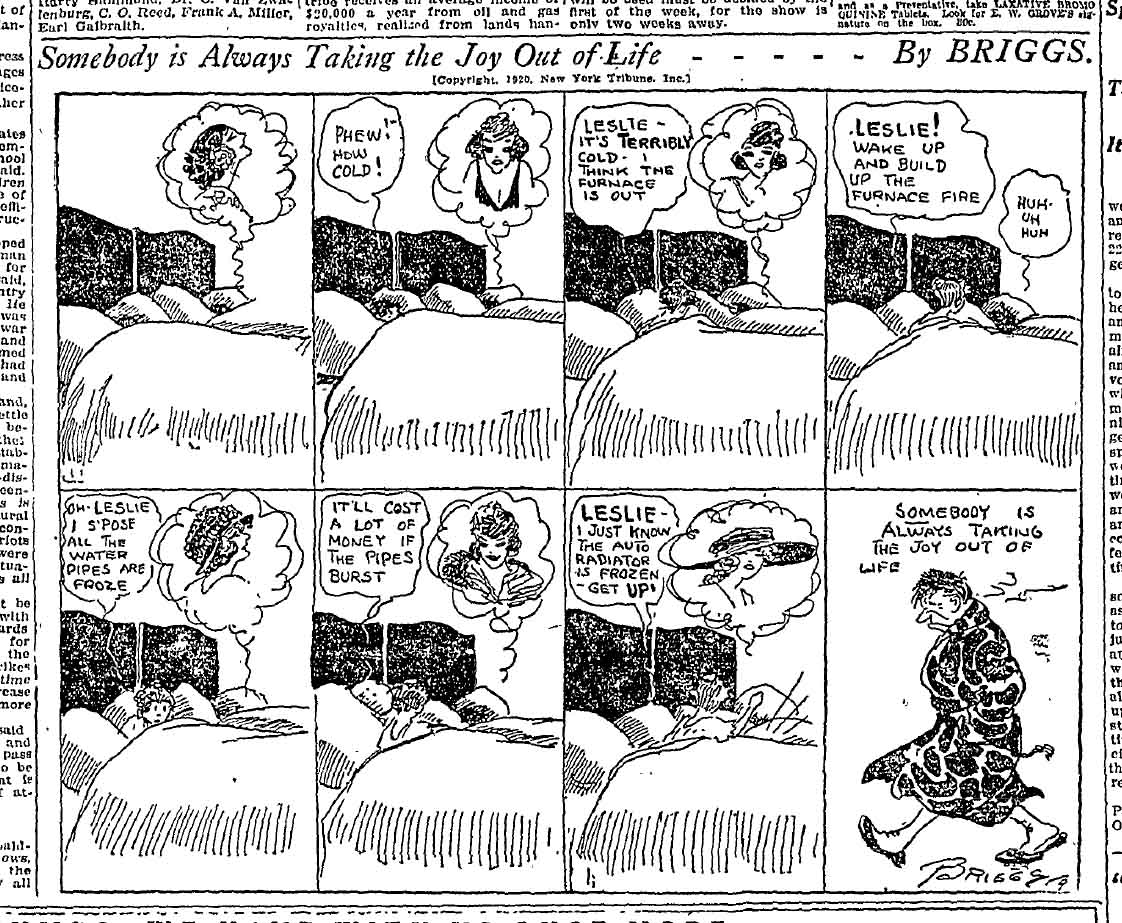
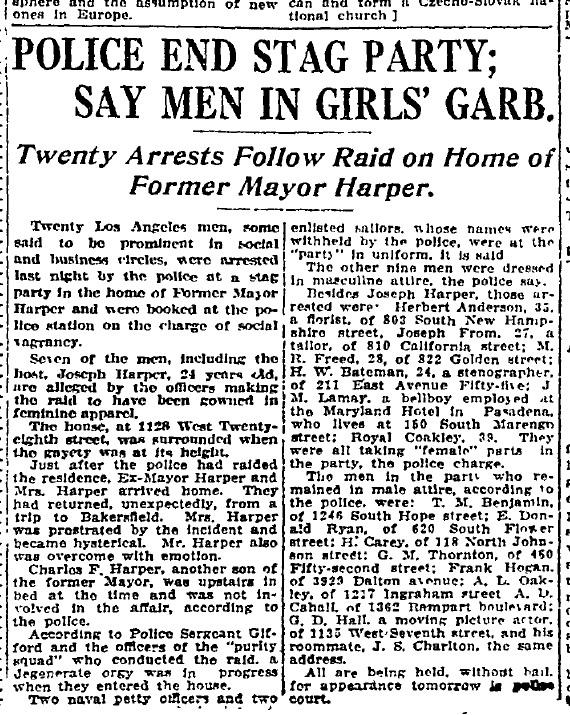
February 8, 1920: Police Arrest Men in Girls’ Garb

February 8, 1920: Comic panels of Somebody's Always Taking the Joy out of Life. A man lying in bed thinking of women as his wife nags him about the furnace and whether the pipes are frozen


February 1, 1920: Police end stag party, say men in girls' garb

February 1, 1920: The purity squad raids a party at the home of former Mayor Arthur Harper. Continue reading →

Posted in #gays and lesbians, Comics, LAPD | Comments Off on February 8, 1920: Police Arrest Men in Girls’ Garb

Through the Lens – Aviation Meet

January 1910 Aviation Meet 
Roy Knabenshue’s dirigible at the Aviation Meet.

January 1910 Aviation Meet
January 1910, Aviation Meet

January 1910: The Aviation Meet is viewed primary for its accomplishments with airplanes, and the balloonists tend to be overlooked. This photo (possibly by Sawyer and Dwyer, the handwriting on the back is in an old-fashioned, elaborate cursive that is hard to read)  shows Roy Knabenshue in a “government dirigible.” At right, Dick [Francis?] gives the order to lift off.

Knabenshue started dirigible passenger service in Pasadena in 1913, using a field at Marengo Avenue and Ipswich Street, his obituary says. He died in 1960 at the age of 83.

image

March 7, 1960, Roy Knabenshue

March 7, 1960: Roy Knabenshue dies.

March 7, 1960, Roy Knabenshue

March 7, 1960, Roy Knabenshue

Posted in Photography, Transportation | Comments Off on Through the Lens – Aviation Meet

Found on EBay – A. Victor Segno

Victor Segno  victor_segnoC
A. Victor Segno sends out a success wave. Note the beautiful hair.

Isn’t this great? A. Victor Segno, one of my favorite Los Angeles con men who sent out “success waves” for $1 a month, had his book on mentalism translated into German! I wonder if “How to Have Beautiful Hair” was also published in other languages. The book, listed on EBay, is $9 under Buy It Now.

Posted in books | Comments Off on Found on EBay – A. Victor Segno

Matt Weinstock, Feb. 1, 1960

Feb. 1, 1960, Peanuts

Different Way to Lose

Matt Weinstock     Those who have learned the hard way will stipulate that race track betting is a snare and a delusion.  Today we have with us reader G.S., who has a dynamic idea to unsnare and undelude it, well maybe a little.

    He proposes windows for reverse betting where the suckers could select and support the horses that finish last, next to last and third from last.  Win, place and show in reverse.

    After all, he points out, the craps tables in Vegas have "don't pass" markings for customers who prefer to bet with the house.

    He is certain reverse betting would get a tremendous play because so many horse players have shown such a remarkable talent for picking them that way.  However, he wishes to emphasize that horse owners should continue to try to win the regular way.  Otherwise, his idea could become more confusing than it sounds.

::


Feb. 1, 1960, Convict     A FRIEND
asked retired policeman John (Chew Tobacco) Smith — he almost always has an unlighted cigar in his mouth — about his recent trip to northern California.

    "The thing I noticed most," he replied wistfully. "was that signing my name on motel registers didn't cause quite the same reaction it did 40 years ago."

::

    IN CONTEMPT
My culinary efforts are
    condemned
When I try to vary the
    menu.
If I didn't love the judge
I'd request a change of
    venue.
    JUNE R. DRUMMOND

::

    HERE AND THERE the language is being punched around again.  A Wilshire Blvd. store had a sale on ladies' loose-fitting sweaters which it advertised as "Better Bulkies" . . . A small grocery store on Sunset Blvd. has the contradictory name, Superette  . . . And the west side market had a  big "Steakarama Sale."

::


    THE MARTINI
madness (should it be 3 to 1, 7 to 1, just wave the vermouth cork or should the olive, if any, have a pimiento stuck in its mouth) has busted wide open at Eddie Spivak's handsome new Redwood Restaurant on W 1st St. Bartender Art Linder serves Martinis with tiny pickled tomatoes speared on metal swords, instead of olives.  And you know, fellow connoisseurs, they taste good.  No, not the metal swords.

::


    AROUND TOWN —
An ad on the classified page for a male black German shepherd lost near Disneyland has the desperate line, "Return dog or adopt our kids."  City Health Department envelopes have imprinted, "The Shadow Knows," reminiscent of an old movie thriller, but actually a reminder to people to get a chest X-ray . . . Carolyn Rabb likes the sign on a market on N Ave. 53 in Highland Park:  "Buy Your Blue Chip Stamps Here.  We Give Groceries."

::


    QUOTE & UNQUOTE —
Kendis Rochlen nominates as the most provocative song lyric of the moment the one in which a fellow who has lost his girl to another, whines, "I've forgotten more about her than you'll ever know."  It kind of gets you . . . When his foot went to sleep, Alan Wolfson , 8, said to his mother, "My leg feels like ginger ale!" . . . Two more "rain in Spain" efforts:  Stan Prime of Pasadena states that eye irritation in the basin is an abomination in this location.  Jane Vidal of La Mirada wonders if the fog in Prague causes traffic clog.

::

    AT RANDOM — Oops, the Reader's Digest article "My Fight for America's First Birth-Control Clinic" by Margaret Sanger is condensed from the magazine Together . . . A man whose driver's license was revoked recently asked for a hearing, which he is entitled to do under the law, and the other day he received a notice in the mail that his hearing has been granted and giving the date.  He is happy about the opportunity to tell his story but he wishes the envelope from the MVD didn't have imprinted, ""Has your driver's license expired?" . . . As Sheldon White sees it:  Miss Eva Marie Saint, pretty obviously ain't.

Feb. 1, 1960, Abby

Posted in Columnists, Comics, LAPD, Matt Weinstock | Comments Off on Matt Weinstock, Feb. 1, 1960

Paul V. Coates – Confidential File, Feb. 1, 1960

Feb. 1, 1960, Mirror Cover

New-Found Evidence Favors Tokyo Rose

Paul Coates    Two months ago, On the 18th anniversary of Pearl Harbor, I printed what I thought was the first interview by a newsman with a woman known to the world as Tokyo Rose.

    Her real name was Iva Toguri D'Aquino.  A graduate of UCLA, she told me how she had gone to Japan shortly before Pearl Harbor to visit a dying aunt, how she repeatedly tried and failed to get back to the United States, and how she eventually was ordered to broadcast to U.S. troops for Radio Tokyo.

    "There was no propaganda in my broadcasts," she maintained.  "All I did was introduce records, play them, and play prisoner-of-war messages to their families.

    "The name I used in my broadcasts was Orphan Ann," she added, "I wasn't the notorious Tokyo Rose.  There were about 18 women broadcasting on Radio Tokyo, but I never heard of one with that name."

    There was a lot of testimony at her post-war trial to back up her claims, but it didn't help her very much.  She was found guilty of treason and handed a 10-year prison sentence.

Feb. 1, 1960, Finch Trial     This week, I learned some more concerning the woman and her case.  First, I found out that I wasn't the only newsman to have an extensive interview with her.  And second, that U.S. servicemen — at the time of the occupation of Japan — were themselves very reluctant to identify her as the infamous Tokyo Rose.

    I got my information from James Ryan, of Los Angeles, who sent me a copy of the Oct. 19, 1945, edition of the service magazine Yank.

    In it was an article by Yank correspondent Sgt. Dale Kramer, entitled "Second-Hand Rose."  Remember, this was the issue of Oct. 19, 1945 — a time when GIs could still smell the smoke of battle, and their hatred of the Japanese hadn't yet faded to a memory.

    The article began:

    "TOKYO — Soon after the 'occupation' of this city by American newsmen, the legendary character called Tokyo Rose became the most sought-after woman in Japan.

    "In the first few days after our entrance into Tokyo particularly, every story was a rat-race of newspaper correspondents, photographers, magazine writers and assorted trained seals seeking 'exclusives.'  But the search for Tokyo Rose had a different novel twist.

 
    "Tokyo Rose simply didn't exist.  She had no more reality than Paul Bunyan.
 
    "That made finding a  reasonable facsimile a pretty difficult matter.  No Jap woman radio commentator had ever called herself Tokyo Rose.
 
    "The origin of the name lies buried somewhere in the mists of the early days of the Pacific War, when it was used by homesick GIs as a label for any feminine Radio Tokyo voice.
 
    "The cumulative effect of all ballyhoo Tokyo Rose received was such that one of the chief objectives of American correspondents landing in Japan was Radio Tokyo.
 
    "There they hoped to find someone to pass off as the one-and-only Rose, and scoop their colleagues.
 
    "When information had been sifted a little, a girl named Iva Toguri emerged as the only candidate who came close to  filling the bill.  For three years she had played records, interspersed with snappy comments, beamed to Allied soldiers on the Zero Hour . . . Her own name for herself was Orphan Ann . . . "
 
    Sgt. Kramer, in the race for exclusives which he described, found Orphan Ann "bending over a small open-hearth stove, placing green vegetables in a cooking pot.

    "We explained Yank's status as the soldiers' magazine (to her)," he wrote.  "Since she had directed her program to the troops, we said, we thought it a good idea to interview her . . ."
Feb. 1, 1960, Vons Fire 
image     Iva Toguri D'Aquino was a willing interviewee for the sergeant, and the story he got was much the same one she gave me 14 years later.
 
    And on the subject of whether Mrs. D'Aquino was really Tokyo Rose, the sergeant concluded:
 
    "No one in Japan was in a position to give an answer.  Radio Tokyo had burned its files.  Miss Toguri and her husband scurried around their house trying to find a few old scripts.
 
    "But ironically, Tokyo Rose was depending chiefly on the U.S. for any defense she might be required to make.  She hoped recordings of her program made in San Francisco would, if not actually clear her of the charges of working with the enemy, at least keep her in a lower war-criminal category than that of, say,Hideki Tojo."
 
    Remember, that was Yank magazine in 1945.
 
Records Lost, Misplaced
 
    As it turned out later to Mrs. D'Aquino's misfortune, most of the San Francisco recordings of her program were destroyed or misplaced by U.S. authorities before her trial.
 
    A few — a very few — voices since that time claimed that this trial resulted in an astonishing miscarriage of justice, born in the emotion of the times. 
 
    Guilty or not, her conviction gave Iva Toguri D'Aquino the ugly distinction of being officially labeled for history as "Tokyo Rose."
 
Posted in #courts, broadcasting, Columnists, Front Pages, Homicide, Paul Coates | Comments Off on Paul V. Coates – Confidential File, Feb. 1, 1960

A Kinder, Simpler Time Dept.: Your Movie Columnist

Feb. 1, 1939, Hedda Hopper 

Feb. 1, 1939: Hedda Hopper gives five bells to “Gunga Din,” but says "Joan Fontaine’s beauty and ability were thrown away in a bit" part.

Posted in Columnists, Film, Hollywood | Comments Off on A Kinder, Simpler Time Dept.: Your Movie Columnist