
| |
|
June 22, 1940: “Robert Taylor's 'calm disposition' can't stand the strain of golf. One too many slices yesterday and he threw his clubs away and stalked off the course,” Jimmie Fidler’s staff says. |
| |
|
June 22, 1940: “Robert Taylor's 'calm disposition' can't stand the strain of golf. One too many slices yesterday and he threw his clubs away and stalked off the course,” Jimmie Fidler’s staff says. |
|
|
|
June 22, 1960: A Chemex! The scientific way to make coffee. On the jump, “The Apartment” or “Macumba Love?” Tough choice. |
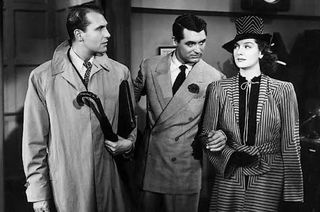 I once read an excellent book about single life that included this recipe for depression: “Go out and rent a movie with Cary Grant in it, come back and put the kettle on.” This advice has never failed me. You cannot go wrong with Cary Grant; his movies are invariably cheering (although “Arsenic and Old Lace” can be headache-inducing). Even in a weepy thriller like “Notorious,” it’s just nice to see him, you know?
The best thing about “His Girl Friday” is what a great ensemble he’s got. Ralph Bellamy is hilarious and Billy Gilbert always absolutely slays me in his small part as Joe Pettibone, but the movie really belongs to the magnificent, suit-wearing, bon-mot-slinging Rosalind Russell. Usually with Cary Grant movies you want to be Cary Grant, but here you really want to be Rosalind.
Does the plot need rehashing? Grant plays Walter Burns, editor of the Morning Post newspaper, and Russell is his ex-wife and ex-star-reporter Hildy Johnson. She drops by to tell Walter she’s marrying boring insurance man Bruce (Bellamy); she’s tired of the exhausting, unpredictable newspaper business and she’s got no regrets about divorcing Walter: “Instead of two weeks in Atlantic City with my bridegroom, I spent two weeks in a coal mine!” she snarls. Distraught but externally unflappable, Walter starts pulling strings to get her back in the newsroom.
| |
|
June 22, 1910: A grocer sends two employees to the home of Francisco Belasco, 232 S. Avenue 19, to recover some goods delivered there by mistake. It doesn’t go well. |
| |
|
June 21, 1960: Matt Weinstock has an update on Maj. Gen. William F. Dean, who was held by the North Koreans for more than three years. CONFIDENTIAL TO CAROLE: Woman does not chase man — neither does mousetrap chase mouse, Abby says. |

|
|
June 21, 1960: Paul Coates has some fun with a municipal judge who wants to get into movies and TV. |
| |
|
June 21, 1940: “Bruce Cabot and Elaine Brandeis, beauty prize winner, taking a portable radio on their nightclub rounds to get late war reports,” Jimmie Fidler says. |
| |
|
June 21, 1960: E.W. Darby of the Chicago Sun-Times says Vice President Richard Nixon is "impatient with such labels" as "conservative," "liberal" or "progressive conservative." "I think it is difficult to categorize people in public life with terms like liberal and conservative because those terms have been distorted by usage and practice," Nixon says. On the jump, see the new Corvair Monza! |
| Los Angeles Times file photo As nearly everyone realized, this is Evelyn Nesbit, the subject of a recent Paul Coates column.
|
|
|
| Central Park, which was renamed Pershing Square in November 1918.
June 26, 1907, a headline that will live in infamy. |
|
June 21, 1910: William Hicks is fined $10 [$227.39 USD 2009] for using “shocking language” in the presence of women. At least he wasn’t using a telephone! On the jump, city officials announce plans for Central Park, now known as Pershing Square. Among the considerations is eliminating seats to “rid the park of loafers and agitators who have made it a rendezvous for years and impaired its usefulness to the general public.” A century later, Pershing Square is a concrete moonscape intended to – wait for it – repel the homeless. |
| One of the more intriguing lost films of the silent era is Theda Bara’s “Salome,” which was destroyed in a vault fire. A still from the film has been listed on EBay. Bidding starts at $10.50.
And look, imdb folks, this movie is lost. So there’s no point in reviewing it based on movie stills or in giving it five stars. Nobody has seen it in generations! |
| |
|
June 20, 1960: Those wags on the Mirror copy desk come up with an ad campaign to give vultures a positive image … And Abby has advice for a young woman who’s crazy about Ernie, but would like his constant companion, Eugene, to get lost. It seems they are always together! |
| Los Angeles Times file photo
|
||
|
Nearly everybody (even poor country boy Fibber McGee!) recognized this week’s mystery guest as Evelyn Nesbit. So here’s another mystery. This handout photo from Warner Bros., dated June 1939, was in Evelyn Nesbit’s photo file and is labeled as being Nesbit. But it’s clearly not her. I went through the movie ads from June 1939 trying to determine what Warners had in release then. I think we can safely rule out "Juarez." So who is it?
|

|
|
June 20, 1960: Paul Coates writes about a failed Utopia in the Galapagos Islands…. And on the jump: This is so cool! Guess who was interviewed for the Mack Sennett feature – none other than my old friend and former boss Elizabeth “Betty” Franklin, who retired to Tucson and worked at the University of Arizona library. After she retired for the second time, from the UA, she volunteered in the library’s special collections and catalogued all the dissertations and other projects. I knew she worked at the Academy of Motion Picture Arts and Sciences library, but I never realized she was head librarian! She used to tell me about seeing the uncut version of “Greed.” She said it was long. |
 |
|
June 20, 1940: “Robert Taylor looks positively nude. The mustache is off!” Jimmie Fidler says. |
| |
|
June 20, 1970: Alex Johnson would win the Angels' only batting title in 1970, finishing with a .329 batting average. But like everything else in Johnson's perplexing career, the season would not be without trouble. In the first inning of a game against Milwaukee, Johnson was ejected after driving in a run with a single. Johnson didn't like a called strike that was a pitch before his base hit. |
| |
|
June 20, 1910: The Times charges $50 [$1,136.94 USD 2009] for six weeks of Linotype school. Notice the reference to the auxiliary plant, where The Times was published after the Oct. 1, 1910, bombing destroyed the newspaper building at 1st and Broadway. On the jump, a burglar ransacks a store but can’t find a cent. |
| |
|
June 19, 1940: “What could be more ironic than the title ‘French Without Tears,’ currently billboarded?” Jimmie Fidler Says |
|
|
|
June 19, 1910: The Times publishes an editorial cartoon by Albert Jean Taylor praising Gov. James Gillett’s ban on the Fourth of July fight between Jack Johnson and James J. Jeffries, which was to be held in San Francisco. Another cartoon of Johnson by Edmund Waller “Ted” Gale accompanied the June 16 story on the prizefight ban. On the jump, picketers “ran like frightened curs” as police enforced a new ban on picketing. “The police drew their sticks and started toward the gang of lawbreakers. They huddled together for an instant and then turned and ran. The majesty of law represented by a handful of policemen overawed the 50 men who knew they were disobeying the law,” The Times said. |


