From the Vaults: ‘Anna Boleyn’ (1920)

Annaleer There's not much reason to watch Ernst Lubitsch's silent historical epic "Anna Boleyn" (which Netflix informs me is also called "Deception"), unless you're, say, a movie blogger who has set herself the cussed task of watching only films from 1920, 1940, 1960 and 1980. Fortunately for you, I am just such a blogger, and so I have watched this film so that you do not have to!

It's not that it's bad by any means; for 1920, the sets and costumes are pretty impressive. Five minutes in, I was waving a pizza slice around and expostulating to the cats, "Look at that crowd shot! All these people in costume! This thing must have cost a fortune!" And the acting is often hammy but fun, and it fits the material. Also, a wench jumps out of a cake! It's just that the thing is so long. Run time is about two hours, but it feels longer.

Part of the problem is that you already know the story, although the tragedy's been hepped up until it feels like "Tess of the d'Urbervilles." Young Anna (German for "Anne," I guess) Boleyn arrives from France to stay with her uncle, the Duke of Norfolk (Ludwig Hartau), and be a lady-in-waiting to Queen Catherine of Aragon. She's excited to meet the queen and also to be reunited with her boyfriend, megacutie Sir Henry Norris (Paul Hartmann).

Instead, she catches the roving eye of big gross King Henry VIII (Emil Jannings, clearly enjoying himself tremendously). He openly chases Anna around, devastating Catherine (the lusciously named Hedwig Pauly-Winterstein) and shattering Anna's relationship with Sir Henry. Anna ends up married to the man she loathes, and we all know how that goes for her.
Continue reading

Posted in Film, From the Vaults, Hollywood | 5 Comments

On Assignment

Clarence Darrow
Los Angeles Times file photo

Clarence Darrow addresses jurors during his trial on charges of jury tampering.

Dropcap Vadis have spent the last few days at the Huntington Library going through transcripts of the trial of James B. McNamara in the 1910 bombing of The Times. They are typed on onionskin paper and bound in heavy leather volumes, but despite their age, they would be familiar to anyone who has ever been through jury selection. Here’s a sample:

Q. In other words, then, you stand indifferent between the people of the state of California on the one hand, don’t you, and the defendant on the other, in spite of any opinion that you have?

A. I couldn’t answer that question. I don’t understand it.

Much of the questioning is being done by Clarence Darrow. These are not the bravura set pieces of his career, the eloquent closing statements and pleas to the jury that are republished in books.  The transcripts show Darrow in the daily courtroom routine of questioning jurors, making objections and responding to challenges from the prosecution. It’s fascinating to get a feel for the man, not from a heroic oration but a mundane conversation.

As in any extended courtroom proceeding, there are long stretches of tedium. Pages and pages go by in which Darrow is focusing on the state of mind of a juror – until the defense finally objects that his point has been thoroughly covered.

But mixed into the grinding, repetitive interrogation are sudden flashes of drama. At one point, Darrow begins asking a prospective juror about whether he studied law. On the back of the opposite page, someone has written in pencil: “How did Darrow know?”

It’s a chilling question.

From our vantage point a century later, we know that Darrow had people on his defense team who were investigating prospective jurors, particularly detective Bert Franklin, who was eventually charged with attempting to bribe two of them.

How interesting it becomes, then, to read the transcript of Darrow and Robert Bain, one of the jurors in the attempted bribery,  and contrast that gentle questioning with the withering barrage Darrow delivered to another prospective juror.

And surprisingly enough, these transcripts offer an undiscovered time capsule of early 20th century Los Angeles. Most of the prospective jurors, so far, don’t regularly read the newspaper – any newspaper – even if they are subscribers. They also don’t read magazines on any consistent basis. They have only a vague knowledge of the case. Something about gas – or dynamite – exploding. 

In other words, the transcripts offer a glimpse into the stories of people who would otherwise be forgotten. They are not wealthy or powerful. They are janitors, carpenters, masons, wagon teamsters, ranchers, the retired and the unemployed. Seeing what a small, small role newspapers played in their lives is a humbling antidote to our notion that the papers of the day – especially The Times – shaped and molded public opinion with the efficiency of a factory machine.

Posted in #courts, 1910 L.A. Times bombing, books | Comments Off on On Assignment

Another Good Story Ruined: Gen. Otis’ Armored Car [2nd Update]

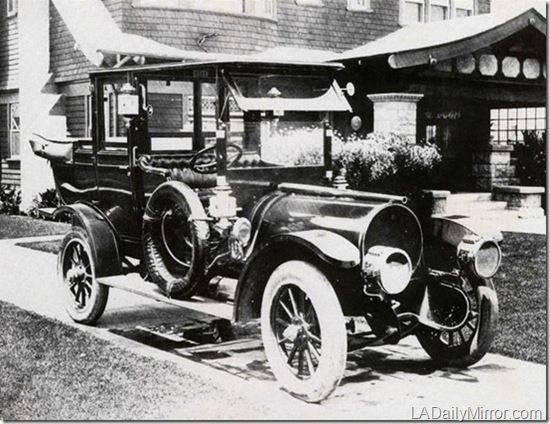
Behold the war machine of Gen. Harrison Gray Otis! A 1910 Franklin Model H landaulet!
 Virtually no one who writes about The Times and Gen. Harrison Gray Otis can resist referring to a cannon mounted on his car. Otis is “the man you love to hate” of Los Angeles history, and what could be more delicious than the armor-plated Otis-mobile with its fearsome artillery piece.Sorry. It was an auto horn. Honk!

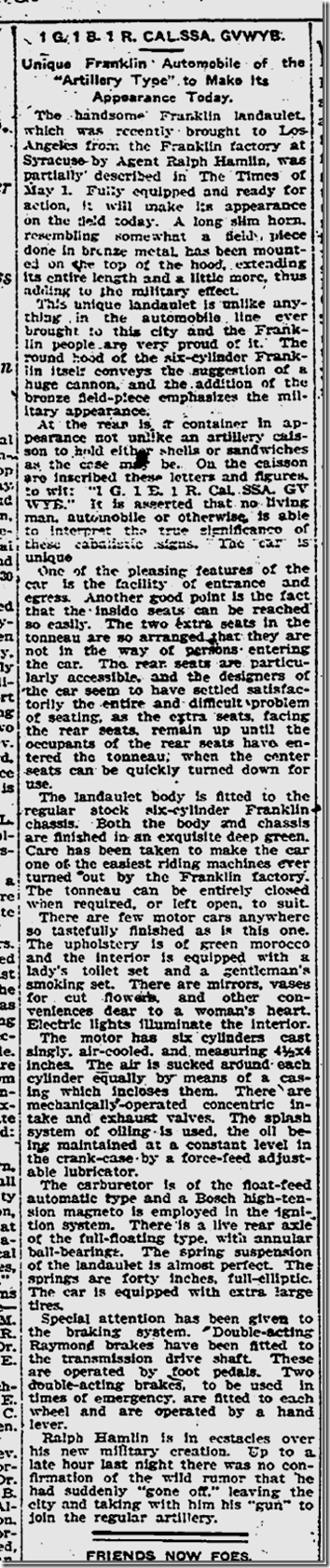
At right, a May 21, 1910, article in The Times describes the custom Franklin. Curiously enough, although Otis wasn’t a shy man, The Times was coy about who owned the new vehicle.

It’s a bit difficult to tell from the photo, but the front of the car (which was air-cooled and had no radiator) resembled a large cannon – at least according to The Times. The bronze car horn was meant to emphasize this military appearance. Here’s a modern photo of a Franklin, which shows the rounded hood and front grille. And yes, it looks a bit like a cannon.

Let’s roll backward through a few examples and see who got it wrong. Ready?

“Otis began tooling around town in an armored car with machine guns mounted on the hood,” “Before the Storm,” Rick Perlstein, 2009. [Ooh! Machine guns! I like this one!]

“… Harrison Gray Otis “patrolled the streets in his private limousine with a cannon mounted on the hood,”  “Dominion From Sea to Sea” by Bruce Cummings, 2009.

[Update] “He mounted a cannon on the hood of his limousine and made sure his chauffeur was prepared to repel, at his command, any enemy attacks,” “American Lightning,” Howard Blum, 2008.

“…to emphasize his truculence, he later had a small, functional cannon installed on the hood of his Packard touring car,”  “American Urban Politics in a Global Age,” by Paul Kantor and Dennis R. Judd, 2008. [A Packard? Oops!]

Gen. Harrison Gray Otis “continued to live in a perpetual state of combat readiness, dressing for work in uniform and mounting a small cannon on the hood of his car,” “High Steel,” by Jim Rasenberger, 2004.

[Updated Aug. 29, 2010: “a small, functional cannon was installed on the hood of Otis’ touring car to intimidate onlookers,” “City of Quartz,” Mike Davis, 1992.]

“While Harrison Gray Otis patrolled the streets in his private limousine with a cannon mounted on the hood…” “Water and Power,” William L. Kahrl, 1983.

“Otis took to riding around Los Angeles in a huge touring car with a cannon mounted on it,” “The Powers That Be,” David Halberstam, 1979. [Not the late David Halberstam! Nooooo!].

[Updated  Aug. 27, 2010: “Otis toured the city with a small cannon mounted on his car,” “Thinking Big,” Robert Gottlieb and Irene Wolf, 1977.]

“While Harrison Gray Otis patrolled the streets in his private limousine with a cannon mounted on the hood…,” California Historical Quarterly, 1976.

Let’s skip a bit. I think we’re getting close to the roots here.

The story of the cannon appears in Morrow Mayo’s 1933 book “Los Angeles,” “Otis had a small cannon mounted on his automobile and went dashing about like a general at the front.”

And we find it in Louis Adamic’s 1931 book, “Dynamite,” “… while fighting the unions, he mounted a small cannon on the hood of his automobile!”

If anyone finds an earlier example, please send it along.

Note: The mystery isn’t over. The “prominent citizen” who bought the car had this inscribed on it: 1G. 1B. 1R. Cal. SSA. GV WYB. Any guesses?

Continue reading

Posted in 1910 L.A. Times bombing, Another Good Story Ruined, Transportation | 7 Comments

Cards Beat Dodgers on 9th-Inning Home Run by Joe Torre

Aug. 29, 1970, Dodgers

Aug. 29, 1970: Joe Torre made the difference in the Dodgers' 1-0 loss to the St. Louis Cardinals.

This wasn't the case of a managerial goof. This was Torre the Cardinals' power-hitting third baseman, whose ninth-inning home run against Don Sutton provided the game's only run. The winning pitcher was Cardinal rookie and future Dodger Jerry Reuss.

"It has been five seasons since I hit a home run here," Torre told The Times' John Wiebusch, "and the only two I got here were hit off Don Drysdale and Sandy Koufax in games we lost."

The home runs were hit for the Braves, the team Torre started with in 1960. He came to the Cardinals in 1969 in a trade for Orlando Cepeda.

Wiebusch noted that Torre had lost 20 pounds and was mostly playing third and only occasionally catching.

"The weight-loss thing was mostly inspired by the fact that this is my 30th year," Torre said. "I do not want to be known as a fat man."

— Keith Thursby

Posted in Dodgers | 1 Comment

Jimmie Fidler in Hollywood, Aug. 29, 1940

Aug. 29, 1940, Draft Voted by Senate

Aug. 29, 1940, Cadets

Aug. 29, 1940: Add strange mishaps: The hundreds of dollars of damage done to furnishings in the Beverly manse of Ann Sothern's mamma when Ann's dog fell into a bucket of paint and ran wild through the house, Jimmie Fidler says. 

Continue reading

Posted in Animals, Columnists, Film, Hollywood | Comments Off on Jimmie Fidler in Hollywood, Aug. 29, 1940

On the Frontiers of Literature

 April 13, 1939, Van Dine

Aug. 28, 1910: If you’re a fan of mystery books, you may have heard of S.S. Van Dine, who wrote "The Greene Murder Case," "The Canary Murder Case" and other Philo Vance stories. Van Dine was the pen name of Willard Huntington Wright (d. 1939), who in 1910 was book editor at The Times. [Disclaimer: Despite many attempts, I have never been able to get through even one of his books. My loss, I’m sure.]

Some opinions: "The Way of All Flesh" by Samuel Butler: “Although it is not thirty years since the author completed this book it is already, in a sense, an antiquity.”

"The Motor Maid" by C.N. and A.M. Williamson: "The most inane and worthless piece of fiction I have ever read."

"The Window at the White Cat," by Mary Roberts Rinehart: "It is the best kind of detective story extant and has many merits which are almost unknown to this type of epileptic literature."

Continue reading

Posted in art and artists, books | Comments Off on On the Frontiers of Literature

Movieland Mystery Photo

    Aug. 23, 2010, Mystery Photo     

Los Angeles Times file photo 

 
Just a reminder on how this works: I post the mystery photo on Monday and reveal the answer on Friday … or on Saturday if I have a hard time picking only five pictures; sometimes it's difficult to choose. To keep the mystery photo from getting lost in the other entries, I move it from Monday to Tuesday to Wednesday, etc., adding a photo every day.

I have to approve all comments, so if your guess is posted immediately, that means you're wrong. (And if a wrong guess has already been submitted by someone else, there's no point in submitting it again).

If you're right, you will have to wait until Friday or Saturday. There's no need to submit your guess five times. Once is enough. The only reward is bragging rights. 

Last week’s mystery guests were Raymond Hackett and Blanche Sweet.   The weekend mystery guests were Mary McIvor and William Desmond

There’s a new photo on the jump!

Continue reading

Posted in Film, Hollywood, Mystery Photo, Photography | 71 Comments

The Bull Pen

Aug. 27, 1960, Dodgers

Aug. 27, 1960: The Dodgers' apparent refusal to sell their future made for an interesting if confusing story.

The team apparently turned down $1.8 million for Frank Howard, Willie Davis, Ron Fairly and three other players. "They are not for sale," Walter O'Malley told The Times' Frank Finch.

So what team had that much money to pay for prospects?

Well, there wasn't one. Turns out nine teams made offers for the six players and the $1.8 million represented the "six best offers," Finch said. Oh.

One team offered $400,000 for Howard, the mammoth young outfielder with the impressive power. He already led the Dodgers in home runs, but he also was striking out at a record pace with 86 strikeouts in 83 games.

The Dodgers traded Howard in 1964 to the Washington Senators in a package that brought pitcher Claude Osteen to Los Angeles. One of the Dodgers included in the deal was pitcher Pete Richert. One of the 1960 minor league Dodgers listed in Finch's story was pitcher Pete Reichert — I'm guessing he meant Richert.

— Keith Thursby

Posted in Dodgers | Comments Off on The Bull Pen

Paul Coates, Aug. 25, 1960

 
Aug. 25, 1960, Comics

Aug. 25, 1960: Tons of steel fall onto Wilshire Boulevard from a building under construction … Richard Bergholz makes a rare appearance as a columnist and Paul Coates analyzes a bill from Los Angeles County for cutting down a damaged tree and replacing it.

CONFIDENTIAL TO DESPERATE … PLEASE HELP: There is no reason to feel guilty. Under the circumstances, anything goes.

Matt Weinstock is on vacation!

Continue reading

Posted in art and artists, Columnists, Comics, Matt Weinstock, Paul Coates | Comments Off on Paul Coates, Aug. 25, 1960

Jimmie Fidler in Hollywood, Aug. 25, 1941

 
Aug. 25, 1941, Churchill Issues Japan Warning

Aug. 26, 1941, Tom Treanor  

Aug. 25, 1941: Fred Astaire is building a private golf course on his San Diego County ranch, Jimmie Fidler says.

Continue reading

Posted in Columnists, Film, Hollywood, Tom Treanor | 1 Comment

Matt Weinstock Is on Vacation, Aug. 24, 1960

Aug. 24, 1960, Comics

Aug. 24, 1960: Matt Weinstock is on vacation.

Dear Abby: I am 19 and work in a large store. One of my supervisors started taking me out for coffee breaks and lunches and then it got serious. I knew he had a wife and family but the attraction was too strong to fight. Now I am expecting his baby. He says I can't expect any help from him, financial or otherwise. I'll have to quit work soon. I can't face my parents Should I go to his wife or should I tell our employer?

Continue reading

Posted in art and artists, Columnists, Comics, Matt Weinstock | Comments Off on Matt Weinstock Is on Vacation, Aug. 24, 1960

Paul Coates, Aug. 24, 1960

Aug. 24, 1960, Mirror

Aug. 24, 1960: The Mirror reports a shouting match between Mayor Norris Poulson and Police Chief William H. Parker over a proposed police cadet program. It sounds like a great item, but alas, so many stories and only one Larry Harnisch, who is focused on the 1910 bombing of The Times these days.

Paul Coates follows up on a story about Emery Newbern, “the Perry Mason of the drunk tank.” 

Aug. 24, 1960, Paul Coates

Posted in City Hall, Columnists, From the Vaults, LAPD, Paul Coates | 1 Comment

Jimmie Fidler in Hollywood, Aug. 24, 1941

Aug. 24, 1941, British Pound at German Bases

Aug. 24, 1941, Tom Treanor

Tom Treanor files a report from Rome on an unusual way to get iron ore from beach sand.

Aug. 24, 1941: That "rustic little cabin" Wally Beery purchased in Jackson Hole, Wyo., won't be "little long." Wally's adding six more rooms and deluxe fixtures, Jimmie Fidler’s staff says. 

Continue reading

Posted in Columnists, Film, Hollywood, Tom Treanor | Comments Off on Jimmie Fidler in Hollywood, Aug. 24, 1941

San Francisco Labor Leaders Visit Los Angeles

Aug. 24, 1910, Tveitmoe

Aug. 24, 1910, Herald

Aug. 25, 1910: In vastly different ways, The Times and the Herald report the arrival of San Francisco labor leaders.

The Times said: "The worthies registered at the Hayward, and almost immediately the big boss who pulls the strings which make the deluded union puppets dance issued a call for a conference and a blanket order for beer. Last night the czar barred himself within his room and in reply to a telephoned inquiry concerning his business here, announced that he was "not talkin' to no reporters."

Coming up next month: San Francisco labor leaders file a libel suit against Times Editor and General Manager Gen. Harrison Gray Otis and Assistant General Manager Harry Chandler.

Continue reading

Posted in #courts, 1910 L.A. Times bombing | Comments Off on San Francisco Labor Leaders Visit Los Angeles

Jimmie Fidler in Hollywood, Aug., 23, 1940

 
Aug. 23, 1940, RAF Blasts

Aug. 23, 1940, Tom Treanor

Tom Treanor, who was killed covering World War II for The Times, on housing in Rome.

Aug. 23, 1940: George Raft's been startling New York natives by making nite club rounds in bedroom slippers, Jimmie Fidler says.

Continue reading

Posted in Columnists, Film, Hollywood, Tom Treanor | 1 Comment

On Assignment

Aug. 23, 2010, Times Eagle
Photograph by Larry Harnisch / Los Angeles Times 

May 31, 1938, Times Monument
A Memorial Day ceremony at the monument in 1938.

I visited Hollywood Forever Cemetery over the weekend to see the memorial to victims of the 1910 bombing of the Los Angeles Times. I was told that The Times’ eagle has been missing its wings since at least 1990 and indeed, they are gone.

Four of the victims were buried elsewhere. Assistant City Editor Churchill Harvey-Elder, for example, is in Rosedale Cemetery. After visiting Hollywood Forever Cemetery, I went over to Rosedale to see if I could find his grave, but the office was closed. Rosedale, which is on Washington Boulevard just east of Normandie Avenue, is an older cemetery with narrow roads, and I ended up getting caught in a funeral procession that parked en masse for a graveside ceremony.

Posted in 1910 L.A. Times bombing, art and artists, Cemeteries | Comments Off on On Assignment

From the Vaults: ‘Friday the 13th’ (1980)

F13poster *claps hands to face, shakes feathered hair, screams*

I'm sorry! I meant to do this last week. Larry pitched this idea when he first started running posts from 1980, and I thought "ooh, there's a Friday the 13th in August" and then I didn't think about it again until, well, last Friday morning, when my "House of Usher" post had just gone live. Well… "Friday the 13th" itself was released on May 9, 1980, so at least there is precedence for not getting the date quite right. That counts… right? ….

Besides, there's no actual mention of Friday the 13th in the movie. It's given as the date for much of the action, but nobody ever says "Boy, I sure hate Friday the 13th! Things always get crazy!" or anything like that. This is fitting; the movie intentionally follows the template of the tremendously successful "Halloween" (1978), which was originally titled "The Babysitter Murders" and involves the holiday largely as window dressing. In the coming years "My Bloody Valentine" (1981) and "April Fool's Day" (1986) would treat their own holiday themes much more seriously. For the original F13, though, it's just all about the camp counselors.

And what counselors they are! Not a single camper is to be seen in this film, unless you count the drowning Jason (was he a camper or just an employee's kid that nobody was really in charge of?) shown in flashback. This film is concerned about the counselors, thank you, the nubile teenagers in high-waisted shorts and crisp white panties. This film clearly knows which side its bread is buttered on! All the action takes place on the day before Camp Crystal Lake is to open, so at least there's a good reason: the story centers on the counselors who are helping get the camp ready. Sadly for them, that will never happen.

Continue reading

Posted in Film, From the Vaults, Hollywood | 3 Comments

Found on EBay – Theda Bara’s ‘Salome’

Theda Bara Salome Theda Bara Salome

This still from Theda Bara’s lost film “Salome” has been listed on EBay. Bidding starts at $9.99.

Posted in Film, Hollywood, Photography | Comments Off on Found on EBay – Theda Bara’s ‘Salome’

Movieland Mystery Photo

 
 Aug. 20, 2010, Mystery Photo
Los Angeles Times file photo

Aug. 22, 2010, Mystery Photo
Los Angeles Times file photo

Here’s our mystery guest with a mystery companion!

Here’s our weekend mystery guest. I like to keep things more informal on the weekends so I’ll post all the comments as they come in rather than waiting. This week’s mystery guest was Raymond Hackett.

Posted in Film, Hollywood, Mystery Photo, Photography | 6 Comments

‘Once in a Lifetime’ Chance to Coach the Lakers

image

Aug. 21, 1960: The Lakers of Los Angeles were coming together.

West Virginia University Coach Fred Schaus was hired as the team's new coach. "It was an opportunity that comes once in a lifetime," he told UPI. The team already had a great young player in Elgin Baylor, and the Lakers' top draft choice was Jerry West.

Schaus coached the Lakers until the 1966-67 season, then become the team's general manager.

Earlier in the month, the Lakers turned down $200,000 from the St. Louis Hawks for Baylor and they hoped West would soon join Schaus, his old college coach.

"The Cleveland AAU team is bidding for Jerry's services. Naturally I hope he joins me out here," Schaus said.

— Keith Thursby

Posted in Lakers | Comments Off on ‘Once in a Lifetime’ Chance to Coach the Lakers