Movieland Mystery Photo — Update

    Aug. 30, 2010, Mystery Photo       

Los Angeles Times file photo 

image

July 10, 1954: Rites are conducted for Joel Watnick, who died after being struck by our mystery guest, actress Lynne Baggett, in a hit-and-run accident at Waring and Orlando avenues. 

Waring and Orlando
Waring and Orlando via Google maps’ street view. 

 
Just a reminder on how this works: I post the mystery photo on Monday and reveal the answer on Friday … or on Saturday if I have a hard time picking only five pictures; sometimes it's difficult to choose. To keep the mystery photo from getting lost in the other entries, I move it from Monday to Tuesday to Wednesday, etc., adding a photo every day.

I have to approve all comments, so if your guess is posted immediately, that means you're wrong. (And if a wrong guess has already been submitted by someone else, there's no point in submitting it again).

If you're right, you will have to wait until Friday or Saturday. There's no need to submit your guess five times. Once is enough. The only reward is bragging rights. 

Last week’s mystery guest was Aline MacMahon. The weekend mystery guest was Loretta Miller. Who’s Loretta Miller? Why’s she’s “Angel Face!”  

There’s a new photo on the jump!

Continue reading

Posted in Film, Hollywood, Mystery Photo, Photography | 31 Comments

Explosions Destroy Nonunion Plant

Sept. 5, 1910, Peoria Explosion

image

Sept. 5, 1910: At 10:30 p.m., a series of blasts destroyed the Lucas Bridge and Iron Co. plant, a nonunion firm in Peoria, Ill. "Three explosions reduced the building to kindling wood and four buildings adjacent to the property were wrecked,” The Times said. And for the second time in several weeks, a bomb in the East Peoria rail yards destroyed carloads of steel girders intended for a Peoria and Pekin Union railroad bridge that was being built over the Illinois River.

Despite the devastation, this incident provided a crucial lead to the identity of the bombers. Several days later, investigators found a an unexploded time bomb hidden in the railway bridge. It too had been set for 10:30 p.m. but malfunctioned.

For the first time, investigators could examine the bomb components, and they began trying to trace the alarm clock and the unusual type of can used for the nitroglycerin.

Continue reading

Posted in 1910 L.A. Times bombing | Comments Off on Explosions Destroy Nonunion Plant

From the Vaults: ‘The Shop Around the Corner’ (1940)

Why, it’s another movie by Ernst Lubitsch! And it could not be more different from the stately silent film we looked at last week. (My God, it’s almost like this was planned.)
A classic comedy of manners, “The Shop Around the Corner” got a boost in 1998 when “You’ve Got Mail” came out; it had also been remade in 1949 as the musical “In The Good Old Summertime” with Judy Garland (and a 3-year-old Liza Minnelli). Timeless as the theme may be, it works really well as a period piece. Shops like this just don’t exist anymore.

James Stewart plays Alfred, top salesman at a retail shop in Budapest, and Maureen Sullavan is new hire Klara. They get off on the wrong foot and spend most of the movie arguing with each other, both unaware that they’re also anonymous pen pals. For both of them, life pretty much revolves around the shop, and both find their letters a welcome escape into a higher realm of thought — and eventually into love!

Really though this is much more of a workplace story than a romance. From the opening scene, when all the shop employees filter in to start the day, the movie’s often an ensemble piece. Stewart’s Alfred is the only person who’s not afraid of boss man Matuschek (Frank Morgan), and a lot of scenes hinge on the different ways the employees try to ingratiate themselves to their boss. Any modern worker can relate, although the top-top boss is more likely to be in a city across the country than an office right off the sales floor. There’s also frequent and noisy comic relief provided by errand boy Pepi (William Tracy).

Once Stewart and Sullavan get going, their snippy exchanges become the movie’s best scenes. My favorites are her hiring scene and another bit in a storage room as she works up to asking for some time off — both scenes start off with a tone of friendly detachment and then gradually dissolve into icy rancor. I love how they coldly address each other as “Miss Novak” and “Mr. Kralik.” Over time, though, they develop a grudging respect for each other.

Before the jump here, I just have to warn you people that there’s a still from one of the final frames toward the bottom there and, well, if you got at all freaked out by Cary Grant dressed as Santa Claus, you might want to brace yourselves. Life is not always pretty, and neither are the movies. OK, here we go.

Continue reading

Posted in Film, From the Vaults, Hollywood | 5 Comments

Jimmie Fidler in Hollywood, Sept. 4, 1940

image

Sept. 4, 1940, Destroyers

Sept. 4, 1940: Comedy of the week: "Argentine Nights," in which the Ritz brothers and Andrews sisters prove laughs and music come in threes, Jimmie Fidler says. 

Coming Sept. 6: The Ice Follies of 1941 at the Pan-Pacific!

Continue reading

Posted in Columnists, Film, Hollywood | Comments Off on Jimmie Fidler in Hollywood, Sept. 4, 1940

Paul Conrad, RIP

 
Aug. 9, 1974, Nixon Resigns, Conrad

Aug. 9, 1974, Paul Conrad on Richard Nixon's resignation.

Also, Paul Conrad on the shooting of Robert F. Kennedy.
Posted in art and artists, RFK, Richard Nixon | 2 Comments

San Francisco Labor Leaders Accuse The Times of Libel

July 19, 1910, Editorial

July 19, 1910: "Jailbird" … "pinhead" …  A typical Times editorial about labor.

Sept. 4, 1910, Libel

Sept. 4, 1910: San Francisco labor leaders file a libel suit against Times Editor and General Manager Gen. Harrison Gray Otis and Assistant Manager Harry Chandler. It’s a bit difficult to determine precisely which stories were cited in the suit because The Times so often used caustic language in writing about unions.

The Times says:  “The complaints were based upon articles in The Times asserting that certain of the aforesaid bosses came to Los Angeles to foment industrial strife and civic disorder,” which sounds very much like this Aug. 25, 1910, story.

At the time the suit was filed, Otis was in Mexico on a goodwill trip at the request of President Taft. Chandler, who had just returned from a vacation trip to British Columbia, was freed on $200 bail, The Times said. The libel charges were dismissed by a judge because of errors in the form and substance of the complaints, The Times said. 

Continue reading

Posted in #courts, 1910 L.A. Times bombing | Comments Off on San Francisco Labor Leaders Accuse The Times of Libel

Jimmie Fidler in Hollywood, Sept. 3, 1940

Sept. 3, 1940, Attack on Freedom

Sept. 3, 1940, Labor Day Parade

Sept. 3, 1940: CONFIDENTIAL COMMUNIQUE TO Peter Lind Hayes: If you and Mary Healy are really in love, why postpone marriage to wait for more professional success? Happiness doesn't depend on income, Jimmie Fidler says.

Continue reading

Posted in Columnists, Film, Hollywood | Comments Off on Jimmie Fidler in Hollywood, Sept. 3, 1940

The Well-Informed Public, 1911

1911, McNamara Trial
Los Angeles Times file photo

1911: James B. McNamara’s defense team leaves the courthouse. At left, Samuel Gompers, famous head of the American Federation of Labor, is eating a snack and holding a cigar. The fellow on the right is defense attorney Joe Scott. The man second from the right is defense attorney LeCompte Davis. 

The man second from the left is identified on the back of the photo as Clarence Darrow but someone crossed it out. Let’s get a closer look. I think it could be Darrow.

1911, McNamara Trial
Los Angeles Times file photo

Looks like Clarence Darrow to me, I must say.


dropcap_I_vadis have been spending quite a bit of time with these men, reading the transcripts of jury selection in the trial of James B. McNamara for bombing The Times.

Remember in this era, there was no television, no  radio and certainly not the Internet. The only source of news – other than rumor and gossip — was the daily papers, the weekly papers and magazines. You might assume people read them regularly. You would be wrong.

Here’s an extract of the voir dire of prospective juror Albert C. Robinson by LeCompte Davis:

Q. What papers do you read, Mr. Robinson?

A. Well, I haven’t read any for about four months. For about four months I did not see a paper.

Q. Just immediately preceding this time for four months you have not read any papers?
A. Not since the first of June.

Q. Prior to that time were you a regular subscriber for any paper?
A. No, sir.

Q. Did you take and read anything?
A. Yes, sir.

Q. What paper did you read at that time?
A. Well, I read the Express and the Examiner and the Sunday Times sometimes.

::


Q. Did you read also the statement of Mr. Chandler, the son-in-law of Colonel Otis, wherein he said that The Times had been destroyed by the enemies of industrial freedom and that no power on earth could prevent them from again assuming the position in the editorial world or in the newspaper world that they had theretofore held?
A. I don’t remember reading that article.

Q. You don’t remember reading that article?
A. No, sir.

Q. Well since that time you have read The Times pretty regularly, have you?
A. No, sir. I read the Sunday Times occasionally.

Q. You read the Sunday Times occasionally?
A. Yes, sir.

Q. When you have read The Times, Mr. Robinson, have you given considerable attention to the articles on the page that it devotes to the differences between capital and labor?
A. No, sir, I seldom ever look at it.

Q. You seldom ever look at those articles?
A. No, sir.

Q. Did you read the Express editorial on the day after the finding of the dynamite at General Otis’ house? There was a long editorial in the Express.
A. I don’t call it to mind.

Q. It came out the day after they found the dynamite, which I think would be on Monday.
A. I don’t call it to mind.

Q. You don’t call that to mind?
A. No, sir.

Q. Well, you read as many of the papers and got as much information on this subject as you could, and as every man did, did you not?
A. No, sir, I don’t think I did.

Robinson isn’t an exception. In fact, he’s fairly typical – more typical than I expected. Judging by what I have read so far (600 pages and counting), newspapers were not the powerful influence on public opinion that we often think they were.


Posted in #courts, 1910 L.A. Times bombing, Homicide | 1 Comment

Jimmie Fidler in Hollywood, Sept. 2, 1940

 
Sept. 2, 1940, Rumanian Mobs

Sept. 2, 1940, Bombing

Sept. 2, 1940: Hollywood Parade — Linda Darnell posing at Ciro's for fan magazine photos while half a dozen candid camera fans snap their fill, Jimmie Fidler says.

Also in Jimmie’s column: Trixie Friganza (former Mystery Photo guest). 

Continue reading

Posted in Columnists, Film, Hollywood | Comments Off on Jimmie Fidler in Hollywood, Sept. 2, 1940

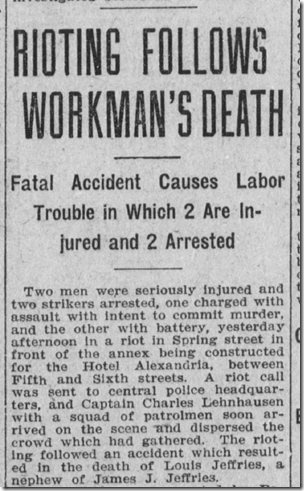
September 2, 1910: Police Quell Labor Riot Over Body of Ironworker Killed at Alexandria Hotel

 
September 2, 1910, the Herald publishes its version of the incident.
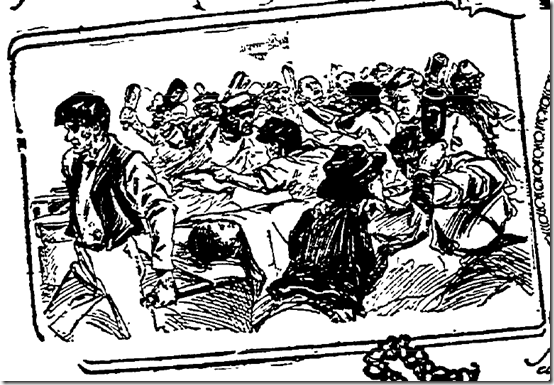
September 2, 1910: Louis Jeffries, a Baker Iron Works employee, is crushed by a steel girder during construction of the Alexandra Hotel Annex. Workers carrying his body to an ambulance on Spring Street are assaulted by union supporters who are picketing the building.

“Around the still warm body of the accident victim the frenzied ruffians swarmed. Vile invectives were hurled at the peaceable workmen who were trying to protect the corpse, and even the dead was not spared,” The Times said.

The Herald didn’t devote as much space to the story but it certainly depicted the violence that erupted. This incident is often cited in later stories about The Times bombing, showing the acute tensions between the labor and open shop factions.

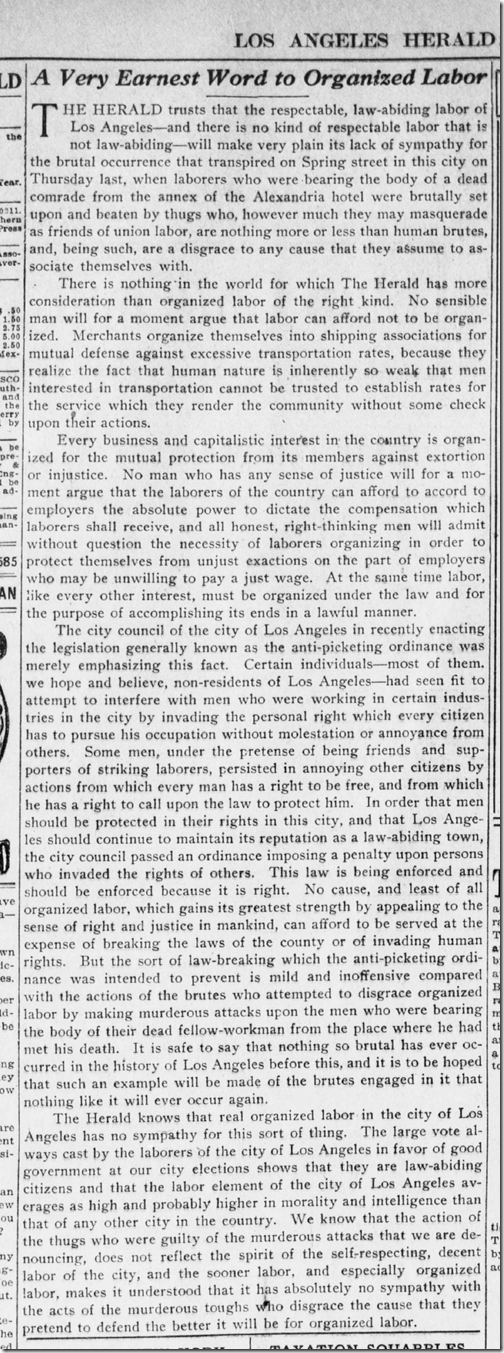
The next day, the Herald published an editorial about the incident. Notice how much more moderate it is than The Times and actually supports workers’ right to organize. Nonetheless, it also condemns labor violence.

Continue reading

Posted in 1910 L.A. Times bombing | Comments Off on September 2, 1910: Police Quell Labor Riot Over Body of Ironworker Killed at Alexandria Hotel

Coming Soon — Los Angeles Plays Itself

“Los Angeles Plays Itself” will be shown will be shown Saturday and Sunday at 7:30 p.m. at the Aero Theatre, 1328 Montana Ave. at 14th Street in Santa Monica. Director Thom Andersen will be speaking about the film after Sunday's showing. Tickets are $11, $9 for students and seniors and $7 for American Cinematheque members.

This has become a cult movie in Los Angeles because it’s not generally available on DVD (although you can find a bootleg in your local video store if you live in certain neighborhoods). “L.A. Plays Itself” isn’t so much a film as it is an essay (read by Encke King in a laconic monotone) that happens to be accompanied by film clips. The movie is notoriously long, even with an intermission, but you’ll find yourself thinking about it for days afterward.

Posted in Architecture, Coming Attractions, Film, Hollywood | Comments Off on Coming Soon — Los Angeles Plays Itself

Jimmie Fidler in Hollywood, Sept. 1, 1941

Sept. 1, 1941, Finnish Peace

Sept. 1, 1941, Tom Treanor

Sept. 1, 1941: Baseball fans and writers are protesting Gary Cooper as Lou Gehrig on the screen because Lou was left-handed and Gary isn't, Jimmie Fidler says.

Continue reading

Posted in Columnists, Film, Hollywood, Tom Treanor | Comments Off on Jimmie Fidler in Hollywood, Sept. 1, 1941

Kennedy, Nixon, Agree on TV Debates

 
image

Sept. 1, 1960: Sen. John F. Kennedy (D-Mass.) and Vice President Richard Nixon agree to a series of televised debates. The latest census shows that 88% of American homes have TV sets, in contrast to the 12% found in the 1950 census. In addition, 11% of U.S. homes have two or more sets and  “urban areas are 91% covered by television,”  The Times says.

Also on the jump, early movie actress Enid Markey, a leading lady in many Thomas Ince films before she left to pursue a stage career in New York, returns to Hollywood for a role in the TV show "Bringing Up Buddy."[She was Jane in the first Tarzan movie, starring Elmo Lincoln].

Continue reading

Posted in broadcasting, Columnists, Comics, Film, Hollywood, JFK, Richard Nixon, Television | Comments Off on Kennedy, Nixon, Agree on TV Debates

Jimmie Fidler in Hollywood, Aug. 31, 1940

Aug. 31, 1940, British Bomb Heart of Berlin

Aug. 31, 1940, Nazi prisoner

Aug. 31, 1940, Nazi prisoner

Aug. 31, 1940: Paulette Goddard, who couldn't afford the loss, dropped seven pounds during her "Second Chorus" dances with Fred Astaire, Jimmie Fidler says. 

And Hedda Hopper (I know you have been missing her!) says Orson Welles filmed every scene in “Citizen Kane” with a metronome. You think?

Continue reading

Posted in Columnists, Film, Hollywood, Photography | 1 Comment

Pages of History

August 1911, McClure's Magazine

Isn’t this a great cover? I love the lettering.

I’m going through the transcripts of jury selection in the McNamara trial, which is dull, tedious,  fascinating work. It’s difficult to convey the experience of having a 1911 typewritten manuscript – old and somewhat fragile — next to a digitized 1911 magazine displayed on my laptop. Put them side by side and a century disappears, collapsing time in a way that I never expected.

I’m about halfway through the first of four volumes of transcripts and I have  discovered that in questioning prospective jurors, defense attorney Clarence Darrow usually asks whether they have seen the August 1911 issue of McClure’s Magazine. That year, McClure’s published a series of stories about detective William J. Burns, who investigated the explosion, and the story in this issue focused on The Times bombing. So far, only one juror said he was a McClure’s subscriber, but he didn’t like detective stories so he didn’t read the article.   

Harvey J. O’Higgins’ story in McClure’s is straightforward and a pretty good read, although I would have to fact-check it before relying on it very much. Burns gets ample opportunity to brag about himself, but he gives a fairly interesting account of investigating a large number of bombings, culminating  in the McNamara case. These days, Burns is often described as a fairly unsavory character, but at the time this story was published, "Never-Fail Burns"  was often called America’s Sherlock Holmes (though not “pale and penetrating” as Holmes was).

Burns’ 1913 book “The Masked War,” published after the McNamaras were sent to prison, is a bit more sensational. For example, it has a rather suspicious account of bribing a fortune teller in Chicago to feed false information to the wife of Ortie McManigal, one of the figures in the bombing. There’s none of that in the McClure’s article. It’s strictly detective work.  If you like police procedural stories, you’ll enjoy this.

The 1911 issues of McClure’s are here. [Warning: The pdf is 89 megabytes.]
 

Posted in #courts, 1910 L.A. Times bombing, books | Comments Off on Pages of History

Found on EBay – Batchelder Tile

Batchelder Tile, EBay batchelder_ebay_peacock_02 This Batchelder tile of a peacock at left has been listed on EBay. Interestingly enough, it’s a different design than these two at the right, which were listed earlier. 
batchelder_peacock_ebay_03Bidding on the tile at left starts at $100.  As with anything on EBay, an item and vendor should be evaluated thoroughly before submitting a bid.
 
Posted in Architecture, art and artists | Comments Off on Found on EBay – Batchelder Tile

Jimmie Fidler in Hollywood, Aug. 30, 1940

 
Aug. 30, 1940, Russia Hurls Threat at Rumania

Aug. 30, 1940, Tom Treanor

Tom Treanor, who died covering World War II for The Times, files a report on Catanzaro, Italy.   

Aug. 30, 1940: Hollywood After Dark: Ann Rutherford losing a set of artificial fingernails when an autografiend snatches at her hand as she leaves the Cocoanut Grove, Jimmie Fidler says.

Continue reading

Posted in Columnists, Film, Hollywood, Tom Treanor | Comments Off on Jimmie Fidler in Hollywood, Aug. 30, 1940

Barry Goldwater, Aug. 30, 1960

Aug. 30, 1960, Fearless Fosdick

Aug. 30, 1960: Perhaps you saw David Klinghoffer’s recent piece about changes in the conservative movement (“From neocons to crazy-cons”) or Jonah Goldberg’s rebuttal. If so, you might like to read some of Barry Goldwater’s thoughts for yourself, from 1960.

Also on the jump, novelist Vicki Baum, author of “Grand Hotel” dies in Hollywood at the age of 72.

Continue reading

Posted in books, Columnists, Comics, Obituaries, Politics | Comments Off on Barry Goldwater, Aug. 30, 1960

Movieland Mystery Photo

 
 Aug. 28, 2010, Mystery Photo
Los Angeles Times file photo

2010_0829_mystery_photo
Photograph by George Lacks / Los Angeles Mirror 

OK, here’s another picture of our mystery woman. And yes, the photo is from the Mirror files.

Update: On the jump, the identity of our mystery guest. Although she was an entertainer, she’s not exactly like our other folks. She has quite a story, though, especially if you have never read about her. I thought she would be a nice change of pace for noir fans who may be a little weary of  The Times bombing.

Here’s our weekend mystery guest. I like to keep things more informal on the weekends so I’ll post all the comments as they come in rather than waiting.

This week’s mystery guest was Aline MacMahon. Her mystery companions were: Marie Nordstrom in Sid Grauman’s stage production of “Once in a Lifetime,” Kaufman and Hart’s satire on Hollywood; Guy Kibbee;  an unidentified fellow; and Robert Knapp, who appeared with her on stage in "The Madwoman of Chaillot."

Continue reading

Posted in Downtown, Mystery Photo, Photography, Stage, Suicide | 6 Comments

From the Vaults: ‘Anna Boleyn’ (1920)

Annaleer There's not much reason to watch Ernst Lubitsch's silent historical epic "Anna Boleyn" (which Netflix informs me is also called "Deception"), unless you're, say, a movie blogger who has set herself the cussed task of watching only films from 1920, 1940, 1960 and 1980. Fortunately for you, I am just such a blogger, and so I have watched this film so that you do not have to!

It's not that it's bad by any means; for 1920, the sets and costumes are pretty impressive. Five minutes in, I was waving a pizza slice around and expostulating to the cats, "Look at that crowd shot! All these people in costume! This thing must have cost a fortune!" And the acting is often hammy but fun, and it fits the material. Also, a wench jumps out of a cake! It's just that the thing is so long. Run time is about two hours, but it feels longer.

Part of the problem is that you already know the story, although the tragedy's been hepped up until it feels like "Tess of the d'Urbervilles." Young Anna (German for "Anne," I guess) Boleyn arrives from France to stay with her uncle, the Duke of Norfolk (Ludwig Hartau), and be a lady-in-waiting to Queen Catherine of Aragon. She's excited to meet the queen and also to be reunited with her boyfriend, megacutie Sir Henry Norris (Paul Hartmann).

Instead, she catches the roving eye of big gross King Henry VIII (Emil Jannings, clearly enjoying himself tremendously). He openly chases Anna around, devastating Catherine (the lusciously named Hedwig Pauly-Winterstein) and shattering Anna's relationship with Sir Henry. Anna ends up married to the man she loathes, and we all know how that goes for her.

Continue reading

Posted in Film, From the Vaults, Hollywood | 5 Comments