
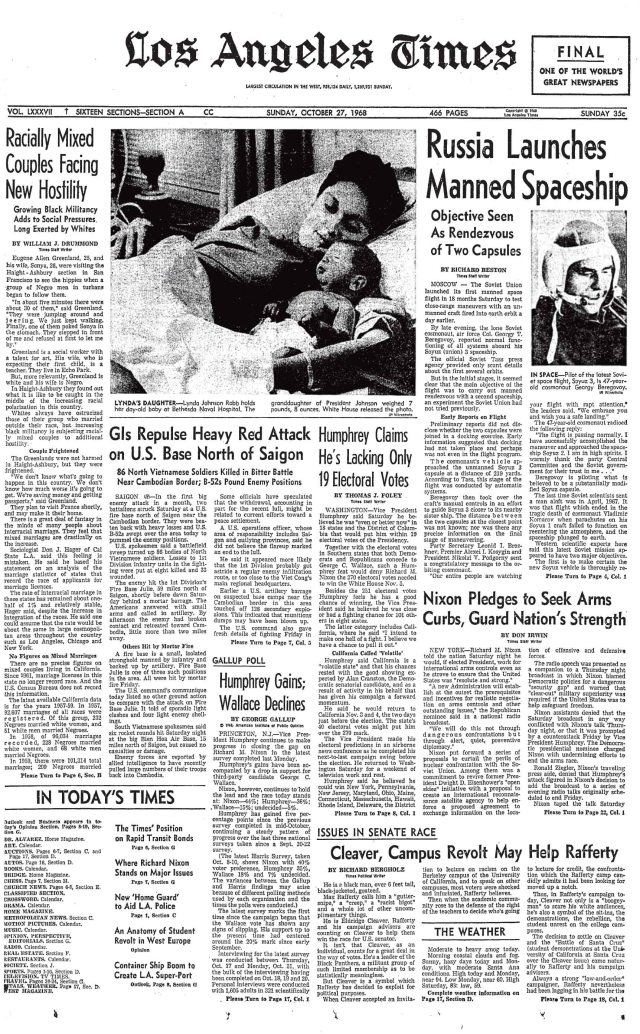
By Keith Thursby
Times staff writer
Wilt Chamberlain tried to explain his political leanings during a turbulent year in American history, particularly his support of Richard Nixon for president. Continue reading
By Keith Thursby
Times staff writer
Wilt Chamberlain tried to explain his political leanings during a turbulent year in American history, particularly his support of Richard Nixon for president. Continue reading

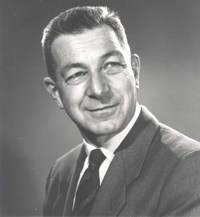 Studies are constantly being made to determine the effects of alcohol, smoking, overeating and noise on people but another perhaps more deadly trauma-producing experience is relatively neglected. Driving in traffic, I mean. It does things to people. At least it has to a man named Hank.
“I finally got it figured out,” he said the other day. “You know these outfits that are always digging up streets and funneling three lanes of traffic into one? They’ve got extrasensory perception!”
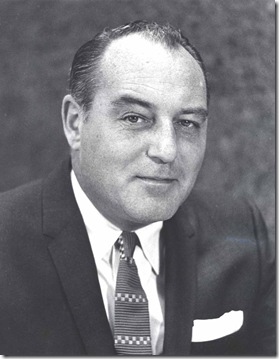 You want my opinion, I say there’s something almost indecent about Japan Air Lines’ luxury flight to Tokyo.
We left Los Angeles after midnight — an hour when self-respecting Occidentals give some thought to retiring. And that was the kind of idea I had in the back of my mind.
But immediately after the no-smoking lights were off, an adorable hostess sidled up to me and, without so much as a by-your-leave, began unbuttoning my jacket.
Well, I knew right then and there what kind of a ride this was going to be.
October 27, 1957
Here I am, giving away the punchline of a “Nancy” comic. My bad. Which reminds me of a game called “Five Card Nancy” that I learned about from Kim Cooper of 47p.
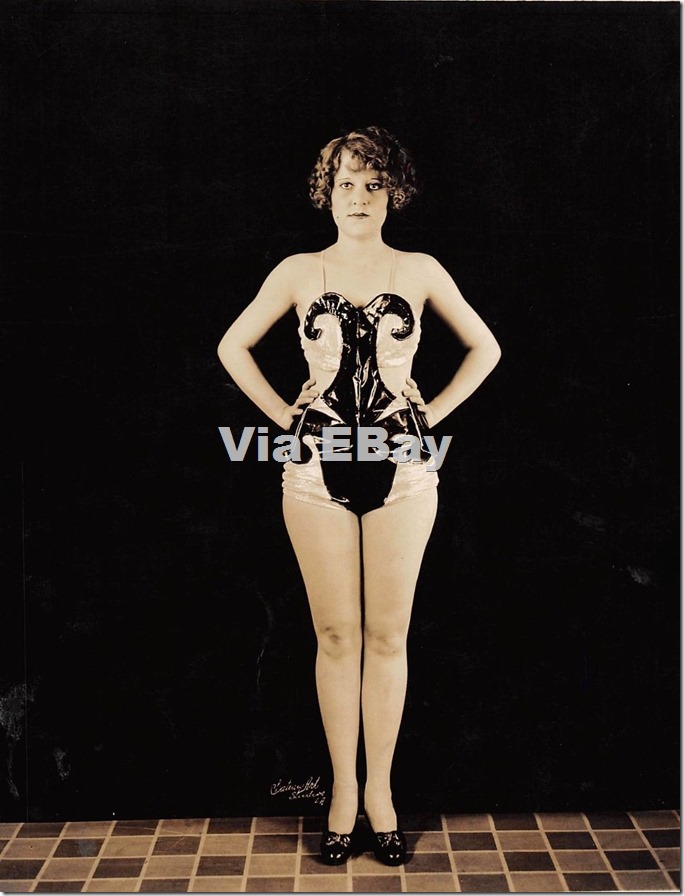
A EBay vendor posted this photo of a woman named Aline or Alene Carberry, and I could not resist unleashing the hounds of research.
Bidding on the “Hot Mamma” photo is currently at $34.50.

Note: This is an encore post from 2006.
October 27, 1907
Los Angeles
Along with “Little Nemo,” “Buster Brown” was a popular feature of the Sunday comics. Like other cartoons of the era, such as “The Katzenjammer Kids” and “Foxy Grandpa,” that were full of naughty children, Buster Brown was fond of pulling pranks on adults.
Unlike Hans and Fritz, who usually ended up getting a good paddling and threats of being sent to reform school, Buster Brown usually learned his lesson the hard way and in the final panel always promised to mend his ways in a long block of text titled “RESOLVED.”

One bit of Buster Brown’s wisdom has stayed with me since I read it as a kid in an anthology on the history of comics: “If the carpet were as worn in front of the bookcase as it is in front of the mirror it would be a better world.”

This week’s mystery movie was the 1940 Warner Bros. film Castle on the Hudson, with John Garfield, Ann Sheridan, Pat O’Brien, Burgess Meredith, Henry O’Neill, Jerome Cowan, Guinn “Big Boy” Williams and John Litel. Continue reading

All Steve Medved wants is to be left alone by the LAPD. He hopes that now, after a third trial, he has it made.
Medved, 38, is a big (6’2, 230), easy going fellow of Yugoslav descent. But he can be tough and stubborn when aroused. He was in the Marine Corps during the Second World War.
His trouble began last Feb. 5 when two officers stopped him at 6th and Bixel and accused him of being drunk. He said he wasn’t but admitted he’d had several beers. The words became hotter and the nightmare began. Continue reading
TOKYO — There’s an ancient and revered Oriental proverb which, roughly translated, goes: “Man who take wife to Japan is man who bring coal to Newcastle.”
But to my way of thinking, this is an archaic, reprehensible attitude. It has no place in today’s western world of togetherness. In our way of life, marriage is a partnership. Fifty-fifty. When we do things we do them as a team. That, friends, is red-blooded, true-blue American sportsmanship. Am I right?
Take my own case, for example. Where I go, my wife goes.
She insists on it.
Reminder: Boxie and I will be doing a live “Ask Me Anything” on George Hodel and Steve Hodel on Tuesday, October 28, at 10 a.m. Pacific time on YouTube.
Can’t make the live session? Email me your questions and I’ll answer them! The video will be posted once the session ends so you can watch it later. Remember, this is ask me anything, so please remember to ask questions rather than make comments. Thanks!

October 26, 1942: Rosetta (D. 1958) and Vivian (D. 1986) Duncan appear in “Topsy and Eva,” a musical version of “Uncle Tom’s Cabin,” a musical comedy in which they first appeared in San Francisco in the 1920s. The Duncan sisters wrote the music and lyrics for the show, adapted by Catherine Chisholm Cushing.
Councilman Norris Nelson tells a story about the ghost of Lon Chaney sitting on a bench at Hollywood and Vine.
In discussing a proposed ordinance to ease restrictions on placement of benches, Nelson said that about 15 years earlier, he had placed an ornamental iron bench at the famous intersection.
Continue reading

 Note: This is an encore post from 2006.
October 26, 1907
Los Angeles
Two women in the West Adams District were badly burned and expected to die after a bowl of gasoline they were using to clean a soiled dress exploded, engulfing their apartment at 42 St. James Park in flames.
Mrs. James P. Burns (identified helpfully by The Times as the wife of James P. Burns) and maid Catherine Blake had spread a dress across a table and wrapped their hands with rags soaked in gasoline to clean it. Because the electric lights weren’t bright enough, Burns told Blake to light several candles. The candles ignited the bowl of gas, which in turn set off a nearby tank of gasoline.
With her clothes on fire, Blake ran to the rear porch of the second-story apartment and jumped to the ground while Burns fled to a hallway. The building manager ran to the second floor upon hearing the explosion and wrapped Burns in a rug to extinguish the flames.
“Nearly all of her hair had been burned off and only a few charred garments remained about her badly burned body,” The Times said of Burns. “Examination by surgeons disclosed a pitiable condition. They expressed little hope of her recovery.”
In the meantime, neighbors got a blanket and rolled Blake on the grass to put out the fire. “Miss Blake was burned about the face, breast, arms and legs,” The Times said. “In some places the flesh fell away. She fainted several times before reaching the hospital.”
Bad streets hampered the Fire Department’s response to the blaze. The Lawrence Apartments, where the blaze occurred, suffered $10,000 ($205,235.70 USD 2005) in damage while the adjoining Mayfair Apartments suffered $3,000 damage, mostly from water.
Burns died the next day, having been put under anesthetic to allay her pain. There was no further word on Blake.

October 25, 1982: Times staff writer Bill Overend profiles Iranian exiles who gather in Santa Monica’s Palisades Park on Sunday afternoons, hundreds of people — mostly Jews and some Muslims — who came to the U.S. because of the Iranian revolution.

 Note: This is an encore post from 2005 and originally appeared on the 1947project.
1957—Toyota Motors announces plans to enter the U.S. market with a four-seat “midget car” ($1,000-$1,200) and a six-seat Toyopet Crown De Luxe ($2,200). The Land Cruiser goes on sale in Cuba for $2,850. Toyota gets permission to open a dealership in Los Angeles..
1958—Jan. 8, the Toyopet, which gets 30 mpg, is supposed to be exhibited at the Imported Motor Car Show at Shrine Auditorium. However a July story says they were introduced during a gala soiree at the Beverly Hills Hotel.
July 31—The Toyopet ($2,187, whitewalls and side mirrors extra) goes on sale in Los Angeles at the Avalon Motor Co., 900 W. Anaheim in Wilmington; Art Frost of Culver City, 11153 Washington Place; Art Frost of Glendale, 737 S. Brand Blvd; Holt Motor Co;, 8230 Van Nuys Blvd.; Walter G. Linch, 312 S. Catalina Ave., Redondo Beach; C. Standlee Martin, 1227 American Ave., Long Beach; and at Balboa Motors, 1475 Broadway in San Diego.

October 25, 1943: Three bandits who hit a handful of businesses met their match at a cafe at 1306 S. Main St. when they tried to hold up assistant manager Joe D. Poindexter.
Two of them came into the cafe and ordered tomato juice. When Poindexter opened the cash register to ring up the sale, they drew guns.
Note: This is an encore post from 2006.
“A dollar’s worth of wholesome fun is really worth a dollar and a half ($40.04 USD 2017).”

 Yet another panel you’ll never see in the legacy version of “Peanuts.”
While driving south from San Francisco recently, Mike Molony stopped in Paso Robles and was momentarily puzzled to discover he was the object of the admiring glances of passerby.
He soon caught on. The men of the town had gone in for whisker growing in observance of the annual Pioneer Day celebration and Mike’s distinguished white beaver, a thing of beauty, virtually established him as king for a day.
Not one to holler copper, Mike permitted himself to be lionized by several home guard enthusiasts as a local pioneer and ventured a few ad lib historical comments. Among other things he recalled the last Indian raid on Paso Robles, back in ’93 he thought it was, and the blood-curdling yells of the marauding redskins. Continue reading

 Note: This is an encore post from 2006.
October 24, 1907
Los Angeles
Upon the suicide in February of Dr. H. Russell Burner, advocate of the “radium milk” cure, his sanitarium at 2033 E. 4th St. was taken over by Dr. F. S. Kurpiers, who is now in trouble with the Health Department.
Kurpiers didn’t have a medical license, so he obtained the certificate of Dr. C.H. King, a dying physician who wept as he told authorities that the only way he could support a few relatives was to rent out his license.
Rather than a “radium milk” cure, Kurpiers suggested that patients follow their instincts in when to eat—preferably never. Rachel Golder, a nurse at the sanitarium, quit because she never got to eat and relatives charged that one patient had become a bag of skin and bones under Kurpiers’ care.

The New York Daily Tribune of Nov. 11, 1871, also carried an account of the massacre.
Chinese Massacre Part 1 | Part 2| Part 3
Wong Chin, a merchant, was the first victim of the hanging. He was led through the streets by two lusty Irishmen, who were cheered on by a crowd of men and grownup boys, mostly of Irish and Mexican birth. Several times the unfortunate faltered or attempted to extricate himself from the two brutes who were leading him, at which a half-drunken Mexican in his immediate rear would plunge the point of a large dirk-knife into his back.

The San Francisco Bulletin’s Oct. 26, 1871, account of the lynching was published in the New York Times.
Los Angeles, although boasting of being the City of the Queen of the Angels, is cursed with such another hotbed of crime and depravity, in its Negro Alley, as San Francisco has in its Barbary Coast and Chinatown.


