
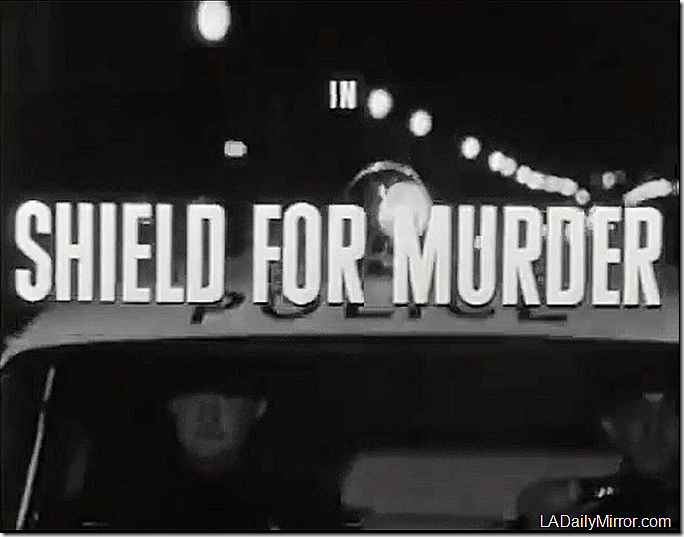
This is “Shield for Murder,” requested by Julie Merholz, who says that she watched some of the filming when she was a student at Beverly Hills High (scene of the swimming pool sequence). Thanks, Julie!
This is “Shield for Murder,” requested by Julie Merholz, who says that she watched some of the filming when she was a student at Beverly Hills High (scene of the swimming pool sequence). Thanks, Julie!

Buddy Rogers, photographed by Preston Duncan.
Motion picture still photography grew rapidly from the early teens through the mid-1920s, becoming the main publicity staple of Hollywood film studios. Begun merely as a record for film scenes, shot by camera operators and cinematographers, stills also quickly expanded into the artistic realm.
At the turn of the 20th century, stage and vaudeville performers personally hired New York studio photographers to shoot images they could employ to promote themselves in newspapers and magazines. David Shields, in his book, “Still: American Silent Motion Picture Photography,” notes that many studios at this time began experimenting with visual language to create what we now know as glamour.
Mary Mallory’s “Hollywoodland: Tales Lost and Found” is available for the Kindle.
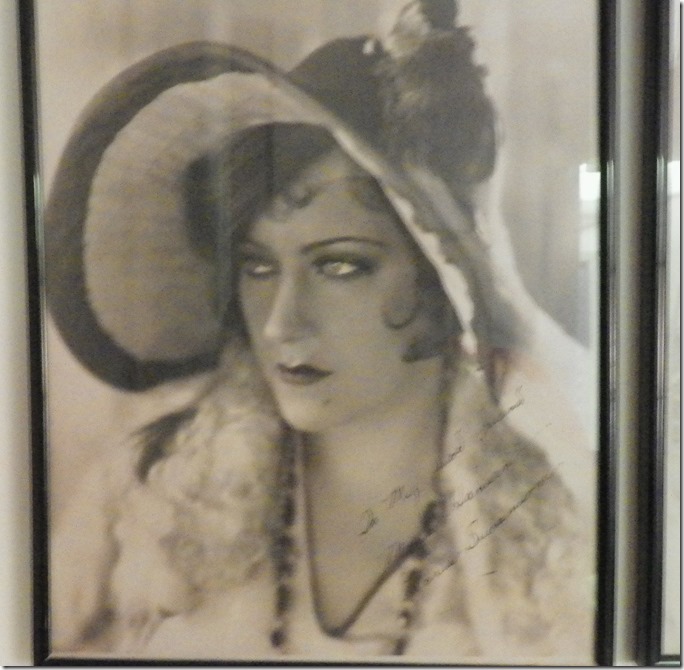
Here’s another item that is tangentially related to the Black Dahlia case: A photograph of Gloria Swanson inscribed to Florentine Gardens business manager Mark Hansen. Hansen was a small-time operator of movie theaters and news accounts of the Black Dahlia case describe his home (now demolished) on Carlos Avenue, where Elizabeth Short lived for a time, as being full of photos of movie stars such as this one.
Bidding on this item starts at $350 or Buy It Now for $499.99. As with anything on EBay, an item and vendor should be investigated thoroughly before submitting a bid.
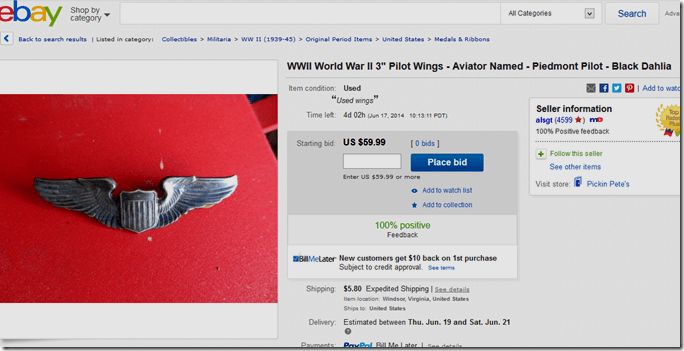

An EBay vendor has listed the pilot wings that belonged to Joseph G. Fickling, Elizabeth Short’s onetime boyfriend. Apparently these items were in a storage unit. The vendor has posted a photo of Fickling’s dog tags (not included in the sale) to prove authenticity.
I interviewed Fickling in 1996 about the case and found him to be a very nice man. After his death, some of Fickling’s other militaria was listed on EBay, including a uniform, as I recall.
Bidding on the pilot wings starts at $59.99. As with anything on EBay, an item and vendor should be investigated thoroughly before submitting a bid.
June 13, 1944
The Times reports the death of pilot Maj. Joseph D.R. Shaffer, 26, of Long Beach, who received the Silver Star and the Distinguished Service Cross for shooting down a Nazi bomber near Reykjavik — the first German plane downed by an American in the European theater. Shaffer was killed in a plane accident over Salisbury, England, officials say. Pilot Elza Shahan also received the Silver Star for attacking the German plane on the same mission with Shaffer.
Howard Whitman of the New York News files a delayed report on German atrocities during the D-Day invasion. Troops told Whitman that Nazi troops executed captured Americans by shooting them point-blank in the face. Other Americans had their throats slit by German troops.
Columnist Tom Treanor, who will be killed in August in a jeep accident during the liberation of France, files a radio broadcast on the invasion.
One of the sights I saw was a little group of German prisoners walking peaceably down a little side lane guarded by a soldier with a fixed bayonet. They looked tired, dirty and generally without spunk. Here, as elsewhere, they certainly fought hard before they surrendered.
In the theaters: “Are These Our Parents” with Lyle Talbot and Helen Vinson. Produced by — hey it’s Donald Wolfe’s stepfather Jeffrey Bernerd!

June 13, 1944
HOLLYWOOD, June 12 — There isn’t a chance of MGM making the same mistake with 14-year-old Jane Powell they made with Deanna Durbin. Deanna slipped through their fingers and then made “Three Smart Girls” for Charles Rogers and immediately zoomed to stardom. Now, as soon as Jane makes one more picture for Rogers (she has been seen in “Song of the Open Road”)_ she’ll return to her home studio.
And advice to empty-nesters from Dorothy Dix.
June 12, 1944
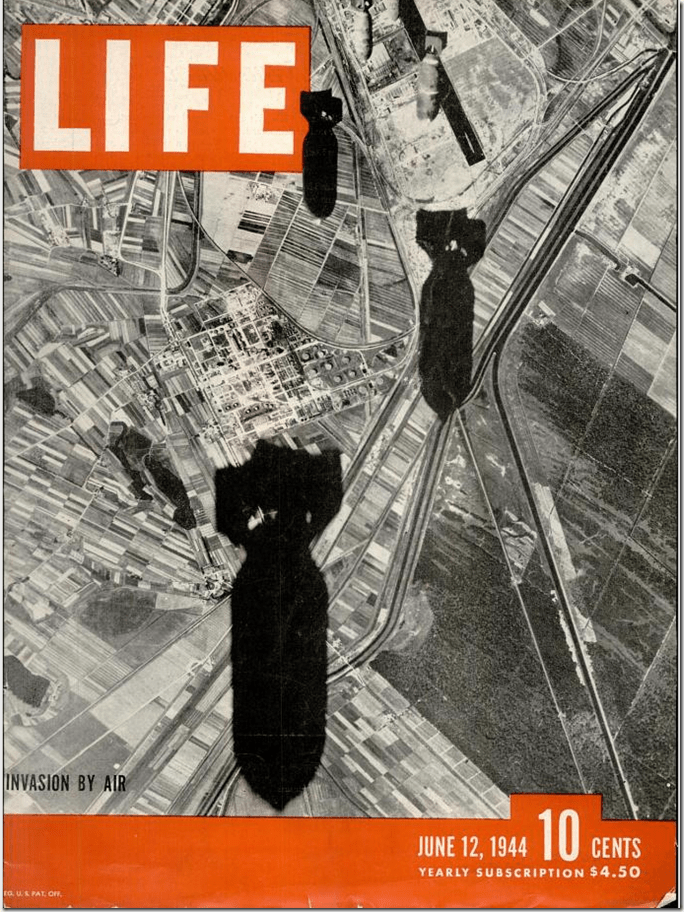
Life’s cover photo shows 500-pound bombs falling on an oil refinery in Leghorn, Italy.
Where does Al Capp get ideas for his characters? Would you believe Veronica Lake?
A feature on Humphrey Bogart says that while filming a dangerous scene in “Action in the North Atlantic” in which he and Raymond Massey were being doubled by stuntmen, Bogart said: “Ray, I’ll bet you $10 my double is braver than yours.”

June 12, 1944
HOLLYWOOD, June 11 — Right out of New York comes word Jack Warner has added “The Two Mrs. Carrolls” to his list of New York plays. Jack, who has spent money unstintingly for New York hits, is starting with a schedule that is terrific from the standpoint of an investment in screen material.
The price reported paid for this murder thriller is $225,000. It was the play in New York with Elizabeth Bergner and Victor Jory. It’s old-fashioned melodrama but the kind the theatergoing public eats up.
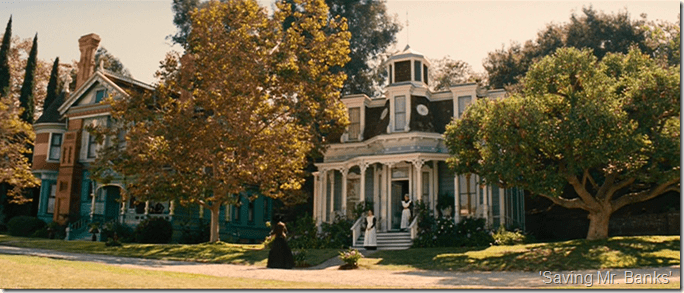
I was underwhelmed by “Saving Mr. Banks,” but look what I found! It’s Heritage Square, which (for out-of-town readers) is just off the Arroyo Seco Parkway.
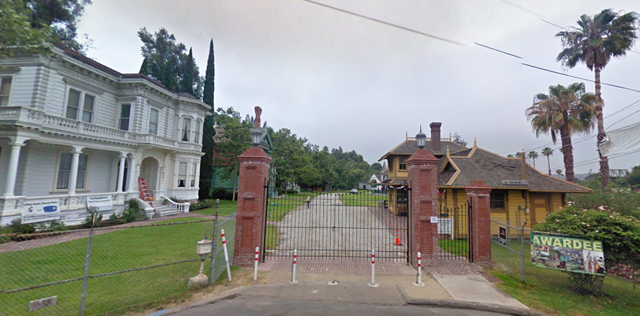
Here’s Heritage Square as shown on Google Street View.
June 10, 1944
HOLLYWOOD, June 9 — There has been so much talk that Joan Fontaine would take her troubles to court and ask to have her David Selznick contract canceled that I did a little investigating. I talked to David Selznick and learned he met with her agent, a Jules Stein representative, on Thursday and offered to set up a trust fund in addition to her salary. Because of the wage stabilization law, it is impossible to give an increase in money.
Interestingly enough, Parsons mentions a Billy Wilder-Charles Brackett project at Paramount titled “Olympe.” It’s hard to picture that as a working title for “Double Indemnity” (released in August 1944) or “Lost Weekend.” Imdb and The Times clips are most unhelpful. Anyone in the Brain Trust have more information on this intriguing project?
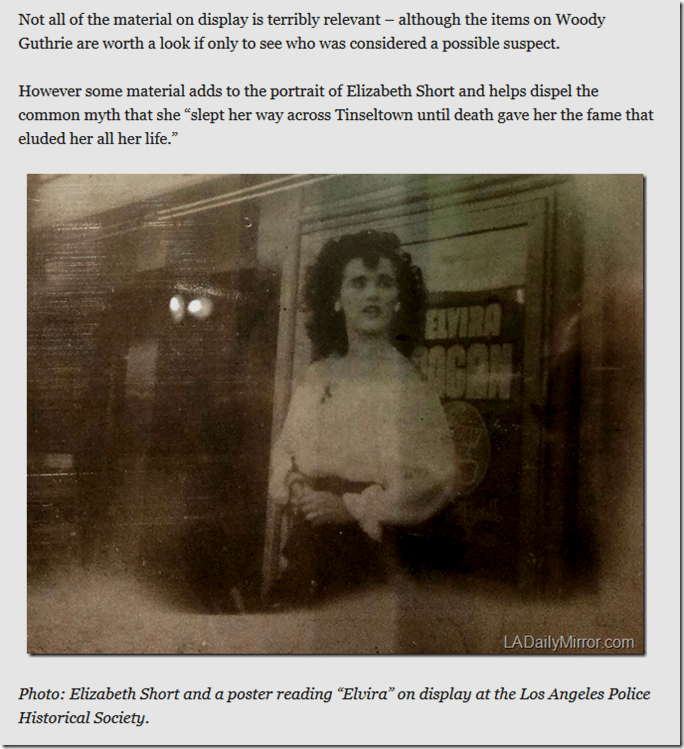
Some folks on the Internet are quite casual about where they get images. I always watermark mine so that even if someone swipes it, the url is still visible — unless someone crops it out. Here’s a case in point.

This week’s mystery movie was “Black Angel,” as requested by B.J. Merholz. Thanks, B.J. And if you have a mystery movie request, email me here.

Clifton’s Pacific Seas, 618 S. Olive St.
Long before kitschy was cool and themed restaurants like tiki bars, Planet Hollywoods and Rainforest Cafes existed, downtown Los Angeles sported eclectically decorated and festive Clifton’s Cafeterias. Over the top and lavishly theatrical, Clifton’s operated in Los Angeles’ heart, including Clifton’s Pacific Seas and Brookdale, one sporting an exotic, tropical setting and the other looking like a set from a national park.
Even more remarkable than their lavishly decorated interiors was the generous, lovely operating philosophy behind the chain. From the beginning, Clifton’s operated on the policy of “the Golden Rule,” hoping to treat others as kindly as they themselves were treated. Clifford Clinton, son of missionary Edmond Clinton, was born in China while his parents served the poor after the Boxer Rebellion. Seeing the hungry and homeless, his deep compassion filled him with a desire to take care of those less unfortunate.
Mary Mallory’s “Hollywoodland: Tales Lost and Found” is available for the Kindle.

June 7, 1944: “The First Nighter” with an episode titled “Susan Stepped Out.” Courtesy of otronmp3.com.

June 6, 1944
HOLLYWOOD, June 5 — When Harriet Parsons (a young producer I know very well — in fact she used to put the bite on me for ice cream sodas) finishes “The Enchanted Cottage” she takes over her second RKO movie, “Who Could Ask for More?” Authoress Kay Smith arrived Friday to huddle with Frank Gruber, who works with her on the script. Remember we told you some time ago about this original story about a femme songwriter who marries a cowboy and gives up Broadway to live out West?


The headline and map by Charles Owens from The Times.
June 6, 1944: Complete radio coverage of the D-Day Invasion. This was pool coverage using correspondents from various news organizations. By 10 a.m., CBS had resumed regular programming with news bulletins, so I’ll only post up to noon. The full day is at archive.org.
It’s worth noting that German radio was the source for most of the information in the early hours of the invasion. The eyewitness accounts are vivid and it’s worth listening to Quentin Reynolds’ analysis on how the Allies learned from disastrous surprise invasion at Dieppe in 1942.
Just a reminder that I will be posting full radio coverage from 1944 of the D-Day invasion starting at 12:37 a.m. Eastern Time (9:37 p.m. Pacific Time), precisely when the first radio announcement was made on June 6, 1944, citing German radio reports.

A still from “Four Horsemen of the Apocalypse” listed on EBay at $14.95.
The 2014 San Francisco Silent Film Festival acts as a mini United Nations with its smorgasbord of films and accompaniment, offering a little something for every taste and nation. Classic American films, programmers, artistic foreign movies, comedy shorts, documentaries, and newly restored prints highlighted the fest, from counties like Great Britain, France, Germany, Japan, China, Sweden and Russia. It shows the breadth of silent film, though sometimes just something full of fun can leave audiences wanting more.
The festival opened Thursday with a screening of Rex Ingram’s powerful antiwar film, “The Four Horsemen of the Apocalypse,” making a star of its ravishing young male lead, Rudolph Valentino, as he sensually leads his tango partner across the floor. Released just a few years after World War I, the Great War, “Four Horsemen” shows the brutality and waste of war, tearing families and nations apart. Mont Alto Motion Picture Orchestra provided another of their romantic, historically accurate scores, compiled from actual score/cue sheets of the period.
Mary Mallory’s “Hollywoodland: Tales Lost and Found” is available for the Kindle.

Oh dear. Here we are at the sixth installment on the making of the film “Laura” and novelist Vera Caspary is barely out of diapers. Be assured that the actors will eventually be cast, the sets will be built, the costumes will be made and the script will be written … and rewritten … and rewritten. Gathering “Laura” material has been quite a treasure hunt and here’s a special shout-out to Mike Hawks of Larry Edmunds for a “final draft” of the heavily revised script. Comparing it to the completed film has been a revelation.
Last time, we had gotten Caspary’s work to Hollywood (she remained on the East Coast), where her play “Blind Mice” with an all-female cast had been turned into the 1931 film “Working Girls” – with the addition of male actors, including Buddy Rogers and Stu Erwin.
Caspary’s autobiography is rich in details about Depression-era New York, but it casts little light on her growth as a writer and the creative process behind “Laura,” so I’m skipping the daily drama of her life except where it touches on films.

June 5, 1944
HOLLYWOOD, June 4 — Erich Pommer, one time high mogul of UFA productions in Berlin, became an American citizen last week and celebrated by signing for two pictures with Producers Corp. of America. Years ago, before the world went crazy, I met Pommer in Berlin and at that time asked him if he ever intended to make a follow-up on his sensational “Cabinet of Dr. Caligari.” “Sometime — maybe,” he replied, and sure enough, “The New Cabinet of Dr. Caligari” will be one of the two films he will make for the Sig Schlager company.
 ladailymirror.com