LAPD Parker Center Cop Shop Files (Updated)

Howard Gantman Press Room

In 2013, I was given a box of material that was cleaned out of the old press room at the LAPD’s Parker Center headquarters, sometimes called “the cop shop.” The box was a jumble of press releases, photographs, artists’ sketches and other items dating from the late 1960s to the early 1980s. I am organizing and cataloging the material and I’ll be posting selected items.

This is one of those mysterious pieces of paper in the cop shop files. Obviously it’s some sort of shipping label … but Howard Gantman?   If you have any ideas, email me.

Update: Several people emailed to say: “These are phone books, you moron!” To which we answer “Yes, we know. In fact we have a collection of vintage Los Angeles phone books and city directories in the Daily Mirror library.”

The question is what was Howard Gantman doing at the LAPD Cop Shop?

Ed Epstein replies:

Howard Gantman worked for UPI in LA. He then worked for Senator Dianne Feinstein in Washington for many years, as her communications director.    He left her staff in 2009 and now is communications director for the Motion Pictures Association of America, the powerful MPAA.    His offices are just a block from the White House.

FYI: As a fan of Old Hollywood, I love your LAdailymirror.com.

Thanks for your help, Ed!
Posted in LAPD, Parker Center Cop Shop Files | Tagged , | 4 Comments

Movieland Mystery Photo (Updated + + + +)

image

Continue reading

Posted in Film, Hollywood, Mystery Photo | Tagged , , | 66 Comments

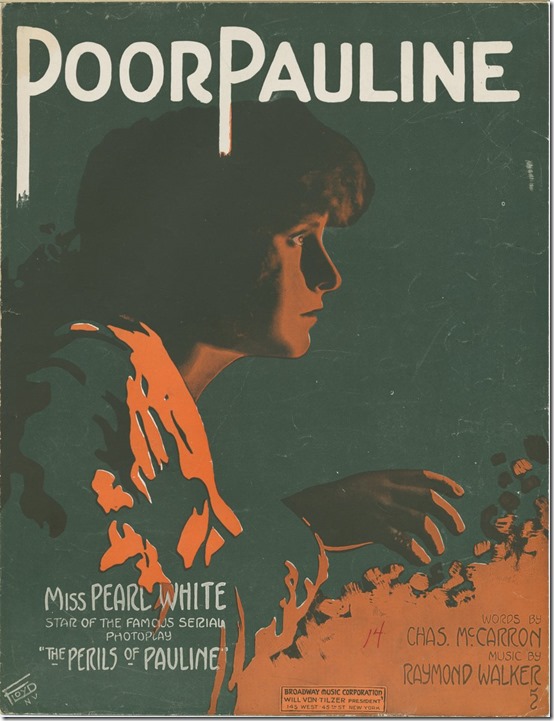
Mary Mallory / Hollywood Heights: ‘Poor Pauline,’ Parody Sheet Music


Poor Pauline
“Poor Pauline,” courtesy of Indiana University.


W
hile sheet music was sold and manufactured beginning in the 1700s, only in the late 1880s did its sales truly take off, when Tin Pin Alley music companies began springing up. By 1900, sheet music was red hot, sold for use in homes, bars, clubs and the stage. Songwriters and publishers created music about almost anything: food, entertainment, home, love, animals, anything could be featured in a song.

Movies were introduced in America in 1895 and by the early 1900s, construction of nickelodeons skyrocketed. By about 1907, entrepreneurs began constructing theaters, which attracted more middle-class audiences. Attendance once again swelled. Many exhibitors even provided such entertainment as singing along to popular songs of the day by employing song slides, which listed lines of lyrics and colorful illustrations on pieces of thick glass. Thus, cross-pollination between movies and sheet music increased sales and receipts for each.

Mary Mallory’s “Hollywoodland: Tales Lost and Found” is available for the Kindle.

Continue reading

Posted in Film, Hollywood, Hollywood Heights, Mary Mallory, Music | Tagged , , , , | 1 Comment

March 2014 Reader Survey

2014 Reader Survey

Here are the results as of Saturday. I’m guessing the figures may change a bit, but not too much.

Continue reading

Posted in 1944, Books and Authors, Columnists, Film, Hollywood, LAPD, Mary Mallory, Radio | Tagged , , , , , , | 10 Comments

1944 on the Radio — ‘First Nighter’

radio_dial_1944

March 29, 1944: “The Chinese Gong” on “The First Nighter” with a script by Arch Oboler. Sponsored by Campana! Courtesy of otronmp3.com.

Posted in 1944, Radio | Comments Off on 1944 on the Radio — ‘First Nighter’

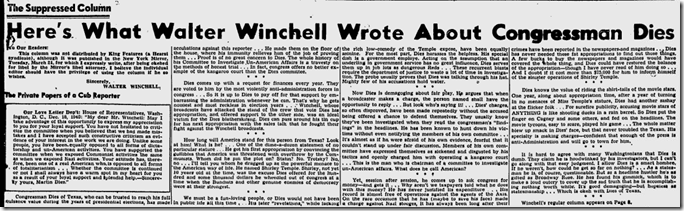
1944 in Print — Walter Winchell on Broadway, March 29, 1944

image

March 29, 1944

The Private Papers of a Cub Reporter

The following is an editorial from the St. Louis Star-Times titled: “Dies Committee’s Un-American Investigation of Winchell” … “The Dies committee to investigate Un-American activities, in the course of its distressingly protracted longevity, has investigated almost everything else. So no one should be surprised that the Dies committee is now investigating Walter Winchell, famous radio commentator and columnist.

* * *

“Always open to criticism on the grounds that it has sought to make headlines, that it has itself furnished material for anti-American elements by its constant Red-baiting and its failure to expose Fascist groups, the Dies committee is now wandering clear off the reservation in a spite attack on Winchell.

From the St. Petersburg Times.

Continue reading

Posted in 1944, Columnists, Politics, Radio | Tagged , , | 3 Comments

1944 on the Radio — Brian Aherne on ‘Burns and Allen,’ March 28, 1944

radio_dial_1944

March 28, 1944

It’s Tuesday in  1944, which means we have:

Brian Aherne is the guest on “Burns and Allen.” Listen for the Frank Sinatra jokes. Courtesy of Otrrlibary.org via Archive.org.

The Great Gildersleeve visits “Fibber McGee and Molly.” Courtesy of Archive.org.

Posted in 1944, Film, Hollywood, Radio | Tagged , , , , | Comments Off on 1944 on the Radio — Brian Aherne on ‘Burns and Allen,’ March 28, 1944

1944 in Print — Hollywood Gossip by Louella Parsons, March 28, 1944

March 28, 1944, Comics

image

March 28, 1944

HOLLYWOOD, March 27 — If you’ve seen “Oklahoma” you’ll remember the red-haired American named Marc Platt, who dances with the grace of Fred Astaire. Well, Marc has been signed by Columbia and is heading for Hollywood to play opposite Rita Hayworth and Janet Blair in “Tonight and Every Night.” Not bad for a newcomer to get two such beauteous co-stars.

The story about young Platt is an amusing one. He studied ballet and took the name of Patnoff when he joined the Ballet Russe. His Russian nom de plume was quickly dropped when he went into the Americania musical “Oklahoma.”

From the Milwaukee Sentinel.

Continue reading

Posted in 1944, Columnists, Film, Hollywood | Tagged , , , | 2 Comments

1944 in Print — Walter Winchell on Broadway, March 28, 1944

image


March 28, 1944

Notes of an Innocent Bystander

The Magic Lantern: “See Here, Private Hargrove” is loaded with familiar comedy gags, but it’s got so doggone much good feeling that you skip the stencils. Besides, it’s got a pair of likable lads — Robert Walker and Keenan Wynn — as the rookies and Donna Reed as the lookie… “The Fighting Seabees” means to be a back-slap for that useful arm of the military, but sometimes the praise gets gibbery. The thing is too Hollywood-flavored to look like war … “The Heavenly Body” does not refer to Hedy Lamarr, who’s in it. The title comes from William Powell’s monkeying with the stars. Sometimes the going gets funny, but too often you can almost hear Powell’s suspenders give from the strain of carrying the frail tail. .. “Tunisian Victory,” action shots by the U.S.A. and British cameras, records some lovely shots of the Rats on the run, than which there is nothing more entertaining.

From the St. Petersburg Times.

Continue reading

Posted in 1944, Columnists, Film, Hollywood | Tagged , , , | 1 Comment

Take the L.A. Daily Mirror Survey

June 25, 1949, Burlesque

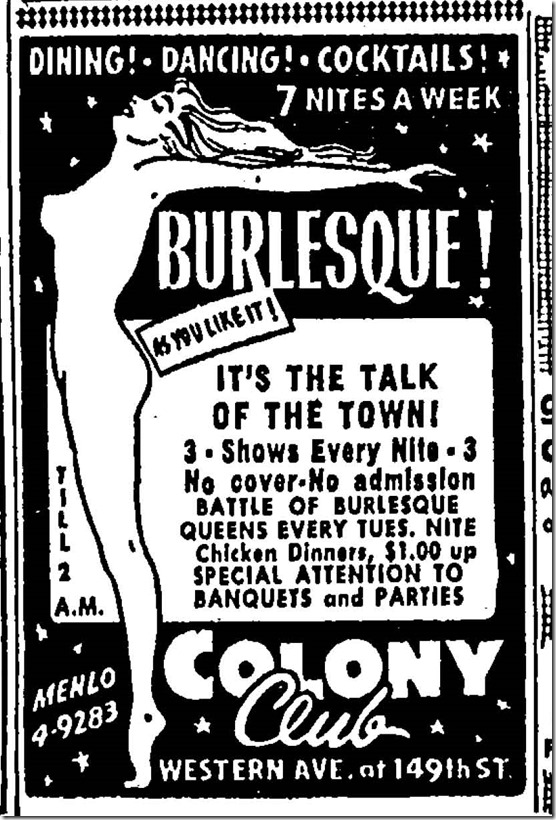
Now that I have your attention, please take a little survey on where the blog goes from here.

Posted in 1944, Film, Hollywood | Tagged | Comments Off on Take the L.A. Daily Mirror Survey

Mary Mallory: Film Noir Fest Visits The Dark Side

Too Late for Tears
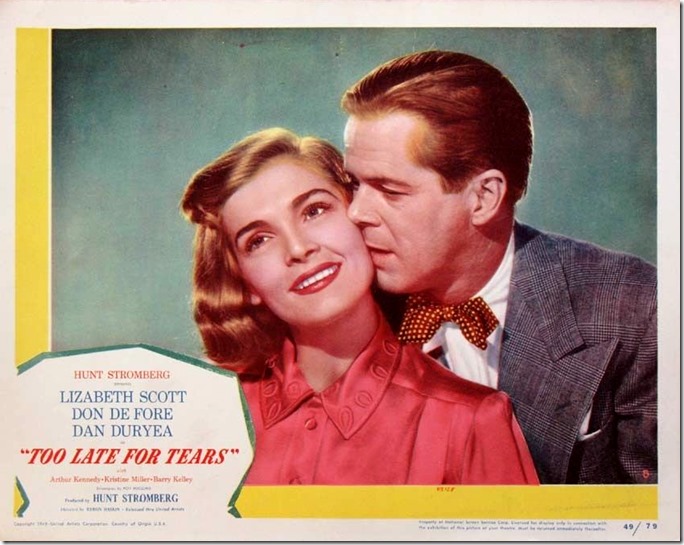
A lobby card for “Too Late for Tears,” listed on EBay as Buy It Now for $75.


F
or 16 years at Hollywood’s Egyptian Theatre, the Film Noir Foundation has been presenting Noir City, a dedicated look at the evil underbelly of the human psyche, not only in Southern California, but now, all over the world. As usual, the festival pairs up films to highlight actors, locations, themes or interesting dichotomies and this year travels the world to reveal human depravity around the globe.

This year’s opening weekend films focused on petty crooks, slimy slicksters, two-faced plotters and double dealings, all featured in glorious shades of black and white, both in delicious 35-millimeter film prints and pristine digital restorations.

Opening night, March 21, showcased the shady shenanigans of droopy-eyed Dan Duryea and his fellow fraudsters. Long sought after by noir aficionados, “Too Late for Tears” opened the Hollywood Fest after a five-year search and rescue operation by the Film Noir Foundation. The film was carefully restored from a multitude of sources for its physical rebirth.

Mary Mallory’s “Hollywoodland: Tales Lost and Found” is available for the Kindle.

Continue reading

Posted in Film, Hollywood, Mary Mallory | Tagged , , | 2 Comments

1944 in Print — Life Magazine, March 27, 1944

March 27, 1944, Life Magazine

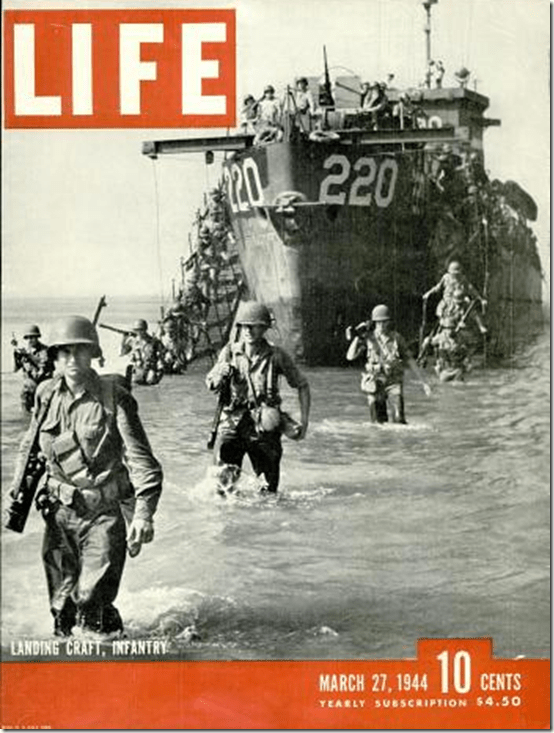
March 27, 1944: Landing craft 220 transports troops to an Italian beach, while LCI 226 lands troops in New Guinea and New Britain, the subject of a profile by John Hersey. Universal movie studios photographer Ray Jones gives a lesson in how to pose a glamour shot, with Elyse “Mummy’s Tomb” Knox. The featured photographer is Alfred Eisenstaedt and this week’s movie is “See Here, Private Hargrove.” Courtesy of Google. Continue reading

Posted in 1944, Film, Hollywood, Photography, World War II | Tagged , , , , | Comments Off on 1944 in Print — Life Magazine, March 27, 1944

1944 in Print — Hollywood Gossip by Louella Parsons, March 27, 1944

image

image

March 27, 1944

HOLLYWOOD, March 26 — A lawsuit that may completely upset one of M-G-M’s most important pictures, starring Susan Peters and Robert Young, looms potent on the horizon. Today, by wire, Pauline Leader Brand, former wife of Millen Brand, author of “The Outward Room,” confirmed information she is preparing to sue M-G-M for $500,000. She is alleging the main feminine character in the movie (now titled “Secrets in the Dark”) is she and that it would damage her because there is an illicit love affair and a baby born out of wedlock.

The picture is nearly finished and at M-G-M they tell me they have not been notified of the suit. Of course, I wonder if Mrs. Brand knows there isn’t a chance of an illicit love affair nor an illegitimate baby in any movie these days? Papa Hays and his office would say” No! No!”

From the Milwaukee Sentinel.

Continue reading

Posted in 1944, Columnists, Film, Hollywood | Tagged , , , | 1 Comment

1944 in Print — Walter Winchell on Broadway, March 27, 1944

March 26, 1944, Walter Winchell

March 27, 1944

Broadway Alien

She was once taken to a New York nightclub on New Year’s Eve and didn’t enjoy herself … She believes everything she reads in the movie mags… The only time she stays up all night is when she has a toothache … Marriage, in her opinion, is something sacred, not just a breathing spell between gigolos … She thinks Lucius Beebe is the name of a perfume … If she wasn’t true to the guy she cared about most, she’d never be able to sleep. It would worry her too much. When she sees a girl snubbing others or being insulting, she doesn’t consider it being sophisticute, but downright rude.

From the St. Petersburg Times.

Continue reading

Posted in 1944, Columnists, New York | Tagged , , , | Comments Off on 1944 in Print — Walter Winchell on Broadway, March 27, 1944

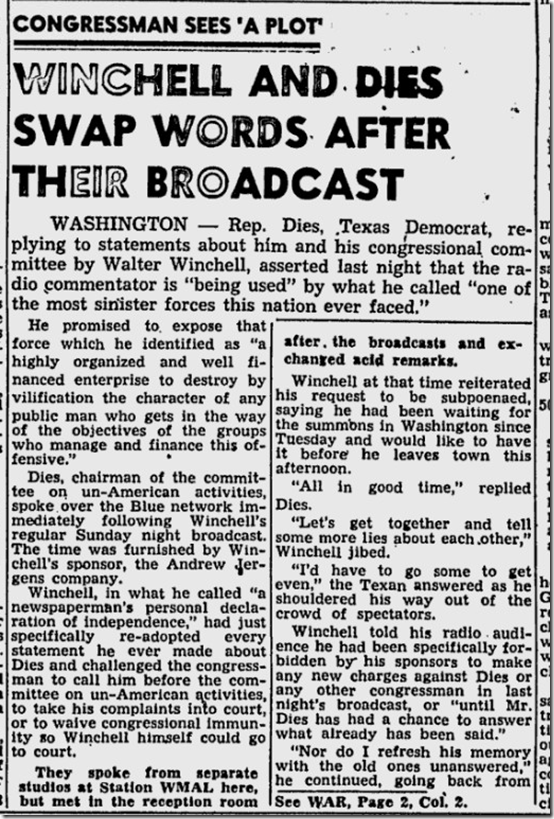
In 1944 in Print — Walter Winchell vs. Rep. Martin Dies

March 26, 1944, Walter Winchell

image


March 27, 1944

Rep. Martin Dies (D-Texas), the head of the House un-American Activities Committee, goes on the radio to accuse Walter Winchell of being used by “one of the most sinister forces this nation ever faced.”

Dies called this shadowy group “a highly organized and well financed enterprise to destroy by vilification the character of any public man who gets in the way of the objectives of the groups who manage and finance this offensive.”

Dies and Winchell spoke from separate studios of WMAL in Washington and met after the broadcasts, where they “exchanged acid remarks.”

Winchell again asked Dies to subpoena him to appear before Congress, to which Dies replied “All in good time.”

Winchell explained that his sponsor, the Andrew Jergens Co., had forbidden him to make any new charges against Dies until the lawmaker “had a chance to answer what had already been said.”

A note accompanying Winchell’s column about Dies states that it was not distributed to his syndicate, although it was published in the New York Mirror.

From the St. Petersburg Times.

Continue reading

Posted in 1944, Columnists, Politics, Radio | Tagged , , , | Comments Off on In 1944 in Print — Walter Winchell vs. Rep. Martin Dies

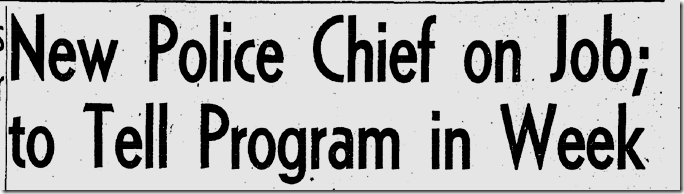
New LAPD Chief Calls for Openness With News Media

July 1, 1949, William Worton

July 1, 1949

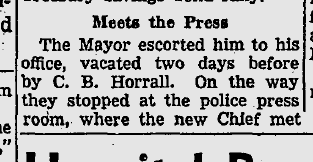
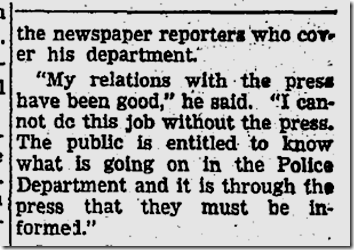
Former Marine Maj. Gen. William A. Worton becomes Los Angeles police chief. On his way to his office with Mayor Fletcher Bowron, he visits the press room:

July 1, 1949, William Worton

July 1, 1949, William Worton

“I cannot do this job without the press. The public is entitled to know what is going on in the Police Department and it is through the press that they must be informed,” Worton says.

Posted in 1949, LAPD | Tagged , | Comments Off on New LAPD Chief Calls for Openness With News Media

L.A. Becomes N.Y. — Again

NYPD Car

NYPD Car

I wandered down to “New York Street” (Spring Street between 4th and 6th in downtown Los Angeles) last night and saw this Hollywood version of an NYPD patrol car.

L.A. Becomes N.Y.

Million Dollar Theatre | Street SceneCSI: NY | Subway Entrance at 4th and Spring

Posted in Downtown, Film, Hollywood, Spring Street | Tagged , , , , | 1 Comment

1944 on the Radio — Fred Allen and Jack Benny, March 26, 1944

radio_dial_1944

March 26, 1944

It’s Sunday in 1944, which means we have:

Rochester sings the current hit song “Besame Mucho” on “The Jack Benny Show.” Courtesy of Otrrlibrary.org via Archive.org.

Ed Gardner of “Duffy’s Tavern” is Fred Allen’s guest on a very funny episode of “Texaco Star Theater.” The Brooklyn Dodgers start spring training! Courtesy of Archive.org.

Posted in 1944, Film, Hollywood, Radio | Tagged , , , , , | Comments Off on 1944 on the Radio — Fred Allen and Jack Benny, March 26, 1944

World War II on the Radio — Eric Sevareid Reports From Italy, March 26, 1944

radio_dial_1944

March 26, 1944

It’s Sunday in 1944:

Eric Sevareid reports from Naples on fighting in Italy on CBS’ “World News Today.” Courtesy of Archive.org.

Winston Church speaks on the BBC. Courtesy of Archive.org.

Posted in 1944, Radio, World War II | Tagged , , | Comments Off on World War II on the Radio — Eric Sevareid Reports From Italy, March 26, 1944

1944 in Print — Hollywood Gossip by Louella Parsons, March 26, 1944

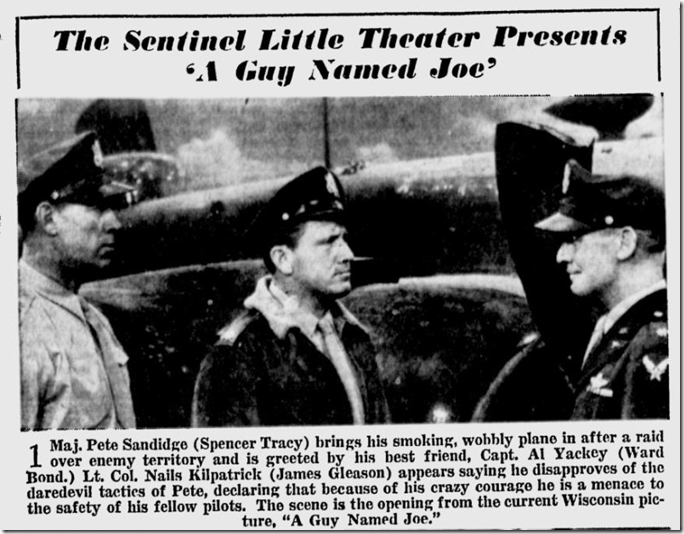
'A Guy Named Joe,' March 26, 1944

image

March 26, 1944

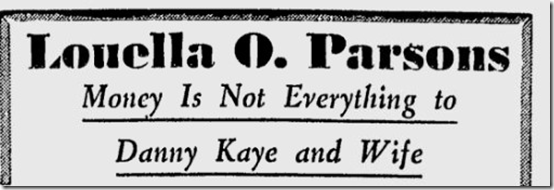
Louella Parsons interviews Danny Kaye and his wife, Sylvia Fine, and writes: I have seldom met two such idealistic young people. To see blond Danny, who makes funny faces and sings eccentric songs, you get no idea of what goes on in that busy brain of his. You have to talk with him to realize how serious he is about his work and how much he wants to be a creative artist — which, of course, he is at this moment.

From the Milwaukee Sentinel.

Continue reading

Posted in 1944, Columnists, Film, Hollywood | Tagged , , , , | 2 Comments