

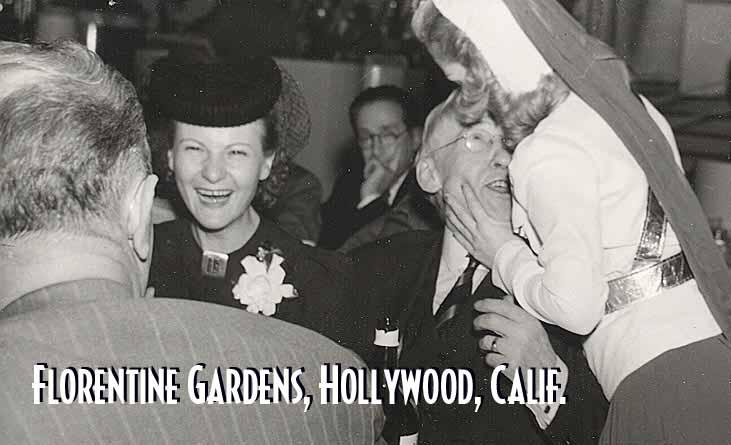
David Wade (@LODaveWade on Twitter) is asking whether anyone can identify this photo. Brain Trust?
David Wade (@LODaveWade on Twitter) is asking whether anyone can identify this photo. Brain Trust?

Feb. 6, 1947: Brooklyn Dodgers President Branch Rickey Sr. signs three more stars of the Negro baseball league: Monty (Monte) Irvin and Larry Doby of the Newark Eagles and Bus Clarkson, formerly of the Philadelphia Stars who most recently played in a Mexican league, the Associated Negro Press reported.
With the latest additions, the Dodgers now have eight players from the Negro league, including Jackie Robinson of the Kansas City Monarchs, who was sent to the Montreal Royals; Roy Campanella of the Baltimore Elite Giants; Don Newcome of the Newark Eagles, the ANP said.
Above, Pepperell (Mass.) High School officials asked the women’s athletic coach to resign after she walked off the basketball court during a game between Pepperell and Ayer High because of two African American players on the Ayer women’s team.

This week’s mystery movie has been the 1934 MGM film “The Show-Off,” with Spencer Tracy, Madge Evans, Henry Wadsworth, Lois Wilson, Grant Mitchell, Clara Blandick, Alan Edwards and Claude Gillingwater. The screenplay was by Herman J. Mankiewicz from a play by George Kelly, with art direction by David Townsend, interior decoration by Edwin B. Willis and photography by James Wong Howe. The film was directed by Charles F. Riesner and produced by Lucien Hubbard.
“The Show-Off” is not commercially available.
Note: This is an encore post from 2006.
And how are we doing? Some glaring omissions, a few mangled facts and some major errors. In all, the book isn’t doing well and we’re only on Page 6. If this were a restaurant, the health department would give it a “B” grade and start looking for vermin infestations and improper storage of food. The suppression of any information about the author’s links to Los Angeles Realtors and one of the leading financiers of the 20th century is particularly troubling—and certainly raises the question of whether the book is going to play fair with the reader.
In all honesty, if this were any other book, I would have already quit, because it’s clear that this is going to be a problematic manuscript all the way to Page 402, and life is short.
Note: This is an encore post from 2007.
Feb. 5, 2007
Sierra Madre
Because it’s celebrating its centennial this month, I paid a visit to Sierra Madre and while savoring a cinnamon dolce latte at the local Starbucks, watched the sun set on a historic Union 76 ball. A perfect fusion of two projects.

Note: This is an encore post from 2013.
From the beginning of the motion picture industry, film companies devised all types of advertising to entice consumers to buy movie tickets. Posters, lobby cards and window displays, glass slides, sheet music and photographs could be employed by exhibitors to lure patrons to see new moving pictures. But how did theater owners learn about promotional materials to help grow their profits?
Note: This is an encore of a post I wrote in 2006.
P. 5
Extra! Extra!
I was raised on the wrong side of the tracks in Beverly Hills.
This is the most marvelously amusing statement. I suppose there are people—somewhere—who might find this believable. But for anybody local, especially a homebuyer, a comment like this is almost indescribably hilarious and I’m starting to wonder if Wolfe was a comedy writer at some point in his career.
In the 1940s, Beverly Hills was a ritzy, exclusive, lily white enclave separate from the city of Los Angeles, with rigidly enforced deed restrictions to keep out non-whites. The only people of color ever seen in Beverly Hills in this era were the maids and chauffeurs. The deed restrictions were so vital to the people of Beverly Hills that several of them filed lawsuits that forced non-whites out of their homes; a very ugly period in Los Angeles history.

Note: This is a post I wrote in 2007.
Feb. 4, 2007
South Pasadena
The Times publishes three architectural drawings of “artistic bungalows” prepared by the firm of Wilson and Barnes. One is being built by W.E. Fox on Columbia near Sunset Boulevard, the second by Dr. T.H. Lowers on Main Street in Alhambra and the third by A.J. Padau on Marengo in South Pasadena “near the Monrovia car line.”
The Times says of Padau’s home: “This, perhaps, is the best located of the three houses, as from its windows can be seen the entire panorama of mountain and valley to the north and east. It is strictly modern in its design. A feature of the exterior is the broad span from corner to corner of the porch, affording an unobstructed view from the large living room in the front of the house. There are five rooms in the little structure. The cost was $2,500 ($51,308.93 USD 2005).”
Note: This is an encore of a post I wrote in 2006.
Page 3
There wasn’t much nightlife in Los Angeles back in the 1940s.
Note: This is an encore post from 2006.
People keep asking me: “Have you read the Wolfe book?” meaning Donald H. Wolfe’s “The Black Dahlia Files: The Mob, the Mogul and the Murder That Transfixed Los Angeles.” My answer is always the same: I bought a copy but I haven’t read it yet.
Still, people keep telling me it’s a wonderful job and solves the murder, usually prefaced by the statement that “I don’t know anything about the case, but…”

Note: This is a post I wrote in 2007.
Feb. 3, 1907
Los Angeles
About 1 a.m. on a dark corner at East Adams and South San Pedro, the hard, shabby life of William Ross ended when he said, “What in hell are you fellows up to?,” drew a pistol and shot plainclothes Officer C.A. May.
May and his partner, J.M. Hoover, were walking east on Adams when they encountered Ross, described as a “rather roughly dressed man.” Earlier in the evening, Hoover and May, who were working plainclothes as part of a crackdown on burglaries in the area, investigated an incident at 223 E. Jefferson Blvd., where L.C. Kelker had reported that two men were on his front porch.

Note: This is a post I wrote in 2007.
Feb. 2, 1907
Los Angeles
Conditions at Chutes Park are so bad that the Society for the Prevention of Cruelty to Animals is making a second inspection to see whether operator J.B. Lehigh has made any improvements before his Feb. 20 trial on charges of abuse and neglect.
Chutes is nothing more than a mud-filled stockyards of suffering animals, The Times says. “The ‘park’ is a long puddle of filth, reeking with slime and mud. In the pen where three little does are confined, one of them so emaciated that it is literally hidebound, a thick green scum has formed over the stagnant pool of slime that occupies a good share of the particular part of the ‘park’ where these poor little animals are shut up.”

Starting Saturday, I’ll begin reposting all 88 entries that I wrote in 2006 when I blogged in real time as I read Donald H. Wolfe’s awful “The Black Dahlia Files,” a book that refutes Piu Eatwell’s claim in “Black Dahlia, Red Rose” that she was the first to look at the Los Angeles County district attorney’s files. (For the record, Los Angeles Times columnist Steve Lopez; “Black Dahlia Avenger” author Steve Hodel; Jacque Daniel, author of “Curse of the Black Dahlia”; and I had all looked at the files before Eatwell.)
This series of posts was a ridiculous amount of work and consumed several months. Which is why I’m not going to bother with a page-by-page debunking of Eatwell’s “Black Dahlia, Red Rose.” (Executive summary: Eatwell’s supposed “killer,” Leslie Dillon, was in San Francisco on the day Elizabeth Short was murdered – oops).
All the posts, which ran from Feb. 3, 2006, to May 1, 2006, in 88 entries, are already online if you want to skip ahead.

Note: This is a post I wrote in 2007.
Feb. 1, 1907
Los Angeles
I was all set to write about Leroyxez, “The Human Pincushion,” being nailed to a cross promptly at 4 p.m. at Chutes Park, and then a story about lynching in the U.S. caught my eye.

Note: This is a post I wrote in 2006 for the 1947project.
It is difficult to believe that there was a time when newspapers published rape victims’ names and addresses, but the Herald-Express had no misgivings about it. Aggie Underwood, Herald reporter and eventually the city editor of the Herald Examiner, said she once had to go out eight weeks in a row and interview rape victims. Since this woman may still be alive, I’ve deleted her name and address.
Attacker
Masked Man Assaults
Girl at Gun Point
A young masked gunman early today attacked an attractive 18-year-old girl in the Hawthorne district after forcing her to enter his automobile on 161st Street near Hawthorne Boulevard.
Note: This is a post I wrote in 2007.
Jan. 31, 1907
Los Angeles
Showing once again that Los Angeles is out of touch with Sacramento, local health officials are fighting an education bill that would lift mandatory smallpox vaccinations for schoolchildren.
Vaccinations were opposed for several reasons in the Legislature. Assemblyman Sackett objected to placing the burden of enforcement on schools. Assemblyman Percival, a Christian Scientist, apparently objected to the measure on religious grounds. Other opponents said the only reason health officials supported the shots is to protect their jobs.
Continue reading

Note: This is a post I wrote in 2006 for the 1947project.
The rewrite desk in action:
The Examiner:
Free Cash, Nylons and Gum—
Then They Took Him Away!
Dollar bills, nylons and bubble gum pelted persons at 6th and Main Streets yesterday.
It started a near-riot and brought police on the double. One woman was injured slightly.
The pelter was Benny Stone, diminutive candy salesman, of 5754 West Fourth Street.

Note: This is an encore post from 2007.
Jan. 30, 1907
Los Angeles
Recent rains have left the city’s streets in terrible shape, as The Times shows in a photo taken at 1st Street and Spring.
This wagon, pulled by a strong team, plunged up to its hubs in one of the potholes and the horses were unable to free it. “Under the whip and vociferous admonitions of their driver, they were helpless to pull it out from the stinking muck in which, hub deep, it stood,” The Times says.

Jan. 30, 1947: An ad in the Sentinel announces a preview of a model home in Carver Manor, a housing development designed by Paul R. Williams at 135th Street and Avalon Boulevard.

Stanford Avenue in Carver Manor, via Google Street View.

The Rev. J.L. Caston, a Baptist minister; attorney Lucius Lomax, publisher of the Los Angeles Tribune and the father of civil rights attorney Melanie Lomax; dental technician Albert Patrick; and attorney Vince M. Townsend Jr. announce that they are running in the City Council 7th District race against the incumbent, Rev. Carl C. Rasmussen, a Lutheran minister. Rasmussen, who was white and endorsed by the Los Angeles Times, was reelected.
Caston was endorsed by the Sentinel, which noted that he was an official of the NAACP, was active in the YMCA and was an honorary member of the Dining Car Workers Union. He placed third in the election after Rasmussen and Don A. Allen.
Note: We’re rebooting the concept of the 1947project (founded by Kim Cooper and Nathan Marsak) by going day by day through 1947 – but using the Los Angeles Sentinel, an African American weekly, rather than the very white and very conservative Los Angeles Times. We promise you an extremely different view of Los Angeles.

(The historic Los Angeles Sentinel is available online from the Los Angeles Public Library. We encourage anyone with a library card to delve into the back issues and explore the history of black L.A.

This week’s mystery movie has been the 1956 Allied Artists film “Crime in the Streets,” a Lindbrook production. With James Whitmore, Sal Mineo, Mark Rydell, Virginia Gregg, Peter Votrian, Will Kuluva, Malcolm Atterbury, Denise Alexander, Dan Terranova, Peter Miller, Steve Rowland and introducing John Cassavetes. Story and screenplay by Reginald Rose, photography by Sam Leavitt. Art direction by Serge Krizman, set decoration by Victor Gangelin, dialogue coaching by David S. Peckinpah and music by Franz Waxman. The producer was Vincent M. Fennelly and the director was Donald Siegel.
The film was adapted from a 1955 episode of “The Elgin Hour,” directed by Sidney Lumet, with Cassavetes, Kuluva and Rydell, with Robert Preston in the role played by Whitmore and Glenda Farrell in the role played by Gregg.
The DVD of the film is available in a boxed set Film Noir Classic Collection, Volume 5 from Warner Archive.


