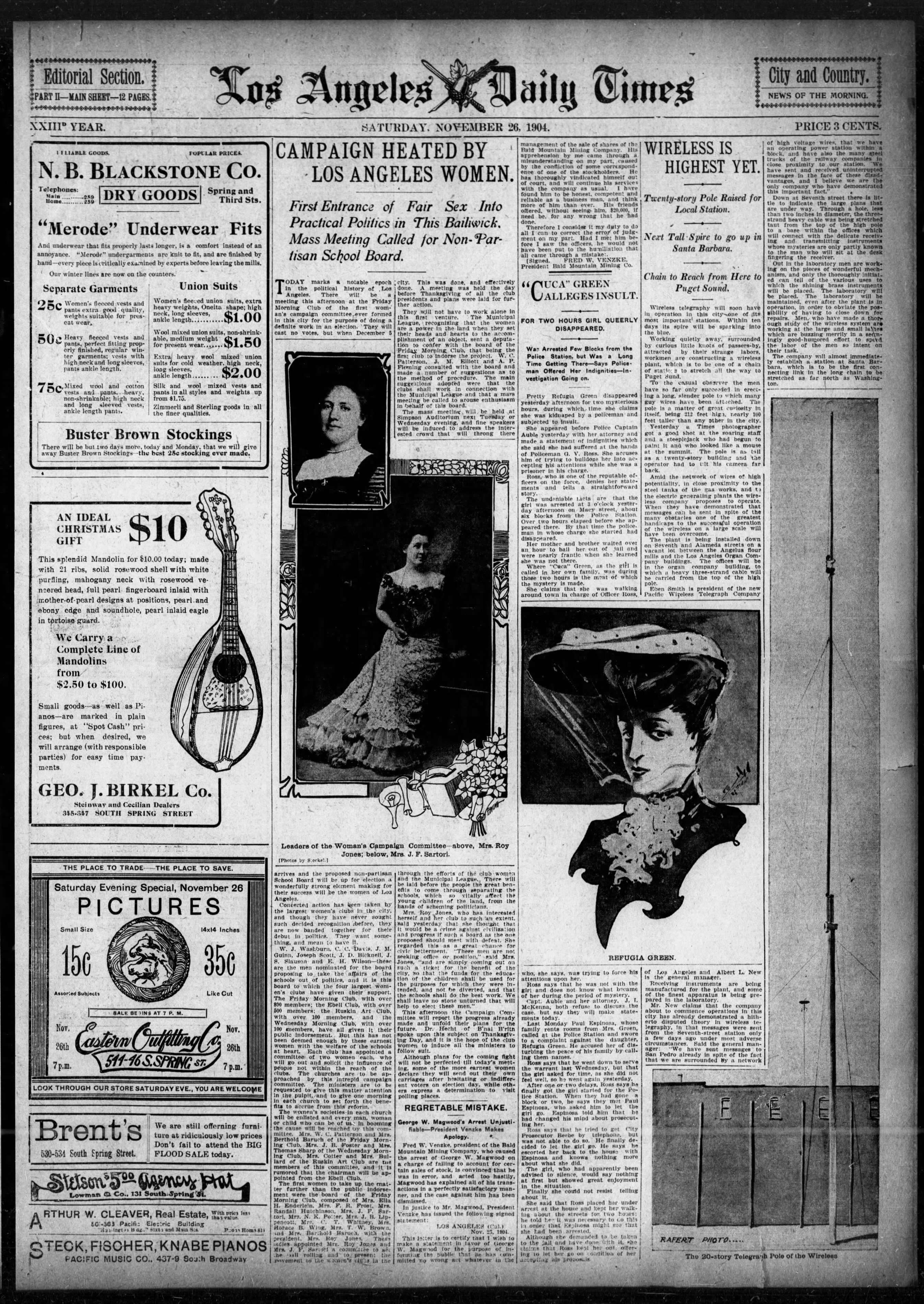
November 6, 1947: LAPD motorcycle officers received a pay differential, so these were desirable jobs. The photograph is fairly dim, but this looks like a three-wheeled Harley-Davidson Servi-Car.

November 6, 1947: LAPD motorcycle officers received a pay differential, so these were desirable jobs. The photograph is fairly dim, but this looks like a three-wheeled Harley-Davidson Servi-Car.

Note: This is an encore post from 2005 and originally appeared on the 1947project..
The Times did absolutely no follow-up to this incident as to whether Everline was tried in the burglary, nor was there any apparent investigation of the officer-involved shooting. Of course, in the 1940s, police shootings were rarely if ever investigated.
Public records shed little light on Wallas, except that he was born in Texas and apparently had no Social Security number. Everline (SS# 467-22-4104), who died in Virginia in 1981, was also born in Texas, but there’s no further information.

Many people wonder if the religious leaders in “Changeling” are actual people. Here’s evidence that the Rev. Gustav A. Briegleb helped Christine Collins. A similar letter in Walter Collins’ file is from the Rev. R.P. “Fighting Bob” Shuler.

Note: This is an encore post from 2006.
November 6, 1907
Los Angeles
Here’s a real mystery, although a minor one, and like all real mysteries, it is incomplete and may have no solution.
Exhibit 1: This postcard up for auction on Ebay.
Tuesday was the day of the big blow. No, it wasn’t windy. It was the day the tax bills hit the fan.
The resultant moans have ranged from low and plaintive, tapering off into controlled disgust, to massive indignation, accompanied by a fierce resolve to do something about it.
Property owners were warned their tax bills would be raised but the blow, as always, caught them unprepared.
A woman who lives in a rundown industrial section in southeast L.A. was dismayed to find her taxes had been increased from $100 to $190, give or take a dollar. She said sadly, “We simply won’t eat for two weeks. I mean it.”
Hong Kong — In this bedlam of political intrigue, British pomposity, sly international trade, glamour and abject poverty, I’ve learned a very disturbing thing about myself.
I never thought the time would come when I could turn my back on a hungry child. But it has.
After just a few days in Hong Kong, you become hardened to the starvation around you. It’s such a massive condition, involving so many hundreds of thousands, that it becomes impersonal.
There’s nothing you can do about it, anyway. You can make the futile gesture of tossing a few coins at the countless beggar children. But if you give a coin to one of them, you are immediately mobbed by dozens of others who seem to come at you from nowhere. They plead, whine, tug at your clothes and curse when you try to break away from them. Continue reading


Note: This is an encore post from 2005 and originally appeared on the 1947project.
November 5, 1947: She called it “The Amazing Career of a Girl Drug Addict” and she wasn’t exaggerating—and yet she was.
Arrested in October for driving erratically on Wilshire Boulevard, a woman calling herself Margaret Burton told police she was a former actress and had become addicted to sedatives during the London Blitz, when a physician gave her tranquilizers to calm her nerves.

November 5, 1944: Arturo Toscanini conducts the NBC Symphony Orchestra in Beethoven’s Symphony No. 3, followed by Glinka’s “Caprice Brillant Jota Aragonesa.” Courtesy of otronmp3.com.

Note: This is an encore post from 2006.
November 5, 1907
Los Angeles
John Richie led the bass section of the choir at St. Machar’s Cathedral in Aberdeen, Scotland, while Testristina Adams was a contralto. They sang in the choir for about 10 years, and fell in love.
Two years ago, in hopes of more opportunity, John left Scotland and came to Los Angeles, but not before asking Testristina, a pretty brunette, according to The Times, to marry him. “If I had not said that I would follow him he would never have come,” she said.
In the November Ask Me Anything on the Black Dahlia case, I discussed my work in progress, Heaven Is Here!
I discussed The Consult podcast by former FBI profilers, Carl Balsiger and why the Black Dahlia case isn’t a game of “Clue.” Continue reading


Note: This is an encore post from 2005 and originally appeared on the 1947project.
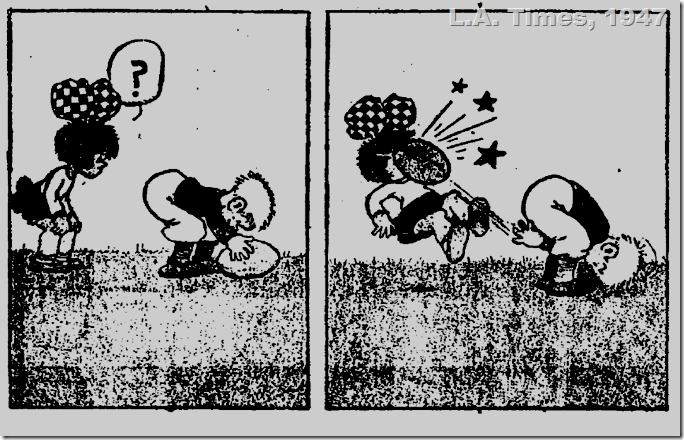
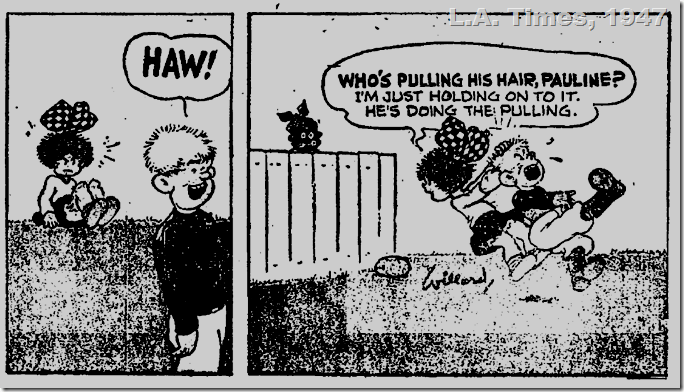
November 4, 1947: Although it isn’t mentioned, this sounds like a riff on “Sadie Hawkins Day,” founded by “Li’l Abner” cartoonist Al Capp, who has been featuring the holiday for the last month.

Note: This is an encore post from 2006.
November 4, 1907
Los Angeles
About a year ago, Eugene Rowe’s little runabout was smashed by a trolley. After some repairs, it won a trophy, but a month later, it was wrecked in the Pasadena hill climb. And then it overturned in a ditch.
Undeterred, and practicing the route of a Thanksgiving run, Rowe and his friend Charles Fuller Gates set off for Box Springs in Riverside County, where the runabout overturned on a curve. Gates was pinned under the car, crushing his left leg. Rowe was thrown clear and although he was badly battered managed to free Gates from the wreck. Continue reading

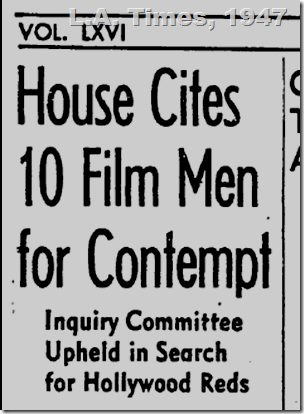
Director Herbert Biberman set out to right wrongs when he directed “Salt of the Earth,” Michael Wilson’s moving script of poor Hispanic miners in New Mexico overcoming their goliath mining owners. As timely now as then, it’s a difficult story of ever making it to theatres through censorship, threats, and bullying by powerful business interests and the government reverberates today.
Biberman, active in liberal politics and supportive of human rights, freedom of speech, and democratic causes, refused to testify in front of the demagogic House Un-American Activities Committee whether he was a member of the Communist party, thus joining the group that came to be known as the Hollywood Ten. While most received one year prison terms on contempt charges for refusing to testify to Congress, the writer/director saw his reduced to a six month term along with director Edward Dmytryk. Continue reading

Honestly! The Christmas ads start earlier every year. I remember when they used to wait until after Thanksgiving! Continue reading
Look beyond the nostalgia factor in this film produced for Studebaker dealers. Listen to the comments. The Studebaker Lark was, according to this film, intended to give consumers what they wanted: a low-priced, fuel economy car. We know today, of course, that Studebaker failed for many reasons. But these executives were positive they had read the market correctly.
“Your product philosophy is right. This is exactly what our customers want.”

![]()
November 3, 1941: Tom Treanor goes to a dance at the Glendale Civic Auditorium for swing shift workers, about 5,000 of them, from 1 a.m. to 5 a.m. on a Saturday morning. Most of the couples are married, he says, and the wives are 18 or 19.
One of the trombonists wasn’t playing because his instrument was broken at a Halloween job. Why did he show up? Because he still got paid, even without his instrument. Trumpeter Wingy Manone [often spelled Wingie and Mannone] (d. 1982) played left-handed because his right arm was missing. Manone wrote an autobiography titled “Trumpet on the Wing.”
Videos of Wingy Manone: Jukebox Joe’s | Tailgate Ramble | Vine Street Blues |
The Times also publishes a story about a woman who was “criminally assaulted” – one of those quaint terms newspapers used to use — by four men. One of them was a friend of her brother and wanted to kill her because she recognized him, but the others prevented him. And, as was customary in those days, The Times published her name and address.
Jimmy Fidler says: REPUBLIC’S “RED RIVER” SET AT A GLANCE: Cowboy extras using between scene leisure to shine already gleaming boots … “Gabby” Hayes displaying femme star temperament when a prop barber’s chair refuses to work … Sally Payne (industriously knitting a washcloth): “Other girls can keep the soldiers warm; I’m concentrating on keeping the Army clean” … The Sons of the Pioneers and Roy Rogers (who used to be one of them) blending voices for a sentimental rendition of “Sweet Adeline” … Veteran Henry Morris, greatest bulldogger in rodeo history, standing in for “Gabby” Hayes … Set visitors examining a bench carved with the initials B.C. as Billy Gilbert explains that Bing Crosby got his screen start on this very sound stage in Sennett shorts … Gale Storm (watching Mexican extras in a knife-throwing contest): “What a useful accomplishment in Hollywood society!”
[And yes, this was released as “Red River Valley.”]

This week’s mystery movie was the 1930 Warner Bros. film Sinners’ Holiday, based on the play Penny Arcade by Marie Baumer, with Grant Withers, Lucille LaVerne, Warren Hymer, James Cagney, Joan Blondell, Noel Madison, Evalyn Knapp, Otto Hoffman, Hank Mann and Ray Gallagher. Continue reading

Note: This is an encore post from 2006.
November 3, 1907
Los Angeles
Mrs. E.N. Eskey is building this 10-room house in Pico Heights, on Van Ness just south of Pico.
According to The Times, the two-story house (with basement) has a first floor divided into a reception hall with an oak staircase leading upstairs. The living room features built-in bookcases and a massive brick mantel. The dining room has a built-in buffet and china closet, with a pantry and kitchen.
The floors are quarter-sawn oak on the first floor and maple flooring in the rest of the house. The Times says there are four chambers, presumably bedrooms, a sewing room and a bathroom upstairs, as well as an alcove.
In the basement, a coal bin and a Rudd heater.
The cost? $5,000 ($102,617.85 USD 2005) a bargain by today’s standards. Note that in March 2004, 1244 S. Van Ness sold for $1,037,500.
Update: This house is still standing and has been painted blue. I’ll post some photos once I get the film developed (yes, I’m old-school).

Pier Angeli and her adorable little friend remind Daily Mirror readers that Daylight Saving Time ends today and to turn your clocks back one hour. Hi Eve!!

Note: This is an encore post from 2005 and originally appeared on the 1947project.
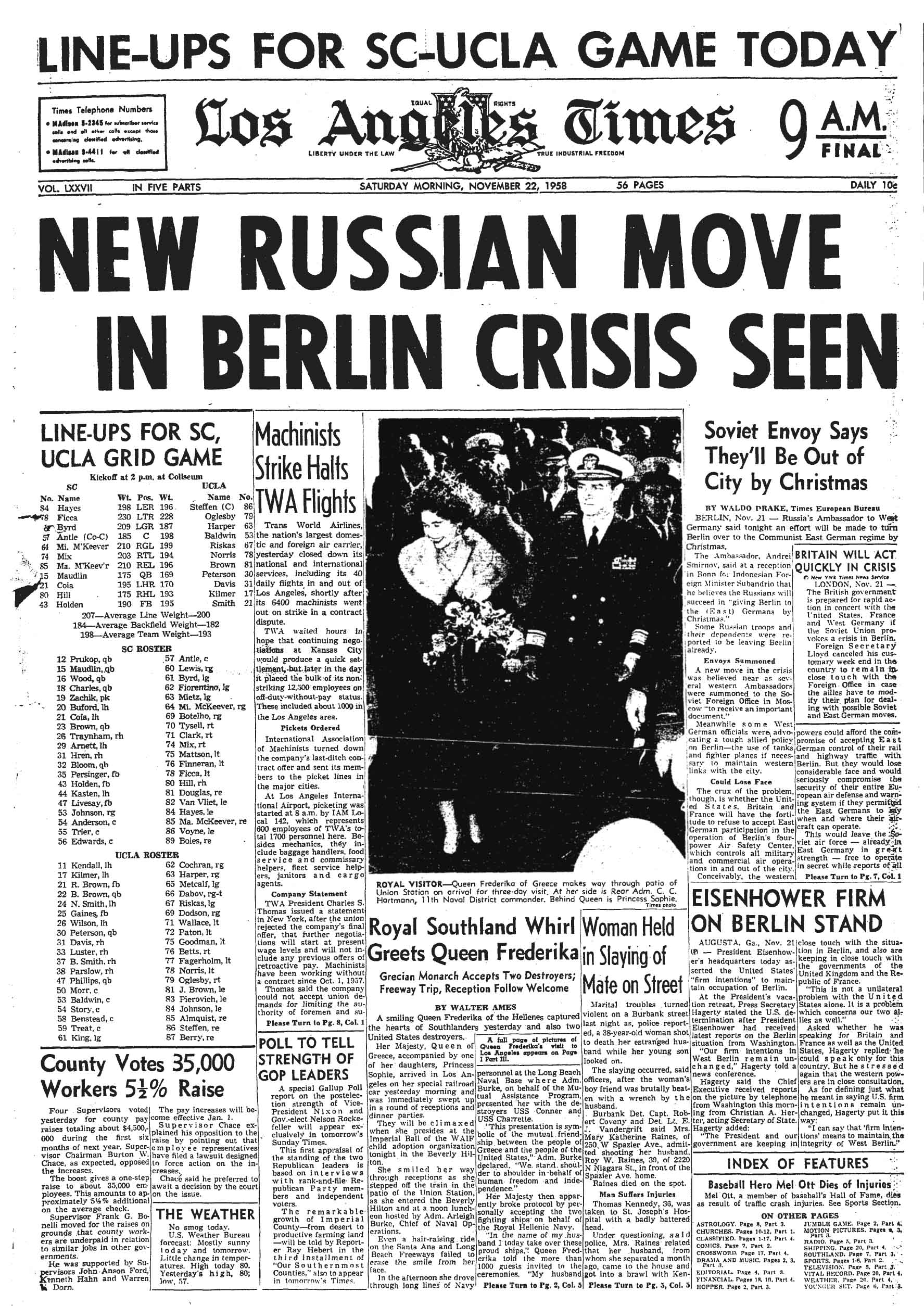
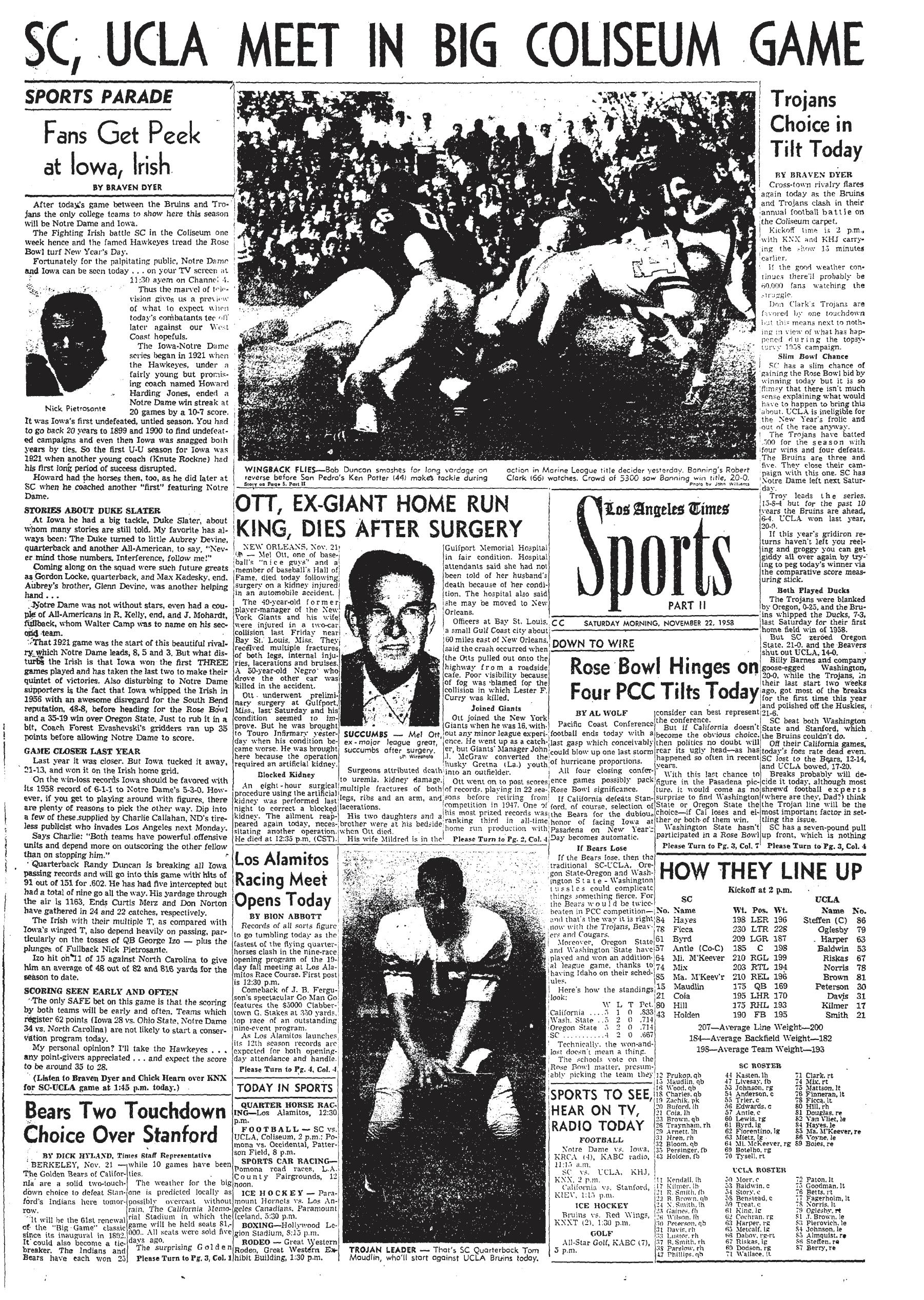
The assault on USC’s campus canine prompted angry letters to The Times and a pointed barb on the sports pages. “Whoever did that had a warped mind,” columnist Braven Dyer said.
Of course, the Trojans were up to the challenge and shortly before the schools’ annual grudge match, painted the Westwood campus with slogans like “George Tirebiter’s Revenge.” The scoreboard was vandalized to read: “USC 1,000, UCLA 0.” The actual score was much closer. USC, which at that point was unbeaten, defeated UCLA 6-0 and went to the Rose Bowl, although it subsequently lost its homecoming game to Notre Dame 38-7.