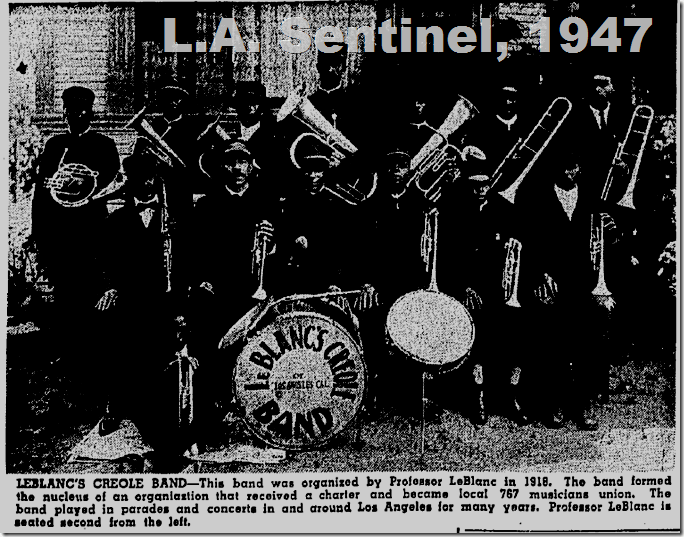
LeBlanc’s Creole Band in an undated photo, via the Sentinel.
May 8, 1947: I went down the research rabbit hole on the story of Thomas R. LeBlanc, who was featured in the Sentinel. This is a story that deserves more time than I have at the moment, but it’s also too good to ignore. So here’s what I have:
On May 1 and May 8, the paper published the first two parts of a three-part series on LeBlanc by Wendell Green, the paper’s theatrical editor, but I cannot locate the final installment.
Bette Yarbrough Cox’s “Central Avenue – Its Rise and Fall” includes LeBlanc among the founders of Local 747, the black chapter of the musicians union in Los Angeles (Local 47), but not much more than that. He isn’t mentioned again in the Sentinel. He’s mentioned once in passing in the Los Angeles Times (a Sept. 24, 1929, article says he conducted the Colored Elks Band) and he can’t be found in the California Digital Newspaper Collection.
Although the Sentinel says he was born in New Orleans in 1871, I can only find a Thomas Rosemon LeBlanc who was born in Louisiana on Aug. 2, 1875, according to his World War I draft registration. According to census records and voter registration, he lived at 1549 E. 21st St. from about 1930 to about 1954.
He may or may not be the Thomas R. LeBlanc who listed in the California Death Index as being born in Louisiana on Oct. 2, 1888, and dying in Pasadena on Sept. 24, 1961.
Continue reading →



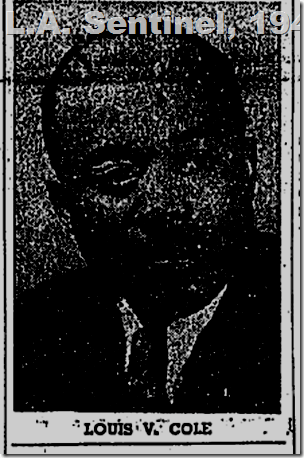 May 15, 1947: About 3 a.m. on April 17, 1947, Louis V. Cole of the Sentinel advertising department was delivering tear sheets of that week’s ads when his car stalled.


![20180515_193725[1]](https://ladailymirror.com/wp-content/uploads/2018/05/20180515_1937251.jpg?w=684&h=440 "20180515_193725[1]")
![20180515_193729[1]](https://ladailymirror.com/wp-content/uploads/2018/05/20180515_1937291.jpg?w=684&h=446 "20180515_193729[1]")






 ladailymirror.com