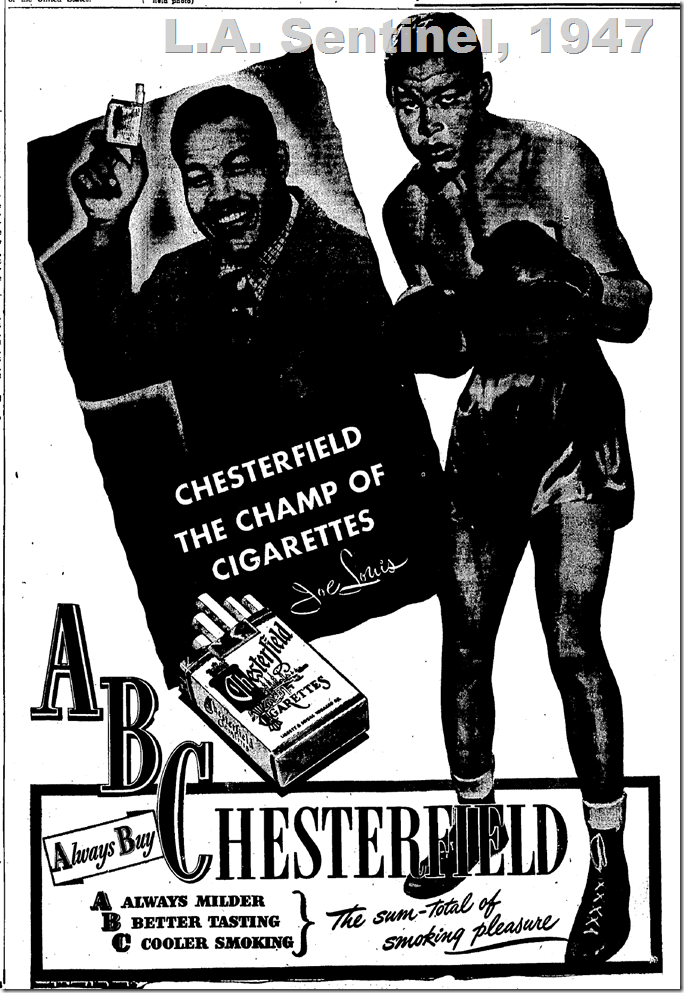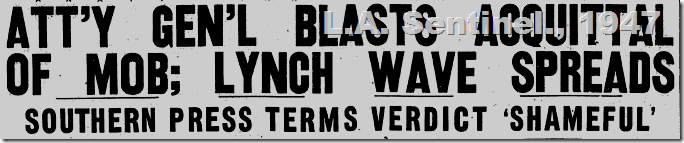
April 17, 1947: Jackie Robinson’s signing with the Dodgers is Page 1 news in the Sentinel….
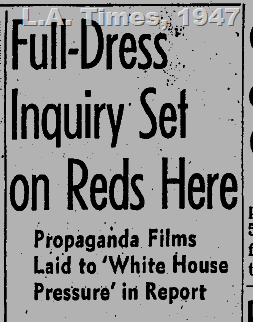
… And on the cover of the sports section in the Los Angeles Times – and no picture or even a Page 1 index item.

April 17, 1947: Jackie Robinson’s signing with the Dodgers is Page 1 news in the Sentinel….
… And on the cover of the sports section in the Los Angeles Times – and no picture or even a Page 1 index item.

This week’s mystery movie has been the 1956 MGM picture “Bhowani Junction,” with Ava Gardner, Stewart Granger, Bill Travers, Abraham Sofaer, Francis Matthews, Marne Maitland, Peter Illing, Edward Chapman, Freda Jackson and Lionel Jeffries. The screenplay was by Sonya Levien and Ivan Moffat from the novel by John Masters. Photography was by F.A. Young, art direction by Gene Allen and John Howell, musical supervision by Miklos Rozsa, costume designs by Elizabeth Haffenden, makeup by Charles E. Parker and hairdressing by Pearl Tipaldi. Produced by Pandro S. Berman and directed by George Cukor.
“Bhowani Junction” is available on DVD from Warner Archive.
Note: This is an encore post from 2006.
I have ceased blogging in real time as I read Donald H. Wolfe’s “The Black Dahlia Files: The Mob, the Mogul and the Murder That Transfixed Los Angeles.” Wolfe uses the “Laura” format, in which the anonymous, butchered body is found and the narrative proceeds in flashbacks. Now, I am taking a few requests before wrapping up the project. Today, we’ll continue our examination of Pages 213-215 at the request of Regular Anonymous Correspondent (who e-mailed me with some more pages. I hope I haven’t lost track of them).
You won’t believe this.
Trust me, you won’t.
Is it worse than faking documents?
Well no. But it’s close.
Remember all that stuff yesterday about Gerald and Sara Murphy?
Here’s the quote:
“It was through Manny [Edward G. Robinson Jr.] that I met Arthur James at the Holiday House in Malibu. Owned by prominent artist Gerald Murphy and his wife Sara, the Holiday House stood on the cliffs overlooking the Pacific Ocean and became a hideaway for Hollywood celebrities who didn’t want to be seen in public with the wrong woman—or the wrong man. Lana Turner and Johnny Stompanato used to stay there, as did Marilyn Monroe, upon occasion, with a young congressman from Boston named Jack Kennedy.”
Note: “Prominent artist Gerald Murphy and his wife Sara.”
So I went through all this research on their house in the Hamptons and how they were the inspiration for “Tender Is the Night.”
Are you ready?
Grab hold of something and hang on tight.
Those were the wrong Murphys.
No, really! I heard from Regular Anonymous Correspondent yesterday, who pointed me in the right direction.
Wolfe isn’t talking about prominent artist Gerald and Sara Murphy. He means prominent film director DUDLEY Murphy and his wife, Virginia. Or as The Times would have referred to him at one point: Film director Dudley “Emperor Jones” Murphy. And the Holiday House was a restaurant and motel at 27400 W. Pacific Coast Highway.
And it must have been some secret hideaway, Murphy wanted to do a TV series based on his guests’ experiences. (Los Angeles Times, Aug. 25, 1950). Hm. Times gossip columnist James Copp paid a visit and overheard John Garfield telling the dieting Shelley Winters not to eat that filet mignon.
Looks like Copp was a regular out there. He wrote about it all the time. Although he never seemed to mention Edward G. Robinson Jr., Arthur James or Donald H. Wolfe.
Well this is interesting. Richard Neutra designed the apartments in 1949 but he and Murphy didn’t get along so Murphy designed the restaurant himself. (Lois Dwan, Los Angeles Times, Oct. 8, 1978).
Apartments apparently demolished in 1986. Used as film location for “Rockford Files” and “$6-Million Man.”
Let me put it this way…..
We’ve already seen that Elizabeth Short wasn’t in Los Angeles in 1944.
That’s when Arthur Curtis James Jr. said he met her. In fact James said he took her to Tucson in 1944, when he got arrested for violating the Mann Act. He drew two years in prison for that little number.
Then in 1947 he confessed to writing bad checks in September 1946, claiming they were to buy luggage for Elizabeth Short. Again, not true, although this story appeared in the Herald-Examiner and John Gilmore’s “Severed,” which is 25% mistakes and 50% fiction.
And Wolfe says James ran some rooming houses for Florentine Gardens business manager Mark Hansen, which is also false. “Severed” doesn’t make this claim, however. This is a new one.
And then Wolfe botches the facts about where the conversation supposedly took place between him and one—if not two—CDPs (conveniently dead people). Just a little matter of the wrong prominent Murphys.
So we’re supposed to believe:
“James said some ‘big shot’ had taken a fancy to Elizabeth and gotten her pregnant, and Hansen had tried to set her up with an abortionist. Instead, she fled to San Diego. The last time James said he saw her was several days before she left the city, and he had heard that the ‘big shot’ was Norman Chandler, heir to the Chandler dynasty. James recalled that he hadn’t heard from Elizabeth again or known what had happened to her until he recognized her picture in the paper and read the gruesome stories.”
Is Wolfe kidding or what?
Time for my walk.
Shout out to:
Malmo, Sweden [ISP Redacted] 6 hours?
Japan [ISP Redacted]
City of Los Angeles [ISP Redacted]
Note: Nobody using Windows 98. I’m very proud of you. I was starting to worry.
Hurry back.

For the ninth consecutive year, the TCM Classic Film Festival returns to Hollywood, April 26 through 29, 2018, as it salutes “Powerful Words: The Page Onscreen.” The festival showcases classic films and stars on the big screen as they were meant to be seen, highlighted by special programs, interviews, ceremonies, and star appearances. It offers a variety of genres for every type of vintage film fan: silents, pre-codes, epics, documentaries, sci-fi, and literary adaptations.
To honor its long time host and icon, the festival will present its inaugural Robert Osborne Award to legendary filmmaker Martin Scorsese, who has tirelessly worked to keep the cultural heritage and legacy of classic films alive for generations to come, just like the inimitable Osborne. The event occurs opening night Thursday, April 26 as part of the official Opening Night Gala at the TCL Chinese Theatre IMAX, which includes the screening of the 1968 film “The Producers,” highlighted by an interview with its director Mel Brooks.
Note: This is an encore post from 2006.
I have ceased blogging in real time as I read Donald H. Wolfe’s “The Black Dahlia Files: The Mob, the Mogul and the Murder That Transfixed Los Angeles.” Wolfe uses the “Laura” format, in which the anonymous, butchered body is found and the narrative proceeds in flashbacks.
Now, I am taking a few requests before wrapping up the project. Yesterday, we examined how the document on Page 198 was faked. Today, we’ll examine Pages 213-215 at the request of Regular Anonymous Correspondent (who e-mailed me with some more pages. I hope I haven’t lost track of them).
About yesterday—faking documents is a serious charge and I did e-mail Wolfe to see if he’d care to comment. Well, I haven’t heard from him as yet and that e-mail address is the only way I have to contact him. So I rooted around ReganBooks’ website to see if I might contact someone there for a response.
Note: This is an encore post from 2006.
I still haven’t received an answer.
—– Forwarded Message —-
From: Larry Harnisch
To: DHWolfe1213@aol.com
Sent: Friday, April 14, 2006 8:51:13 AM
Subject: The “D” Memorandum

Note: This is an encore post from 2006.
I have ceased blogging in real time as I read Donald H. Wolfe’s “The Black Dahlia Files: The Mob, the Mogul and the Murder That Transfixed Los Angeles.” Wolfe uses the “Laura” format, in which the anonymous, butchered body is found and the narrative proceeds in flashbacks.
As we discovered yesterday, the alleged memo on Page 198 of Wolfe’s book is a fake, pasted together from two unrelated documents.
Today, let’s see how it was done.

Note: This is an encore post from 2006.
I have ceased blogging in real time as I read Donald H. Wolfe’s “The Black Dahlia Files: The Mob, the Mogul and the Murder That Transfixed Los Angeles.” Wolfe uses the “Laura” format, in which the anonymous, butchered body is found and the narrative proceeds in flashbacks.
Yesterday, we looked at a particularly foul and nasty installment, Page 167, at the request of Mary Pacios. Today we’ll do Pages 197-198 at Mary’s request. I hope you are ready for a shocker. Even for Donald H. Wolfe, this is nasty, nasty work. A ruthless, conniving, calculating and cynical attempt to pull off a fraud.
You are so busted, Donald H. Wolfe.

Charlie Chaplin, as Adenoid Hynkel, performs a balletic routine with a globe in “The Great Dictator.”
John Bengtson, who has performed fabulous detective work in tracking down movie locations in early films, will introduce Charlie Chaplin’s “The Great Dictator” at 7:30 p.m. on April 19 at the Alex Theater, 216 N. Brand Blvd., in Glendale. Bengtson will also have a book signing for “Silent Traces: Discovering Early Hollywood Through the Films of Charlie Chaplin.”
Released before the U.S. entered World War II, “The Great Dictator” is a satire on Adolf Hitler with Chaplin in dual roles as dictator Adenoid Hynkel of “Tomania” and “a Jewish barber.” The cast also features Jack Oakie as Benzini, the head of Bacteria (a burlesque of Benito Mussolini of Italy); Henry Daniell as Herr Garbitsch (propaganda minister Joseph Goebbels); and Billy Gilbert as Herring (Hermann Goering). Paulette Goddard, who plays Hannah, made her debut as a leading lady in “Modern Times” and was Chaplin’s third wife. She separated from him in late February 1940 shortly after production finished on “The Great Dictator” and divorced him the next year.
David Totheroh, the grandson of Roland “Rollie” Totheroh, the cinematographer on many Chaplin films, including “The Gold Rush,” “Modern Times” and “The Great Dictator,” will also attend.
The movie is being presented by the Alex Film Society. Ticket information is available at this link.

April 10, 1947: James O. Plinton Jr., left, and Sentinel Publisher Leon H. Washington with one of the Grumman planes Plinton bought for his air service.
April 10, 1947: Karla Rosel Galarza, 22, is refusing requests by the Washington, D.C., Board of Education to transfer from Margaret Murray Washington Vocational High School because she is the only white at the all-black school, according to a story in the Sentinel from the Associated Negro Press.
Galarza, formerly of Sacramento, said she doesn’t want to transfer to Burdick Vocational High School, which is for white students, because it doesn’t offer the course in dress design that she’s taking at her current school. Galarza promised a legal fight to remain at the school and she was supported by her father, Ernesto Galarza, a former officer of the Pan American Union.
The request for Galarza to change schools came from school Supt. Hobert M. Corning and Garnet C. Wilkinson, first assistant superintendent in charge of Negro schools.
Note: This is an encore post from 2006.
I have ceased blogging in real time as I read Donald H. Wolfe’s “The Black Dahlia Files: The Mob, the Mogul and the Murder That Transfixed Los Angeles.” Wolfe uses the “Laura” format, in which the anonymous, butchered body is found and the narrative proceeds in flashbacks.
Yesterday, I explored the history of “courtesy cards,” which are a key element of Vincent A. Carter’s book: “LAPD’s Rogue Cops Cover Ups and the Cookie Jar.” Today, we’ll look at Page 167 at the request of Mary Pacios.
Holy smokes! Thanks a lot, Mary.
Note: This is an encore post from 2006.
I have ceased blogging in real time as I read Donald H. Wolfe’s “The Black Dahlia Files: The Mob, the Mogul and the Murder That Transfixed Los Angeles.” Wolfe uses the “Laura” format, in which the anonymous, butchered body is found and the narrative proceeds in flashbacks.
I am taking a few requests before wrapping up the project as it’s extremely time-consuming. Yesterday we looked at Will Fowler’s tall tale about Elizabeth Short’s supposed physical abnormality at the request of Regular Anonymous Commenter.
Note: This is an encore post from 2006.
Pity the blind
Note: This is an encore post from 2006.
I have ceased blogging in real time as I read Donald H. Wolfe’s “The Black Dahlia Files: The Mob, the Mogul and the Murder That Transfixed Los Angeles.” Wolfe uses the “Laura” format, in which the anonymous, butchered body is discovered and the narrative proceeds in flashbacks.
The two-minute executive summary:
I am taking a few requests before wrapping things up. We have found the usual reliance on John Gilmore’s “Severed,” (recall that the title of this book is “The Black Dahlia Files,” although “Severed: 2006” would be more appropriate) and extensive manipulation of the scant material that Wolfe actually takes from the district attorney’s materials. Wolfe also engages in a hearty and enthusiastic smear of Capt. Jack Donahoe, based mostly on Vincent Carter’s “Rogue Cops” with a healthy dose of embellishment.

The former La Vada Apartments, site of a stag party in 1947, via Google Street View.
![]()
April 10, 1947: Police raided the ballroom of the La Vada Apartments, 249 E. Vernon, arresting 126 men who had paid $1 for admission to a stag party.
The Sentinel reported that a crap game was underway with “approximately 15 women of the ‘preferred complexion’ circulating among the crowd.”
The paper said 126 men were arrested on charges of shooting dice and three women were arrested on charges of selling liquor without a license.
“Observers reported that the beautiful women present were herded into a police car, but the Sentinel could find no record of their being detained at police headquarters.”
The men were fined $5 to $10 and given two-day suspended sentences.
The Sentinel then published the names of all of those who had been arrested:

The North Hollywood Playhouse in 1962, when “Rebel Without a Cause” was being performed, from the Los Angeles Public Library. In her memoir, actress Teri Garr wrote being in the production.
For more than 75 years, North Hollywood has hosted theater companies offering acting opportunities for local residents, as well as presenting trained actors sharpening their skills. The North Hollywood Playhouse, located at 11043 Magnolia Blvd. and the corner of Blakeslee Avenue, perhaps served as the first theater in what is now theater row in North Hollywood, serving all ages as it promoted and extolled the joys of theater.
Little is known about the exact date the Playhouse opened and when it was built, as building records appear not to exist with the City of Los Angeles. City directories show that the address served as the Boy Scouts of America Hall from at least 1926-1930, but neither newspaper accounts nor building records show when this structure would have been erected, or whether it was later adapted into the Playhouse, though the city does list that an alteration permit was pulled in 1938 for the address. Not until February 20, 1941 was a certificate of occupancy issued for the theater.
Mary Mallory’s latest book, “Living With Grace: Life Lessons from America’s Princess,” will be released June 1.
Note: This is an encore post from 2006.
I have ceased blogging in real time as I read Donald H. Wolfe’s “The Black Dahlia Files: The Mob, the Mogul and the Murder That Transfixed Los Angeles.” Wolfe is using the “Laura” format, in which the anonymous, butchered body is found and the narrative proceeds in flashbacks. Now I’m taking a few requests before I wrap it up.
On Friday, I raised the issue of Nina Blanchard’s appearance in Wolfe’s book. He doesn’t cite any source, so I couldn’t figure out where he got the material since she’s not listed in the district attorney’s files or any of the original newspaper accounts.

This week’s mystery movie was the 1941 RKO picture “Father Takes a Wife,” with Adolph Menjou, Gloria Swanson, John Howard, Desi Arnaz, Helen Broderick, Florence Rice, Neil Hamilton, Grady Sutton, George Meader, Mary Treen and Ruth Dietrich. The screenplay was by Dorothy and Herbert Fields, the musical director was Roy Webb, photography by Robert de Grasse, art direction by Van Nest Polglase and Albert d’Agostino, Miss Swanson’s gowns by Rene Hubert, other wardrobe by Edward Stevenson, set decoration by Darrell Silvera, jewelry designed by Laykin and Co., dialogue director Peter Godfrey. Produced by Lee Marcus and directed by Jack Hively.
This was Swanson’s first movie since she retired from the screen after making “Music in the Air” in 1934. Her next film was “Sunset Boulevard.”
“Father Takes a Wife” is available on a Region 2 DVD from Amazon.
Note: This is an encore post from 2006.
I have ceased blogging in real time as I read Donald H. Wolfe’s “The Black Dahlia Files: The Mob, the Mogul and the Murder That Transfixed Los Angeles.” Wolfe is using the “Laura” format, in which the anonymous, butchered body is found and the narrative proceeds in flashbacks.Now I’m taking a few requests before I wrap it up. Yesterday, we looked at Page 131 at the request of Mary Pacios. Today, we’ll look at Page 162 at the request of Regular Anonymous Commenter.
Page 162
This chapter is titled “A Riddle Wrapped in a Mystery…” paraphrasing former Examiner reporter Will Fowler, author of “Reporters.” As stated previously, “Will Fowler remembers” are three of the most frightening words in the English language, as we have caught Will in any number of false statements. I knew Will for years and treated him as a friend, but he lied his head off to me about the Black Dahlia case. I don’t think it was malicious; he just like to tell a good story.
Note: This is an encore post from 2006.
I have ceased blogging in real time as I read Donald H. Wolfe’s “The Black Dahlia Files: The Mob, the Mogul and the Murder That Transfixed Los Angeles.” Wolfe is using the “Laura” format, in which the anonymous, butchered body is found and the narrative proceeds in flashbacks.
Now I’m taking a few requests before I wrap it up. Yesterday, we looked at Pages 121-122, today, we’ll examine Page 131 at the request of Mary Pacios.
Recall that yesterday we found some particularly nasty, scheming misuse of the district attorney’s material on Ann Toth, one of Elizabeth Short’s roommates. Wolfe actually skipped several pages with the note “Finis quickly changes the subject” and altered a name in the material to make it appear as if Toth were referring to Maurice Clement when she was referring to another man.
Not trivial errors, folks. This is a scheming, calculating, cynical lie intended to prop up a fictitious premise.
Let’s see what Wolfe has in store for us today: