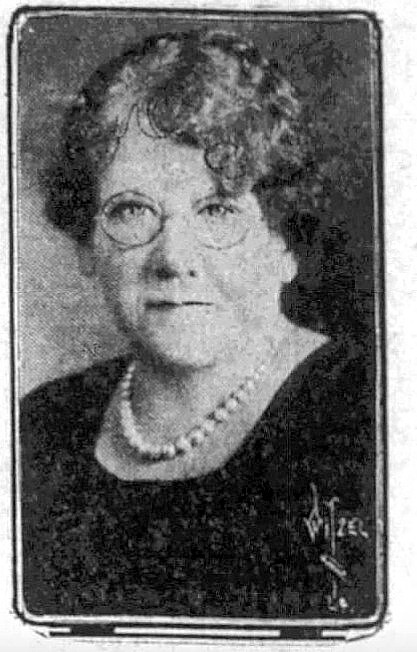
Florence Casler, 1928.
Long before Rick Caruso, CIM group, Lincoln Property, and others hit the Los Angeles real estate world, Florence C. Casler dominated its ranks, constructing many of Los Angeles’ most successful skyscraper buildings in the 1920s. Powerhouse Casler observed her father and husband in their financial and real estate dealings, turbocharging herself into one of Los Angeles’ earliest real estate developers through daring, drive, and insight.
Born Florence C. Sherk in Sherkston, Weiland, Ontario, Canada in 1869, Casler grew up on her family’s farm, where her father Hugh grew mammoth strawberries and other fruits and vegetables and she studied music. Her successful father Hugh made extra money allowing the gas company to set up their telegraph and telephone office on his property.
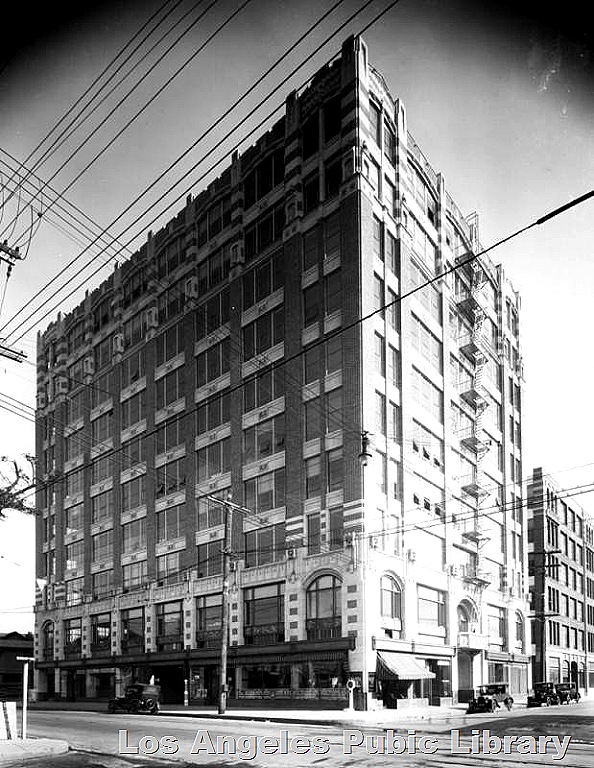
The Allied Crafts Building at Pico and Maple, developed by Florence C. Casler, courtesy of the Los Angeles Public Library.
On April 27 1892, she married John H. Casler at her family’s farm before moving with him to Buffalo, New York. Plumber Casler invested well besides running a busy plumbing concern. He purchased real estate lots around town while also appearing litigious, suing and being sued.. Looking to possibly cash in on recent mineral finds nearby, Casler established the Grace Mining Company in 1892, serving as President.
While he dug for gold in Alaska, Casler herself managed the plumbing business in Buffalo as a successful licensed plumber. He returned with little to show for his adventures, while his driven wife managed a flourishing plumbing concern with a twelve man crew. By the early early 1900s, his shares were purchased, but he would sue the company in 1909 for $12,000 mortgage.
Looking for more opportunity, the couple moved across country to Los Angeles the same year, where Mr. Casler operated a string of failing businesses. Feeling abandoned and alone as her husband floundered (some claim he chased gold in Alaska), Casler filed for divorce February 17, 1910, receiving her decree in July. Sharp and observant, she studied architectural plans, finance reports, real estate projects, learning the construction business as she turned it profitable.
The savvy Casler determined to chase her own dreams rather than supporting others, betting on herself and her real estate skills. She purchased property in Buffalo in 1911 under the name F. C. Casler to construct a small apartment building and her first plot in Orange County from Title Guarantee and Trust in May 1913, purchasing land publicly under her own name, Florence Casler. Trying to distance herself from her husband and perhaps give her some respectability, Casler listed herself as widow in the City Directory, though in fact she was a divorcee.
That November, she filed for homestead on this ten-acre ranch in Orange County. Casler hit pay dirt in December, selling some of her land to J. K. Lloyd, soon to be her real estate partner. While their long-term partnership yielded high returns, her first few years in real estate truly were a learning experience, forcing her to file for bankruptcy.
The Casler-Lloyd partnership made their move to Los Angeles in 1914, looking for ranches or bungalows that could be demolished for duplexes or small apartments, foreseeing explosive growth in the City of the Angels. Their first purchase on New Hampshire Avenue and Hoover Street in 1916 would lead to the construction of two-story, 16-room apartment buildings.
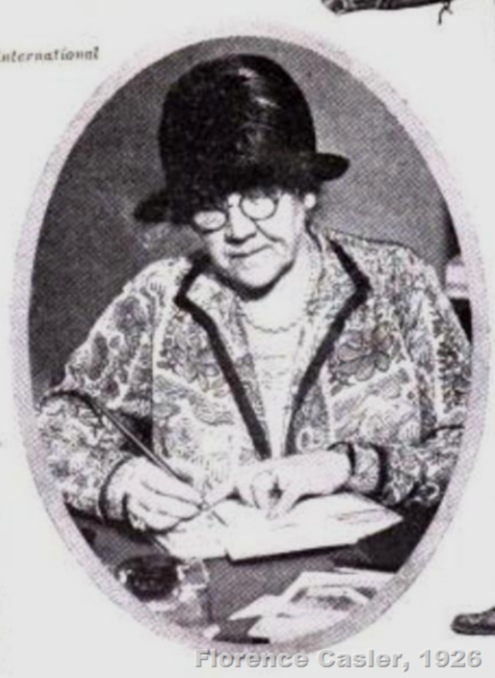 Recognizing success in the commercial arena, they pulled permits to construct two apartment buildings downtown in 1917. Using profits from one project, the team would invest in new and larger projects, growing their wealth. The intelligent, driven Casler served as President of the booming concern, with her wise counsel and decisions pushing them to the top of their profession. Casler herself moved on up with her own residence as well, purchasing 111 Windsor Boulevard adjacent to Hancock Park.
As business profits rolled in, Casler-Lloyd took more risks and upsized their projects, first constructing four-story apartment dwellings after World War I, the first ones constructed in Los Angeles, and then erecting multi-story loft buildings for light manufacturing. Casler herself increased her profits by practicing assembly line processing inside these buildings, with manufacturing moving from top down. Keeping everything inhouse saved time and money, boosting company success, allowing them to construct high-end, modern projects. Everything she touched turned gold.
By 1925, Los Angeles’ business community recognized Casler’s real estate savvy and skills, turning to for advice and consultation. People’s National Bank even named her a member of the Board of Directors that year, acknowledging her importance to commercial real estate as the first female director of a major bank in the city. Tough and determined as a builder, Casler remained gentle and modest in her personal dealings, a sweet little grandma with a killer business brain.
Los Angeles Times columnist Valerie Watrous wrote in a 1927 column, “Her manner isn’t what you’d expect from the head of a million-dollar corporation; it isn’t what one would anticipate from a licensed plumber – there’s no hint of the bank director about her, yet she’s all three…When she discusses the program of her newest twelve-story loft building she seems to be saying: ‘And then I rolled out the crust, put in some apples and baked a pie.” Watrous reported that just in four years, Casler had developed “three small buildings, three height-limit loft buildings, and has a fourth nearing completion.” Recognizing Los Angeles’ explosive growth, the busy builder told the reporter she had more in mind, “…Los Angeles is to be a big city and we’ve got to have space for our industries to grow.”
Casler recognized the needs of various craft fields, and filled them. Lloyd-Casler constructed the ten-story, block-long Allied Crafts Building at Pico and Maple for printing companies, as well as the Graphic Arts Building and the Textile Center, all multi-story skyscrapers downtown. Perhaps her best known work today is the recently refurbished Renaissance Building, now renamed the Downtown Women’s Center, a residence for homeless women. Unlike contemporary developers, who hire temporary workers for each project to increase their profits, Casler worked with the same crews over and over to work as a well oiled machine.
“I keep the same crew of men all the time, the carpenters, plumbers, and foremen. We understand each other and everything moves more smoothly than if new workmen were assembled for each enterprise.” She also worked exclusively with architect William Douglas Lee, whoc brought innovative modern design to projects, employing high end construction forms like terra cotta, brick,and stone, adding huge amounts of light with banks of clerestory windows, and adding elegant decorative touches around moulding, arches, doors, and such.
A few months later, Lloyd-Casler constucted the Printing Center skyscraper adjacent to the others for a cost of over $600,000. The skyscraper would feature more than 160,000 square feet. With the start of excavation, the development firm had already leased more than sixty percent of the floor space. Thanks to the company’s success in the area, and their worth as a $1 million dollar firm, the Greater Pico Street Association named Casler one of their Board of Difectors in November.
Lloyd-Casler partnership dissolved in 1928, with both going their separate ways. Casler organized the F. C. Casler Construction Company, going on to build the Bendix Building at 1206 South Maple Avenue on behalf of the Bendix Aviation Corporation, her last major project. She joined the Board of the Hollywood Finance and Loan Company in November 1929, with some stories claiming that she had constructed over 4000 homes throughout her career. She was acknowledged at the time for studying construction innovations and supervising purchasing, looking for the best products for her structures as her own bulding contractor.
The developer announced a planned combined theatre/office building project on Wilshire Boulevard between Western and Vermont in February 1930 to cost approximately $2 million dollars and feature its own radio station, but the terrible financial mood of Los Angeles during the early days of the Great Depression left it only an oversized dream. Her firm soon wound down operations as every one of its buildings were sold off. She even lost her home at 163 S. Larchmont to bankruptcy.
The successful developer appreciated women and their talents as well, with a female draftsman for blueprints and her oldest daughter Ruth serving as accountant. Once a month, she and 49 other successful businesswomen met for dinner, their own best consultants and advisors.
Mostly forgotten today, Casler introduced style and innovations to real estate development in booming 1920s Los Angeles, more daring and risktaking than her male competitors. The Los Angeles Cultural Heritage Commission recognized her contributions to the city’s history in 2008, acknowledging her as “one of the first women in the early 20th Century to head a company in the field of development and construction of high rise buildings.” She demonstrated the power and creativity of women in conceiving, planning, and managing large scale projects in Los Angeles’ cut throat real estate world, constructing elegant buildings that mostly survive to this day.

 ladailymirror.com