Note: This is an encore post from 2012.
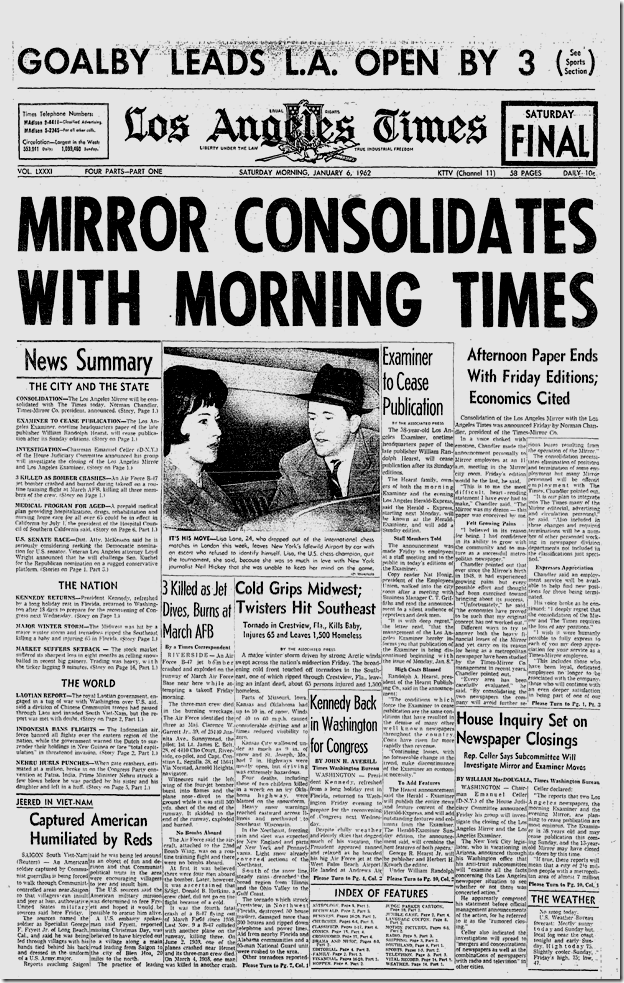
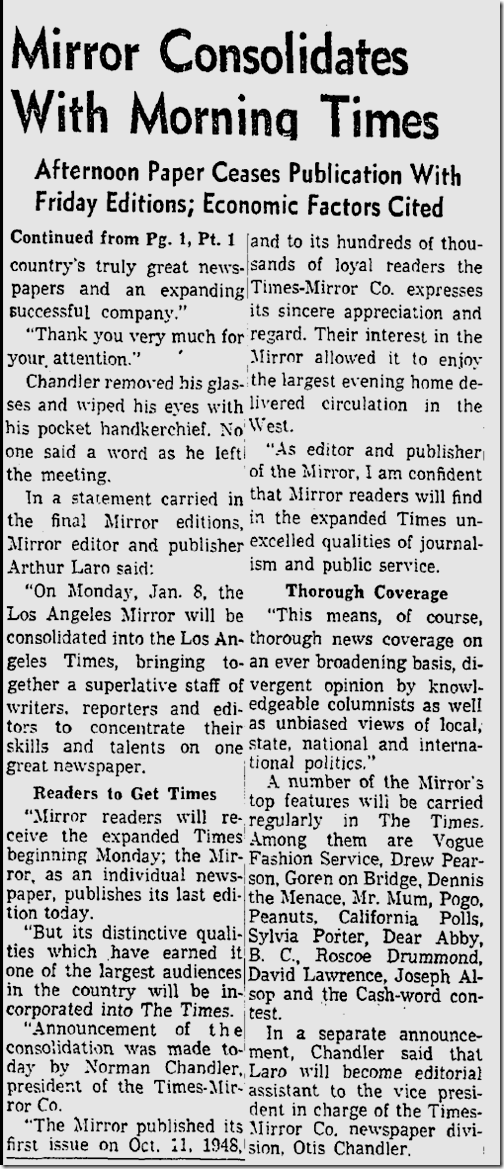
January 5, 1962: A dark, painful day in the history of Los Angeles journalism. Virtually overnight, the city becomes a two-newspaper town. The evening Mirror ceases publication Jan. 5, merging with The Times, and the morning Examiner merges with the evening Herald-Express on Jan. 7, prompting a congressional investigation of possible collusion.
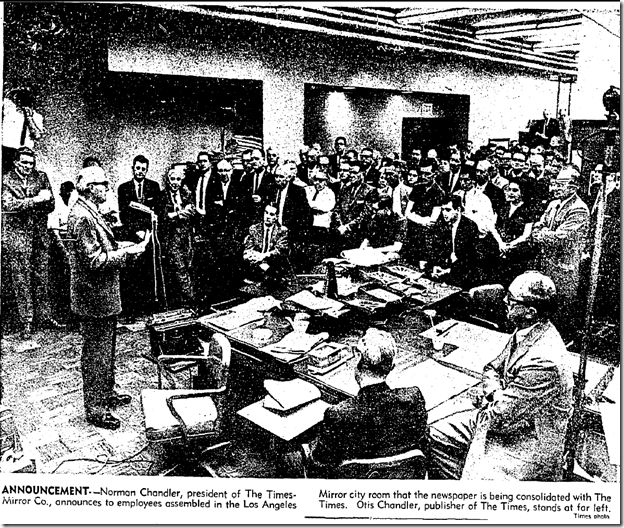
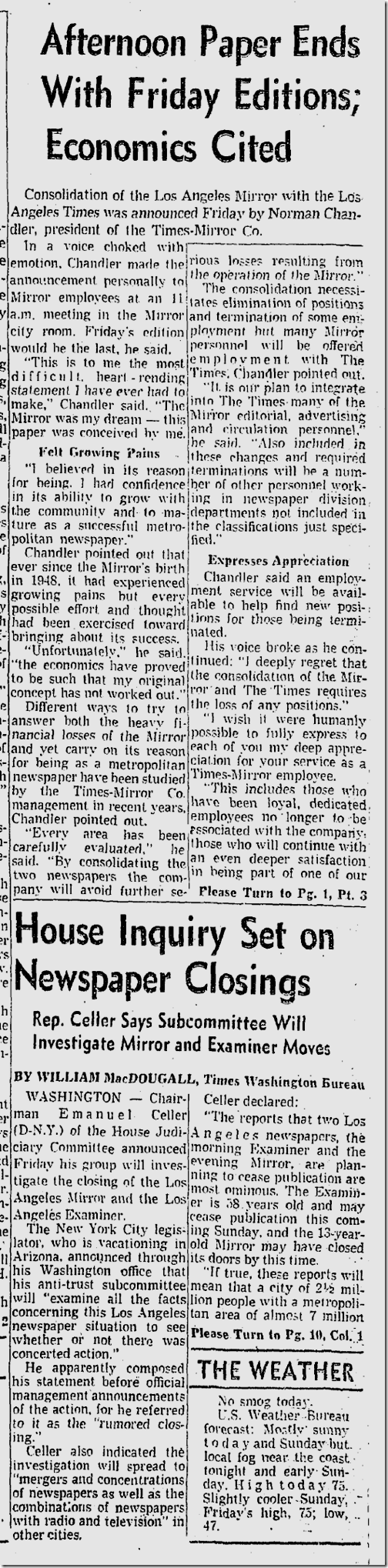
A tearful Norman Chandler, president of Times-Mirror Co., tells Mirror employees: “This is to me the most difficult, heart-rending statement I have ever had to make. The Mirror was my dream — this paper was conceived by me. I believed in its reason for being. I had confidence in its ability to grow with the community and to mature as a successful metropolitan paper.”
“Unfortunately, the economics have proved to be such that my original concept has not worked out.”
Randolph A. Hearst, president of Hearst Publishing Col, says: “The conditions which force the Examiner to cease publication are the same conditions that have resulted in the demise of many other well-known newspapers throughout the country. Costs have risen far more rapidly than revenue. Continuing losses, with no foreseeable change in the trend, make discontinuance of the Examiner an economic necessity.”
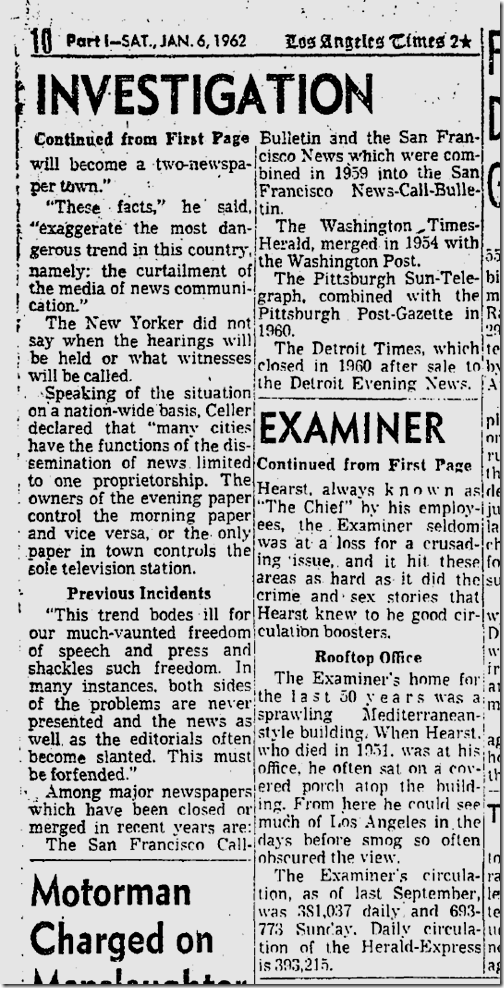
Rep. Emanuel Celler (D-New York), head of the House Judiciary Committee, says “a city of 2 1/2 million people with a metropolitan area of almost 7 million will become a two-newspaper town.”
Discussing the consolidation of newspapers, Celler says: “This trend bodes ill for our much-vaunted freedom of speech and press and shackles such freedom. In many instances, both sides of the problems are never presented and the news as well as the editorials often become slanted. This must be forfended.”
The late Marty Rossman, who worked at The Times in 1962, told me: “The blood ran on the floor that day.” Some of the Mirror’s high-profile columnists and writers (Paul Coates, Matt Weinstock and Paul Weeks, for example) moved to The Times. Others were not so fortunate. The late Bill Kershaw, a slot when I started at The Times, lost his job and went to the Herald Examiner before rejoining The Times. The late Jerry Clark, a former Mirror employee, once said he asked Otis Chandler who decided to kill the Mirror. Otis replied: “I did. Next question.”
For people too young to recall afternoon papers or understand their function, here’s a brief explanation: The morning papers (or AMers) tended to be a straightforward reporting of the news of the day, and for much of the 20th century, there were multiple editions per day for home delivery, closing stock market figures, racing results, street sales, etc. The afternoon papers (or PMers) tended to be updates of breaking news stories, with more sensational treatment, stock market figures, racing results, features, serialized novels (a specialty of the Herald-Express) and that sort of thing.
As American lifestyles changed after World War II and into the 1960s, more people were getting their news from television, cutting into the circulation of afternoon papers until they slowly faded away.
The Examiner’s circulation was 381,037 daily; 693,773 Sunday. The Herald-Express’ circulation was 393, 215. I’ll have to do some digging to find the Times’ and Mirror’s circulation figures. The Herald Examiner folded in 1989 and many employees joined The Times.


 ladailymirror.com