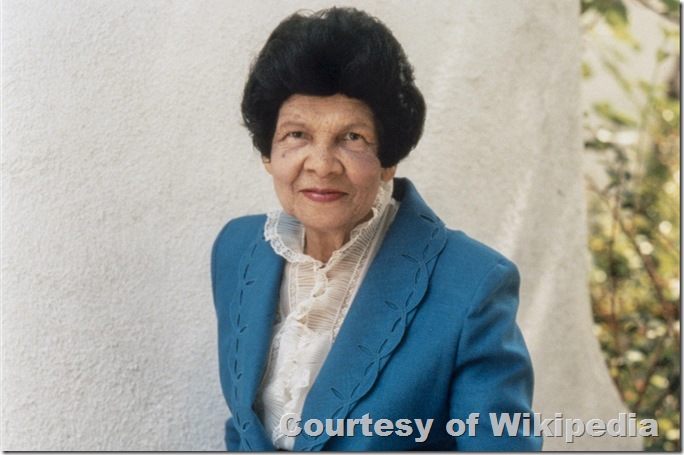
Miriam Matthews in undated photo, courtesy of Wikipedia.
At a time when African Americans found themselves stuck at the back of the bus, denied educational and work opportunities because of their race, black librarian Miriam Matthews set out to acknowledge and honor the achievements and contributions of her fellow citizens. She worked to educate and inform patrons not just through library programs and books, but by her own scholarship, combining her love of learning, curiosity, and service to become one of Los Angeles’ leading librarians and historians for 35 years. Serving as Los Angeles’ first African American librarian, the education dynamo revealed the city’s often hidden and distorted past, acknowledging the leading role people of color played in Los Angeles’ founding.
Born in Pensacola, Florida August 6, 1905, Matthews’ family moved to California in 1907 in search of greater opportunity and freedom from segregation. Discovering a love of reading and researching, she excelled at school, assertively advocating for her full education. After graduating from high school at 16, Matthews spent two years at University of California, Southern branch here in Los Angeles before finishing her degree from University of California, Berkeley, and a certificate in librarianship a year later.
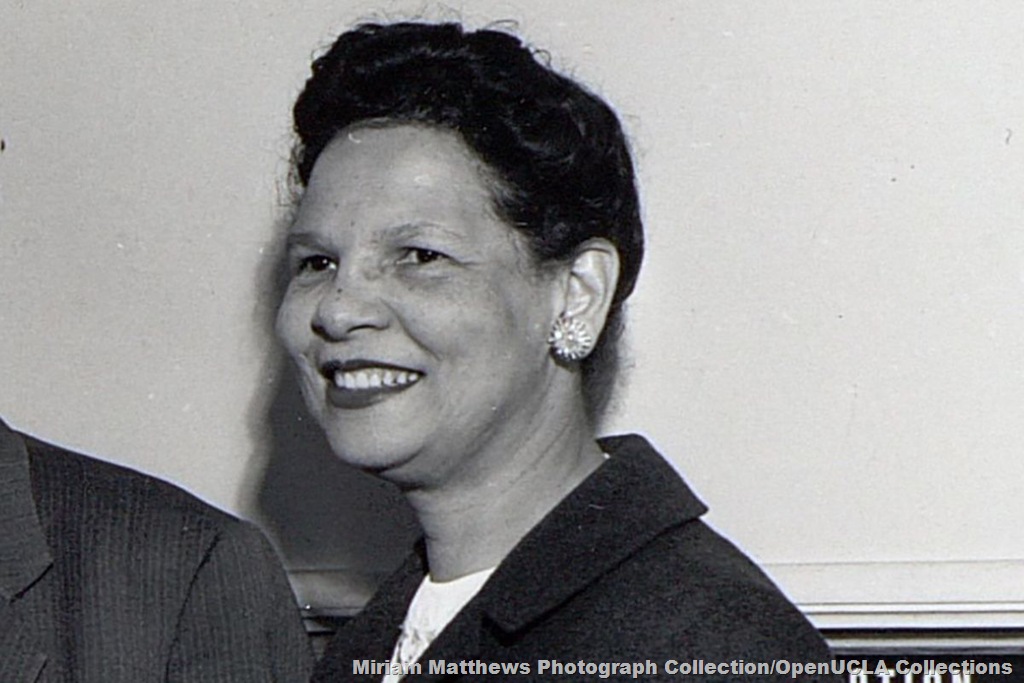
Miriam Matthews in an undated photo, courtesy of the Miriam Matthews Photograph Collection/OpenUCLA Collections.
The young graduate experienced frustration upon trying to join the Los Angeles library system in 1927 when they failed to inform her of the dates for the civil service exam, finding out just the day before the test in May from a family friend. After passing, she joined the Los Angeles Public Library as it and California’s first black librarian in July 1927, when the system hired her as a substitute librarian in the Jefferson and Vermont Square branches.
By that October, Matthews was a full librarian at the Robert Louis Stevenson branch. Moving to the Helen Hunt Jackson branch, she found a small collection of books on the Negro, inspiring her passion to collect, read, and research black history, a long neglected subject in the state and country. In 1929, Matthews advocated for a Negro History Week in Los Angeles, a strongly white city that discarded or ignored its own often painful past. The city finally acknowledged and promoted this Black History Week in 1931. She strove to open the world to all citizens of Los Angeles, writing book reviews for African American papers and providing on-air reviews for seven years on both KHJ and KFI beginning in 1929.
Matthews worked to assure greater outreach to African Americans as well as increased opportunities for enrichment by these constituents. From the beginning of her career, Matthews fought institutional as well as civic racism. In a 1982 interview with the Los Angeles Times, she recalled painful memories even landing a library promotion. The city failed to promote her to branch librarian after 10 years of service, leading her to take a leave of adsence to work on a masters’ degree in library science, at the University of Chicago, not really planning on returning. After pleading from her family, Matthews came back to California, finally gaining her promotion and eventually one to regional librarian in charge of 12 branches.
The inspired professional always advocated for greater access and freedom of information for all, as well as researching and promoting forgotten or overlooked African American contributions to California history. She served as a one woman crusade in acknowledging the accomplishments and successes of her race, when others often turned away.
Matthews dedicated herself to service and improving education, health, and life for all. Throughout her life, she remained active in community affairs, serving on more than 50 boards and committees covering a wide swath of the arts, education, and civil rights. Before the Los Angeles Board of Supervisors in 1948, Matthews, as a member of the California Library Association, joined others in protesting “censoring of county library books by a group ‘because of partisan or doctrinal disapproval,’ as well as the Board itself making these decisions rather than qualified librarians. The Board declared they would “advise and not censor,” leaving decisions to the County Librarian, John D. Henderson.
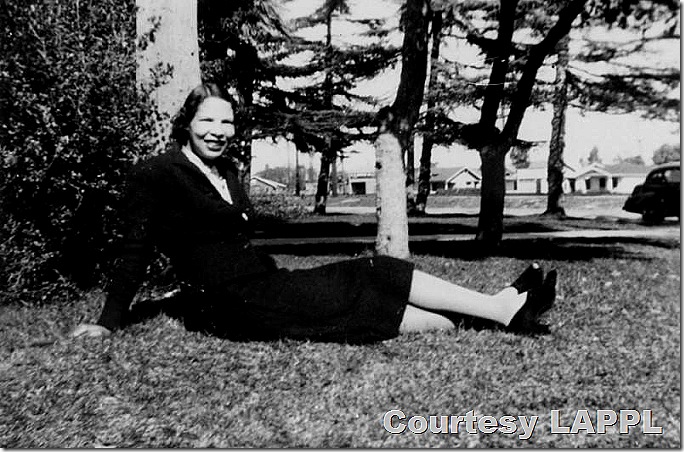
Miriam Matthews in an undated photo, courtesy of the Los Angeles Public Library.
Businesses also often relied on her detailed knowledge and expertise when it came to matters of Californian African American history. In 1949, Golden State Life Insurance Co. hired the erudite Matthews to research and investigate historic moments and accomplishments of California African Americans for two murals they commissioned for their new headquarters on West Adams Boulevard. She continued to build on her scholarship, acquiring several thousand photos, along with books, brochures, and ephemera on the state’s black history, which she graciously shared with researchers and historians. She aimed to expand black history, not contract or erase it from history books.
Even after retiring in 1960, businesses and individuals continued to call on her for help in expanding and preserving this largely undocumented history. NBC employed Matthews for research and help with an hour-long TV documentary about Black Los Angeles in the late 1960s. During celebrations for the United States Bicentennial in 1976, local museums and stores such as Los Angeles County Museum of Art, the Los Angeles Children’s Museum, and the downtown May Company Department Store exhibited many of her works crafted by black artists and photographers.
To help promote the Dunbar Museum in South Los Angeles that recognized black cutlure and history, which she helped found, Matthews loaned nearly 100 photographs for a long term exhibit on African American firsts. Museum head Bernard Johnson acknowledged her loan and the exhibit’s intentions to the Los Angeles Times in 1983, “We here feel it is important to be exposing, recording and rewriting the pages of history to include the achievements of black people. Throughout history, black people have been achieving in spite of slavery.”
Matthews’ aim throughout her long life was to acknowledge and give voice to forgotten pioneers and their contributions to civic life. To reach as many people as possible, she wrote articles and books, organized exhibits, arranged theatrical and musical performances, lectured, and politically advocated for the preserving and publicizing of African American history.
The state recognized the importance of her cause, honoring both her commitment and service, as well as funding programs to preserve history, before the California Historical Society presented her an award of merit in 1982. Governor Jerry Brown appointed her to the California Heritage Preservation Commission and the California State Historical Records Advisory Board in 1977. During her seven-year tenure, Matthews campaigned for and ultimately convinced the City of Los Angeles hire a professional archivist and establish a permanent city archive in 1977. Through Matthews’ diligent research, documents revealed Los Angeles’ diversity from the very beginning. For Los Angeles’ Bicentennial Celebration in 1981, the city erected a monument and plaque based on her in-depth research at El Pueblo de Los Angeles State Historic Park recognizing the community’s original forty-four founders. This hardy band of pioneers walked from the San Gabriel Mission on September 4, 1781 to found El Pueblo de Nuestra Senora la Reina de Los Angeles de Porciuncula. This little pueblo’s residents tilled the land, growing bountiful crops like grapes, beginning the area’s long importance feeding the nation. First settled by Native Americans like the Gabrielino tribe, the community’s first settlers were mulatto, mestizo, and Native American; 26 were black, 16 Indian, and only 2 white. The city finally acknowledged its strong diversity, thanks to Matthews’ impassioned, thorough detective work discovering the city’s long forgotten and buried past.
After decades of painstaking work researching and rebuilding Los Angeles’ and California’s African American history, Matthews passed away at the age of 97 on June 23, 2003, leaving her almost 5,000 photographic collection to UCLA. Honoring Matthews’ legacy educating and informing city residents as one of Southern California’s leading teachers and historians, the city of Los Angeles named the new Hyde Park branch after her in 2004, just months after her death.
A beacon shining a spotlight on intrepid pioneers and their amazing accomplishments, Miriam Matthews herself produced great works educating and informing the general public on emulate this outstanding historian to broadcast the forgotten stories and accomplishments of all people of color.

 ladailymirror.com