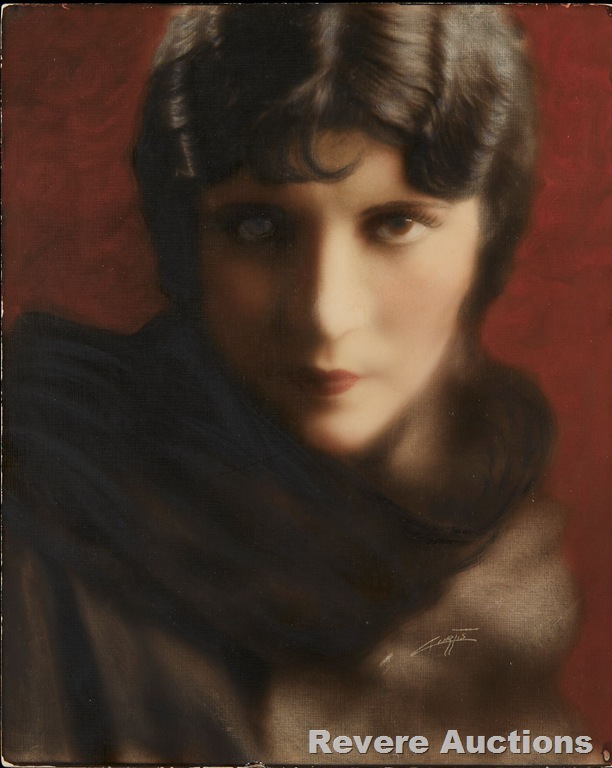
Olive Borden / Edward Curtis, hand-colored by Emma G. Hoffman, courtesy of Revere Auctions.
Early cinema captured the attention of filmgoers through its realistic depiction of everyday life, enhanced by gorgeously crafted images and heart tugging acting. It grew out of what was called real photo postcards, those providing a documentary look at a place and people, as well as stereoptican cards and lantern slides, which offered a more visceral means of storytelling. To enhance these static images, color was often applied, adding beauty and vivacity but also accentuating the important story element of the image. Mostly men served as photographers and cinematographers in these first decades, but forgotten women behind the scenes applied the hand coloring which dazzled audiences with its visual impact and beauty.
The detailed, meticulous work handcoloring postcards, lantern slides, and 35mm film frame by frame was accomplished by the exhausting work of women artists, who dominated this trade at the end of the nineteenth century. Just like with cutting film later, they headlined these fields due to what many called their attention to detail and their preciseness. As a trade story noted, “Lantern slide coloring should offer special opportunities to women, ‘for it requires a delicacy of handling and a keenness for artistic perception which are more easily met with in women than in man… .” As another story put it, “There is no limit of age for this work, but it is essential that a lantern slide colorist should possess good eyesight and steady, sensitive hands. Indeed, it is apparently work peculiarly suitable for women.’
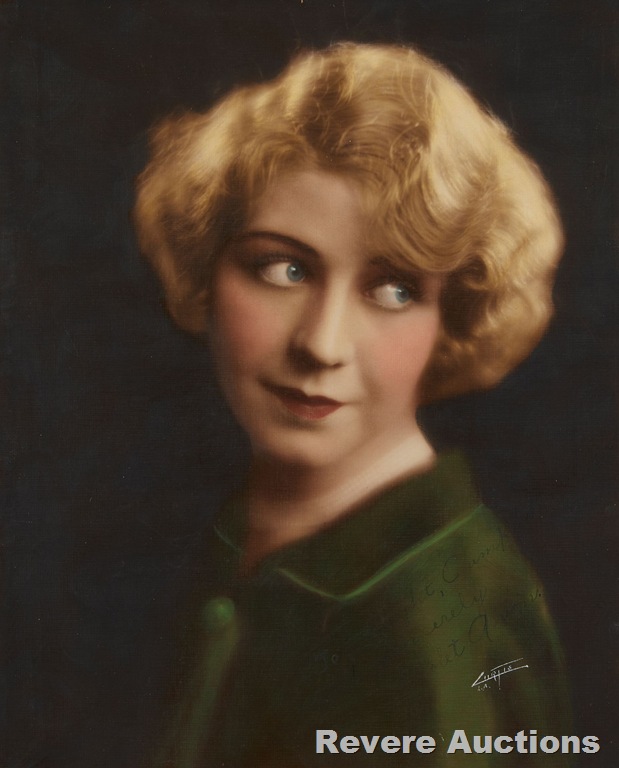
Violet La Plante / Edward Curtis, hand-colored by Emma G. Hoffman, courtesy of Revere Auctions.
Few records exist to give a better understanding of their work and experiences. Archives do reveal the story of French colorist Elisabeth Thuiller, who operated her own studio colorizing frames of film for film master Georges Melies, later passed on to her daughter Marie-Berthe. Her staff of 220 female employees followed her carefully crafted templates and color palettes, employing a magnifying glasses while applying what author Amanda Schercker describes as water-soluble aniline dye, one frame and one color at a time.
Due to the expense, mostly short films were colorized, starting with such films as the “Serpentine Dance” films, emphasizing the folding and twirling skirts, and fantastic Melies’ work, emphasizing the special effects, props, and set pieces that brought magic to his stories. The color made the billowing skirts or Melies’ otherworldly effects literally pop onscreen. Writing in the trade journal Nickelodeon in 1909, “The color film has the most interest of all…The audience literally ‘sits up and takes notice’ when the first scene of a colored picture film flashes on the screen.”
Little is known of female colorists in the United States, but trade magazine ads and stories do demonstrate their dominance of the field, with the majority of ads announcing female applicants only and other trade listings showing only women pursuing this occupation. Four of these early practitioners find mention in late nineteenth and early twentieth century trade magazines which emphasize their superior work. In multiple trade journals in 1907, only women are listed as slide colorist or film colorist cataloging those leaders of each field.
Scan information can be found on Mrs. Hattie White, who worked out of 83 Hanson Place in Brooklyn, New York. Born Hattie Hoffman in Brooklyn in 1860, she married Judson A. White in 1879 and possibly died in 1909.
Mrs. Leila Silverwood on the other hand, dabbled in a variety of careers before turning to colorizing slides. The 1900 census shows Silverwood stated she was born in Ireland in 1864, arriving in New York in 1896. She lived in Pennsylvania in the early 1900s, taking out ads showing she was a “Logopath Chenosophist and Psychic Palmist.” On the side, she wrote poems and essays for theosophic journals like The Temple Artisan, and in 1904 served as Secretary of the Art Workers Union in New York.
She firsts appears as a colorist in the Moving Picture World listing for that occupation in 1907. Later that year, they reported that she had moved from Harlem into a more convenient neighborhood at 160 West Sixty Sixth Street. She decried the work of cheap lantern slide makers as well as art in the city. “I have no time for art in New York City, and those few of us who have appreciation of it are compelled to suffer tortures from our environments.” By 1910, Silverwood appeared to have departed the field, taking out ads in the New York Times in 1910 listing herself as a metaphysician at the New Thought Temple near Carnegie Hall, and in 1915, is mentioned in the Psychical Research Review. The trail goes cold at that point.
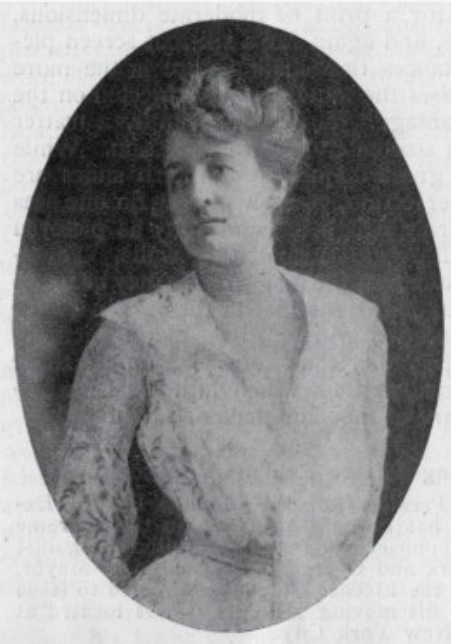 Perhaps trying to distinguish herself from the other women and hide the fact of her sex, Elizabeth Martine (shown at right) listed herself as E. M. Martine in places liike Moving Picture World. She served as the veteran of the film and slide coloring world in the United States, with 12 years of experience. Elizabeth was born in Orange, New Jersey in 1874, and would remain living with her parents or siblings the vast majority of her life there. She considered herself an artist, and listed herself as such in the 1910 United States Census.
Moving Picture World interviewed her in 1907, stating she was “well known to the trade as an expert film colorist.” Movie companies from across the United States sent her prints to colorize, as did producers in such countries as France, England, Algeria, South Africa, and Puerto Rico. Her work graced lantern slides for songs as well as film, displaying her versatility. They reported that she “aims to give satisfaction, believing that one pleased customer is worth keeping. We learned that the films were very much improved with coloring and were given a new lease of life.”
Moving Picture News interviewed her in October 1908, she claimed to have entered the business “since the early days of the Idolscope and Vitascope Companies…” and the birth of the film industry, at a time when “…the public…and the managers themselves were hardly farsighted enough to predict the moving picture of today.” She had no respect for colored films unless the hues were added perfectly. Sadly, she disappears from the trades and newspapers by 1910.
Unlike the women who toiled at colorizing slides and film prints, Los Angeles resident Emma G. Hoffman colorized or “tinted” portraits at her studio in the 907 Central Building downtown. Born in Georgia in 1895, she studied at the Mark Hopkins Art Institute in San Francisco in 1904 and 1905. Advertising herself in local papers and in the trade magazine “Camera!,” in 1923, she pitched her work as providing “a beautiful velvet-like tone” to photographs at a low cost. She also stressed the special deals for those wanting large quantities of fan photos colorized. Some of her work has been auctioned recently, revealing her artistic touch with color. Unfortunately after marrying, it appears she retired from photography work, as listings for her service disappear from trades or newspapers.
While the male photographers earned acclaim for their gorgeous images, these female colorists who enhanced or glamorized the same photos received little to no recognition for their work, and quickly seemed to have disappeared from the industry after only a few years of action. Perhaps more information can be discovered to give these women the praise and recognition they deserve, supervising others, running their own businesses, and earning respect as artists.

 ladailymirror.com
wow. Emma Hoffman’s work is just gorgeous. I have never seen tinted photos like this before.
LikeLiked by 1 person
I recently rewatched THE MAN WITH THE MOVIE CAMERA, and I love how we actually see Elizaveta Slivova cutting the very film we are watching. The film is in black-and-white, so I do not know what her tinting might have been like.
LikeLike
This is a great piece, thank you. Along the lines of women cutting film, I just rewatched THE MAN WITH A MOVIE CAMERA, and I always love seeing Elizaveta Svilova cutting the very film we are watching.
LikeLike
Thanks for putting together this research. I wonder what happened to Olive’s eye in that first photo.
LikeLike